
A Marketing Leader's Guide to Reducing SaaS Customer Acquisition Cost
Learn how to calculate, benchmark, and lower your SaaS customer acquisition cost. This guide provides actionable strategies for profitable growth in 2026.
Your SaaS Customer Acquisition Cost (CAC) is the total price you pay in sales and marketing to land one new customer. It’s the cost of winning. For marketing leaders and business owners, this metric has become a critical indicator of financial health and operational efficiency.
The SaaS market is more crowded than ever, and competition for attention is fierce. This saturation means efficient, profitable growth isn't just a goal—it's a requirement for survival. Understanding and actively managing your SaaS customer acquisition cost is no longer optional.
Why Your SaaS Customer Acquisition Cost Keeps Rising
If you're a founder or marketing leader, this probably sounds familiar: the budget that used to bring in a steady stream of customers is suddenly underperforming. You’re spending more to get less. It’s not just you. Market-wide studies show that customer acquisition costs have shot up by as much as 60-70% in the last five years alone.
This shift forces us to be smarter and more data-driven. We can't just throw money at marketing and hope for the best. Every dollar needs to be accounted for and deliver a measurable return on investment. That process starts with getting brutally honest about what your CAC really is.
Demystifying Your CAC Inputs
One of the most common mistakes marketing leaders make is only counting ad spend in their CAC. A true, or "fully loaded" CAC, is much broader. It includes every single expense that contributes to acquiring a new customer, from salaries to software. Getting this number right is the first step to actually controlling it.
Key Insight: A high CAC isn't automatically a red flag, especially if your Customer Lifetime Value (LTV) is healthy enough to justify it. The real problem is not knowing your numbers. When you fly blind, you can't see that your acquisition costs are silently eating away at your long-term revenue.
To get a handle on your SaaS CAC, you have to track all the contributing expenses. Let's break down what that looks like.
Breaking Down Your SaaS CAC Formula
To calculate a true CAC, you must sum all sales and marketing costs over a specific period and divide that by the number of new customers acquired in that same period. Here are the expense buckets you absolutely must include to get an accurate picture.
Getting a clear picture of these components is a game-changer. It shows you exactly where your money is going and shines a light on areas ripe for optimization. For instance, if salaries are a massive chunk of your CAC, you might explore building a more efficient, self-serve growth engine or outsourcing specific functions to a specialized team like Ezca to improve ROI.
If you're struggling to track performance across platforms, our guide to multi-channel marketing can help you connect the dots. The end goal is to build a complete financial model, so you can make confident, data-backed decisions that drive profitable growth.
How to Accurately Calculate Your SaaS CAC
Knowing you need to calculate your SaaS customer acquisition cost is one thing; doing it with precision is another. To make CAC a metric that genuinely informs your strategy, you have to get into the weeds and account for the messy, real-world details.
The basic formula seems simple: divide your total sales and marketing spend over a certain period by the number of new customers you brought in. But the devil is in the details of what "total spend" really includes.
This diagram gives you a clean visual of how that money flows from your budget to new customer revenue—the very core of the CAC calculation.
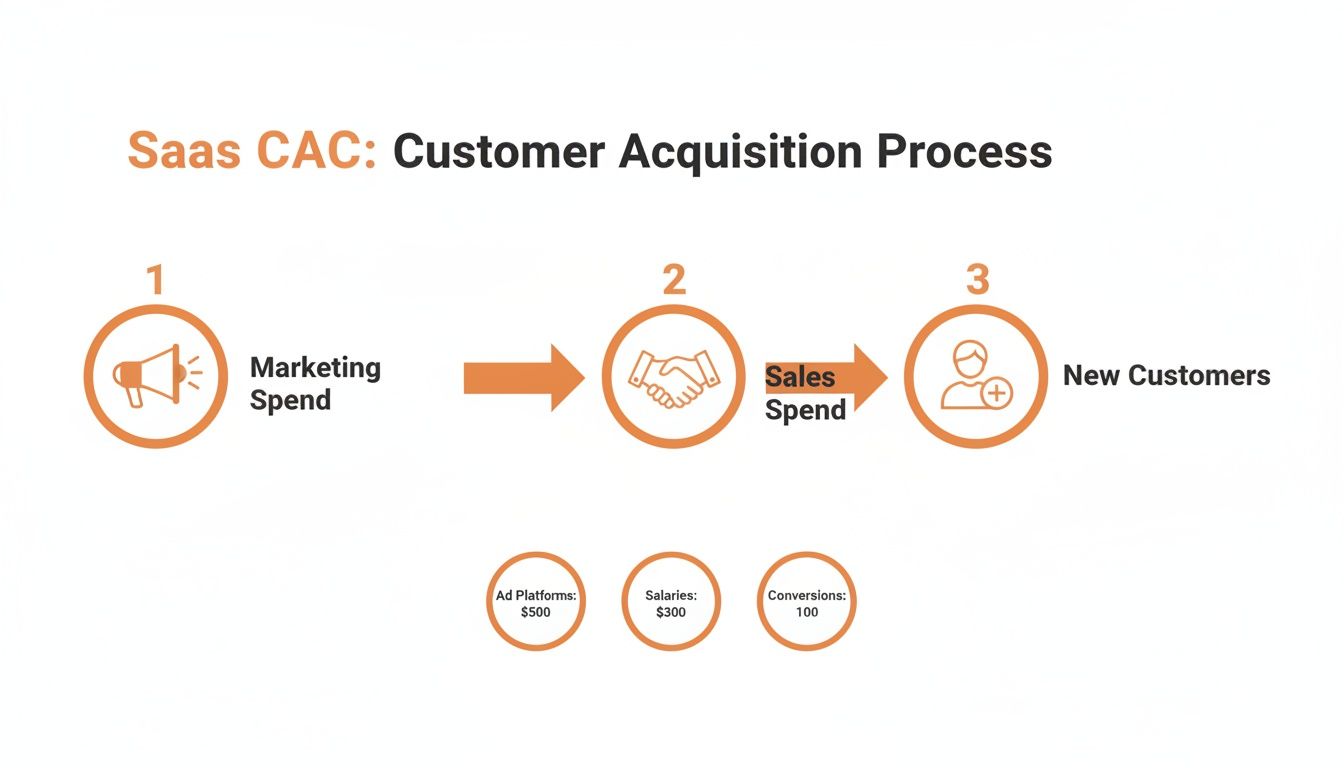
As you can see, both marketing and sales investments are critical inputs that lead directly to the new customers you sign.
Fully Loaded vs. Marketing-Only CAC
A common mistake is only counting direct ad spend. This gives you a "marketing-only" CAC, which paints a dangerously incomplete and overly rosy picture. For a true sense of your efficiency, you absolutely must calculate a fully loaded CAC.
A fully loaded CAC is the real cost. It bundles in everything associated with your go-to-market engine: salaries and commissions for your sales and marketing teams, subscriptions for your CRM and automation tools, content creation expenses, and even related overhead. Ignoring these costs doesn't just make you look good—it leads to bad decisions.
Think about it this way. If you spend $10,000 on ads and get 100 customers, your marketing-only CAC is $100. Easy. But what if you add $15,000 in team salaries and $5,000 in software costs for that same period? Suddenly, your true, fully loaded CAC jumps to $300. That’s a massive difference when you’re deciding where to put your next dollar.
A Step-by-Step Calculation Example
Let's walk through a practical example for a fictional SaaS company, "SyncUp," for one quarter (Q1).
- Identify and Sum All Costs: First, the SyncUp team rounds up every relevant sales and marketing expense. Marketing Salaries: $45,000
- Sales Salaries & Commissions: $60,000
- Paid Ad Spend (Google & LinkedIn): $30,000
- Content & SEO Contractor Fees: $7,500
- Marketing & Sales Software (CRM, etc.): $4,500
- Total Q1 Costs:$147,000
- Count New Customers: During that same quarter, SyncUp acquired 300 brand-new paying customers. This number must exclude existing customers who simply upgraded plans.
- Calculate Blended CAC: Now, they just do the math. $147,000 (Total Costs) / 300 (New Customers) = $490 Blended CAC
This $490 figure is their blended, or company-wide average, CAC. It’s a vital health metric, but to get actionable insights, you have to dig deeper.
Segmenting CAC by Channel
A blended CAC is an average, and averages can be deceiving. It completely hides the performance of individual channels—some might be incredibly efficient while others are secretly draining your budget. By segmenting your costs and attributing customers to specific channels, you can finally see which ones are your true growth drivers.
Let's imagine SyncUp can attribute its 300 new customers like this:
- Paid Ads: 150 new customers
- Organic Search (SEO): 100 new customers
- Sales Outreach: 50 new customers
Next, they attribute costs to each channel. Direct costs like ad spend are easy. For shared costs like salaries or software, they might allocate them based on team time spent or strategic priority.
- Paid Ads CAC: ($30,000 Ad Spend + $15,000 portion of salaries) / 150 Customers = $300 CAC
- Organic CAC: ($7,500 Content Fees + $10,000 portion of salaries) / 100 Customers = $175 CAC
This analysis immediately reveals that organic search is their most efficient channel by a long shot, bringing in customers for just $175 a pop. This data empowers SyncUp’s leadership to confidently shift more budget toward SEO and content, knowing it’s a proven way to lower their overall SaaS customer acquisition cost.
To get this right, you can use a dedicated customer acquisition cost calculator to ensure you're not missing any variables. At Ezca, this is exactly the kind of channel-level analysis we use to find and scale our clients' most profitable acquisition loops.
SaaS CAC Benchmarks for 2026
So you've calculated your Customer Acquisition Cost. That's a great first step. But what does that number actually mean? Is your $490 CAC a sign of a well-oiled machine, or a warning that you're burning through cash?
Without context, it’s just a number. The answer depends on your industry, target customer, and business maturity. The only way to truly know if your acquisition strategy is working is to benchmark it against the rest of the market.
A recent analysis paints a sobering picture: over the past five years, SaaS customer acquisition costs have skyrocketed, climbing by a staggering 60-70%. As of 2025-2026, the median B2B SaaS company now spends $1,200 to land a single new customer.
This is the direct result of more competition and crowded marketing channels. Even more concerning, the median SaaS company now spends $2.00 to acquire every $1.00 of new annual recurring revenue (ARR), a 14% jump from 2023 alone. You can dig deeper into these SaaS acquisition trends and see how the numbers break down.
In this climate, understanding benchmarks is non-negotiable. It's how you justify your budget and set goals that are ambitious but grounded in reality.
Benchmarks by Company Stage
A seed-stage startup has a completely different cost profile than a scale-up with an established brand. Your company's maturity is a major factor in determining what a "good" CAC looks like.
- Early-Stage (<$5M ARR): You're still dialing in product-market fit and testing channels. CAC will be higher and more volatile. The goal isn't a low blended CAC, but finding one or two repeatable, scalable channels.
- Growth-Stage ($5M - $20M+ ARR): With a clear picture of your most efficient channels, the pressure to optimize and drive down CAC kicks in. Benchmarks become your guide as you build a profitable growth engine.
Watch out for "CAC creep" as you grow. As you exhaust efficient channels, you must spend in more expensive arenas to maintain growth. This is why investing early in sustainable, long-term channels like SEO is so critical.
Benchmarks by Customer Focus: SMB vs. Enterprise
Who you sell to completely changes the math. Acquiring a small business for a $50/month plan is a world apart from landing a six-figure enterprise contract.
Here’s a general breakdown:
For a SaaS company selling to SMBs, a $500 CAC might be perfectly healthy if the customer lifetime value is high enough. But that same $500 CAC would be a disaster for a product that only costs $20/month.
On the flip side, an enterprise SaaS company might happily spend $25,000 to acquire a new logo, knowing the contract is worth $300,000 over three years. It’s a reminder that the absolute CAC number isn't nearly as important as its relationship to LTV and your payback period.
Knowing these benchmarks provides a data-driven reality check. It helps you set smarter goals and defend the strategic investments needed to improve efficiency. At Ezca, we use these benchmarks to ground every client strategy, focusing our 90-day sprints on channels that will deliver a competitive CAC for their specific market.
Connecting CAC to LTV for a Full Financial Picture
Knowing your SaaS customer acquisition cost is a great start, but it's only looking at one side of a balance scale. You see the cost, but without knowing the value on the other side, you can't tell if your business is balanced for growth or tipping toward disaster.
Smart leaders know that CAC only tells half the story. The other, arguably more important, half is Customer Lifetime Value (LTV).
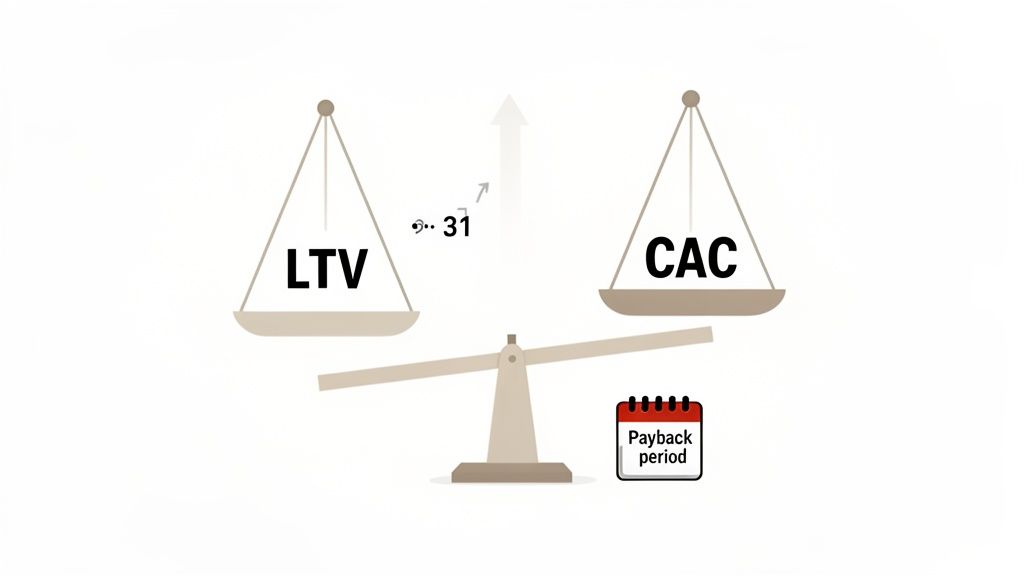
LTV is the total revenue you can realistically expect from a customer over their entire time with your product. When you connect these two metrics, you stop just tracking costs and start measuring the real, long-term profitability of your growth strategy.
The Power of the LTV to CAC Ratio
The LTV:CAC ratio is one of the most vital health metrics in SaaS. It directly compares the value a customer brings to your business against what it cost you to get them. It’s a simple ratio that cuts through the noise to signal your marketing and sales efficiency.
For a healthy, sustainable SaaS business, the ideal LTV:CAC ratio is 3:1 or higher. This means for every dollar you spend acquiring a customer, you get at least three dollars back over their lifetime.
Here's what the different ratios tell you:
- 1:1 Ratio: You're losing money on every new customer. For every dollar you spend, you only make one back over time—before factoring in other operational costs. This model is a sinking ship.
- <3:1 Ratio: You might be breaking even, but you aren't building a profitable growth engine. This usually points to inefficient marketing or poor retention, leaving little margin for error or reinvestment.
- 3:1 Ratio: This is the sweet spot. It indicates a solid, scalable business model. You're acquiring customers profitably and have enough margin to cover other costs and fuel future growth.
- >5:1 Ratio: While this sounds amazing, it can sometimes mean you're underinvesting in growth and being too conservative with marketing spend, leaving money on the table.
Understanding this relationship changes how you think about acquisition cost. A high CAC isn't automatically bad if it's attached to an even higher LTV. Spending $10,000 to land an enterprise customer is a brilliant move if their LTV is $50,000.
Calculating Your CAC Payback Period
While the LTV:CAC ratio shows long-term profitability, the CAC Payback Period measures short-term efficiency and cash flow. It answers a critical question: how many months does it take to earn back the money you spent to acquire a customer?
The formula is straightforward:
CAC Payback Period (in months) = CAC / (Average MRR per Customer x Gross Margin %)
Let's say your SaaS has a $600 CAC. Your average customer pays $100 in Monthly Recurring Revenue (MRR) and you operate with an 80% gross margin.
- Payback Period = $600 / ($100 x 0.80) = 7.5 months
This means it takes seven and a half months to break even. From that point, every dollar is profit. For most venture-backed SaaS companies, a payback period of under 12 months is the gold standard. A longer period ties up cash and slows your ability to reinvest in growth.
At Ezca, our data-driven sprints are designed to attack both sides of this equation. We don't just lower your CAC through optimized campaigns; we also focus on attracting higher-value customers to improve LTV and slash your payback period.
Actionable Strategies to Reduce Your SaaS CAC
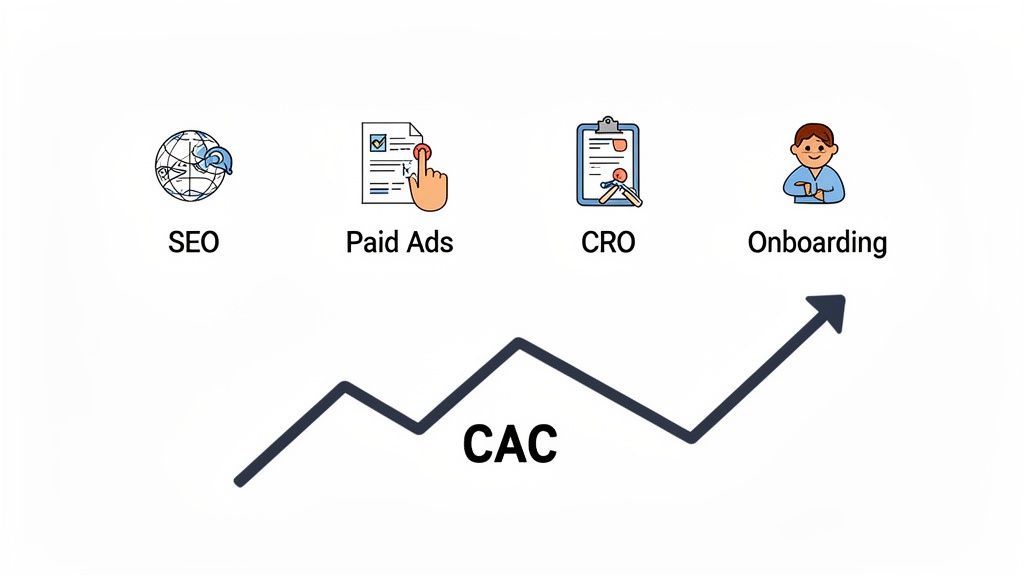
Knowing your CAC is one thing; actually bringing that number down is where real marketing leadership shines. It means getting past high-level theories and putting a tactical playbook into action.
Lowering your Customer Acquisition Cost isn't about arbitrarily slashing budgets. It’s about being smarter with your resources—doubling down on the channels and tactics that deliver the best ROI. This takes a focused approach, balancing long-term strategic moves with quick, measurable wins.
Build a Moat with SEO and Content Marketing
Paid ads offer speed, but organic channels build a durable competitive advantage. Think of SEO and content marketing not as expenses, but as assets. Every blog post you publish and backlink you earn works around the clock, drawing in high-intent prospects for years—without continuous ad spend.
This creates a powerful flywheel effect. As your website's authority grows, your cost to acquire customers through search drops dramatically. You're building a competitive moat that is difficult and expensive for others to replicate. While it takes time, the result is a sustainable, highly profitable growth engine.
Sharpen Your Paid Media with AI and Better Targeting
For most SaaS companies, paid media is the single biggest chunk of the CAC pie, making it the most obvious place to hunt for savings. The key is to get laser-focused on targeting, bidding, and ad creative to squeeze more value out of every dollar.
Go deeper than broad keyword targeting. Use AI-powered bidding to automatically optimize for actual conversions, not just vanity clicks. Pair this with hyper-specific landing pages for each ad group to boost your Quality Scores and drive down cost-per-click.
Here are a few specific tactics:
- Implement AI Bidding: Let Google's machine learning do the heavy lifting. Use Target CPA (tCPA) or Target ROAS (tROAS) to align your ad spend directly with your acquisition cost goals.
- Refine Audience Targeting: Layer in demographic data, in-market segments, and custom intent audiences to ensure your ads only reach people genuinely in the market for your solution.
- A/B Test Ad Creative: Constantly iterate on your headlines, descriptions, and calls-to-action to find the combination that resonates with your audience and lowers costs.
Boost Funnel Conversion with Targeted CRO
Your website and product funnels are almost certainly leaking customers. Even small friction points—a confusing signup form, a slow-loading page, a muddled value proposition—can tank conversion rates and send CAC soaring. Conversion Rate Optimization (CRO) is how you systematically find and plug those leaks.
A Practical Takeaway: A 1% lift in your sign-up conversion rate might not sound like a game-changer, but it directly cuts your CAC from that channel by 1%. These small, incremental wins stack up and have a huge financial impact over time.
Zero in on high-leverage points in your funnel, like the homepage, pricing page, and free trial signup. Use heatmaps and session recordings to see where users are dropping off, then run A/B tests to prove your fixes are working. Every bit of friction you remove makes your entire acquisition budget work harder.
Refine Onboarding to Drive Activation and Retention
Getting a user to sign up is only the beginning. If they don't use the product and experience its value, you've wasted all the money spent to acquire them. A smooth onboarding experience turns a new user into an engaged, paying customer. The faster they get to that "aha!" moment, the better your chance of keeping them.
Improving your activation rate directly boosts your LTV, making your LTV:CAC ratio much healthier. It also helps your CAC by cutting down on "empty" acquisitions—users who sign up and then churn. Speaking of bringing in the right users, if you want to know how to increase organic traffic, we’ve put together a comprehensive guide.
And of course, keeping the customers you've won is a massive part of the equation. Explore these actionable SaaS customer support best practices to significantly improve retention and lifetime value.
Comparing Different CAC Reduction Strategies
Each strategy has its place, but the most effective approach often involves a mix of short-term optimizations and long-term investments.
At Ezca, this is exactly what we do. Our 90-day sprints are built to systematically tackle these challenges. Our squad model brings together SEO, PPC, and CRO experts who dive into your data, pinpoint the biggest opportunities for CAC reduction, and execute with a relentless focus on delivering measurable results.
Let's Lower Your CAC with Our 90-Day Performance Sprints
Knowing how to lower your SaaS customer acquisition cost is one thing. Actually doing it is what separates the companies treading water from the ones leading the market.
The real challenge is getting all the moving parts—SEO, PPC, CRO—to work together in a way that delivers real, measurable results. Fast. If you're a marketing leader feeling the pressure to prove ROI, this can feel like an impossible juggling act.
That's where a different way of thinking comes in. Instead of launching a dozen disconnected projects that might show value in six months, you need a focused, agile system built for immediate impact. This is exactly what our 90-day performance sprints at Ezca are designed to do.
How Our Sprints Drive Down Your CAC
We've thrown out the old, slow-moving agency playbook. In its place, we give you a dedicated ‘squad’—a handpicked team of senior-level experts in SEO, paid media, and conversion optimization who act as a single, integrated unit focused squarely on your business. This structure lets us move with speed and precision.
Our entire process is guided by data, not guesswork. In the very first week, we roll up our sleeves and dive deep into your analytics to find the biggest financial levers we can pull to reduce your CAC.
A marketing strategy is only as good as its financial outcome. Our 90-day sprints are designed to turn marketing activities into provable CAC reduction and profitable growth, giving you the hard numbers to justify every dollar spent.
Armed with that initial analysis, we build a sprint plan that targets the lowest-hanging fruit first. That might mean shifting a bloated PPC budget toward a high-converting organic keyword cluster or running A/B tests on a leaky pricing page that's costing you customers.
The Squad Model in Action
Imagine your marketing efforts operating with the focus and intensity of a special ops team. That’s our squad model. This integrated team works in a tight weekly rhythm to execute, measure, and adjust, ensuring no time or momentum is wasted.
Here’s what it looks like:
- Week 1-2: Analysis & Strategy: The squad audits your current channels, pinpoints the top 3-5 opportunities for immediate CAC improvement, and maps out the 90-day sprint roadmap.
- Week 3-10: Execution & Optimization: The team executes in parallel. While the SEO expert builds out topic clusters, the PPC specialist is busy refining ad campaigns, and the CRO expert is testing new landing page variations.
- Week 11-12: Reporting & Renewal: We deliver a comprehensive report showing the tangible reduction in your blended and channel-specific CAC, along with a clear plan for the next sprint.
For SaaS leaders weighing their options, understanding the trade-offs of an in-house vs. agency marketing team is crucial. Our model is designed to give you the specialized expertise of an agency but with the dedicated focus of an in-house team. We've refined this process with leading SaaS brands to deliver scalable, profitable growth, sprint after sprint.
Frequently Asked Questions About SaaS CAC
Here are some of the most common questions we hear from founders and marketing leaders, along with straightforward, actionable answers.
How Often Should We Calculate and Review CAC?
You need to be calculating CAC at least monthly. This gives you a tight feedback loop for tactical adjustments. A quarterly review is essential for a deeper, more strategic dive into trends and channel performance.
This regular rhythm lets you see the immediate effects of your actions. Let’s say you launch a new ad campaign. A monthly check will show if it's impacting your blended CAC, allowing you to pivot quickly. Waiting a full quarter to discover an inefficient campaign is just burning cash.
How Do I Attribute Costs in a Sales-Assisted Model?
This is a classic challenge for any SaaS with a hybrid or sales-led motion. The key is to fairly allocate a portion of your sales team's cost to your marketing CAC. You can't just lump it all into a general "sales" bucket if they're working leads marketing generated.
A simple approach: If your sales development reps (SDRs) spend 50% of their day on inbound leads from your blog and webinars, you must attribute 50% of their salaries and commissions to your marketing CAC. This provides a true, fully loaded cost for marketing-generated deals.
What if My Payback Period Is Too Long?
If your CAC payback period is creeping past the 12-month benchmark, that's a red flag for your cash flow and a signal to take immediate action.
A long payback period means your growth is tying up too much cash for too long. To fix this, you have to either lower your CAC, increase your average revenue per account (ARPA), or improve your gross margin. Ideally, you’ll work on all three.
Your two most direct levers are:
- Lower Your CAC: Get ruthless with optimizing paid campaigns. Are you bidding on the right keywords? Is your ad copy converting? At the same time, pour more fuel on efficient organic channels like SEO that pay dividends long-term.
- Increase Your ARPA: Shift your focus toward attracting higher-value customers who will pay more from day one. You can also get better at encouraging existing customers to upgrade to higher-tier plans sooner.
By mastering these concepts, you can go from just measuring your SaaS customer acquisition cost to actively managing it as a core component of your growth strategy.
Ready to stop guessing and start seeing a measurable reduction in your CAC? Ezca’s 90-day performance sprints are designed to deliver tangible results. Let's build your profitable growth engine.