
How to Increase Organic Traffic with a Data-Driven Framework
Discover how to increase organic traffic using a proven, data-driven framework. Get actionable SEO and content strategies for measurable business growth.

For marketing leaders and business owners, increasing organic traffic isn't about chasing vanity metrics. It's about building a predictable revenue engine. The strategy boils down to a disciplined, ROI-focused approach: a technically sound website, high-intent content, and an authoritative backlink profile. When executed correctly, this framework delivers sustainable growth, not just traffic spikes.
Why Organic Traffic is a Critical Revenue Channel
With the rise of AI search and zero-click results, many leaders question the ROI of SEO. It's a valid concern. The search landscape is evolving faster than ever, and old tactics are failing.
The key isn't to abandon SEO, but to adapt. The modern approach is an agile, sprint-based system that connects every action to a business outcome. Organic traffic isn't dead; it's simply demanding a more sophisticated strategy.
The Unmatched ROI of Organic Search
Despite market shifts, organic search remains the dominant source of website traffic. The data is clear: organic search drives over 53% of all website traffic, making other channels pale in comparison. You can dig into the details of that search statistic here. For any B2B, SaaS, or e-commerce business, this isn't a "nice-to-have"—it's the core of a scalable customer acquisition strategy.
The power lies in intent. Paid ads interrupt, but organic search provides answers at the exact moment of need. This builds trust, drives qualified leads, and delivers a superior return on investment compared to outbound channels.
Organic search is a direct line to your most motivated buyers. The traffic you earn is a direct reflection of your market authority and relevance, making it one of the most durable, high-ROI assets you can build.
A Modern Framework for Driving Growth
Random acts of SEO—a blog post here, a technical tweak there—don't deliver predictable results. To win today, you need a structured, agile system. At Ezca, we leverage focused sprints to diagnose technical roadblocks, develop a data-backed strategy, and build momentum that translates directly to the bottom line.
This three-part process—Diagnose, Develop, Build—is the foundation of our organic growth programs.
It begins with a deep diagnostic to identify high-impact opportunities. From there, we develop a strategic roadmap. Finally, we execute the build phase—creating the content, links, and technical fixes that drive measurable business outcomes.
The Organic Growth Framework at a Glance
This table outlines the five-phase framework that serves as a roadmap to sustainable, revenue-driven organic growth.
This provides a high-level view of each stage. Now, let's explore the actionable details of each phase.
Diagnose Your Foundation with a Technical SEO Audit
Attempting a content strategy on a technically flawed website is like pouring marketing budget into a leaky bucket. A technical SEO audit is the critical first step to plug those leaks, uncovering the hidden issues that suppress your organic traffic and revenue.
For marketing leaders, the objective isn't to master technical jargon. It's to understand which issues have the most significant business impact, allowing you to prioritize fixes that directly unlock growth.
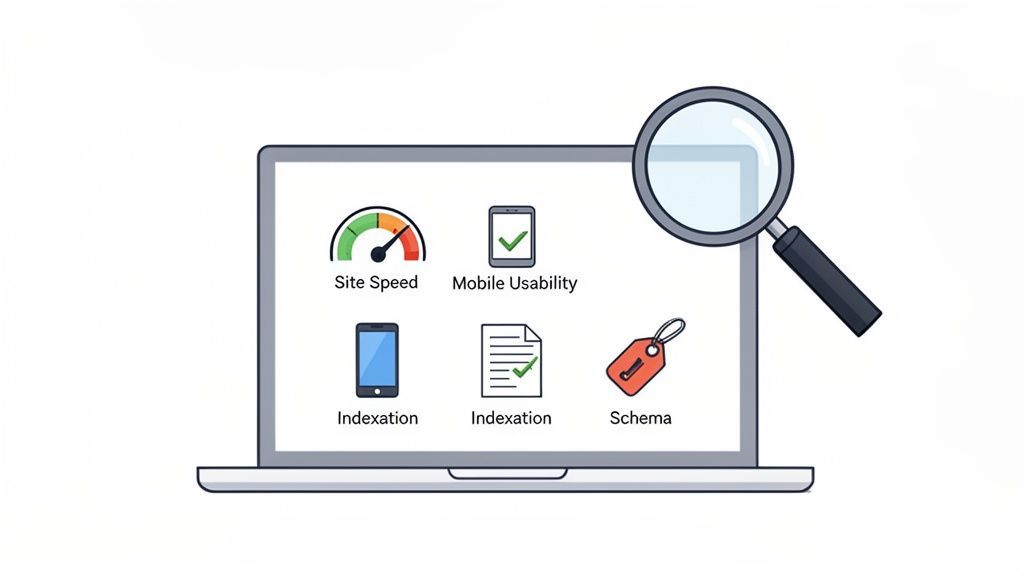
Prioritizing High-Impact Technical Fixes
A comprehensive audit can generate hundreds of "issues." The reality is that only a few will meaningfully impact your bottom line. Chasing a perfect score on an automated tool is a waste of resources. Instead, focus on fixes that affect how Google crawls, indexes, and understands your site—and how users experience it.
Start by focusing on these four critical areas:
- Site Speed and Core Web Vitals: A slow site actively harms rankings and kills conversions. Google's Core Web Vitals (CWV) are direct ranking signals measuring user experience. For an e-commerce site, a one-second page load delay can decrease conversions by 7%.
- Mobile-First Indexing and Usability: Google primarily uses a site's mobile version for indexing and ranking. A poor mobile experience makes you invisible to a massive segment of your audience. This goes beyond responsive design; it means ensuring easy navigation, legible fonts, and tappable buttons on small screens.
- Crawlability and Indexability: If search engine bots can't find and understand your pages, they can't rank them. Key issues include crawl budget waste (Googlebot spending time on low-value pages), incorrect
robots.txtdirectives, or "noindex" tags blocking critical content. - Structured Data (Schema Markup): Schema is code that provides context to search engines about your content. Correctly implementing schema for products, articles, or services can earn rich snippets in search results—like star ratings or pricing—which can boost click-through rates by up to 30%.
From Diagnosis to an Actionable Plan
Once you've identified the key issues, translate them into a prioritized action plan for your development team. Don't just provide a list of technical errors; frame the fixes in terms of business impact to get buy-in.
Instead of saying, "Improve LCP score," frame it as, "Our slow product page load time is costing an estimated $15,000 in lost monthly revenue. Compressing images and deferring non-critical JavaScript are the highest-priority fixes to recapture this."
A technical SEO audit transforms your strategy from guesswork into a data-backed plan. It ensures every dollar invested in content and promotion is built on a foundation that can support and amplify success.
Your audit should produce a clear, prioritized list. A simple impact vs. effort matrix helps focus resources on quick wins and high-value projects.
This scoring model directs your team's limited resources toward fixes that deliver the greatest ROI in the shortest time. Ezca's SEO services begin with this deep diagnostic to identify your largest growth opportunities, ensuring foundational issues are resolved before scaling content and link acquisition.
Develop a High-Intent Content Strategy
With your technical foundation secure, the next step is building a content engine that attracts qualified buyers, not just casual browsers. The old model of targeting high-volume keywords is obsolete. Today's search landscape demands a strategic pivot.
Consider this: zero-click searches now make up over 60% of Google queries, and AI-powered search is used by nearly half of all consumers. This shift requires a focus on user intent and authority, specifically targeting middle and bottom-of-funnel (MOFU and BOFU) topics that drive clicks and conversions. You can find more data on these evolving search trends to inform your strategy.
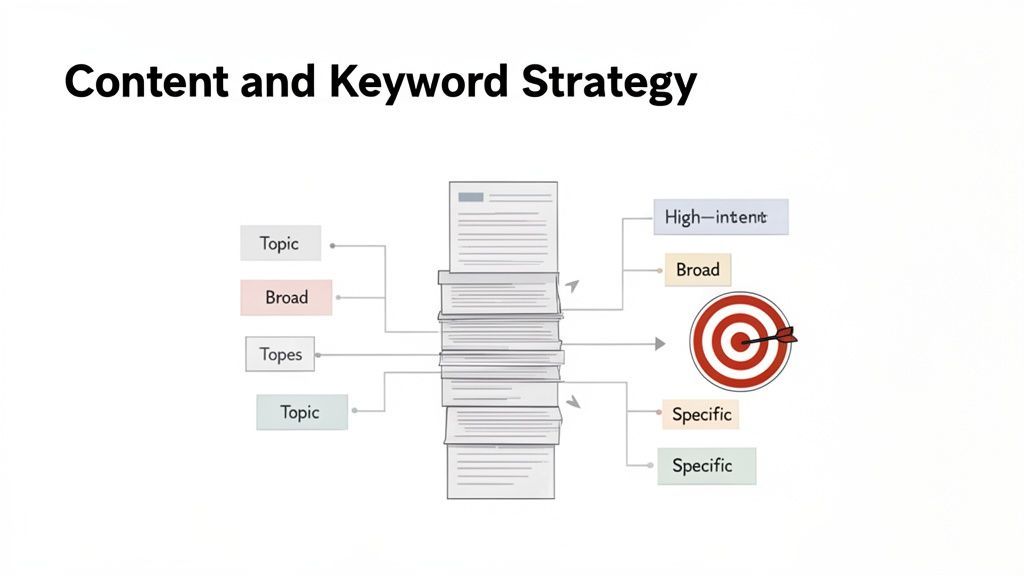
Our goal is no longer just traffic; it's attracting qualified leads actively seeking the solutions you provide. This requires a surgical keyword strategy and a content structure that signals deep expertise.
Target High-Intent Keywords
Your most valuable traffic comes from prospects who are past the initial research phase and are actively evaluating solutions. These are "problem-aware" or "solution-aware" buyers, and their search queries reveal their intent.
Instead of a broad term like "project management," target specific long-tail keywords that indicate purchase intent.
- Problem-Aware Keywords: These prospects have a defined pain point and are searching for a solution. They use queries like "how to track team workload" or "why is my team missing deadlines." Your content should educate and guide them toward your solution category.
- Solution-Aware Keywords: These users are actively comparing options. They search for "best Trello alternatives," "Asana vs Monday comparison," or "project management software for small teams." This is your opportunity to directly position your product as the ideal choice.
Focusing on these bottom-funnel keywords delivers traffic that is significantly closer to converting, yielding a much higher ROI on your content investment.
Build Authority with Topic Clusters
Modern SEO requires demonstrating topical authority to users and search engines like Google. The most effective way to do this is with topic clusters: a comprehensive "pillar page" on a broad topic, supported by in-depth "cluster pages" on related subtopics, all interlinking to create a web of expertise.
For a SaaS company offering an email marketing tool, a topic cluster might look like this:
This structure organizes your content and creates a dense internal linking network that channels authority to your pillar page. It signals to Google that you are the definitive resource on that topic, increasing your likelihood of ranking for competitive terms and capturing featured snippets or AI Overview placements.
A well-executed topic cluster transforms your blog from a random collection of articles into a strategic moat of authority around your core business topics, making you the go-to resource for your target audience.
Executing this strategy requires a disciplined process. At Ezca, we integrate this bottom-funnel keyword focus and topic cluster methodology into every 90-day growth sprint, ensuring each piece of content is engineered not just for traffic, but for driving measurable business results.
Build Authority with Strategic Link Building
With a solid technical foundation and a high-intent content strategy, the next step is to build domain authority. Backlinks remain a critical ranking signal for Google, but the focus has shifted from quantity to quality.
A single, editorially earned link from a top-tier industry publication provides more value than hundreds of low-quality links. For marketing leaders, this requires an ROI-driven mindset. We aim to earn backlinks that not only improve rankings but also drive qualified referral traffic and cement brand credibility. This is digital PR, not algorithm manipulation.
Create Something Worth Linking To
The most effective way to earn high-quality links is to create assets that journalists, bloggers, and industry experts actively want to reference. When you provide value, the dynamic shifts from asking for a favor to offering a resource that improves their own content.
These types of assets are natural link magnets:
- Original Research & Data Reports: Unique data is highly linkable. A B2B SaaS company could survey 1,000 project managers and publish a "State of Team Productivity in 2025" report. This proprietary data becomes a primary source that industry blogs will cite and link to for years.
- Free Tools & Calculators: A simple, useful tool can generate links passively. An e-commerce brand selling fitness equipment could create a "Daily Calorie Intake Calculator." This type of resource is frequently linked to from health and wellness articles without any outreach required.
- The "Ultimate" Guide: A truly definitive pillar page that is deeply researched and well-designed becomes the go-to resource in your industry. It covers a topic so comprehensively that others naturally link to it as the authoritative source.
These assets require a significant upfront investment but deliver compounding ROI over time by passively generating high-authority links and positioning your brand as a thought leader.
The modern link-building mindset is to stop asking for links and start creating assets that deserve them. When your content is the best resource on a topic, earning links is a natural byproduct of providing value.
Focus on Digital PR and Building Relationships
With a link-worthy asset in hand, the next step is strategic outreach. This is the role of digital public relations (PR). It's about building genuine relationships with authors, editors, and journalists at publications your target customers read and trust. The goal is to get your asset featured because it provides genuine value to their audience.
This involves identifying relevant publications and crafting personalized pitches that clearly articulate the value of your content for their readers.
This approach earns media coverage, not just hyperlinks. The resulting links are more powerful because they originate from trusted sources and are embedded within contextually relevant content. Our guide to effective link building strategies offers a deeper dive into these modern tactics that turn link building from a cost center into a powerful growth driver.
Turn Organic Traffic into Revenue with CRO
Driving organic traffic is only the first step. For marketing leaders, the real goal is converting that traffic into revenue. This is where Conversion Rate Optimization (CRO) becomes essential, bridging the gap between your SEO efforts and your bottom line.
CRO is the systematic process of improving your website to increase the percentage of visitors who take a desired action—like requesting a demo, starting a trial, or making a purchase. It allows you to draw a direct line from SEO investment to revenue growth.
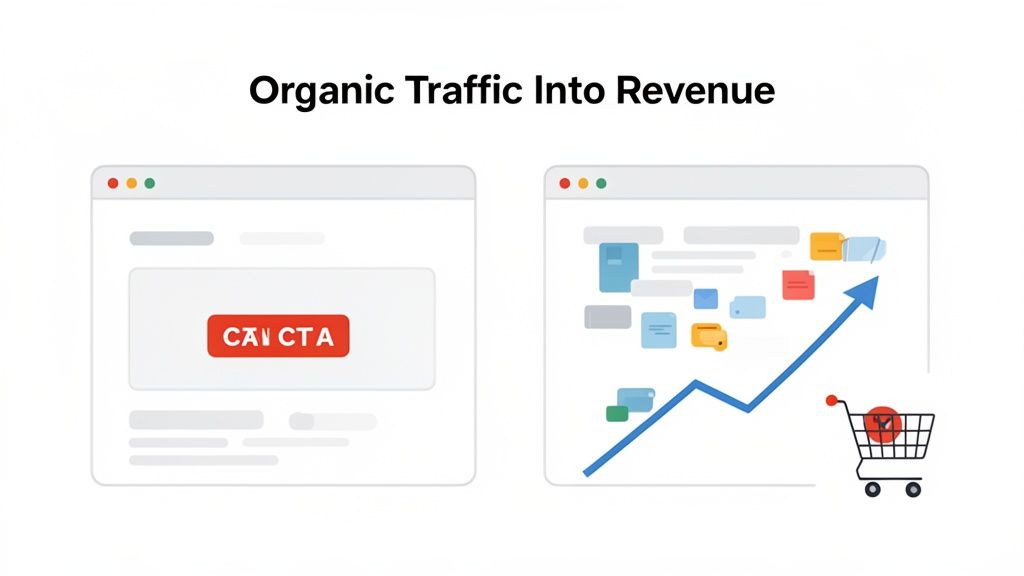
From Clicks to Customers
A user's journey begins with a search, a click, and arrival on your landing page. That page has one job: to instantly convince them they are in the right place. Every element, from the headline to the call-to-action (CTA), influences their decision.
Optimizing this journey is a continuous cycle of hypothesis, testing, and analysis. The objective is to identify and eliminate friction points that prevent users from converting. Even small, incremental improvements can lead to significant revenue gains over time.
Mastering the Art of the A/B Test
The core of any effective CRO strategy is the A/B test. You create two versions of a page—a control (A) and a variation (B)—and show them to different segments of your audience to determine which performs better. This data-driven approach removes guesswork and lets user behavior guide your design and copy decisions.
A successful test begins with a clear hypothesis. For example: "Changing the generic 'Submit' button text to the more value-driven 'Get Your Free Demo' will increase form submissions." Testing this hypothesis provides hard data to validate the change, ensuring every modification is a step toward better performance.
Conversion Rate Optimization is a strategic discipline that ensures the valuable organic traffic you acquire contributes to business growth. It answers the critical question: "How do we turn these visitors into revenue?"
We saw this with a B2B SaaS client whose demo request page was getting significant traffic but had a low conversion rate. Their CTA button was generic ("Submit") and placed below a long form.
Our hypothesis: a more compelling, visible CTA would increase conversions.
- Test A (Control): The original page with the "Submit" CTA.
- Test B (Variation): We changed the button text to "Request My Personalized Demo" and made it a contrasting color that stood out.
The result: the variation produced a 32% uplift in demo requests over a 30-day period. This single change, validated by data, directly translated into a substantial increase in qualified sales leads from existing traffic.
High-Impact CRO Tests for Organic Landing Pages
Focus your initial tests on your highest-traffic organic landing pages to maximize ROI. Ezca's our CRO services implement a data-first approach to turn traffic into tangible business results.
Here is a prioritized list of A/B tests that typically yield the highest returns for pages receiving organic traffic.
By systematically testing these high-impact elements, you can unlock the hidden revenue potential within your existing organic traffic.
Measure and Iterate: Driving Growth in 90-Day Sprints
"Set it and forget it" SEO is a myth. Sustainable organic growth comes from a disciplined system of continuous, agile improvement. We achieve this by structuring all activities into 90-day marketing sprints. This framework forces accountability, maintains focus on high-impact initiatives, and allows for rapid adaptation.
A 90-day window is the ideal timeframe for execution and measurement. It's long enough to implement a strategy and see tangible results, yet short enough to pivot based on data. This agility is your competitive advantage, preventing wasted resources on underperforming tactics.
Stop Chasing Vanity Metrics. Define KPIs That Matter.
Before each sprint, define what success looks like in terms of business outcomes, not just marketing metrics. Your KPIs must connect SEO activity directly to revenue.
Focus on KPIs that truly matter to the C-suite:
- Rankings for High-Intent Keywords: Obsess over the 10-15 keywords that "solution-aware" buyers use just before converting. Moving a term like "best project management software for agencies" from page two to the top three is a significant financial win.
- Marketing Qualified Leads (MQLs) from Organic: Track how many demo requests, trial sign-ups, or contact form fills originate from organic search. This KPI measures traffic quality, not just quantity.
- Revenue Attributed to Organic: This is the ultimate measure of ROI. Use attribution modeling to track the exact revenue generated from customers who found you through a non-branded organic search.
An agile, sprint-based approach transforms SEO from a long-term hope into a predictable growth engine. It creates a repeatable process to analyze results, double down on what works, and quickly eliminate what doesn’t.
The Monthly Performance Check-In
Within each 90-day sprint, a monthly performance review is crucial for staying on track. This isn't a lengthy report; it's a concise, data-backed summary designed to facilitate quick, informed decisions.
At Ezca, our client check-ins are focused on ROI and clear next steps.
This simple dashboard connects actions to outcomes, providing the clarity needed to make strategic decisions. By repeating this measure-and-iterate cycle every 90 days, you build unstoppable momentum and ensure your organic channel is a consistent driver of business growth.
A Few Common Questions About Growing Organic Traffic
Business leaders often have the same core questions when investing in organic growth. Here are straightforward, data-backed answers.
How Long Does It Actually Take to See SEO Results?
While significant, revenue-driving results often take 6-12 months, you should see positive leading indicators within the first 90 days.
Don't fixate on the overall traffic graph in the first quarter. Instead, monitor rankings for your highest-intent, bottom-of-funnel keywords. Seeing a crucial term like "best CRM for startups" move from page three to the bottom of page one is a strong early indicator of success. These initial ranking improvements are proof that the strategy is working, long before the full traffic impact is realized.
Should I Create More Content or Better Content?
Better content, unequivocally. In today's competitive landscape, one exceptional, deeply researched asset will outperform a dozen mediocre blog posts.
Search engines are highly effective at distinguishing between content that solves a user's problem and content created merely to target a keyword.
Focus on creating "pillar" assets. A single, definitive guide can attract high-quality backlinks and rank for hundreds of related long-tail keywords. The ROI on that one piece will dwarf the cumulative effort of churning out low-impact articles that fail to engage, convert, or earn links.
Adopt this mindset: your goal is to create the single best resource on the internet for your target topic. This simple shift in perspective moves you from a volume game to a value game, which is exactly what Google's algorithms are built to reward.
Are Keywords Still a Thing with AI Search?
Yes, but their application has evolved. Keyword stuffing is obsolete. The focus now is on comprehensive topical coverage and natural language.
Google's AI Overviews and other AI-driven search features are designed to understand intent and context, not just keyword strings.
This means your strategy should revolve around answering the questions your audience is asking. Conversational, long-tail keywords are more important than ever. Instead of targeting only a broad term like "SaaS marketing," you'll gain more traction by creating content that answers a specific question like, "How do I calculate customer acquisition cost for my SaaS?" This approach directly aligns your content with user intent, making it a prime candidate for AI-powered search features.
Ready to stop guessing and start growing? Ezca implements a data-driven, 90-day sprint methodology to increase your organic traffic and tie every marketing action directly to revenue. See how our performance marketing squads can build your growth engine.