
What Is Multi Channel Marketing: A Leader's Guide to Driving Growth
Discover what is multi channel marketing and how a unified approach boosts engagement, attribution, and ROI across channels.
Multi-channel marketing is the practice of using multiple, independent channels to engage with customers. Each platform—email, social media, SEO, paid ads—operates as a distinct path to your audience. The goal is to maximize visibility by meeting customers on the platforms they already use, creating more opportunities for them to convert. It's about casting a wide, strategic net, not just a single line.
Understanding Multi-Channel Marketing and Why It's a Business Imperative
At its core, multi-channel marketing is about offering customer choice. Think of it like a media company with separate channels for news, sports, and movies. Each is designed to capture a specific audience segment, but they aren't engineered to create a single, unified viewing experience. The primary business objective is to expand reach and ensure your brand is present wherever potential customers are searching, scrolling, or shopping.
This is no longer a "nice-to-have." It's a fundamental requirement for sustainable growth. Customers expect to engage with brands on their preferred platforms. By diversifying your presence, you de-risk your marketing efforts and allow customers to interact on their own terms, which directly translates into more pathways to revenue.
The Driving Force Behind Multi-Channel Adoption
The shift to multi-channel isn't a trend; it's a direct response to modern customer behavior. The data is unequivocal. A significant 86% of marketers globally confirm that the effectiveness of multi-channel strategies is increasing year over year.
The ROI is even more compelling: brands using three or more channels achieve a 287% higher purchase rate compared to single-channel operations. Consistent messaging across multiple touchpoints builds trust and top-of-mind awareness—the critical factors that convert consideration into purchase. You can discover more insights on how brands use multiple channels for growth.
The core idea of multi-channel marketing is straightforward: meet your customers where they are. Instead of forcing them down a single path, you provide multiple doors for them to enter.
Core Components of a Multi-Channel Strategy
Executing a successful multi-channel strategy requires a disciplined focus on several key pillars. Simply being active on various platforms is not enough; each channel must be optimized to perform its specific role effectively.
Here's a breakdown of the essential components for building a robust and profitable marketing presence.
Mastering these components ensures your efforts are strategic and ROI-focused, not just scattered. Each channel plays a specific role, contributing to the broader business goals of customer acquisition and lifetime value.
Multi-Channel vs. Omnichannel Marketing: What's the Real Difference?
For any marketing leader, nailing the difference between multi-channel and omnichannel marketing is absolutely critical. It’s not just semantics. Getting this wrong can lead to scrambled goals, wasted ad spend, and a customer experience that feels completely disconnected. While both strategies use multiple platforms to reach people, the philosophy behind each is worlds apart.
Multi-channel marketing puts the brand at the center. Think of it as a hub-and-spoke model. You have your core message, and you push it out through various independent channels—social media, email, PPC ads, you name it. Each channel is essentially its own silo, working to get that message in front of as many people as possible on that specific platform.
Omnichannel, on the other hand, puts the customer at the center. This approach is all about creating a single, seamless experience for the user across every single touchpoint. The channels aren't just running in parallel; they’re actively working together. The journey feels continuous, whether a customer is jumping from your mobile app to your website to a physical store.
Visualizing the Core Difference
The easiest way to really get this is to picture how the customer moves through each setup. With a multi-channel strategy, the paths are separate. One path comes from social, another from email, and so on—all leading back to the brand. An omnichannel approach, however, weaves an interconnected web around the customer.
This diagram shows a classic multi-channel structure where the customer has distinct paths to interact through social, email, and the company website.
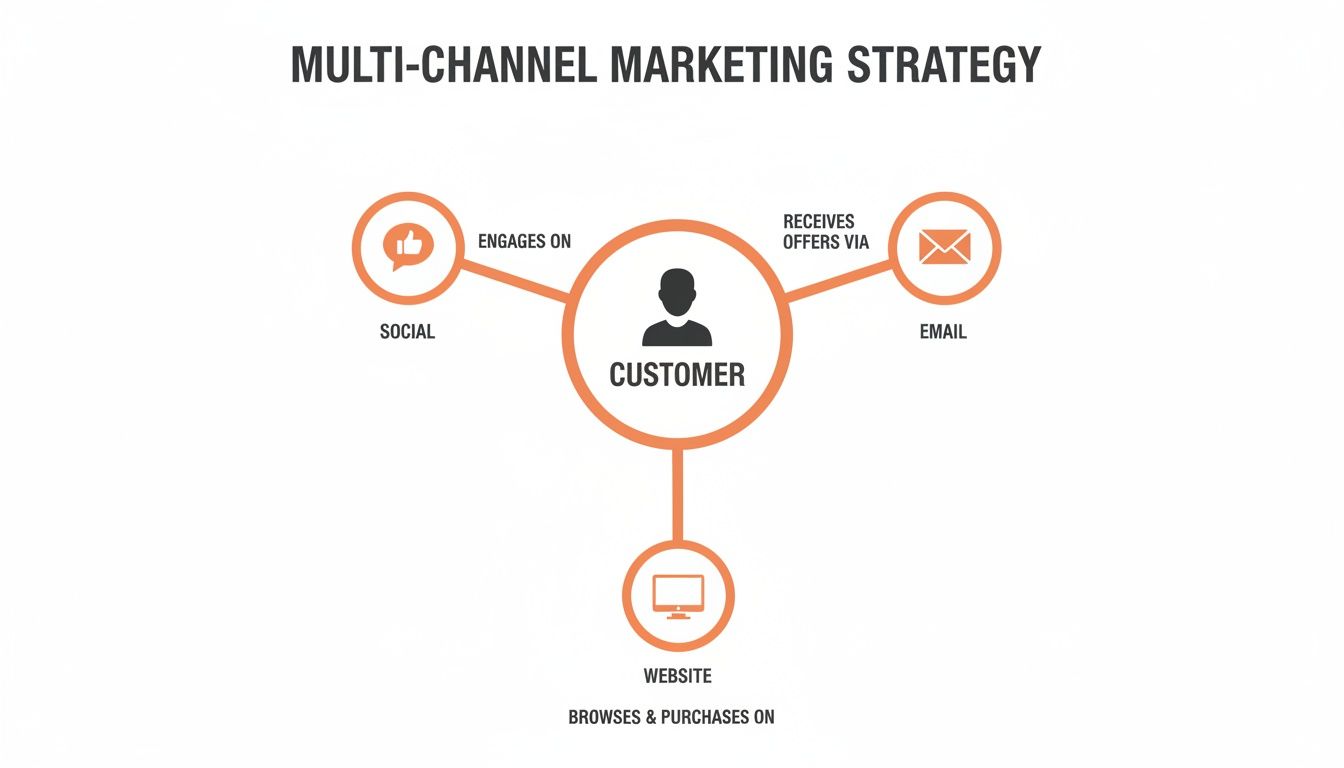
The key takeaway here is how siloed the interaction is. Each channel gives the customer a direct line to the business, but none of the channels are aware of what's happening on the others.
The Orchestra vs. The Solo Artists Analogy
I’ve found it helps to think of marketing like a musical performance.
Multi-channel marketing is like a music festival with a bunch of talented solo artists on different stages. Each one is great in their own right, but they aren't playing the same song or coordinating their performances.
Omnichannel marketing is a symphony orchestra. Every instrument and every musician is playing in perfect harmony from the same sheet music, creating one powerful, cohesive masterpiece.
This difference has a direct impact on your ROI. A multi-channel approach is fantastic for building broad brand awareness and lets you optimize each channel individually. For example, you can run different offers on Facebook and Google Ads to see what works best on each platform in isolation. The downside? You often miss out on opportunities for deeper, more meaningful personalization.
Omnichannel requires a serious investment in tech and cross-team collaboration, but the payoff is huge in customer loyalty and lifetime value. In fact, companies with strong omnichannel strategies retain an average of 89% of their customers, a stark contrast to the 33% retention rate for companies with weak cross-channel engagement.
Ultimately, the right approach depends on where your business is today. Many companies we work with at Ezca start by building a rock-solid multi-channel foundation, getting really good at individual channels first. From that strong base, they can start layering in the integrations needed to evolve into a more sophisticated, truly customer-centric omnichannel model.
Choosing Your Key Channels and Tactics
Let's get tactical. Translating strategy into revenue starts with one critical decision: where to allocate capital for the highest possible return.
Effective multi-channel marketing isn’t about spraying your message across every platform. It's about surgical precision. You must deploy the right tactics in the right channels where your ideal customers are most receptive. This requires data, not guesswork, to identify where they actually spend their time online.
The objective is to select a few high-impact channels you can dominate. Build a strong foundation on these core platforms before considering expansion. This prevents spreading your team and budget too thin—a common mistake that kills ROI and leads to mediocre results across the board.
Building Your Foundational Channel Mix
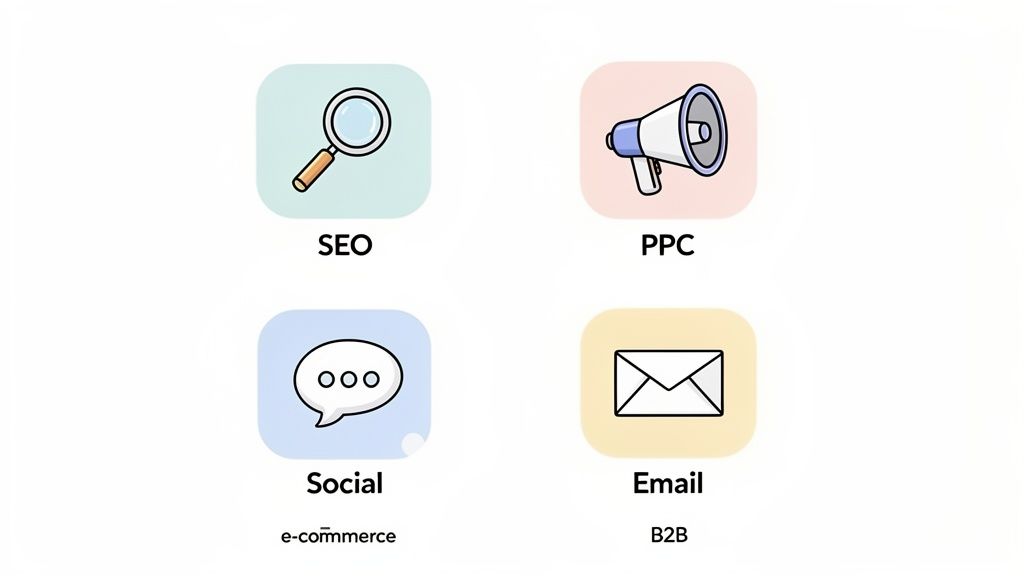
So, where do you start? Let's analyze four powerful digital channels with specific, actionable tactics for different business models. Remember, in a multi-channel framework, each operates with its own distinct objectives and metrics.
1. Search Engine Optimization (SEO)
SEO is a long-term capital investment in your brand's digital real estate. It’s about securing top rankings on Google for high-intent keywords, creating a predictable stream of qualified organic traffic that doesn't vanish when you pause ad spend.
- For SaaS: The primary tactic is to intercept prospects during their problem-aware solution search. Create in-depth content (guides, articles) targeting keywords like "how to improve team productivity" or "best project management software." The key metric isn't traffic; it's the number of free trial sign-ups or demo requests generated from organic search.
- For E-commerce: SEO is about product discovery. Optimize product and category pages for precise, long-tail search terms ("women's waterproof running jacket"). The critical KPI is revenue from organic search and the conversion rate of non-branded keywords.
2. Pay-Per-Click (PPC) Advertising
PPC delivers immediate visibility and is the ideal tool for rapid testing of offers, messaging, and target audiences. It allows you to place your solution directly in front of buyers at the exact moment of intent, making it a powerful engine for lead generation and sales.
- For B2B: Focus on LinkedIn Ads and Google Ads. A high-leverage LinkedIn tactic is targeting specific job titles and industries with high-value content offers, like an exclusive industry report. Measure success by Cost Per Lead (CPL) and, ultimately, lead-to-opportunity conversion rate.
- For E-commerce: Google Shopping and social ads (Instagram, Facebook) are essential. Dynamic Product Ads for retargeting users who viewed a product but didn't purchase is a must-have tactic. The single most important metric is Return on Ad Spend (ROAS). A healthy benchmark is a 3:1 or 4:1 ratio.
The most powerful multi-channel strategies don't just pick channels; they align specific, high-leverage tactics within each channel to a clear business objective. The tactic—not just the channel—is what drives the result.
Engaging Audiences with Social and Email
While search captures existing demand, social media and email create it. These channels are for building relationships, nurturing leads, and guiding prospects toward a purchase decision.
3. Social Media Marketing
Treat each social platform as its own unique environment. Your strategy and content must align with user expectations for that specific channel.
- B2B on LinkedIn: Move beyond generic company updates. A superior tactic is to position company leaders as subject matter experts sharing actionable industry insights. This builds authority and generates high-quality inbound leads from prospects who value your expertise.
- E-commerce on Instagram/TikTok: This is a visual-first environment where short-form video (Reels, TikToks) is dominant. Showcase products using an authentic, user-generated content (UGC) style to drive brand awareness and direct traffic. Key metrics are engagement rate and website clicks.
4. Email Marketing
Email marketing consistently delivers one of the highest ROIs because you own the channel. It is your direct line for nurturing leads into customers and customers into repeat buyers. If you need expertise in this high-ROI channel, Ezca provides specialized email marketing services.
- SaaS Nurture Sequence: A proven tactic is a 5-part automated email sequence triggered by a content download. Each email should provide value, educate the prospect on their problem, and strategically introduce your software as the solution, culminating in a soft call-to-action for a demo. The success metric is the lead-to-opportunity conversion rate.
- E-commerce Abandoned Cart Flow: This is non-negotiable for any online store. A simple 3-email sequence can recover 10-15% of otherwise lost revenue. The first email is a reminder, the second overcomes a common objection (e.g., shipping), and the third offers a time-sensitive incentive. The only KPI that matters is recovered revenue.
How to Measure Success Across Your Channels
Executing a multi-channel strategy without rigorous measurement is just expensive guesswork. For marketing leaders and business owners, the priority is to move beyond vanity metrics (like social media likes) and focus on the KPIs that directly correlate with business growth. The goal is not activity, but measurable impact on revenue.
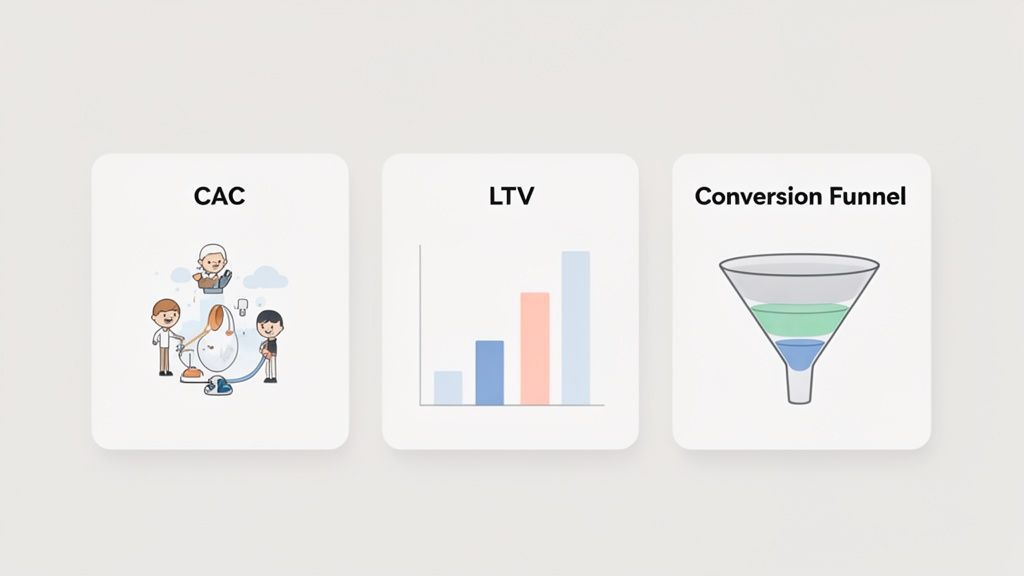
This begins with two bedrock metrics: Customer Acquisition Cost (CAC) and Customer Lifetime Value (LTV). CAC is what you spend to acquire a new customer. LTV is the total revenue that customer is projected to generate. A healthy, scalable business model requires an LTV significantly greater than its CAC, with a 3:1 ratio serving as a standard benchmark for success.
Connecting Channel Performance to Business Goals
While LTV and CAC provide the C-suite view, you need channel-specific metrics to optimize performance on the ground. This is where you connect tactical execution to strategic outcomes.
- For SEO: Don’t just report on keyword rankings. Report on the number of marketing qualified leads (MQLs) or sales generated from organic traffic.
- For PPC: Click-through rate is an intermediate metric. Return on Ad Spend (ROAS) is the business metric that matters. For every dollar invested, what is the revenue returned?
- For Email Marketing: Open rates are irrelevant without action. Focus on the conversion rate: what percentage of recipients completed the desired action (e.g., demo request, purchase)?
Essential Multi-Channel Marketing KPIs
A balanced scorecard of KPIs is essential for a holistic view of performance. The table below outlines the critical metrics to track, categorized by their direct impact on the business.
Tracking these KPIs provides a clear, data-driven narrative of what’s working, what isn't, and where to allocate the next dollar of your budget.
Demystifying Marketing Attribution
Consider a common scenario: a customer sees a LinkedIn post, clicks a Google Ad a week later, and finally converts from an email campaign. Which channel gets the credit? This is the core challenge of marketing attribution.
Attribution modeling is simply the framework you use to assign value to each touchpoint in a customer's journey. Getting this right is the difference between confidently scaling your budget and just throwing money at different channels, hoping something sticks.
While attribution can become highly complex, starting with a multi-touch attribution model, such as a linear or time-decay model, is a significant step forward. These models distribute credit across multiple touchpoints, providing a more realistic view of how channels work together to drive conversions. To go deeper on this, check out our comprehensive guide on attribution modeling.
Using Data for Agile Budget Decisions
The entire purpose of measurement is to enable action. Elite marketing teams don't operate on static annual budgets. They use real-time data to make agile decisions, reallocating capital to maximize performance on a weekly or bi-weekly basis.
At Ezca, our squad model is built on this principle. We conduct weekly performance reviews, identifying opportunities to shift budget. If LinkedIn Ads are generating a lower CAC than Google Ads for a client this week, we reallocate funds immediately to maximize their overall return.
This agile approach allows you to:
- Double down on what’s working by funneling more budget into your highest-performing channels.
- Cut losses quickly on underperforming campaigns before they drain your budget.
- Prove marketing's value to the C-suite with hard data showing how every dollar is driving real business results.
When you track the right KPIs and adopt an agile mindset, you transform marketing from a cost center into a predictable, scalable revenue engine for your business.
Building Your Multi-Channel Marketing Strategy Step-by-Step
Transforming multi-channel theory into a revenue-generating engine requires a disciplined, repeatable process. It's not about chasing trends; it's about executing a series of strategic sprints designed for rapid learning and continuous improvement. This blueprint provides a practical framework for marketing leaders and business owners to move from concept to execution.
Follow these steps to build a strategy that is both ambitious in its goals and grounded in measurable results.
Step 1: Define Your Ideal Customer Profile (ICP) with Precision
Before allocating a single dollar of your budget, you must achieve an almost obsessive understanding of your Ideal Customer Profile (ICP). Generic personas are insufficient.
You need actionable intelligence. Conduct customer interviews. Analyze your CRM data for patterns among your best customers. Use tools like SparkToro to uncover which podcasts they listen to and which social accounts they follow. The objective is to answer critical business questions: What is their primary pain point? Which channels do they trust for professional advice? What content formats compel them to act?
The most common failure point is relying on internal assumptions. Validate every belief about your audience with real-world data.
Step 2: Set Measurable, Business-Oriented Goals
Vague objectives like "increase brand awareness" are useless for driving performance. Your goals must be Specific, Measurable, Achievable, Relevant, and Time-bound (SMART). This clarity creates focus and establishes a clear benchmark for success or failure.
Instead of a nebulous goal, define a concrete target: "Generate 200 marketing-qualified leads (MQLs) per month from LinkedIn Ads and SEO with a target CPL of $150 within Q3." This goal dictates channel selection, tactical execution, and the specific KPIs you must monitor, transforming marketing from a cost center into a predictable growth function.
Step 3: Select Your High-Impact Channels
With a defined ICP and clear goals, you can now select your channels. The key is to avoid the temptation to be everywhere. Choose two or three channels where your ICP is most concentrated and where you have a strategic advantage to win. Master these before considering expansion.
For example:
- A B2B SaaS company might focus on LinkedIn Ads for precision targeting and technical SEO to capture high-intent search traffic.
- An e-commerce brand would likely prioritize Instagram Shopping for product discovery and Google Shopping ads to capture bottom-of-funnel demand.
This focused approach concentrates budget and resources where they will yield the highest ROI, preventing the common mistake of spreading efforts too thin and achieving no meaningful traction.
Step 4: Ensure Consistent Core Messaging Across All Channels
While tactics and content formats must be adapted for each channel, your core brand message, value proposition, and tone of voice must remain unwaveringly consistent. A customer should instantly recognize your brand, whether they encounter a paid ad, a blog post, or an email.
This consistency builds trust and brand equity. A frequent pitfall is allowing channel managers to operate in silos, resulting in a fragmented and confusing customer experience. Establish clear brand guidelines and ensure every piece of marketing collateral reinforces your central value proposition.
The global multi-channel marketing hubs market reached a staggering USD 6 billion, poised for explosive growth at a 17.7% CAGR through 2034. This surge is driven by companies prioritizing tools for personalization at scale, with the U.S. market leveraging AI to fuel hyper-targeted campaigns. Read the full research on multi-channel marketing hubs to understand the market trends.
Step 5: Build Your Performance Dashboard
Finally, establish a single source of truth for tracking progress. An effective performance dashboard consolidates the critical metrics from all active channels, providing a clear, at-a-glance view of performance against goals.
This dashboard must focus on business-level KPIs defined in Step 2—Cost Per Lead (CPL), Customer Acquisition Cost (CAC), and Return on Ad Spend (ROAS)—not vanity metrics. This is the agile methodology we employ at Ezca; weekly performance reviews inform budget re-allocation to maximize ROI. This data-driven rigor enables rapid learning and continuous optimization, turning your strategy into a high-performance machine.
When to Partner with a Performance Marketing Agency
Executing a high-performance multi-channel strategy is a significant operational challenge. It requires deep, specialized expertise in SEO, paid media, analytics, and conversion rate optimization—plus the dedicated bandwidth to manage and optimize campaigns daily. For most in-house teams, this presents a critical decision: build these capabilities internally or partner with a specialist agency.
Simply running campaigns on multiple platforms is not the same as managing a cohesive, data-driven growth engine. True multi-channel excellence requires an operational model built for speed, agility, and accountability—precisely what a dedicated external partner provides.
The Advantage of a Dedicated Squad
Partnering with an agency like Ezca provides immediate access to a dedicated squad of specialists. Instead of searching for a "unicorn" marketer who excels at everything, you get a fully-integrated team: a PPC expert, an SEO strategist, a content lead, and a data analyst, all focused on your business outcomes.
This model offers distinct advantages over a traditional in-house structure:
- Diverse Expertise: You gain access to top-tier talent in every critical marketing discipline without the overhead of multiple senior-level salaries.
- Unbiased Perspective: An agency brings an objective, data-first viewpoint, free from internal politics or legacy thinking. Their sole focus is on performance against KPIs.
- Access to Enterprise Tools: Leading agencies invest heavily in advanced analytics, competitive intelligence, and optimization platforms that are often prohibitively expensive for a single company.
Driving Results with an Agile Framework
The right partner provides not just a team, but a proven process. An agile framework, structured around 90-day sprints, is the ideal operational model for multi-channel marketing. This approach deconstructs large annual goals into manageable quarterly objectives with clear deliverables and KPIs.
This sprint-based system creates a powerful feedback loop. It forces a rigorous focus on what’s working right now, allowing us to rapidly shift budget to the highest-performing channels and maximize ROI.
This structure delivers the discipline and accountability required to translate strategy into measurable results, quickly. Instead of waiting a year to evaluate success, you get clear performance data and actionable insights every quarter. If this model aligns with your growth objectives, explore our performance marketing services to see how we build scalable revenue engines for our clients.
Partnering with a performance agency is a strategic decision to integrate an operational system designed for one purpose: turning marketing investment into a predictable and scalable source of revenue.
A Few Common Questions We Hear
Adopting a multi-channel strategy is a significant move. It's smart to have questions. Here are concise answers to the most common queries we get from business owners and marketing leaders.
How Do I Pick the Right Marketing Channels?
Don't start with channels; start with your customer. The only question that matters is, "Where does my Ideal Customer Profile spend their time and attention?" Use customer interviews, surveys, and audience intelligence tools to get a data-backed answer.
You don't need to be everywhere. For a B2B SaaS company, this likely means LinkedIn and SEO. For a D2C apparel brand, it's probably Instagram and TikTok. Select two or three channels where you can establish a dominant presence, execute flawlessly, and only expand once you have clear, positive ROI data. Focus on impact, not breadth.
What's a Realistic Budget for a Multi-Channel Campaign?
There is no single magic number, but a common starting point is allocating 10-15% of your target revenue to marketing. How you deploy that capital depends entirely on your immediate business objectives.
If you need to hit a quarterly sales target, a larger portion will go to performance channels like Google and LinkedIn Ads. If you're building a defensible long-term brand, more investment should be directed toward SEO and content. The key is agility. Review performance weekly and reallocate capital to the channels delivering the best return.
A static budget is a wasted opportunity. The core of performance marketing is reallocating capital to the channels that are actively proving their worth, maximizing your overall return on investment.
How Long Until I Actually See Results?
This is entirely channel-dependent. Paid advertising can generate leads and sales almost immediately, often within the first few weeks. It's the ideal tool for rapid feedback and achieving short-term revenue goals.
Organic channels like SEO and content marketing are long-term asset-building activities. Expect a 6-9 month timeline to see significant, predictable traffic and leads. An effective multi-channel strategy balances both: it uses paid channels for immediate wins and momentum while investing in organic channels to build a sustainable, competitive advantage. You should see leading indicators of success, such as improved engagement and lead flow, within the first 90 days.
Ready to build a multi-channel strategy that brings in predictable revenue? The expert squads at Ezca Agency design and run data-driven marketing plans in focused 90-day sprints. Get in touch to see how we can help you scale.