
In-House vs Agency Marketing: A Guide for Marketing Leaders
Deciding between in-house vs agency marketing? Get a data-driven comparison of costs, skills, and ROI to make the right choice for your SaaS or B2B business.
Deciding between an in-house marketing team and an agency is rarely a simple choice. The optimal solution isn't about picking a side; it's about engineering a marketing function—often a hybrid—that aligns with your company's growth stage, budget, and strategic objectives. This decision boils down to a clear-eyed analysis of total cost, required skill sets, and the velocity needed to scale.
A Strategic Framework for Your Marketing Model
For a marketing leader or business owner, your team structure directly impacts growth and ROI. It's time to move beyond generic pro/con lists. This guide provides a strategic framework for making the right call. The in-house vs. agency marketing debate is a resource allocation problem tied to your most critical business goals.
The trend toward building internal teams is clear. A 2023 study found that 82% of brands now operate their own in-house agencies. Yet, 92% of those same companies still collaborate with external partners. This highlights a crucial reality: the most effective marketing combines the deep brand knowledge of an internal team with the specialized firepower of an agency. You can learn more about the rise of hybrid marketing models and what it means for modern brands.
My goal is to provide a data-backed comparison so you can build a marketing engine that drives revenue, not just consumes budget.
At-A-Glance Decision Matrix: In-House vs. Agency
Let's start with a high-level view. Use this matrix to see which model aligns with your immediate business needs across five core areas.
This table is a starting point. The optimal choice depends on the nuances of your business, which we'll explore next.
Calculating the True Cost and ROI of Each Model
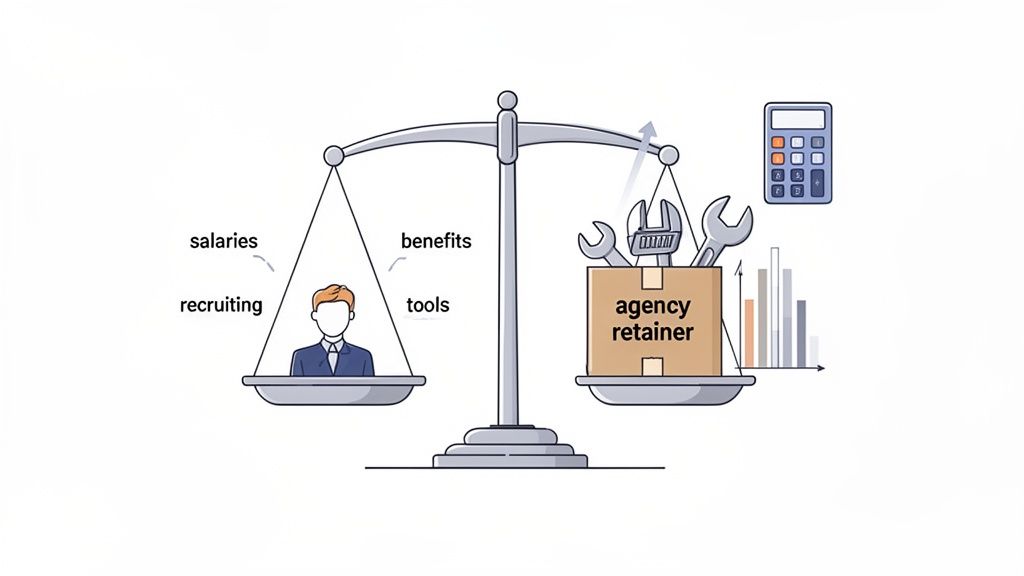
A common mistake is comparing an in-house marketer's salary directly against an agency's retainer. To make a sound financial decision, you must calculate the Total Cost of Ownership (TCO) for both models. Hidden expenses are what truly impact your budget.
An in-house team’s real cost extends far beyond their salary. These additional fixed costs can easily inflate a base salary by 30-40%, an oversight many businesses make.
Unpacking the Hidden Costs of an In-House Team
Let's break down the math. Suppose you hire a single in-house marketer with an $80,000 annual salary. Here’s a more realistic cost breakdown:
- Recruitment and Onboarding: Using a recruiter often costs 20-25% of the first year's salary ($16,000 - $20,000). Even without one, your team's time spent screening and interviewing represents a significant upfront investment before any work begins.
- Benefits and Taxes: Health insurance, retirement contributions, and payroll taxes typically add another 25-30% to the base salary, which is $20,000 - $24,000 annually.
- Essential Software Stack: Modern marketing requires tools. Licenses for SEO platforms like Ahrefs or Semrush, analytics software, a CRM, design tools like Adobe Creative Cloud, and project management systems can easily cost $5,000 - $15,000+ per year.
- Training and Development: To prevent skill stagnation, budget for conferences, courses, and certifications. Plan for an additional $2,000 - $5,000 per employee, per year.
Suddenly, your $80,000 marketer has a TCO between $123,000 and $144,000. To build a team with specialists in paid ads, content, and conversion rate optimization, you're looking at an annual investment of over half a million dollars.
The real financial drain of an in-house team isn't just the salary—it's the fixed overhead. These costs are incurred regardless of campaign performance or seasonal business needs, creating significant financial rigidity.
The Agency Model: A Predictable Path to ROI
An agency transforms the cost structure. The monthly retainer is a predictable operational expense, not a fixed overhead. This single fee grants you access to a full team of specialists—strategists, copywriters, designers, SEO experts, and ad managers—for a cost comparable to one or two senior hires.
Crucially, agencies bundle the cost of their enterprise-level tool stack into the retainer. You leverage the power of top-tier software without the direct licensing fees. For any business managing cash flow, this financial predictability is a significant advantage.
While a survey by the World Federation of Advertisers found 60% of brands cite cost savings for in-housing, the same study revealed 100% of those brands still rely on external partners to manage capacity and access specialized skills without incurring long-term fixed costs.
Comparing ROI: The 90-Day Sprint Scenario
Consider a typical SaaS company needing to generate qualified leads quickly.
- In-House Team: The hiring process alone can take 60-90 days. Add another 30-60 days for onboarding and ramp-up. You are likely 4-6 months away from seeing a meaningful ROI.
- Agency Sprint: A performance marketing agency like Ezca can launch a focused 90-day sprint within weeks. We deploy proven frameworks and begin testing channels immediately to lower your Customer Acquisition Cost (CAC) and improve Lifetime Value (LTV).
By the time an in-house hire is just starting to deliver, a skilled agency has completed a full optimization cycle, identified winning channels, and is generating a tangible return on investment. For growth-focused companies, this speed-to-ROI is a powerful advantage. You can see how we structure our services to maximize that return by looking at Ezca's transparent pricing models.
Comparing Expertise and Skillset Access
Beyond budget, the core of the in-house vs. agency debate is capability. It's a strategic trade-off: deep, focused brand knowledge versus broad, diverse market expertise. The right fit depends on your current business stage and future objectives.
An in-house team develops an intuitive understanding of your product, customers, and industry nuances. This concentrated knowledge is a significant asset, especially for B2B companies with complex sales cycles or SaaS businesses requiring highly technical content. Your team lives and breathes your brand daily.
In contrast, a performance marketing agency brings a different kind of value. Having driven growth for dozens of companies, they offer a battle-tested perspective on what works—and what doesn't—across various markets. This cross-pollination of strategies is something an internal team cannot replicate.
The Specialist vs. The Squad Model
Consider the team structure. When building internally, you often hire a few marketing generalists or one or two specialists. For example, a great SEO manager might excel at on-page optimization but lack deep experience in technical schema or international SEO.
An agency operates on a squad model. When you partner with a firm like Ezca, you don't get one person; you get an integrated team: a strategist, a paid media buyer, an SEO analyst, a copywriter, and a conversion rate specialist, all collaborating on your account.
An in-house hire masters your business. An agency team has mastered the marketing channels. The ideal scenario combines deep product knowledge with broad channel expertise.
This structure is designed for agility. Our squads continuously analyze performance across all channels, ready to pivot instantly. If a Facebook Ads campaign underperforms, they can reallocate budget to a high-converting Google Ads strategy immediately. A single in-house generalist, however talented, lacks the bandwidth and specialized skills for such rapid optimization.
A Functional Comparison of Skills
Let's get specific on how the depth-versus-breadth dynamic impacts core marketing functions. The right choice depends on whether you need a dedicated expert to own a platform or a coordinated team to weave strategies across multiple channels. To see how these skills integrate, explore our approach to SaaS marketing services.
A skillset comparison often clarifies the decision. Laying out core functions helps leadership teams identify their biggest gaps and opportunities.
Skillset Deep Dive: In-House Specialist vs Agency Squad
Ultimately, the decision comes back to your immediate goals. If your priority is creating hyper-specific technical documentation for a mature product, an in-house writer is invaluable. But if your goal is to rapidly test five acquisition channels to find product-market fit, an agency's breadth of experience will get you there faster.
Evaluating Speed, Agility, and Scalability
In today's market, the ability to adapt and scale is a core survival skill. When weighing an in-house team against an agency, agility is a critical factor. It's not just about raw speed—it's about the type of speed you need.
Day-to-Day Quickness vs. Strategic Pivots
Your in-house team will almost always be faster for day-to-day execution. Need a last-minute email or a quick copy change? They're in your Slack and can execute without formal briefs. This is a huge advantage for routine tasks.
However, this internal speed can be a double-edged sword. When a major strategic shift is required—like responding to a competitor or entering a new market—in-house teams often struggle. Suddenly, you need expertise in a channel you've never used, like programmatic advertising or advanced technical SEO, which can't be developed overnight.
The Scaling Dilemma: Hiring is a Drag
Building an internal team is a slow, expensive process. Sourcing, interviewing, and onboarding a new marketing hire often takes 45-60 days. From there, expect another 90 days before that person is fully productive and making a tangible impact.
This three-to-five-month ramp-up period can be a significant business drag. Market opportunities don't wait while you review resumes. If you need to scale for a product launch, your team may lack the bandwidth or specific skills to manage a sudden spike in activity, causing you to miss the window and leave revenue on the table.
An agency acts as an on-demand special operations team. You can deploy them instantly to seize an opportunity, bypassing the months-long delay of hiring and training.
How Agencies Deliver Structured Agility
Effective agencies are built for rapid response. At Ezca, we operate on a 90-day sprint model. This framework is designed for testing, measuring, and optimizing in rapid, focused cycles—a structured agility that is difficult for most internal teams to replicate.
For example, imagine you're a SaaS company entering a new vertical:
- Weeks 1-2 (Discovery & Strategy): An agency team analyzes the new market, identifies the best acquisition channels, and develops a complete launch plan.
- Weeks 3-8 (Execution & Testing): Campaigns go live across paid search, LinkedIn, and content syndication. The team continuously monitors data, reallocating the budget weekly to channels driving the highest quality leads (SQLs) at the lowest cost.
- Weeks 9-12 (Optimization & Scaling): With a clear understanding of what works, the agency doubles down on winning strategies, increasing spend and refining messaging to maximize ROI from the sprint.
This entire cycle can begin within days of signing a contract. In that same timeframe, an in-house team would likely still be screening candidates. This speed to market provides a massive competitive edge, and the ability to scale up or down offers financial flexibility that a fixed payroll cannot match.
A Practical Framework for Your Decision
Making the right choice between an in-house team and an agency requires a clear assessment of your company's stage, growth goals, budget, and risk tolerance. The best decision is entirely situational. This framework will help you ask the right questions.
Assess Your Business Stage and Growth Velocity
First, be honest about where your business is now and how fast you need to grow. A seed-stage startup's needs are vastly different from a mature enterprise's.
- What is the #1 marketing job to be done? Are you trying to find product-market fit, generate a flood of SQLs for sales, or optimize existing profitable channels? For rapid lead generation, an agency's ability to execute quickly is hard to beat.
- How predictable is your marketing playbook? If you have a proven strategy that needs more execution power, an in-house team can provide that focus. If you're still discovering what works, an agency’s breadth allows you to test multiple channels simultaneously.
- What is your real speed-to-market requirement? Do you need a campaign live in two weeks or is two quarters acceptable? Hiring and training a specialist can take months. An agency can launch a campaign in a fraction of that time.
For any early-stage company, time is your most valuable resource. An agency sprint can deliver critical market feedback and initial traction far faster than the 4-6 months it takes to hire and ramp up a single internal team member.
Analyze Your Budget and Risk Tolerance
Next, address the financials. The cost conversation is about fixed overhead versus a variable investment, not just salary versus retainer.
The core financial difference is simple: an in-house team represents a fixed, long-term liability. An agency is a flexible, performance-based operational expense that you can scale up or down as needed.
Consider these financial realities:
- Can you absorb the full TCO of an in-house team, including the extra 30-40% for benefits, software, and training?
- Do you need the agility to increase spending for a launch or reduce it during a slow season?
- Is your budget better spent on one or two in-house generalists or on accessing an entire squad of specialists for a similar monthly cost?
This decision framework highlights the trade-offs.
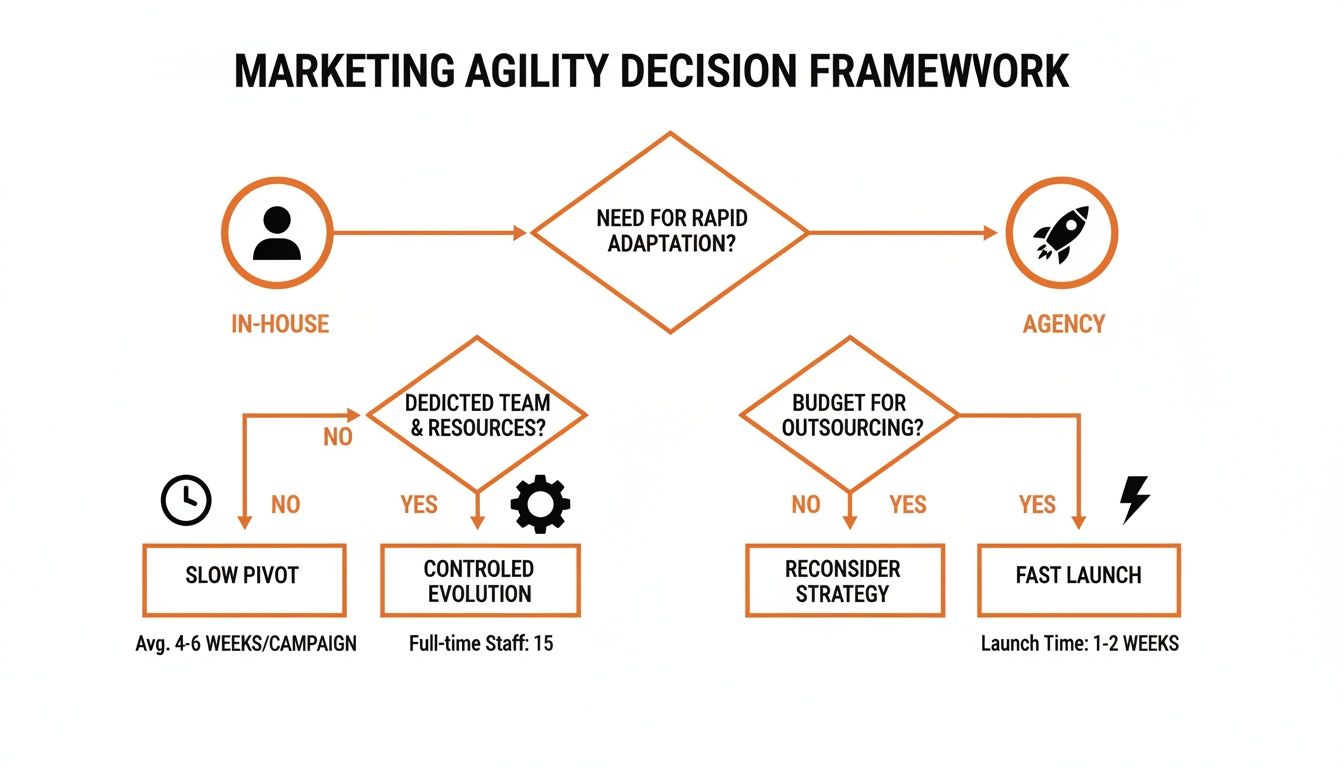
As the decision tree illustrates, building an in-house team offers deep integration. However, when launching a new initiative or pivoting to a market opportunity, an agency's agility provides a significant advantage.
Situational Recommendations
Here are two common scenarios where the choice becomes clearer:
- Seed-Stage SaaS Needing Rapid Growth: A startup with a new product and aggressive lead targets is a textbook case for an agency. You gain immediate access to specialists in SEO, paid media, and content, allowing you to test channels fast and identify a winner. This approach minimizes fixed costs while maximizing speed-to-ROI—critical when seeking the next funding round. For a deeper dive, read our guide on how to increase organic traffic.
- Mature E-commerce Brand with an Established Team: For a larger brand with a solid internal team, a hybrid model is often the smartest choice. Keep in-house experts focused on brand building, social media, and content, where their deep product knowledge is irreplaceable. Outsource highly technical, performance-driven channels like Google Ads or CRO to a specialized agency. They can bring advanced optimization tactics and insights from other industries to maximize performance.
How to Build a Successful Agency Partnership
Engaging a marketing agency can accelerate your growth, but a positive outcome depends on finding the right fit and building a relationship based on transparency, clear goals, and mutual accountability. Treat it as a key strategic hire, not a vendor relationship.
Dig deeper than fees and capabilities. Your goal is to understand their process, how they define and measure success, and whether their culture aligns with yours. Vague promises are a red flag; you need a partner with a clear, data-driven plan.
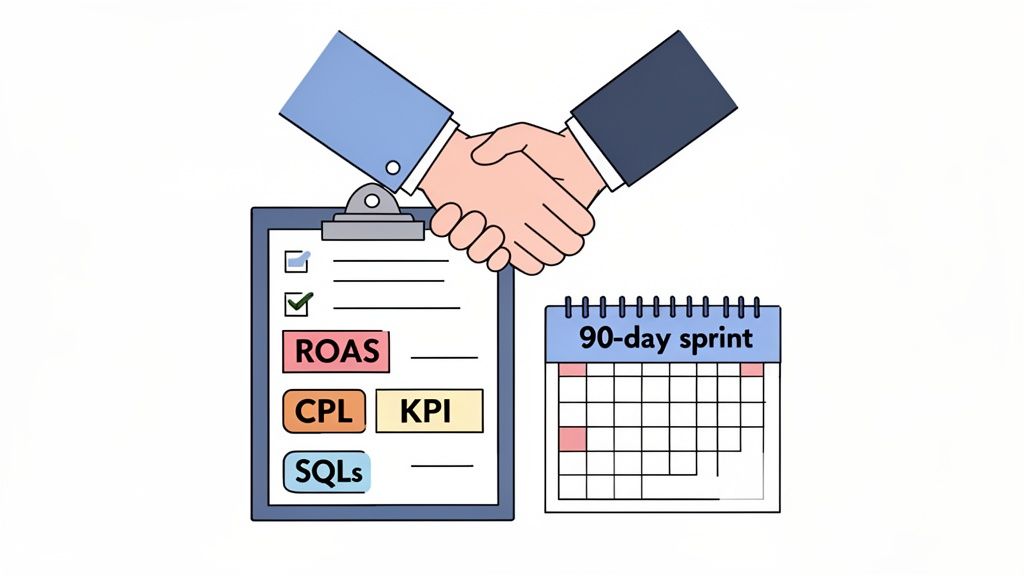
Critical Questions to Ask Potential Agencies
To find a true strategic partner, ask questions that reveal how they operate. Push for specifics and avoid generic answers.
Here are three non-negotiable questions for every agency you vet:
- "How do you measure and report on ROI for a client like us?" A strong answer moves beyond vanity metrics like clicks and impressions to focus on business outcomes: Customer Acquisition Cost (CAC), Marketing Qualified Leads (MQLs), Sales Qualified Leads (SQLs), and Return on Ad Spend (ROAS). They should clearly describe their reporting schedule and show you the dashboards they use to provide real-time visibility.
- "Walk me through your process for a 90-day sprint." This question tests their agility and strategic thinking. A great agency, like Ezca, will outline a structured plan including discovery, rapid channel testing, and weekly budget shifts based on performance data. You want to hear a clear system for learning and adapting.
- "Can you share a case study from a client with challenges similar to ours?" The key here is "similar challenges." A big-name logo is not enough. Ask them to detail the problem they solved, the strategy they implemented, the specific KPIs they improved, and the timeline to achieve those results.
A top-tier agency doesn't sell services; they sell outcomes. Their entire process, from proposal to reporting, should be relentlessly focused on hitting the business goals you care about most.
Defining KPIs and Contract Terms
Once you've chosen a partner, the contract formalizes the relationship. This document should be a concrete agreement on what success looks like and how it will be measured.
Your contract must explicitly define the key performance indicators that matter. Ambiguity is the enemy.
- For E-commerce: Lock in metrics like ROAS, Average Order Value (AOV), and Customer Lifetime Value (LTV).
- For SaaS/B2B: Prioritize metrics like Cost per Lead (CPL), SQL volume, and the conversion rate from demo to closed deal.
Beyond metrics, look for transparency and flexibility. A confident agency will not shy away from performance clauses that tie compensation to specific targets. Insist on a clear reporting schedule (weekly or bi-weekly) and a single point of contact to streamline communication. This structure creates a true partnership where everyone is aligned on driving tangible business growth.
Got Questions? We've Got Answers
Deciding between an in-house team and an agency always brings up a few more practical questions. Let's tackle the most common ones we hear from marketing leaders to help you solidify your next steps.
When Should We Move Marketing from an Agency to In-House?
The right time to bring marketing in-house is when your strategy has moved from experimentation to execution. Think of it this way: once you have a proven, predictable growth engine, your main goal becomes optimizing and scaling it consistently.
You'll know you're there when:
- You have a mature playbook. You know exactly which channels work and you just need more hands on deck to scale them.
- Marketing needs to be closer to other teams. Your efforts require constant, deep collaboration with product and sales.
- The numbers just make sense. Your company is stable enough to handle the long-term Total Cost of Ownership (salaries, benefits, software) of a dedicated team.
Can a Hybrid Model Actually Work for a Small Business?
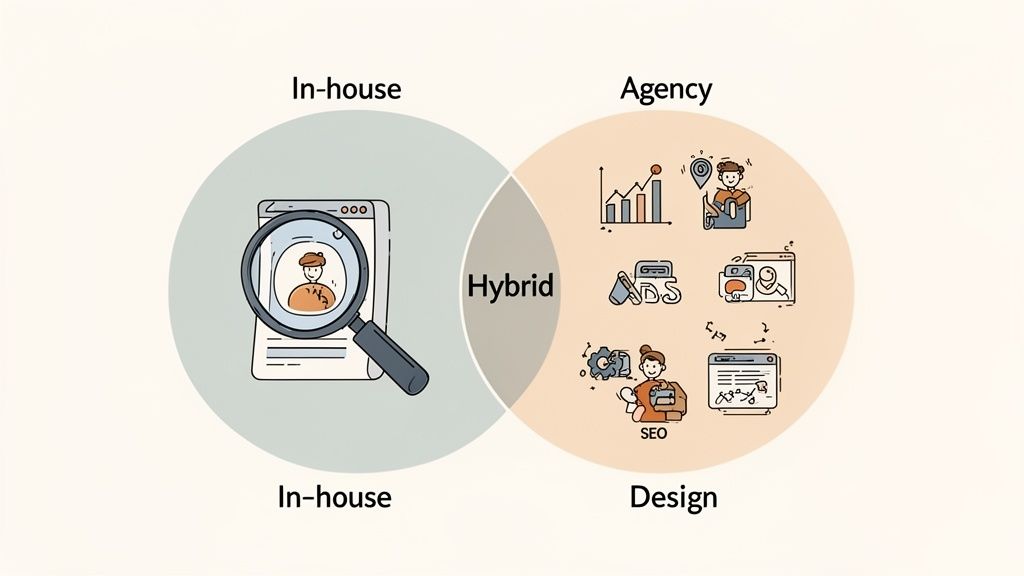
Yes, and it's often the smartest way for a small business or startup to grow. A hybrid approach gives you the best of both worlds. You can keep strategic control and brand voice in-house—maybe with a single marketing manager—while outsourcing the heavy lifting to specialists.
This model is all about capital efficiency. Your internal person ensures brand consistency, while an agency handles the complex, technical stuff like SEO, paid ads, or CRO, where expert execution delivers a much faster ROI.
What Are the Biggest Red Flags to Watch for in an Agency?
Be wary of any agency that talks a big game but is light on the details. The most obvious red flags are vague promises of "results" without a clear process, an inability to share case studies with real numbers, or a cookie-cutter strategy that they seem to apply to every client.
A great agency will dive deep into your specific goals from the very first call. They'll want to co-create a strategy with you, defining clear KPIs and milestones before a contract is even mentioned. This obsession with measurable outcomes is what separates a true growth partner from just another vendor.
At Ezca Agency, we build our partnerships on transparent data and measurable growth. Our 90-day sprints are built to deliver a clear ROI, giving you specialized expertise without the long-term overhead. Learn how our squad model can accelerate your growth.