
10 Actionable Marketing Budget Allocation Best Practices for 2026
Stop wasting ad spend. Learn the top 10 marketing budget allocation best practices for SaaS, e-commerce, & B2B to maximize ROI and drive growth.

For marketing leaders and business owners in 2026, effective budget allocation isn't just a best practice—it's the critical link between spend and revenue. The pressure to prove every dollar's contribution to the bottom line is immense. Generic advice like "spend more on what works" is no longer enough. You need a dynamic, data-driven framework that ties investment to profitability and satisfies even the most skeptical CFO.
This guide provides a prioritized checklist of 10 battle-tested marketing budget allocation best practices. We'll cover agile, sprint-based cycles, channel-specific LTV:CAC targets, and dynamic reallocation models that maximize returns. Forget the annual "set it and forget it" budget. It's time to manage your marketing spend like a high-performance investment portfolio. These strategies are designed for leaders who need to demonstrate clear ROI and make every dollar count.
We will move beyond outdated models and provide actionable frameworks you can implement immediately. For a comprehensive overview of modern approaches to funding your marketing efforts, you can also refer to A Modern Guide to Marketing Budget Allocation from AdStellar AI. This listicle, however, focuses on specific, repeatable systems that top-performing companies use to win.
1. Dynamic Channel Reallocation Based on Performance Metrics
Treat your budget not as a fixed, annual plan but as fluid capital. Dynamic channel reallocation is a data-driven approach that involves continuously monitoring channel performance and shifting funds weekly or bi-weekly toward the highest-performing initiatives. This agile methodology allows you to capitalize on emerging opportunities and cut losses from underperforming channels in near real-time.
Instead of locking in quarterly budgets, you analyze leading indicators like Return on Ad Spend (ROAS), Customer Acquisition Cost (CAC), and CAC Payback Period. When one channel consistently outperforms others against these metrics, you reallocate a portion of the budget to scale its success. For instance, a SaaS company might shift funds from a paid search campaign with a rising CAC to its organic content strategy after seeing a drop in CAC from users who read a blog post before converting.

How to Implement Dynamic Reallocation
This strategy is core to performance marketing agencies like Ezca, which use a squad-based model to shift resources between SEO, PPC, and Conversion Rate Optimization (CRO) based on weekly sprint results. DTC brands also excel here, often reallocating ad spend between Meta and Google Ads based on daily conversion data.
Follow these actionable steps to implement this yourself:
- Establish Performance Thresholds: Before moving money, define clear "go" or "no-go" signals. For example, a channel must maintain a minimum 3x ROAS to receive additional budget, or a CAC must remain below a specific dollar amount.
- Use Multi-Touch Attribution: Relying on last-click attribution can be misleading. Use a multi-touch model to understand how different channels assist conversions, ensuring you don't defund a critical top-of-funnel channel that influences bottom-of-funnel results.
- Allocate an "Experiment" Budget: Set aside 10-15% of your total marketing budget for testing new or unproven channels. This allows you to discover future growth drivers without jeopardizing the performance of your core channels.
- Document Every Decision: Maintain a log of all reallocation decisions, including the data that drove them and the outcomes. This documentation is invaluable for quarterly reviews and refining your overall strategy.
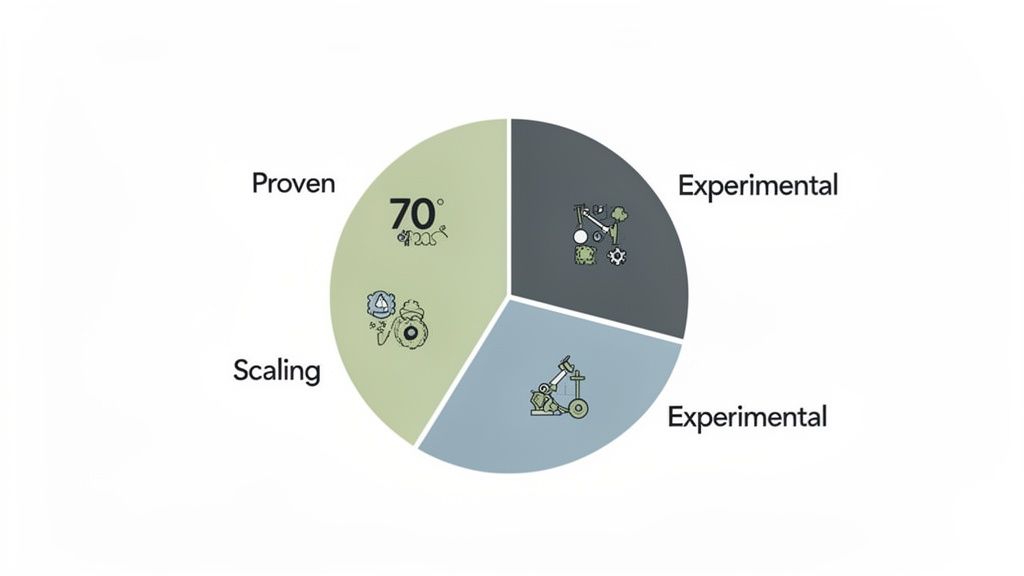
2. The 70-20-10 Budget Allocation Framework
The 70-20-10 framework provides a structured approach to balancing short-term performance with long-term growth. It dedicates 70% of your budget to proven, core marketing channels, 20% to emerging channels with demonstrated potential, and 10% to completely new, experimental initiatives. This balanced portfolio approach ensures predictable ROI from your mainstays while actively cultivating future growth drivers.
An e-commerce brand might allocate 70% of its budget to its high-performing Google and Meta Ads, 20% to scaling influencer marketing on YouTube, and the final 10% to test emerging platforms like programmatic audio. Similarly, a B2B SaaS company could invest 70% in LinkedIn paid ads and SEO, 20% in expanding its podcast presence, and 10% in testing niche community sponsorships. This framework ensures you don't over-invest in declining channels or miss out on the next big opportunity.
How to Implement the 70-20-10 Framework
The core of this strategy lies in disciplined classification and periodic reviews of your channels. Your team, whether you are building an in-house vs agency marketing model, must be aligned on the criteria for each tier.
Follow these actionable steps to implement this yourself:
- Define Graduation Criteria: Establish clear, data-driven rules for when a channel moves between tiers. For example, an experimental (10%) channel must achieve a positive ROAS for two consecutive months to move to the emerging (20%) tier. An emerging channel must sustain a 3.5x ROAS for six months to graduate to the core (70%) tier.
- Protect the 10%: Your experimental budget is the first to get cut during a tough quarter. Vigorously protect this allocation, as it is your engine for future innovation and discovering channels with lower CAC before they become saturated.
- Align with Business Stage: Early-stage startups might use a more aggressive 50-30-20 split to find product-market fit, while mature, established companies may stick closer to a conservative 80-15-5 model to protect market share.
- Conduct Quarterly Reviews: Re-evaluate and re-classify every channel each quarter. A "proven" channel’s performance can decline, while an "experimental" one might suddenly show incredible promise, requiring a budget shift.
3. Customer Acquisition Cost (CAC) Payback Period Framework
Beyond looking at CAC in isolation, a powerful best practice is to prioritize channels based on how quickly they recoup their acquisition costs. The CAC Payback Period Framework shifts focus from pure acquisition volume to capital efficiency, allocating budget toward channels that return your initial investment the fastest. This is critical for sustainable growth, ensuring marketing spend generates positive cash flow sooner.
Instead of just measuring what it costs to get a customer, you analyze how many months of revenue it takes to pay back that cost. For example, a B2B SaaS company might find that self-serve signups driven by organic content have a 3-month payback period, while enterprise leads from high-cost paid channels take 14 months. Armed with this data, they would strategically over-invest in their content and SEO engine to shorten their overall business payback timeline.
How to Implement the CAC Payback Framework
This framework is a staple for venture-backed startups and SaaS companies where cash flow and runway are paramount. E-commerce brands also use it to ensure paid ad campaigns are profitable within a specific timeframe, often aiming for a 3-6 month payback.
Follow these actionable steps to implement this yourself:
- Calculate Payback by Channel: Determine the CAC and average monthly revenue per customer for each specific channel. Divide the CAC by the average revenue to find the payback period in months. For example, if your Google Ads CAC is $900 and the average customer pays $150/month, the payback is 6 months.
- Set Channel-Specific Targets: Not all channels will perform equally. A top-of-funnel brand awareness channel might have an acceptable 18-month payback, while a bottom-of-funnel paid search campaign should have a target under 6 months.
- Incorporate Customer Retention: Your analysis is incomplete without retention data. Use customer cohort retention curves to model a more accurate lifetime value and payback period, as churn will impact how quickly a cohort truly pays back its acquisition cost.
- Differentiate Blended vs. Paid Payback: Calculate both a blended CAC payback (including all marketing and sales expenses) for a holistic business view and a paid-channel-specific payback to evaluate ad performance directly. This helps you make smarter decisions about paid spend versus organic investment.
4. 90-Day Sprint-Based Budget Cycles with Quarterly Reviews
Ditch the rigid annual budget in favor of a more agile framework: 90-day sprint-based cycles. This approach treats your marketing budget as a series of focused, quarterly experiments designed to achieve specific objectives. By operating in these 90-day windows, you can rapidly pivot based on market feedback and performance data, ensuring your capital is always deployed against the highest-impact initiatives.
This methodology forces your team to set clear, measurable goals each quarter, such as "Reduce CAC by 15% in Q3" or "Increase MQL-to-SQL conversion rate by 10% in Q1." It aligns marketing activities directly with immediate business needs and financial cycles, a common practice among venture-backed SaaS companies and growth-stage e-commerce brands testing seasonal campaigns. The goal is to learn and iterate quickly, compounding growth every 90 days.
How to Implement 90-Day Sprint Cycles
This agile rhythm is central to performance-driven organizations. At Ezca, we build our entire client engagement model around 90-day performance sprints, using dedicated squads to hit quarterly targets. This structure enables rapid optimization and clear accountability.
Follow these actionable steps to implement this yourself:
- Set SMART Sprint Objectives: Begin each 90-day cycle by defining a primary objective that is Specific, Measurable, Achievable, Relevant, and Time-bound. This north-star metric will guide all budget decisions within the sprint.
- Conduct Weekly Performance Reviews: Hold brief (15-30 minute) weekly check-ins to monitor progress against sprint goals. These are not for overhauls but for minor course corrections, like reallocating ad spend between campaigns.
- Run Sprint Retrospectives: At the end of each 90-day cycle, conduct a retrospective to analyze what worked, what didn’t, and why. Document these key learnings to inform the strategy and budget allocation for the next sprint.
- Align Sprints with Business Cadence: Sync your 90-day marketing sprints with other key business activities, such as product release schedules or sales quotas, to create compounding momentum across the organization.
5. Channel-Specific LTV:CAC Ratio Targets and Scaling Rules
Moving beyond broad ROAS goals, a sophisticated best practice is setting distinct Lifetime Value to Customer Acquisition Cost (LTV:CAC) ratio targets for each channel. This acknowledges that not all channels attract the same quality of customer. By establishing clear scaling rules based on these channel-specific ratios, you create a system that automatically directs investment toward the most profitable growth engines.
A healthy business typically aims for an overall LTV:CAC ratio of at least 3:1, but this average can hide inefficiency. For instance, an e-commerce brand might target a 4:1 ratio for paid social and a more aggressive 5:1 for high-intent paid search, while accepting a 3:1 ratio for its long-term content marketing efforts. To effectively set these targets, it's crucial to first understand how to calculate Customer Lifetime Value with precision.
How to Implement LTV:CAC-Based Scaling
This methodology is a cornerstone for growth-stage companies and provides a clear, data-driven framework for sustainable scaling.
Follow these actionable steps to implement this yourself:
- Establish Clear Ratio Bands: Define specific actions for different performance levels. For example, scale the budget if a channel's LTV:CAC is above 4:1, maintain it if the ratio is between 3:1 and 4:1, and conduct a review or reduce spend if it drops below 3:1.
- Use a Conservative LTV Model: Calculate LTV based on a realistic timeframe, such as a 12 or 24-month payback period, rather than an overly optimistic "lifetime" projection. This prevents over-investing based on inflated future value.
- Account for Cohort Quality: Recognize that customers from different channels may have varying LTVs. A customer acquired via a referral may have a higher LTV than one from a display ad. Factor these cohort differences into your channel-specific ratio calculations for greater accuracy.
- Review Ratios and Targets Regularly: Your LTV:CAC ratios should be monitored monthly to inform immediate budget adjustments. Revisit your target ratios quarterly to ensure they still align with your overarching business goals and market conditions.
6. Percentage-of-Revenue Budget Allocation
One of the most stable and scalable best practices is to tie your marketing spend directly to your company's financial health. The percentage-of-revenue method involves dedicating a fixed percentage of your total revenue (either actual or projected) to your marketing budget. This ensures that your marketing investment grows or shrinks in lockstep with business performance, maintaining financial discipline.
This method provides a straightforward, defensible starting point that is easily understood by executive teams and finance departments. For example, a high-growth SaaS startup might allocate 15-20% of its Annual Recurring Revenue (ARR) to marketing to fuel aggressive customer acquisition. In contrast, a mature B2B company might allocate a more conservative 5-10%. This model keeps spending sustainable and directly linked to top-line results.
How to Implement Percentage-of-Revenue Allocation
This strategy is common in both early-stage startups needing a simple budgeting rule and large enterprises that require predictable financial models.
Follow these actionable steps to implement this yourself:
- Establish Industry and Stage Baselines: Research benchmarks for your specific industry and growth stage. A scaling e-commerce brand might allocate 20-25% of revenue during a growth phase, while a stable B2B services firm might only allocate 2-5%.
- Use Projected Revenue for Planning: Set your annual budget based on forecasted revenue to plan ahead. However, you must reconcile this against actual revenue each month or quarter, adjusting spend up or down to stay within your target percentage.
- Create Separate Brand vs. Performance Allocations: Within your total percentage, create sub-allocations. For instance, you could dedicate 70% of the budget to performance marketing (with clear ROI goals) and 30% to longer-term brand-building initiatives that are harder to measure directly.
- Adjust the Percentage for Strategic Goals: Be prepared to increase your allocation percentage during key periods, such as a new market entry, a major product launch, or in response to heightened competitive pressure.
7. Attribution-Based Budget Allocation Using Multi-Touch Models
A common pitfall is over-relying on last-click attribution, which ignores the crucial role that top and mid-funnel channels play. Attribution-based budget allocation uses multi-touch models (e.g., first-click, linear, time-decay, data-driven) to distribute credit more accurately across all contributing channels, providing a clearer picture of each channel's true value.
By understanding the entire conversion path, you can make more informed decisions. For example, an e-commerce brand might discover that its TikTok ads, while rarely the last click, are highly effective at introducing new customers who later convert through a branded search ad. A last-click model would defund TikTok, whereas a multi-touch model would justify its budget, showing the importance of a cohesive multi-channel marketing strategy.
How to Implement Attribution-Based Allocation
Leading analytics platforms like Google Analytics 4 now offer sophisticated data-driven attribution models, while specialized tools provide deep insights for e-commerce.
Follow these actionable steps to implement this yourself:
- Start with Simple Comparisons: Before diving into complex models, compare your last-click data with first-click data. This initial analysis can immediately highlight undervalued awareness channels that are driving new customer discovery.
- Use Time-Decay as a Practical Middle Ground: A time-decay model, which gives more credit to touchpoints closer to the conversion, is often a great starting point. It's more sophisticated than single-touch models but easier to interpret than fully data-driven ones.
- Combine Attribution with CAC Payback: No model is perfect. Supplement your attribution insights with core business metrics like Customer Acquisition Cost (CAC) and CAC Payback Period to ensure your budget decisions align with overall profitability goals.
- Educate Stakeholders: Ensure your entire team understands that attribution models are directional tools, not definitive truths. Use them to guide strategic conversations about channel synergy rather than making absolute, rigid budget cuts.
8. Segment-Based Budget Allocation with Customer Cohort Analysis
A one-size-fits-all budget ignores a critical truth: not all customers are equally valuable. Segment-based allocation is a sophisticated practice where you divide your marketing budget based on the distinct profitability and potential of different customer groups. Instead of a single blended CAC or LTV, you analyze these metrics for specific segments, such as enterprise versus SMB clients or high-intent industry verticals.
This data-driven approach allows you to invest strategically where the returns are highest. For example, a SaaS company might discover its enterprise cohort has a 5x higher LTV than its SMB cohort. This insight justifies allocating a larger portion of the budget to acquire fewer, more valuable enterprise customers, even if their initial CAC is higher.
How to Implement Segment-Based Allocation
This is a core strategy for B2B and SaaS companies aiming for sustainable growth. HubSpot, for instance, refines its marketing spend by company size and industry, ensuring its budget is directed toward the most profitable customer profiles.
Follow these actionable steps to implement this yourself:
- Define Key Customer Segments: Identify 3-5 strategically important segments based on LTV, profitability, or market potential. This could be by company size, industry, geographic location, or product line.
- Calculate Segment-Specific Metrics: For each segment, calculate its unique LTV, CAC, and payback period. This reveals which groups provide the best return on investment.
- Allocate Proportionally to Opportunity: Distribute your budget in proportion to each segment's margin contribution and growth potential, not just its current revenue. High-potential segments may warrant disproportionately higher investment.
- Review and Adjust Quarterly: Use cohort analysis to track the performance of segments over time. Adjust your budget allocations each quarter based on these trends to capitalize on what's working and address underperforming areas.
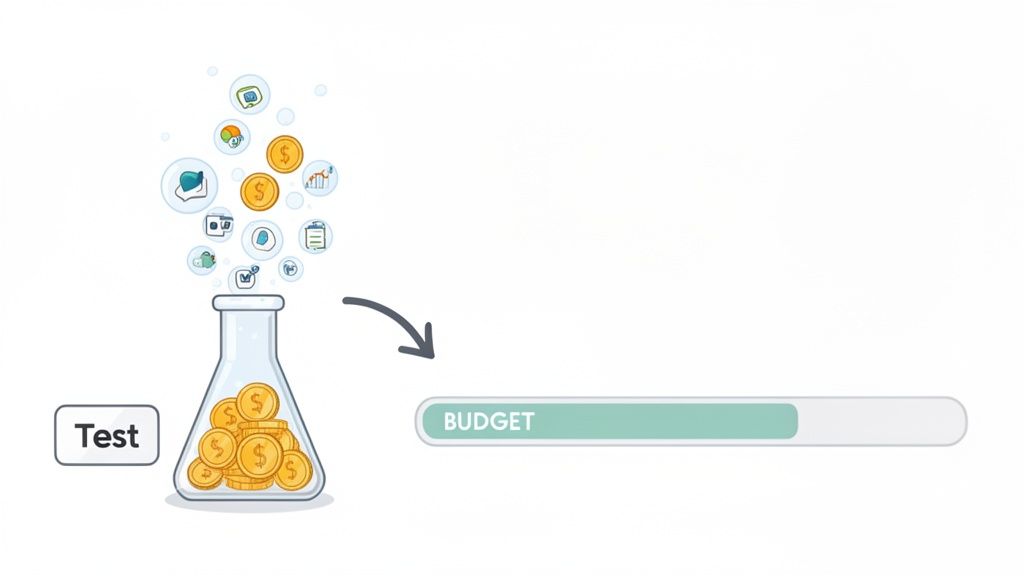
9. Test-and-Learn Budget Reserve with Structured Experimentation
Institutionalize innovation by reserving 10-20% of your budget exclusively for experimentation. This "test-and-learn" approach involves systematically testing new channels, messaging, creative formats, and audience segments. This strategy prevents budget stagnation and ensures you are constantly discovering new, scalable growth levers before your competitors do.
Instead of randomly trying new things, this reserve funds structured experiments with predefined hypotheses, timelines, and success metrics. A B2B company might use this budget to test an account-based marketing (ABM) pilot program on a small scale before committing to a major investment. This disciplined approach minimizes risk while maximizing the potential for breakthrough performance.
How to Implement a Test-and-Learn Reserve
This methodology transforms budgeting from a rigid allocation exercise into a dynamic engine for discovery. Performance-focused agencies often build this into their client engagements to ensure continuous improvement.
Follow these actionable steps to implement this yourself:
- Establish Clear "Graduation Criteria": Define what success looks like before launching an experiment. For a test to "graduate" to the core budget, it might need to achieve a specific ROAS or maintain a target CAC while scaling spend by 2x.
- Set a Minimum Test Duration: Avoid making premature decisions based on short-term data volatility. Commit to a minimum test period, typically 6-12 weeks, to allow for proper data collection, optimization, and performance analysis.
- Document Every Experiment: Maintain a central repository or "experiment log" that details the hypothesis, budget, timeline, key metrics, and outcomes for every test. This log becomes an invaluable asset for strategic planning and knowledge sharing.
- Create a "Retirement Protocol": Not all tests will succeed. Establish a clear process for shutting down underperforming experiments to prevent "zombie" initiatives that drain resources. Celebrate the learnings from failed tests as valuable data on what not to do.
10. Lead Quality and Sales Conversion Feedback Loop Budget Optimization
One of the most critical best practices, especially for B2B, is to move beyond surface-level marketing metrics. This approach optimizes spending based on what truly matters: sales conversion rates and revenue. Instead of allocating budget based on Cost Per Lead (CPL), you direct funds to the channels that deliver high-quality leads who become profitable customers. This ensures marketing is directly fueling bottom-line growth.
This feedback loop requires tight alignment between marketing and sales. For example, a B2B SaaS company might discover that while a specific whitepaper generates hundreds of downloads at a low CPL, webinar attendees convert to paying customers at a 5x higher rate. Despite a higher initial acquisition cost, the webinar channel delivers a far superior ROI. Budget is then shifted from asset downloads to webinar promotions, optimizing for revenue, not just lead volume.
How to Implement a Sales Feedback Loop
This strategy is fundamental for businesses with longer sales cycles, where lead quality is paramount. It shifts the conversation from "how many leads did we get?" to "how much revenue did our leads generate?".
Follow these actionable steps to implement this yourself:
- Establish a Unified Lead Definition: Work with your sales team to create a clear, mutually agreed-upon definition of a Marketing Qualified Lead (MQL) and Sales Qualified Lead (SQL). This ensures both teams are evaluating leads against the same criteria.
- Integrate Your CRM and Marketing Automation: Ensure every lead is automatically tagged with its original marketing source in your CRM. This non-negotiable step makes it possible to track a lead's journey from first touch to closed-won deal, attributing revenue back to the right channel.
- Hold Monthly Sales-Marketing Alignment Meetings: Review reports that show conversion rates and deal sizes by marketing channel. Discuss which sources are producing the best-fit customers and which are wasting the sales team's time, then adjust budget allocation accordingly.
- Account for Sales Cycle Delays: Don't make budget decisions based on last week's data. Implement a 60 or 90-day look-back window to allow leads enough time to mature through the sales pipeline and convert. This provides a more accurate picture of channel performance.
10-Point Marketing Budget Allocation Comparison
From Budgeting to Growth Engine: Your Next Move
Effective marketing requires more than a spreadsheet and annual goals. The journey from a static budget to a dynamic growth engine is paved with strategic frameworks, data-driven agility, and a relentless focus on performance. The traditional "set it and forget it" approach is no longer viable. Today's market leaders treat their marketing budget not as a fixed expense, but as a fluid investment portfolio, constantly rebalancing to maximize returns.
The marketing budget allocation best practices detailed in this guide are interconnected components of a modern marketing machine. Mastering this machine means shifting your mindset from annual planning to agile, data-informed execution.
Synthesizing the Strategy: Your Core Takeaways
The goal is to build a hybrid system that provides both stability and flexibility. A rigid, single-model approach will inevitably leave opportunities on the table.
Here are the most critical principles to internalize:
- Embrace Dynamic Reallocation: The most crucial takeaway is to abandon the static annual budget. Your most powerful lever for growth is the ability to shift funds based on real-time performance data. Implementing weekly or bi-weekly reviews to move budget from underperforming channels to high-return opportunities is a non-negotiable for competitive businesses.
- Structure Innovation with the 70-20-10 Rule: This framework provides the perfect balance. It protects your core, high-performing channels (the 70%) while institutionalizing experimentation. Your 20% allocation to adjacent channels and 10% to high-risk, high-reward tests ensures you are always building your next growth channel.
- Anchor Decisions in Unit Economics: Vague metrics lead to vague results. Grounding your allocation strategy in hard metrics like CAC Payback Period and LTV:CAC Ratios per channel transforms budget conversations from subjective debates into objective, data-driven decisions.
- Operate in Agile Sprints: The 90-day sprint cycle forces accountability and accelerates learning. Instead of waiting a full year to assess a strategy's success, you get four major learning cycles. This cadence allows you to test hypotheses, analyze results, and pivot your strategy with a speed your slower competitors cannot match.
Putting It All Into Action: Your First 90 Days
Transforming your budgeting process can feel overwhelming, but progress starts with a single, focused sprint. Don't try to implement all ten best practices at once.
Your immediate next steps should be:
- Establish Your Baseline: For the next 30 days, focus solely on tracking your channel-specific CAC, LTV, and conversion rates to create a clear performance baseline.
- Launch Your First Test-and-Learn Fund: Carve out just 5-10% of your total budget for a dedicated experimentation fund. Define three clear hypotheses you want to test over the next quarter, each with its own budget and success criteria.
- Implement a Feedback Loop: Schedule a recurring meeting between marketing and sales leaders. The single goal is to review lead quality and sales conversion data from the previous week. Use this feedback to make small, immediate adjustments to your channel spend.
Ultimately, mastering marketing budget allocation is about building a system—a growth engine—that is smarter, faster, and more responsive than the market itself. This strategic discipline is what separates companies that simply spend on marketing from those that invest in predictable, scalable growth.
Ready to transform your budget from a line item into a strategic growth asset? The team at Ezca Agency specializes in implementing these advanced, data-driven allocation models, using our agile sprint framework and AI-powered analytics to ensure every dollar is working its hardest. Schedule a strategy call with us to see how we can build a predictable growth engine for your business.