
How to Create Buyer Personas That Actually Drive ROI
A practical guide on how to create buyer personas that work. Learn data collection, synthesis, and activation to boost your performance marketing.
A buyer persona is a research-backed profile of your ideal customer, built to guide strategic decisions. It's not a demographic sketch; it's an actionable tool that captures their goals, challenges, and purchasing triggers.
These profiles are built by blending quantitative data from analytics with qualitative insights from customer interviews. The objective is to create a clear, evidence-based picture of your target audience, which then becomes the north star for product development, ad creative, and content strategy.
Moving Beyond Marketing Fluff to Profitable Personas
For many businesses, buyer personas are a "one-and-done" exercise. They are created in a workshop, presented in a slide deck, and then left to collect digital dust in a forgotten folder.
This happens when personas are based on guesswork. You end up with vague descriptions like "Marketing Mary," who "is active on social media" and "wants to grow her business." This type of profile offers zero strategic value and has no impact on the bottom line. It’s marketing fluff.
A profitable persona, however, is a data-driven asset that directly impacts your P&L. It’s what separates a generic email blast from a hyper-targeted campaign that speaks to a customer's specific problems and motivations. In today's market, this isn't a "nice-to-have"; it's a competitive necessity for efficient growth.
The Business Case for a Persona-Driven Strategy
Dedicating resources to building detailed personas delivers a tangible and rapid return on investment. Companies that integrate personas into their go-to-market strategy see measurable improvements across the entire funnel. The link between well-documented personas and financial success is clear.
Research shows that 71% of companies that exceed their revenue and lead goals have formally documented their personas. You can dig into the specifics of that study from Delve.ai.
This is why performance marketing agencies like Ezca build our entire 90-day sprint methodology on a foundation of deep customer understanding. Actionable personas enable us to make data-backed decisions that drive measurable growth for our clients.
A well-crafted persona isn't just a description; it's a predictive tool that helps you anticipate customer needs, answer questions before they're asked, and guide them to a solution with precision.
From Vague Concepts to Tangible Results
Committing to a persona-driven strategy fundamentally changes your marketing operations. You stop playing a volume game—trying to reach everyone—and start focusing on value, concentrating resources where they will generate the highest return.
The shift from a generic, "spray-and-pray" approach to a focused, persona-driven one is stark. It’s a fundamental change in how you operate, measure success, and ultimately, grow your business.
The Shift From Generic Blasts to Strategic Targeting
This table illustrates the profound impact of this strategic shift. You move from shouting into a void to having a meaningful conversation with a prospect who wants to hear from you.
Here’s what that strategic shift delivers in real-world business metrics:
- Higher Conversion Rates: When your landing pages, ad copy, and emails align with a persona’s specific needs, conversions increase.
- Improved Ad Spend Efficiency: You stop wasting budget on audiences that will never convert. Every dollar is invested in reaching high-intent segments, lowering your Customer Acquisition Cost (CAC).
- Shorter Sales Cycles: When your sales team is armed with persona insights, they can anticipate objections, tailor demos, and accelerate deal velocity.
Ultimately, this is about turning a theoretical marketing exercise into one of your most powerful growth tools. It’s the essential first step in building a marketing engine that doesn’t just reach more people, but resonates deeply with the right people.
Your Blueprint for Actionable Customer Research
Building personas on guesswork is a waste of time. A persona based on assumptions is a liability; one built on real evidence is a strategic asset. To create profiles that move the needle on ROI, you need a framework for gathering the raw intelligence that reveals who your customers are, what they need, and why they choose you.
This isn't just about grabbing a few data points. The strategic advantage comes from blending the quantitative 'what' from your analytics with the qualitative 'why' from real human conversations. That's how you build a complete, three-dimensional picture of your ideal customer.
The process is straightforward: move from a generic understanding of your market to a detailed, evidence-backed persona. That focus unlocks growth.
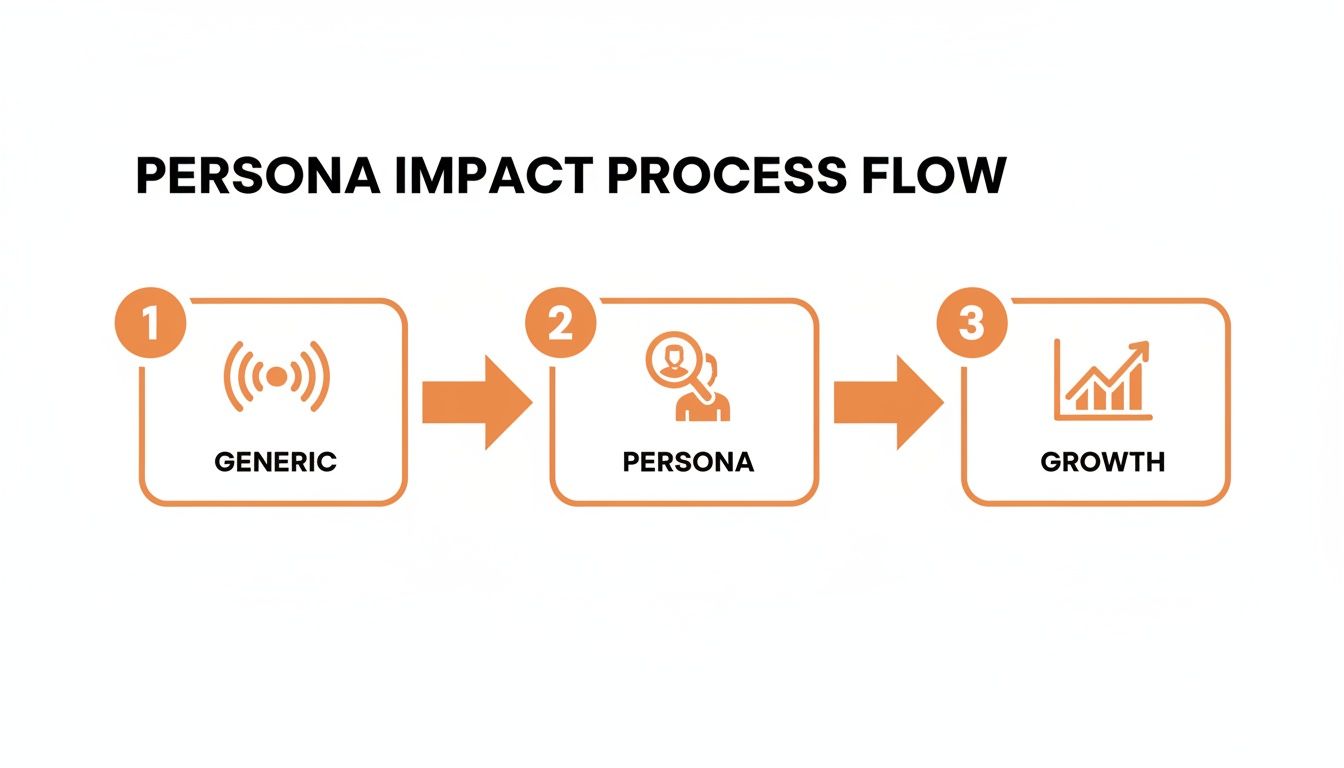
Persona development is the bridge between casting a wide, generic marketing net and executing targeted, high-return strategies that work.
Unearthing Quantitative Gold in Your Data
Start with the quantitative data you already have. This is where you spot macro trends and segment your audience based on behavior. Don't just glance at dashboards; dig in and look for the stories the numbers are telling you.
Focus on these key data sources:
- Google Analytics (GA4): Go beyond surface-level traffic numbers. Use the Audience > Demographics and Tech details reports for a baseline on age, gender, location, and device usage. The real power is in the Explore tab, where you can build custom funnels to see exactly where different customer segments drop off.
- CRM Data: Your CRM is a goldmine. Filter contacts to isolate your most profitable customers—those with the highest lifetime value (LTV). Analyze their industry, lead source, and sales cycle length. This data begins to paint a picture of a high-value customer.
- Social Media Insights: For B2B leaders, platforms like LinkedIn Analytics are invaluable. You can see the job titles, seniority levels, and company sizes of people engaging with your content, helping you pinpoint the exact roles you need to reach.
By synthesizing these sources, you can form data-backed hypotheses. You might discover, for example, that your best customers are VPs of Marketing at SaaS companies with 50-200 employees who found you via a specific LinkedIn ad campaign. That’s a powerful starting point.
Capturing the 'Why' with Qualitative Insights
Quantitative data tells you what people do. Qualitative research uncovers why they do it. This is where you find the motivations, frustrations, and buying triggers that numbers can't explain. For example, to learn how to increase organic traffic, you must understand searcher intent—and that comes from deep-dive qualitative insight.
The goal of a customer interview isn't to validate your assumptions; it's to challenge them. The most valuable insights often come from the answers you least expect.
Systematic data collection is the engine behind personas that drive business impact. Research from CleverX shows that B2B brands with well-documented buyer personas report improvements from 10–30% in key funnel metrics. It’s a process of sharp analysis and smart implementation. You can learn more about these persona development findings if you want to dig deeper.
Gathering Actionable Qualitative Data
Your mission here is to have candid conversations that get to the heart of your customers' experiences. Here’s a practical guide to getting it done right.
1. Talk to Your Customers
Interview 5-10 people for each persona you're building. Focus on recent customers who clearly remember their decision-making process. Avoid yes/no questions and ask open-ended ones that encourage detailed stories:
- "Walk me through the day you realized you needed a solution for [the problem]."
- "What were the biggest obstacles you encountered while researching solutions?"
- "What other options did you evaluate, and what was the deciding factor for choosing us?"
- "If our product disappeared tomorrow, what would be the biggest negative impact on your work?"
2. Debrief Your Sales Team
Your sales reps are on the front lines. They hear unfiltered objections, goals, and motivations daily. Set up regular debriefs and ask specific questions:
- "What are the top three questions you get on every demo call?"
- "What are the most common reasons we lose a deal to a competitor?"
- "Which features or outcomes generate the most excitement from prospects?"
3. Analyze Support Tickets
Open your helpdesk software, whether it's Zendesk or HubSpot Service Hub, and look for patterns. Are users constantly getting stuck on a specific feature? Are they requesting integrations you don't offer? These tickets are a direct line into your customers' real-world challenges.
At Ezca, our performance marketing squads use this exact blend of research as the foundation for our 90-day sprints. We analyze CRM data to identify lead sources with the highest LTV, then interview those customers to understand the 'why' behind their journey. This ensures our strategies are built on a solid understanding of the target audience, turning research directly into revenue.
Turning Raw Data Into Relatable Customer Stories
You’ve done the research. You've dug through Google Analytics, sifted through CRM data, and conducted eye-opening customer interviews. Now, you're looking at a mountain of raw data—spreadsheets, call transcripts, survey results. This is where research becomes revenue.
A spreadsheet isn't a persona, and a list of data points won't inspire your team to create high-performing campaigns. The magic happens in synthesis—transforming raw intelligence into living, breathing customer stories that your entire organization can rally behind.
This isn't about documenting every finding. It’s about spotting the patterns, shared motivations, and common frustrations that link individual customers into a representative archetype. The sweet spot is 3-5 core personas. Any more becomes difficult to manage; any fewer and you risk oversimplifying your market.
From Patterns to Profiles
Start by clustering qualitative notes. As you review interview transcripts and sales feedback, themes will emerge. Are multiple customers mentioning the same competitor? Do they use the same words to describe their biggest challenge? These recurring ideas are the foundation of your persona’s narrative.
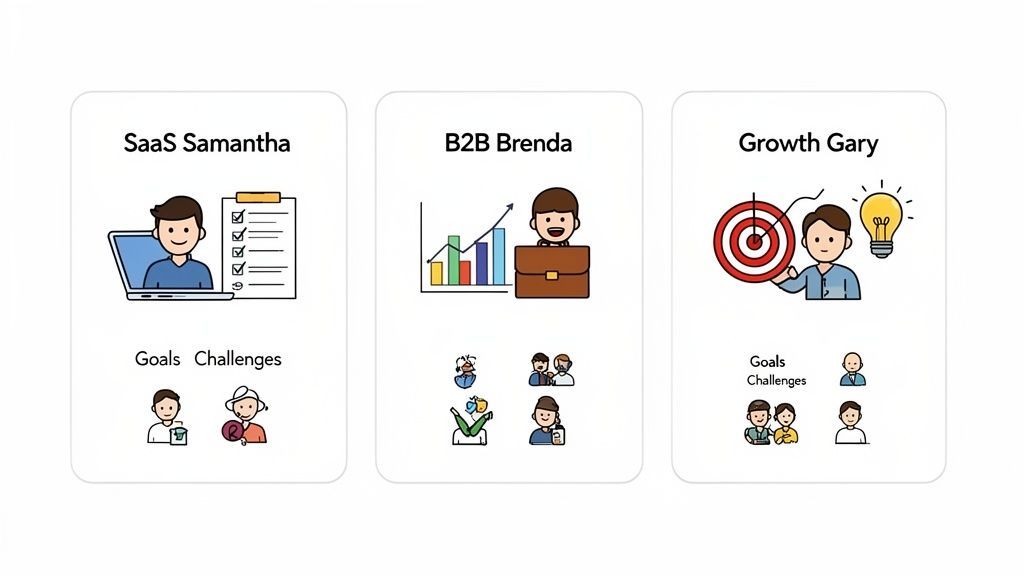
For instance, you might notice several product managers mentioning their frustration with "integrating multiple tools" and their need for a "single source of truth." That's not just a pain point; it’s the core of a persona. The outline of 'SaaS Samantha' begins to take shape—a tech-savvy manager driven by a need for operational efficiency.
The most powerful personas are built on the exact language your customers use. Dropping direct quotes from interviews into your profiles makes them instantly more authentic and memorable for your team.
Once you have these clusters of shared experience, layer in quantitative data to add depth. Check your CRM—do the customers complaining about tool integration also have a higher lifetime value (LTV)? Dive into Google Analytics—are they spending more time on your integrations page? This blend of the 'why' and the 'what' is what makes a persona strategically powerful.
Building Your Persona Template
A great persona template goes beyond basic demographics. It’s a strategic snapshot that captures the psychological and professional world of your ideal customer. While you should tailor it to your business, a solid template always has these core components.
Key Persona Template Components:
- Goals & Motivations: What is this person trying to achieve professionally? What does success look like for them? For a CFO, it might be hitting a quarterly revenue target.
- Challenges & Pain Points: What is standing in their way? What keeps them up at night? This is where you articulate the exact problems your product solves.
- Common Objections: Get this from your sales team. What are the common reasons this type of customer hesitates? Is it price, implementation time, or a missing feature?
- Watering Holes: Where do they get their information? List the specific blogs, podcasts, influencers, and social media channels they trust. This is tactical gold for media buying and content strategy.
Bringing Your Personas to Life
The final step is to wrap everything in a compelling narrative. Give each persona a name, a stock photo, and a quick bio that tells their story. You want them to feel like real people, not just a collection of bullet points. That human element makes a persona memorable and easy to apply in daily work.
Here are two examples for common business models:
Example 1: B2B Persona "ROI-Focused Rachel"
- Role: CFO at a mid-market manufacturing firm.
- Story: Rachel is under pressure to cut operational costs by 15% this year without sacrificing output. She is deeply skeptical of new technology and will not approve any expense unless a clear ROI can be proven within two quarters.
- Key Challenge: She struggles to get reliable, real-time data from the factory floor to make informed financial decisions.
- Watering Holes:The Wall Street Journal, Gartner reports, and exclusive CFO networking groups on LinkedIn.
- Common Objection: "We don't have the IT resources for a complex implementation. How quickly can we see a return?"
Example 2: SaaS Persona "Growth Gary"
- Role: Head of Growth at a Series B SaaS startup.
- Story: Gary must double qualified leads this year with a constrained budget. He is metric-driven, loves A/B testing, and is always hunting for scalable growth channels.
- Key Challenge: His current marketing stack is fragmented, making it nearly impossible to track full-funnel attribution and prove marketing's impact on revenue.
- Watering Holes:GrowthHackers.com, the My First Million podcast, and X (formerly Twitter), following other marketing leaders.
- Common Objection: "We’ve been burned by agencies before. How is your process different, and how do you guarantee performance?"
By creating these rich, narrative-driven profiles, you give your entire organization a shared language for discussing the customer. At Ezca, these detailed personas are the bedrock of our 90-day sprints. They dictate everything from the ad copy we write to the A/B tests we run, ensuring every action is laser-focused on what our customers truly need.
Activating Personas to Drive Performance
All that research and profiling you did? It's time to cash in.
Creating a set of buyer personas is a fantastic start, but they can't just live in a beautifully designed PDF. Their real power is unleashed when you put them to work every single day in your marketing campaigns. A persona that sits on a shelf is a wasted investment. This is the moment your research becomes revenue.
When you start activating these insights, you're no longer just throwing tactics at a wall to see what sticks. You're building a focused, high-return growth engine. You can move forward with confidence, knowing every piece of ad copy, every landing page, and every email is built on a solid foundation of what your customer actually wants.
Driving Your SEO and Content Strategy
Your persona profiles are a goldmine for your SEO and content teams. Forget chasing high-volume keywords with vague intent. Now you can build a content calendar that directly addresses the real-world problems and burning questions of your ideal customers.
Consider your "Growth Gary" persona and his struggle with full-funnel attribution. That one insight immediately provides a cluster of high-intent keywords to target:
- "how to track marketing attribution"
- "best b2b marketing attribution tools"
- "full-funnel marketing reporting template"
When you create content that answers these exact questions, you attract a much more qualified audience. Your content becomes a magnet for the right people, pulling them in right when they're actively searching for a solution.
Hyper-Targeting in Paid Media
For paid media, this is where you can become radically efficient. Stop burning cash on broad demographic targeting. Instead, build laser-focused audiences on platforms like Google, LinkedIn, and Meta.
Let's use your "ROI-Focused Rachel" persona. You know she's a CFO in mid-market manufacturing who trusts Gartner reports. On LinkedIn, you can build an audience targeting her precise job title, industry, and company size, then layer on an interest for "Gartner."
Now, you can serve her an ad that speaks her language: "See how we delivered a 15% reduction in operational costs for [Competitor Name]. Download the case study." That level of specificity sends click-through rates soaring and brings your cost per acquisition (CPA) down.
Personas force a critical shift in your paid media mindset. You stop asking, "Who can we reach?" and start asking, "Who do we need to reach, and what do they need to hear from us?" It’s the difference between buying impressions and buying real business outcomes.
Smarter Conversion Rate Optimization (CRO)
Personas are your secret weapon for conversion rate optimization (CRO). They help you move beyond random tests like changing button colors and start forming intelligent, data-backed hypotheses for A/B testing.
You know "Growth Gary" wants scalable growth and has been burned by agencies. A smart A/B test for your landing page might look like this:
- Hypothesis: A headline focused on guaranteed performance and a transparent process will convert more "Growth Garys" than a generic "Grow Your Business" headline.
- Version A (Control): "The Performance Marketing Agency for SaaS"
- Version B (Test): "Marketing Sprints That Deliver Results. See Our Process."
By testing messages that tackle his known goals and objections head-on, you're not just optimizing a page—you're optimizing a conversation with your ideal customer. This is the exact philosophy behind Ezca's 90-day sprints, where we use persona insights to constantly test and refine campaigns, ensuring budget flows to the creative that truly connects.
How to Activate Personas Across Channels
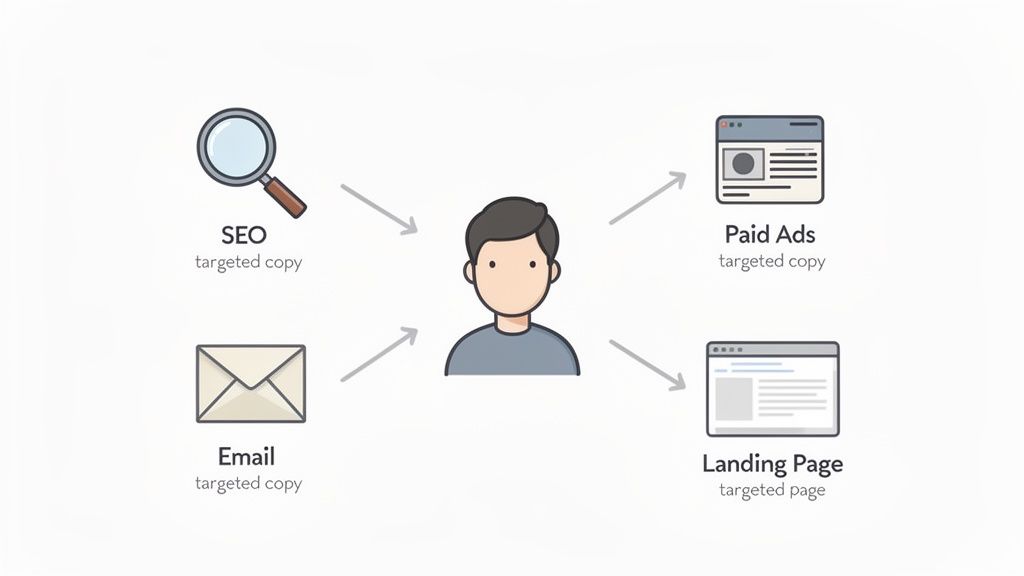
To bring this all together, here’s a practical matrix showing how these insights translate into specific actions across your main performance marketing channels.
Persona Activation Matrix for Performance Marketing
This matrix isn't just a list of ideas; it's a blueprint for making your marketing more cohesive, relevant, and effective.
Unlocking Channel-Specific Wins
The impact of this persona-driven approach is hard to overstate. Data from HubSpot shows that personalized emails can generate 18 times more revenue than generic broadcast emails. Another study found that companies using personas saw a 100% increase in the number of pages visited on their websites and revenue bumps between 5% and 25%. These aren't just small tweaks; they are serious business drivers. You can find more stats on persona-driven personalization and its powerful effect on the bottom line.
This level of targeting is the bedrock of any solid multi-channel marketing strategy, ensuring each channel speaks to the right person at the right time. For a deeper look, check out our guide on what is multi-channel marketing and how to build a seamless customer journey.
Ultimately, activating your personas is about making every marketing dollar work harder. It's how you stop chasing traffic and start attracting the right traffic—the kind that converts into profitable, long-term customers.
How to Measure and Refine Your Personas Over Time
Building your buyer personas isn't the finish line; it’s the starting block. Markets shift, customer needs evolve, and new competitors emerge. For your personas to remain valuable strategic assets, they must be treated as living documents.
A common mistake is treating persona development as a one-and-done project. Teams do the work, create the profiles, and then shelve them. That persona becomes obsolete within a year. The real value is realized when you build a consistent feedback loop that keeps your customer understanding sharp and tied directly to business goals.
This requires a process for validation, measurement, and refinement. It’s how you ensure your marketing campaigns continue to resonate and deliver a clear, defensible return on investment.
Validate Personas with Your Frontline Teams
Your best source for ongoing persona validation isn't in a spreadsheet—it's your sales and customer support teams. They talk to your customers every day and hear unfiltered challenges, goals, and objections firsthand.
Set up a quarterly check-in with these teams. Present your core personas and ask simple, direct questions:
- "Does 'Growth Gary' still reflect the prospects you're talking to on discovery calls?"
- "Are we missing any key objections that 'ROI-Focused Rachel' has been bringing up recently?"
- "What new feature requests are we hearing from our 'SaaS Samantha' users?"
This qualitative feedback is invaluable. If your sales team says, "We haven't heard that pain point in months," it’s a clear signal that your persona's priorities have shifted and your messaging needs to adapt.
Tie Personas to Hard Financial Metrics
To secure leadership buy-in and prove the value of this work, you must connect personas to financial outcomes. It’s not enough to say they make marketing "better." You need to show exactly how they impact revenue.
Start by tagging every lead and customer in your CRM with their corresponding persona. This simple step unlocks powerful, persona-specific reporting. Suddenly, you can move beyond vanity metrics and track the KPIs the C-suite cares about.
This is how you transform marketing from a cost center into a predictable revenue engine. By tracking metrics per persona, you can clearly show which customer segments are most profitable and confidently argue for putting more resources into acquiring them.
Here are the metrics you should be tracking for each persona:
- Lead-to-Customer Conversion Rate: Are certain personas more likely to buy? If "Growth Gary" converts at a high rate, your messaging is resonating.
- Customer Acquisition Cost (CAC): How much does it cost to acquire a customer from each segment? If "ROI-Focused Rachel" has a high CAC, it might be time to find more efficient channels to reach her.
- Customer Lifetime Value (CLV): This is the ultimate report card. Which personas generate the most revenue? A high CLV is proof you're attracting and retaining the right customers.
- Sales Cycle Length: Do deals with certain personas close faster? A shorter sales cycle for one group can help you refine sales training and allocate resources more effectively.
Imagine reporting, "Our 'SaaS Samantha' persona has a 30% higher CLV and a 15% lower CAC than our other segments." That’s not just a marketing win; it's an undeniable business case for your strategy.
Set a Cadence for Persona Refreshes
Markets don't stand still, so your personas can't either. A persona created today can be out of date in 12 months. To maintain their strategic edge, commit to a refresh cycle every 6 to 12 months.
This doesn't mean starting from scratch. Think of it as an iterative process of updating and tweaking, not completely rebuilding.
Here’s a simple checklist for your refresh:
- Re-interview a small sample: Talk to 2-3 new customers for each key persona. Are their goals and challenges the same as last year?
- Dig into recent data: Analyze the last six months of your CRM and analytics data. Have any new behavioral trends emerged?
- Check in with the front lines: Hold your quarterly meeting with sales and support to gather their latest on-the-ground insights.
- Update the documents: Tweak the goals, challenges, and "watering holes" in your persona profiles to reflect what you've learned.
This regular refinement is at the heart of how we operate at Ezca. Our 90-day sprints are built on constant learning and adaptation. We use persona-driven performance data to make weekly budget shifts, moving ad spend to the campaigns and channels delivering the best return for our clients' most valuable customer segments.
The question of whether to manage this process yourself or bring in a specialized team often boils down to resources and expertise. For a deeper dive, our guide on in-house vs. agency marketing can help you weigh the pros and cons. An agile approach ensures your customer understanding never gets stale, keeping your marketing sharp, relevant, and profitable.
Common Questions About Building Buyer Personas
Even with a solid plan, practical questions will arise once you're in the trenches building your buyer personas. As a leader, you need straight answers to sidestep common traps and ensure the effort pays off.
Let's address a few of the most frequent questions.
How Many Buyer Personas Do We Actually Need?
The answer is almost always: "fewer than you think." The goal isn't to map every possible buyer. It's about focusing on the segments that truly drive your business.
For most businesses, 3-5 core personas is the sweet spot. It's a manageable number for your team to remember and apply, yet distinct enough to inform different marketing strategies. If you exceed seven, they often start to blend together, which dilutes their strategic value.
Start with your single most profitable customer segment. Build that one persona with rigorous research. Only then should you consider expanding. Quality over quantity is paramount.
What Is a Negative Persona and Do We Really Need One?
A buyer persona defines who you should target. A negative persona, on the other hand, defines who you should actively avoid. It is an archetype of the customer who is a poor fit for your offering.
Is it necessary? For marketing leaders, it is a massive time and resource saver. A negative persona helps you explicitly identify:
- Prospects who lack the budget for your solution.
- Clients who are so high-maintenance they drain support resources and lead to churn.
- "Freebie-seekers" who use your free tools with zero intention of ever converting to a paid plan.
Knowing who not to market to is as powerful as knowing who to target. It sharpens your ad targeting, improves lead qualification, and prevents your sales team from wasting energy on conversations that will go nowhere.
How Do We Get the Sales Team to Actually Use These?
This is critical. If your sales team ignores your personas, the entire exercise is a waste of time. The key to securing their buy-in is to involve them from day one. Their frontline insights are invaluable.
Interview your top sales reps during the research phase. Ask them about their best leads, the most common objections, and the "aha" moments that close deals. When you present the finished personas, they will see their own experiences reflected in the final product.
The fastest way to get sales on board is to show them what's in it for them. Don't call it a "marketing document." Frame it as a sales enablement tool designed to help them hit their quota faster.
Once they realize how these profiles can help them tailor a pitch or preempt an objection, they won't just use them—they'll become your biggest champions.
Ready to build buyer personas that don't just sit in a folder but actively drive revenue? The experts at Ezca use a data-driven, sprint-based approach to turn deep customer understanding into measurable marketing performance.
Discover how our performance marketing squads can help you grow