
A Business Owner's Guide to Distribution Channels Marketing
A complete guide to distribution channels marketing. Learn how to select, manage, and optimize channels to drive measurable business growth and ROI.
Choosing the right distribution channels is not just a marketing task; it's a critical business decision that directly fuels growth. A robust strategy determines how you deliver your product or service to your customers, shaping profitability, brand perception, and market share. This guide provides a strategic framework for making those choices with confidence.
Your Modern Playbook for Channel Marketing
As a business leader, your resources are finite. Success isn't about being everywhere; it's about making deliberate, data-backed investments where they matter most. This playbook moves beyond theory to provide actionable insights for acquiring customers and driving revenue.
Think of your channels as a financial portfolio. Some, like SEO, are long-term assets that build compounding value. Others, like paid search, are designed for rapid, targeted returns. A resilient growth strategy balances this portfolio, mitigating risk and maximizing ROI.
The Three Core Channel Categories
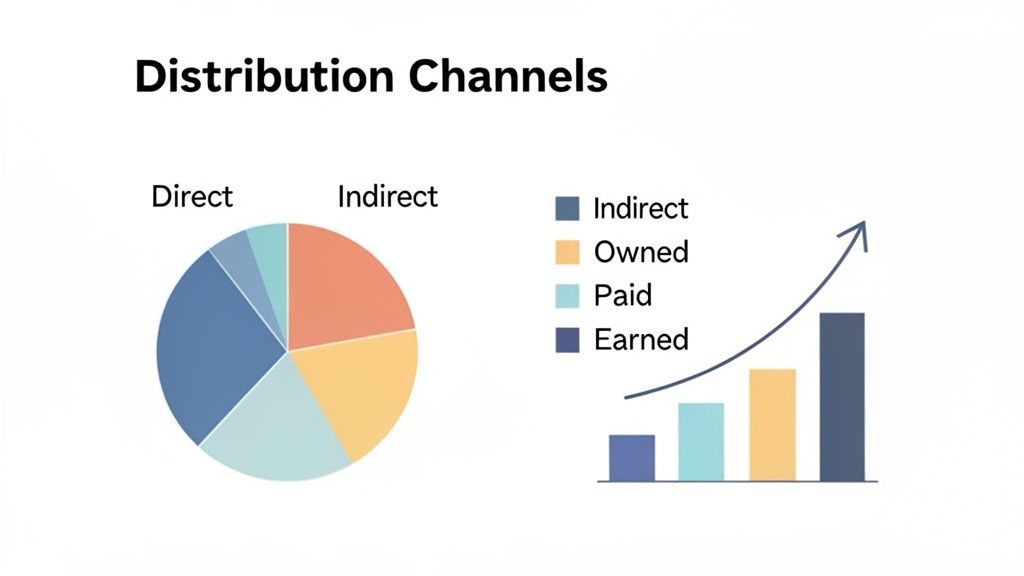
To build a winning strategy, we must first clarify the fundamentals. Every marketing channel falls into one of three distinct categories. Understanding this framework is the first step toward building a cohesive, effective marketing mix.
Core Distribution Channel Types at a Glance
This table breaks down the fundamental types of distribution channels, providing clear examples and highlighting their primary business applications for quick reference.
A sophisticated marketing strategy integrates these three channel types to create a self-reinforcing growth loop. For example, use paid ads to drive traffic to a valuable blog post (owned media), which in turn gets shared and earns backlinks (earned media), boosting your organic authority.
Deciding whether to manage this complex mix internally or partner with a specialized team is a significant decision. Our guide on in-house vs. agency marketing offers a framework for evaluating this choice based on your current stage and goals.
At Ezca, we implement this integrated approach through focused 90-day sprints. Our teams analyze real-time performance data to identify high-performing channels and reallocate budget to maximize ROI. This agile methodology ensures your marketing spend is always deployed for maximum impact.
Direct vs. Indirect Channels: Your First Big Strategy Call
The first strategic decision is fundamental: will you sell directly to your customers, or will you leverage partners? This choice defines your customer relationship, profit margins, and control over brand experience. It's a foundational decision that impacts your entire business model.
A direct-to-consumer (D2C) model means you own the entire customer journey. You control the messaging, the experience, and—most importantly—the data. This provides an unfiltered connection to your market.
Conversely, using indirect channels—wholesalers, retailers, affiliates—is like securing premium shelf space in a major supermarket. It offers immediate access and scale that would take years to build independently, but it comes at the cost of margin and direct customer interaction.
Why Going Direct is a Strategic Imperative
The primary advantage of a direct channel is total control over your brand and customer data. Every interaction is an opportunity to reinforce your brand story and gather invaluable first-party data on customer behavior, preferences, and feedback.
This direct line is a powerful competitive asset that allows you to:
- Build a loyal community: Direct engagement via your website, email, and social channels transforms customers into brand advocates.
- Maintain price integrity: You control pricing and promotions, preventing brand dilution from third-party discounting.
- Accelerate product iteration: Customer feedback comes directly to you, enabling rapid improvements and innovation.
The D2C model's growth is undeniable. A recent PwC survey on consumer behavior found that nearly two-thirds of consumers now purchase directly from brands online. This trend is not just about convenience; it's about a desire for authenticity and a direct connection.
The Undeniable Power of Indirect Channels
While D2C offers control, indirect channels provide something equally valuable: massive, instantaneous market reach. Partnering with established distributors or marketplaces places your product in front of a built-in audience, dramatically accelerating market penetration.
This access requires a trade-off. You relinquish a portion of your profit margin and lose direct ownership of the end-customer relationship. The retailer, not you, becomes the primary point of contact.
For business owners, the decision often hinges on a critical calculation: does the volume and reach of an indirect partner generate more net profit than a lower-volume, higher-margin direct approach? It’s the classic strategic tension between margin and volume.
How to Make the Right Choice for Your Business
Choosing between direct and indirect channels is not about finding the "best" option, but the right one for your business model, product, and financial goals. To make a data-driven decision, focus on two core metrics:
- Customer Acquisition Cost (CAC): For direct channels, this includes ad spend, content creation, and sales costs. For indirect channels, it's primarily the partner's margin and any associated marketing fees.
- Lifetime Value (LTV): This is the total net profit you expect from a single customer over time. Direct channels typically yield a higher LTV by enabling you to nurture the relationship and drive repeat purchases.
The key indicator of a sustainable model is a healthy LTV-to-CAC ratio, with 3:1 serving as a widely accepted benchmark. If your direct CAC is unsustainable, leveraging an indirect partner might be the more prudent path to profitability. Conversely, if your product has high LTV potential, investing in a direct channel to own that long-term relationship is almost always the superior long-term strategy.
Owned, Paid, and Earned Media: The Three Levers of Growth
Beyond the direct vs. indirect framework lies the interplay of owned, paid, and earned media. These are not siloed tactics but interconnected components of a single, powerful growth engine. True marketing leverage comes from orchestrating them in concert.
Owned media is your strategic foundation. These are the assets you control completely: your website, blog, and email list. They are long-term investments that appreciate over time, providing a direct line to your audience without intermediary costs.
Paid media is your growth accelerator. It encompasses everything from Google Ads and sponsored content to social media campaigns on Meta or LinkedIn. It is the most effective way to reach new, targeted audiences, validate offers, and generate immediate market feedback.
Kickstarting the Flywheel Effect
Sustainable momentum is achieved when you strategically use owned and paid media to generate the most valuable asset: earned media. This is the credibility you cannot buy—authentic press coverage, organic customer advocacy on social media, and authoritative SEO rankings.
This synergy creates a powerful growth flywheel. A well-executed paid campaign drives traffic to your owned content, which grows your email list. The resulting engagement and traffic signal authority to search engines, boosting your organic rankings and generating valuable earned media.
This graphic breaks down how your channel choices fit into this bigger picture.
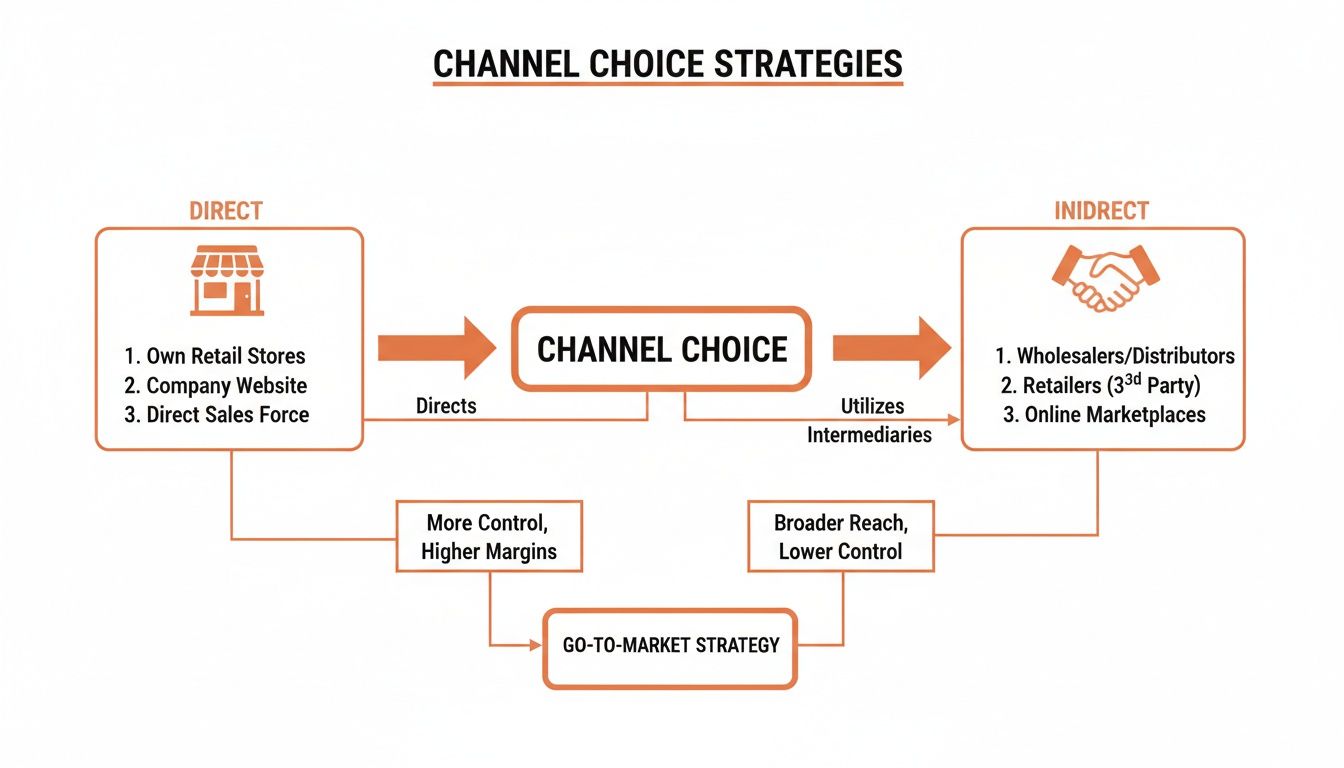
The flowchart illustrates the core trade-off: direct channels offer control, aligning with an owned media strategy, while indirect channels provide reach, often amplified by paid or earned partnerships.
Putting an Integrated Media Strategy to Work
An effective integrated strategy requires agility and a data-first mindset. As of 2024, Statista's latest global survey shows that 91% of marketers use social media, solidifying its role as a central hub where owned content, paid ads, and earned conversations converge.
This is why at Ezca, we manage campaigns in 90-day sprints. We don't lock in an annual budget and hope for the best. Our teams analyze performance data weekly, dynamically shifting investment to the channels delivering the highest return.
A real-world example: A paid social campaign shows exceptional ROI with a specific audience segment. We immediately increase spend on that channel. Concurrently, we use the campaign's data-driven insights to develop a new blog post (an owned asset) tailored to that audience's pain points. That article then becomes a cornerstone of our SEO strategy to capture long-term, high-value earned traffic.
This integrated model directly impacts your bottom line:
- Lower Customer Acquisition Cost (CAC): As earned media grows, your reliance on paid channels decreases, driving down your blended CAC over time.
- Higher Lifetime Value (LTV): Owned channels like email are ideal for nurturing existing customers and increasing repeat purchase rates, directly boosting LTV.
- A Defensible Competitive Moat: A strong foundation of earned media and valuable owned content creates a durable competitive advantage that cannot be replicated with ad spend alone.
Building this system requires a relentless focus on testing, learning, and optimizing. For a deeper dive into building the earned media component, see our guide on how to increase organic traffic.
How to Select Your Optimal Channel Mix
There is no universal formula for selecting marketing distribution channels. The optimal mix for a B2B SaaS company with a long sales cycle is fundamentally different from that of a D2C e-commerce brand driven by impulse purchases. The right strategy is a direct reflection of your business model, customer profile, and market dynamics.
The starting point is not a list of trendy channels but a clear understanding of your business. Where do your ideal customers seek information and solutions? What is your average customer LTV and sales cycle? Answering these questions provides the strategic clarity needed to move from speculation to a data-informed plan.
Frameworks for Key Business Models
To make this actionable, here are proven channel frameworks for common business models. Use these as strategic starting points, not rigid prescriptions.
For a SaaS Company The primary objective is generating qualified leads and booking demos. Customers are actively researching solutions to solve a pressing business problem.
- SEO-Driven Content Marketing: Build a sustainable lead pipeline by creating authoritative content (blogs, guides, tools) that answers your target audience's critical questions.
- Hyper-Targeted Paid Search: Focus on long-tail, high-intent keywords that signal a readiness to buy (e.g., "best CRM for real estate agencies" vs. "CRM software").
- Integration Marketplaces: List your solution on platforms like the Salesforce AppExchange or HubSpot App Marketplace to be present within your customers' existing workflows.
For an E-commerce Brand The path to purchase is often short and visually driven. Discovery and impulse buys are critical growth levers.
- Social Commerce: Leverage platforms like Instagram Shops and TikTok Shops to collapse the funnel between discovery and purchase, capturing customers at the peak of their interest.
- Google Shopping & Performance Max: These are non-negotiable for most e-commerce businesses, placing your products directly in front of high-intent buyers.
- Influencer & Affiliate Marketing: Partner with trusted voices in your niche to generate powerful social proof and drive qualified traffic, often on a performance-based model.
For a B2B Enterprise The goal is to build relationships and influence multiple decision-makers over a complex, often lengthy, sales cycle.
- LinkedIn Ads & Content: Utilize LinkedIn's unparalleled B2B targeting (by job title, company, industry) to reach key stakeholders with relevant, high-value content.
- Account-Based Marketing (ABM): Focus marketing and sales resources on a curated list of high-value target accounts with a coordinated, multi-touch approach.
- Industry Content Syndication: Partner with trade publications and research firms to distribute your key assets (whitepapers, webinars) to a pre-qualified and engaged audience.
To extract maximum value from B2B content, a multi-faceted distribution approach is essential. This guide to 10 Content Distribution Strategies to Maximise Webinar ROI provides excellent tactical ideas.
The Channel Scorecard Method
To bring analytical rigor to your selection process, use a "channel scorecard." This simple tool forces an objective evaluation of potential channels based on your strategic priorities.
A channel scorecard transforms selection from a subjective debate into a structured analysis. By scoring each channel against consistent criteria, you can clearly see which options offer the best strategic fit and highest potential return for your specific business goals.
For each potential channel, score it from 1 to 5 on these criteria:
- Audience Alignment: How precisely does the channel's audience match your Ideal Customer Profile (ICP)? A 5 is a perfect match.
- Cost to Acquire (Est. CAC): What is the projected cost to acquire a customer? A 5 indicates a very low expected CAC.
- Scalability: How easily can you increase investment and achieve proportional results? A 5 represents massive scaling potential.
- Strategic Fit: Does this channel support your long-term brand goals and help build owned media assets? A 5 denotes perfect alignment.
Sum the scores for each channel. This provides a clear, data-informed hierarchy of which channels to test first. The agile, 90-day sprints at Ezca are designed to rigorously test these top-scoring channels, using real-world data to validate or invalidate initial hypotheses and quickly scale what works. Understanding how these channels fit into a broader strategy is also key; learn more in our guide on what multi-channel marketing really is.
Measuring and Optimizing Channel Performance
Effective marketing is not about outspending the competition; it's about out-thinking them. Once your distribution channels are active, the critical work of measurement and optimization begins. This means moving beyond vanity metrics like followers or traffic and focusing on the KPIs that directly impact your bottom line.
The goal is to transform your channel mix into a high-performance engine. This requires rigorous tracking of the right metrics and a clear understanding of marketing attribution. Without reliable data, you are operating on assumptions, risking budget on underperforming channels while missing opportunities for profitable growth.
Focusing on Metrics That Matter
As a business leader, profitability is the ultimate measure of success. Your measurement framework must be built around core financial metrics that tell a clear story of ROI.
Focus intently on these KPIs:
- Customer Acquisition Cost (CAC): Calculate this for each individual channel to understand its true efficiency. Total spend on channel / Number of customers acquired from channel = Channel CAC.
- Lifetime Value (LTV): The total net profit a single customer generates over their entire relationship with your brand. A high LTV allows for a higher sustainable CAC.
- LTV-to-CAC Ratio: The single most important metric for assessing the health of your marketing. A ratio of 3:1 or higher indicates a profitable and sustainable growth model.
- Channel-Specific Conversion Rates: Track conversion rates at each stage of the funnel (e.g., lead-to-MQL, MQL-to-customer) for each channel to identify where your highest-quality customers originate.
The best marketing leaders are obsessed with the LTV-to-CAC ratio. It’s the single most important number that tells you if your distribution channel strategy is a profitable investment or just a very expensive hobby.
Demystifying Attribution Models
Attribution is the process of assigning credit for a conversion to the various marketing touchpoints a customer encounters. The model you choose directly impacts your budget allocation decisions.
Here are two primary approaches:
- First-Touch Attribution: Assigns 100% of the credit to the first channel a customer interacted with. This is useful for identifying channels that are effective at generating initial awareness.
- Multi-Touch Attribution: Distributes credit across multiple touchpoints, providing a more holistic view. Models like "linear" (equal credit to all touches) or "time-decay" (more credit to touches closer to conversion) better reflect the complexity of the modern customer journey.
For most businesses, a multi-touch model provides a more accurate understanding of how channels work together to drive conversions.
To connect your channel strategy to tangible results, it's crucial to align your KPIs with your primary objectives. Different channels excel at different things, so measuring them with the same yardstick is a recipe for confusion.
This table provides a strategic map for aligning your measurement with your goals, enabling a clear, unbiased view of channel performance.
Agile Optimization With 90-Day Sprints
The era of the static annual marketing plan is over. Today's market requires an agile, iterative approach. At Ezca, we manage campaigns for industry leaders like HubSpot and Logitech using a 90-day sprint methodology.
This framework ensures continuous improvement. A dedicated team analyzes your channel performance data weekly. Based on real-time CAC and conversion metrics, they reallocate budget from underperforming channels to those delivering the best ROI. This ensures your marketing spend is always working as efficiently as possible. This agile approach turns marketing from a cost center into a predictable, data-driven revenue engine.
The Future Is Integrated Digital and Physical Distribution
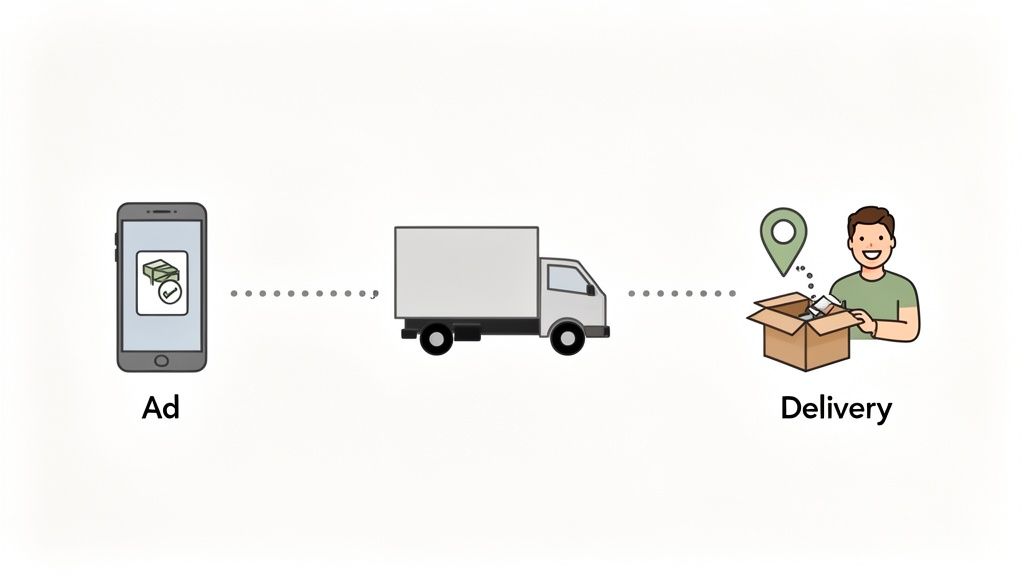
It is a common mistake to view marketing and logistics as separate functions. In the customer's mind, they are a single, unified experience. A customer journey that begins with a compelling digital ad only concludes successfully with the timely arrival of a physical product.
That final-mile experience is a critical marketing touchpoint where your brand promise is either validated or broken. A brilliant campaign can be nullified by a delayed shipment. Conversely, a seamless delivery and premium unboxing experience can transform a first-time buyer into a loyal advocate. The entire fulfillment process is a powerful marketing asset.
Bridging the Digital and Physical Divide
The distinction between online browsing and physical product ownership has effectively vanished. Customers expect a seamless, continuous experience. A winning strategy must align every touchpoint, from the first ad impression to the final unboxing. This holistic integration is a source of profound competitive advantage.
Market data confirms this trend. E-commerce now accounts for a 32% share of the global distribution logistics market, a clear indicator of how digital channels are fundamentally reshaping physical supply chains. The growth of this USD 9.4 trillion market is inextricably linked to the demand for perfectly synchronized e-commerce fulfillment.
Your customer doesn't care about your org chart. They don't see a "marketing department" and a "shipping department." They just see one brand. A delay in logistics feels like a failure by the entire company, and it can erase all the goodwill your marketing team worked so hard to build.
This deep integration represents the next frontier in distribution channels marketing. Understanding the interplay between digital demand generation and physical fulfillment is critical. Exploring concepts like Omnichannel vs Multichannel E-commerce provides a valuable framework for building a future-proof strategy.
Aligning Operations with Marketing Sprints
To achieve this integration, marketing leaders must collaborate closely with their operations counterparts. Performance data from marketing campaigns should serve as a direct input for inventory planning and fulfillment strategy.
For example, if a paid social campaign is driving unexpectedly high demand in a specific geographic region, this is an immediate, actionable signal for the logistics team to position inventory accordingly to ensure rapid delivery.
At Ezca, our agile 90-day sprints are designed to bridge this gap. We provide data-driven forecasts that give operations teams the visibility needed to prepare for shifts in demand. This alignment ensures a seamless customer experience from ad to doorstep, transforming operational efficiency into a powerful marketing tool.
Your Top Channel Marketing Questions, Answered
As a business leader, refining your distribution channel strategy is an ongoing process. Here are concise, actionable answers to the most common questions about building and managing an effective channel mix.
What’s the Difference Between a Channel and a Tactic?
The distinction is simple but critical. A channel is the platform or environment where your audience exists (e.g., "social media," "search engines"). A tactic is the specific action you take on that channel (e.g., "running a LinkedIn lead generation ad," "publishing an SEO-optimized blog post").
An effective strategy requires both: selecting the right channels where your customers are active, and then executing the right tactics to engage them effectively.
How Many Distribution Channels Should I Actually Use?
There is no magic number. A startup may focus all its resources on one or two channels to gain initial traction, while a large enterprise manages a complex, multi-channel portfolio.
The most effective approach is to start with a focused strategy. Use the channel scorecard method to identify the 2-3 channels with the highest potential ROI and concentrate your efforts there.
The biggest mistake I see is spreading a budget too thin across too many channels. You'll get way better results by truly owning one or two key channels than by having a barely-there presence on ten.
Master a few core channels and prove their profitability before expanding. This disciplined approach ensures your resources are deployed for maximum impact.
When Is It Time to Ditch a Marketing Channel?
Exiting a channel should be a data-driven decision, not an emotional one. A new channel requires a fair test period—typically at least one 90-day cycle—to gather sufficient performance data.
It is time to divest from a channel if it consistently demonstrates:
- A high, unprofitable CAC that resists optimization efforts.
- Low-quality leads that do not convert into valuable customers.
- A lack of scalability, where increased investment fails to produce a corresponding increase in results.
This is a core benefit of an agile sprint methodology. Sprints provide natural, data-driven checkpoints to make decisive calls, reallocating budget from underperforming channels to those that are driving profitable growth.
At Ezca, our 90-day sprint system is designed to identify and scale your most profitable distribution channels with precision and speed. If you're ready to build a growth engine driven by data, not guesswork, let's connect.