
The Core Benefits of Data Driven Marketing for Growth
Explore the key benefits of data driven marketing. Learn proven strategies to boost ROI, personalize customer experiences, and achieve scalable growth.
As a business leader, you're not just managing a marketing budget—you're investing in a revenue engine. Data-driven marketing is the framework that ensures your investment generates predictable returns. It replaces gut-feel decisions with a systematic approach, using hard evidence to define who your best customers are, which channels reach them most effectively, and how every dollar spent impacts the bottom line.
This shift from intuition to insight is what separates high-growth companies from the rest. It enables you to maximize ROI, eliminate wasteful spending, and build customer experiences that drive loyalty and lifetime value.
Stop Guessing and Start Growing with Data

Running a marketing department without clear data is like trying to fly a plane blindfolded. You might have a general idea of your destination, but you have no instruments to navigate turbulence or guide you to a safe landing. Data provides the cockpit view, handing you a full dashboard of metrics to make confident, strategic decisions.
For leaders in competitive B2B, SaaS, or e-commerce markets, this isn't optional—it's essential for survival and growth. It's how you get definitive answers to critical questions: Which channels produce our highest LTV customers? What's our true Customer Acquisition Cost (CAC)? What message actually resonates with our ideal buyers and shortens the sales cycle?
To move beyond assumptions and build a scalable growth engine, you need to implement proven data-driven marketing strategies that connect every action to a measurable business outcome.
A Quick Look at Key Advantages
To give you a clearer picture, let's take a high-level look at the core benefits we’ll be digging into. This table summarizes the main advantages of putting data at the center of your marketing efforts.
Core Benefits of Data-Driven Marketing at a Glance
Each of these benefits represents a tangible outcome, from improving financial returns to building much stronger connections with your customers. We’ll unpack them one by one.
Boost Your ROI and Budget Efficiency
For any marketing leader or business owner, every dollar must be accountable. Data-driven marketing connects your marketing spend directly to revenue, turning your budget from a line item expense into a predictable growth investment. You stop allocating funds based on last year's plan and start making surgical decisions based on real-time performance data.
This approach requires a clear understanding of your financial metrics. Before you can optimize, you must define Marketing ROI and establish a reliable measurement framework. Once in place, you can confidently answer questions like, "Which campaign is generating customers with the highest lifetime value?" and "What is our exact cost to acquire a qualified lead from LinkedIn vs. Google Ads?"
From Wasteful Spending to Smart Allocation
Consider a B2B company spending equally across three paid channels. A deep data analysis might reveal that one channel delivers high-volume but low-quality leads that never close, while another produces fewer leads that consistently convert to high-value deals. Data gives you the clarity to reallocate the budget from the low-performing channel to the high-performer, instantly boosting your ROI without increasing overall spend.
This becomes even more powerful in an agile environment. At Ezca, our data-informed squads conduct weekly performance analyses to pivot ad spend toward the campaigns and channels delivering the best results right now. This continuous optimization loop ensures your budget is always working as efficiently as possible, reacting to market dynamics in days, not quarters.
Data-driven companies are 6x more likely to be profitable, and those with a strong data culture see 3.2x more revenue growth than their peers. When Ezca implements data-backed decision-making for clients, we see campaign ROI improve by 31% on average. On top of that, companies that truly embrace data cut their marketing waste by 21%.
A Practical Look at Metrics in Action
When you put data first, financial metrics become your north star. Here’s what that looks like for different types of businesses:
- For SaaS: The core metric is the LTV:CAC ratio. By tracking which content and channels attract users with the highest lifetime value (LTV) for the lowest acquisition cost (CAC), you build a model for sustainable, profitable growth.
- For E-commerce: You can get incredibly precise with your Return on Ad Spend (ROAS). It becomes possible to attribute sales directly to specific ads, allowing you to kill the campaigns that aren't working and double down on the ones proven to turn browsers into buyers.
- For B2B: Monitoring Cost Per Lead (CPL) and Marketing Qualified Lead (MQL) quality helps you pinpoint which campaigns deliver leads that actually close. This tightens alignment between marketing and sales, shortening the sales cycle and improving revenue forecasting.
Making these metrics the bedrock of your strategy builds an undeniable case for marketing's direct contribution to revenue. It's also a core factor in deciding whether an in-house team or an agency can deliver the results you need. You can learn more about making that call in our guide to in-house vs agency marketing.
Achieve Pinpoint Audience Targeting
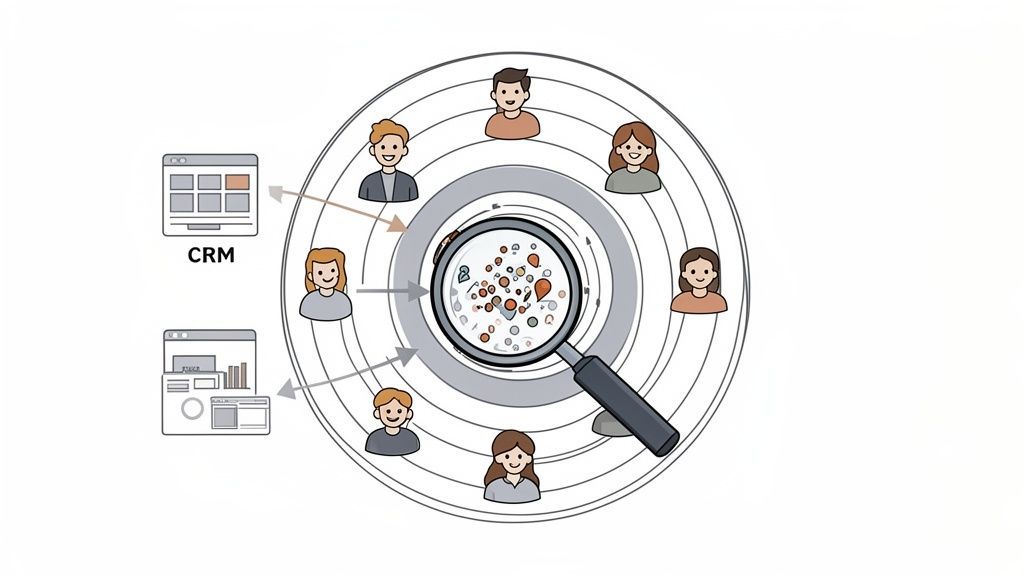
Effective marketing starts with knowing exactly who you're talking to. Instead of relying on vague personas, data allows you to build a precise Ideal Customer Profile (ICP) based on the actual attributes of your most profitable customers. This is one of the most significant benefits of data driven marketing, as it ensures your message and budget are focused exclusively on those most likely to buy.
This process begins by analyzing your first-party data—the information you already own. Website behavior, CRM data, purchase history, and product usage patterns reveal who your best customers are, what problems they have, and what motivates them.
From Raw Data to High-Value Segments
By analyzing this data, you can build a fact-based ICP that reflects reality. This profile becomes the foundation for all your strategic decisions, from ad targeting to content creation.
For a B2B SaaS company, this means analyzing your CRM to identify common firmographics. You might discover your best customers aren't just "tech companies," but specifically mid-sized firms in North America with 50-200 employees that recently hired a VP of Operations. That insight allows you to stop wasting ad spend on everyone else.
Using data to refine your audience isn't just about efficiency; it's about connecting with intent. When you can pinpoint companies actively researching solutions like yours, you dramatically improve lead quality and shrink the sales cycle.
Actionable Targeting Tactics in Practice
Armed with a clear, data-defined ICP, you can execute highly effective targeting strategies.
- For E-commerce: Upload a list of your top-spending customers to platforms like Meta or Google to create lookalike audiences. Their algorithms will identify new users who share the behavioral DNA of your best buyers, often leading to a significant increase in ROAS.
- For B2B Marketing: Layer your ICP with intent data from a platform like Bombora or 6sense. This reveals which of your target accounts are actively researching keywords related to your solution right now. You're not just finding the right companies; you're finding them at the exact moment they have a problem you can solve.
At Ezca, this is a core part of our 90-day sprints. We build and refine these audiences constantly, analyzing performance data to ensure every dollar of ad spend is aimed squarely at the segments that deliver the best leads and sales. You can see more on how this works in our guide on what is multi-channel marketing.
Drive Revenue with True Personalization
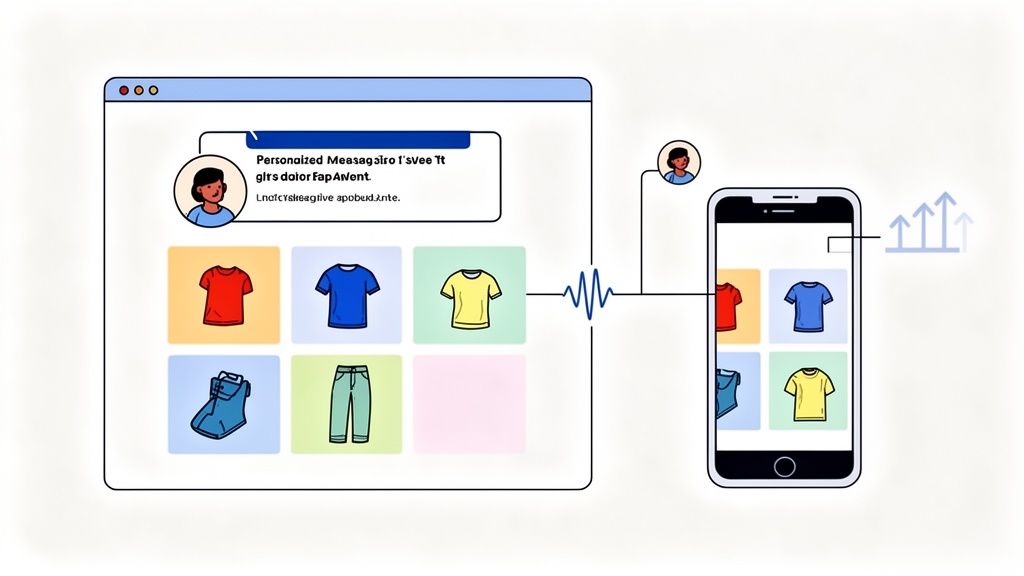
True personalization is not just using a first name in an email. It's delivering the right message to the right person on the right channel at the right time—a feat only possible with clean, actionable data. This is how you stop broadcasting generic messages and start having valuable conversations that directly grow revenue.
The impact is measurable. Data-informed retention strategies can increase repeat purchases by 36%. A personalized onboarding flow can boost activation rates by 27%, and smart recommendation engines have been shown to lift average order value by 22%.
For subscription businesses, using behavioral triggers to personalize renewal offers can increase retention by 21%. You can dig deeper into how these tactics drive real results in this report on marketing ROI stats for marketing leaders. This is the relevance that separates market leaders from the competition.
Personalization in Action Across Business Models
Data enables you to create experiences based on actual user behavior, not assumptions. This creates a powerful feedback loop: a better experience drives more engagement, which generates richer data to make the next experience even better.
- For E-commerce: Instead of a generic homepage, use a visitor's browsing history to display dynamic product recommendations. Someone who viewed hiking boots should see a curated block of related outdoor gear. This simple tactic directly increases average order value.
- For SaaS: When a user struggles with a new feature, trigger an adaptive in-app tooltip or a short video tutorial. Proactive, contextual support reduces friction and churn while improving user satisfaction and long-term retention.
- For B2B: Segment your nurture sequences. A lead who downloads a whitepaper on logistics automation should be enrolled in a tailored email sequence that addresses their specific challenges, guiding them through the buyer's journey far more effectively than a generic newsletter.
Personalization is the engine of modern customer loyalty. It shows customers you understand their needs, respect their time, and are committed to providing value at every single touchpoint. This builds trust and directly increases Customer Lifetime Value (LTV).
Connecting Personalization to Your Bottom Line
Every one of these personalization tactics is measurable. You can directly track how dynamic content impacts conversion rates, how an in-app guide reduces support tickets, or how a tailored email sequence shortens your sales cycle.
At Ezca, our squads use behavioral data to inform everything from ad creative to landing page copy, ensuring our clients' messaging connects with their most valuable segments. This is a core benefit of data-driven marketing—it transforms communication from a creative exercise into a quantifiable growth driver.
Optimize Your Funnel with Continuous Testing
Data isn't just for reporting on past performance; its real power lies in providing the insights needed to improve future results. Conversion Rate Optimization (CRO) is the process that turns your marketing funnel from a static path into an adaptive system that gets smarter with every interaction. It allows you to stop guessing and start methodically testing your way to better outcomes.
The process begins by identifying points of friction in your customer journey. Tools like Hotjar heatmaps can show you where users hesitate, while session recordings let you watch real users abandon a form or bounce from a landing page. This isn't just a report; it's a diagnostic tool showing you exactly where you're losing revenue.
From Observation to Hypothesis
Once you've identified a problem area, data helps you form a testable hypothesis. You move beyond vague ideas like "let's change the button color" and toward specific, data-informed theories.
For example, a SaaS company might observe a significant drop-off on their pricing page before users start a trial. This leads to a testable hypothesis:
"We believe that adding a 'No credit card required' trust signal below the 'Start Free Trial' CTA will increase sign-ups by 15%. Our analytics show high exit rates at this step, suggesting commitment anxiety is the primary friction point."
This is the perfect setup for an A/B test. You run the original page against the new version and let user behavior provide a definitive winner. Ego and opinions are replaced by empirical evidence.
Cultivating a Culture of Relentless Improvement
When you adopt this mindset, every marketing asset—from landing pages and email subject lines to ad copy—becomes an opportunity to learn and improve. A single A/B test is a tactic; committing to continuous testing is a strategy that delivers compounding returns.
This agile, test-and-learn cycle is the foundation of our work at Ezca. Our 90-day sprints are built around this exact process: analyze data, form a hypothesis, execute a test, and apply the learnings.
This structure forces us to constantly challenge assumptions and use real performance data to validate that every optimization is driving meaningful results. By building a culture of relentless improvement, you create a marketing engine that doesn't just perform—it adapts, evolves, and delivers rapid, data-validated growth.
Your Roadmap to Data-Driven Mastery
Becoming a truly data-driven organization is more of a cultural shift than a technical upgrade. It’s about changing the fundamental question from "what happened?" to "what should we do next?" For leaders ready to make that leap, here’s a practical path to get there.
The journey doesn't start with fancy software; it starts with clarity. Before you get lost in dashboards and metrics, you need to define the Key Performance Indicators (KPIs) that actually matter to your business goals. If you run a SaaS company, your north star might be lowering your Customer Acquisition Cost (CAC). For an e-commerce store, it's likely all about boosting Customer Lifetime Value (LTV).
Building Your Foundation
Once you know what you’re measuring, you can pick the right tools for the job. You don't need a sledgehammer to hang a picture. A startup can get surprisingly far with Google Analytics and a basic CRM. On the other hand, a company hitting its growth stride might need a full-blown Customer Data Platform (CDP) to stitch together data from a dozen different sources. The goal is to choose tech that answers your most important questions, not just to hoard data for its own sake.
For leaders who want to get there faster, bringing in a partner with a proven framework can help you skip the common pitfalls and avoid the long, painful internal learning curve.
An effective data-driven approach isn't about having the most data; it's about having the right data and the agility to act on it. This focus on actionable insights is what separates high-growth companies from the competition.
Accelerating with a Structured Approach
This is exactly why we built our process around Ezca’s 90-day sprints. Instead of locking into a rigid year-long plan based on last quarter's assumptions, we operate in tight, agile cycles. Each sprint is designed to test a specific hypothesis, learn from the results, and quickly re-allocate your budget to what’s actually working.
Our squad model gives you a dedicated team of experts who blend human intuition with AI-powered analysis to review performance every single week. This relentless pace of adaptation is crucial, especially when you're trying to increase organic traffic while simultaneously making your paid channels more efficient. It gives you a clear, data-validated path forward, whether you're just starting out or looking to fine-tune a mature strategy.
Common Questions About Data-Driven Marketing
Diving into a data-first marketing approach can feel like a big shift, and it's natural for business leaders to have questions. Let's walk through a few of the most common ones I hear and offer some practical, straightforward answers.
What’s the First Step to Becoming a Data-Driven Marketing Team?
Forget about buying expensive software right out of the gate. Your real first step is much simpler: define just one or two Key Performance Indicators (KPIs) that tie directly to a critical business goal.
For a SaaS company, that might be your Customer Acquisition Cost (CAC). If you're in B2B, maybe it's Marketing Qualified Leads (MQLs). The metric itself matters less than its connection to your bottom line.
Once you’ve picked your KPI, make sure you can track it reliably. A basic tool like Google Analytics is often all you need to start. With a trustworthy baseline in place, you can begin forming hypotheses and running simple tests to see if you can move that number. This is how you build a data-first mindset without overwhelming your team.
This simple flow captures the essence of getting started.
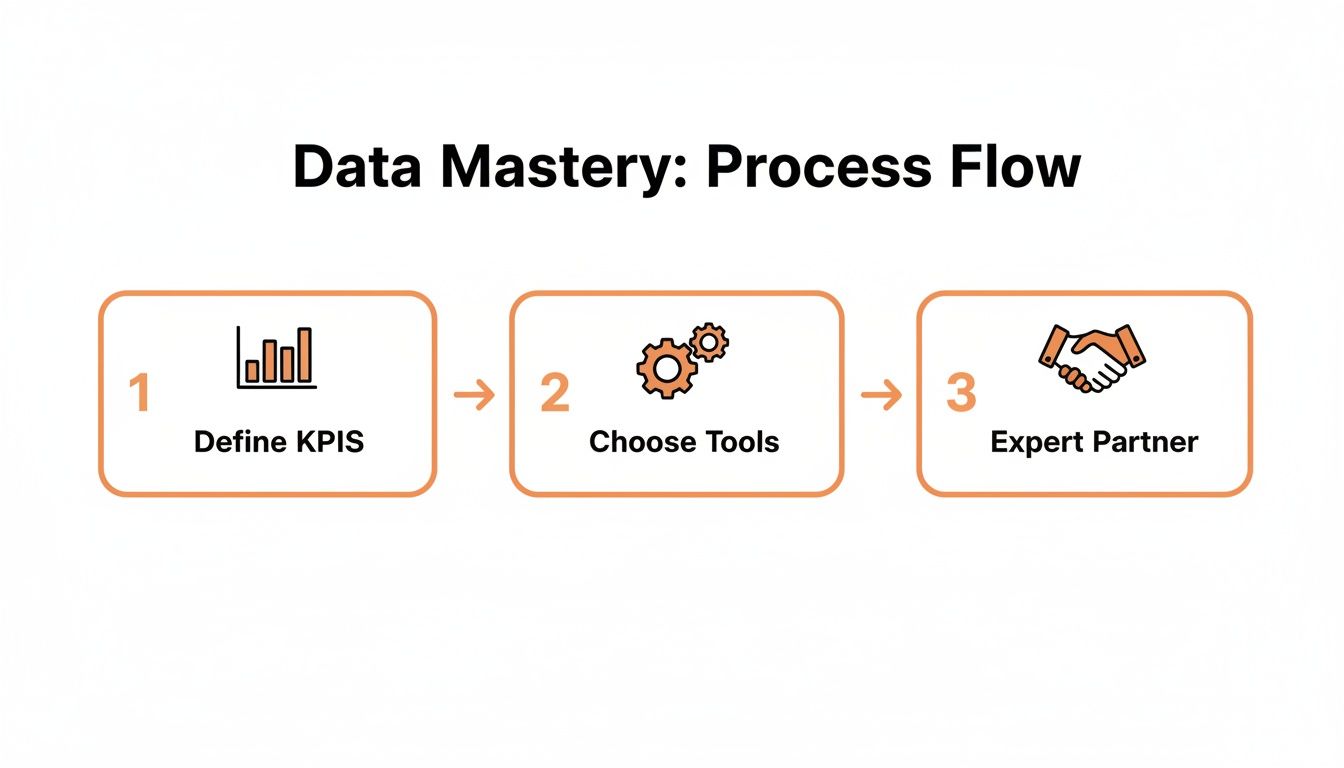
The big takeaway here is that mastery starts with clear goals. The right technology comes next, and the whole process gets a serious boost when you bring in an expert partner to guide you.
How Much Data Do I Need to Get Started?
You probably have more useful data than you think. Start with what’s already at your fingertips: website traffic in Google Analytics, sales figures from your CRM, and engagement numbers from your email platform. The initial goal isn't to build a massive dataset; it's to get clean, accurate data for one specific part of your funnel.
You don't need millions of data points. Even a few hundred conversions can give you statistically significant results for an A/B test on a high-traffic landing page. The key is to start using the data you have to make one better decision, then another, and another.
Does Data-Driven Marketing Stifle Creativity?
Absolutely not. In fact, it does the opposite—data gives creativity the guardrails it needs to be truly effective.
Instead of your team guessing what might resonate with an audience, data tells them who the audience is, what they genuinely care about, and where their biggest pain points are. Think of it this way: data defines the "what," freeing up your creatives to nail the "how."
For instance, your data might reveal that your highest-value customers are all struggling with team productivity. This single insight empowers your creative team to develop hyper-relevant ad copy, imagery, and blog posts that speak directly to that need. Their work becomes more impactful because it’s built on a foundation of truth, not a hunch.
Ready to stop guessing and start building a predictable growth engine? Ezca Agency combines human expertise with AI to help you unlock the full potential of your marketing data. Learn how our 90-day sprints deliver measurable results.