
How to Choose an SEO Agency: A Guide for Driving Business Growth
Discover how to choose seo agency for success. Our 2026 guide offers a data-driven framework, vetting tips, interview questions, & how to avoid red flags.
Choosing the right SEO agency is a high-stakes decision that can define your company's growth trajectory for the next 12-24 months. Success hinges on a few critical steps: defining goals in terms of revenue, scrutinizing case studies for proof of ROI, and asking questions that separate strategic partners from tactical vendors.
A top-tier agency aligns its entire strategy with your business model to deliver measurable financial returns—not just vanity traffic reports.
A Framework for Choosing an SEO Partner that Delivers ROI
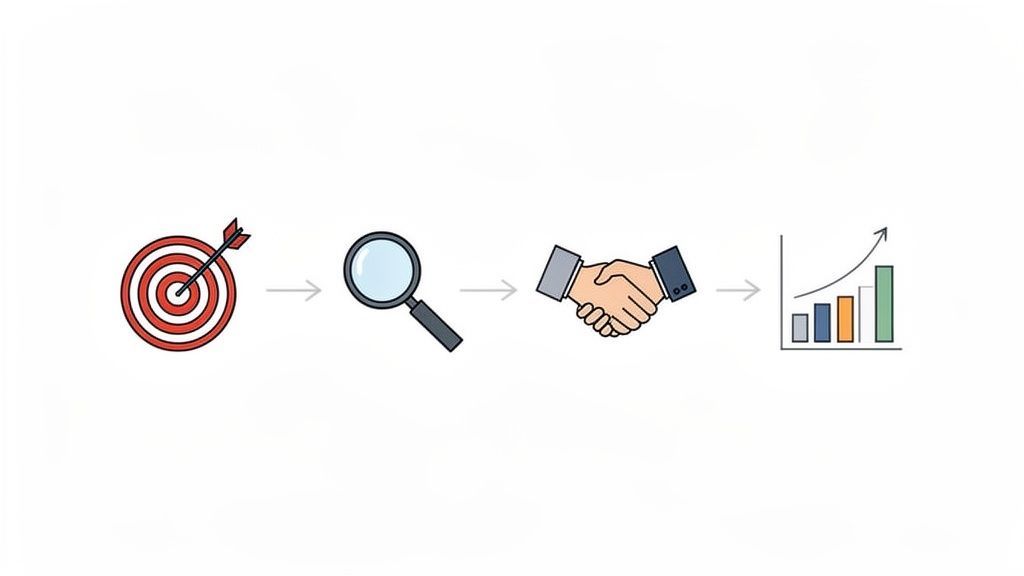
Treat this process as a strategic investment, because that's what it is. The right SEO partnership unlocks scalable growth by focusing on what actually matters—more qualified leads, higher sales revenue, and increased market share. The wrong one? A wasted budget, stagnant metrics, and a year of missed opportunities.
This guide provides a practical, no-fluff framework for marketing leaders and business owners who need to see tangible returns. We’ll show you how to vet an agency based on its track record, technical depth, and understanding of your specific business—whether you're a B2B SaaS company hunting for demo-ready leads or an e-commerce brand scaling revenue.
Focus on Business Outcomes, Not Vanity Metrics
It's easy to get distracted by metrics like keyword rankings and total traffic. While useful as secondary indicators, they don't impact your P&L. A true growth partner ties every action back to your bottom line.
Their reports and strategic discussions must center on the metrics that matter:
- Marketing Qualified Leads (MQLs) and Sales Qualified Leads (SQLs) from organic search.
- Customer Lifetime Value (CLV) attributed to SEO-driven acquisitions.
- Tracked organic revenue and Average Order Value (AOV) for e-commerce.
- Conversion rates from organic visitors to paying customers or trial users.
The most critical factor is finding an agency whose strategy is engineered to drive conversions. An agency that targets high-intent keywords will always deliver a better ROI than one that chases high-volume, low-value search terms.
This guide is your blueprint for finding a partner that understands this. This is especially vital when deciding between an in-house team or an agency, as any external partner must prove its value through measurable results.
At Ezca, our squad-based model and focused 90-day sprints are designed for exactly this kind of accountability. Our performance-driven strategies have directly generated over $100M+ in attributable revenue for our clients.
Define What SEO Success Looks Like for Your Business
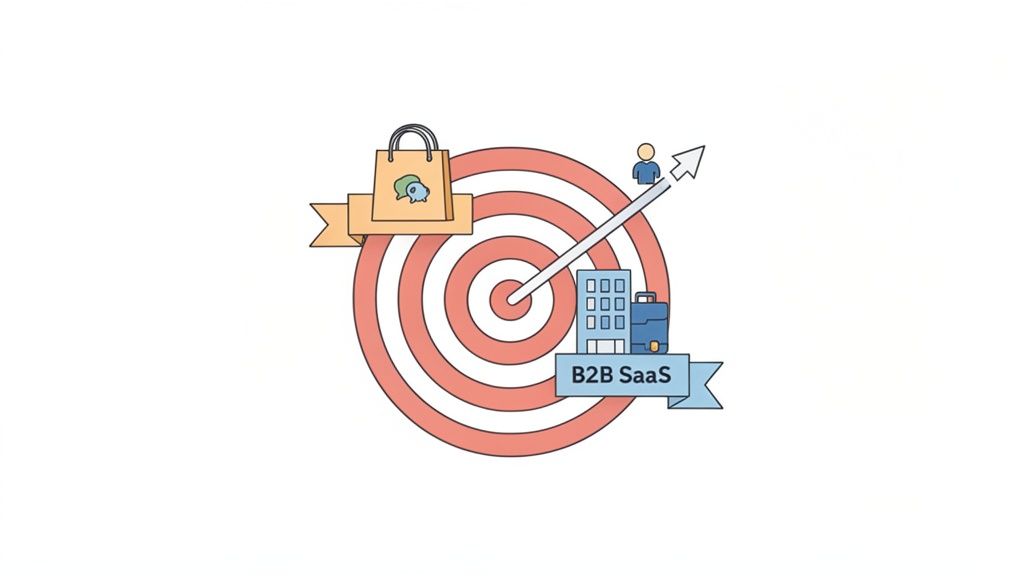
Before you draft a shortlist of agencies, you must define the destination. A common pitfall is hiring an SEO partner with a vague goal like "increase traffic." Six months later, traffic is up, but revenue is flat. Why? Because an SEO campaign without concrete business goals is just an expensive exercise.
Chasing "more traffic" is the fastest way to burn your budget. Any competent agency can increase traffic. The real question is whether it's the right traffic—visitors with commercial intent who are likely to convert.
You must look past vanity metrics and define what success means for your bottom line.
From Business Goals to SEO KPIs
The most effective approach is to work backward from high-level business objectives and translate them into specific, measurable Key Performance Indicators (KPIs). This exercise ensures you and your future agency are speaking the same language: the language of ROI.
From a CEO's perspective, keyword rankings are irrelevant; new customer acquisition is everything. For a B2B SaaS company, the translation should look like this:
- Business Objective: Increase new customer acquisition by 25% year-over-year.
- Primary SEO KPI: Generate 200 new Marketing Qualified Leads (MQLs) from organic search each quarter.
- Secondary SEO KPI: Increase rankings for 15 high-intent, bottom-of-funnel keywords into the top 3 positions.
This level of detail is non-negotiable. It immediately shifts the conversation from generic tactics to a targeted strategy. An e-commerce brand would have a different but equally specific target, like achieving a 40% increase in organic revenue within 12 months.
An agency that immediately starts talking about leads, conversions, and revenue is an agency that gets it. If their pitch revolves solely around traffic and rankings without connecting those metrics to your pipeline, that’s a major red flag.
Your Goals Dictate the Strategy
The goals you set will fundamentally shape the SEO strategy. A focus on MQLs demands a content strategy targeting problem-aware, solution-seeking keywords, driving users to book a demo or start a trial. An e-commerce revenue goal requires a heavy emphasis on technical SEO, category page optimization, and product-led content.
We cover this topic in much more detail in our guide on how to increase organic traffic with intent-focused strategies.
Having these goals defined before you start outreach puts you in control. It allows you to evaluate potential partners on their ability to deliver what truly matters.
Matching Business Objectives to SEO KPIs
Use this as a starting point. Armed with clear, revenue-centric goals, you're not just hiring a vendor—you're partnering with a team you can hold accountable for business growth.
How to Vet an Agency's Track Record and Case Studies
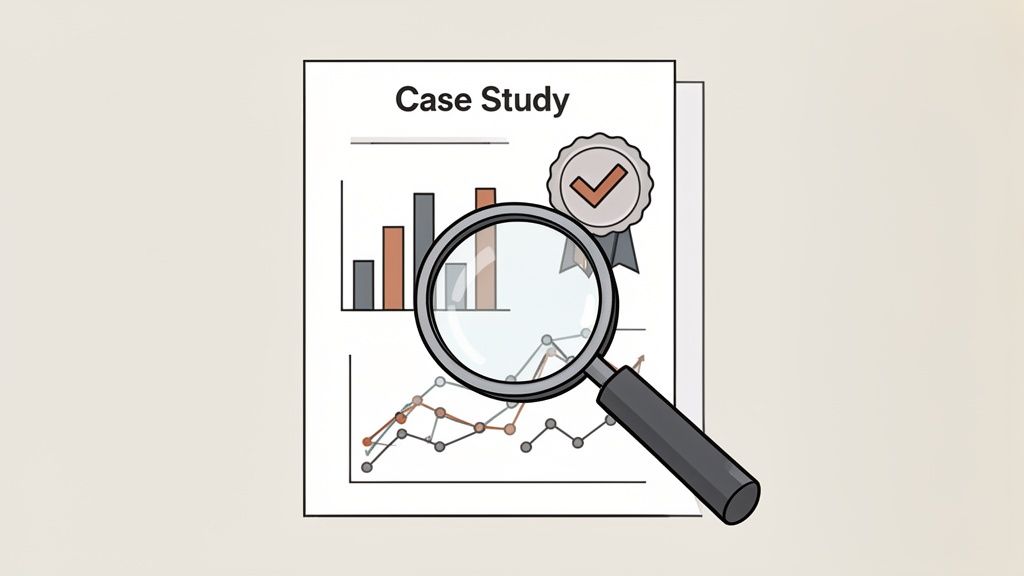
With your goals defined, it's time to separate proven agencies from the pretenders. When figuring out how to choose an SEO partner, past performance is the best predictor of future success. But you can't just take their word for it—you need to see verifiable proof.
Client logos and testimonials are a start, but they don't tell the whole story. You must request detailed case studies and learn how to deconstruct them. This isn't about being cynical; it's about getting past the marketing veneer to see if an agency can deliver results that matter to your business.
Moving Beyond Vanity Metrics
I've seen it a hundred times: an agency presents a case study with a traffic graph showing a 300% increase. It looks impressive, but that spike is meaningless if it didn't lead to more sales, qualified leads, or product signups. You have to push for specifics that connect their work to your revenue pipeline.
A genuinely skilled agency won't just show you traffic growth; they'll show you how it moved the needle on revenue or lead generation. They should be able to answer tough questions about business impact without hesitation.
The most critical part of vetting an agency is connecting their SEO tactics to bottom-line results. An agency that can’t demonstrate how they generated leads, sales, or signups for past clients probably can't do it for you either.
At Ezca, our case studies are built around performance. We track the numbers that our clients’ CFOs care about, like the $100M+ in e-commerce revenue or the 200K+ qualified B2B leads we've generated. This creates a clear, undeniable line from our work to their bottom line.
Deconstructing a Case Study
When you receive a case study, analyze it like a financial report. You're looking for the story behind the numbers. Here’s what to look for and what to ask.
The "Before" Picture
- What was the client's starting point? A new site, or a site recovering from a Google penalty?
- What were their baseline metrics for organic traffic, keyword rankings, and, most importantly, conversions (leads, revenue)?
- What specific business challenges were they facing in their market?
The Strategy and Execution
- What, specifically, did the agency do? Was it a deep technical SEO audit, a content cluster strategy, or a digital PR campaign to earn high-authority backlinks?
- How did they prioritize their actions? Ask them to explain the rationale behind their strategy.
- Verify their ethical standards. Shady tactics like buying traffic can get your site penalized. Understand why you must never buy bot traffic for SEO.
The Tangible Outcomes
- What were the final results? Demand specific numbers for traffic growth, rankings for high-intent keywords, and the quality of new backlinks.
- Crucially, what was the business impact? Ask for the number of leads, MQLs, or sales generated. Can they attribute revenue to their work?
- What was the timeline? Real SEO takes time. Be skeptical of promises for page-one rankings in 90 days.
Ask for Relevant and Recent Proof
Since there’s no official "SEO certification," an agency's documented track record is everything. Data shows the top Google result gets a 27.6% click-through rate (CTR), while the second page gets less than 1%. Agencies that can secure top rankings deliver disproportionate value.
Always ask for recent case studies from clients in your industry or with a similar business model. An agency that can show you fresh, relevant, and detailed results is confident in its methodology. Our own B2B content SEO case studies exemplify this, breaking down how we use a sprint-based approach to hit specific business goals. That’s the level of transparency you should expect.
The Agency Interview Questions That Reveal True Expertise
This is where you separate the experts from the salespeople. You've reviewed their proposals and case studies. Now, you need to see how they think. Asking sharp, situational questions is the only way to gauge their problem-solving abilities.
Generic questions yield rehearsed answers. You need to dig deeper with questions that force them to demonstrate their strategic approach to driving business growth, not just ranking keywords.
Gauging Their Strategic and Technical Chops
These questions test their real-world competence. Their answers will reveal how they analyze a situation, prioritize actions, and connect their work back to your business objectives.
- "Based on a quick review of our site, what are the top three SEO opportunities you see, and why do you consider them priorities?" A sharp agency will have done their homework. For an e-commerce site, they might flag poor internal linking on category pages or slow mobile page speed. For a B2B SaaS company, they might highlight a lack of content targeting bottom-of-funnel, "jobs-to-be-done" keywords. The "why" reveals their strategic thinking.
- "How do you adapt strategy when a Google core update impacts client rankings?" You're listening for a calm, data-driven process, not panic. A good partner will talk about analyzing SERP changes, auditing affected pages against Google's E-E-A-T guidelines, and reinforcing a sound long-term strategy rather than chasing reactive fixes.
- "Describe how you integrate SEO with other channels like PPC or content marketing." Modern marketing is integrated. A great agency will talk about using PPC data to identify high-converting keywords for SEO or using paid social to amplify new content to accelerate backlink acquisition. This demonstrates they think holistically about customer acquisition.
Understanding Their Process and Team
An agency's internal structure and process directly impact your experience. You need clarity on who you'll be working with and how they operate to prevent future headaches.
A huge part of choosing the right SEO agency is understanding the team dynamic. You need to know who owns the strategy and who your day-to-day contact is. Misalignment here is one of the most common reasons agency partnerships fall apart.
Ask these questions for clarity on roles and responsibilities:
- Who will be our main point of contact, and what's their strategic background? You need a strategic partner, not just a project manager. This person should be able to answer questions directly and offer strategic advice.
- Who is responsible for high-level strategy versus day-to-day execution? It's common to have a senior strategist steering the ship while specialists handle execution. Understanding this structure helps you know who to talk to about what.
- What is your process for understanding our product, customers, and market to create effective content? The best content comes from deep domain expertise. An agency like Ezca uses a process of interviewing product, sales, and customer support teams to extract unique insights for copy that converts. A vague answer here suggests they will produce generic content.
This line of questioning helps you determine if their model is a good fit. Whether you need technical SEO for a complex site or a global content strategy, these questions will tell you if the agency has the right people and processes.
Evaluating Proposals and Getting a Handle on Pricing
Once proposals arrive, the real evaluation begins. A proposal is more than a price tag—it’s a reflection of whether an agency truly listened to your needs.
You’re looking for a document that directly addresses your business goals. It should feel custom-built, not like a generic template. Does it clearly outline a scope of work (SOW) with specific deliverables, timelines, and owners? Vague promises are a deal-breaker. If they can’t define success on paper, you can’t hold them accountable.
A great proposal lays out a clear plan of attack, often using a 90-day sprint methodology. This breaks work into manageable phases, perhaps dedicating the first month to a technical audit and the next to building out high-intent content clusters. This shows a structured, agile process.
Decoding SEO Pricing Models
Understanding how an agency structures its fees is crucial for budgeting and calculating ROI. Most agencies use one of three main models.
- Monthly Retainer: The most common model. You pay a fixed fee each month for a predefined scope of services. It’s predictable for budgeting, but the SOW must be specific. You're paying for ongoing value, not just access. Retainers for serious businesses typically run from $5,000 to over $25,000 per month.
- Project-Based Fees: Ideal for one-off tasks with a clear start and end, like a site migration, a technical audit, or a targeted backlink campaign. It’s clean and straightforward but offers no ongoing support.
- Performance-Based Pricing: This model ties the agency's compensation to results, like a percentage of revenue growth or a fee per qualified lead. While it aligns incentives, be cautious. These agreements can be complex and may encourage a focus on short-term wins over sustainable, long-term strategy.
A top-tier proposal doesn't just give you a price; it proves the value. It should draw a straight line from their proposed activities to your business goals, showing exactly how their work will impact your bottom line.
Red Flags to Watch for in a Proposal
I've reviewed hundreds of proposals; the weak ones share common warning signs. Spotting these red flags will save you from a bad partnership.
Steer clear of any proposal that includes:
- Guaranteed Rankings: Run. No one can guarantee a #1 spot on Google. This is an outdated and unethical sales tactic that signals inexperience.
- Vague Deliverables: Phrases like "ongoing optimization" or "link building activities" without specifics are a red flag. What exactly will they do? How many articles? How many links? If they can't define it, they don't have a plan.
- A Cookie-Cutter Approach: If the proposal doesn’t reference your specific challenges, competitors, or goals, they weren't listening. They see you as just another contract.
To understand what a strong proposal looks like, review a comprehensive SEO proposal template. This provides a baseline for comparing agencies fairly. The right proposal will be transparent, customized, and focused on delivering measurable business results.
Structuring Your Partnership for Success
Signing the contract is the starting line, not the finish. The final piece of the puzzle is establishing a partnership built on transparency, communication, and mutual accountability. A great partner welcomes scrutiny because they are confident in the value they deliver.
This is what turns a vendor relationship into a strategic growth alliance. You should see regular, detailed reports that tie every SEO activity directly back to the business-critical KPIs you agreed on. This ongoing conversation ensures your SEO program is a dynamic part of your growth strategy, not a "set it and forget it" budget item.
Establishing Reporting and Accountability
A solid SEO report is a strategic document, not a data dump. It should tell a clear story about what’s working, what isn’t, and—most importantly—what the plan is for the next sprint. Insist on reports that provide actionable insights.
At a minimum, your reporting framework should include:
- Performance Against KPIs: The report must open with progress against your primary goals—MQLs, organic revenue, or trial signups.
- Organic Traffic and Conversion Trends: Look for segmentation showing traffic and conversions by page, topic cluster, or user intent.
- Keyword Ranking Changes: Focus on the movement of high-intent, bottom-of-funnel keywords tied to revenue.
- Backlink Acquisition Quality: The report should detail new links acquired, the authority of those domains, and the context in which they were earned.
The real gold standard for reporting is attribution. A great agency will be able to connect specific articles and technical optimizations to the actual leads and sales they generate, proving their ROI in black and white. If an agency struggles to provide this, they aren't a true performance partner.
This visual timeline breaks down those final checkpoints before you sign, making sure you’ve covered all your bases, from spotting red flags to digging into the contract details.
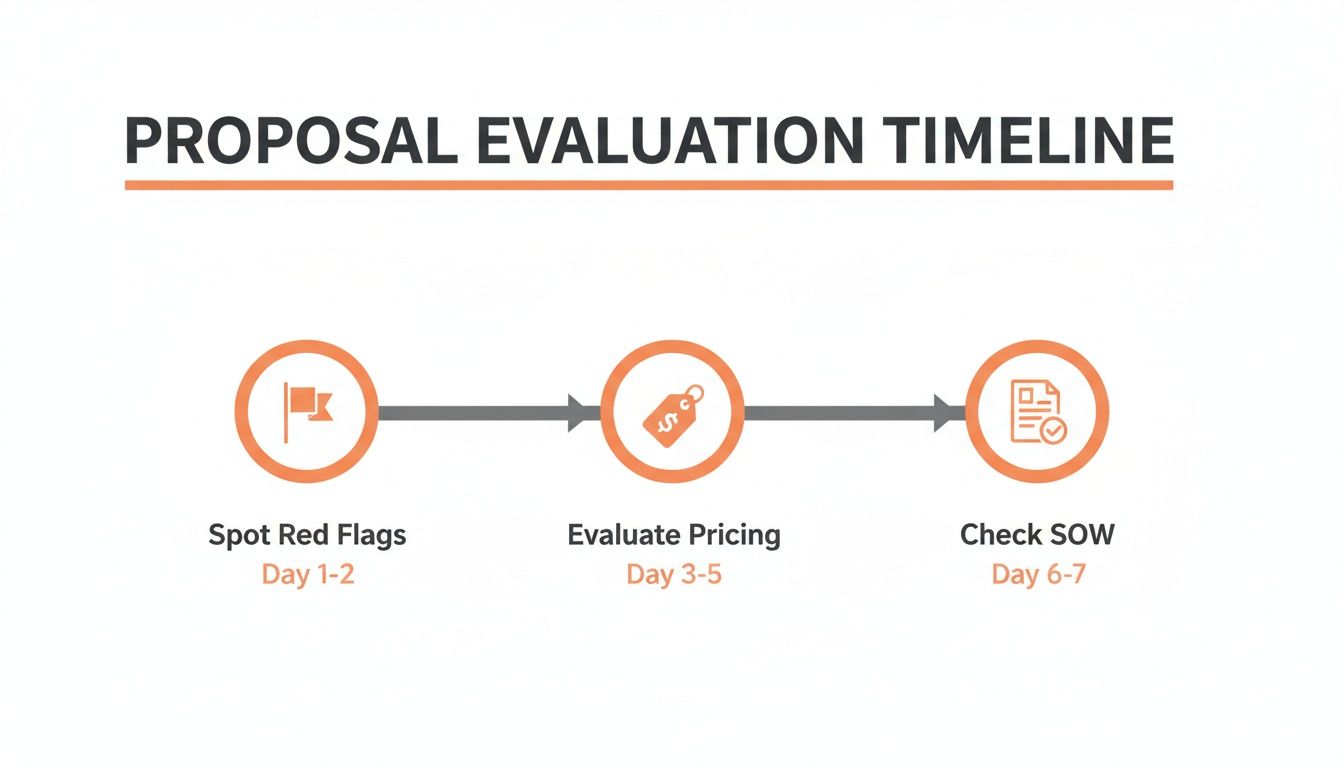
Think of these final evaluation steps as your last line of defense. They’re what protect you from partnering with an agency that can't actually deliver on its promises.
Communication and Strategic Alignment
Beyond static reports, regular strategy calls are essential. These meetings are your opportunity to review progress, discuss challenges, and align on strategy adjustments.
An agency that operates with an agile approach, like Ezca's 90-day sprints, will provide dynamic updates and be ready to pivot based on performance data. This is what keeps your SEO program nimble and effective.
Transparent reporting is non-negotiable and directly shows you the ROI. While vanity metrics have their place, you must demand breakdowns of attributable conversions from organic search. Remember, the top three results in Google get 54.4% of all clicks, so tracking your high-intent keyword rankings with precision is vital.
This data-first approach is how top partners deliver incredible growth—I've seen campaigns achieve organic traffic increases of 150-400% in under a year. For more on what to look for, you can explore detailed guidance on vetting agencies to ensure they can prove their value month after month.
Ultimately, this approach transforms the relationship from a service agreement into a genuine partnership. When both sides are aligned on goals and transparent about performance, you create a feedback loop that drives continuous improvement and measurable business growth.
A Few Lingering Questions About Choosing an SEO Agency
Even after thorough due diligence, a few practical questions often remain. Here are the most common ones I hear from marketing leaders and business owners.
How Much Should I Really Be Budgeting for SEO?
SEO costs vary widely, with retainers ranging from a few hundred dollars to over $25,000 a month.
For a serious business in a competitive market, a realistic budget is crucial. Plan to invest at least $5,000 to $15,000+ per month for an agency capable of moving the needle. Anything less is unlikely to provide the strategic depth and execution power needed to win.
Three factors drive this cost:
- The Scope: Are you seeking a full-service partner for technical SEO, content strategy, creation, and digital PR, or just one specific service? A comprehensive plan costs more.
- The Competition: Targeting "project management software" is vastly different from targeting "plumber in Dubuque, Iowa." A more competitive keyword landscape requires a greater investment.
- The Agency's Track Record: Elite agencies with a proven history of generating tangible revenue command higher fees. You are paying for their expertise and past success.
A word of caution on "bargain" SEO packages: low-cost providers often use outdated tactics or deliver low-quality work that won't impact your bottom line, wasting both time and money.
When Will I Actually See Results from This?
Patience is essential. While quick wins from technical fixes can occur early, SEO is a long-term investment. Expect to wait 6 to 12 months to see a meaningful impact on your business.
Meaningful impact means a measurable lift in organic traffic, qualified leads, and revenue—not just a few keywords moving up a couple of positions.
Here's a typical timeline:
- Months 1-3 (Foundation): The agency conducts audits, finalizes keyword strategy, and begins execution. You might see some initial ranking movement.
- Months 4-6 (Traction): New content starts to gain traction, and traffic from high-intent keywords begins to flow. The first attributable leads or sales often appear here.
- Months 7-12 (Momentum): Momentum builds as domain authority grows. You should start seeing a clear, positive return on investment.
Any agency promising page-one rankings in 90 days is either selling a fantasy or using risky, short-term tactics that could get your site penalized by Google.
If You Could Only Pick One Thing, What's the Most Important Factor in an Agency?
If I had to boil it all down to one thing, it's this: find an agency that is obsessed with business outcomes, not vanity metrics. A top-tier partner builds their entire strategy around driving what matters to you—leads, sales, and booked demos.
Pay close attention to how they define success in your conversations. Do they immediately pivot to how their work impacts revenue? Or are they stuck talking about traffic numbers and keyword rankings?
The right partner lives and breathes your pipeline. They should be able to draw a straight line from their proposed SEO activities to your company's growth. It's the core philosophy we live by at Ezca, where every single 90-day plan is laser-focused on delivering measurable ROI.
Ready to work with an agency that’s as committed to your bottom line as you are? Ezca Agency builds data-backed strategies and executes them relentlessly to drive predictable growth for SaaS and e-commerce brands. Discover how our performance marketing squads can help you scale.