
The CMO's Playbook for High-ROI Direct Response Ads
Master direct response ads to drive immediate, measurable growth. This guide covers strategies, metrics, and tactics to boost ROI for any business.
Direct response ads are engineered to do one thing exceptionally well: drive a specific, measurable action right now. It's advertising built on direct attribution, allowing you to trace every dollar spent directly to a result. For marketing leaders and business owners obsessed with ROI-driven growth, this isn't just another tactic—it's a core financial lever for the business.
What Are Direct Response Ads, Really?
The clearest way to define direct response is by contrasting it with brand advertising. Think of brand advertising as the long-term project of building a city's reputation. It happens over years, and it's nearly impossible to measure the impact of a single billboard on a given day.
Direct response ads are the 'Grand Opening' signs with a can't-miss, limited-time offer. They aren’t there to build a reputation for the long haul; they're there to pull customers through the door today. This isn’t just a different ad type; it's a different business philosophy focused on provoking a response and knowing immediately if your investment paid off.
As a business owner or marketing leader, that distinction is critical for budget allocation. While your brand campaigns build long-term equity, direct response is what fuels your short-term cash flow and validates your offer with cold, hard data.

It's All About Action and Attribution
Every direct response ad has one clear job: get a potential customer to perform a specific action. That might be making a purchase, downloading a whitepaper, or booking a demo. The action is always explicit and immediate.
The model works because it's a straightforward value exchange. You offer something valuable—a discount, a free trial, an exclusive report—and in return, the customer gives you a measurable action. This creates a transparent, real-time feedback loop between spend and revenue.
This obsession with data enables a powerful operational rhythm: the 90-day sprint. When you can track performance daily, you can rapidly reallocate budget away from underperforming campaigns and double down on the winners. It’s about ensuring every dollar is deployed for maximum ROI.
Direct Response vs. Brand Advertising: The Strategic Difference
To allocate budget effectively, you must understand the fundamental differences between these two approaches. One builds your name for tomorrow, while the other drives revenue today. This table breaks down exactly where they diverge.
Ultimately, a healthy marketing strategy needs both. Brand advertising creates the trust that lowers the cost of your direct response efforts. But without direct response, you’re just building a reputation without ever asking for the sale.
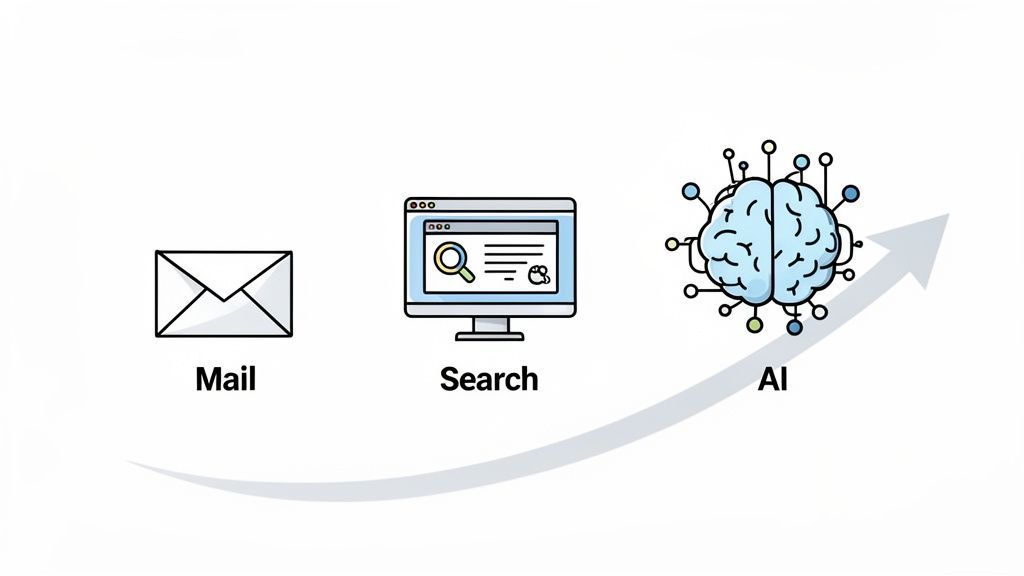
From Mailbox to Machine Learning: The Evolution of Direct Response
To master direct response ads, you have to appreciate their origins. This isn't a new concept from Silicon Valley; its roots are in direct mail. Those old-school mailers were the original accountable advertising, built on the exact pillars we rely on today: a compelling offer, a clear call-to-action, and a measurable outcome.
It might sound archaic, but that analog approach set a high bar for performance. Direct mail still boasts an impressive ROI, with some studies showing returns of 112%, often outperforming digital channels. It provides a tangible baseline for what "good" performance means. You can dive deeper into these numbers in this full advertising market analysis.
The Digital Revolution of Direct Response
The internet didn't invent direct response; it supercharged it. Platforms like Google and Meta took the core principles of targeting, offering, and tracking and gave them unprecedented scale and precision.
Suddenly, you weren't just mailing to a zip code; you could target users based on searches, demographics, and online behavior. The fundamental DNA remained, but the tools became infinitely more powerful.
- The Offer: A paper coupon became a unique discount code.
- The Call-to-Action: A tear-off reply card became a "Shop Now" button.
- The Tracking: Counting returned postcards became instant, pixel-based conversion tracking.
This shift from physical mail to digital clicks provided faster feedback loops, sharper targeting, and the ability to A/B test creative at a velocity impossible in print.
The AI-Powered Present
We are now in the next era: AI-driven direct response. Modern campaign management is far more than just setting an audience and a budget. Machine learning algorithms now optimize nearly every component in real-time, from audience selection to bidding and creative delivery.
AI doesn’t replace the fundamentals of direct response. It executes them with a speed and efficiency no human team ever could. It analyzes thousands of signals to predict who is most likely to convert, then adjusts bids and creative on the fly to maximize your ROI.
This is the exact model we've refined at Ezca. We blend timeless direct response principles with a powerful synthesis of AI and expert human strategy. This allows us to treat a marketing budget less like a fixed expense and more like a dynamic investment portfolio, constantly reallocating capital to the highest-returning assets. It’s the ultimate expression of the direct response philosophy, fully realized.
Actionable Tactics for Key Direct Response Channels
Strategy is essential, but execution is what drives revenue. A direct response plan proves its worth when it generates clicks and conversions. The key isn't to blast the same message everywhere, but to tailor your offer and creative to the unique user behavior on each platform.
Your goal—driving action—is constant. But how you achieve it must adapt to the channel. You need to know how to stop a user mid-scroll on Instagram just as effectively as you intercept a high-intent buyer on Google.
Social Media: The Art of Interruption
On platforms like Meta (Facebook and Instagram) or LinkedIn, your ad is an uninvited guest. You’re interrupting a user's feed, so your creative must be ‘thumb-stopping’—it needs to grab attention instantly and present an irresistible offer. For an e-commerce brand, this could be a dynamic user-generated video paired with a strong call to action, like "40% Off Ends Tonight."
For B2B marketers on LinkedIn, the goal shifts from an immediate sale to a high-value, low-friction exchange. Instead of pushing for a demo upfront, successful ads offer something genuinely useful, like a proprietary industry report or a free assessment tool.
- Utilize Native Lead Gen Forms: These forms pre-populate with a user's profile data, dramatically reducing the friction to convert. A 10% increase in form completion rate can have a massive impact on your Cost Per Lead (CPL).
- Target with Precision: Don’t just target an industry. Focus on specific job titles, company sizes, and skill sets to ensure your offer reaches actual decision-makers. This is fundamental to managing your CPL.
- Test Creative Relentlessly: Pit static images against short-form video. Test a carousel ad versus a single-image ad. Let the data, not assumptions, dictate which creative formats drive the best ROAS.
Paid Search: Capturing High Intent
Google Ads is a different game. You’re not interrupting; you’re providing an answer. A user is actively searching for a solution, which signals high intent. Your job is to align your ad and landing page perfectly with their search query.
If someone searches for "best CRM for small business," your ad headline must reflect that exact intent. A headline like "The #1 CRM for Small Businesses" confirms they are in the right place, leading to a higher Click-Through Rate (CTR) and better Quality Score.
At Ezca, we obsess over matching keyword intent with ad copy and landing page experience. This meticulous process ensures that clicks come from genuinely interested prospects, protecting your Return On Ad Spend (ROAS).
Podcast Ads: Leveraging Trusted Voices
Podcast advertising has emerged as a direct response powerhouse. The intimate relationship between a host and their audience creates an environment of unparalleled trust. The most effective tactic is the host-read ad, where the host personally endorses your product, often sharing their own experience.
The market data validates this. Direct response ads in podcasting reached USD 12.3 billion in 2024 and are projected to hit USD 21.4 billion by 2030, according to this detailed market report on podcast advertising. These personal endorsements often deliver conversion rates significantly higher than standard display ads.
Of course, these channels perform best when integrated. To learn more, read our guide on what multi-channel marketing means for your business.
Crafting Creatives and Copy That Convert
In direct response, your creative and copy do 100% of the heavy lifting. The most sophisticated media buying strategy is worthless if the ad itself fails to make someone stop, think, and act. This is where direct response diverges sharply from brand advertising. Your creative isn't art; it's a tool with one job: get a click, a lead, or a sale.
It all begins with the hook. Whether it's your headline or the first three seconds of a video, you must earn the user's attention. To see what this looks like in practice, check out these powerful hook sentence examples.
Building High-Converting Ads with the AIDA Framework
The AIDA formula (Attention, Interest, Desire, Action) is a reliable roadmap for structuring persuasive ad copy. It guides a prospect from initial awareness to conversion within a single ad experience.
- Attention: Your scroll-stopper. A bold claim, a disruptive image, or a question targeting a specific pain point. For a SaaS ad: "Still wasting 10 hours a week on manual reporting?"
- Interest: Now that you have their attention, hold it. Agitate the problem you just introduced. Show you understand their frustration and hint at a better way.
- Desire: Pivot from the problem to the promise. Show them what life looks like with your solution. Use testimonials, data points, or before-and-after visuals to make the transformation tangible.
- Action: Close with a clear, low-friction command. This is a direct instruction: "Get Your Free Demo," "Download the Report Now," or "Claim Your 50% Discount."
The Psychology of an Irresistible Offer
An effective AIDA structure needs fuel, and that fuel is your offer. A compelling offer is what turns a passive viewer into an active lead or customer. The best offers leverage core psychological triggers.
The heart of a great direct response ad isn’t just showing your product. It’s crafting an offer so compelling that the prospect feels like they'd be losing out if they ignored it. This is achieved by stacking value, urgency, and risk reversal.
To make your offer a no-brainer, combine these elements:
- Urgency & Scarcity: "Offer ends tonight" or "Only 50 spots left" activates a fear of missing out (FOMO) and compels immediate action.
- Social Proof: "Join 25,000+ happy customers" builds instant credibility. People feel safer following the crowd.
- Risk Reversal: A "30-day money-back guarantee" is one of the most powerful conversion tools. It completely removes the fear of making a bad purchase decision.
When you combine the AIDA framework with these psychological triggers, you stop "running ads" and start building systematic direct response engines. Getting creative right is a major lever for performance and is closely related to improving other KPIs, like learning how to increase your organic traffic.
The Metrics and Tracking That Define Your ROI
In direct response, running a campaign without precise tracking is like flying blind. The entire model is built on data—if you can't measure it, you can't manage it, and you certainly can't make it profitable. For a marketing leader, clean data is the foundation of smart decisions and the key to proving ad spend value to the C-suite.
Forget vanity metrics like impressions or likes. Focus on the numbers that directly connect to your P&L. These are the core metrics that tell the true story of campaign performance and define your ROI.
The Metrics That Truly Matter
We judge direct response success by a clear set of performance indicators. While Click-Through Rate (CTR) offers an early clue about creative effectiveness, the real story is told by metrics that track the entire journey from click to revenue.
- Cost Per Acquisition (CPA): Your true cost to acquire a paying customer. For most direct response campaigns, this is the North Star metric.
- Return On Ad Spend (ROAS): The ultimate measure of profitability. ROAS shows you how much revenue you generate for every dollar of ad spend. A 3:1 ROAS means you generated $3 for every $1 spent.
- Customer Lifetime Value (LTV): This metric looks beyond the first purchase to estimate the total revenue a customer will generate. A high LTV allows you to justify a higher CPA, enabling you to scale more aggressively.
The hierarchy of these metrics shapes your entire strategy, from copy to creative. This visual breaks down how effective copy moves a user from awareness to a measurable action.
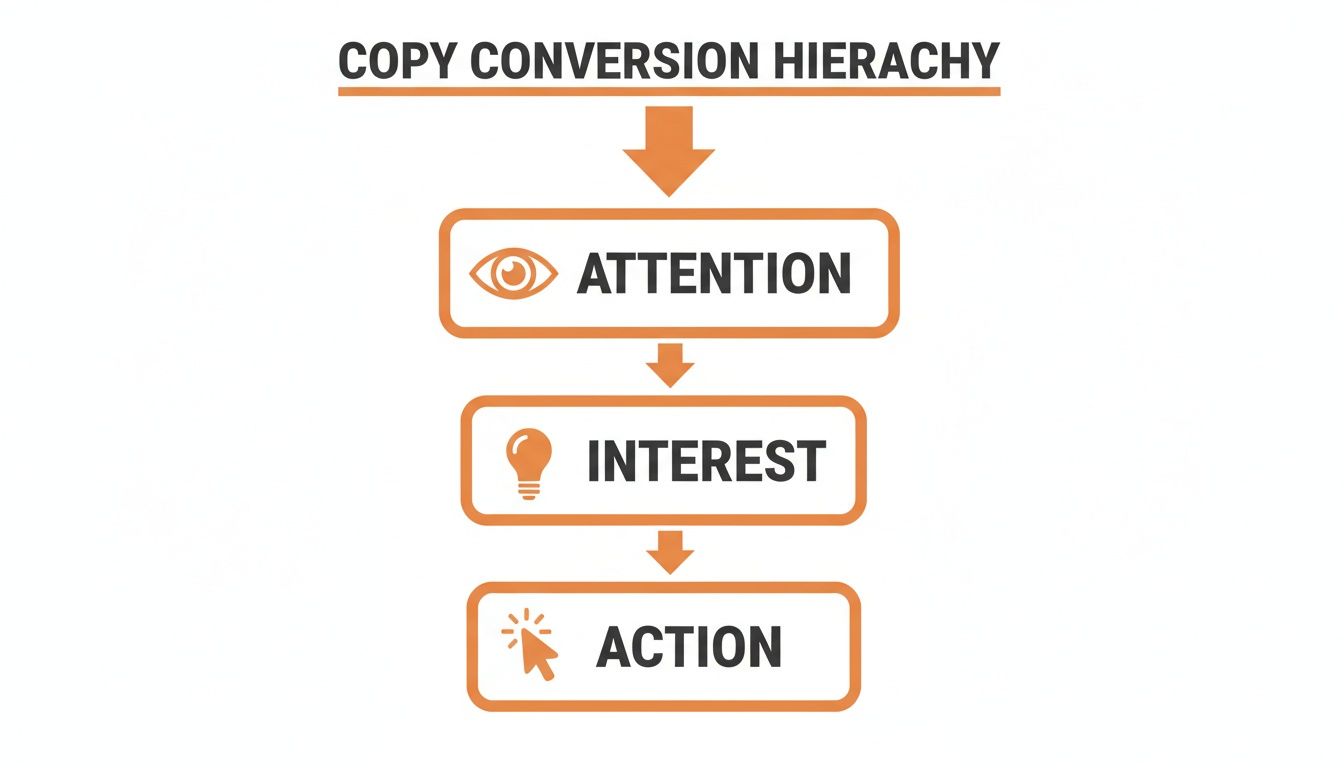
This flow is a critical reminder that every element of an ad must work in concert to drive the user toward a specific, trackable goal.
Building Your Foundational Tracking Stack
To get clean, reliable data, you need the right tools working in harmony. A robust tracking setup is non-negotiable. At Ezca, we ensure this foundation is rock-solid before a single ad dollar is spent.
- Platform Pixels: Install tracking pixels from each ad platform (e.g., Meta Pixel, Google Ads Tag) across your website. These code snippets are essential for tracking conversions and building high-value retargeting audiences.
- UTM Parameters: Use Urchin Tracking Module (UTM) codes on all ad links. These tags provide granular attribution, telling your analytics platform exactly which campaign, channel, and ad drove each visitor.
- Analytics Platform: A tool like Google Analytics 4 should be your central source of truth, consolidating data from all your channels to analyze user behavior and multi-touch attribution.
Understanding channel-specific performance is crucial. For example, a deep dive into SMS marketing conversion rates can reveal optimization opportunities for that high-engagement channel.
The incredible ROI of direct response is why it remains a cornerstone of performance marketing. Even today, direct mail delivers an average ROI of 112%, with 74% of marketers calling it a top performer. A significant 26% of consumers report that direct response mail helped them make smarter purchasing decisions, proving its lasting impact.
Launching Your 90-Day Direct Response Sprint
Theory is useless without a concrete action plan. We execute all direct response campaigns in focused 90-day sprints—a framework that transforms strategy into measurable quarterly results.
This approach prevents analysis paralysis and breaks down large goals into manageable stages, allowing for rapid learning and adaptation. The goal isn't perfection on day one; it’s to build momentum, gather data quickly, and hold your budget accountable.
Month 1: Foundation and Initial Testing
The first 30 days are about establishing your baseline. The objective is to get your tracking infrastructure right and launch initial tests to gather benchmark performance data.
Your month one checklist:
- Audience & Offer Definition: Solidify your ideal customer profile and the core pain points your offer solves.
- Technical Setup: Implement all tracking pixels and UTM parameters. This is non-negotiable for ensuring 100% data integrity from day one.
- Initial Creative Development: Build your first ad sets using the AIDA framework, focusing on a strong hook and a clear call to action.
- Small-Budget Launch: Go live on 2-3 high-potential channels. The goal is not profit, but to establish your initial CPA and CTR benchmarks.
Month 2: Optimization and Scaling
With a month of data, it’s time for decisive action. Month two is dedicated to analyzing performance and reallocating resources.
The rule is simple: cut your losers and feed your winners. There is no room for emotional attachment. If a campaign isn't hitting your target CPA, kill it and reallocate that budget to one that is.
During this phase, you double down on what works. Increase spend on your best-performing ad sets and scale campaigns that are delivering profitable returns. This is also when you'll have a clear sense of your team's capacity, a common decision point when considering building an in-house team versus hiring an agency.
Month 3: Expansion and Refinement
In the final month of the sprint, your focus shifts to strategic expansion. Your winning campaigns are now running at scale and delivering predictable ROI. The goal is to build on that success and inform your next sprint.
Use this time to test new variables: launch on a new channel, test a new audience segment, or experiment with a different offer. The insights gathered here become the foundation for your next 90-day plan, creating a continuous cycle of data-driven growth and turning marketing into a predictable revenue engine.
Frequently Asked Questions About Direct Response Ads
If you're a business owner or marketing leader considering direct response ads, you likely have questions. It operates differently from traditional advertising, so let's address the most common ones.
How Much Should I Budget for My First Campaign?
The right answer isn't a specific dollar amount—it's an approach. Start with a test budget you are comfortable learning with, sufficient to get statistically significant data from two or three channels.
Think of this initial budget as a data acquisition cost, not a profit driver. You are spending money to determine your baseline Cost Per Acquisition (CPA). Once a channel proves it can deliver customers at a viable CPA, you have a data-backed case for scaling investment.
How Quickly Will I See Results?
You will see leading indicators—clicks, impressions—almost immediately. However, the business metrics that truly matter, like your CPA and Return On Ad Spend (ROAS), require more time.
Expect to see early performance indicators within the first 1-2 weeks. However, you need to allow 30-45 days for campaigns to mature. This gives platform algorithms time to optimize and provides you with enough data to make informed decisions about scaling or cutting spend.
What Is the Biggest Mistake to Avoid?
By far, the most common and costly mistake is launching with incomplete or nonexistent tracking. The entire premise of direct response is to measure the response. If you cannot do so accurately, you are simply guessing.
Without clean data from UTMs and conversion pixels, you are flying blind. A close second is using vague, brand-style creative. A direct response ad must have a clear, specific message and an unambiguous call to action that tells the user exactly what to do next.
Ready to turn your ad spend into a predictable revenue engine? The team at Ezca specializes in data-driven 90-day sprints that deliver measurable results. Schedule a consultation with us today to see how we can build a performance marketing strategy that drives growth for your business.