
Data-Driven Marketing Solutions That Actually Drive ROI
Stop guessing and start growing. This guide reveals actionable data-driven marketing solutions to increase ROI, with real-world strategies for 2026 and beyond.
Marketing leaders and business owners know the feeling: you pour budget into campaigns based on intuition and hope for the best. This approach turns marketing into an unpredictable expense rather than what it should be: a reliable revenue engine.
Data-driven marketing solutions replace that guesswork with concrete evidence. It’s about using real customer data to steer every single decision—from your channel mix to your ad copy—ensuring your budget is spent on what actually works to drive bottom-line results.
Moving Beyond Guesswork With Data-Driven Marketing
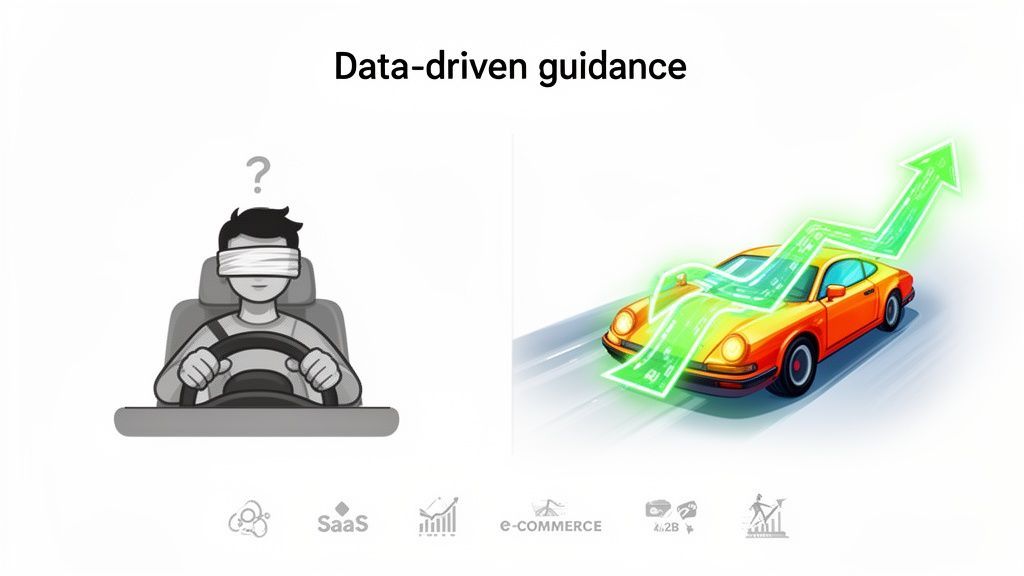
Many marketing leaders launch campaigns that feel like a shot in the dark. You approve the budget, the team gets to work, and everyone crosses their fingers for a positive ROI. That old method is like driving blindfolded—you might get somewhere eventually, but the trip is risky, inefficient, and burns through cash.
A data-driven approach, on the other hand, is like having a modern GPS for business growth. Instead of assuming what your audience wants, you use real-time data to map out every strategic move, turning marketing into a predictable, scalable function.
The difference is striking. Research shows that companies embracing data-driven marketing are six times more likely to be profitable year-over-year. That’s because every choice—from the ad creative you run to the channels you invest in—is backed by evidence, not just opinion.
How Data-Driven Decisions Create Predictable Growth
When you base your strategy on evidence, your results become measurable and repeatable. This is how the marketing department stops being seen as a cost center and starts being recognized as a predictable source of revenue—giving executives the clarity and confidence they need to invest in growth.
Here’s how this looks in practice with real examples:
- E-commerce: A clothing retailer analyzes purchase history and browsing patterns to send personalized product recommendations via email. Real-world result: This tactic regularly lifts repeat purchase rates and increases average order value (AOV) by 10% or more.
- B2B: A software firm tracks which webinars or whitepapers generate the most qualified demo requests. They then double down on creating content around those winning topics, which improves lead quality and slashes customer acquisition cost (CAC).
- SaaS: A subscription business monitors user behavior to identify customers at risk of churning. By proactively offering support or a targeted incentive, they can reduce churn by 5-10%, directly boosting customer lifetime value (LTV).
The Essential Shift in Mindset
In every one of these cases, data reveals the "why" behind customer behavior, allowing for smart, targeted actions that deliver tangible results. It’s not about collecting data for the sake of it; it’s about turning those numbers into actionable insights that fuel real growth.
This philosophy is the foundation of everything we do at Ezca. We believe that by relentlessly tracking performance, we can systematically identify what works, cut what doesn't, and reallocate your budget to maximize ROI. Using data isn’t just an advantage anymore—it’s a fundamental requirement for staying competitive. This guide provides the actionable framework to implement these solutions in your business.
The Four Pillars of a Modern Marketing Engine
To build a marketing function that generates predictable revenue, you need a system. A truly effective data-driven marketing solution is built on four core pillars. They all work together, turning abstract numbers into real, tangible business growth.
Think of it as a high-performance engine. Each part is critical for driving you forward, and if one piece is missing, the whole thing sputters. This framework breaks down the process, showing how you move from collecting raw data to measuring financial impact, making sure every action is intentional and ROI-focused.
1. Strategic Data Collection
First things first: this isn't about collecting all the data. It's about collecting the right data. Many businesses drown in a sea of irrelevant metrics. The goal is to zero in on the information that directly signals customer intent and business health. That means tracking not just what happens, but why it happens.
For a B2B SaaS company, this means looking beyond simple website visits. Actionable data points include:
- User Behavior: Which features are trial users actually engaging with? Where do they get stuck? Tools like Mixpanel or Amplitude reveal product-market fit and pinpoint opportunities to improve onboarding.
- Content Engagement: Which whitepapers or case studies are prospects downloading right before requesting a demo? This identifies the content resonating with your highest-intent audience.
- Firmographics: What is the company size, industry, and revenue of your best customers? This data helps you sharpen your ideal customer profile (ICP) and focus ad spend where it counts.
This selective approach ensures you're gathering actionable signals instead of just noise. It’s the foundation for all your data-driven marketing solutions.
2. Insightful Analysis
Once you have the right data, the next step is to turn it into insight. Raw numbers are meaningless until you analyze them to uncover the patterns, trends, and stories hidden within. This is where human expertise, often augmented by AI, becomes critical. Your team’s job is to ask the right questions of the data.
For an e-commerce brand, a powerful analysis might look like this:
- They notice a high cart abandonment rate specifically among mobile users.
- By digging into session recordings and heatmaps, they discover a clunky usability issue in the mobile checkout flow.
- They also see from Google Analytics that customers who watch at least three product videos have a 30% higher average order value (AOV).
The point of analysis is to translate data points into a clear narrative. It’s about finding that "aha!" moment—like realizing customers from a specific social media channel have a 50% higher lifetime value (LTV) than those from search ads. This insight has immediate ROI implications.
3. Actionable Strategy
Insights are only valuable when they lead to action. This third pillar is about turning what you’ve learned into concrete marketing campaigns and strategic adjustments. It’s where you bridge the gap between knowing something and doing something about it. Every strategy should be a direct response to a data-backed insight.
Let’s follow the e-commerce example:
- Insight: The mobile checkout is flawed and costing sales.
- Action: The CRO team prioritizes an A/B test to simplify the mobile payment process. Metric to watch: Conversion Rate.
- Insight: Product videos are driving much higher AOV.
- Action: The content team creates more videos for top-selling products, and the paid media team tests video ads on Facebook. Metric to watch: Average Order Value.
At Ezca, we build our 90-day sprints around this pillar. We analyze performance data weekly and dynamically shift budgets toward the strategies delivering the highest return. This ensures our clients’ resources are always focused on what’s proven to work, not just what we think will work.
4. Measurement and Iteration
The final pillar closes the loop. After launching your data-informed campaigns, you must measure their performance against the goals and KPIs you set. This isn't a one-and-done report; it's a continuous cycle of learning and optimizing. Did the changes work? What was the ROI? What did we learn for the next sprint?
This constant cycle of measuring and iterating is the true engine of growth. It's how you refine your understanding of your customer and make smarter decisions over time. This is also how you prove marketing’s value to the C-suite with clear metrics like Customer Acquisition Cost (CAC), LTV, and marketing-sourced revenue.
To get a better sense of how to apply this thinking across your channels, check out our guide on creating an effective multi-channel marketing strategy. Each pillar feeds the next, creating a self-improving system that turns marketing from a cost center into your most powerful growth driver.
Your 90-Day Sprint to Data-Driven Results
Jumping into data-driven marketing can feel overwhelming. The idea of overhauling your entire strategy sounds huge, but it doesn't have to be. Forget about trying to do everything at once. The secret is to think in terms of a 90-day sprint.
This approach breaks the massive goal of "becoming data-driven" into a practical, step-by-step plan. Each month builds on the last, creating a rhythm of continuous improvement that delivers tangible wins—fast.
At its heart, the process is simple: gather the right information, figure out what it's telling you, build a strategy around those insights, and measure the results to calculate ROI.
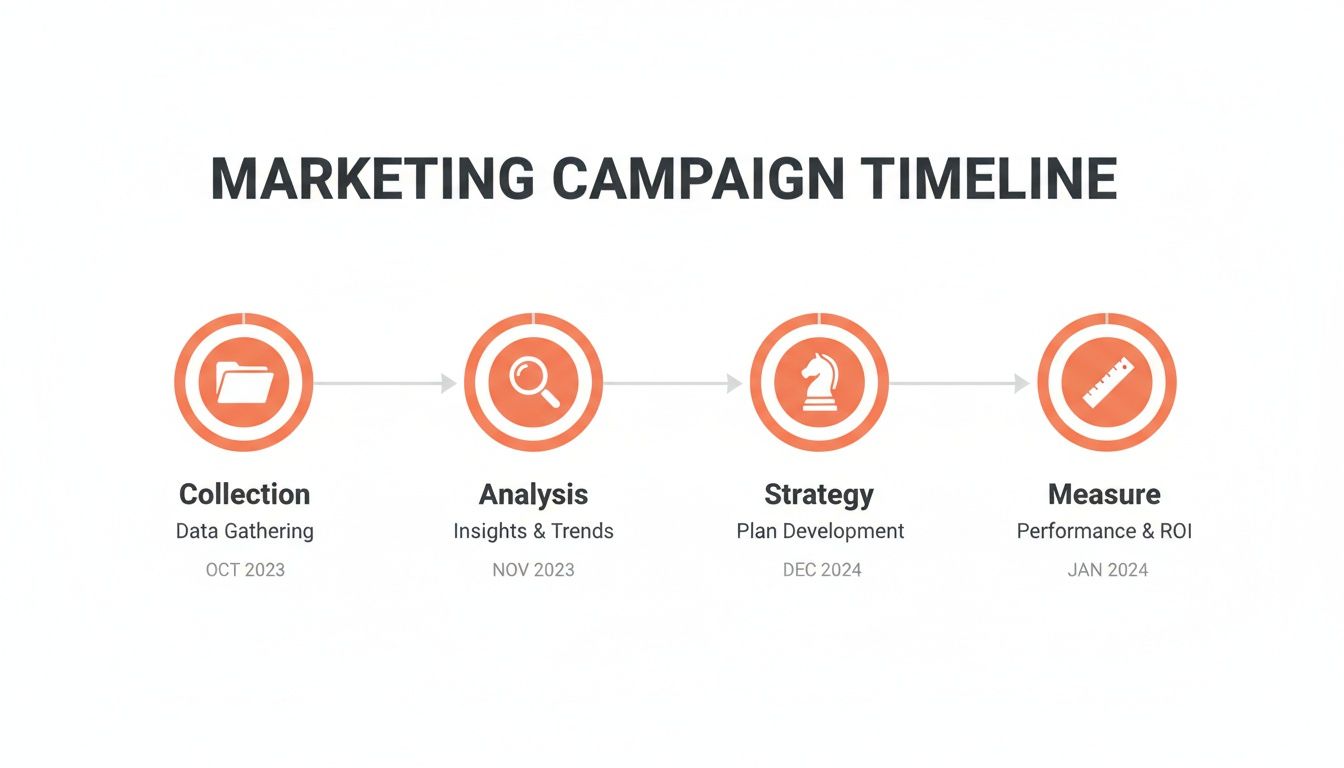
This cycle is the engine behind every successful data-driven marketing program we've ever built.
Days 1-30: Audit and Foundation
The first month is about getting your house in order. You can't make smart decisions when your data is messy or spread across disconnected platforms. The goal here is to create a single source of truth that your team can trust.
Your key objectives are:
- Unify Your Analytics: Pull your core platforms—Google Analytics, your CRM, your email tool—into one dashboard to see the full customer journey.
- Define Your Real KPIs: Move past vanity metrics. Zero in on the numbers that matter to the business, like Customer Acquisition Cost (CAC), Customer Lifetime Value (LTV), and Marketing-Sourced Revenue.
- Run a Performance Audit: Dig into what's already working and what’s not. Identify your best-performing blog post that drives demo requests or the ad campaign with a painfully high CAC. This audit provides a clear baseline and highlights quick wins.
Days 31-60: Launch and Test
With a solid foundation, month two is for action. Take the insights from your audit and launch small, controlled pilot campaigns. The point isn't to be perfect; it's to get real-world data and feedback as quickly as possible.
This is where you challenge assumptions. You might be convinced customers care about Feature X, but a simple landing page A/B test could prove they respond much better to Benefit Y. That discovery can save you a fortune in ad spend.
Here's where to focus your energy:
- Launch Pilot Campaigns: Pick one or two promising channels from your audit and launch a test. If data showed LinkedIn brings in high-LTV customers, start there with a small, dedicated budget.
- A/B Test Key Variables: Be scientific. Test one thing at a time, whether it's an email subject line, a call-to-action button, or ad creative.
- Monitor Real-Time Data: Check campaign performance daily. Are click-through rates exceeding benchmarks? Is your cost per lead on target? Early signals will tell you if you're on the right track.
At Ezca, this agile approach is core to our 90-day sprints. We use this testing phase to find the winning combination before pouring significant budget into it, which minimizes risk and maximizes ROI from the start.
Days 61-90: Optimize and Scale
The final month is where the magic happens. You now have hard data from your tests, and it's time to turn those learnings into scalable growth. The mission is to kill what isn't working, double down on what is, and create a playbook for future success.
Your priorities for this final stretch are:
- Analyze Test Results: Dive deep into the performance data. Identify the clear winners—the ad, message, or channel that delivered the best results against your core KPIs.
- Reallocate Your Budget: This is the most important step. Confidently move money away from underperforming campaigns and funnel it into the proven winners. This single action is what separates truly data-driven marketing solutions from the rest.
- Document and Repeat: Turn your successful campaign into a blueprint. Document the audience, messaging, and tactics so your team can replicate this win again and again.
This 90-day cycle creates a powerful feedback loop that drives predictable growth. For teams wanting to fast-track results, a tool like lunabloomai's Starter App can provide the framework to execute a sprint like this effectively.
The industry is clearly shifting toward "AI-augmented specialists" who pair deep expertise with smart technology. We consistently see this approach lead to conversion lifts of 20-40% in just 90 days. You can discover more about how these trends are shaping marketing strategies for 2026.
Bringing Your Data-Driven Strategy to Life, Channel by Channel
A brilliant strategy on paper means nothing if it doesn't translate into real-world action. This is where we move from big-picture insights to the specific tactics that make a difference on each marketing channel. It’s the point where data stops being a buzzword and starts becoming your most valuable asset.
Let’s skip the generic advice. Here’s what it actually looks like to execute a data-driven plan across the channels that matter most to your business.
Put Your SEO on a Data-First Diet
Modern SEO has moved far beyond simply chasing keywords. It's about deeply understanding user intent and how your content actually performs. Data shows you where to focus your limited resources for the biggest impact on qualified traffic and conversions.
- Prune and Refresh Your Content: Use Google Search Console and analytics to find pages with high impressions but low click-through rates, or content with declining traffic. Instead of starting from scratch, you can often get a faster ranking boost by refreshing these assets with new data, updated examples, and stronger internal links.
- Build Topic Clusters That Convert: Identify your "money pages"—the articles that consistently generate the best leads or sales. Use that data as a blueprint to build out topic clusters around those proven themes. This creates a powerful content network that cements your authority and pulls in valuable long-tail search traffic. For a deeper dive, check out our guide on how to increase your organic traffic.
Fine-Tune Your Paid Ads for Real-Time ROAS
Paid advertising is the ultimate data laboratory. Every dollar spent, every click, and every conversion is a data point for immediate optimization. Stop obsessing over surface-level metrics like cost-per-click (CPC) and start focusing on what truly matters: Return on Ad Spend (ROAS) and Customer Acquisition Cost (CAC).
A B2B tech client was spending heavily on LinkedIn Ads with mediocre results. By analyzing CRM data, we found that leads from Google Search Ads, despite a higher initial CPL, had a 2x higher conversion rate to 'Sales Qualified Lead'. We shifted 40% of the LinkedIn budget to Google Ads and lowered their overall CAC by 35% in one quarter.
This is dynamic budget allocation in action—a cornerstone of the data-driven marketing solutions we build at Ezca. We don’t set and forget budgets; we adjust them weekly based on what the numbers tell us is delivering the highest return.
Use User Behavior to Guide Conversion Rate Optimization (CRO)
Conversion Rate Optimization is how you turn browsers into buyers. A data-driven approach to CRO takes the guesswork out of the equation. Instead of throwing random ideas at the wall, you let actual user behavior tell you what to test.
Here’s a practical, three-step process:
- Heatmap and Scroll Map Analysis: Tools like Hotjar visually show where users are clicking, scrolling, and getting stuck. Are they clicking on non-clickable elements? Are they abandoning a page before seeing your CTA? This data provides an actionable to-do list for improvement.
- Session Recordings: Watch anonymized recordings of real users navigating your site. It’s the fastest way to uncover frustrating usability issues or friction points in your checkout process that raw analytics numbers will never reveal.
- Form Analytics: Watch how people interact with your lead forms. A massive drop-off on a specific field is a red flag. The field may be confusing, ask for too much information, or be unnecessary. Test removing it.
Give Your Social Media and Email a Personal Touch
For channels like social media and email, data is what separates a welcome message from annoying spam. It’s all about sending the right thing, to the right person, at the right time.
For example, when planning your content calendar, check a data-driven guide on LinkedIn posting times to ensure posts land when your audience is most engaged. For email, this means segmenting your list based on past behavior—like products viewed, content downloaded, or last purchase date—to send campaigns that feel hyper-relevant.
The role of AI in refining this process is only getting bigger. According to Salesforce's latest research, 83% of sales teams using AI in their data toolkit saw revenue growth, compared to only 66% of those who didn't. This shows how combining smart tech with human expertise—like we do in our 90-day sprints—can make a huge difference, a point reinforced by these marketing statistics.
Measuring What Matters for True Business Impact
As a marketing leader or business owner, you’re constantly under pressure to prove ROI. Drawing a straight line from your marketing budget to the company's bottom line can feel impossible if you're stuck reporting on vanity metrics like impressions and social media likes. These numbers mean little to the C-suite.
A truly data-driven marketing solution cuts through that noise. It builds a system that connects every marketing dollar to a real business outcome, giving you the confidence to report on your true impact without hesitation.
First Things First: Getting Attribution Right
Before you can measure impact, you have to know where to give credit. Attribution is simply figuring out which marketing touchpoints convinced a customer to buy. If you can’t get this part right, you’re flying blind, never knowing which channels are actually driving revenue.
The trick is to pick a model that makes sense for your sales cycle.
- First-Touch: Gives 100% of the credit to the first time a customer interacts with you (e.g., an ad they clicked). It's useful for measuring top-of-funnel awareness.
- Last-Touch: Gives 100% of the credit to the final step before converting (e.g., clicking "Request a Demo"). It’s easy to track but ignores the entire journey.
- Multi-Touch: Distributes credit across all touchpoints that influenced a sale. Models like Linear, U-Shaped, or W-Shaped give a much more balanced and realistic picture of how your channels work together.
Choosing the right model is critical. A B2B company with a six-month sales cycle using a last-touch model is making a huge mistake. It would completely erase the value of the webinars, whitepapers, and email nurtures that did the heavy lifting early on.
Shifting Focus to KPIs That Actually Matter
Once you know how to assign credit, it’s time to focus on the numbers that reflect real business health. Your CFO doesn't care about a viral video. They care about revenue, profitability, and sustainable growth.
Your dashboard should be a "single source of truth" centered on a few core, business-critical KPIs.
A recent survey revealed that a staggering 65% of marketers find it difficult to show the quantitative impact of their campaigns. The answer isn't more data; it's a relentless focus on the right data—the KPIs that leave no doubt about marketing's value to the business.
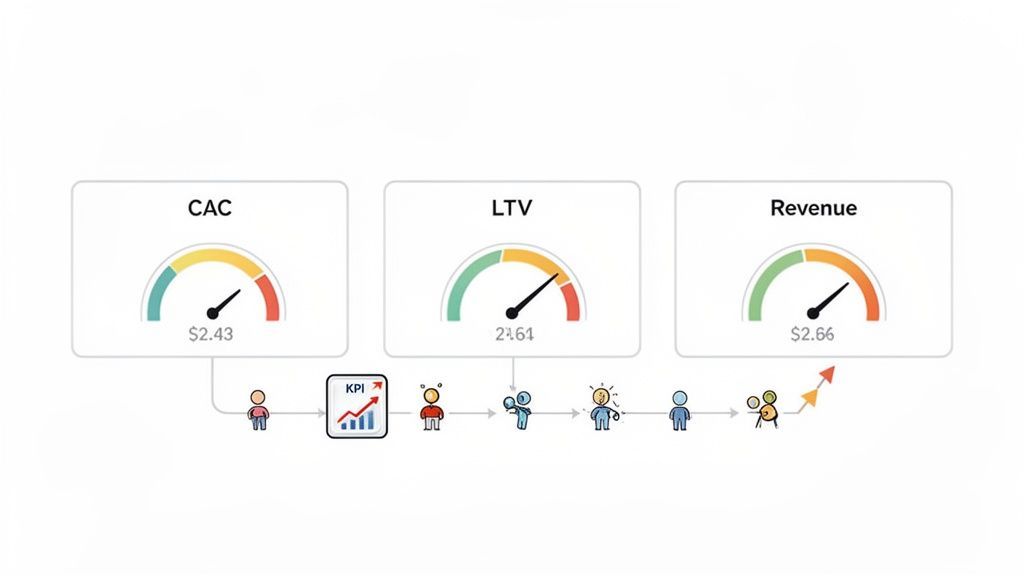
Your core dashboard should always track:
- Customer Acquisition Cost (CAC): How much does it cost to acquire one new paying customer? Calculated by dividing total sales and marketing spend by the number of new customers.
- Customer Lifetime Value (LTV): What is the total revenue you can expect from a single customer? A healthy business should aim for an LTV that is at least 3x your CAC.
- Marketing-Sourced Revenue: What percentage of the company's total revenue came directly from marketing's efforts? This is the ultimate proof point for demonstrating marketing’s contribution to the bottom line.
At Ezca, we build every client dashboard around these core metrics. This level of transparency shows our clients precisely how our work moves the needle, transforming their marketing function from a cost center into a predictable engine for growth.
Choosing Your Path: Agency Partner vs. In-House Team
Every marketing leader hits a strategic crossroads: how do we build the team that will actually get us to the next level? Do you invest in building an in-house group of data specialists from scratch, or do you partner with a dedicated performance agency?
There's no single "right" answer. The choice has significant impacts on your budget, speed, and results.
Building an in-house team is appealing because you get people who live and breathe your brand. But this path comes with a hefty price tag—salaries, benefits, and expensive software subscriptions add up quickly. Hiring the right talent is slow, and it can easily take a year before a new team is running at full steam.
The alternative is partnering with a specialized agency. This gives you instant access to a battle-tested team with proven systems. An agency like Ezca brings cross-industry knowledge from solving similar challenges for other companies. That outside perspective is invaluable for spotting blind spots and kickstarting growth from day one, all without the heavy overhead and long-term commitments of hiring.
We cover this topic in much more detail in our complete guide to in-house vs. agency marketing.
A Strategic Comparison
To make the right call, you have to honestly weigh the differences in cost, speed, and expertise. For many businesses, the sheer investment required to build a proper data-driven marketing team internally is a non-starter.
Consider the ROI: the fully-loaded cost for just one senior data analyst—including salary, benefits, training, and software—can easily top $150,000 a year. An agency partnership often gives you a full team of specialists for a fraction of that cost.
Let's lay out the key differences in a simple decision matrix to make it clearer.
Decision Matrix: In-House Team vs. Performance Agency
Ultimately, this decision comes down to your immediate goals and resources. If you have significant capital and a long-term plan to build a large internal department, going in-house can be a great move.
However, for most businesses that need fast, cost-effective, and scalable data-driven marketing solutions, a flexible partnership with a performance-focused agency like Ezca is the most powerful and efficient path to growth.
Frequently Asked Questions About Data-Driven Marketing
When considering a shift to a data-first approach, a few questions always come up. Getting straight answers is the only way to move forward with confidence. Here are practical responses to the most common concerns from business owners and marketing directors.
What Is the First Step with Limited Resources?
If your budget is tight, don’t try to boil the ocean. The most powerful first step is a focused performance audit. Open your existing Google Analytics and CRM data and hunt for your single best-performing asset.
Is there a blog post pulling in 80% of your qualified leads? Or one email in your welcome series with a click-through rate that blows the others away? Find that one winner, figure out why it works, and then your mission is simple: create more of what works or put more budget behind promoting it.
How Do You Ensure Data Quality and Avoid Bad Decisions?
Bad data is a huge risk that leads to bad decisions. The solution is to create a “single source of truth” by connecting your most important platforms, like your CRM and web analytics. This prevents conflicting numbers and gives you one clear picture of the customer journey.
You also must focus on data hygiene. This means regularly cleaning email lists, using consistent UTM parameters for every campaign, and fixing tracking errors. At Ezca, we kick off every engagement by building this solid data foundation. It’s the only way to be sure the data-driven marketing solutions we build are based on accurate, reliable information.
The goal isn’t perfect data; it's trustworthy data. By focusing on a few core, validated metrics instead of chasing every data point, you dramatically reduce the risk of making a poor decision.
How Long Does It Really Take to See an ROI?
While quick wins can appear in a few weeks, a tangible return on your investment from a full data-driven strategy typically materializes within 90 days. This is precisely why we build our client projects around focused 90-day sprints.
In the first month, we solidify your data foundation and identify low-hanging fruit. The second month is about launching targeted experiments based on those insights. By the third month, you have enough hard data to confidently reallocate budget to proven winners, leading to a measurable improvement in key metrics like ROAS or CAC. It's a process built for momentum, delivering small wins that build on each other over time.
Ready to stop guessing and start building a predictable revenue engine? The team at Ezca specializes in creating data-driven marketing solutions that deliver measurable results. Get in touch with us today to see how our 90-day sprints can transform your growth.