
B2B SaaS Marketing Strategies That Actually Drive Revenue
Explore b2b saas marketing strategies that drive growth for modern SaaS brands. Learn ABM, PLG, content, and lifecycle marketing with practical examples.
Effective B2B SaaS marketing strategies aren't a checklist of tactics; they are a revenue-generating engine designed to attract high-value customers, prove your product's value, and maximize lifetime profitability. In a market where every competitor claims to be a "solution," a generic playbook won't cut it. You need a system that integrates long-term authority building (SEO) with surgical, short-term pipeline generation (ABM), all powered by the ultimate conversion tool: your own product (PLG).
Crafting a Modern B2B SaaS Growth Playbook
For marketing leaders and business owners, the goal is to build a predictable revenue machine, not just run campaigns. Every marketing dollar must be tied directly to business outcomes like Monthly Recurring Revenue (MRR), Customer Lifetime Value (LTV), and Customer Acquisition Cost (CAC). Vanity metrics are out; ROI is in.
The modern growth engine coordinates multiple strategies. SEO and content marketing create a sustainable flow of inbound, high-intent leads. Simultaneously, Account-Based Marketing (ABM) and paid acquisition allow you to target your ideal, high-value accounts with precision. Tying it all together is Product-Led Growth (PLG), which uses the product experience itself to convert and retain users.
This diagram illustrates how these pillars integrate into a modern, defensible growth engine.
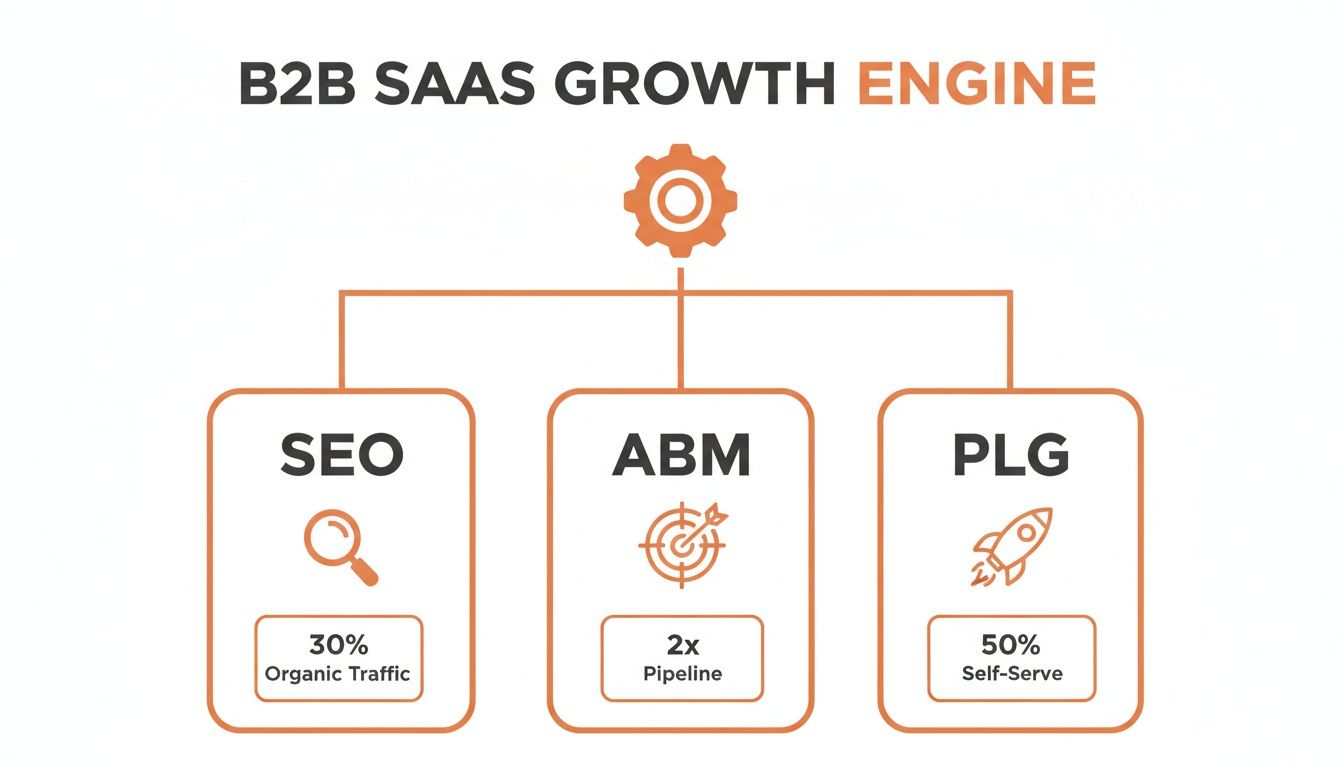
A robust growth strategy doesn't rely on a single channel. It masterfully weaves together SEO, ABM, and PLG. The core of this playbook is a modern B2B demand generation strategy focused on creating valuable, qualified pipeline at every stage of the buyer's journey.
The table below breaks down the core strategies, their business objectives, and the metrics leaders should be tracking.
Core B2B SaaS Marketing Pillars and Key Metrics
Understanding these pillars is the first step. Next, we’ll dive into the specific actions and mindsets needed to bring this engine to life.
Key Pillars of a Winning Strategy
To execute this engine, you must master three foundational components. Each has a distinct purpose and a corresponding set of metrics to monitor.
- Establishing a Clear Ideal Customer Profile (ICP): Your entire strategy hinges on a granular understanding of your best customers. This goes beyond firmographics to include technographics (their current tech stack), pain points (the specific business problems they face), and buying triggers (events that signal a need for your solution).
- Mapping the Full Customer Lifecycle: SaaS isn't a one-time sale; it's a long-term relationship. You must map the complete journey from initial awareness and acquisition through onboarding, value realization, retention, and expansion. Each stage requires a different marketing touchpoint.
- Adopting an Agile, Data-Driven Approach: Top-performing marketing teams operate in focused, data-driven sprints. They analyze performance weekly and are prepared to reallocate budget and resources to what's generating pipeline. This agile methodology, which we use at Ezca, ensures marketing efforts are always aligned with measurable business results.
Building Your Organic Growth Engine with SEO
While paid channels deliver immediate traffic, sustainable, long-term growth in B2B SaaS is built through organic search. SEO is not just a tactic; it's your most valuable marketing asset, creating a predictable, compounding stream of high-intent leads. This is about building true authority, not just ranking for keywords.
The goal is to own the conversation around the core problems your software solves. This is achieved by creating "topic clusters"—a central, authoritative "pillar" page on a broad topic, supported by a network of in-depth articles answering every specific question your ICP is asking Google. For example, a cybersecurity SaaS might have a pillar on "Data Breach Prevention," linked to articles like "Incident Response Plan Checklist" and "Phishing Simulation Best Practices."
From Keywords to Conversations
Modern SEO prioritizes user intent over exact-match keywords. Your task is to map every stage of the buyer's journey and provide valuable content that meets their needs at that specific moment.
A high-ROI content plan addresses the entire funnel:
- Top-of-Funnel (ToFu): Attract a broad audience with educational content. An expense management tool might publish an article on "5 Ways to Reduce Corporate Travel Costs." The goal is awareness and lead capture via a relevant download, like a policy template.
- Middle-of-Funnel (MoFu): Nurture prospects weighing their options with comparison guides, case studies, and webinar recordings. A post like "Brex vs. Ramp vs. Our Tool" directly targets users in the consideration phase.
- Bottom-of-Funnel (BoFu): Convert high-intent prospects with product-focused content. This includes detailed feature pages, pricing breakdowns, and implementation guides that push them toward a demo or free trial.
This full-funnel approach ensures you are a visible, trusted resource at every step, guiding prospects from problem-aware to solution-ready. You can learn more about how to increase organic traffic with a holistic content strategy that drives qualified leads.
Technical SEO: The Unseen Foundation
Brilliant content is useless if search engines can't crawl, index, and understand it. Technical SEO is the non-negotiable foundation of your organic strategy. It involves ensuring your site is fast, secure, mobile-friendly, and structured logically for search engine bots.
Key elements include a clean site architecture, proper use of canonical tags to avoid duplicate content, and an optimized XML sitemap. Neglecting this is like building a skyscraper on a weak foundation—it will eventually crumble. To gain a competitive advantage, it's also crucial to implement the latest essential AI SEO tactics.
In B2B SaaS marketing, SEO stands out, delivering an average 702% ROI with a break-even time of just 7 months. Organic search now drives 44.6% of all B2B revenue, making it the largest single channel. While PPC ads can generate traffic, they convert visitors to leads at a mere 0.7%, compared to SEO's far more efficient 2.1% rate. Discover more SaaS marketing statistics and insights.
Paid ads are rented traffic; SEO is a owned, revenue-generating asset. At Ezca, our approach involves 90-day sprints to systematically build topical authority, acquire high-quality backlinks, and track metrics that directly impact pipeline, turning your website into a reliable lead generation machine.
Targeting High-Value Accounts with Paid Ads and ABM
SEO is the long-term engine for organic growth. But to fill the pipeline now and target your most valuable prospects, you need a disciplined, data-driven paid acquisition and Account-Based Marketing (ABM) strategy.
This approach shifts from a wide-net "casting" model to precision "spear-fishing." Instead of broadcasting a generic message, you first identify a specific list of high-value target accounts. Then, you execute highly personalized, multi-channel campaigns to engage key decision-makers within those accounts. This flips the traditional funnel and is a cornerstone of modern b2b saas marketing strategies focused on ROI.
This strategic focus is critical. B2B SaaS sales cycles now average 134 days, and 84% of B2B SaaS leaders are prioritizing shortening them. Every delay directly increases your Customer Acquisition Cost (CAC), a metric that has already risen by 180% in recent years.
While many marketers invest in paid ads, only 28% of SaaS firms report hitting their lead generation targets. This isn't because ads don't work; it's a clear signal that a generic, untargeted approach is a recipe for wasted budget. Discover more insights about B2B SaaS benchmarks.
Building Your ABM Foundation
A true ABM program is a systematic process that aligns marketing and sales around a shared list of high-value accounts. This alignment is the key to maximizing ROI on every marketing dollar.
The process is built on two critical steps:
- Define Your Ideal Customer Profile (ICP): Move beyond basic firmographics. A strong ICP includes technographics (what tools do they use?), buying triggers (did they just receive funding or hire a new VP?), and the specific business pains of key personas (e.g., the CFO cares about ROI, the Head of Engineering cares about integration).
- Build a Prioritized Target Account List (TAL): Using your ICP, build a definitive list of companies that are a perfect fit. Then, tier these accounts (e.g., Tier 1 for strategic, high-touch engagement; Tier 2 for one-to-few campaigns) based on revenue potential and strategic fit. This dictates your resource allocation.
With this foundation, you can orchestrate multi-touch campaigns that are personal, relevant, and far more likely to generate high-quality pipeline.
An effective ABM campaign is a coordinated effort. Marketing uses targeted ads and content to warm up the account. As engagement signals appear, sales follows up with personalized outreach. The result is a seamless, compelling buyer experience that accelerates the sales cycle.
Executing High-ROI Paid Campaigns
With a clear target list, you can deploy paid channels with surgical precision. The objective is to maximize Return on Ad Spend (ROAS) by focusing on high-intent platforms and audiences. At Ezca, we use an agile methodology, shifting budgets weekly to double down on what’s working.
Here are the tactics that consistently deliver:
- LinkedIn Ads for Laser-Targeting: For B2B, LinkedIn is unparalleled. You can target your TAL directly, layering on job titles, seniority, and company size to reach decision-makers. Serve them personalized assets, like an industry-specific case study or a whitepaper addressing their known pain points.
- High-Intent Paid Search: On Google Ads, focus your budget on bottom-of-funnel keywords that signal purchase intent. Bid on competitor comparison terms ("Salesforce alternative") and solution-oriented searches ("best B2B lead generation software").
- Retargeting and Nurturing: Use retargeting campaigns to stay in front of engaged contacts from your target accounts. Ads should guide them to the next logical step, such as booking a demo, watching a webinar, or starting a free trial.
This combination of paid search and ABM creates powerful synergy. Your ads capture immediate demand from active buyers, while your ABM campaigns ensure you are always top-of-mind with the accounts that can truly impact your revenue. To see this in action, explore our B2B account-based marketing results.
Using Your Product to Drive Growth with PLG
What if your product was your most effective salesperson? That’s the core principle of Product-Led Growth (PLG). It’s a go-to-market strategy where the product itself is the primary driver of customer acquisition, conversion, and expansion.
For marketing leaders, PLG represents a fundamental shift. Instead of just marketing to prospects, you market through the product experience. It's one of a modern CMO's most potent b2b saas marketing strategies because it delivers value upfront. Users experience the product's benefits firsthand, rather than just hearing about them in a sales demo.
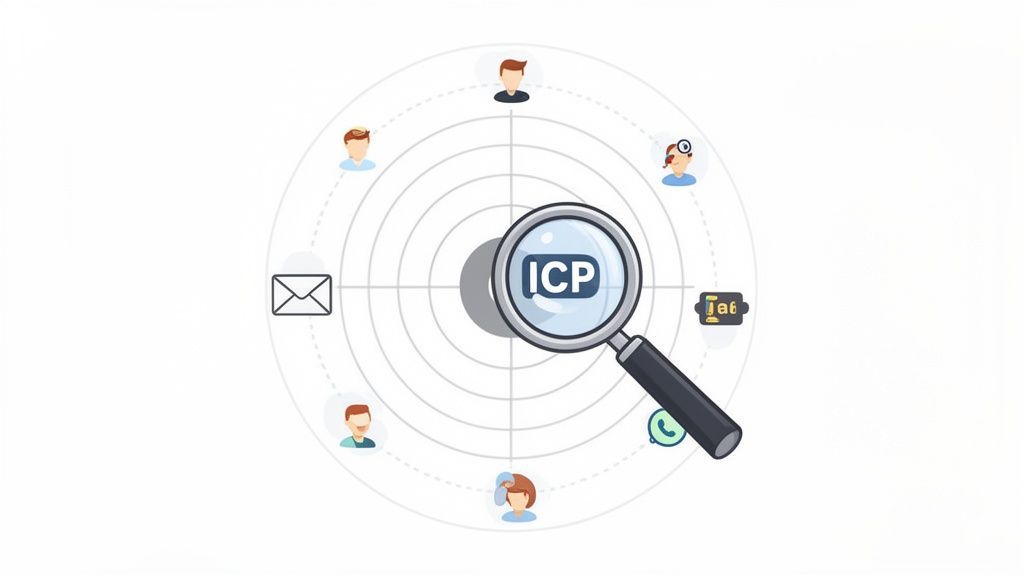
The entire customer journey is built around the product, making it the central engine for growth. The game is all about creating a seamless path for users to try your software, and then using their behavior to guide your marketing and sales efforts.
Choosing Your PLG Model: Free Trial or Freemium
Your first strategic decision is how to let users experience your product. The two dominant models are free trials and freemium plans. The right choice depends on your product's complexity and your market.
A free trial provides full or near-full product access for a limited period, typically 14 or 30 days. This model creates urgency and is best for products whose value is realized after exploring a complete feature set. The goal is to get users hooked before the trial ends, making the upgrade a logical next step.
A freemium model offers a basic, feature-limited version of your product for free, indefinitely. This is a powerful strategy for maximizing user acquisition, especially for products with a broad appeal and simple core functionality. Revenue is generated by converting a percentage of free users into paying customers by placing advanced features or higher usage limits behind a paywall.
Identifying the Aha! Moment and the PQL
A PLG strategy succeeds or fails based on how quickly a user reaches their "aha!" moment—the point where they internalize your product’s value and see how it solves their specific problem. A well-designed onboarding experience is crucial for guiding every user to this moment of clarity.
As users interact with your product, their actions provide powerful buying signals. This is where the focus shifts from Marketing-Qualified Leads (MQLs) to Product-Qualified Leads (PQLs). An MQL is based on marketing engagement (e.g., downloaded an ebook), while a PQL is defined by in-product behavior.
A PQL is a user who has experienced the "aha!" moment and taken actions indicating a high likelihood of converting. These actions could include inviting three teammates, using a key premium feature five times, or integrating with another tool like Salesforce.
Defining your PQL criteria is a critical exercise that requires collaboration between your marketing, sales, and product teams. You must pinpoint the exact in-app behaviors that correlate with a high probability of conversion.
Once a user meets the PQL criteria, you can trigger automated marketing or sales plays, such as an in-app message offering a demo of an advanced feature or an alert to your sales team for personalized outreach. You can discover how we help SaaS companies implement these strategies and turn product usage into predictable revenue.
Driving Profitability with Customer Retention and Expansion
Acquiring a new customer is 5 to 25 times more expensive than retaining an existing one. Yet, many businesses remain fixated on acquisition. For marketing leaders, the secret to sustainable, capital-efficient growth lies in keeping and expanding the customer base you already have.
The most critical metric for this is Net Revenue Retention (NRR). NRR measures the percentage of recurring revenue retained from existing customers over a given period, including expansion and churn. An NRR over 100% means your business is growing even without acquiring new customers—the hallmark of a healthy SaaS company with a valuable product.
Focusing on retention is a core pillar of modern b2b saas marketing strategies. While median NRR hovers around 101%, top-tier companies consistently achieve 110-120% or higher. The difference is proactive strategy. A mere 5% increase in customer retention can boost profits by 25% to 95%. Read more about SaaS retention benchmarks to see the financial impact.
Crafting a World-Class Onboarding Experience
Your best defense against future churn begins the moment a customer signs on. A world-class onboarding experience is not a simple product tour; it's a structured journey designed to guide users to their first "aha!" moment as quickly as possible. This is where you lay the foundation for long-term loyalty and adoption.
A strong onboarding program includes:
- A Personalized Welcome Sequence: Trigger a series of emails based on the user's role or stated goals, guiding them through critical initial setup steps.
- Clear Success Milestones: Define the key actions a user must take in their first 30 days to become successful. Track these milestones and use in-app messaging to celebrate their progress.
- Proactive Human Touch: For high-value accounts, assign a dedicated onboarding specialist to provide personalized training and ensure a smooth implementation.
The goal is to eliminate friction and demonstrate value rapidly. A customer who achieves an early win is far more likely to remain a long-term, high-value partner.
Proactive Customer Success and Churn Prevention
Waiting for a customer to complain is a losing strategy. A modern customer success team prevents fires rather than just extinguishing them. This requires leveraging data to identify at-risk accounts and intervening before a minor issue becomes a churn event. This demands tight alignment between marketing, product, and success teams.
Proactive strategies that drive retention:
- Monitor Product Usage Data: Identify accounts with declining engagement or underutilization of key features. A sudden drop in logins is a critical warning sign that requires immediate, helpful outreach.
- Conduct Quarterly Business Reviews (QBRs): For key accounts, schedule regular strategic reviews to showcase the ROI they've achieved, discuss their future goals, and identify expansion opportunities.
- Build Health Scores: Combine product usage data, support ticket history, and NPS feedback into a customer health score. This allows your team to prioritize outreach to at-risk accounts before they churn.
View customer success as a revenue-driving function, not a cost center. Their primary objective is to make customers so successful with your product that churn is not a consideration.
Building a Playbook for Expansion Revenue
The most profitable SaaS companies don't just retain customers—they grow them. A significant portion of their new ARR comes from their existing customer base. This is expansion revenue, the key to capital-efficient growth. Marketing's role extends beyond the initial sale to nurture upsell and cross-sell opportunities.
Map customer behaviors to expansion triggers:
- Upsell Triggers: A customer consistently hitting their user or data limits is a clear signal they need to upgrade to a higher tier.
- Cross-sell Signals: A team in one department achieving significant results creates an internal case study you can use to market a different product or feature set to another department within the same company.
Marketing's role here is to execute targeted lifecycle campaigns to existing users, educating them on advanced features or introducing them to complementary products. At Ezca, we help clients build these automated campaigns, turning their happiest customers into their most profitable growth channel.
Your First 90-Day B2B SaaS Marketing Plan
Strategy without execution is just a document. This 90-day plan translates these concepts into an actionable roadmap, mirroring the agile, results-focused approach we use with our clients. This sprint is your launchpad for building momentum and generating tangible results.
We'll break the quarter into three 30-day phases. Each phase builds on the previous one, allowing for data-driven adjustments. This is not a rigid plan; it's a framework for moving from strategy to action to optimization within a single quarter.
Month 1: Laying the Foundation
The first 30 days are about strategic preparation. Many marketing teams fail by jumping directly into execution—launching ads or content—without a solid foundation. This leads to wasted ad spend and content that misses the mark.
The goal this month is to gain absolute clarity on your audience, ensure your technical infrastructure is sound, and build the architecture for your campaigns. This groundwork ensures every dollar and hour invested later is maximized for impact.
Month 1 Action Items:
- Go Deep on Audience Research: Move beyond generic personas. Listen to recorded sales calls, interview your best customers, and survey users to understand their precise pain points and the exact language they use. This is the source of your most compelling messaging.
- Run a Technical SEO Audit: Before creating new content, use tools like Ahrefs or Semrush to identify and fix critical technical issues like slow page speed, broken links, or indexing errors that are hindering your organic performance.
- Build Your Campaign Architecture: Get into Google Ads and LinkedIn and set up your campaigns now. Configure conversion tracking, build your target audiences, and create your initial keyword and target account lists so you're ready to launch.
Month 2: Execution and Launch
With a solid foundation, Month 2 is about execution. This is where your strategy meets the real world and you begin collecting the initial data that will guide your optimization efforts.
Focus is key. Don't try to do everything at once. Select a few high-impact initiatives and launch them effectively. The goal is to build momentum and move from theory to real-world feedback quickly.
Month 2 Focus Areas:
- Content Activation: Publish your first pillar page and its supporting topic cluster articles. Immediately begin targeted outreach to acquire the first few high-quality backlinks to accelerate its authority.
- Paid Campaign Launch: Activate your paid search and LinkedIn ABM campaigns with a controlled initial budget. The goal is learning, not scaling. Closely monitor leading indicators like click-through rates (CTR) and cost-per-click (CPC).
- Initial Data Gathering: Your analytics dashboards are now active. Begin tracking your primary KPIs from day one. Look for early signals: which ad creative has the highest engagement? Which landing pages are converting?
Month 3: Optimization and Scaling
In Month 3, you are no longer operating on assumptions. You have baseline performance data. Your role now is to analyze what’s working, what isn't, and reallocate your budget to double down on the highest-performing channels and tactics.
The goal of a 90-day sprint is not perfection; it is meaningful, data-informed progress. The data from Month 2 is your guide for Month 3. It tells you where to invest more and what to cut, setting the stage for a stronger next quarter.
This iterative cycle is how a resilient, high-performance marketing engine is built.
Month 3 Priorities:
- A/B Test Everything That Matters: Identify your top-performing ads and landing pages and begin testing variations. Test new headlines, different calls-to-action, or alternative imagery. Small, systematic improvements in conversion rates lead to significant ROI gains.
- Analyze and Reallocate: Which channels are delivering the lowest Cost Per Acquisition (CPA)? Which are generating the highest-quality pipeline for sales? Identify your most efficient channels and increase their budget.
- Refine the Plan for Next Quarter: Use your learnings to sharpen the strategy for your next 90-day sprint. What new insights have you gained about your audience? Which content topics resonated most? This ensures continuous improvement.
Your B2B SaaS Marketing Questions, Answered
Implementing a new strategy always raises questions. Here are concise, actionable answers to the most common questions from SaaS marketing leaders and business owners.
How Much Should We Actually Spend on Marketing?
There is no one-size-fits-all answer. Your marketing budget should be a direct reflection of your growth stage and strategic goals.
Early-stage startups focused on capturing market share often reinvest 20-30% of revenue into marketing. More established companies with a strong brand presence can operate more efficiently, typically allocating 10-15% of ARR to drive steady growth and defend their market position.
The most important guideline is the LTV:CAC ratio (Lifetime Value to Customer Acquisition Cost).
Aim for a minimum 3:1 LTV:CAC ratio. For every dollar you spend to acquire a customer, you should generate at least three dollars in lifetime value. Focus your budget on channels where you can prove and scale this return.
What are the B2B SaaS Marketing Metrics that Genuinely Matter?
Move beyond vanity metrics like social media likes or raw traffic, which don't correlate with business success. The metrics that should be on every leader's dashboard are those directly tied to revenue and business health.
The four most critical business-level metrics are:
- Monthly Recurring Revenue (MRR)
- Customer Acquisition Cost (CAC)
- Lifetime Value (LTV)
- Net Revenue Retention (NRR)
These provide a comprehensive view of your business, from acquisition efficiency to customer loyalty. For a more granular view of your marketing funnel, track Visitor-to-Lead Conversion Rate, MQL-to-SQL Conversion Rate, and your average sales cycle length.
Should We Go All-In on Inbound or Outbound?
This is not an either/or decision. The most effective strategies blend both, using them strategically at different stages of growth.
Inbound marketing (SEO and content) builds a long-term, compounding asset. It creates a sustainable, cost-effective engine for growth and a defensible competitive advantage. It is a slow burn with a massive long-term payoff.
However, you need pipeline now. This is where targeted outbound and paid campaigns are essential. Use Account-Based Marketing (ABM) on LinkedIn to generate immediate, high-quality pipeline while your inbound engine gains momentum. Over time, as your organic authority grows, you can strategically shift budget from paid channels to your more efficient inbound machine.
Ready to build a marketing engine that drives predictable revenue? The team at Ezca Agency uses data-backed, 90-day sprints to help B2B SaaS companies scale smarter. Learn how we can help you hit your growth targets.