
What is an advertising campaign? A Practical ROI Guide
Discover what is advertising campaign: a practical ROI guide to strategy, channels, and measurement.
An advertising campaign is not just a collection of ads. It is a strategic, coordinated series of actions designed to achieve a specific business objective within a defined timeframe. The goal could be generating qualified pipeline, driving attributable revenue, or capturing market share.
For marketing leaders and business owners, this distinction is critical. A disciplined campaign transforms advertising from a line-item expense into a predictable, measurable growth engine. It's the difference between hoping for results and engineering them.
Thinking Beyond Ads to Strategic Campaigns
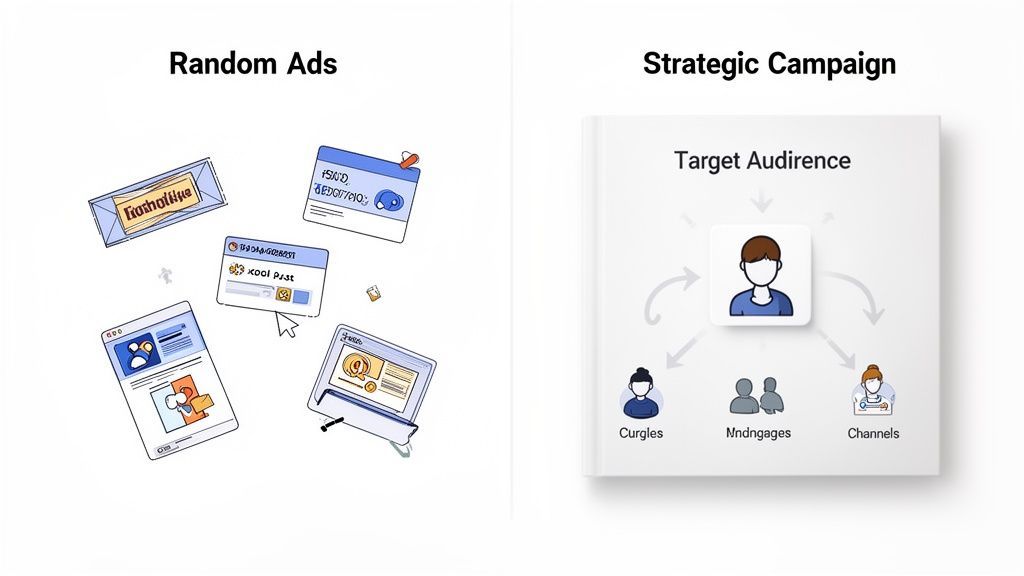
Viewing advertising as an investment, not a cost, is the first step. Think of the difference between a musician playing random notes and an orchestra performing a symphony. The symphony has a theme, a structure, and a target emotional impact—it’s designed from start to finish for a specific outcome.
An effective advertising campaign operates the same way. It weaves a core message across multiple, carefully selected channels to achieve a concrete business goal. For example, instead of just running a few disconnected Facebook ads, a strategic campaign might coordinate LinkedIn lead gen forms, Google search ads, and remarketing video sequences, all centered on a single value proposition and tracked against a specific pipeline target.
The 5 Core Components of a Modern Advertising Campaign
Every profitable campaign is built on five pillars. Mastering these is foundational to building a predictable revenue machine. Each component answers a critical business question and works in concert with the others.
Core Components of a Modern Advertising Campaign
Understanding how these five elements interlock transforms advertising from a guessing game into a reliable growth strategy.
A true advertising campaign is a system where each component—objective, audience, creative, and channel—is optimized to produce a measurable return on investment. It transforms marketing from an expense into a predictable driver of business growth.
This structured thinking is the bedrock of the 90-day sprint methodology we use at Ezca, where we build and refine these systems for clients. To get deeper into planning, especially if you're using video, check out this practical video marketing strategy guide. It will help you lay the foundation for a modern, ROI-focused approach.
Building the Six Pillars of a High-Performance Campaign
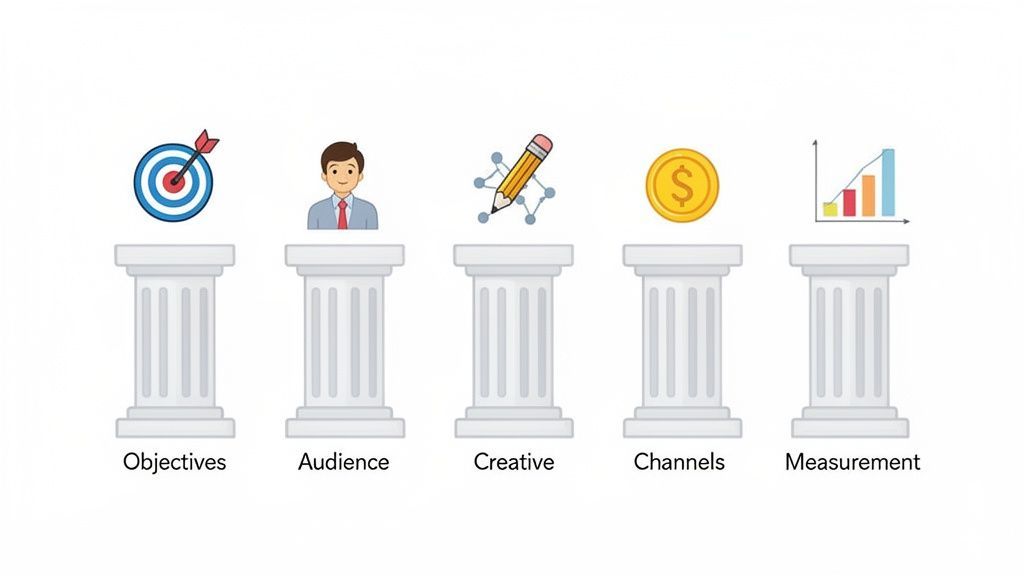
While the five components are the "what," these six pillars are the "how." This is the practical framework for making every dollar accountable. Getting these pillars right is what separates campaigns that burn budget from those that become predictable profit centers.
This isn't theory—it's the system that turns advertising from a gamble into a reliable growth engine.
Pillar 1: SMART Objectives
You can't hit a target you don't define. Vague goals like “increase brand awareness” are operationally useless because they lack a clear metric for success. Campaign objectives must be Specific, Measurable, Achievable, Relevant, and Time-bound (SMART).
A powerful objective sounds like this: "Achieve a 4:1 ROAS by generating 500 new e-commerce sales in Q3" or "Generate 150 Marketing Qualified Leads (MQLs) from our target account list in Q2 at a Cost Per MQL under $400." This gives your team a clear finish line and a benchmark for success.
Pillar 2: Precision Audience Targeting
Knowing your audience means going beyond basic demographics. It's about creating data-backed buyer personas that detail their specific pain points, their online research habits, and the triggers that lead to a purchase.
- E-commerce Example: Target "30–45-year-old urban mothers who follow sustainable living influencers on Instagram and have a historical average order value of over $150."
- B2B SaaS Example: Target "VPs of Operations at manufacturing firms with 500+ employees who have engaged with G2 review pages for competitor software in the last 90 days."
This level of detail is what unlocks efficient ad spend.
A campaign that tries to speak to everyone ends up connecting with no one. Deeply understanding a narrow, high-value audience segment is the foundation of efficient customer acquisition.
This focus allows you to craft a message that resonates and place it directly in front of the people most likely to convert.
Pillar 3: Compelling Creative and Messaging
Your creative—the ad copy, images, and videos—is the execution of your strategy. It must grab attention and communicate your value proposition in seconds. The key is to speak directly to the pain points identified in your audience research and offer a clear, compelling solution.
For instance, a generic "Buy our software" B2B ad is ineffective. A stronger approach is: "Tired of manual reporting? Our AI platform automates it in minutes." It’s a direct answer to a known frustration. At Ezca, we relentlessly A/B test multiple creative variations to pinpoint the messaging that drives the lowest Cost Per Acquisition (CPA).
The Final Three Pillars Driving ROI
With your goals, audience, and message locked in, the final pillars focus on execution and measurement.
- Strategic Channel Selection: Don't just allocate budget to Google or Facebook because they're large. Go where your specific audience is most active and receptive. A B2B company might find its best leads on LinkedIn, while a D2C brand could build its customer base on TikTok.
- Data-Driven Budget Allocation: Your budget should not be static. An agile approach involves starting with a test budget and then dynamically shifting funds—often weekly—toward the channels, campaigns, and ads that deliver the best ROAS or lowest CPA. This maximizes your return.
- Actionable KPIs and Measurement: Track the metrics that directly connect to business outcomes. Ignore vanity metrics like impressions. The numbers that matter are Customer Acquisition Cost (CAC), Return on Ad Spend (ROAS), and Lead-to-Customer Rate. These KPIs tell you if your campaign is profitable.
Choosing Your Digital Advertising Channels Wisely
Selecting the right channels is a critical strategic decision that will make or break your campaign's ROI. The goal is not to be everywhere, but to be precisely where your ideal customers are actively looking for solutions or are receptive to new ideas.
Think of it as resource allocation. The channels you pick must be the right tools for the job, whether that job is capturing high-intent leads, generating demand, or driving immediate online sales.
Matching Channels to Business Goals
A profitable campaign is built on a strategic mix of channels. Global digital ad spend data highlights the primary categories: search advertising ($295B), social media ($210B), video ($110B), and display ($145B). Each serves a distinct purpose in the customer journey.
- Search Advertising (Google, Bing): This is for capturing existing demand. You connect with prospects at the exact moment they are actively searching for a solution you provide. It's essential for B2B lead generation and e-commerce bottom-of-funnel conversions.
- Social Media Advertising (LinkedIn, Meta, TikTok): This is where you create demand. You can build an audience and introduce your brand to prospects who don't know they need you yet. It works by targeting users based on firmographics, interests, and online behavior.
- Video and Display Advertising: These are your brand-building and remarketing workhorses. They are ideal for telling a brand story, increasing share of voice, and executing powerful retargeting campaigns that bring high-intent visitors back to your site to convert.
An Actionable Framework for Channel Selection
Your channel strategy must be agile. At Ezca, our performance marketing teams constantly analyze performance data, reallocating budgets to the channels delivering the best results in real-time. This dynamic approach ensures every dollar is maximized for impact.
The real question isn't "Which channel is best?" It's "Which channel is best for this person, at this point in their journey?" A winning campaign layers channels together to guide a customer from just browsing to making a purchase.
Consider a B2B software company's funnel. They might use a LinkedIn ad with a gated whitepaper to generate top-of-funnel awareness. Then, they could retarget those leads with Google Display ads showcasing a customer case study. Finally, when that prospect searches for their brand or a competitor, a high-intent Google Search ad is there to secure the demo request.
This is a simple but effective multi-channel strategy. To dive deeper into this concept, see our guide on what is multi-channel marketing. This strategic layering is what transforms disparate ads into a cohesive, profitable campaign.
Putting Theory Into Practice: Campaign Blueprints for SaaS, B2B, and E-commerce
Theory is one thing; a proven playbook drives growth. An effective advertising campaign is not one-size-fits-all; it's an engine engineered for a specific business model, sales cycle, and customer journey.
Let's break down actionable blueprints for turning strategy into results for SaaS, B2B, and E-commerce.
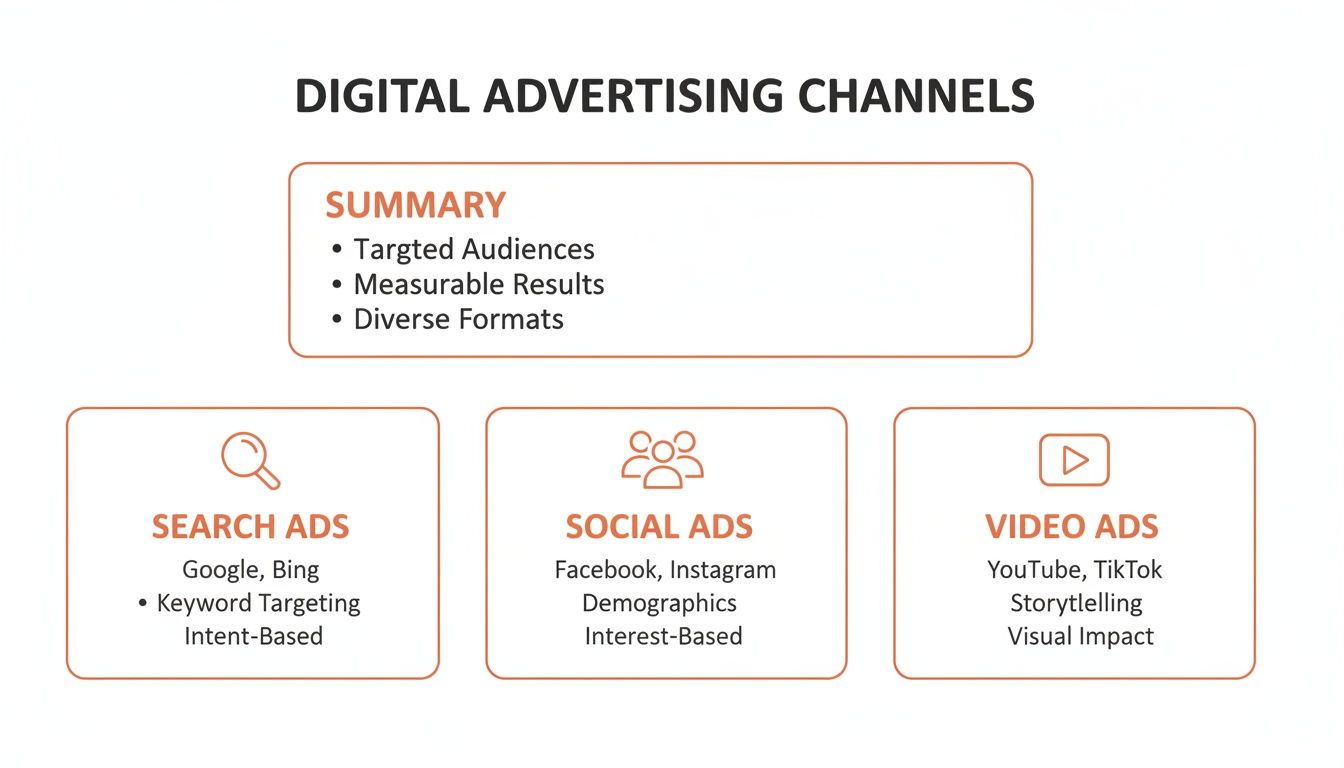
A winning strategy almost always involves a mix—capturing active searchers, building brand awareness on social, and using video to tell a compelling story.
The SaaS Lead Generation Blueprint
For a SaaS company, the primary goal is generating a predictable pipeline of qualified leads for the sales team. The campaign nurtures prospects through a longer decision-making process by educating them and building trust.
- Objective: Generate 150 marketing-qualified leads (MQLs) per month while keeping Customer Acquisition Cost (CAC) under $2,500.
- Audience: VPs of Marketing at mid-market tech companies (500-2,000 employees).
- Channel Mix & Tactics:LinkedIn Ads: Target by job title and company size with a high-value content offer, like an industry report or an interactive assessment tool, to capture lead data.
- Google Search: Capture high-intent searches for problem-aware keywords (e.g., "best marketing automation platform for b2b") and branded terms.
- Strategic Retargeting: Nurture leads with case study videos and demo offers shown to users who downloaded content but have not yet converted.
- Key Metrics:Cost per MQL, Lead-to-Demo Conversion Rate, and the ultimate health metric: CAC to LTV Ratio.
For SaaS, a campaign is a pipeline-building machine. It's designed to prove your value at every single touchpoint, from the first ad they see to the final sales call.
This methodical approach is essential for high-ticket software. You can see these principles in action in the results from a SaaS company paid search campaign we executed.
The E-commerce Sales Engine Blueprint
E-commerce campaigns are built for speed and efficiency, designed to convert browsers into buyers quickly. The strategy is driven by compelling visuals, social proof, and a frictionless path to purchase, with a focus on direct sales and immediate profitability.
- Objective: Achieve a 4:1 Return on Ad Spend (ROAS) and generate $200,000 in revenue per month.
- Audience: Millennials (ages 25-40) passionate about sustainable fashion, who follow specific eco-conscious influencers.
- Channel Mix & Tactics:Meta Ads (Instagram & Facebook): Use high-quality video and carousel ads for prospecting, targeting interest-based audiences and building lookalike audiences from your highest-value customers.
- Google Shopping: This is non-negotiable for capturing bottom-of-funnel demand from users searching for specific products you sell.
- Dynamic Product Retargeting: Automatically show ads of the exact products a user viewed or abandoned in their cart across the web and social media.
- Key Metrics: The core metrics are ROAS, Conversion Rate, and Average Order Value (AOV).
The B2B Account-Based Marketing (ABM) Blueprint
For B2B companies targeting enterprise clients, broad campaigns are inefficient. An ABM campaign flips the funnel, focusing all resources on a curated list of high-value target accounts, treating each company as its own market.
- Objective: Engage 50 target accounts and generate 5 qualified sales opportunities from that list in one quarter.
- Audience: A hand-picked list of 100 strategic accounts. Targeting is focused on specific C-level executives and department heads within those organizations.
- Channel Mix & Tactics:LinkedIn Sponsored Content & Conversation Ads: Deliver personalized content and messages directly to the decision-makers on your target account list.
- Programmatic Display: Use IP targeting to serve display ads exclusively within the office networks of your target companies.
- Coordinated Outreach: Synchronize ad campaigns with personalized emails and sales outreach for a multi-touch, integrated approach.
- Key Metrics: Success is measured by Account Engagement Score, Pipeline Velocity (how quickly deals progress), and the final Deal Size.
Executing and Measuring Your Campaign for Profit
A brilliant strategy is useless without disciplined execution and relentless measurement. The outdated model of rigid annual planning has been replaced by agile execution.
A 90-day sprint methodology is a game-changer. It forces rapid learning, testing, and optimization cycles. Instead of waiting a year to analyze results, you make data-backed decisions every few weeks, ensuring your budget is always allocated to the highest-performing tactics.
From Plan to Profit: A Framework for Execution
This phase begins with implementing robust tracking and attribution to trace every conversion back to its source. Without clean data, optimization is just guesswork.
Once tracking is live, establish a consistent review cadence. At Ezca, our performance marketing squads hold weekly reviews to analyze data, identify winning ads and channels, and reallocate budgets dynamically. This ensures capital flows to what's working now.
An advertising campaign isn't a "set it and forget it" machine. Think of it as a living system that needs constant attention and adjustment. The real goal is to create a feedback loop where real-time data fuels immediate action, turning insights directly into profit.
This data-first approach is more critical than ever. The global ad market has surpassed $1 trillion, with digital advertising comprising $777 billion (75.2%) of that total—a figure that has doubled since 2016. In this competitive landscape, efficient budget allocation is paramount.
Measuring What Truly Matters for ROI
To prove profitability, you must look beyond vanity metrics like clicks. The objective is to connect ad spend directly to revenue. This requires focusing on KPIs that measure the financial health of your campaign.
These are the core metrics for any marketing leader's dashboard:
- Customer Acquisition Cost (CAC): The total cost to acquire one new paying customer.
- Return on Ad Spend (ROAS): The gross revenue generated for every dollar spent on advertising.
- Customer Lifetime Value (LTV): A projection of the total revenue a business can expect from a single customer account.
Understanding the nuances between these metrics is vital. For SaaS businesses, differentiating ROI from ROAS is critical for assessing true profitability. Furthermore, post-click performance is equally important. Our work in conversion rate optimization (CRO) focuses on turning more of that paid traffic into customers, directly improving your campaign's bottom-line ROI.
Your Action Plan for Launching a High-ROI Campaign
We've covered the strategy behind effective advertising campaigns. Now, let's translate theory into an actionable roadmap. These foundational decisions separate profitable campaigns from costly experiments.
Each step is designed to bring sharp focus to your strategy and set you on a path to measurable results.
Your Pre-Launch Checklist
Before spending a single dollar on ads, complete these four crucial steps. This preparation ensures your first campaign is built on solid ground and ready for a powerful 90-day sprint.
- Solidify Your Business Objective: What is the specific business result this campaign must deliver? Is it adding $50,000 in new monthly recurring revenue (MRR)? Or acquiring 1,000 new e-commerce customers at a target CPA? Quantify it.
- Define a Realistic Test Budget: Your initial budget is for buying data, not just sales. A sound practice is to allocate enough budget to generate at least 50-100 conversions during an initial 90-day sprint. This provides a statistically significant sample to identify which channels and creative are performing.
- Gather Your Audience Data: Analyze your existing customer base. Who are your most profitable clients? Dig into their firmographics, demographics, behaviors, and acquisition paths. This first-party data is infinitely more valuable than broad market assumptions and will inform your initial targeting.
- Evaluate Your Internal Capabilities: Be honest about your team's expertise and bandwidth. Do you have dedicated specialists in PPC, CRO, and analytics who can optimize campaigns daily? Understanding your limitations is key to deciding whether to build in-house or partner with an agency like Ezca to accelerate results.
Common Questions We Hear About Ad Campaigns
Business leaders need clear, actionable answers. Here are the most common questions we encounter, with practical advice drawn from in-the-trenches experience.
How Much Should I Budget for My First Campaign?
There is no magic number. A proper budget is reverse-engineered from your business goals, industry benchmarks, and growth targets. Instead of picking an arbitrary number, frame the investment in terms of Customer Acquisition Cost (CAC) and Lifetime Value (LTV). The question is: what are you willing to pay to acquire a profitable customer?
We recommend starting with a dedicated test budget for a 90-day sprint. This first investment is for buying data—it establishes your baseline cost-per-lead and cost-per-acquisition on various channels, which is the foundation for building a predictable, scalable growth model.
How Long Does It Take to See Results?
While some channels like Google Search can deliver leads within weeks, building a sustainable, profitable advertising engine requires a strategic, patient approach. Be wary of anyone promising massive, overnight success. Real momentum is built through disciplined testing and continuous optimization.
A 90-day sprint provides sufficient time to gather meaningful data, identify performance trends, and calculate an initial ROI. This timeframe allows for enough experimentation with creative, audiences, and channels to determine what is truly scalable.
What’s the Difference Between a Campaign and Just Running Ads?
This question gets to the heart of strategic marketing. "Running ads" is a series of disconnected tactics—boosting a post, launching a single Google ad—without an overarching plan. This approach often leads to wasted spend, unreliable data, and unrepeatable results.
An advertising campaign is a coordinated, strategic effort with a clear objective, a unified message, and a defined start and end date. Every ad, landing page, and channel works in concert toward one measurable business goal. It’s the difference between hoping for growth and engineering it.
Ready to stop just "running ads" and start building a strategic campaign that drives real profit? At Ezca Agency, we use data-driven 90-day sprints to get measurable results for SaaS, B2B, and e-commerce businesses. Let's build your growth engine together.