
Website SEO Audit Services: Your Blueprint for Measurable Growth
Discover how expert website SEO audit services build your growth roadmap. Learn to turn audit findings into measurable ROI and choose the right agency partner.

For marketing leaders and business owners, a professional website SEO audit service isn't a cost—it's a high-ROI investment. It's the diagnostic tool that reveals why your digital marketing isn't delivering and provides the blueprint to turn your website into a predictable revenue engine.
This guide moves beyond generic advice to give you the actionable framework you need: specific metrics, ROI calculations, and the strategic questions to ask before you invest.
Why an SEO Audit Is Your Foundation for Growth
Many business leaders pour budget into content and ads, only to see flat or declining traffic. The reason? Hidden technical and structural issues that an SEO audit is designed to uncover. Your website's performance is either a growth engine or a growth ceiling.
Think of your website as a physical retail store. You could run the best ad campaign in the city, but if your front door is locked (a crawlability error), the aisles are cluttered (poor site structure), and the checkout counter is broken (slow page speed), you won't make any sales. An SEO audit is the inspection that ensures your store is open, accessible, and optimized for business.
Uncovering Hidden Revenue Blockers
Without a deep audit, your website could be crippled by issues invisible to the naked eye, such as:
- Crawlability Errors: A misconfigured
robots.txtfile can make your most valuable service pages invisible to Google. This is a zero-traffic, zero-lead problem until it's fixed. - Slow Page Speed: A 1-second delay in mobile load time can reduce conversions by up to 20%. For an e-commerce site doing $1M in annual revenue, that's a potential loss of $200,000.
- Poor Mobile Experience: With over 60% of traffic coming from mobile, a clunky interface doesn't just annoy users—it actively drives away paying customers.
- Content Cannibalization: When multiple pages compete for the same keyword, they dilute your authority and confuse Google, often causing all of them to rank poorly.
These are not minor technical glitches; they are direct barriers to revenue. A proper audit doesn't just list these problems—it prioritizes them by potential ROI, creating a clear, actionable roadmap.
For example, a common discovery in our audits at Ezca is "crawl budget waste." This occurs when Google spends its limited resources crawling low-value pages (like old tags or outdated press releases) instead of your money-making product or service pages. Reallocating that budget can result in core pages being indexed and ranked faster, directly impacting lead flow.
An audit provides the data-driven clarity needed to stop wasting budget and start investing in activities that measurably move the needle.
An SEO audit provides a crucial baseline. It’s the first step in turning your website from a passive digital brochure into an active, lead-generating asset that works for you 24/7. It's about building a solid foundation before you start building the house.
What’s Actually In a Comprehensive SEO Audit?
Not all "website SEO audit services" deliver the same value. A cheap, automated scan will flag surface-level issues but miss the strategic "why." A comprehensive audit is a strategic deep dive that analyzes the interconnected pillars of your website's performance.
A valuable audit provides a prioritized plan, not just a 100-page data dump. It connects every finding to a business outcome.
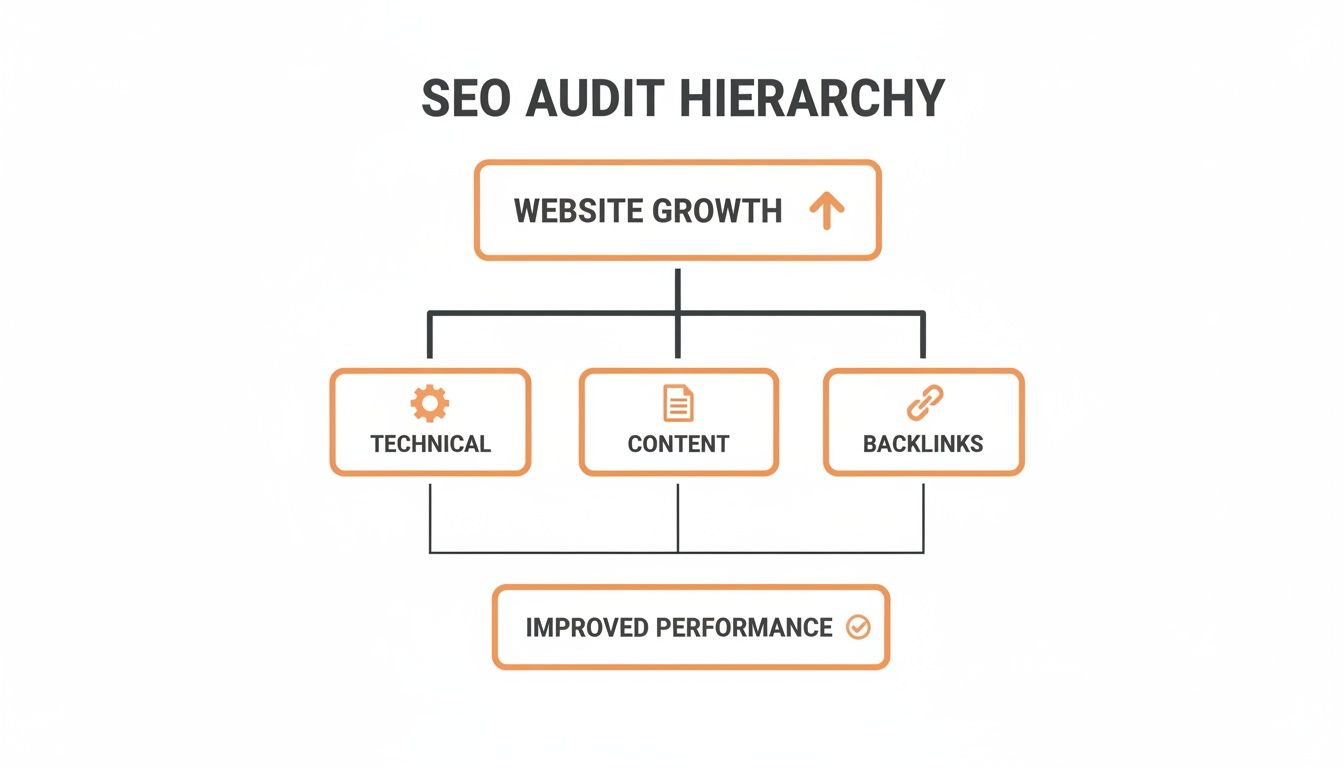
Sustainable growth requires a holistic approach. A technically sound site with poor content won't rank, and great content without backlinks will struggle for authority.
Technical SEO: The Engine Room
Technical SEO is the non-negotiable foundation. If search engines can't efficiently crawl, render, and index your site, your content and marketing efforts are wasted. For B2B companies, where over half of leads often originate from search, technical soundness is the price of entry.
A technical audit analyzes hundreds of data points, but focuses on those with the highest business impact:
- Page Speed & Core Web Vitals: We analyze metrics like Largest Contentful Paint (LCP) and Cumulative Layout Shift (CLS). Improving these not only boosts user experience but is a confirmed ranking factor. A 0.1-second improvement in mobile site speed can grow conversion rates by 8%.
- Indexability: Are your most important pages actually in Google's index? We check for
noindextags, canonicalization issues, androbots.txtblocks that can accidentally de-list critical revenue-driving pages. - Site Architecture: A flat, logical site structure helps both users and search engines find what they're looking for. A deep, confusing structure buries your best content and dilutes link equity.
Content and On-Page SEO
This audit pillar assesses whether your content is a strategic asset or dead weight. It’s not about keyword stuffing; it’s about user intent, competitive positioning, and commercial value.
The key questions we answer are:
- Keyword & Intent Mapping: Are you targeting keywords that attract qualified buyers, or just vanity traffic? We analyze whether your content matches the "search intent" (e.g., informational "what is" vs. commercial "buy now").
- Content Gap Analysis: A thorough competitive analysis identifies high-value keywords your competitors rank for, but you don't. This provides a data-backed roadmap for new content creation.
- "Zombie Page" Pruning: We identify pages with zero traffic, no backlinks, and no conversions. These "zombie pages" can drain your site's overall authority. Pruning or improving them often results in a site-wide ranking boost.
Backlink Profile Health
Backlinks are powerful endorsements, but quality trumps quantity. A single link from an authoritative industry publication is worth more than 1,000 low-quality directory links. A toxic backlink profile can even trigger a Google penalty.
A backlink audit isn't about counting links. It’s about assessing quality and risk. We separate the assets from the liabilities to make sure your link profile is a source of strength, not a penalty waiting to happen.
Our analysis focuses on three critical metrics:
- Authority & Relevance: Do your links come from websites that Google trusts and that are relevant to your industry?
- Anchor Text Distribution: Is the text used to link to you natural and diverse, or is it over-optimized with commercial keywords, a classic spam signal?
- Link Velocity: A sudden, unnatural spike in new links can look manipulative. We look for a steady, organic growth pattern.
This analysis produces a clear action plan: disavow toxic links that pose a risk and build a strategy to earn high-authority links that drive rankings and referral traffic. This data-driven intelligence is what fuels Ezca's 90-day growth sprints.
Turning Your Audit into an Actionable Roadmap
A 100-page audit report full of technical jargon is useless. The value lies in translating that data into a prioritized, ROI-focused action plan. This is how you move from analysis paralysis to measurable results.
The critical first step is to prioritize every finding based on its impact versus the effort required. This simple matrix immediately clarifies where to focus your resources for the fastest return.
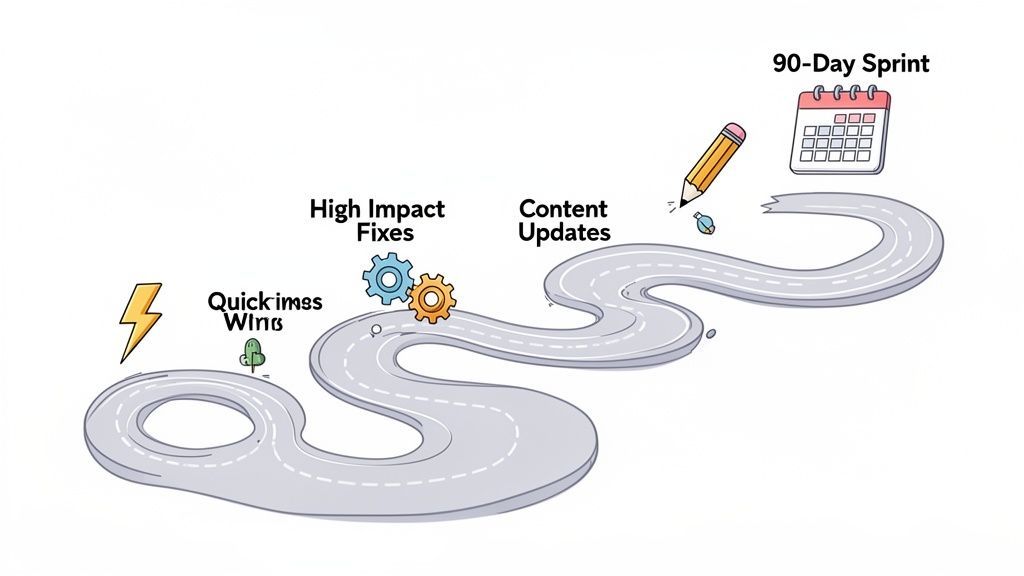
This framework helps you build momentum and demonstrate value quickly to stakeholders.
Prioritizing for Immediate ROI
Your tasks will naturally fall into four categories. The goal is to secure early wins that build momentum and justify further investment.
- Quick Wins (High Impact, Low Effort): These are the no-brainers to execute in week one. Examples: Fixing broken internal links to high-value service pages, optimizing the title tags of pages ranking on page two, or resolving a critical
robots.txterror. - Major Projects (High Impact, High Effort): These are the game-changers that drive long-term growth. Examples: A comprehensive site speed overhaul, a strategic content cluster build-out, or implementing a schema markup strategy to win rich snippets.
- Fill-In Tasks (Low Impact, Low Effort): These are important for site hygiene but won't transform your business overnight. Examples: Adding missing alt text to images or cleaning up inconsistent URL formats. Schedule these around higher-priority items.
- Reconsider (Low Impact, High Effort): These are resource traps to avoid. A complete redesign of a low-traffic, low-conversion section of your website likely falls here. De-prioritize these and focus on what drives revenue.
This prioritization model is central to how modern agencies like Ezca operate. We translate audit findings into focused 90-day sprints, starting with quick wins to generate immediate lift while scoping the larger, high-impact projects.
A successful roadmap is not just a list of fixes; it's a strategic sequence of actions. By tackling the highest-impact items first, you ensure your investment starts generating a return in weeks, not years.
Executing the 90-Day Sprint
Breaking the roadmap into a 90-day sprint creates focus, urgency, and accountability. It transforms a daunting list into a manageable, milestone-driven project.
A typical post-audit sprint could look like this:
- Weeks 1-2 (Technical Foundation): Execute all "Quick Win" technical fixes. For an e-commerce client, this might mean fixing canonicalization issues that were causing product pages to be de-indexed, instantly restoring potential revenue.
- Weeks 3-8 (Content Offensive): Launch a "Major Project." A great example is a content gap campaign. Identify three high-intent keywords your competitors own, then create and promote content that is demonstrably better. Our guide on how to increase organic traffic details this process.
- Weeks 9-12 (Conversion Optimization): Focus on a high-impact UX improvement. For instance, A/B testing the call-to-action on your highest-traffic landing page. A 0.5% conversion rate increase on a page with 20,000 monthly visitors generates 100 new leads per month.
This sprint model operationalizes the audit data, aligning technical SEO, content strategy, and UX to achieve a singular goal: driving more revenue.
DIY Audit vs. Agency Services: Which Path Is Right for You?
Every business leader faces this choice: dedicate internal resources to an SEO audit or partner with a specialized agency. This is a strategic "build vs. buy" decision that hinges on your team's expertise, bandwidth, and the complexity of your digital footprint.
The right choice depends on a frank assessment of your internal capabilities versus your growth ambitions.
The Realities of a DIY SEO Audit
A Do-It-Yourself (DIY) audit can seem cost-effective, but the hidden costs in time and missed opportunities are significant.
- The Time Investment: A thorough manual audit requires 40-60 hours for a mid-sized website. This isn't just data pulling; it's deep analysis. That's a full week or more of a senior marketer's time taken away from other revenue-generating activities.
- The Tool Stack Cost: Professional-grade tools are non-negotiable. A subscription stack including Semrush, Ahrefs, and Screaming Frog can easily exceed $500-$1,000 per month.
- The Expertise Gap: This is the most critical factor. Tools provide data; experts provide interpretation. A tool might flag "thin content," but an expert can distinguish between a low-word-count page that should be pruned and one that serves a critical user need and should be expanded. Misinterpretation can lead to costly mistakes.
A DIY audit is suitable for a small business with a simple website or a marketing manager building foundational skills. For any business where organic search is a critical revenue channel, the DIY approach often produces a surface-level report that misses the most lucrative opportunities.
A DIY audit often identifies the 'what'—the symptoms of poor SEO performance. A professional agency audit uncovers the 'why'—the root causes—and provides a prioritized, ROI-driven plan to fix them.
The Strategic Advantage of Agency Services
Hiring a professional website SEO audit service is an investment in specialized expertise, efficiency, and an objective perspective. It's less about outsourcing a task and more about embedding a strategic specialist within your team.
An agency brings experience from auditing hundreds of websites across various industries. They recognize patterns and solutions that an in-house team, however skilled, is unlikely to have encountered. This external viewpoint is crucial for challenging the "we've always done it this way" inertia that stifles growth.
To frame the decision, consider this direct comparison:
DIY vs. Agency SEO Audit Comparison
At Ezca, our AI-powered audits are not standalone deliverables; they are the strategic foundation for a 90-day growth sprint. We don't just hand you a report; we partner with you to execute the findings, bridging the critical gap between insight and implementation. This model ensures the audit translates directly into measurable results.
If you're still weighing your options, our analysis of in-house vs. agency marketing can provide a broader strategic framework.
Ultimately, the choice is clear: a DIY audit tells you where the leaks are. An agency audit provides the blueprint and the crew to rebuild the ship for speed and performance.
How to Choose the Right SEO Audit Partner
Selecting an agency for your SEO audit is a critical business decision. The right partner will deliver a strategic roadmap to revenue growth. The wrong one will deliver a costly, unactionable report.
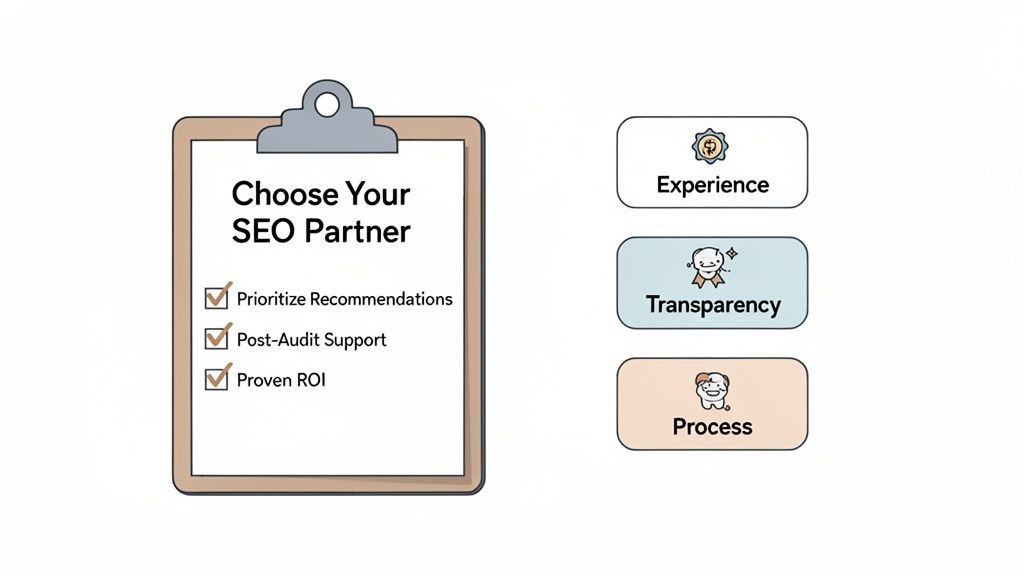
To vet a partner effectively, you must look beyond their sales pitch and scrutinize their process, strategic thinking, and track record of delivering business results.
Beyond the Sales Pitch
Vague promises are a red flag. Demand to see a structured, repeatable methodology. Your goal is to understand how they think, not just what they do.
Ask these critical questions during the vetting process:
- "Walk me through your prioritization framework." Their answer must involve a clear model for balancing impact and effort. If they say, "we prioritize whatever the client wants," or "we fix all the critical errors first," press for more detail. A strategic partner prioritizes based on ROI.
- "What happens after the audit is delivered?" A top-tier partner doesn't just email a PDF and disappear. Ask about implementation support, project roadmaps, and ongoing performance monitoring. The audit is the beginning, not the end.
- "Show me a case study where you tied specific audit findings to a business KPI like leads or revenue." Reject fuzzy metrics like "impressions" or "traffic." Demand a clear line from problem to action to result. For example, "Fixing issue X led to a Y% increase in MQLs."
Analyzing Case Studies and Spotting Red Flags
A compelling case study tells a clear, data-driven story: We identified this problem, we implemented this specific solution, and it generated this measurable business outcome.
A strong example: "Our audit found that 40% of their key service pages had slow mobile load times (LCP > 4s). After optimizing images and deferring non-critical JavaScript, we improved LCP by 2.2 seconds, leading to a 15% increase in form submissions from mobile traffic within 45 days."
Conversely, watch for these red flags:
- Guaranteed Rankings: This is the most significant warning sign. No one can guarantee rankings on an algorithm they don't control. Ethical partners guarantee a rigorous process, not a specific rank.
- Focus on Vanity Metrics: If their case studies focus on "impressions" or "keyword rankings" without connecting them to leads or sales, they may not be business-focused.
- One-Size-Fits-All Approach: If their proposal feels like a template, they haven't listened to your specific business goals. Your audit should be tailored to your unique challenges and market position.
Ensuring Process Alignment
The best partnerships occur when processes and communication styles align. If your organization operates in agile sprints, an agency that delivers a single, monolithic plan will create friction.
This is why at Ezca, our entire service model is built on 90-day growth sprints. Our AI-powered audit serves as the strategic playbook for the first sprint. Our cross-functional "squads" use those findings to build and execute a focused plan designed to deliver measurable results quickly.
This agile approach ensures accountability and keeps the entire team focused on the KPIs that matter to your bottom line. We don't just find the problems; we become the execution team that solves them. To see how this integrated model translates into real-world results, you can explore Ezca's full-service SEO offerings.
Your SEO Audit Questions, Answered
When marketing leaders and business owners evaluate SEO audit services, the discussion always comes down to four core questions: cost, timeline, ROI, and frequency.
Here are the direct, no-fluff answers you need to make an informed investment decision.
How Much Do Website SEO Audit Services Cost?
The cost of an SEO audit varies widely, and as with most professional services, you get what you pay for. A cheap, automated report for a few hundred dollars is a symptom-checker, not a diagnostic tool. It identifies problems but offers no strategic cure.
For a comprehensive, expert-led audit, a small-to-medium-sized business should budget between $2,500 and $10,000. For large e-commerce sites or complex enterprise platforms, the investment can range from $15,000 to $25,000+.
The cost isn't for a spreadsheet of errors. It's for a prioritized, ROI-driven action plan crafted by experts who know how to turn those errors into revenue opportunities.
This is why at Ezca, the audit is the integral first step of our 90-day growth sprint, not a standalone product. The cost is directly tied to an executable strategy, ensuring your investment is focused on generating a measurable return from day one.
How Long Does a Thorough SEO Audit Take?
A true audit is a meticulous deep dive, not a two-day task. An agency promising a full audit in 48 hours is likely just running an automated tool and rebranding the output.
A realistic timeline is:
- Small to Mid-Sized Websites:2 to 4 weeks from initial kickoff to delivery of the strategic roadmap.
- Large or Complex Websites:4 to 6 weeks to allow for deeper data analysis, competitive research, and strategic planning.
This timeline reflects the depth required. It includes technical crawling, content quality assessment, backlink analysis, competitive benchmarking, and, most importantly, synthesizing all that data into a prioritized, actionable plan that aligns with your business objectives.
What Is the Expected ROI from an SEO Audit?
An audit report itself has zero ROI. The return is generated by the disciplined execution of the prioritized recommendations. The audit is the blueprint; the value is created during construction.
ROI from an audit typically materializes in three stages:
- Quick Wins (Weeks 1-4): Fixing critical technical errors can yield immediate results. For example, correcting a faulty canonical tag strategy can get key product pages re-indexed, leading to a direct lift in organic traffic and sales within a month.
- Mid-Term Growth (Months 2-9): Executing on content and on-page recommendations can drive significant gains. A targeted content campaign based on a gap analysis can increase organic traffic to commercial pages by 50-200% over six to nine months.
- Long-Term Profitability (Year 1+): A fully optimized site becomes a predictable lead and revenue generation machine. Successful SEO dramatically lowers your blended Customer Acquisition Cost (CAC) compared to paid channels, turning your website into your most profitable marketing asset.
Consider this tangible ROI example: an audit identifies that your primary lead-gen landing page has a slow mobile load time. The fix improves the conversion rate by 1.5%. On 10,000 monthly visitors, that one change generates an additional 150 leads per month. That's the power of an executed audit.
How Often Should My Website Be Audited?
SEO is a continuous process, not a one-time project. Your website's health requires ongoing attention, just like any critical business asset.
We recommend a major, comprehensive SEO audit once per year. This serves as a strategic annual review to realign your SEO strategy with evolving business goals and major shifts in the search landscape.
However, relying solely on an annual check-up is a mistake in the dynamic digital marketplace.
The annual deep-dive should be supported by agile, quarterly "health checks." These are smaller, focused reviews to monitor site speed, Core Web Vitals, ranking changes, and backlink quality to catch small problems before they become big ones.
This is the exact cadence built into the Ezca model. Our 90-day sprints inherently include this continuous monitoring and adjustment, ensuring the insights from the initial audit deliver compounding returns quarter after quarter.
Ready to turn insights into action? Ezca's AI-powered audits are the first step in our focused 90-day sprints, designed to deliver measurable results fast. Let's build your growth roadmap together.