
A Growth Playbook for SEO B2B Marketing in 2026
Discover how top companies leverage SEO B2B marketing to drive leads and revenue. This playbook offers actionable strategies for sustainable growth in 2026.

As a business leader, you're under constant pressure to generate a predictable stream of qualified leads with a budget that never seems to grow. You’re juggling paid ads, social campaigns, and virtual events, all while the C-suite demands a clear ROI on every dollar spent.
What if your most powerful growth channel is the one you've been under-resourcing? For B2B companies, SEO isn't just about keywords; it's a strategic asset that consistently delivers the highest returns and builds a defensible competitive advantage.
Why SEO Is Your Most Powerful B2B Growth Engine
Paid advertising is like renting an audience. The moment you stop paying, the traffic disappears. SEO, on the other hand, is about building a valuable asset. Every piece of high-intent content you publish and every quality backlink you earn compounds over time, creating a self-sustaining engine that attracts qualified prospects 24/7.
These aren't just any prospects. They're decision-makers actively searching for the exact solutions you provide.
The Unbeatable ROI of Organic Search
The data is clear. Organic search drives 53% of all trackable website traffic for B2B businesses. This isn't just noise; it’s the primary source of real commercial opportunities.
More importantly for your bottom line, SEO is responsible for an incredible 44.6% of all B2B revenue—more than double the contribution of any other marketing channel.
Leads sourced from organic search also close at a far higher rate. The average conversion rate is 14.6%, which dwarfs the 1.7% you typically see from traditional outbound marketing.
For business owners, every dollar spent on a smart SEO B2B marketing strategy is a direct investment in your most profitable customer acquisition channel. It’s about being there with the right answer the moment a high-intent buyer begins their research.
To see how dominant SEO is, here’s a quick comparison of its performance against other common B2B channels.
B2B Channel Performance at a Glance
The data is unequivocal: when it comes to driving measurable business results—from initial lead to final revenue—no channel performs as efficiently or effectively as organic search.
Building Your Competitive Moat
In a crowded market, a strong SEO presence is your best defense. When you consistently own the top search results for your most important topics, you're not just capturing leads—you're building undeniable authority. You become the default resource in your niche, making it incredibly difficult for competitors to gain a foothold.
This strategic positioning delivers tangible business benefits:
- Lower Customer Acquisition Cost (CAC): As your organic traffic scales, you can reduce spend on expensive paid ads, significantly lowering your blended CAC.
- Higher-Quality Sales Pipeline: Prospects who find you organically are already problem-aware and solution-seeking. Your sales team gets warmer, more qualified conversations from the start.
- Unmatched Brand Credibility: Dominating search results positions your brand as a trusted industry leader, long before a prospect ever speaks to a salesperson.
This is the core philosophy behind our work at Ezca. We focus on executing targeted 90-day sprints designed to build these strategic moats for our B2B clients. By treating SEO B2B marketing as a central business function, we systematically increase organic traffic and turn your website into a predictable growth engine.
Uncovering High-Intent B2B Keywords
Many B2B companies get keyword research wrong. They chase high-volume, generic search terms that bring in unqualified traffic and zero leads. The real ROI in B2B SEO isn’t in broad visibility; it’s in uncovering the specific, nuanced questions your ideal customers ask when they’re ready to solve a business problem.
A search for "project management software" could be a student. But a search for "gantt chart software for construction projects" or "project management tool with Salesforce integration"? That’s a decision-maker with a specific need and a budget.
Mapping Keywords to the Buying Committee
In B2B, you're rarely selling to just one person. You're selling to a buying committee, and each member has different priorities, pain points, and search habits. A robust keyword strategy must address them all.
Imagine you sell an advanced analytics platform. Your keyword plan needs to target the entire committee:
- The End-User (Data Analyst): Searches for technical fixes like “sql query optimization for large datasets” or “how to visualize streaming data.” They care about features that make their job easier.
- The Manager (Head of BI): Searches for efficiency and results, like “business intelligence platforms comparison” or “roi of data analytics tools.” They need to justify the purchase.
- The Executive (CFO/CTO): Searches for risk, cost, and security, like “enterprise analytics platform security compliance” or “total cost of ownership bi software.” They care about the big picture.
Mapping your keywords to each persona allows you to create content that answers everyone's questions, helping build the internal consensus needed to close a deal.
From Problem-Aware to Solution-Seeking
A powerful way to structure keyword research is by mapping it to the buyer's journey. This ensures your content meets them at the perfect moment.
Your goal isn't just to get found. It's to get found right when a prospect is evaluating options and is closest to making a decision.
Let's walk through an example for a B2B cybersecurity firm selling a threat detection platform.
1. Problem-Aware Keywords: The prospect knows something’s wrong but isn't sure what to do. Their searches are diagnostic. * "signs of a network breach" * "common phishing attack examples" * "how to calculate data breach risk"
2. Solution-Seeking Keywords: The prospect is actively hunting for solutions and comparing product categories. * "best endpoint detection and response (EDR) solutions" * "managed detection and response services" * "CrowdStrike vs SentinelOne comparison"
3. High-Intent, Bottom-Funnel Keywords: The searcher is on the verge of buying and is looking for final proof points or direct contact. * "[Your Brand] pricing" * "[Competitor] alternatives" * "cybersecurity platform demo"
At Ezca, we focus our clients' resources on solution-seeking and high-intent terms. This ensures every piece of content is built to drive pipeline and revenue, not just vanity traffic, turning your keyword strategy into a powerful demand generation engine.
Building Authority with the Pillar and Cluster Model
Once you've identified your high-intent keywords, it's time to stop chasing individual rankings and start owning entire topics. This is how you become the go-to authority in your space. The most effective framework for this is the pillar and cluster model.
Think of your most important topic as the sturdy trunk of a tree—your pillar page. The branches are your cluster content, with each piece diving deep into a related sub-topic. By linking all cluster "branches" back to the main pillar "trunk," you build a highly organized content hub that signals deep expertise to Google.
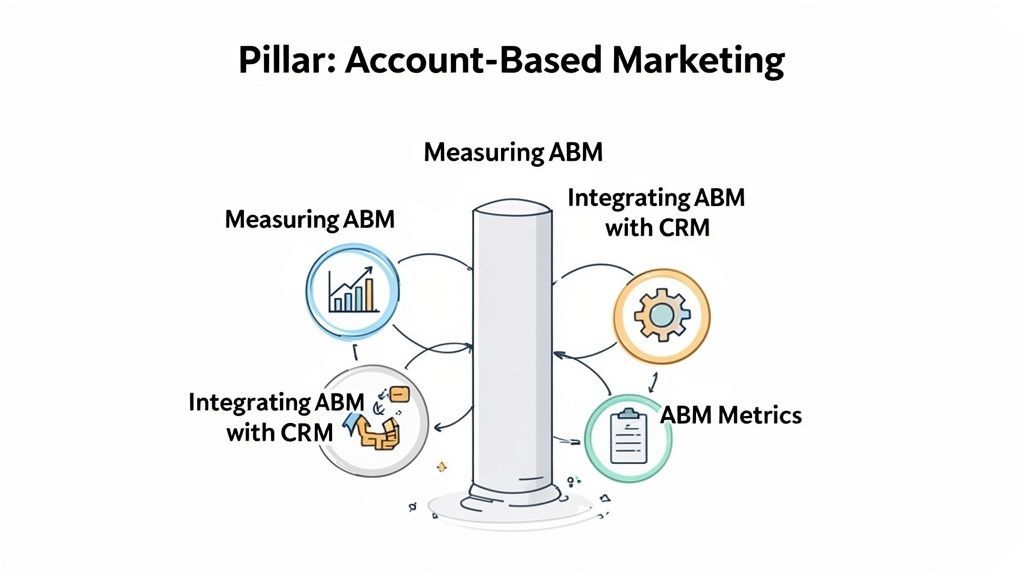
This approach is perfectly suited for the long B2B sales cycle. It allows you to create a library of content that anticipates and answers every possible question from the buying committee, guiding them through their research journey without them ever leaving your site.
A Tangible Pillar and Cluster Example
Let's apply this to a B2B SaaS company selling an Account-Based Marketing (ABM) platform. Your core topic is "Account-Based Marketing Platforms."
Your pillar page would be a comprehensive guide covering what ABM platforms are, their benefits, essential features, and how to choose the right one.
From this central hub, you'd build out supporting cluster content:
- Cluster Post 1: "How to Measure ABM Campaign Success" (Speaks directly to managers focused on ROI).
- Cluster Post 2: "Integrating Your ABM Platform with Salesforce" (Perfect for the technical user or ops team).
- Cluster Post 3: "Building Your First Target Account List" (Designed for marketers just getting started).
- Cluster Post 4: "Key ABM Metrics Your CFO Actually Cares About" (Aimed straight at the executive buyer).
Each cluster post is an in-depth article answering a specific question, and every one links back to your main pillar page, reinforcing its authority. This turns your site from a collection of blog posts into an interconnected library of expertise.
The pillar and cluster model isn't just an SEO play; it’s a sales enablement strategy. You're arming prospects with the information they need to build an internal business case for your solution, shortening sales cycles and improving lead quality.
From Content to Conversions
This interconnected content web directly impacts your bottom line. By comprehensively answering your audience's questions, you keep them on your site longer, lowering bounce rates and boosting engagement—strong positive signals for Google.
Most importantly, it becomes an engine for your sales funnel. A well-built pillar and cluster naturally guides a prospect from awareness to decision, allowing you to place strategic calls-to-action (CTAs) that match their buying stage.
For instance:
- On a top-of-funnel post like "What is Account-Based Marketing?," the CTA would be to download a beginner's guide.
- On a bottom-of-funnel post like "ABM Platform Pricing Models," the CTA should be more direct, like "Request a Demo" or "Get a Custom Quote."
This strategic approach turns content from an expense into a predictable revenue-generating machine. At Ezca, this model is a core part of our 90-day sprint methodology. We focus on building out one core pillar and its clusters per sprint, enabling clients to establish topical authority and see measurable results quickly. If you want to go deeper, check out our guide on effective content marketing strategies.
High-Impact Technical SEO Fixes for B2B Websites
"Technical SEO" can sound intimidating, but for a marketing leader, ignoring it is a costly mistake. A technically weak site is like a Ferrari with flat tires—it doesn't matter how powerful your content engine is if the foundation is broken.
Solid SEO B2B marketing is built on a strong technical foundation. This doesn't mean you need to learn to code. It means focusing on the few technical issues that directly kill your ability to attract and convert high-value customers. For B2B sites, focusing on three areas delivers the highest ROI: site speed, mobile experience, and crawlability.
Master Your Site Speed
Your B2B prospects are busy professionals. A slow-loading website disrespects their time. The data shows even a one-second delay in page load time can cut conversions by up to 7%.
Let that sink in. If your key landing page takes three seconds too long to load, you could be losing over 20% of your potential leads. That’s a massive, self-inflicted wound to your marketing budget.
A tool like Google's PageSpeed Insights gives you an immediate report card on your site's performance, pinpointing issues like oversized images or slow server response times. Fixing these isn't a "tech task"—it's an essential action to protect your revenue.
Prioritize the Mobile Experience
While many B2B deals close at a desktop, the research phase often starts on a phone. An executive browses industry news on their commute; a manager looks up a solution between meetings. If your website is difficult to use on a small screen, you create a poor first impression and lose credibility.
This is more than a user experience problem. Google uses mobile-first indexing, meaning it judges your entire site based on the mobile version. A clunky mobile site actively hurts your search rankings across all devices.
Check your Google Search Console mobile usability report. It will flag critical problems like:
- Text too small to read: Forcing users to pinch-and-zoom guarantees they will leave.
- Clickable elements too close together: Frustrating users who can't tap the correct link.
- Content wider than the screen: Forcing horizontal scrolling is an immediate signal of a poor experience.
These aren't minor flaws. They are red flags to Google that will cause your rankings for critical B2B keywords to suffer. A seamless mobile experience is a fundamental requirement for capturing decision-makers.
Ensure Google Can Crawl Your Site
Your content is worthless if search engines can't find and understand it. "Crawlability" is simply Google's ability to navigate your website. Simple technical roadblocks can make entire sections of your site invisible.
When we run technical audits at Ezca, we often find simple but devastating issues like a misconfigured robots.txt file blocking key product pages or a web of broken internal links that trap search engine crawlers. These mistakes prevent your best content from ever being indexed and ranked.
Ensuring your site has a clean XML sitemap and a logical internal linking structure is like handing Google a well-lit map to your most valuable assets. This basic technical hygiene is crucial for protecting your investment in SEO B2B marketing.
Building Links That Actually Drive B2B Growth
In B2B link building, quality trumps quantity. A single link from a respected industry journal is worth a hundred generic directory listings. Real SEO B2B marketing is about earning high-value backlinks that prove your credibility to Google and, more importantly, to your ideal customers.
Think of these authoritative links as powerful endorsements. They boost your domain authority and search rankings, but their real value is driving qualified referral traffic, sparking demo requests, and building brand recognition in a way paid ads cannot replicate.
Don't Just Create Content, Create Linkable Assets
The foundation of a serious link building campaign rests on "linkable assets." These aren't your everyday blog posts. They are substantial, often proprietary, resources that journalists and industry experts genuinely want to reference because they offer unique value.
The most successful assets are built on original research or are free tools that solve a real problem for your audience.
- Proprietary Data Reports: Survey your customers or analyze anonymized user data to create industry benchmarks no one else has. A report like "The 2026 State of AI in Manufacturing," packed with fresh data, is a magnet for journalists covering your sector.
- Free Industry Tools: A simple ROI calculator, a project timeline generator, or a free assessment tool can become an indispensable resource. A logistics company could build a free "LTL Freight Class Calculator" that gets linked to repeatedly by industry blogs and forums.
These assets require a real investment, but the payoff is enormous. They become evergreen link-earning machines that continue to pull in high-authority backlinks for years.
It's All About Digital PR and Building Real Relationships
Once you have a valuable asset, it’s time for focused digital PR. This means building genuine relationships with the editors, journalists, and key figures in your space, not just blasting a generic email to a purchased list.
Identify the specific writers and publications that your target audience reads. Follow them, engage with their work, and understand the stories they cover. When you reach out, your pitch must be personal, relevant, and helpful.
Frame your outreach as offering a resource, not begging for a link. Instead of, "Please link to our new tool," try, "I saw your recent piece on project management challenges. Your readers might find our new timeline calculator useful for planning their next launch."
This one tweak changes the dynamic. You are providing value, not asking for a favor. Your success rate will skyrocket.
Measuring the Real ROI of Your Links
As a business leader, you must justify the spend on link building. That means looking past vanity metrics like link count and focusing on what moves the needle. This is where a robust link building strategy becomes essential.
These are the core metrics you need to track:
At Ezca, our link building services for B2B clients are designed around this ROI-first mindset. We create high-value assets and run targeted digital PR campaigns to secure placements that don't just lift domain authority—they drive tangible business results within our 90-day sprints.
Your First 90-Day B2B SEO Sprint
A strategy is useless without execution. A 90-day sprint is the most effective way to launch a B2B SEO marketing program because it forces prioritization and builds visible momentum within a single quarter.
Here is a practical, actionable plan to get started.
Weeks 1-2: Laying the Foundation
You can't build a house on sand. The first two weeks are for a technical audit and strategic planning. Your first job is to identify and fix critical site issues—site speed, mobile experience, and crawlability roadblocks. Concurrently, you'll finalize the high-intent keywords your buyers use and select the topic for your first pillar page.
- Week 1: Initiate the technical audit using Google Search Console and a site crawler. Begin deep keyword research, focusing on problem-aware and solution-seeking phrases.
- Week 2: Finalize technical fix recommendations and deliver them to your development team. Lock in your first pillar page topic and map out two cluster posts to target valuable long-tail keywords.
Weeks 3-6: Content Creation and Execution
Now it’s time to build. This four-week block is dedicated to creating the authoritative content that will fuel your SEO engine. The goal is singular: write and publish your pillar page and its first supporting cluster articles. This is a heavy lift, but it is the most critical investment of the sprint.
A great pillar page isn't just a blog post; it's a long-term asset that will generate leads for years. It cements your expertise and acts as a central hub, creating a web of authority that search engines reward.
Weeks 7-10: Promotion and Initial Outreach
Content does no good if no one sees it. Now, you pivot from creation to promotion. Start by distributing the content through all owned channels—your email list, social media, and sales team. This is also when you begin link-building outreach. For B2B, this means promoting a genuinely useful asset—like a data report or free tool—that other sites will want to reference.
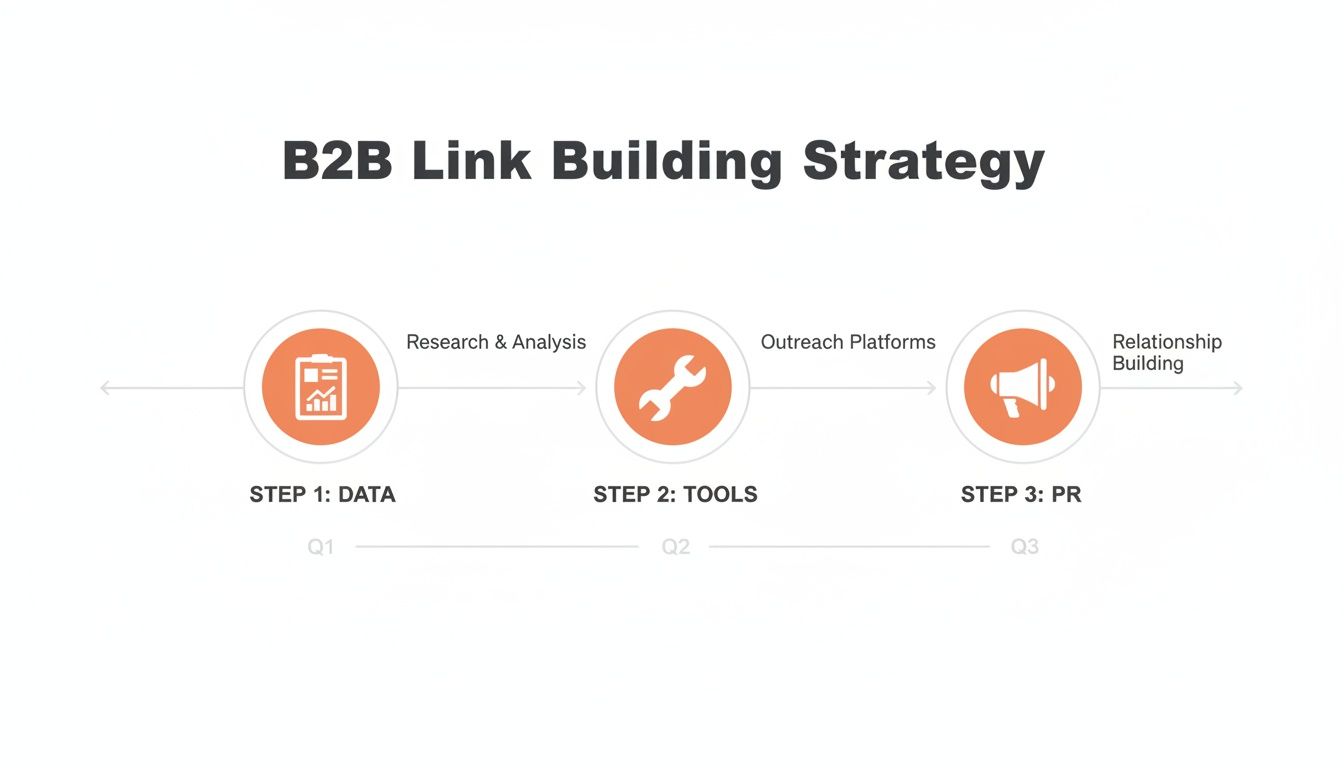
The key takeaway is that B2B link building is about creating assets so valuable they earn links naturally. Deciding if you have the resources for this is a critical question. For more on that, check out our guide on in-house vs. agency marketing.
Weeks 11-12: Analysis and Planning the Next Sprint
The final two weeks are for analyzing data and planning your next move. You need to know what worked and what didn't to improve results next quarter. Use the best AI search tracker tools to monitor ranking progress for your target keywords.
The SEO landscape is always evolving. By 2026, 60% of Google queries might end in zero clicks due to AI overviews. Even so, 91% of B2B marketers are increasing their investment in SEO, because organic search still drives 53% of all leads. With B2B teams planning a 46% growth in content budgets, proving ROI is more critical than ever. Use this time to analyze leading indicators like traffic growth and new keyword rankings, then map out your next 90-day sprint.
Common B2B SEO Questions (and Straight-Up Answers)
As a business leader, you're accountable for results. You need to know when you'll see a return, what to measure, and how to get the C-suite on board. Here are the honest answers to the questions you're likely asking.
When Will We Actually See Results?
Anyone who gives you a single, simple answer is not being truthful. It depends. You can see ranking jumps within weeks from technical fixes like improving page speed. But the significant, bottom-line results from a content and link-building strategy require 4-6 months to gain traction.
This is why we champion a 90-day sprint approach for any SEO B2B marketing plan. It forces a focus on activities that create early momentum—like ranking improvements and initial traffic growth—to prove the strategy is working while building toward a significant impact on leads and revenue within two to three sprints.
What Metrics Should We Really Be Tracking?
Forget vanity metrics like raw traffic. To prove the value of your B2B SEO, you must track KPIs tied directly to revenue.
Here’s what should be on your dashboard:
- Pipeline Contribution: This is the ultimate metric. How many Marketing Qualified Leads (MQLs), demo requests, and how much attributable pipeline revenue is organic search generating?
- Cost-Per-Acquisition (CPA): Compare your organic CPA against paid search and social. Over the long term, SEO almost always provides a more efficient cost per lead.
- Share of Voice: Track your visibility for your most important keywords against your top competitors. This shows you’re winning the conversations that matter to your buyers.
When you walk into a meeting with data on pipeline contribution and CPA instead of just traffic charts, you completely change the conversation from a marketing activity to a business growth driver.
How Do I Justify the Investment to My Leadership?
Frame SEO as what it is: a long-term, revenue-generating asset that appreciates in value over time, not a marketing expense.
Build your case using the language of ROI and competitive advantage. Create a clear forecast showing the projected Customer Acquisition Cost (CAC) from SEO versus the rising costs of paid channels. Arm yourself with industry data, like the fact that SEO leads have a 14.6% close rate, while outbound leads are stuck at 1.7%. You're not just asking for budget; you're presenting a data-backed plan for more sustainable and profitable growth.
Ready to turn your SEO into a predictable revenue engine? At Ezca Agency, our 90-day sprints are designed to deliver measurable results for B2B companies by focusing on the strategies that drive pipeline, not just traffic. Learn how we can build your growth strategy.