
The Actionable Playbook for Outsourced B2B Lead Generation
Discover how outsourced B2B lead generation can cut costs, accelerate growth, and build a predictable revenue pipeline. Get actionable strategies now.
Outsourced B2B lead generation is the strategic decision to partner with a specialized agency to manage the entire process of finding, qualifying, and booking sales appointments with new business leads. Instead of building a team from scratch, you leverage a partner's proven system and expertise to deliver a predictable sales pipeline.
This guide provides marketing leaders and business owners with actionable insights, real-world examples, and the critical metrics needed to make a smart outsourcing decision.
Why Marketing Leaders Outsource B2B Lead Generation
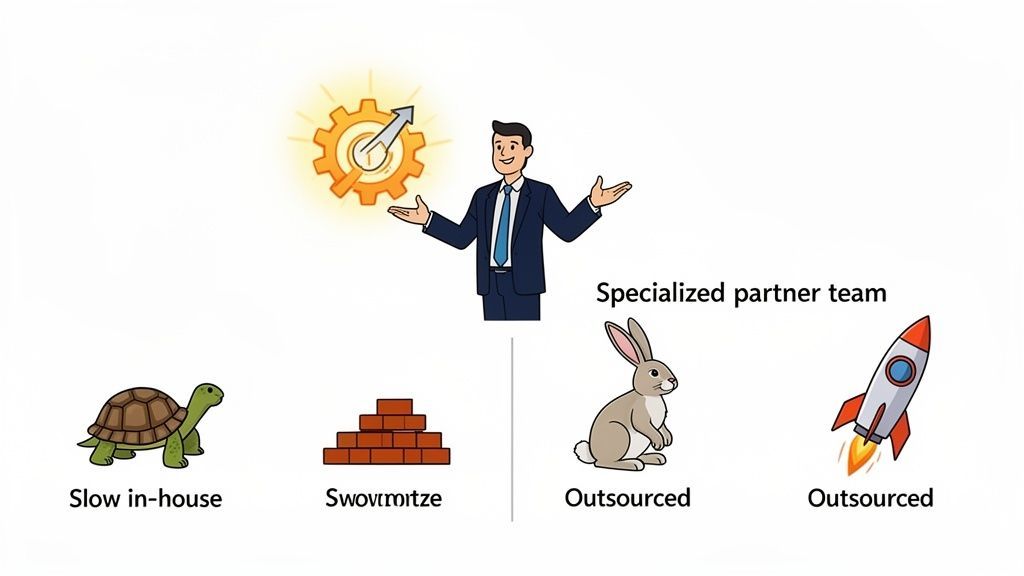
For any leader tasked with delivering a predictable sales pipeline, the "build vs. buy" decision is a critical strategic choice. This isn't just about cutting costs; it's about speed to market and competitive advantage. A staggering 64% of B2B marketers now turn to external partners to deliver results that an internal team might take months or even years to achieve.
The real question isn't just about saving money. It's about investing in a proven engine for growth. This section gets to the heart of the matter—'Is outsourcing right for our business?'—by exploring the operational and financial trade-offs between building your own team and partnering with an expert.
The Hidden Cost of Building Internally
On the surface, building an in-house lead generation team feels like the logical path. But this approach is loaded with a hidden "opportunity cost."
Every month spent recruiting, hiring, training, and equipping a new team is a month your competitors are engaging your prospects and winning deals. This internal ramp-up, which can easily stretch 3-6 months before a single qualified lead is generated, is a massive drain on both momentum and resources.
The real cost of building in-house isn’t the salaries—it’s the revenue you lose while your team is still learning. An agile outsourced partner eliminates this delay, delivering results from day one.
A specialized agency like Ezca, for instance, lets you completely bypass this learning curve. We arrive on day one with an experienced team, a proven playbook, and a fine-tuned tech stack, ready to launch campaigns and generate leads within weeks, not quarters.
In-House vs Outsourced: A Head-to-Head Comparison
To make a truly informed decision, you must look at the hard numbers and operational realities. This table breaks down how the two models stack up on the metrics that directly impact your bottom line.
The data tells a compelling story. An outsourced B2B lead generation partner offers a clear advantage in speed, cost-efficiency, and the ability to scale on demand. While an in-house team offers direct control, it often comes at a steep price and a much slower pace.
Ultimately, the right partner doesn't just work for you; they work with you, acting as an extension of your team to build the predictable, high-growth revenue engine your business needs to win.
Choosing Your Outsourcing Model
Once you've decided to outsource, the next critical decision is who to hire. Not all providers are created equal, and picking the wrong one is like hiring a great electrician to fix your plumbing—it creates expensive, frustrating problems. Your choice defines your strategy, budget, and ultimately, your results.
For most business leaders, the decision comes down to two main partner types. Each solves a different problem, and understanding the difference is key to aligning your goals with their services.
The Full-Service Agency: Your Strategic Growth Partner
Think of a full-service agency as the general contractor for your entire revenue engine. This is the right model when you need more than a task-doer; you need a strategic partner to design, build, and run a complete, multi-channel lead generation machine.
A true agency partner brings a 30,000-foot view, weaving together SEO, paid ads, content, and social media into a cohesive strategy. They take ownership of the entire funnel, from capturing a prospect's attention to handing off a sales-qualified opportunity.
For example, a full-service agency might:
- Build a content plan targeting your customers' biggest pain points to drive organic leads.
- Launch and optimize LinkedIn Ad campaigns to reach key decision-makers within target accounts.
- Implement smart email nurture sequences that guide prospects toward a sales conversation.
This integrated approach creates a flywheel effect. Strong content boosts SEO, which lowers ad costs. Ad campaigns generate data that sharpens your Ideal Customer Profile (ICP). It’s a system designed for sustainable growth. At Ezca, our squad model is built on this philosophy, providing a dedicated team that acts as a natural extension of your own.
A full-service agency is your best bet when you need strategic direction and integrated execution. You're not just buying leads; you're investing in a scalable system for predictable revenue.
This model is ideal for companies that lack deep in-house expertise across all marketing channels or are building a lead generation function from scratch. For a deeper look at the numbers and operational differences, check out our guide on in-house versus agency marketing.
The SDR-as-a-Service Provider: Your Tactical Sales Support
In contrast, an SDR-as-a-Service provider is a specialist you bring in to execute one critical job with expert precision: outbound prospecting and appointment setting. Their focus is narrow and deep.
With this model, you dictate the strategy. You provide the target account list, messaging framework, and overall game plan. They provide the trained professionals to execute it, filling your sales team's calendar with qualified meetings. It's a tactical service designed to add firepower to an existing sales or marketing function.
An SDR-as-a-Service team is a great fit if:
- You have a validated ICP and solid product-market fit.
- Your sales reps spend too much time prospecting and not enough time closing.
- You have a clear, short-term objective, like penetrating a new vertical or territory.
However, be aware of the limitations. This model is often single-channel, relying heavily on cold email and LinkedIn outreach. It lacks the strategic oversight to pivot if the initial approach fails. Without close management, it can generate high volumes of low-quality meetings that waste your sales team's time. It fills a specific gap but doesn't build the entire revenue engine.
The Financial Case for Outsourcing Your Lead Funnel
As a leader, every budget decision must pass the "CFO test." To get buy-in for outsourced B2B lead generation, the conversation must be about hard numbers, real returns, and a direct line to the bottom line. This is where outsourcing shifts from a tactical option to a powerful strategic investment.
The core financial argument is simple: a specialized partner can slash your Cost Per Qualified Lead (CPL) while significantly shortening the time to revenue. Building an in-house team requires massive upfront costs: recruiter fees, salaries, benefits, training, and an expensive tech stack. An outsourced team arrives on day one with a proven playbook and tools, eliminating these initial hurdles.
Deconstructing the Cost-Per-Lead Advantage
When you hire internally, you pay for the learning curve. A new Sales Development Representative (SDR) might take six months to become fully productive, all while drawing a full salary for minimal output. This inefficiency directly inflates your CPL.
A specialized agency has already gone through that grind. Their teams are veterans, their outreach scripts are battle-tested, and their strategies are built on data from hundreds of clients. You benefit directly from this operational efficiency, resulting in a much lower cost for a much higher quality lead.
A true outsourced partner isn't interested in vanity metrics like clicks or impressions. Their success is measured by what grows your business: Marketing Qualified Leads (MQLs), Sales Qualified Leads (SQLs), and closed-won deals.
This sharp focus on pipeline contribution reframes marketing from a cost center into a predictable revenue engine. For example, when a partner like Ezca works in agile 90-day sprints, we constantly reallocate budget to the highest-performing channels, ensuring every dollar of your investment works to deliver a measurable return.
The ROI Equation Backed by Data
The performance gap between a new internal team and a mature outsourced partner is exponential. An in-house group might struggle to produce 20-50 leads per month in its first six months. A seasoned agency can start delivering 100-300+ leads in that same window. This speed has a direct impact on your sales cycle and market penetration.
Industry data confirms this. According to 2026 statistics, companies that outsource B2B lead generation see an average ROI improvement of 43% compared to purely in-house efforts. The numbers show a staggering drop in the cost per qualified lead, from an internal average of $250-400 down to just $80-150 with an outsourced partner. You can explore how outsourcing drives B2B lead generation ROI to see exactly how this is achieved.
Beyond Cost Savings to Strategic Value
The financial case for outsourcing is about more than saving money. It’s about reallocating your most precious resources—your team's time and talent—to their highest-value activities. By offloading top-of-funnel prospecting, you empower your internal teams to focus on strategy and closing.
Your marketing strategists can focus on brand and product marketing. Your expert closers can spend their days in qualified meetings, not chasing cold prospects. This strategic alignment creates a more efficient, motivated, and effective revenue organization, making outsourced lead generation one of the smartest investments a growth-focused company can make.
Your 90-Day Sprint to a Predictable Pipeline
Partnering with an outsourced B2B lead generation team shouldn't be a shot in the dark. The best engagements are structured as agile sprints designed to prove their worth—fast. We approach every partnership with a 90-day sprint framework, a clear and accountable plan to build a predictable sales pipeline in one quarter.
This playbook removes the guesswork. We break down the first three months into distinct phases, each with its own checklist and deliverables, so you know exactly what’s happening and when to expect results. It’s a transparent roadmap from day one to measurable pipeline growth.
This process turns an initial investment into a well-oiled execution engine, which in turn delivers tangible ROI.
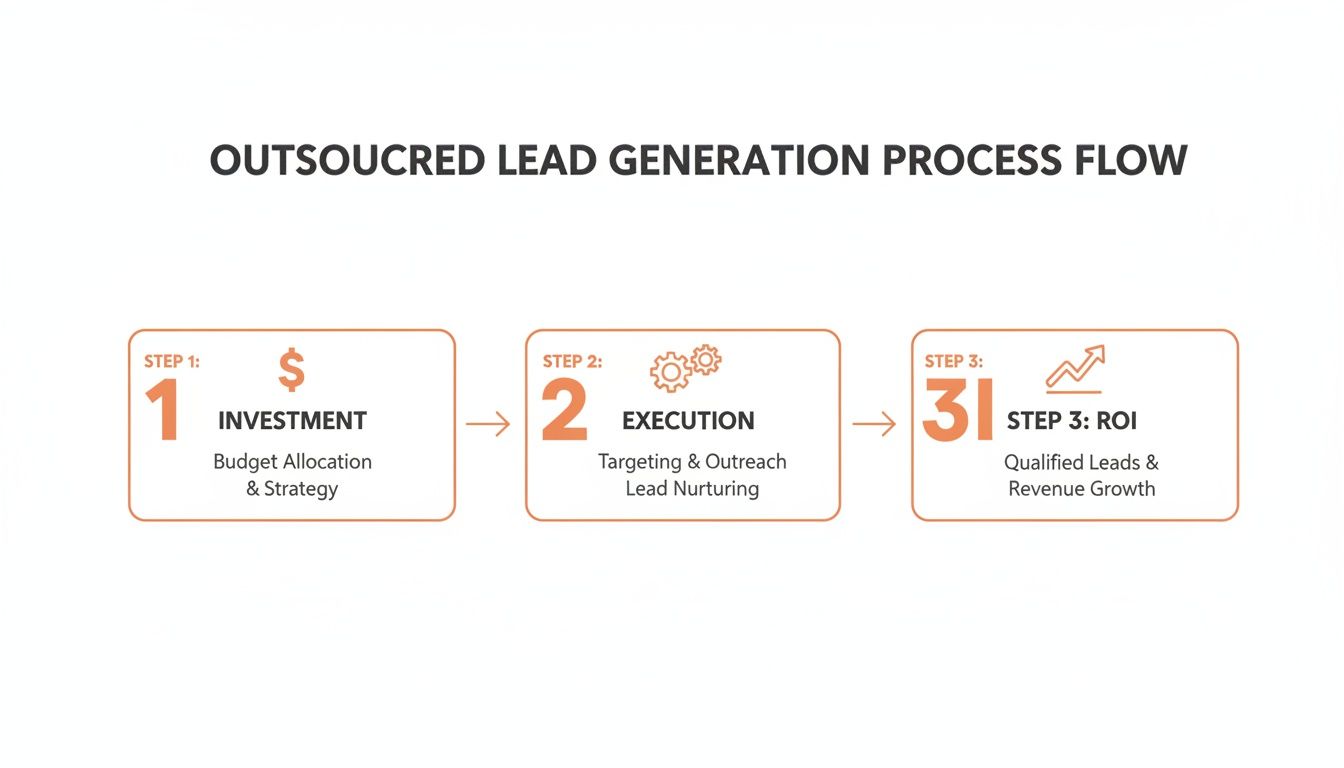
It’s a straightforward formula: a smart investment fuels a sharp execution process, driving real ROI and business growth.
Phase 1: Days 1-30 — Strategy and Onboarding
The first 30 days are about building a rock-solid foundation. Rushing into execution is a recipe for failure. This month is dedicated to a deep dive into your business, customers, and market to ensure every action is precise and impactful.
Our goal is to move from kickoff to "campaign-ready." Your new partner should feel like an extension of your team, absorbing your institutional knowledge and turning it into a concrete go-to-market plan.
Key Actions for Month 1:
- ICP & Persona Workshop: We facilitate a deep-dive session to document your Ideal Customer Profile (ICP)—who they are, their pain points, and their roles in the buying decision.
- Tech Stack Integration: We connect our tools to your CRM and marketing platforms to ensure seamless data flow and lead tracking from the start.
- Initial Asset Creation: Based on the ICP, our team develops the first round of campaign assets, including email copy, ad creative, and landing page concepts.
- KPI & Reporting Alignment: We agree on primary KPIs (MQLs, SQLs, CPL) and establish a clear reporting cadence.
Phase 2: Days 31-60 — Launch and Optimization
With the strategy locked in, the second month is about action, testing, and rapid learning. The engine starts humming, and data starts flowing. We shift from planning into active campaign management and relentless optimization.
We launch initial campaigns and immediately begin A/B testing—experimenting with messaging, offers, and audiences to see what connects. This iterative process is how we quickly refine the approach and dial in performance. To see how this plays out on a specific channel, check out our results from past B2B LinkedIn lead generation campaigns.
The goal of this phase isn't perfection; it's progress. You're gathering real-world market feedback to quickly identify winning formulas and cut losing bets.
Key Actions for Month 2:
- Campaign Launch: We activate multi-channel campaigns targeting your core ICP segments via LinkedIn Ads, cold email, content syndication, or a mix of tactics.
- A/B Testing & Analysis: We systematically test variables in messaging and creative to pinpoint what drives engagement and conversions.
- Lead Qualification Refinement: As the first leads arrive, we work with your sales team to review them. Their feedback is crucial for tightening our MQL and SQL definitions.
- Weekly Performance Reviews: We hold regular check-ins to review early data, share insights, and make quick adjustments to the campaign strategy.
Phase 3: Days 61-90 — Scaling and Reporting
The final 30 days are focused on one thing: capitalizing on what works. The data now tells a clear story about which channels, messages, and audiences are delivering. This phase is about doubling down on those winners to scale lead volume and deliver a powerful ROI report.
Your partner will shift budget toward the highest-performing campaigns identified in month two. You’ll see a significant uptick in qualified lead flow. The 90-day sprint concludes with a comprehensive performance review showcasing the pipeline generated, your cost per acquisition, and a data-backed plan for the next quarter, giving you the business case to continue the investment.
How to Choose the Right Lead Generation Partner
Picking an outsourced lead generation partner is a high-stakes decision. Get it right, and you accelerate growth and pack your pipeline with quality opportunities. Get it wrong, and you burn budget, set your company back months, and damage your brand's reputation with sloppy outreach.
This isn't just about comparing prices. You're handing over a critical business function. The goal is to find a true partner who acts as a seamless extension of your company. To do that, you must ask the C-suite-level questions that separate the pretenders from the performers.
Beyond the Sales Pitch
Any agency can promise leads. A genuine partner can prove how they'll deliver them. As you vet potential agencies, push past surface-level questions and demand concrete proof and strategic thinking.
This is your chance to dig into their process, expertise, and definition of success. A great partner will welcome this diligence.
Essential Vetting Questions to Ask:
- Show me verifiable case studies from companies in a similar niche. Ask about the specific challenges, the strategies used, and the hard numbers they produced (MQLs, SQLs, pipeline value).
- How do you define an MQL vs. an SQL, and what is your process for tracking them? This question reveals their understanding of the sales funnel and their commitment to sales-marketing alignment. A clear, documented process is non-negotiable.
- Walk me through your weekly optimization and budget reallocation process. A nimble partner like Ezca doesn't "set and forget." They should explain how they use data each week to double down on what’s working.
- Demonstrate your expertise in a multi-channel approach beyond just cold email. Relying on a single channel is a red flag. A modern partner must speak fluently about weaving together content, paid social, SEO, and email into a cohesive strategy.
Scrutinizing the Partnership Model
Beyond tactical skills, evaluate the partnership model itself. How will they integrate with your team? What does their communication and reporting cadence look like? A lack of structure is a recipe for frustration.
The best outsourced B2B lead generation partnerships are built on radical transparency, shared goals, and constant communication. If an agency is cagey about their process or metrics, walk away.
The market for these services has ballooned. As of 2026, 64% of B2B marketers have outsourced lead generation, a trend fueled by the intense resources needed for in-house prospecting. With over 300,000 companies offering these services, a solid evaluation framework is critical. You can find more insights about the rise of outsourced lead generation on whistle.ltd.
Final Checks Before Signing
Before you put ink to paper, run one last round of due diligence.
- Request Client References: And actually call them. Ask about their first 90 days, lead quality, and the partner's responsiveness.
- Meet the Actual Team: Don't just talk to the sales rep. Insist on meeting the account manager and strategists who will be in the trenches with you.
- Review the SLA: Go through the Service Level Agreement with a fine-tooth comb. Look for crystal-clear definitions of deliverables, KPIs, and reporting timelines that align with your business goals.
Choosing the right partner is an exercise in mitigating risk and accelerating growth. This framework will help you find an ally who is truly invested in your success.
The Modern Playbook: Fusing AI with Multi-Channel Mastery
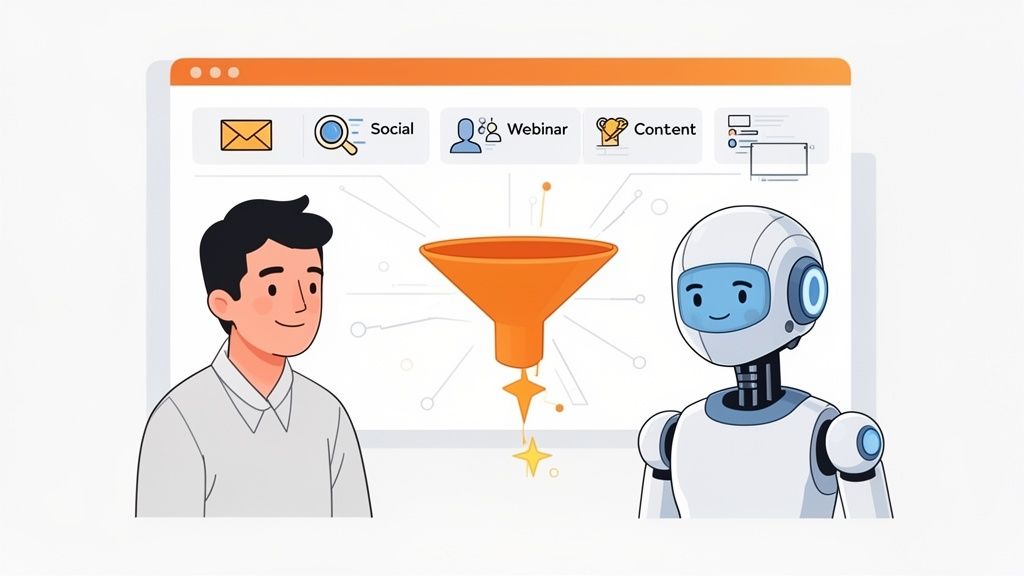
What separates a decent outsourced lead generation program from one that truly moves the needle? The smart fusion of human expertise with AI-powered efficiency. The modern approach isn't about replacing skilled marketers with algorithms; it's about giving them superpowers.
The best partners put AI to work at every stage of the funnel, automating tasks like list building with predictive scoring so humans can focus on strategy. This enables personalizing thousands of emails with dynamic content and forecasting channel ROI with stunning accuracy, turning lead generation into a data-backed science.
Weaving Channels Together for Better Results
Relying on a single channel is like trying to build a house with only a hammer. The most successful programs use a multi-channel framework because prospects move between email, social media, and your website. Your partner needs a plan to generate B2B leads with a modern GTM playbook, leaving outdated, siloed tactics behind.
This integrated approach creates a flywheel effect where each channel amplifies the others.
- Content & SEO: A great blog post or webinar pulls in prospects actively searching for solutions.
- Paid Social: That same content can be promoted with laser-targeted LinkedIn ads aimed at your Ideal Customer Profile (ICP).
- Email Nurturing: As leads come in, they enter automated email sequences designed to build trust and guide them toward a sales call.
When channels work in concert, your overall cost per lead drops significantly.
The Real-World Impact of AI and Inbound
The numbers don't lie. Mixing AI with a smart, multi-channel strategy gets results. Businesses combining AI's power with genuine human relationship-building achieve 30-40% higher conversion rates than those stuck in a single channel or relying purely on automation.
Specifically, using AI can lift sales-ready leads by 50% and slash customer acquisition costs by up to 60%. And methods like content marketing produce three times more leads at 62% lower costs than old-school outbound tactics.
A specialized agency is built to orchestrate these moving parts. They use real-time data to shift budget toward what's working right now, ensuring every dollar you spend is pulling its weight to grow your pipeline.
This level of sophistication is required to win today. At Ezca, we guide companies through this journey with our AI enablement services, helping them build a growth engine that’s ready for the future.
Frequently Asked Questions
As a marketing leader or business owner, you likely have questions about outsourcing B2B lead generation. Let’s tackle the most common ones head-on so you can move forward with confidence.
How Long Until I See Qualified Leads?
While every campaign is different, a proficient agency should start delivering the first batch of qualified leads within 2-4 weeks. You won't wait a full quarter to see if things are working.
The first 90 days are a critical momentum-building sprint. The first month focuses on strategy and setup. The next 60 days are dedicated to launching, testing, and optimizing. As your partner gathers real-time market feedback, both the quality and quantity of leads should ramp up.
How Will the Agency Integrate with My Sales Team?
A true partner doesn't just toss leads over the fence. They become an extension of your team, building a seamless lead handoff process that helps your sales reps close more deals.
Here’s what that integration looks like in practice:
- CRM Integration: The agency plugs directly into your CRM, whether it’s Salesforce, HubSpot, or another platform, ensuring instant and accurate lead data flow.
- Unified MQL/SQL Definitions: They work with your team to create rock-solid definitions for Marketing Qualified Leads (MQLs) and Sales Qualified Leads (SQLs) so everyone is aligned.
- Regular Feedback Loops: Expect weekly or bi-weekly syncs between the agency and your sales reps to review lead quality, discuss conversion rates, and adjust targeting.
This constant communication ensures both teams are aligned on the only goal that matters: driving revenue.
What Does a Typical Engagement Cost?
Investment for outsourced B2B lead generation varies by model and scope. A focused SDR-as-a-Service model might be a few thousand dollars a month. A comprehensive, multi-channel strategy from a full-service agency could be a five-figure monthly retainer.
The most important calculation isn't the monthly fee, but the cost versus the projected ROI. An effective outsourced partner should deliver a lower cost per qualified lead than you could achieve internally.
When evaluating the price, factor in the costs you're avoiding—recruiter fees, salaries, benefits, training, and a tech stack. An agency’s retainer often represents a fraction of the cost to build the same team in-house, and they deliver results much faster.
Ready to build a predictable revenue engine without the overhead of an in-house team? Ezca Agency combines human expertise with AI to deliver measurable growth through data-driven strategies.