
A Business Leader's Guide to Marketing Agency Pricing Models
Explore marketing agency pricing models and find the best fit for your biz. Compare retainer, project-based, and performance pricing for SaaS and e-commerce.

Choosing the right marketing agency is a critical decision, but the real secret to a successful partnership lies in selecting the right marketing agency pricing model. The structure of your agreement—whether it's a Retainer, Performance-Based, Project-Based, or Hourly model—directly impacts budget predictability, financial risk, and your agency's motivation to drive tangible results. This guide provides actionable insights for marketing leaders and business owners to evaluate which model truly aligns with their growth objectives.
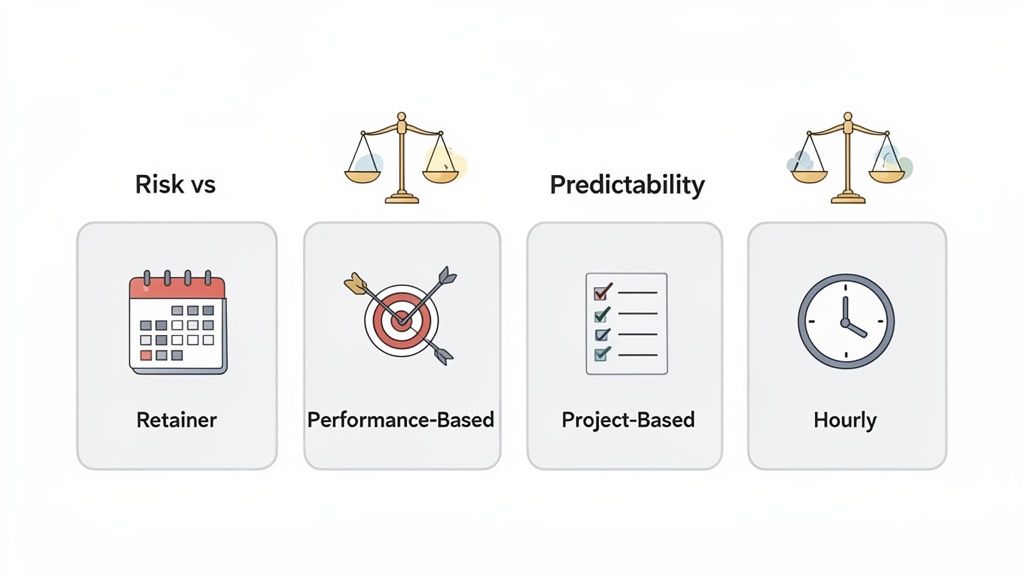
Comparing Core Marketing Agency Pricing Models
For a marketing leader or business owner, the pricing structure you choose sets the entire tone for the agency relationship. It defines how success is measured and, crucially, who shoulders the financial risk. This isn't just a cost calculation; it's a strategic decision to ensure your agency's incentives are perfectly aligned with your company's growth targets, whether that's steady brand building or hitting aggressive customer acquisition numbers.
Let's break down the most common models you'll encounter.
A High-Level Overview
Before diving into the specifics of each model, a side-by-side comparison can frame your thinking. The best fit depends on your company's stage, cash flow, and the clarity of your marketing goals. For example, a VC-backed startup focused on rapid growth might favor a performance-based deal, while an established B2B company may prefer the stability of a retainer for consistent, long-term strategic execution.
This table outlines the fundamental trade-offs at a glance.
Quick Comparison of Agency Pricing Models
Here's a straightforward look at how the common pricing models compare based on what matters most to business leaders.
This comparison makes it clear there's no single "best" option—only the one that aligns with your specific situation and tolerance for risk.
Key Insight: Your choice of pricing model is a strategic decision that signals your priorities. A retainer prioritizes a long-term partnership, while a performance model prioritizes immediate, quantifiable results.
At Ezca, we've found that a hybrid approach often works best. We frequently combine a base retainer with performance incentives inside our 90-day sprints. This ensures the essential strategic groundwork gets done while still keeping everyone laser-focused on hitting tangible outcomes, like qualified leads or tracked revenue—a perfect fit for the growth-obsessed SaaS and e-commerce brands we partner with.
The Retainer Model: Your Engine for Predictable Growth
The monthly retainer is the bedrock of many successful agency-client relationships. Think of it less as a project with a start and end date, and more like an ongoing partnership. You pay a consistent, fixed fee each month for a pre-agreed scope of services, effectively making the agency an extension of your marketing team.
This model is built for consistency and is ideal for channels like SEO and content marketing where results compound over time. The stability of a retainer allows an agency to dedicate reliable resources, think strategically for the long term, and deeply understand your business.
Why Retainers Dominate the Agency Landscape
The retainer's prevalence is a strategic choice benefiting both parties. For business leaders, it eliminates financial surprises and simplifies budget forecasting. For agencies, predictable revenue allows them to retain top talent, which ultimately benefits you, the client.
Data confirms this trend. Monthly retainers are the go-to model for digital marketing agencies, with 78% of agencies using it as their primary structure, a significant increase from 64% the prior year. This reflects client demand for predictable costs to cover continuous campaign management and strategic optimization.
Retainer fees can range from $1,000 per month for basic support to over $25,000 for complex, multi-channel strategies. To ensure this investment yields a positive ROI, robust marketing agency reporting is essential to connect the agency's monthly efforts directly to your bottom-line metrics.
Structuring Retainers for Maximum ROI
A successful retainer is built on a rock-solid Scope of Work (SOW) that prevents scope creep and ensures alignment. A well-defined SOW is your primary tool for managing expectations and guaranteeing both you and the agency are clear on deliverables.
A robust SOW must include:
- Specific Deliverables: Be granular. Define exactly what will be delivered each month (e.g., 4 blog posts, 1 email campaign, weekly ad optimization).
- Key Performance Indicators (KPIs): Agree on the metrics that matter to your business, such as Cost Per Acquisition (CPA), Marketing Qualified Leads (MQLs), or organic traffic growth.
- Reporting Frequency: Set clear expectations for when and how results will be shared (e.g., a bi-weekly call and a comprehensive monthly dashboard).
- Communication Channels: Define how you'll communicate. Will it be a dedicated Slack channel or scheduled weekly check-ins?
Actionable Insight: Always push for a "use it or lose it" clause in your SOW. This simple line prevents unused hours or deliverables from rolling over month after month, which can create a logistical nightmare and muddy the waters on what you're actually getting for your money.
At Ezca, we structure our retainers around focused 90-day sprints. This provides the stability of a traditional retainer while adding a layer of accountability. Each sprint has clear, measurable goals, allowing us to act as a true growth partner while giving our clients the financial predictability they need.
When the Retainer Model Works Best
The retainer model excels when marketing requires a long-term, continuous effort rather than a one-time fix. If you're focused on sustainable growth, a retainer is likely your best bet.
Consider a retainer for these scenarios:
- SaaS Lead Generation: A SaaS company needs a steady stream of MQLs. A retainer empowers an agency to consistently refine SEO, manage paid search campaigns, and nurture leads through content over the long term.
- E-commerce Brand Building: An online store aiming to build loyalty can use a retainer for ongoing social media management, email marketing, and conversion rate optimization to steadily grow customer lifetime value (LTV).
- Comprehensive SEO Strategy: Ranking on Google is a marathon. A retainer provides the necessary runway for deep technical audits, consistent content creation, and strategic link-building that drives sustainable organic growth.
Performance-Based Models That Pay For Results
For business owners and marketing leaders who live and breathe ROI, performance-based pricing is the ultimate "put your money where your mouth is" model. Instead of paying for hours logged or tasks completed, you pay for tangible business outcomes. This structure directly ties an agency’s compensation to hitting specific, measurable goals like qualified leads, new customers, or attributable revenue.
This approach flips the traditional risk dynamic. The agency shoulders most of the financial risk, betting on its ability to deliver. If they don't produce results, their compensation is minimal. This high-stakes setup ensures your agency is as invested in your bottom line as you are, making them a true partner in growth.
Unpacking Common Performance Structures
Performance-based agreements must be built around the specific metrics that drive your business forward. The most common structures are Cost Per Lead (CPL), Cost Per Acquisition (CPA), and Revenue Share, each suited to different business contexts.
Here’s how they break down in practice:
- Cost Per Lead (CPL): A standard for B2B service companies. You pay a fixed fee for every qualified lead the agency generates. Success requires a crystal-clear, mutually agreed-upon definition of a "qualified" lead.
- Cost Per Acquisition (CPA): Common in SaaS and e-commerce, you pay the agency for each new customer they acquire. It's a powerful metric directly tied to new business revenue.
- Revenue Share: The most aligned model, popular with e-commerce brands. The agency earns a percentage of the revenue generated directly from their marketing efforts, such as sales from a specific ad campaign.
Key Insight: The success of any performance model hinges on two things: rock-solid tracking and a mutually agreed-upon definition of success. Without precise attribution, disagreements over compensation are almost inevitable.
Industry Benchmarks and Hybrid Approaches
Performance-based pricing is gaining traction, especially for B2B SaaS and e-commerce brands where results are easily tracked. You'll often see CPA rates between $50-$200 per qualified lead, with average CPLs hovering around $237. Revenue share agreements typically fall in the 5-25% range of new, attributable income, guaranteeing agencies only win when their clients do.
However, a pure performance model can be challenging for an agency, as factors outside their control (e.g., your sales process, product pricing) can impact results. This has led to the rise of hybrid models, which combine a smaller base retainer to cover strategy and groundwork with performance bonuses for hitting ambitious targets.
This hybrid approach offers the best of both worlds. The retainer ensures the agency can dedicate quality resources to long-term strategy, while the performance component keeps everyone laser-focused on growth. This is a core part of the performance marketing services we’ve built at Ezca, blending stability with a powerful incentive for results.
When to Use a Performance Model
This pricing structure is a powerhouse, but only in scenarios where goals are clear and results can be tracked unambiguously. It's an excellent choice for businesses with a validated product and a strong grasp of their unit economics.
A performance-based model is a great fit if you're a:
- Venture-Backed Startup: You need to accelerate customer acquisition without burning cash on large upfront retainers. A CPA or CPL model allows you to pay for growth as it happens.
- E-commerce Brand with Strong Margins: A revenue-share agreement can be a game-changer for scaling paid ads. You give up a slice of revenue, but the agency is massively motivated to maximize your sales.
- B2B Company with a Solid Sales Process: If you know your conversion rate from an MQL to a closed deal, a CPL model can be a highly predictable way to fill your sales pipeline.
Project-Based Pricing for Specific Marketing Needs
Sometimes, you don't need a long-term agency partnership; you need a specific job done well. That’s where project-based pricing comes in. Think of it as hiring a specialist for a one-off task with a clear start and finish, like a website overhaul, a deep-dive SEO audit, or a 90-day campaign launch.
Unlike a retainer, which focuses on an ongoing relationship, a project-based fee is a single, fixed price for a specific set of deliverables. You know the exact cost upfront, simplifying budgeting. This model is ideal for companies needing a burst of specialized expertise without the commitment of a full-time hire.
When Project-Based and Hourly Models Make Sense
The primary benefit of project or hourly billing is flexibility. You can access top-tier agency talent exactly when needed to solve a pressing problem or capitalize on an opportunity. It’s an ideal setup for executing tactics when you already have a strategy in place.
Hourly rates are common, with B2B agencies quoting around $75-$200 per hour and digital strategy firms often in the $100-$149 range. These rates are suitable for short-term needs—like a quick PPC audit or content refresh—without a long-term contract.
Project-based models are best for clearly defined scopes, like a site redesign or a focused content sprint, with fixed fees ranging from $2,500 to over $10,000. Data shows many agencies prefer hourly rates for tactical work as it structures specific, measurable tasks. You can get a more granular look at how these numbers stack up in this analysis of B2B agency pricing models for 2026.
So, when should you opt for a project-based model? Here are a few classic scenarios:
- Website Development or Redesign: Building a new site has a concrete beginning, middle, and end, making it a perfect candidate for a project fee.
- Technical SEO Audit: A one-time, comprehensive analysis of your site’s technical health to create an action plan for your internal team.
- Content Creation Sprint: Developing a new pillar page and supporting articles to enter a new market is a well-defined project.
- Campaign Launch Package: This could cover creating ad visuals, landing pages, and the initial setup for a new product launch.
The Tradeoff: Short-Term Clarity vs. Long-Term Strategy
The certainty of a fixed project fee is appealing, but it comes with a major caveat: this model is inherently transactional. The agency's job is to deliver the agreed-upon tasks and move on, not necessarily to drive your long-term business growth. Once the project is complete, the engagement ends.
This can create strategic gaps. For instance, an agency that builds you a new website isn't responsible for the ongoing SEO or conversion rate optimization (CRO) needed for its success. That continuous improvement is what retainers and performance models are designed for.
Actionable Insight: Treat a project-based engagement as a "test drive" before committing to a long-term retainer. A successful project, like an SEO audit or a small campaign, is a low-risk way to see if you like an agency's work, communication style, and overall vibe.
Here at Ezca, for instance, we often kick off a new relationship with a project-based technical SEO audit. When the client sees the depth of our analysis and how we work, it often becomes a seamless transition into one of our comprehensive 90-day growth sprints, which functions much more like a strategic partnership.
Crafting a Project Brief That Gets You an Accurate Quote
The success of any project-based engagement depends on the quality of your project brief. A vague brief leads to inaccurate quotes, scope creep, and disappointing results. To get a sharp, fair price, your brief must be airtight.
A rock-solid brief always includes these key elements:
- Clear Business Goals: What is the business objective of this project? (e.g., "Increase qualified leads from organic search by 15% within six months of the new site going live.")
- Specific Scope of Work: List every single deliverable you expect. (e.g., "Design and develop a 15-page WordPress website, including wireframes, mockups, mobile optimization, and content migration.")
- Defined Timeline: When does this need to be completed? Are there critical milestones along the way?
- Budget Range: Providing a realistic range helps agencies propose a solution that works for you.
- Success Metrics: How will you measure success? (e.g., "Achieve a Google PageSpeed score of 90+ on both mobile and desktop.")
Investing time in a thorough brief upfront empowers agencies to provide an accurate quote and, more importantly, sets the stage for a successful project.
How To Choose The Right Pricing Model For Your Business
Choosing the right pricing model is a strategic decision that must align with your business goals, risk tolerance, and growth stage. There is no single "best" answer, only the model that makes the most sense for your business right now.
Start with your primary objective. If you are a B2B company focused on building a predictable pipeline of marketing qualified leads (MQLs), a retainer model often provides the stability needed for long-term, consistent effort. Conversely, if you're an e-commerce brand launching a new product and need a massive, immediate sales spike, a performance-based model directly ties agency compensation to those results.
Aligning Your Model With Business Objectives
The right marketing agency pricing model should act as a growth lever, not just an expense. Your decision must be rooted in your company's immediate needs and long-term vision, considering factors like cash flow, strategic priorities, and desired level of collaboration.
Before engaging with agencies, research the market to establish a baseline. Understanding benchmarks like the typical SEO costs in Australia if you operate in that region will put you in a stronger negotiating position.
This simple decision tree can help guide your initial choice: are you tackling a specific, short-term task or investing in a long-term strategic partnership?
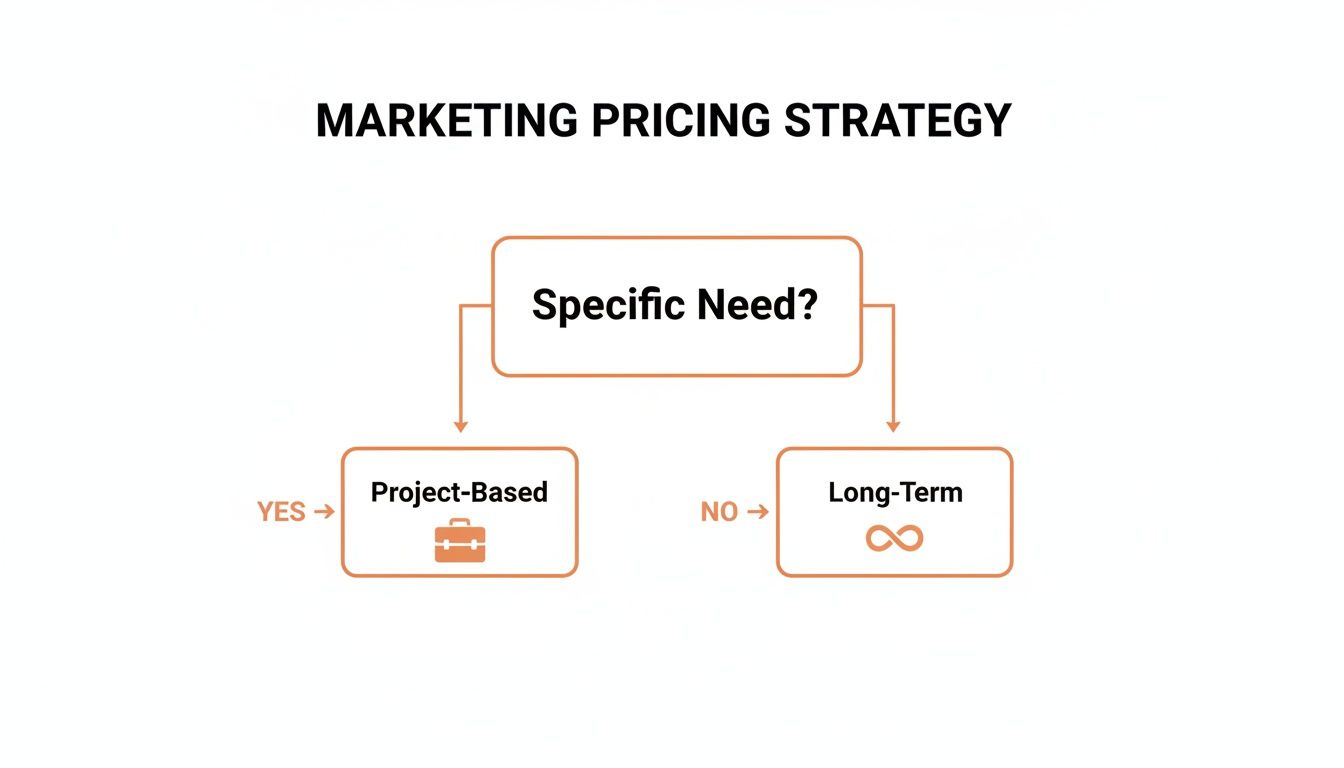
As the flowchart illustrates, if your need has a clear start and end, a project-based fee is logical. Otherwise, a longer-term model is required to support ongoing growth.
A Decision Framework For SaaS And E-commerce Leaders
For fast-paced SaaS and e-commerce brands, the choice often involves balancing speed with sustainability. A pure performance model can deliver quick results but may neglect the foundational work needed for long-term brand equity. A retainer builds that foundation but can feel slow if you're under pressure to show immediate traction.
This is a central consideration in the in-house vs. agency marketing debate. You must weigh the need for quick wins against the long-term goal of brand building.
Key Insight: The best model often changes as your business grows. An early-stage startup might start with a performance-based deal to manage cash flow and prove ROI. Later, as it scales and needs more strategic planning, it might switch to a retainer.
At Ezca, we bridge this gap with our 90-day growth sprints. This hybrid model provides the strategic guidance of a retainer with the outcome-focused incentives of a performance model, ensuring we are always driving toward measurable results.
Decision Matrix Matching Pricing Models To Business Needs
To simplify your decision, this matrix breaks down how each pricing model aligns with different business factors. Use it as a guide to identify the most logical partnership structure for your company's current stage.
This matrix highlights the trade-offs of each model. Your final choice should be a calculated one, balancing immediate needs with long-term ambitions to find a marketing agency pricing model that truly works for you.
Negotiating Your Agency Contract and Setting Clear Expectations
After selecting a pricing model, the next step is to finalize the contract and Service Level Agreement (SLA). This document is the foundation of your partnership, protecting both parties and setting clear, measurable expectations from day one.
Effective negotiation is about more than reducing the price; it's about clearly defining the rules of engagement to prevent future misunderstandings, especially with retainers or performance deals where scope can evolve.
Defining The Scope Of Work and KPIs
The core of your contract is the SLA, where you translate business goals into specific deliverables and metrics. This document must be unambiguous, spelling out exactly what success looks like so you know you're paying for results, not just effort.
A well-structured SLA must include:
- Specific KPIs: Avoid vague promises. Instead of "increase traffic," specify: "achieve a 20% increase in marketing qualified leads (MQLs) from organic search within 90 days."
- Reporting Frequency and Format: Agree on when and how you’ll get updates, such as "a bi-weekly performance call, access to a real-time dashboard, and a detailed PDF report at the end of each month."
- Communication Protocols: Define how you'll interact, such as a dedicated Slack channel for daily questions and scheduled weekly calls for strategy.
- Ownership of Deliverables: Clarify who owns creative assets, ad accounts, and campaign data, especially in the event the partnership ends.
Think of your contract as the single source of truth. It should clearly outline what happens if performance targets are missed or if you need to pivot your strategy, turning potential arguments into productive conversations.
Building In Flexibility for Long-Term Success
A rigid contract can hinder growth. Business needs change, and your marketing strategy must adapt. Building flexibility into your agreement allows the partnership to evolve without requiring a new contract each quarter.
Consider including clauses that anticipate change:
- Performance Review Cadence: Schedule formal reviews every 90 days to assess progress against KPIs. This provides a natural opportunity to adjust the plan and budget.
- Budget Adjustment Terms: Define a clear process for scaling the budget up or down, which is critical for performance-based models where you may want to increase investment in successful campaigns.
- Termination Clause: Establish a clear exit strategy. A standard "30-day notice for termination without cause" is a fair and professional way for either party to end the relationship if it's not the right fit.
Finalizing these details ensures your chosen pricing model works in practice, not just on paper. You can see how different partnership structures are laid out by looking at the various Ezca pricing options we offer. By setting clear expectations before any work begins, you’re building a partnership based on trust and a shared focus on real growth.
Common Questions About Agency Pricing Models
Navigating agency pricing can be complex. Here are straightforward answers to the most common questions from business leaders.
What Is The Most Common Pricing Model For Marketing Agencies?
The monthly retainer is by far the most common model. Recent studies show that nearly 78% of agencies use retainers as their primary pricing structure.
This popularity stems from its mutual benefits: clients get predictable costs for budgeting, and agencies get stable revenue. This stability is ideal for building long-term partnerships focused on ongoing work like SEO and content marketing, where results compound over time.
How Much Should I Expect To Pay For A Marketing Agency?
The cost of a marketing agency varies widely based on the pricing model, scope of work, and the agency's reputation and expertise.
Here’s a general range of what you can expect:
- Monthly Retainers: These can range from $1,000 for basic services to over $25,000 for a comprehensive, enterprise-level strategy.
- Project-Based Work: A one-off project, like a technical SEO audit, might start around $2,500, while a full website redesign will be significantly higher.
- Performance Models: Costs are variable. You might pay a modest base fee plus a percentage of revenue (often 5-25%) or a set price per qualified lead, which can range from $50 to $500.
Focus on the potential value and ROI of the engagement, not just the cost.
How Do I Measure The ROI Of My Marketing Agency?
Your ROI calculation should be directly tied to your business goals and the agreed-upon pricing model. For performance-based deals, the ROI is often straightforward, as you can draw a direct line from agency fees to the revenue they generated.
For retainers, you'll need to watch the Key Performance Indicators (KPIs) you both agreed to in your Service Level Agreement (SLA). These aren't vanity metrics. We're talking about hard numbers like Customer Acquisition Cost (CAC), Lifetime Value (LTV), marketing qualified leads (MQLs), conversion rates, and the actual revenue you can attribute to their efforts.
A great agency partner will provide detailed reports that clearly connect their monthly activities to your bottom-line results.
Ready to partner with an agency that ties every action to measurable growth? At Ezca Agency, our 90-day sprints are designed to deliver clear ROI, dynamically shifting your budget to the highest-performing channels. Learn more about our performance-driven approach.