
How to Use AI in Digital Marketing: An Actionable Guide for 2026
Learn how to use AI in digital marketing with our proven guide. Get actionable strategies for SEO, ads, and content that deliver real ROI for your business.
Integrating AI into your digital marketing isn't about chasing technology. For marketing leaders and business owners, it's a strategic imperative to drive efficiency, unlock revenue, and build a sustainable competitive advantage. AI allows you to analyze complex data instantly, deliver hyper-personalized customer experiences, and free your team from low-value, repetitive tasks.
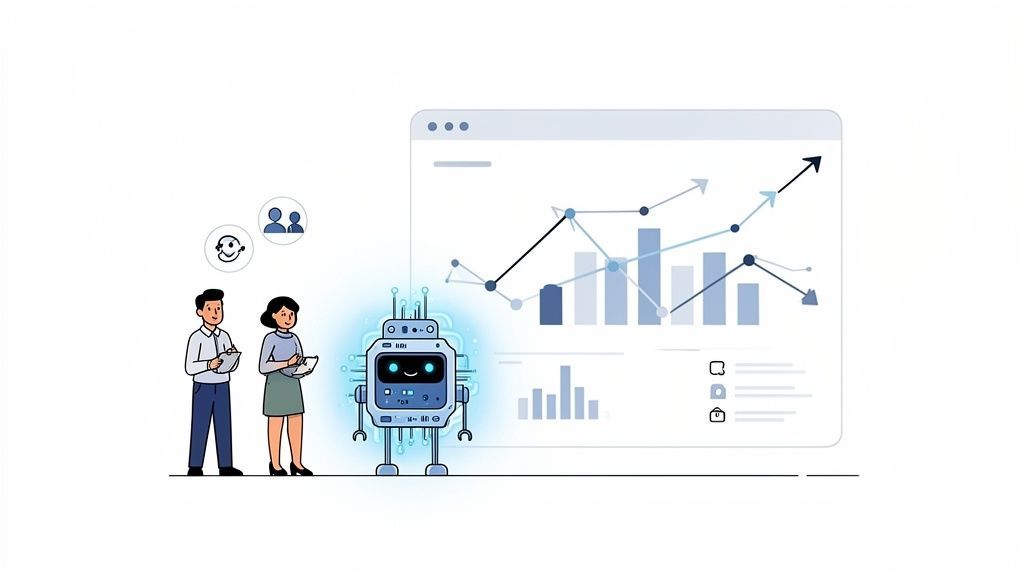
Why AI in Marketing is No Longer Optional
This is not a hypothetical, futuristic discussion. This is a playbook for what high-performing marketing leaders are executing right now. We will break down how B2B, SaaS, and e-commerce companies are leveraging AI to drive measurable growth.
The core principle is simple: use artificial intelligence to make better, faster decisions. This empowers your team to focus on uniquely human strengths—strategic thinking, creative problem-solving, and building authentic customer relationships.
The market has already placed its bet. The global AI in marketing sector has surged to $36 billion USD, with AI-managed ad spend hitting $370 billion USD worldwide. As you can see from the latest AI marketing investment data on Statista, this is no longer an experiment; it's a core component of modern business strategy.
For marketing leaders, the question has shifted from "Should we use AI?" to "How do we implement it to drive ROI, and how quickly?" It's time to integrate AI into your operational workflow to see a tangible impact on revenue and efficiency.
Shifting from Manual Drudgery to Strategic Impact
Consider the hours your team spends on manual work: pulling reports, segmenting audiences, A/B testing ad copy, and optimizing campaigns with lagging data. This is precisely the operational drag that AI is designed to eliminate.
Instead of your team spending days in spreadsheets to reallocate budget, an AI model can do it in real-time. For example, at Ezca, our AI-assisted performance marketing teams use a model that automatically shifts ad spend to the highest-performing channels and creative on a daily basis. This means our clients capitalize on opportunities the moment they emerge, not weeks later.
ROI Focus: The objective isn't just to automate tasks; it's to equip your team with strategic leverage. Let AI handle the data crunching so your experts can focus on interpreting insights and making high-value strategic decisions.
This shift transforms marketing from a reactive to a proactive growth engine. The table below outlines how AI reframes core marketing functions for greater impact.
AI's Impact on Core Marketing Functions
By offloading the tactical heavy lifting to AI, your team is free to focus on brand strategy, customer insights, and creative innovation—the activities that truly differentiate your business.
A Channel-by-Channel Guide to Implementing AI
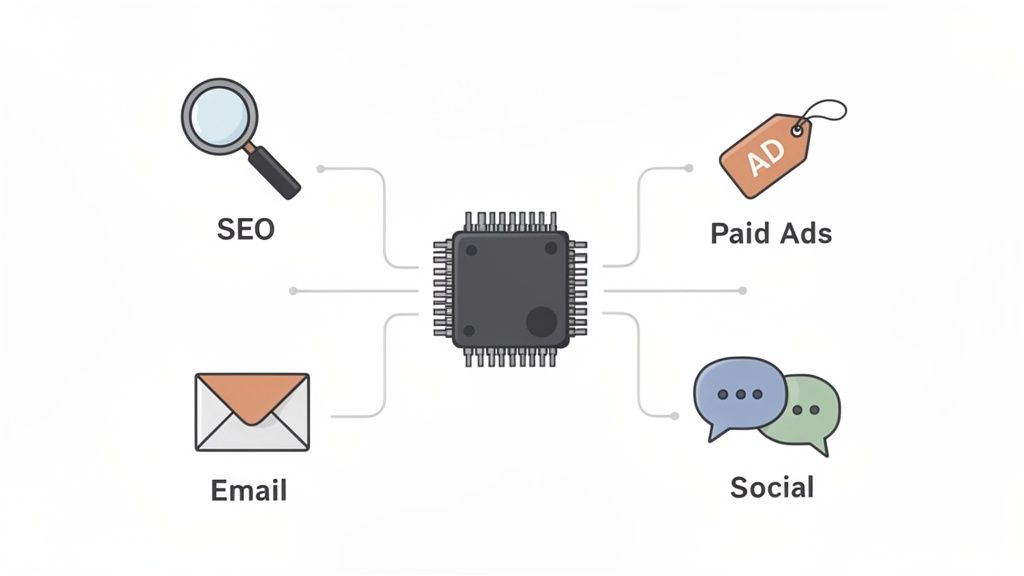
It's tempting to search for a single, all-in-one AI platform. However, the most effective strategy is to view AI as a series of strategic upgrades to your existing marketing channels. The goal is to make every channel—SEO, paid ads, email—smarter, faster, and more profitable.
For business owners and marketing leaders, this is where strategy meets execution. It's about identifying the biggest operational bottlenecks in your day-to-day workflow and applying a specific AI solution to solve that problem. When you apply this methodology across all channels, the results compound into a more cohesive and powerful multi-channel marketing engine.
Use Programmatic SEO to Dominate Niche Markets
Traditional SEO is often a slow, manual process. AI enables programmatic SEO, a strategy that shifts the focus from writing single articles to systematically capturing hundreds or thousands of long-tail keyword opportunities. It involves using AI to identify these niches and then programmatically generate unique, optimized pages at scale.
Real-World Example: A B2B SaaS company offering project management software can move beyond the hyper-competitive term "project management software." Using AI, they can generate dedicated landing pages for "best project management software for architecture firms" or "Trello alternative for remote marketing teams." Each page is tailored to a specific user intent, capturing high-value traffic that would be impossible to target individually.
- Actionable Tactic: Use an AI tool to analyze your competitors' sitemaps and your own Google Search Console data. Identify patterns like "your brand vs. competitor" or "your product for [industry]" to uncover programmatic opportunities.
- Metric to Track: Measure the increase in qualified organic leads from these highly specific pages and the corresponding drop in your blended Cost Per Lead (CPL).
Maximize Ad Spend with AI-Powered Bidding and Creative
In paid advertising, speed and agility win. AI provides a decisive advantage by managing real-time bidding on platforms like Google Ads and Meta with a precision no human can achieve, constantly optimizing based on thousands of signals. Algorithms can now predict a user's likelihood to convert with over 90% accuracy, ensuring your budget is allocated to the most valuable impressions.
AI also revolutionizes creative production. Instead of manually writing a few ad variations, you can use AI to generate dozens of distinct headlines, descriptions, and calls to action in minutes. You can even generate AI UGC ads that feel authentic and resonate more deeply with your audience.
E-commerce Example: An online retailer can use a tool like Jasper AI to generate 25 different ad copy versions for a new product. Loading these into Google's Performance Max, the AI algorithm tests all combinations, automatically shifting budget to the top performers. The result is a direct increase in ROAS (Return on Ad Spend) and a lower CPA.
Accelerate Conversions with AI-Driven CRO
Traditional Conversion Rate Optimization (CRO) often relies on educated guesses. AI-powered CRO tools like Evolv.ai or Intellimize transform this process. They don't just run A/B tests; they run hundreds of multivariate tests simultaneously, testing endless combinations of headlines, images, and CTAs. The AI learns from every interaction and rapidly converges on the optimal experience for different user segments.
- Actionable Tactic: Use an AI-powered analytics tool to identify "rage clicks"—where users repeatedly click on non-interactive elements. This is a clear indicator of user frustration and an easy UX fix that can immediately improve conversions.
- ROI Calculation: A 5-10% uplift in conversion rate on a key landing page is a realistic goal for a 90-day sprint. Calculate the ROI by comparing the new revenue generated against the cost of the AI tool.
Personalize Email and Social Media at Scale
One-size-fits-all campaigns are dead. Customers expect relevance, and AI makes delivering personalization at scale feasible.
In email, AI can write subject lines tailored to a user's engagement history or populate emails with product recommendations based on their browsing behavior. For social media, AI can analyze engagement data to determine the optimal posting time for different audience segments, not just your audience as a whole.
SaaS Onboarding Example: A company can use the AI features within a platform like Mailchimp to create a smarter onboarding flow.
- AI Segmentation: The AI automatically groups new users based on the first features they use in the application.
- Targeted Nurturing: It then triggers an email sequence with tips relevant only to those specific features, avoiding generic content.
- Predictive Optimization: The AI continuously analyzes open and click rates, automatically refining subject lines and send times to improve performance for future users.
This data-driven approach directly improves user activation and reduces churn, making a clear impact on revenue. This is the type of practical AI application we execute in our 90-day sprints at Ezca to deliver measurable performance improvements for our clients.
Building Your AI-Powered Content Engine
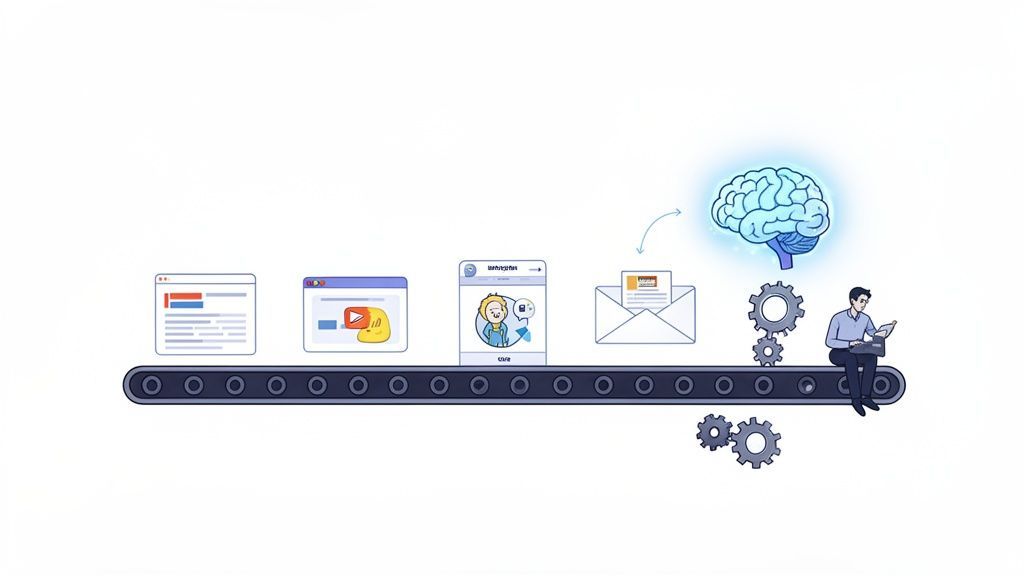
While content generation is the most visible application of AI, most marketing leaders are underutilizing it. The real value isn't asking an AI to "write a blog post." It's about building a scalable content engine that achieves specific business goals, like driving organic leads or reducing customer support queries.
This requires a mindset shift. Your team's role evolves from manual content producers to strategic editors, analysts, and promoters. When AI handles 80% of the drafting, research, and initial optimization, your experts can focus on adding proprietary data, unique insights, and brand voice—the elements that create a true moat around your business.
From Guesswork to Data-Driven Topic Research
Effective content strategy begins with deep audience understanding, not brainstorming. AI enables you to move from educated guesses to data-backed conviction.
Use AI to analyze competitor content, customer reviews from sites like G2 and Capterra, and social media conversations at a scale impossible for a human. This reveals not just what people search for, but the specific pain points, questions, and language they use.
A Practical Workflow:
- Aggregate Data: Feed an AI tool the URLs of top-ranking articles for your target keyword, plus dozens of customer reviews and relevant Reddit or forum threads.
- Synthesize Insights: Prompt the AI to identify the recurring questions, pain points, and desired outcomes.
- Build a Topic Cluster: Use these insights to map out a central pillar page and the necessary supporting articles to establish topical authority, ensuring no customer question goes unanswered.
This method helps you create content that not only resonates but is structured to rank. For a deeper dive, check out our guide on how to increase organic traffic with strategic content planning.
From First Draft to Authoritative Final Product
Once your plan is set, AI can produce a solid first draft in minutes. The key is to treat this output as a well-structured foundation, not a finished piece. It's your team's job to transform it into something exceptional.
Your human experts then perform the high-value work:
- Injecting Proprietary Insights: Weaving in your company's unique data, case studies, and expert opinions that an AI cannot generate.
- Ensuring Brand Voice: Refining the tone, style, and vocabulary to align perfectly with your brand identity.
- Fact-Checking and Verification: Validating all claims and statistics to maintain credibility and earn audience trust.
Key Takeaway: The "Human-in-the-Loop" model is the only sustainable way to produce high-quality content at scale. AI provides speed and efficiency, while your team provides the authority and authenticity that build a loyal audience.
Systematize Content Optimization for Performance
Creating content is only half the battle. AI-driven optimization is essential for ensuring it gets found. Data shows that 51% of marketing teams now use AI for content optimization. This makes sense when you see that 50% are creating content with AI and 45% are brainstorming with it. You can see more on these marketing trends and their implications on SurveyMonkey.
A systematic approach involves using AI tools to analyze top-ranking content for your target keyword. The AI can instantly identify:
- Content Gaps: Subtopics your competitors cover that you've missed.
- Semantic Keywords: Related terms crucial for signaling topical authority to Google.
- Optimal Structure: The ideal word count, heading structure, and readability for a specific search query.
Armed with this analysis, your team can enrich the draft to be more comprehensive than the competition before publication. When building your content engine, exploring Taplio alternatives for AI-powered content generation and analytics can introduce you to powerful tools for this process. This is a core component of the performance-driven sprints we run at Ezca, where content isn't just created—it's engineered to perform.
Measuring ROI with Predictive Analytics
As a marketing leader, proving the value of any investment is non-negotiable. To justify AI spend, you must measure its impact on the bottom line. It's time to move beyond vanity metrics and focus on the financial ROI delivered by predictive analytics.
This is where AI evolves from a simple tool to a strategic partner. Instead of analyzing last month's reports, you begin forecasting future outcomes. Predictive models identify which campaigns are likely to succeed and which are destined to fail—before you waste your budget.
Forecasting Campaign Outcomes and Customer Behavior
AI-powered predictive analytics has revolutionized performance marketing. AI systems can now reliably forecast campaign results, identify high-value customer segments, and flag underperforming initiatives before they burn through significant cash.
This is a fundamental shift from retrospective analysis to proactive, real-time decision-making. Marketing teams can finally draw a clear line from their tactics to business results, enabling transparent attribution. You can find some great examples of how marketing teams are using AI on monday.com.
For example, an AI model can analyze your historical data to predict customer churn risk with high accuracy. It flags at-risk accounts, allowing your customer success team to intervene with targeted support, directly impacting retention and Customer Lifetime Value (LTV).
Key Takeaway: Predictive analytics transforms marketing from a reactive guessing game into a proactive, data-driven strategy. You stop spending money to see what happens and start investing where data indicates the highest probability of return.
Implementing an AI-Driven Budget Allocation Framework
One of the most impactful applications of this technology is dynamic budget allocation. Imagine a system that makes intelligent budget decisions on a weekly, or even daily, basis. In 2026, this is a practical reality.
By continuously feeding performance data into an AI model, you can build a framework that constantly re-evaluates your marketing mix. The model can recommend shifting funds away from campaigns with a low predicted ROI and doubling down on those with the highest potential. This makes your marketing budget fluid and relentlessly efficient.
This agile approach is central to the 90-day sprints we run at Ezca. Our AI-assisted teams don't wait for quarterly reviews; they are empowered to adjust ad spend weekly, ensuring client budgets are always maximally effective. For a B2B SaaS client, this might mean shifting budget from a plateauing LinkedIn campaign to a high-converting Google Ads keyword mid-week.
Tracking the KPIs That Matter to the C-Suite
To build a compelling business case for AI, you must track the metrics your CFO cares about. The C-suite wants to see bottom-line impact, not clicks and impressions.
Focus on these essential KPIs:
- AI-Influenced Revenue: Track the revenue generated from leads or customers who engaged with an AI-driven touchpoint, such as a personalized email, a predictive retargeting ad, or a chatbot-qualified lead.
- Reduction in Customer Acquisition Cost (CAC): By optimizing ad spend and improving targeting, AI should directly lower your CAC. A 15-20% reduction is a realistic goal for an initial 90-day AI sprint.
- Improvement in Lead-to-Close Ratio: Predictive lead scoring ensures your sales team focuses on high-propensity leads, making the entire funnel more efficient. Tracking this ratio proves AI's value to sales productivity. To see this in action, learn more about SaaS predictive lead scoring and the results it delivers.
Focusing on these metrics demonstrates that AI is a direct driver of revenue and efficiency, not just another line item on the marketing budget.
Launching Your First 90-Day AI Marketing Sprint
Theory is good; execution is better. It's time to move from "what if" to "what is" with a practical, 90-day plan. This isn't a massive, department-wide overhaul. It's a focused sprint designed to deliver a quick, measurable win that builds momentum.
Think of this as a pilot program. The goal is to prove the concept, generate hard data, and create a compelling business case for broader implementation.
Month 1 (Weeks 1-4): Foundation and Planning
The first 30 days are about disciplined preparation. Rushing this stage leads to messy data and inconclusive results. The goal is to align your team, technology, and success metrics before you begin.
First, audit your existing tech stack. You may already be paying for tools with powerful, unused AI features. Activating these can deliver an immediate win with zero new spend.
Next, select a single, high-impact area for your pilot. Don't try to boil the ocean. A perfect starting point is using AI for ad copy generation and creative testing in a specific paid media campaign. The metrics—CTR, CPA, ROAS—are clean and easy to measure against a control group.
Finally, upskill the pilot team. They don't need to be data scientists, but a baseline understanding is crucial.
- Hands-On Training: Ensure the team actively uses the chosen AI tool.
- Prompt Engineering 101: Teach them to write clear, context-rich prompts. The quality of AI output depends directly on the quality of the input.
- Define Success: The entire team must be aligned on the specific KPIs the sprint aims to improve.
Month 2 (Weeks 5-8): Execution and Iteration
This is the execution phase. Launch the pilot and enter a cycle of continuous monitoring and optimization. This month is about making small, data-driven adjustments.
Using the paid media example, deploy dozens of AI-generated ad variations in a Google Ads campaign. Monitor performance against your baseline daily.
At Ezca, we run mandatory weekly check-ins with our sprint teams. These agile sessions are critical for sharing early results, identifying roadblocks, and adapting our approach on the fly. This allows our squads to pivot based on real-time data, not outdated plans.
This "test-and-iterate" rhythm is what makes AI a strategic advantage. If a creative angle is failing, cut it quickly. If a headline is outperforming, use AI to generate more variations of that winner.
Month 3 (Weeks 9-12): Analysis, ROI, and Scale
In the final month, your role shifts from executor to analyst and strategist. The focus is on quantifying the sprint's impact and building a bulletproof case for expansion.
Synthesize all performance data, but translate the metrics into tangible business value.
Example ROI Presentation:
- Efficiency Gains: "We reduced the time to create and launch new ad copy for a campaign from 8 hours to 2, increasing our creative team's capacity by 75%."
- Performance Lift: "The AI-generated ad variants achieved a 15% higher CTR and a 10% lower CPA compared to our manually created control group."
- Financial Impact: "This performance lift translates to a projected $25,000 increase in revenue per quarter from this campaign alone."
Present this data-backed win to leadership, then immediately propose a strategic roadmap for the next 90-day sprint. You've now earned the credibility to ask for a larger investment to scale what works.
Key AI Questions for Marketing Leaders
As a marketing leader, you need to cut through the hype. Here are direct answers to the most common questions about implementing AI in marketing.
What is the Real Cost of Getting Started with AI?
You can start small with a tool like ChatGPT for Teams for a nominal monthly fee. However, focusing on the sticker price of a tool is shortsighted. The real question is about the Return on Investment (ROI).
Consider the value of the time you are buying back. If a $500/month AI platform saves your team 40 hours of manual work and contributes to a 15% improvement in lead quality, it has paid for itself many times over in the first month.
A strategic shortcut is to partner with a performance marketing agency like Ezca. Instead of investing time and capital to research, onboard, and master a new AI stack, you gain immediate access to a proven, optimized system. We've already made the investment, so you get the results without the upfront cost and learning curve.
A 90-day sprint provides the perfect structure to go from initial planning to seeing measurable results.
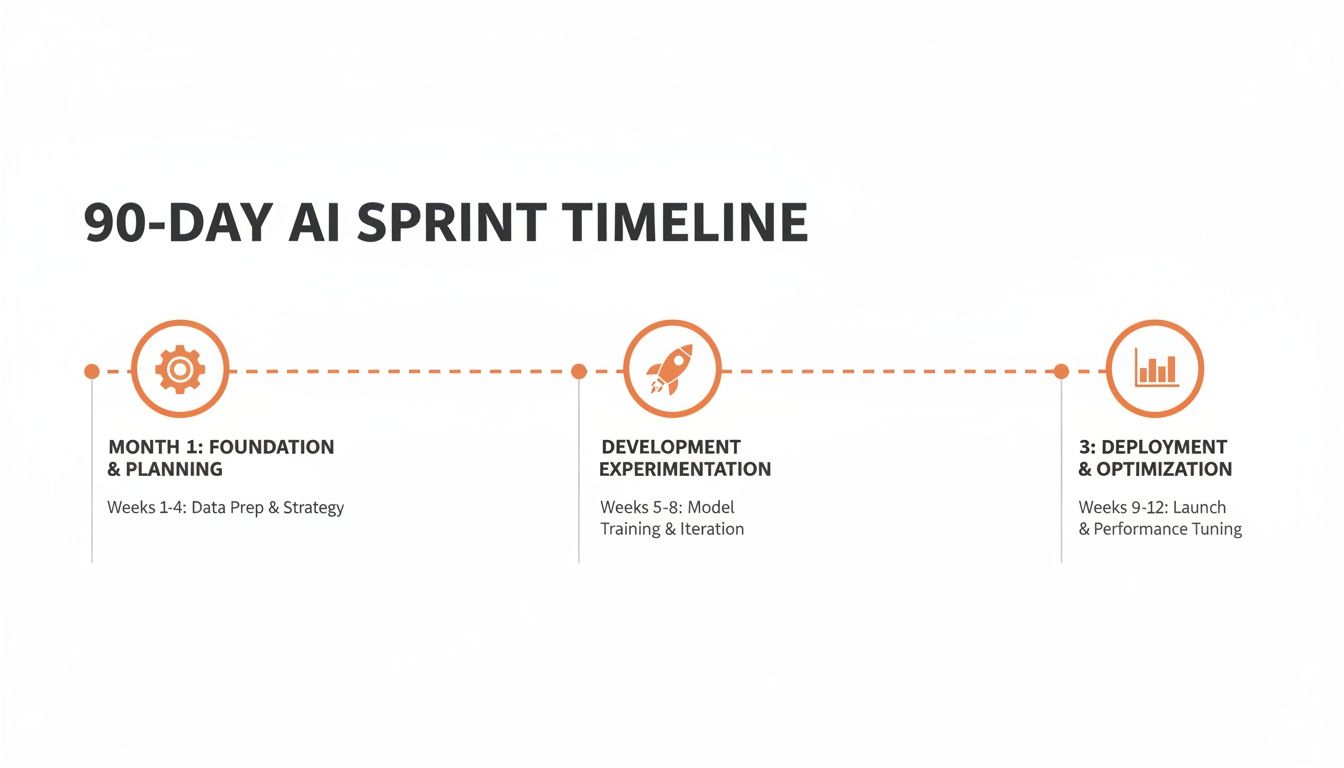
This phased process ensures you start with a solid foundation, move into controlled experimentation, and then scale what works based on hard data.
Will AI Replace My Marketing Team?
This is a common fear, but it's misplaced. AI is a force multiplier for your marketers, not a replacement. It automates the tedious, repetitive work that leads to burnout, freeing your best people to focus on high-value activities.
Think of AI as your tireless junior analyst, not your seasoned strategist. It can spot opportunities in data, but it requires a human to understand the strategic context and make the final call.
- AI's Role: Mass-scale A/B testing, drafting content, analyzing campaign data, and building hyper-specific audience segments.
- Your Team's Role: Defining strategy, infusing brand voice, building customer relationships, and making final creative and budget decisions.
AI handles the "what," so your team can focus on the "why" and "how." This is where true growth originates.
How Do I Maintain Brand Voice with AI-Generated Content?
A critical concern. Generic, robotic content can damage your brand. The solution is to treat AI like a new team member that requires clear direction and training.
Develop a comprehensive AI Brand Voice & Style Guide. This is a tactical document you provide to the AI as part of your prompt.
Elements of an Effective AI Style Guide:
- Tone & Personality: Define your voice with 3-5 core adjectives (e.g., "Authoritative, but approachable and witty").
- Vocabulary Rules: Create "use this" and "never use this" word lists to guide the AI's language (e.g., "Use 'team members,' not 'employees'").
- "Gold Standard" Examples: Provide 3-4 snippets of your best-performing content to show the AI what "good" looks like.
With this level of instruction, the AI produces a high-quality, on-brand starting point. Your team’s role shifts from writing from scratch to strategic refinement—a faster, more valuable use of their expertise.
Ready to move from theory to results? Ezca builds high-performance marketing engines for SaaS, e-commerce, and B2B companies through focused, data-driven 90-day sprints. Book a call to see how we can help you scale.