
A Strategic Guide to Reducing Customer Acquisition Cost
Learn how to reduce customer acquisition cost with our practical guide. Discover actionable tactics for SEO, CRO, and retention to lower CAC and boost ROI.
Reducing your Customer Acquisition Cost (CAC) requires a fundamental shift in strategy. It's not about slashing budgets or finding cheaper clicks. It's about optimizing the entire customer journey for profitability. This means investing smarter in channels that deliver high-value customers, obsessing over conversion rates, and maximizing customer lifetime value (LTV).
When marketing leaders get this right, the function evolves from a cost center into the primary growth engine of the business.
Why Your Customer Acquisition Cost Keeps Climbing
Are you spending more to acquire each new customer? You're not imagining it. Marketing leaders and business owners are navigating a perfect storm of factors driving acquisition costs skyward, making profitability an elusive target.
The digital landscape is saturated. Every major ad platform, from Google to Meta, is crowded with competitors bidding for the same audience. This fierce competition directly inflates your ad costs. This saturation also fuels ad fatigue; your audience is bombarded with so many ads they begin to tune them out, forcing you to spend more just to capture their attention.
The New Rules of Engagement
On top of increased competition, the rules for ad targeting have been rewritten. Privacy updates like Apple's iOS changes and the phasing out of third-party cookies have made it significantly harder—and more expensive—to reach the high-intent audiences we once relied on. The efficiency of paid media has taken a measurable hit.
However, not all pressure is external. Many cost drivers are internal. Countless companies pour marketing spend into a "leaky bucket"—a website with a poor user experience or dismal conversion rates. They pay for qualified traffic, only to watch potential customers bounce. Without a firm grasp on your unit economics, you could be scaling channels that are losing money on every conversion.
The core issue isn't just rising ad costs. It's that acquisition strategies are often disconnected from business profitability. To win, you must connect every marketing dollar to the long-term value it generates.
Data confirms this trend, particularly for SaaS and B2B companies. Over the last five years, customer acquisition costs have surged by 60%. Some businesses now spend as much as $2.82 to acquire just $1 of new revenue—a fundamentally unsustainable model. With the average startup CAC hitting $225 per customer, achieving a healthy LTV:CAC ratio of at least 3:1 is no longer a goal; it's a prerequisite for survival. You can explore these customer acquisition cost benchmarks on genesysgrowth.com for more industry context.
Before you can fix a high CAC, you must diagnose the root cause. What is truly driving up your costs? Most issues fall into a few common categories.
This table provides a framework for diagnosing common drivers and identifying the right strategic response.
Diagnosing High CAC Drivers and Strategic Solutions
By correctly identifying the driver, you can pull the right strategic lever instead of resorting to guesswork.
Ultimately, controlling CAC means shifting focus from growth-at-all-costs to profitable, sustainable acquisition. That begins and ends with mastering your LTV:CAC ratio and making it the north star for every marketing decision. At Ezca, our data-driven sprints are built to do just that—we identify and scale the most profitable growth channels for our clients.
Building Your Financial Foundation with a CAC and LTV Audit
To gain control over customer acquisition costs, you must begin with a rigorous analysis of your numbers. Many marketing leaders rely on a simplistic formula: total ad spend divided by new customers. This back-of-the-napkin calculation is dangerously incomplete and masks the true cost of growth.
To get an accurate picture, you must calculate a fully loaded CAC. This means accounting for every single cost associated with acquiring a customer, not just direct ad spend.
Moving Beyond Basic Calculations
Your fully loaded CAC must include all the "hidden" expenses that support your acquisition efforts. Without them, you're operating with a skewed view of profitability and making strategic decisions based on flawed data.
Essential costs to include:
- Salaries: The portion of your marketing and sales teams' salaries dedicated to acquiring new customers.
- Software & Tools: The cost of your martech stack—CRM, analytics platforms, email marketing software, and specialized ad tools.
- Creative & Content: All costs for producing ad creative, writing content, shooting videos, and designing landing pages.
- Overhead: A proportional share of general business costs that support your acquisition team.
Calculating this number provides clarity. It may be higher than you expect, but this accuracy is the first step toward meaningful optimization.
Unlocking Your LTV to CAC Ratio
Knowing your true CAC is only half the equation. The real insight comes from comparing it to your Customer Lifetime Value (LTV). LTV represents the total revenue you can reasonably expect from a single customer throughout their relationship with your brand.
The LTV:CAC ratio is the single most important metric for gauging the long-term health and scalability of your business. It tells you whether you're building a sustainable growth engine or just burning cash. For a deeper look at this critical health metric, see this great breakdown of the optimal LTV:CAC ratio.
A healthy LTV:CAC ratio is generally considered to be 3:1 or higher. For every dollar spent on acquisition, you should generate at least three dollars in lifetime value. A 1:1 ratio is a major red flag, indicating you are breaking even at best, before even factoring in the cost of goods sold.
This process of diagnosis, strategic solution, and measurement forms a continuous improvement loop.
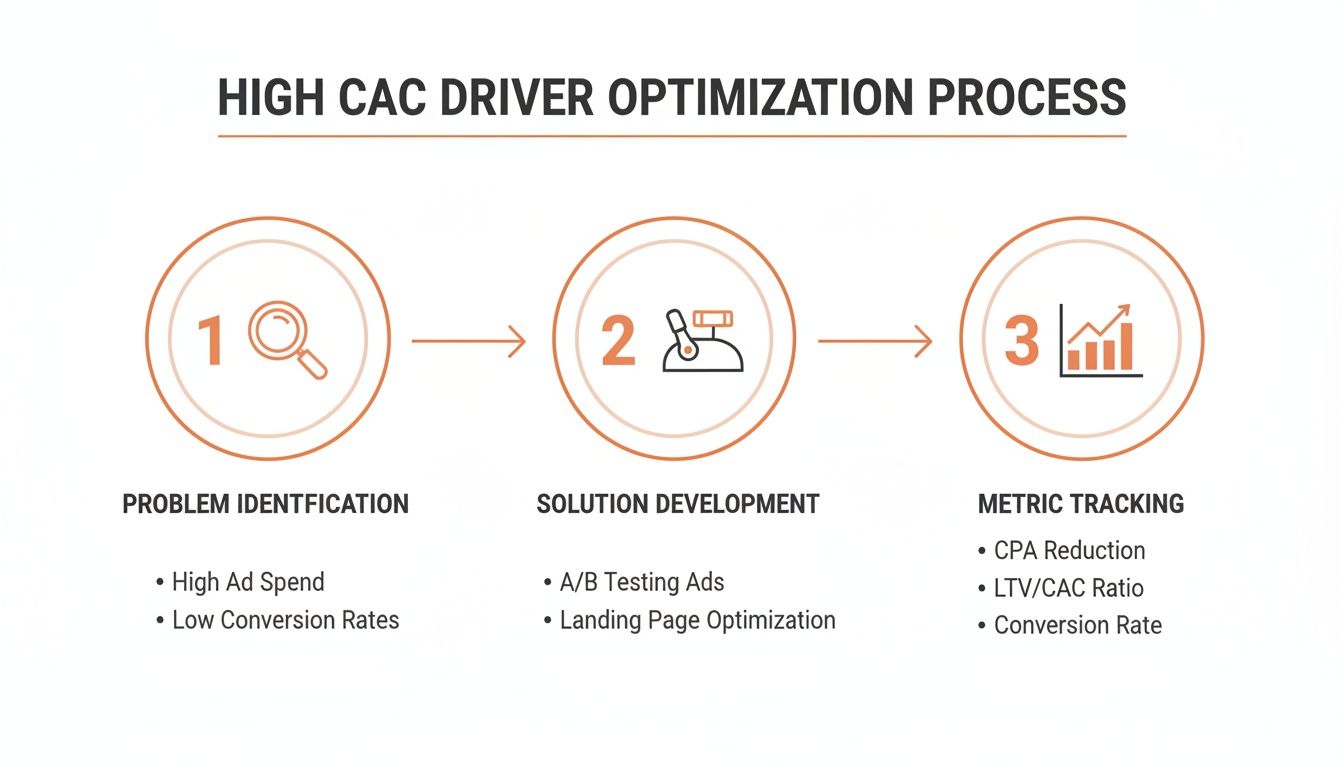
As the chart illustrates, the process involves identifying core CAC drivers, applying a strategic solution, and measuring the right KPIs to ensure you're making a positive impact.
Real-World Calculation Scenarios
Let's ground this in reality. While the inputs differ, the core principle of comparing long-term value to upfront acquisition cost is universal across business models like SaaS and e-commerce.
A SaaS business will focus on recurring revenue and churn, while an e-commerce brand will analyze repeat purchase rates and average order value. This table breaks down how two different business models might calculate their unit economics.
Sample LTV to CAC Calculation Scenarios
In both scenarios, these businesses are in a strong position. The SaaS company's 15:1 ratio is so robust it suggests they may be underinvesting in growth and could afford to be more aggressive. The e-commerce brand's 8.6:1 ratio provides a powerful foundation to scale paid channels with confidence.
This audit is not just a financial exercise; it's a strategic necessity. It provides the hard data needed to build a business case for smarter marketing investments, shift budget to high-performing channels, and demonstrate your team's contribution to the bottom line.
Driving Cheaper Traffic with SEO and Content Marketing
Paid ads deliver immediate traffic, but that speed comes at a high and often increasing cost. For long-term, sustainable growth, the single most powerful lever for lowering CAC is organic search.
A strategic SEO and content program is more than a marketing tactic; it's the creation of a valuable business asset. It’s an engine that compounds in value over time, methodically reducing your dependence on the expensive cycle of paid acquisition. You stop renting traffic and start owning it.
Target High-Intent Long-Tail Keywords
The key to a cost-effective SEO strategy is to avoid competing for broad, high-volume keywords. The real opportunity lies in long-tail keywords—longer, more specific phrases that signal strong user intent.
While their individual search volume is lower, their collective volume is massive. More importantly, they attract users who are closer to a purchase decision.
For example, a project management SaaS should not burn its budget trying to rank for "project management software." A smarter, more efficient approach is to target what their ideal customers are actually searching for:
- "best project management software for creative agencies"
- "how to track remote team productivity"
- "agile workflow templates for marketing teams"
These searchers have a specific problem and are actively seeking a solution. Creating content that directly answers these queries places you in front of highly qualified leads at a fraction of the cost of paid search.
Build Authority with Topic Clusters
Google rewards expertise. The most effective way to demonstrate authority is by using the topic cluster model. This involves creating an interconnected library of content on your website, rather than publishing standalone blog posts.
The model starts with a comprehensive "pillar page" covering a broad topic. This is supported by several "cluster pages" that explore related subtopics in detail, all linking back to the central pillar.
You’re not just publishing articles; you're building an authoritative resource. This structure signals to search engines that you are an expert on the subject, which boosts rankings for all related content and drives down your blended organic CAC.
For instance, if your pillar page is "The Ultimate Guide to E-commerce CRO," your cluster content could be deep dives on "Optimizing Product Page UX," "Strategies to Reduce Cart Abandonment," and "A/B Testing Your Checkout." This network of content helps you rank for hundreds of related terms, creating a steady stream of free, high-intent traffic. Our guide on how to increase your organic traffic breaks down these strategies step-by-step.
Maximize ROI by Repurposing Content
Creating high-quality content is a significant investment. To maximize its value and reduce your effective CAC, you must treat each piece as a reusable asset. A single piece of content can fuel marketing efforts across multiple channels.
A well-researched guide can be repurposed to generate 10x the impact from 1x the effort.
How to Repurpose a Single Blog Post:
- Video: Create a short YouTube video or LinkedIn post summarizing key takeaways.
- Infographic: Visualize data and statistics for Pinterest and other social media feeds.
- Social Media Carousel: Develop a carousel for Instagram or LinkedIn that tells the story in a few slides.
- Email Newsletter: Feature the post in your newsletter to drive subscribers back to your site.
- Webinar: Host a webinar that explores the topic in greater depth, capturing a new batch of leads.
At Ezca, we build these content engines for our clients within focused 90-day sprints. We don't just create content; we build the system to amplify it, turning one foundational asset into a lead-generating machine that consistently lowers CAC and strengthens your entire marketing ecosystem.
Optimizing Your Paid Channels for Maximum Efficiency
While organic channels build long-term value, paid advertising provides the power to scale immediately. The challenge is to make ad spend work smarter, not harder. Many marketing leaders fall into the trap of simply increasing budgets to hit targets—a strategy that leads to diminishing returns and a bloated CAC.
Efficiency isn't about finding cheaper clicks. It's about maximizing the value of each impression, click, and conversion. This requires moving beyond basic campaign setups to advanced strategies that tie ad spend directly to profitability.
In the competitive e-commerce landscape, this is a survival tactic. Customer acquisition costs have skyrocketed. Recent studies show most brands now lose an average of $29 for every new customer they acquire—a 222% increase from the $9 loss in 2013. Top-tier brands are obsessed with cost efficiency for this very reason.
Refine Audiences with Your First-Party Data
With the decline of third-party cookies, your first-party data has become your most valuable asset. Stop relying solely on broad, expensive, platform-based interest targeting. Use your own data to build custom audiences that are laser-focused and highly profitable.
This goes beyond simply uploading your entire customer list. Segment your lists and upload them to platforms like Google Ads and Meta to create lookalike audiences based on your best customers.
Actionable segmentation examples:
- High-LTV Customers: Build lookalikes based on customers who spend the most over their lifetime.
- Repeat Purchasers: Target new users who resemble your most loyal, repeat buyers.
- High AOV Customers: Find prospects who mirror the spending habits of those with the highest average order value.
Focusing your budget on audiences modeled after your most profitable segments dramatically increases the odds of acquiring high-value customers, which is a direct path to lowering your effective CAC.
Tie Smart Bidding to Profitability Goals
Modern ad platforms offer powerful automated bidding strategies, but many advertisers stop at "Maximize Conversions." To effectively reduce CAC, you must connect your bidding strategy to real business outcomes.
Instead of optimizing for any conversion, use strategies like Target ROAS (Return On Ad Spend) or Target CPA (Cost Per Acquisition). This shift changes the algorithm's focus from conversion volume to conversion profitability, all within the financial guardrails you set.
For example, an e-commerce brand can set a Target ROAS of 400%. This instructs Google to only bid on auctions where it predicts the resulting sale will generate at least $4 for every $1 spent. This disciplined approach prevents overspending on low-margin products or unprofitable segments.
The goal of smart bidding isn't just to get cheaper clicks. It’s to acquire customers who contribute to your bottom line from their first purchase. This is the foundation of profitable scaling.
This logic is directly applicable to SaaS. Consistently tracking and improving paid search efforts leads to massive gains. See how we helped a SaaS company drastically improve its paid search performance with this focused approach.
Elevate Your Ad Creative to Boost Quality Scores
On platforms like Google, your Quality Score is a critical factor in determining ad rank and CPC. A higher Quality Score allows you to win better ad positions at a lower cost. Ad creative is a major component of this score, so combating creative fatigue with fresh, high-converting ad scripts is essential.
Consider an e-commerce brand spending heavily on broad-match keywords with generic ad copy. Their click-through rate is low, their Quality Score is poor, and their CAC continues to rise.
Pivoting to a campaign type like Performance Max, armed with dynamic and high-quality creative assets, can be a game-changer. Performance Max uses Google's AI to serve the right ad to the right person across all of Google's properties. By providing it with strong video creative, compelling headlines, and high-resolution images, you give the algorithm the fuel it needs to find conversions at a much lower cost.
This is where agility provides a competitive advantage. At Ezca, our squad model is designed for this. We don’t lock budgets into rigid channel silos. Our teams constantly analyze performance data and have the autonomy to shift budgets quickly, ensuring capital flows to the highest-performing campaigns each week to maximize ROI and keep your CAC in check.
Fixing Your Leaky Bucket with Conversion Rate Optimization
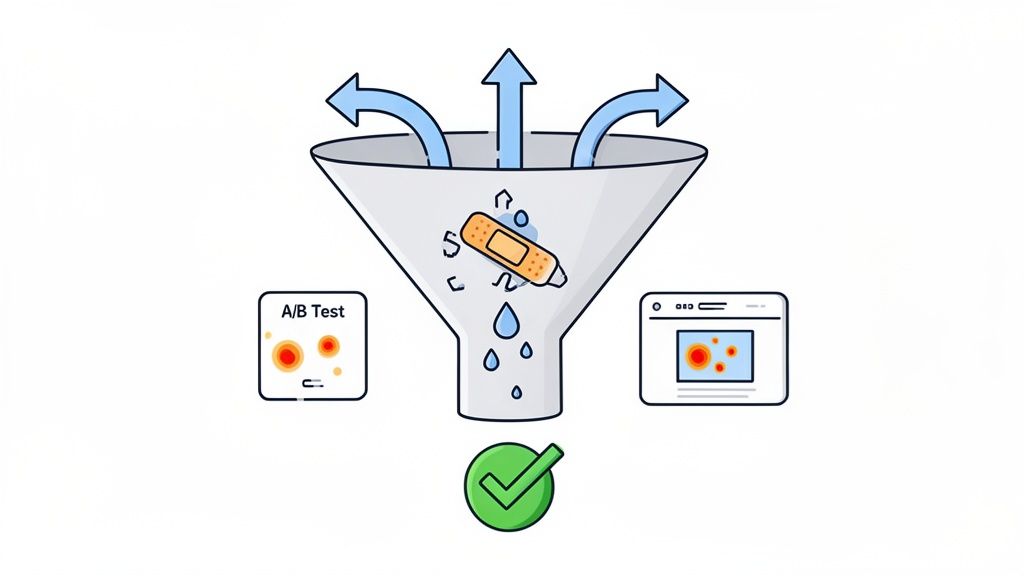
Driving traffic to a website that doesn’t convert is like pouring water into a bucket full of holes. It's a guaranteed way to inflate your Customer Acquisition Cost and burn through your budget. This is why the single highest-impact lever you can pull for an immediate drop in acquisition costs is Conversion Rate Optimization (CRO).
The math is simple but powerful. If you spend $10,000 to get 1,000 visitors and convert 1% of them, you gain 10 new customers at a CAC of $1,000. If you double that conversion rate to 2%, the same spend yields 20 customers, and your CAC is slashed to $500.
You didn't find cheaper traffic—you made the traffic you already have twice as valuable.
Uncovering Your Biggest Conversion Blockers
Before testing button colors, you must identify where the biggest leaks in your conversion funnel are. The goal is to pinpoint moments of friction that cause potential customers to leave. This requires a combination of quantitative and qualitative data analysis.
Start with your analytics. Look for pages with high exit rates. Is your pricing page underperforming? Are users abandoning your signup form? These are your first clues.
Once you know where the drop-offs occur, you need to understand why. This is where qualitative tools are invaluable:
- Heatmaps: Visualize user behavior to see where people click, how far they scroll, and where they hesitate. You might discover they are trying to click a non-interactive element or ignoring your primary call-to-action.
- Session Recordings: Watch anonymized recordings of real user sessions. This provides direct insight into moments of confusion, frustration, and usability issues you would otherwise miss.
Combining these insights allows you to move from guessing to forming powerful test hypotheses based on real user behavior.
Prioritizing and Running Tests That Matter
With a list of potential issues, you must prioritize. You can't fix everything at once. Focus on changes that offer the highest potential impact for the lowest effort. A simple framework is to score each idea on a 1-5 scale for potential impact, confidence in the outcome, and ease of implementation.
Now you are ready to run controlled A/B tests. This involves showing two versions of a page—the original "control" and a new "variation"—to different audience segments to determine which performs better.
The golden rule of A/B testing is to change only one significant element at a time. If you alter the headline, CTA button, and main image simultaneously, you won’t know which change drove the result.
A classic high-impact test for e-commerce brands is simplifying the checkout process. Reducing form fields or adding a guest checkout option can significantly decrease cart abandonment. Our case study on e-commerce checkout optimization shows how much revenue can be unlocked with a few strategic tweaks.
The Power of AI-Driven Personalization
While traditional CRO is effective, the next frontier is AI-powered personalization. Instead of a one-size-fits-all experience, you can create hyper-relevant journeys tailored to individual user behavior and intent.
In practice, this could mean dynamically changing the homepage hero image based on a visitor's industry or displaying product recommendations based on their browsing history. These personalized touches create a more intuitive and relevant experience, directly leading to higher conversion rates.
At Ezca, we integrate AI-driven strategies into our clients' CRO programs. By creating tailored experiences at scale, we not only lift conversion rates but also build stronger customer relationships from the first click, ultimately driving down the long-term cost to acquire and retain a customer.
Turn Your Customers Into Your Best Acquisition Channel
In the relentless pursuit of new customers, businesses often overlook their most powerful and cost-effective acquisition engine: their existing customer base. While you battle rising ad costs, your happiest customers represent an untapped resource that can dramatically lower your blended CAC.
The economics are undeniable. Acquiring a new customer costs 5 to 25 times more than retaining an existing one. This isn't just about cost savings; it's about shifting your marketing from a linear expense into a self-sustaining growth loop.
Build Die-Hard Fans with an Unforgettable Experience
Before a customer will advocate for you, they must be more than just satisfied—they need to be a fan. This loyalty is not built on discounts. It is forged through exceptional service, proactive support, and a genuine post-purchase experience that makes them feel valued.
A personalized email marketing strategy is a key tool here. Move beyond generic "thank you" messages. Use customer data to send relevant content that enhances their experience with your product.
- Nail the Onboarding: Guide new users with tips and tutorials that help them achieve an "aha!" moment quickly, immediately demonstrating the value of their purchase.
- Share Insider Content: Provide loyal customers with early access to new features, exclusive guides, or behind-the-scenes content to make them feel like part of an inner circle.
- Celebrate Milestones: Acknowledge customer anniversaries or key usage milestones with a personal note to reinforce their value to your business.
This consistent, valuable communication transforms a transaction into a relationship—the foundation of advocacy.
Make Referrals a System, Not a Hope
Hoping for word-of-mouth is not a strategy. To turn your customer base into a growth engine, you need a structured referral program with clear incentives. The program must be simple, rewarding, and easy for your best customers to use.
The goal is to build a predictable, low-cost acquisition channel. A well-designed program removes friction and gives customers a compelling reason to actively champion your brand.
A successful program has a few key components. First, the incentive must be a two-way street, rewarding both the referrer and the new customer. This could be discounts, account credits, or exclusive merchandise.
Second, make it incredibly easy. Provide each customer with a unique, shareable link in their account dashboard. You can even offer pre-written social media posts or email templates to remove all effort.
Finally, track everything. Monitor your referral rate, the conversion rate of referred leads, and the LTV of customers acquired through this channel. This data will prove the ROI and help you identify your super-advocates, whom you can then engage with VIP treatment to encourage further referrals.
At Ezca, we view this as the ultimate strategy for lowering CAC. When you invest in retention and build a referral system, you create a powerful flywheel. Happy customers stay longer (boosting LTV) and bring in new, high-intent customers for a fraction of the typical acquisition cost. This is how you build a sustainable engine for profitable growth.
Common Questions About Lowering Your CAC
Marketing leaders and business owners often encounter the same challenges when trying to improve marketing efficiency. Here are answers to some of the most common questions.
What's a Good LTV to CAC Ratio?
The industry benchmark for a healthy LTV:CAC ratio is 3:1. This means you generate three dollars in lifetime value for every dollar you spend on acquisition. It represents a sustainable and scalable model.
A 1:1 ratio indicates you are losing money on every new customer once you factor in all business costs. Conversely, a ratio of 10:1 or higher might signal that you are underinvesting in growth and could be more aggressive to capture market share.
How Long Until SEO Actually Lowers My CAC?
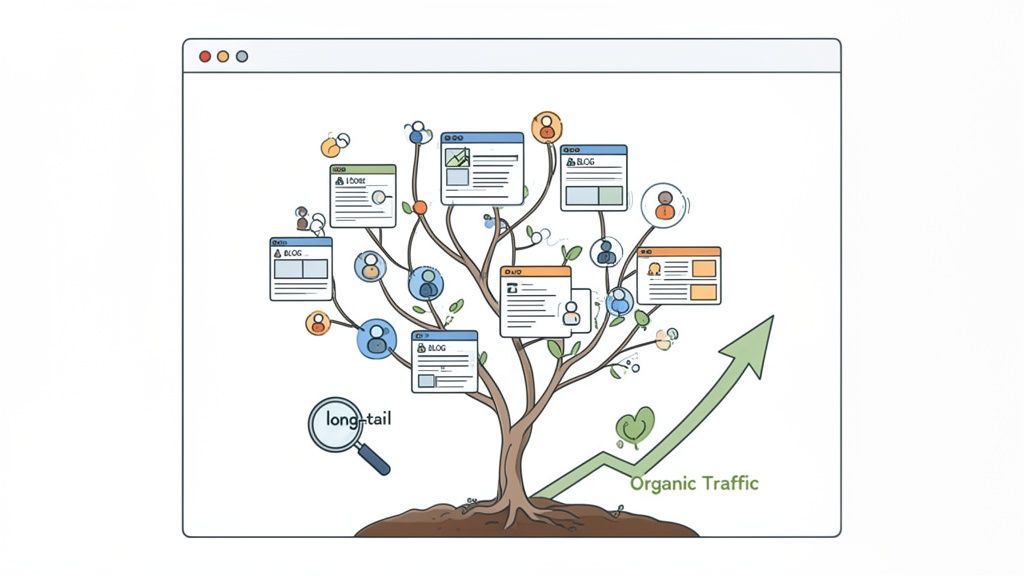
Unlike paid ads, which offer immediate results, SEO is a long-term investment. Think of it as planting a tree rather than buying a plant.
Realistically, you should expect to see a noticeable impact on your blended CAC from SEO efforts within 6 to 12 months. As your organic traffic and domain authority grow, you can gradually reduce your reliance on more expensive paid channels, which lowers your overall acquisition cost.
Where Should I Start if I Need to Lower CAC Fast?
For the fastest results, start with Conversion Rate Optimization (CRO). It is the highest-leverage activity because it improves the efficiency of the traffic you already have.
Why spend more money to pour water into a leaky bucket? Fix the holes first. Doubling your conversion rate effectively cuts your CAC in half without spending an additional dollar on advertising. It makes every other marketing channel perform better.
At Ezca, our 90-day sprints are designed to identify and execute on the highest-impact growth levers for your business, whether that's CRO, SEO, or paid media optimization. Discover how our data-driven approach can lower your CAC and accelerate growth.