
A Data-Driven Playbook for Improving Marketing ROI
Discover how to improve marketing ROI with our data-driven playbook. Learn to diagnose leaks, prioritize fixes, and scale growth with proven strategies.
To improve marketing ROI, you need a clear game plan. The most effective approach boils down to three core pillars: first, building a solid measurement foundation so you actually know what’s working. Second, you zero in on high-leverage optimizations that deliver quick wins. Finally, you run agile 90-day sprints to test, learn, and scale what’s successful in a predictable way.
This system shifts marketing from an unpredictable cost center into a reliable engine for revenue.
Why Most Marketing Spend Is a Black Box
Does this sound familiar? You're in a meeting, defending the marketing budget. You point to rising impressions and a healthy click-through rate. But then the CFO asks, "What was the real return on this spend?" Suddenly, the answer gets fuzzy.
This struggle is far from unique. For many leaders, marketing feels like a black box. You pour money in, but drawing a straight line to revenue is a constant challenge, making it incredibly difficult to justify your budget, let alone ask for more.
While 83% of marketing leaders say demonstrating ROI is a top priority, few are confident in their ability to measure it accurately. The first, most critical step is to understand how to properly measure marketing ROI. Companies that nail data-driven attribution see their ROI jump by 15-20% compared to those stuck with basic tracking.
From Cost Center to Revenue Driver
The problem isn't a lack of effort—it's the absence of a solid operational framework. When you don't have a system connecting marketing activities directly to sales outcomes, you’re flying blind. You might be active on multiple platforms, but which touchpoints actually convince people to buy? It’s hard to say. You can learn more about managing these efforts in our guide to what is multi-channel marketing.
A structured, data-first approach makes all the difference. At Ezca, we use this playbook to turn marketing departments into performance engines built on clarity and agility.
The goal is to create a direct line of sight between every dollar spent and every dollar earned. When you can confidently show how a specific ad campaign generated a 5x return, budget conversations shift from defense to strategic planning for the next quarter's growth.
This playbook gives you the blueprint to find that clarity. We're going to walk through how to diagnose the leaks in your funnel, prioritize the fixes that will have the biggest impact, and run a sprint-based system that ensures you're always improving. It’s time to open that black box for good.
A Quick-Start Framework to Boost ROI
This table summarizes the core strategies for immediate action.
This framework isn't just theory; it’s a practical system designed to deliver measurable results. Now, let’s get into the specifics.
Finding Your ROI Leaks with a Measurement Blueprint
Before you can boost your marketing ROI, you have to stop the bleeding. The biggest killer of a marketing budget isn't one failed campaign; it’s the hundred untracked leaks that drain your cash. The fix starts with building a measurement blueprint for a brutally honest look at what’s actually working.
This means getting beyond vanity metrics like clicks and impressions. You need a tracking setup that connects every touchpoint to revenue. This typically involves integrating tools like GA4 with server-side tagging and your CRM to build one reliable source of truth. This is the first thing we do in our 90-day sprints at Ezca—without it, you’re flying blind.
This is our roadmap for turning things around. It all starts with that solid data foundation, then moves into optimization and agile sprints to really scale what works.
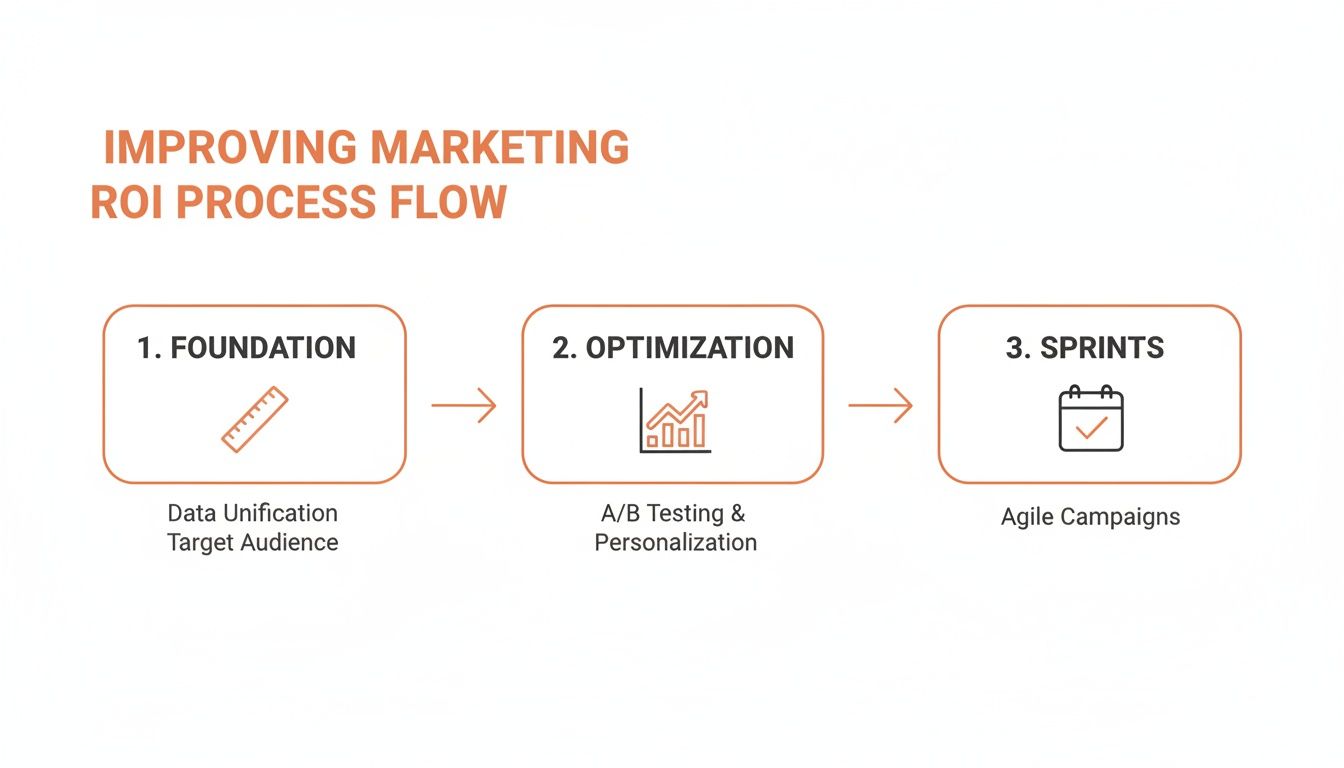
As you can see, reliable measurement isn't optional. It’s the launchpad for any real ROI improvement.
Choosing the Right Attribution Model
Once your tracking is locked in, the next piece is attribution. An attribution model is the rulebook that decides how credit for a sale gets distributed across all the touchpoints a customer interacted with. Picking the right one is critical for knowing which channels truly deserve your budget.
There are a few common models:
- First-Touch Attribution: Gives 100% of the credit to the first ad, blog post, or link a customer clicked. It's great for seeing what originally brought people in the door but ignores the rest of their journey.
- Last-Touch Attribution: The default for many platforms. It gives all the credit to the final touchpoint before conversion. It helps identify your "closers" but often over-credits things like branded search.
- Multi-Touch Models (Linear, U-Shaped, Data-Driven): These are more sophisticated, spreading credit across multiple interactions. The gold standard is a data-driven model, which uses machine learning to figure out the real impact of each touchpoint, giving you the most accurate picture.
The goal isn’t to find a "perfect" model but to choose one that aligns with your business goals. For most businesses with multiple marketing channels, a multi-touch model provides the most actionable insights.
A Real-World Example: Uncovering Hidden ROI
We once worked with an e-commerce brand pouring money into Facebook Ads. Their last-touch attribution model said organic search was driving almost all sales. Leadership was a day away from gutting the Facebook budget, convinced it was a waste.
We switched them to a data-driven model, and the real story emerged. While organic search was the final click, a staggering 70% of those customers had first discovered the brand through a Facebook ad.
The Facebook campaigns were creating awareness and getting people interested. The organic search traffic was mostly people who already knew the brand and were searching for it by name. Instead of slashing the Facebook budget, they reallocated it to top-of-funnel campaigns and created content to capture search intent later on. The result? A 35% jump in overall ROI in just six months.
A deep audit won't just show you what’s broken; it will uncover hidden connections between channels that you can scale for massive growth. Getting visitors to your site is only half the battle; improving your landing pages is just as important. You can see how we handle that with our conversion rate optimization services, and for more on tracking content, Mastering Content Marketing ROI is a fantastic read.
Quick Wins: High-Leverage Optimizations
You’ve got your measurement and attribution dialed in. Now it's time to turn those insights into action and get some quick wins.
Instead of trying to fix everything at once, we’ll zero in on the three areas that consistently move the needle fastest: creative, audience targeting, and landing page experience. This is the core of the 90-day sprint approach we use at Ezca—find the small hinges that swing the biggest doors.
Give Your Creative and Messaging a Jolt
Your ad creative is often the first handshake between your brand and a potential customer. If it’s weak, even the most brilliant targeting won't save the campaign. This is where a disciplined A/B testing mindset becomes your secret weapon.
Forget testing two shades of blue on a button. Go for bold changes. Test two completely different value propositions. For a SaaS company, that might look like testing "Save 10 Hours a Week" against "Cut Project Errors by 50%." One hits on operational pain, the other on a financial one. Discovering which angle resonates can slash your cost per lead almost instantly.
High-Impact A/B Testing Priorities
Use this guide to decide what to test first for the fastest improvements in ROI.
Big-picture elements like your headline, core offer, and main visual are where you'll find the most leverage.
Sharpen Your Audience Targeting
The next lever for a quick ROI boost is refining who sees your ads. Throwing your budget at a massive, poorly defined audience is the marketing equivalent of setting cash on fire. Move past basic demographics and start targeting based on intent and behavior.
One of the most powerful tactics is building lookalike audiences. Platforms like Meta and Google let you upload a list of your best customers—the ones with the highest lifetime value—and then find millions of new users who share similar traits. It's a simple, data-backed way to focus ad spend on people far more likely to become great customers.
For B2B marketers, intent data is a game-changer. This means targeting users who are actively signaling they’re in the market for a solution like yours, whether they’re visiting specific review sites or downloading relevant whitepapers. By focusing your budget here, you’re meeting buyers at the exact moment they’re ready to talk business.
Don't just target who you think your customer is. Target who your best data tells you they are. This shift from assumption to data-driven action is fundamental to improving marketing ROI.
Make Your Landing Page Work for You
You can have the world’s greatest ad and perfect targeting, but if your landing page fumbles the handoff, your ROI is toast. Conversion rate optimization (CRO) is all about turning those hard-won clicks into customers, and even tiny improvements can lead to huge returns.
Start with the essentials on your landing page:
- The Headline: Does it perfectly match the promise you made in your ad? Any disconnect is a one-way ticket to a high bounce rate.
- The Call-to-Action (CTA): Is it obvious, compelling, and singular? Giving visitors too many choices often leads to them making none.
- The Form: Every field you add creates friction. Only ask for what is absolutely necessary.
We worked with a SaaS client whose landing page form had eleven fields. Their lead-to-trial conversion rate was a painful 1.5%. We ran a simple A/B test with a new form that only asked for a work email.
The result was staggering. The simplified form shot their conversion rate up to 3.2%, more than doubling it. That single change had a bigger impact on their ROI than months of tweaking ad campaigns.
Putting It All Together: Your First 90-Day Growth Sprint
You’ve got your measurement blueprint and a list of high-leverage fixes. Now it’s time to build an operational framework that turns ideas into repeatable, measurable results. This is where the 90-day sprint comes in—the agile system we live by at Ezca to drive rapid progress.
Forget vague annual goals. A 90-day sprint forces you to zero in on a single, critical objective. This approach swaps slow-moving plans for short, intense cycles of doing, learning, and iterating to build momentum and prove ROI fast.
Marketing gets better when you consistently test, measure, and double down on what’s actually working. A 90-day window is the sweet spot—long enough to see real results from your experiments but short enough to keep the pressure on and adapt to what the data is telling you.
How to Structure Your First Sprint
The power of a sprint is its relentless focus. Define one primary objective and the key results that track your progress. This singular focus is your team’s shield against distraction.
Let’s say your objective is to: Reduce customer acquisition cost (CAC) by 20% over the next 90 days.
Now, you need to define the specific, measurable key results. These are the metrics that prove you’re on the right track.
- Key Result 1: Boost landing page conversion rate from 2% to 3.5% by testing new headlines and simplifying forms.
- Key Result 2: Drop cost per lead (CPL) on LinkedIn Ads from $80 to $65 by building better lookalike audiences.
- Key Result 3: Get a 15% lift in our email-to-demo conversion rate by launching a new personalized nurture sequence.
Each key result is a mini-experiment that directly ladders up to the main goal. This gives your team absolute clarity on what to prioritize and empowers them to say "no" to everything else.
The Weekly Rhythm of Agile Marketing
A 90-day sprint isn’t a set-it-and-forget-it plan. Its success hinges on a disciplined weekly rhythm of analysis and action. This cadence turns marketing into a performance engine, letting you react to data in near real-time.
This weekly meeting is the heartbeat of the sprint. Imagine your dashboard shows a Google Ads campaign crushing it with leads at a $50 CPA. Right next to it, a new LinkedIn campaign is struggling, bringing in leads at a $90 CPA. The data is practically shouting at you.
The weekly sprint meeting is where strategy meets execution. It’s the forum for making data-backed decisions to immediately reallocate budget from underperforming tests to the clear winners, maximizing your ROI week after week.
In that scenario, the decision is a no-brainer. You immediately shift a chunk of the LinkedIn budget over to the Google Ads campaign to pour fuel on the fire. This kind of agile budget reallocation stops you from burning thousands of dollars on campaigns that aren't cutting it.
This disciplined, weekly process of looking at the data and making quick, decisive changes is the key to improving marketing ROI. It replaces guesswork with a predictable system for growth.
Scaling Growth with AI and Automation
You’ve run your 90-day sprints and found a winning strategy. Now, how do you scale this without your ROI taking a nosedive?
This is where AI and automation stop being buzzwords and become your most valuable players. They let you execute your winning plays at a speed and scale that’s impossible for a human team to keep up with.
The goal is to build a marketing ecosystem where data from one channel automatically fuels the strategy for another, creating a compounding growth loop. This is how you shift from incremental gains to sustained, long-term ROI.
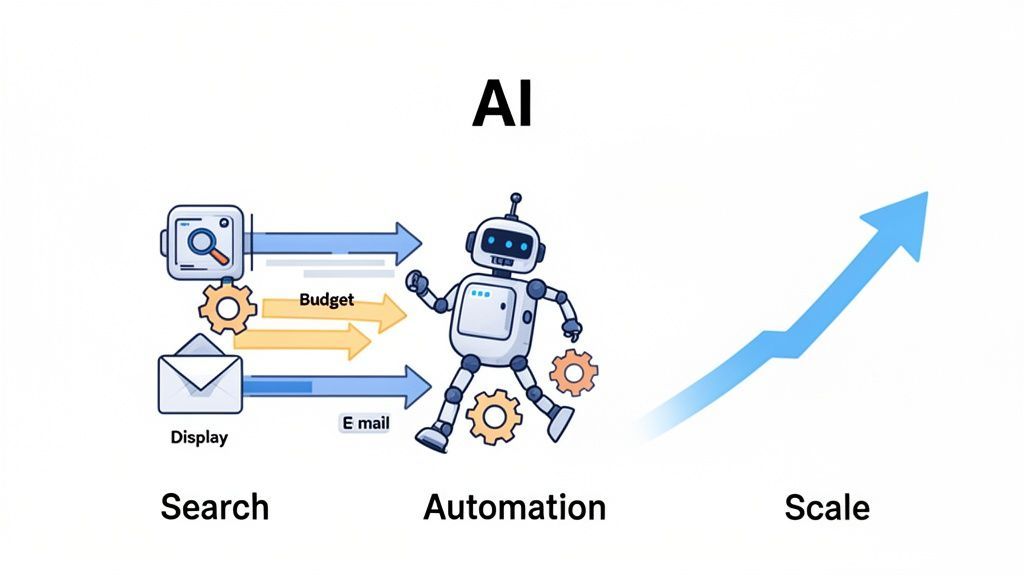
This isn't a far-off future concept. A recent survey showed 93% of CMOs are seeing clear ROI from their GenAI projects. They're seeing real results, like an 84% jump in content creation speed and real-time budget shifts that eliminate waste. You can dig into more of these marketing ROI trends to see the impact.
Automating for Peak Performance
The quickest win with AI is automating campaign management. Tools like Google's Performance Max don't just tweak bids; they crunch thousands of real-time signals to manage targeting, bids, and creative combinations across Google's entire network, hunting down the most profitable spots for your ads.
For example: an AI platform plugged into your e-commerce sales data notices a specific jacket sells best on Tuesday mornings to people in the Pacific Northwest who've watched a certain video ad. Instantly, the system reallocates budget to hit that exact micro-audience at that exact time. That’s a level of optimization a human analyst can’t replicate.
AI doesn't replace the strategist; it empowers them. It handles the relentless, data-heavy lifting of optimization, freeing up your team to focus on the big-picture strategy, messaging, and creative direction that machines can't replicate.
Predictive Analytics and Personalization
Beyond doing today's tasks faster, AI gives you a peek around the corner. Predictive analytics tools can analyze market trends and your historical data to tell you which blog topics will be popular next quarter or which customer segments are showing signs of churning.
This is what makes true one-to-one personalization possible. An AI-powered email platform can analyze a user’s browsing history and past purchases to build and send a newsletter featuring only the products and articles they’re most likely to care about.
This works in a couple of key ways:
- Predictive Lead Scoring: An AI model studies your CRM, learns the DNA of your best customers, and scores new leads based on how closely they match that ideal profile. Your sales team can then focus only on opportunities with the highest potential to close.
- Dynamic Creative Optimization (DCO): DCO tech builds the perfect ad for each individual, mixing and matching headlines, images, and CTAs in real-time based on that user's data. Relevance skyrockets, and so do conversion rates.
This is the core of modern performance marketing. For companies ready to pour fuel on the fire, we help build these kinds of integrated systems through our AI enablement services. We turn disconnected data points into a single, self-optimizing growth engine.
Common Marketing ROI Questions
As you dig into your marketing performance, you're bound to run into some practical questions. Let's tackle some of the most common hurdles we see from marketing leaders.
The first one that always comes up is about benchmarks. People want a target that tells them if they're doing a good job.
What Is a Good Marketing ROI to Aim For?
The classic rule of thumb is a 5:1 ratio—$5 back for every $1 you spend. It's a decent starting point, but that number can be all over the map depending on your industry, business model, and channels.
A well-run email marketing campaign can deliver a massive ROI, sometimes hitting 40:1 or more because the cost to send an email is incredibly low. On the flip side, B2B content marketing or SEO starts slow and builds value over time, so the initial ROI will naturally look lower.
For paid ads in a SaaS or e-commerce business, we've found that a healthy, sustainable target is usually in the 3:1 to 5:1 range. If you're consistently below that, you might be struggling to cover your customer acquisition costs and other business expenses.
The best thing you can do is figure out your own baseline. Know your profit margins, what a customer is worth over their lifetime (LTV), and your growth goals. From there, your real goal is to beat your own numbers every quarter.
How Long Does It Take to Actually See ROI Improve?
This depends entirely on where you’re putting your effort.
- Paid Advertising (Google, Meta, LinkedIn): You can see a real difference here within a single 90-day sprint. Tweaking creative, targeting, or landing pages can produce a measurable lift in just a few weeks.
- Organic Channels (SEO, Content Marketing): These are investments. It often takes a good 6-12 months to see a meaningful ROI as you build site authority and start ranking for valuable keywords.
Our approach at Ezca is built to manage both timelines. We aim for quick wins on paid channels in the first 90 days to get momentum and free up cash flow, while simultaneously laying the groundwork for the compounding returns you get from organic channels.
Should I Fix One Channel at a Time or All of Them at Once?
For almost every business we've worked with, the answer is to focus. Trying to fix everything at once—spreading your budget, team, and attention thin—is a recipe for mediocre results everywhere.
The smarter move is to pick one or two channels that are either your current top performers or have the most obvious untapped potential. Go all-in on that channel for a 90-day sprint. Test everything and squeeze every drop of performance out of it.
Once you’ve got that channel humming predictably, you can take what you’ve learned (and the extra revenue you’re generating) and apply it to the next channel on your list. This methodical, one-by-one approach builds a much stronger, more resilient marketing machine.
Ready to stop guessing and start building a predictable growth engine for your business? The team at Ezca uses this exact data-driven, 90-day sprint methodology to help companies like yours achieve measurable and scalable marketing ROI. Schedule a call with us today to see how we can help.