
How to Improve Email Open Rates and Drive Real Growth
Discover how to improve email open rates with proven strategies for deliverability, personalization, and testing. Turn your email list into a revenue driver.
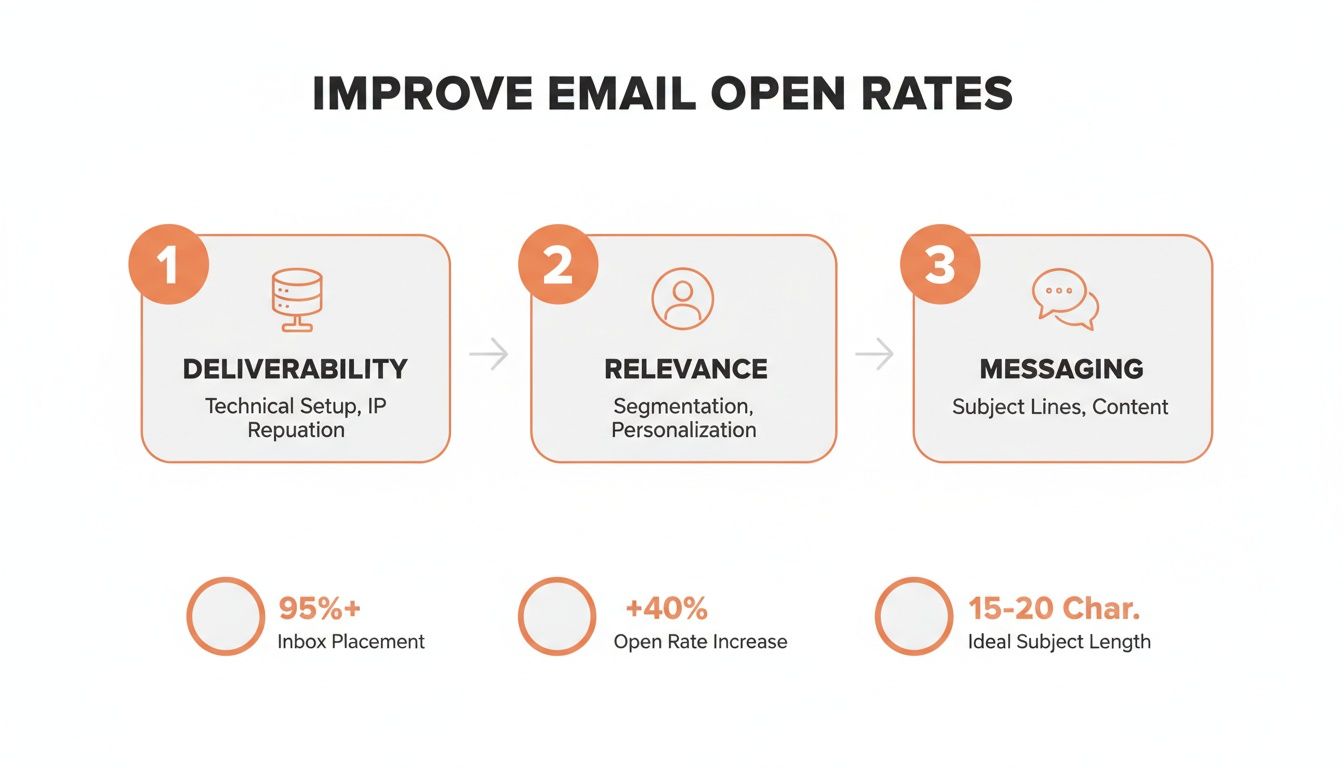
Boosting your email open rates with a snappier subject line is like trying to fix a car's engine with a new coat of paint. It misses the point. The real performance levers are buried deeper—in your technical deliverability, audience segmentation, and messaging relevance.
A low open rate isn't just a sign of a bad campaign; it's a symptom of a broken system. For marketing leaders and business owners, it's a direct hit to the bottom line.
Why Your Emails Are Really Being Ignored
Watching email open rates drop is frustrating. You pour resources into building your list and crafting campaigns, only for them to underperform.
The knee-jerk reaction is to blame the subject line or tinker with the send time. But that’s treating the symptom, not the cause. It rarely works because the problem isn't that simple.
Low engagement signals one of two core issues: either your emails are getting blocked before they even have a chance, or your message is completely out of sync with your audience's needs.
Let's Go Deeper Than Quick Fixes
To genuinely improve your email open rates, you must treat email as a performance channel, just like paid ads or SEO. It requires a structured, data-driven process, not just a dash of creative flair.
Instead of asking, "What's a good subject line?", the real questions to answer are:
- Is my sender reputation holding me back? Poor domain authentication can torpedo your efforts, sending emails directly to spam.
- Am I emailing people who actually want to hear from me? A list clogged with unengaged subscribers actively hurts your deliverability and dilutes the engagement of your best customers.
- Is this message even relevant? The days of "batch-and-blast" are over. Your audience expects personalized, timely communication.
The problem is almost never a single bad email; it's the absence of a system. I've seen SaaS companies settle for a 25% open rate, thinking it's acceptable. They don't realize that with proper segmentation and deliverability, they could hit 40% or more—directly boosting trial sign-ups and revenue.
This guide lays out a framework for diagnosing and fixing these foundational issues. At Ezca, we use a similar sprint-based approach to find and plug these performance leaks, turning stagnant email lists into powerful growth channels. We'll show you a repeatable process to not only get more opens but also to tie that engagement directly back to business results.
Mastering Deliverability and List Hygiene
Before you agonize over subject lines, answer a more fundamental question: Are your emails actually making it to the inbox?
Poor deliverability is the silent killer of email ROI. Your sender reputation acts like a credit score with inbox providers like Gmail. A low score gets you flagged, while a high score earns you prime inbox real estate.
Getting this foundation right isn’t an IT chore; it's a core marketing function that directly impacts your bottom line.
Securing Your Sender Reputation
As a marketing leader, you don't need to be a network engineer, but you do need to understand why these technical standards matter. Think of them as digital handshakes that prove your message is legitimate.
- SPF (Sender Policy Framework): Your guest list. It tells servers which domains are authorized to send email on your behalf.
- DKIM (DomainKeys Identified Mail): Your tamper-proof seal. It adds a digital signature to confirm the email hasn't been altered.
- DMARC (Domain-based Message Authentication, Reporting & Conformance): Your security policy. It tells servers what to do if an email fails SPF or DKIM checks.
Proper setup isn't a "nice-to-have." Inbox providers are cracking down, and failing to authenticate is a fast-track ticket to the spam folder, killing your open rates before your campaign even has a chance.
The Hidden Cost of a Dirty Email List
The quality of your list is the single biggest factor influencing your sender reputation. A bloated list full of unengaged contacts, typos, and spam traps is a huge liability. It signals to inbox providers that people don't want your emails.
Sending to a list where 20% of subscribers are inactive can lower your overall deliverability by up to 10%. You're not just failing to reach the disengaged; you're hurting your chances of reaching your best customers.
This is where proactive list hygiene becomes non-negotiable. Shift your focus from the vanity metric of list size to the actionable metric of engagement.
The Deliverability Health Checklist
Use this simple checklist to gauge the health of your email program and identify opportunities.
If you have multiple items in the "Needs Review" column, that's your priority—long before testing subject lines.
A Practical Framework for List Cleaning
Regularly pruning your list is one of the most powerful levers you can pull to improve email open rates. A smaller, more engaged list will always outperform a larger, inactive one.
1. Identify Your Inactive Subscribers. Define "inactive" for your business. A good starting point is anyone who hasn't opened an email in 90-120 days. For high-frequency senders (e.g., daily e-commerce deals), shrink that window to 60 days.
2. Launch a Re-Engagement Campaign. Before you purge, try to win them back. A 2-3 email sequence with a compelling offer or a direct question like, "Do you still want to hear from us?" is often all it takes.
3. Purge Unresponsive Contacts. If a subscriber ignores your win-back campaign, remove them. This is a positive action. It tells inbox providers you care about engagement, which boosts your sender reputation and gives future campaigns a better chance of being seen.
At Ezca, we've seen clients boost their overall open rates by 5-15% in a single quarter just by implementing a disciplined list hygiene process. It’s a foundational step that makes every other optimization more effective.
Hyper-Personalization and Smart Segmentation
The era of "batch-and-blast" email is over. The single most powerful lever to pull for higher open rates is relevance. Moving beyond a [First Name] token isn't a strategy—it's the bare minimum.
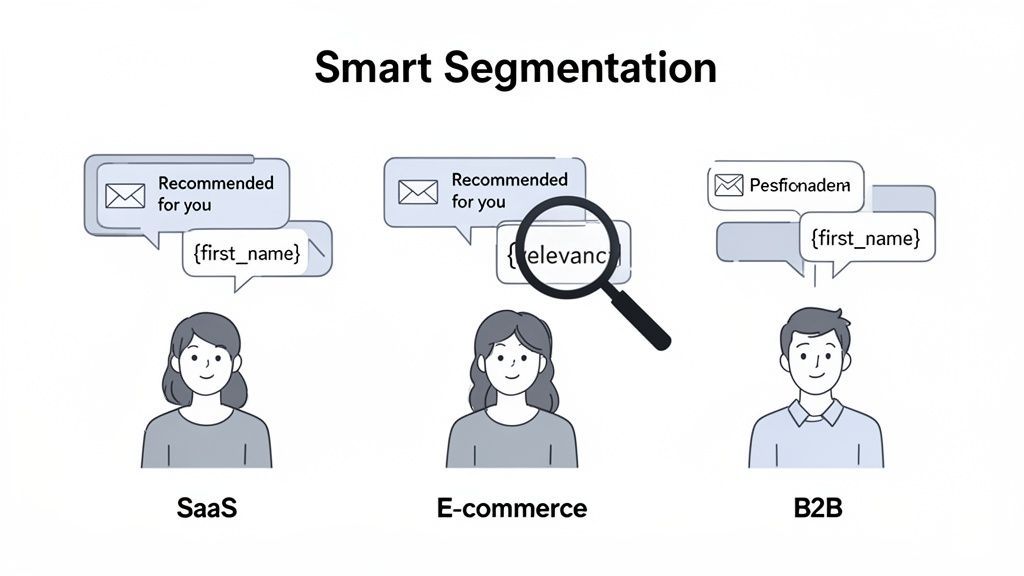
True personalization comes from smart segmentation. This is how you transform your email from a generic broadcast into a one-on-one conversation, showing subscribers you understand them.
Segmentation Strategies That Actually Drive Opens
Your segmentation strategy must align with your business model. Use the unique data you have to create high-value audience groups.
For SaaS Companies:
Your goldmine is user behavior. A generic "new feature" announcement is a missed opportunity.
- Feature Adoption: Target users who haven't tried a key feature with an email showing them what they're missing. For example, a project management tool could target users who haven’t created a Gantt chart.
- User Activity: A power user might get an invite to a beta program, while an inactive user gets a "3 tips to get more value" guide.
- Subscription Tier: An email to a user on a lower-tier plan who is hitting their usage limits is far more effective than a generic upsell blast.
For E-commerce Brands:
Purchase history is everything. Use it to predict what customers want next.
- Past Purchase Category: If someone bought running shoes, follow up with emails about athletic apparel, not winter coats.
- Purchase Frequency: Create a "VIP" segment for frequent buyers and reward them with exclusive access to sales or free shipping.
- Average Order Value (AOV): High-AOV customers are interested in premium lines. Price-sensitive shoppers respond better to bundles or "20% off" offers. To execute this well, dive deep into email segmentation best practices.
For B2B Businesses:
Content engagement is your crystal ball. It reveals a prospect's current challenges.
- Content Downloads: Someone who downloaded your e-book on SEO is a prime candidate for your upcoming webinar on the same topic.
- Industry or Role: Segment by job title or industry to send hyper-specific case studies. A CTO at a fintech company has different challenges than a marketing manager at a nonprofit.
- Sales Stage: A prospect in the consideration stage needs a competitor comparison sheet, while someone just starting their research needs a foundational guide.
The Real-World ROI of Getting Personal
Personalization can boost open rates by up to 26%. We've seen it time and again. While average B2B benchmarks are around 23-28%, SaaS companies that nail personalization often push into the 35-45% range.
In e-commerce, where baseline opens are often 18-22%, just adding a dynamic subject line like 'Hey [Name], your exclusive deal awaits' can lead to 22% higher engagement.
A generic email is an interruption. A hyper-personalized email is a service. When an email feels like it was written for me, it commands attention and earns the open.
Powering Your Segments with the Right Data
This level of personalization requires a solid data strategy. Connect your email service provider with your CRM, e-commerce platform, or product analytics tools to get a unified view of each customer.
This is where Ezca’s expertise in data-driven marketing becomes a game-changer. We use predictive models to analyze customer data and spot segmentation opportunities a human might miss. This data-first approach lets us move beyond obvious segments and uncover high-impact groups based on complex behavioral patterns, driving truly effective lifecycle campaigns.
When you invest in smart segmentation, you stop shouting at a crowd and start speaking directly to an individual. That shift is the most reliable way to improve your open rates and drive sustainable growth.
Finding Your Perfect Send Time
Forget the old advice to send on Tuesdays at 10 AM. Relying on generic stats is like using an outdated map—you’ll never find the fastest route.
The truth is your perfect send time is unique to your audience. A SaaS founder is in their inbox during the workday, but a shopper might be more active on a Sunday evening. Guessing doesn't work. You have to use your own data.
Stop Guessing and Start Testing
The only way to find your ideal send time is by testing methodically. Most email platforms like Mailchimp or HubSpot have send-time optimization features that use algorithms to predict when an individual is most likely to open.
But running your own manual tests provides valuable insights. Here’s a simple framework:
- Form a hypothesis. Example: "Our B2B subscribers will open more emails sent mid-week between 9-11 AM than in the afternoon from 2-4 PM."
- Split your list. Randomly split a segment of your subscribers into two equal groups.
- Test one variable. Send the exact same email to both groups, changing only the send time.
- Check the results. Wait 24-48 hours and see which time slot won.
Running these tests replaces guesswork with evidence. A single win can lift your open rates on every future campaign. Think about that compounding return—it's a small effort for a massive long-term payoff.
Match Your Send Time to Your Business
Your customers' daily lives are the biggest clue.
For B2B and SaaS Leaders Your audience is on a 9-to-5 clock. The best results are typically mid-week, from Tuesday to Thursday. People have cleared the Monday morning chaos and are ready to focus.
For E-commerce Brands Your customers have more flexible schedules. Lunch breaks (12-2 PM), evening commutes, and relaxed weekend mornings are great windows. Test promotional sends on a Saturday or Sunday when people have more time to browse.
Smart Timing Makes a Real Difference
Optimizing send time can boost open rates by 20-30%.
The first hour after sending is critical. It's when 21.2% of all opens happen. You want to land in the inbox when subscribers are most active. Well-timed weekly newsletters can see open rates of 48.31% and a 5.71% CTR, far outpacing daily sends. You can find more detailed statistics on average email open rates to see how you stack up.
At Ezca, we build timing tests directly into our 90-day sprints. We constantly refine send schedules based on performance data, turning a simple scheduling decision into a strategic advantage.
Building a System for Continuous Improvement
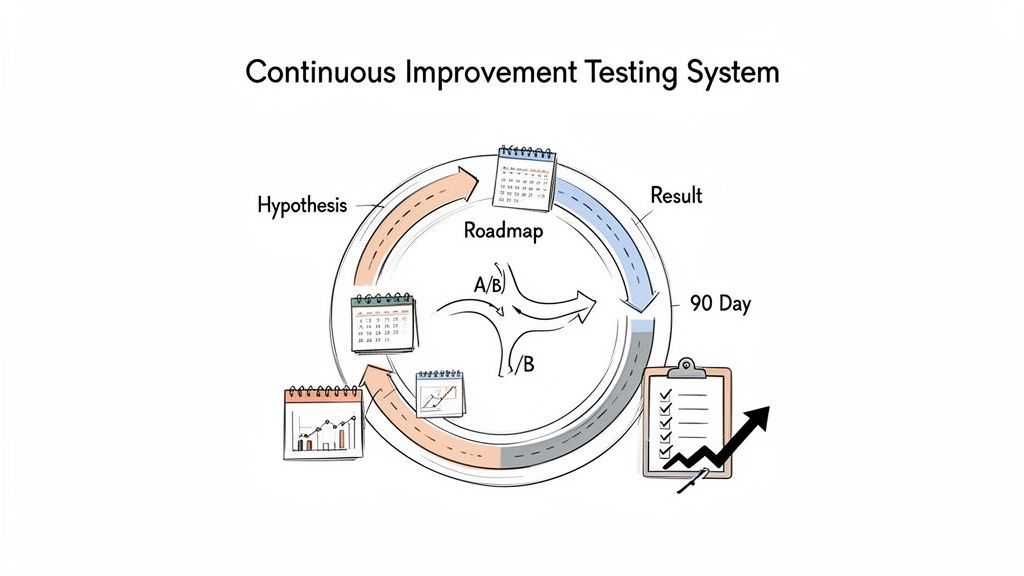
Great email marketing isn’t about a single killer campaign. It’s about building a repeatable system of methodical, continuous improvement. To boost open rates and drive predictable revenue, you need a structured framework for testing.
This system turns guesswork into a science. Instead of throwing ideas at the wall, you create a disciplined process: form a clear hypothesis, test one variable, ensure statistical significance, and document every learning. This is how small, iterative wins create massive long-term gains in engagement and ROI.
Establishing Your Testing Framework
Without a clear structure, your "tests" are just random acts of marketing that teach you nothing. A good framework ensures every email generates valuable, actionable data.
Every test should follow these core principles:
- Form a Strong Hypothesis: Start with an educated guess. Example: "We believe changing the sender name from 'Ezca Team' to 'Maria from Ezca' will increase open rates by 5% because it feels more personal."
- Isolate a Single Variable: This is non-negotiable. If you test a new subject line and a new send time, you’ll never know which change moved the needle.
- Ensure Statistical Significance: Use a sample size calculator to ensure your audience is large enough for trustworthy results. A 95% confidence level is the industry standard.
- Document and Analyze Learnings: The real value is the insight you gain. Document everything in a shared repository so the team benefits.
I've seen teams get excited about A/B testing but fail to document anything. Six months later, a new hire suggests an idea that was already tested and proven ineffective. A testing log is your program's long-term memory. It stops you from wasting effort and compounds your knowledge.
A 90-Day Testing Roadmap
Thinking in 90-day sprints brings focus to your optimization efforts. It allows you to plan tests that build on each other, creating a clear path toward your goals. For a deeper dive, check out these 7 Proven Strategies to Improve Email Open Rates.
Here’s a sample 90-day roadmap to systematically improve email open rates:
Month 1: Foundational Elements
- Weeks 1-2: Sender Name Test. Pit your company name against a personal name (e.g., "Ezca" vs. "James at Ezca").
- Weeks 3-4: Subject Line Formula Test. Test a question-based subject line ("Struggling with lead gen?") against a benefit-driven one ("Drive more leads with this trick").
Month 2: Preheader and Personalization
- Weeks 5-6: Preheader Text Test. Test a detailed preheader that summarizes the email vs. a short one that sparks curiosity.
- Weeks 7-8: Personalization Token Test. For B2B segments, test including a
[Company Name]token in the subject line.
Month 3: Frequency and Re-Engagement
- Weeks 9-10: Send Frequency Test. Take a segment and test sending once vs. twice a week to find the sweet spot between engagement and fatigue.
- Weeks 11-12: Re-Engagement Subject Line Test. For inactives, test a direct subject line ("Is this goodbye?") against an incentive-based one ("A special offer to welcome you back").
This structured approach guarantees you're making data-driven decisions. At Ezca, our email marketing services are built around this sprint methodology. It’s how we systematically identify and execute the highest-impact optimizations for our clients.
Connecting Open Rates to Business ROI
A high open rate is a great start, but it's not the finish line. For marketing leaders and business owners, the real question is: are those opens turning into revenue?
This is where email marketing shifts from a budget line item to a growth engine. It's about drawing a straight line from every percentage point gained in opens to a tangible impact on the business.
A higher open rate means more qualified people see your message. This creates a bigger pool of potential clickers, which drives more traffic, which leads to more conversions and revenue. It all starts with earning that open.
Tracking the Metrics That Matter
To prove ROI, connect open rates to the downstream KPIs your leadership team cares about.
For a SaaS business, track metrics that signal user commitment:
- Trial Sign-Ups: Does a campaign with a 40% open rate drive more trials than one with a 25% open rate?
- Feature Adoption: Did an educational email about a new feature get more people to use it?
- Demo Requests: Is there a correlation between high open rates in nurture sequences and demos booked?
For an e-commerce brand, the connection to revenue is direct:
- Average Order Value (AOV): Are people who consistently open your emails spending more per purchase?
- Customer Lifetime Value (CLV): You'll often find that your most engaged email subscribers are your most valuable long-term customers.
- Conversion Rate: What percentage of people who open an email end up buying?
An open rate is a measure of trust and relevance. A conversion is a measure of value. You cannot achieve the second without first earning the first. The goal is to build a measurable bridge between them.
A Simple Formula for Email ROI
You don't need a data science degree to calculate the ROI of your email program.
Formula: [(Gain from Investment - Cost of Investment) / Cost of Investment] x 100
For instance, if a campaign drove $10,000 in sales and cost $2,000 to execute, your ROI is 400%. When you can tie this result back to your efforts to improve open rates, you're no longer just sending emails—you're driving profitable growth.
Presenting this data proves that improving email performance is a core part of a smart business strategy. To see this in action, check out how we built a powerful ecommerce email revenue engine for one of our clients.
Answering Your Lingering Questions
Let's tackle some of the most common questions I hear from marketing leaders.
What’s a Good Email Open Rate to Aim For?
While benchmarks often cite 20-30%, context is everything. Non-profits can see rates past 50%, while an e-commerce brand might be happy with 32%.
The number that truly matters is your number. Focus on beating your own historical performance. A consistent 5% lift for your specific audience is a massive win that will do more for your bottom line than chasing a generic benchmark.
How Often Should I Be Cleaning My Email List?
For most businesses, a quarterly rhythm for list cleaning is a great habit. This means removing hard bounces and re-engaging subscribers who haven't opened in 90-120 days.
If you're a high-frequency sender, tighten that to a monthly scrub. A pristine list is non-negotiable for maintaining a strong sender reputation.
An unengaged subscriber isn't a future opportunity; they are a current liability. Keeping them on your list harms your ability to reach your best customers by dragging down your deliverability.
Will Emojis in Subject Lines Land Me in the Spam Folder?
This is a common fear, but for the most part, the answer is no. Today's spam filters are smart enough to understand that a well-placed emoji is part of modern communication. In fact, they can be a fantastic tool for grabbing attention.
The trick is to be tasteful and relevant.
- Use them to add context or emotion.
- Test which ones resonate with your audience.
- Avoid overdoing it—a single, powerful emoji often works best.
The real danger isn't the spam filter; it's the human filter. If your emojis look spammy, people will ignore you.
At Ezca, we don't just talk about this—we live it. We bake these advanced testing and hygiene protocols into our 90-day marketing sprints. We're focused on building a robust, data-backed email engine that drives consistently higher open rates and real ROI. See how our performance marketing approach can transform your results at https://ezcaa.com.