
Mastering the Funnel in SEO for Revenue Growth
Master the funnel in SEO. Marketing leaders, map intent to content, measure performance & turn organic traffic into revenue. Drive growth.
Most advice about the funnel in SEO is still stuck in a 2018 playbook. Publish more blog posts. grow traffic. trust that leads will follow.
That approach breaks when the wrong visitors land, skim, and leave. It also breaks when search results answer the question before anyone clicks. If your SEO program stops at rankings, you’re measuring activity, not commercial impact.
The better frame is simple. SEO isn’t a content calendar. It’s a revenue path. You attract demand at the top, shape consideration in the middle, and capture intent at the bottom. Every page should have a job inside that path.
That’s why strong teams build around a funnel, not a list of keywords. The funnel gives you structure for content, technical SEO, measurement, and conversion design. It also forces hard choices. Some pages should educate broadly. Some should qualify. Some should sell. Mixing all three jobs into one asset usually weakens all of them.
Beyond Rankings Why SEO Is a Revenue Engine
Traffic by itself is a vanity metric if it doesn’t move prospects toward pipeline or sales.
A lot of SEO programs fail because they chase broad visibility without deciding what that traffic should do next. The result is familiar. High impressions, decent sessions, weak engagement, and no clear contribution to revenue. Teams celebrate ranking gains while sales asks why lead quality hasn’t improved.
The funnel in SEO fixes that because it treats search as journey design, not page publishing.
What changes when you use a funnel lens
Instead of asking, “How do we rank for more terms?” the better questions are:
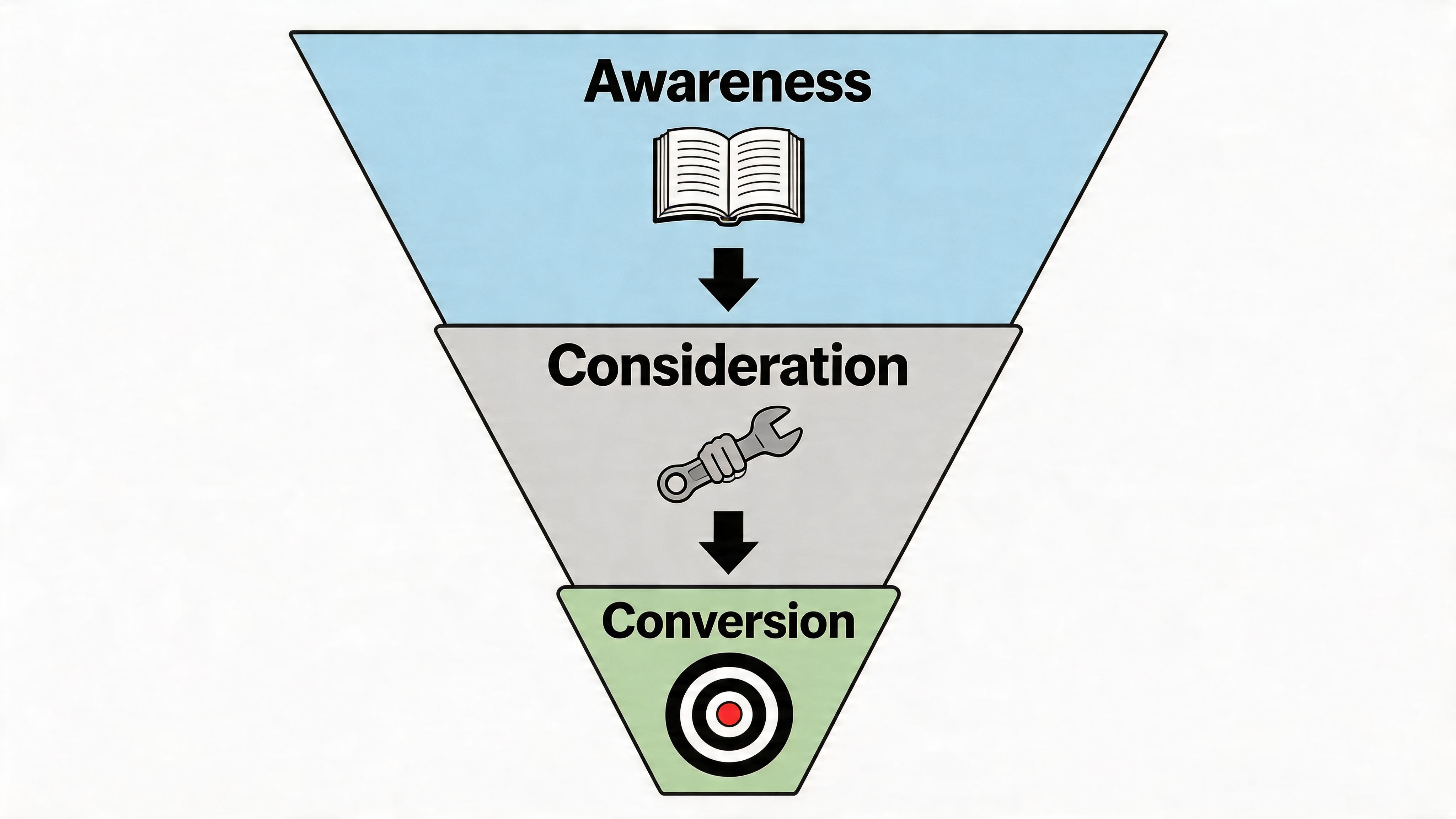
- Awareness: Which searches introduce the problem your buyer is trying to solve?
- Consideration: Which searches show active evaluation of approaches, vendors, or product types?
- Conversion: Which searches indicate the buyer is ready to book, buy, request, or compare final options?
That shift matters because different pages do different jobs. An educational article shouldn’t be judged like a pricing page. A comparison page shouldn’t read like a glossary. A service page shouldn’t bury the CTA under generic thought leadership.
Practical rule: If a page has no defined role in the buyer journey, it usually becomes an expensive traffic asset with weak business value.
What works and what doesn’t
What works
- Building topic clusters that move users from broad questions to high-intent pages
- Matching content depth to search intent
- Treating internal links as funnel transitions, not just SEO hygiene
- Measuring each stage with the KPI that fits its purpose
What doesn’t
- Publishing TOFU content and hoping branded demand appears on its own
- Sending all organic visitors to one generic conversion page
- Judging success only by rankings or sessions
- Combining education, comparison, and hard-sell copy on the same URL
The businesses that win with SEO usually stop treating it like an isolated channel. They treat it like part of their growth system. Search brings the right visitor in. Content qualifies them. UX removes friction. Analytics shows where money is leaking.
What Is the SEO Funnel
The easiest way to understand the funnel in SEO is to think like a retailer.
A physical store doesn’t expect every passerby to walk in and buy immediately. First, the window display gets attention. Then the shopper browses the aisle and compares options. Finally, they reach the checkout counter and make a decision.
Search works the same way.
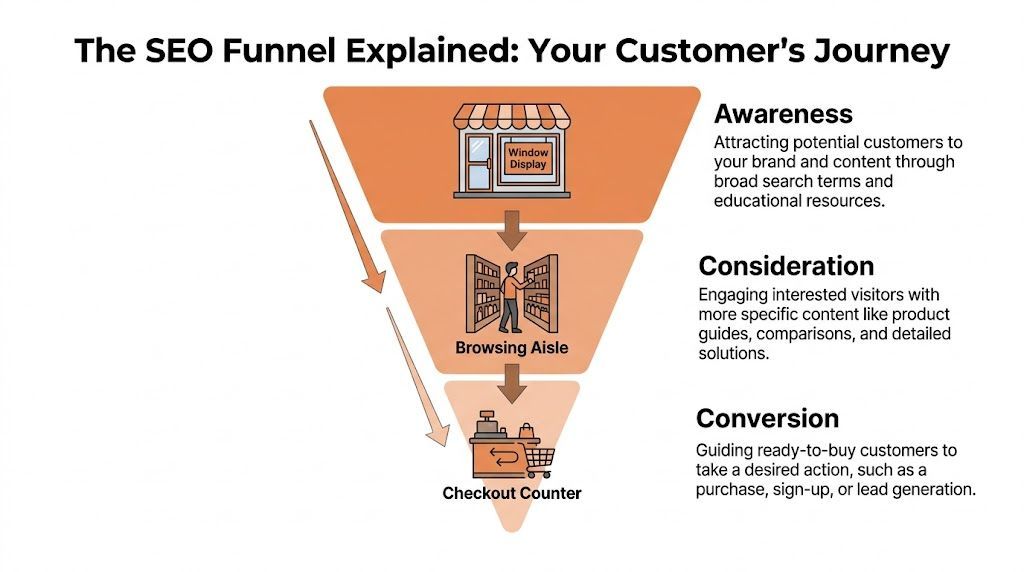
Awareness
This is the window display.
People at the top of the funnel aren’t usually looking for your company by name. They’re trying to understand a problem, learn terminology, explore options, or get unstuck. Content here attracts attention and earns trust.
Typical assets include:
- Educational articles that explain a topic clearly
- Glossaries and definitions for emerging categories
- Problem-focused guides that speak to pain points before product talk starts
Consideration
This is the browsing aisle.
Now the visitor is evaluating solutions. They know the problem and want help choosing the right path. Many SEO programs underinvest at this point. They publish broad content and jump straight to sales pages, skipping the pages that build commercial confidence.
Consideration-stage content often includes:
- Comparison pages between approaches or vendors
- Use-case pages designed for audience segments
- Detailed solution guides that connect pain to product fit
Conversion
This is the checkout counter.
The visitor is close to acting. They need confidence, clarity, and a frictionless next step. Your BOFU pages should answer commercial questions fast and make the CTA obvious.
Common examples:
- Service pages
- Product pages
- Pricing pages
- Demo, trial, or quote pages
The reason this framework matters more now is search behavior itself has changed. Over 60% of Google searches on mobile now end without a click, and AI Overviews appear in more than 13% of queries according to Logic Inbound’s analysis of the evolving SEO funnel. That means visibility alone isn’t enough. You need content that supports the whole journey, including searches where the first interaction may happen on the results page, not your website.
The core idea
The funnel in SEO isn’t just about generating visits. It’s about moving qualified searchers from first touch to commercial action.
If your SEO assets don’t connect across stages, you don’t have a funnel. You have pages.
Mapping Search Intent to Funnel Stages
Ranking for the wrong query is a waste of budget.
A visitor who searches “what is inventory forecasting” is asking for context. A visitor who searches “inventory forecasting software comparison” is trying to reduce buying risk. Send both to the same page and one of them will bounce, or worse, stay and never progress.
Intent mapping fixes that. It gives each query a job, each page a role, and each stage a measurable outcome. That is how SEO starts acting like a revenue system instead of a publishing calendar.
SEO Funnel Mapping From Intent to KPI
How to use the table without oversimplifying it
Each stage needs a different scoring model.
TOFU earns attention from the right audience. MOFU proves fit. BOFU captures demand that is already close to action. If a team uses lead volume as the only KPI across all three, it will underinvest in early intent and misread which pages create pipeline.
That mistake shows up in reporting all the time. A broad guide may never generate many last-click conversions, yet still drive a meaningful share of assisted conversions by feeding readers into comparison, demo, or pricing pages. A pricing page may have low traffic and still be one of the highest-value assets on the site because its visitors convert at a much higher rate.
The operational fix is simple. Track the stage-specific action you want, then track the handoff to the next stage.
For TOFU, that usually means visibility plus progression. Are the right people landing? Do they click into deeper pages? For MOFU, measure evaluation signals. Are visitors reaching product, service, or pricing pages after reading comparisons or use-case content? For BOFU, tie performance to pipeline and revenue, not just form fills.
Teams that need a clearer operating model often benefit from an SEO service built around funnel-stage intent mapping and revenue reporting, because the page strategy, internal linking, and KPI definitions need to be set together.
Do not judge a TOFU page by whether it closes the deal. Judge it by whether it qualifies the visit and moves the searcher one step closer to buying.
What intent mapping looks like in practice
In SaaS, a practical path often starts with a category or problem query, moves into a comparison page, and ends on demo or pricing. The top-of-funnel article gets the visit. The middle-of-funnel page narrows the shortlist. The bottom-of-funnel page converts the buyer who is ready.
In e-commerce, the path is usually shorter but less linear. A shopper may start with “how to choose running shoes,” jump to a category page, compare features, then convert on a product page. Intent mapping matters because educational content alone rarely closes the sale, and product pages alone rarely capture earlier discovery searches.
For B2B services, the middle usually carries more weight than teams expect. Buyers want proof that you understand their context before they book a call. That makes use-case pages, “agency vs in-house” pages, and service-specific pages some of the highest-impact assets in the funnel.
The trade-off teams need to accept
One page rarely does two jobs well.
Pages built for broad discovery usually lose focus if they push too hard on conversion. Pages built to convert often struggle to rank for educational searches because they do not satisfy the query fully. Strong SEO funnels accept that trade-off and connect assets instead of forcing every page to rank, persuade, and convert at once.
That is also why Ezca’s 90-day sprint model works in practice. The first sprint maps intent clusters to funnel stages and existing URLs. The second builds or revises the pages with the biggest commercial gap. The third tightens internal links, CTA paths, and reporting so traffic movement between stages is visible. That sequence gives teams something better than more content. It gives them a funnel they can measure.
Content and Technical Tactics for Each Stage
Ranking the top of the funnel is the easy part. Turning that traffic into pipeline is the job.
Teams often overinvest in educational content because production is straightforward and volume looks good in reporting. The harder work sits in the middle and bottom of the funnel, where pages need sharp positioning, clear buyer guidance, and tighter conversion paths. That is also where the fastest revenue impact usually shows up.
Ezca’s 90-day sprint model helps keep execution honest. Sprint one identifies the pages that deserve to exist at each stage. Sprint two builds or rewrites the highest-value assets. Sprint three removes friction between them through internal links, template updates, and cleaner reporting.
TOFU tactics that attract the right audience
Top-of-funnel content should bring in the right visitor, not just more visitors.
Build problem-first educational assets
For SaaS, that might mean pages like “how to reduce churn forecasting errors” or “product analytics for subscription teams.” For e-commerce, it could be fit guides, care guides, or category education. For B2B services, the strongest topics usually explain an operational problem in plain language and connect it to a buying decision.
Each page needs to do three jobs:
- Match the query language the buyer uses
- Answer the main question near the top of the page
- Point the reader to the next logical evaluation page
Traffic without a next click is just a vanity metric.
Create glossary and definition pages for category capture
Glossary pages work well when buyers search unfamiliar terms before they search vendors. They can rank for early discovery queries, clarify the category, and push qualified readers toward use-case, service, or category pages.
This tactic is especially useful in SaaS and technical B2B, where product language often gets ahead of buyer understanding.
Use internal links as stage transitions
Internal links at TOFU should move readers into consideration, not just keep them browsing.
A few examples:
- A SaaS guide about attribution models links to a comparison page for attribution tools
- A skincare education page links to collection pages by concern or ingredient
- A B2B explainer on lead qualification links to a service page or an in-house versus agency comparison
Technical support at this stage is practical, not flashy:
- Tight title tags and meta descriptions that match broad intent without overselling
- Clear content clusters and crawl paths so related pages are easy to find
- Templates that surface the next-step CTA high enough on the page to earn attention
MOFU tactics that turn interest into evaluation
Middle-of-funnel pages decide whether your brand makes the shortlist.
This is the stage many content programs underbuild. A site may have 100 blog posts and no serious comparison pages, weak use-case content, and generic solutions copy. That setup can rank. It rarely converts efficiently.
Write comparison pages with a point of view
Good comparison pages help the buyer choose. Weak ones summarize features and avoid judgment.
For SaaS, compare products by team size, setup effort, reporting depth, and integration fit. For e-commerce, compare product types by use case, material, durability, or fit. For B2B services, compare in-house versus agency, specialist versus generalist, or project-based versus retainer support.
A simple structure works:
- Best for
- Not ideal for
- Decision criteria
- Next step
That framework is more useful than a generic pros-and-cons table because it reduces uncertainty. Buyers in the middle of the funnel are not asking for more information. They are asking for help making a decision.
Gate selectively, not aggressively
Calculators, templates, webinars, and original research can perform well here if the value is obvious. Hard-gating every useful asset usually slows progression and suppresses organic performance.
A better trade-off is to let the page rank on its own merit, then offer the gated asset as the deeper resource. If the form creates too much friction, use analytics to confirm it. Teams that track Google Analytics custom funnels can see whether visitors move from comparison content to demos, pricing, or lead forms.
Here’s a useful explainer on funnel-oriented execution before the visitor reaches the final conversion step:
Add trust signals to evaluation pages
Evaluation pages need specifics that lower perceived risk:
- Feature or capability breakdowns
- Audience-fit statements
- Implementation expectations
- Proof points, FAQs, and objection handling
These pages are often the best place to align SEO with sales. If sales calls keep surfacing the same objection, that objection belongs on the page.
If you want a practical benchmark for how these pages fit into a broader organic program, strong SEO services usually prioritize this layer earlier than many internal teams do.
Technical support at MOFU should improve clarity and movement:
- Structured headings that map to buyer questions
- FAQ blocks where they help intent match
- Internal links to pricing, demos, service pages, and category pages
- Page templates that keep comparison tables and CTAs easy to scan on mobile
BOFU tactics that capture demand
Bottom-of-funnel pages win when they remove doubt fast.
Tighten product and service pages around buyer questions
The highest-converting BOFU pages usually answer a short list of questions immediately:
- What is it?
- Who is it for?
- Why choose this option?
- What happens next?
For SaaS, that usually means pricing logic, onboarding expectations, integrations, and proof of outcomes. For e-commerce, product pages need fit details, materials, shipping information, and return clarity. For B2B services, service pages need scope, process, qualification cues, and evidence that the team has solved this problem before.
Build commercial landing pages around one action
Pages with one primary CTA usually outperform pages that split attention across multiple asks. If the goal is demo bookings, make the page about booking the demo. If the goal is quote requests, remove extra exits and keep the path clear.
Buyers at this stage do not need more education. They need enough confidence to act.
Use schema and SERP enhancements where they support clicks
Schema helps when it improves how the page appears in search and sets better expectations before the click. FAQ, product, and service markup can support qualified traffic if the underlying page already matches intent.
Technical priorities at BOFU:
- Schema markup for product, service, and FAQ contexts where appropriate
- Fast page templates with obvious CTA placement
- Strong mobile usability on forms, quote flows, and demo requests
- Indexation control so low-value variants do not compete with core commercial pages
What tends to hurt BOFU performance is adding generic educational copy just to make the page feel more “SEO friendly.” High-intent pages need relevance, trust, and a clear next step. If extra copy delays any of those, it works against the business.
How to Measure SEO Funnel Performance
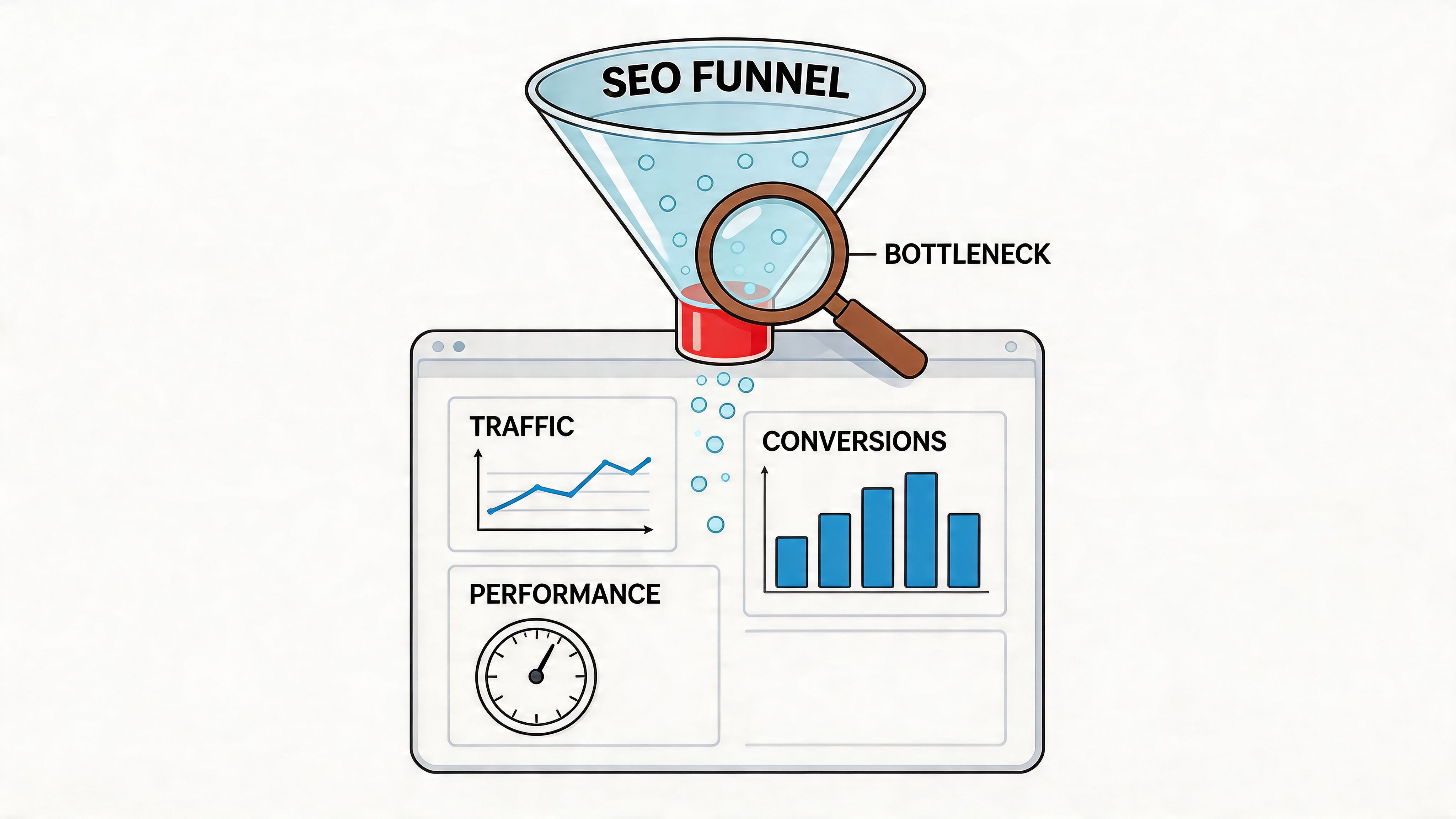
A funnel only matters if you can see where it leaks.
Most SEO reporting still stops at rankings, clicks, and sessions. That view is incomplete. You need search data to understand demand capture and site analytics to understand what happened after the click. Without both, you can’t tell whether the issue is visibility, intent match, page quality, or conversion friction.
Connect GSC and GA4 around the same page groups
Start by grouping URLs by funnel stage.
A simple structure works:
- TOFU group for educational guides, blog posts, glossaries
- MOFU group for comparisons, alternatives, use cases, gated asset pages
- BOFU group for product, service, pricing, demo, and quote pages
In Google Search Console, watch impressions, clicks, average position, and CTR by page group. In GA4, watch engaged sessions, bounce behavior, scroll depth, assisted conversions, and primary conversions.
The value comes from comparing the two systems together.
How to diagnose common bottlenecks
The combined view described in seoClarity’s SEO performance funnel guide is the right model. It shows how search metrics and site behavior expose different failure points. A high bounce rate above 60% on TOFU pages can signal an intent gap that reduces MOFU progression by 50%, while pages with over 3 minutes of dwell time convert 4x higher.
Use that logic in practice:
- High impressions, low CTR means the page is visible but not compelling in search. Fix titles, meta descriptions, and SERP alignment.
- Good clicks, weak engagement means the query match is loose or the page opens too slowly, answers too late, or targets the wrong intent.
- Strong engagement, weak progression means internal links, CTA design, or the next-step offer isn’t strong enough.
- Strong MOFU activity, weak BOFU conversion usually points to commercial friction on pricing, forms, product pages, or qualification logic.
If impressions rise and conversions stay flat, don’t celebrate the traffic. Find the break point.
What to build in GA4
Set up event tracking for actions that reveal movement through the funnel:
- Scroll depth on TOFU pages
- Comparison table interaction on MOFU pages
- Video views or asset downloads
- Form starts and form submissions on BOFU pages
If your team needs a practical walkthrough, this guide on how to track Google Analytics custom funnels is useful because it focuses on building visibility into the actual path, not just the endpoint.
What to do with the data
Reporting should lead to reallocation, not just explanation.
If TOFU pages attract traffic but don’t generate meaningful progression, tighten intent targeting or route that budget toward comparison and commercial assets. If BOFU pages rank but underperform, improve offer clarity and reduce friction before creating more awareness content.
For teams trying to improve this system, a practical reference on how to increase organic traffic can help, but traffic should still be treated as an input, not the finish line.
Your 90-Day SEO Funnel Implementation Plan
Most companies don’t need another annual SEO strategy deck. They need a short operating cycle with clear ownership, fast diagnostics, and weekly decisions.
A 90-day sprint works because it’s long enough to ship meaningful assets and short enough to force prioritization. That matters in funnel work. If you try to fix every stage, every template, and every keyword set at once, execution slows and reporting gets muddy.
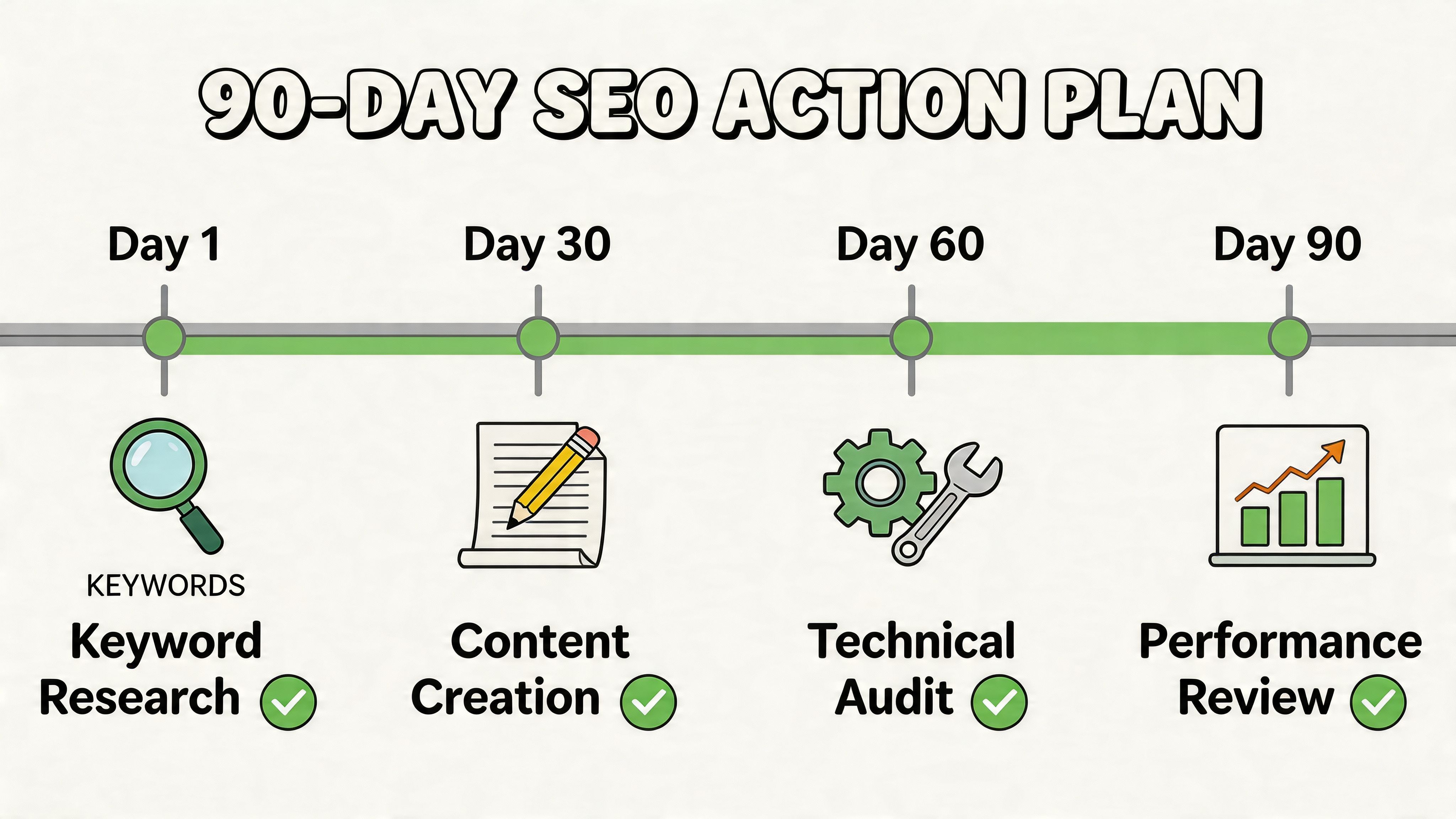
Days 1 to 15 audit and funnel mapping
Start with diagnosis.
Review your current pages and assign each one a funnel role. If a page can’t be categorized cleanly, that’s often a sign it’s trying to do too much. Pull search data, analytics data, and conversion data into one sheet or dashboard. Then map keywords by intent, not by raw volume alone.
During this phase, focus on:
- Page inventory by TOFU, MOFU, and BOFU
- Query mapping by informational, commercial, and transactional intent
- Current bottlenecks in CTR, engagement, and conversion path
- Internal linking gaps between stages
- Template issues on key commercial pages
You should leave this phase with a ranked priority list, not a giant backlog.
Days 16 to 60 content and technical execution
This is the production window.
The biggest win usually comes from fixing the middle and bottom before scaling more top-of-funnel content. That means shipping comparison pages, solution pages, product or service page rewrites, CTA improvements, and technical clean-up on pages already close to revenue.
A practical sprint sequence looks like this:
- Upgrade BOFU pages first Tighten offer clarity, CTA placement, FAQs, schema support, and page speed on product, pricing, service, and demo pages.
- Launch MOFU bridge pages Create comparisons, alternatives, use-case pages, and buyer guides that connect awareness traffic to commercial pages.
- Refine TOFU assets with pathways Update existing educational content so it routes users into the newly improved middle and bottom stages.
- Repair technical blockers Improve internal linking, metadata, indexing priorities, template consistency, and event tracking.
Days 61 to 90 measurement and iteration
Now you judge what moved.
Look at performance by page group, not just by individual URL. The point is to understand whether the funnel itself got stronger. Did TOFU pages send more qualified users into consideration? Did comparison pages assist more conversions? Did BOFU pages convert a larger share of intent?
Use the final month to make targeted changes:
- Rewrite underperforming titles where impressions are strong but CTR is weak
- Adjust internal links when engagement is good but progression is poor
- Refine CTAs and forms on bottom-funnel pages if evaluation traffic is arriving but not converting
- Prune or consolidate pages that attract the wrong intent
The operating rule for the whole sprint
Don’t spread effort evenly across all assets. Concentrate on the pages closest to revenue and the handoff points between stages.
That’s where the funnel in SEO becomes useful for leadership. It turns SEO from a broad content function into a system with clear priorities, weekly signals, and accountable outcomes.
Agency Case Notes SaaS E-commerce and B2B
Rankings rarely explain why SEO is underperforming. Funnel friction does.
Across SaaS, e-commerce, and B2B, the failure pattern is usually the same. Traffic arrives. Interest exists. Revenue stalls because the site does not help buyers move from curiosity to evaluation to action. That is why Ezca’s 90-day sprint model starts with handoff points, not vanity metrics.
SaaS with strong trial volume but weak paid conversion
This SaaS company did not need more top-of-funnel traffic. It already had educational content and steady free-trial signups. The gap sat between interest and commitment. Prospects could understand the category, but they could not quickly answer practical buying questions such as team fit, implementation effort, pricing logic, or how the product compared with alternatives.
The 90-day fix focused on middle-funnel assets first. We prioritized comparison pages, role-based solution pages, migration content, and onboarding expectation pages. That changed the quality of trial starts. Product-led teams often assume the product should do all the selling inside the trial. In practice, a large share of qualification should happen before signup, especially when onboarding takes time or requires internal buy-in.
One useful benchmark supports that logic. Amra & Elma’s funnel conversion benchmarks note that nurtured leads tend to generate larger purchases. The business takeaway is straightforward. More trials are not the goal. Better-fit trials are.
E-commerce with too much dependence on paid demand capture
This brand had demand, but organic search was not carrying enough revenue weight. Paid search was doing the closing work because the organic experience stopped too early in the journey. Informational pages attracted visitors, but they did little to support comparison, product selection, or purchase confidence.
The fix was structural. Collection pages gained clearer internal pathways from educational content. Product detail pages answered decision-stage objections more directly. Comparison modules helped buyers distinguish between options without leaving the site. In the sprint model, this work usually lands in days 31 to 60 because it depends on intent mapping completed in the first month.
The trade-off is real. Commercial page improvements usually produce faster revenue impact than publishing another batch of blog posts, but they also require tighter coordination across SEO, UX, merchandising, and development.
Tooling matters here because large catalogs break undetected. Teams assessing workflow support can review this list of best tools for SEO agencies for platforms that help with rendering checks, page monitoring, and technical QA across revenue-driving templates.
B2B service firm with authority but weak lead quality
This firm had visibility and credibility, but too many inbound leads were a poor fit. The content educated well and qualified poorly. Sales paid the price. Time went into calls that had little chance of closing.
The correction was not more traffic generation. It was sharper positioning in the middle and bottom of the funnel. Industry pages, use-case pages, and more specific service pages made the offer clearer. Comparison content also filtered out weak-fit prospects before they filled out a form. That usually lowers raw lead volume, and that is often the right trade.
For this client, video helped support evaluation. Short process explainers and solution walkthroughs answered trust questions faster than another long article could. The point was not to add media for its own sake. The point was to remove uncertainty that slowed qualified buyers down.
Stronger SEO funnels improve lead quality, sales efficiency, and close rates. They do not just increase form fills.
Execution ownership affects how fast these fixes happen. Teams weighing resourcing options should look at the trade-offs in this breakdown of in-house vs-agency marketing.
Advanced SEO Funnel Questions Answered
How should you handle the dark funnel created by AI search
Annual SEO strategy decks often fail because they describe the shift without changing the operating model. AI search creates more invisible touches before a visit, so the fix is tighter instrumentation and shorter decision cycles.
Treat visibility before the click as a research problem, not a reporting gap. Review which commercial questions AI tools and search results answer without sending traffic. Then audit whether your site owns the pages those systems pull from most often: comparison pages, category pages, product or service detail pages, review pages, and FAQ blocks with clear entity signals.
In Ezca’s 90-day sprint model, this work starts with a source audit in days 1 to 30, page upgrades in days 31 to 60, and assisted-conversion review in days 61 to 90. The goal is simple. Find where buyers form preference before they visit, publish pages that shape that preference, and measure whether those pages support revenue later even when first-click attribution stays incomplete.
Lumar’s SEO revenue funnel framework is useful here because it frames SEO around revenue contribution instead of raw traffic totals.
Does every business need all three funnel stages
No. Every business needs funnel coverage. Very few need equal investment in each stage.
A niche B2B firm with a long sales cycle may get better returns from middle and bottom-funnel content first. A consumer brand entering a crowded category may need top-funnel education to earn consideration at scale. The trade-off is efficiency versus reach. Top-funnel content can expand the market, but it usually takes longer to connect to pipeline. Bottom-funnel content converts faster, but it caps growth if nobody discovers the brand earlier.
The right mix depends on sales cycle length, deal size, search demand, and how much education the buyer needs before they are ready to act.
What matters more, rankings or progression between stages
Progression between stages is the metric that changes budget decisions.
Rankings help only if they move a prospect toward the next meaningful action: a second pageview, a demo request, a trial start, an add-to-cart, or a sales conversation with real purchase intent. A page that ranks third and drives qualified movement is worth more than a page that ranks first and produces low-intent visits.
This is why we review pathing, assisted conversions, and conversion rate by page type inside each 90-day sprint. If awareness content attracts traffic but no evaluation behavior, the issue is not visibility. It is weak funnel design.
When should branded search become a KPI
Use it when your SEO program is mature enough to influence demand, not just capture it.
For newer programs, branded search is usually a secondary signal. For established brands, high-consideration categories, or markets where buyers research across multiple sessions, it becomes more useful. It can show whether SEO is helping buyers remember the company and return with intent. It should still sit beside harder performance metrics such as qualified leads, revenue by landing page group, trial starts, and close rate from organic-sourced opportunities.
If your SEO program is generating activity but not enough revenue clarity, Ezca Agency can help you rebuild it around a measurable funnel. Ezca works in focused 90-day sprints for SaaS, e-commerce, and B2B teams, combining strategy, content, technical SEO, CRO, and channel reallocation around business outcomes. Learn more at Ezca Agency.