
10 E-commerce Marketing Strategies for Measurable Growth in 2026
Discover 10 actionable e-commerce marketing strategies for 2026. Drive ROI with expert insights on PPC, SEO, CRO, and AI-powered tactics for business owners.
The e-commerce market is more competitive than ever, demanding more than just a functional website and a product catalog. For marketing leaders and business owners, the key to sustained growth lies in executing sharp, data-driven e-commerce marketing strategies that deliver measurable ROI. Generic advice falls short; what you need are proven, actionable playbooks that align with ambitious revenue goals and drive predictable performance.
This article cuts through the noise. We are providing a roundup of 10 high-impact strategies that successful brands use to scale, covering critical channels like paid advertising, SEO, CRO, and lifecycle marketing. Forget abstract theories and surface-level tips. Instead, we'll give you a practical framework for each strategy, detailing exactly what it is, why it's critical, the key metrics to track, and a clear 90-day implementation plan.
Drawing from our experience helping brands like Logitech and Samsung achieve market leadership, we present a clear path to execution. You will learn how to prioritize initiatives, allocate budgets effectively, and integrate data-backed optimization into your weekly workflow. Our goal is to equip you with the specific tactics needed to turn your marketing efforts into a consistent growth engine. Let's move beyond basic campaigns and focus on the high-impact e-commerce marketing strategies that create lasting value and tangible results.
1. Performance-Based Paid Search (PPC) Optimization
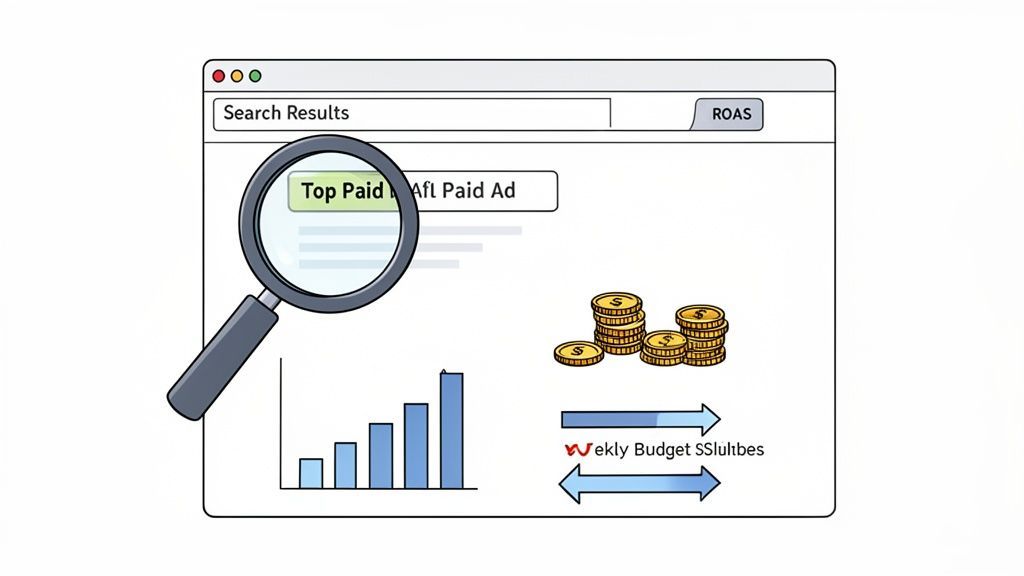
Performance-based paid search is a dynamic, data-driven approach to managing PPC campaigns on platforms like Google Ads. It moves beyond static budget allocation and focuses on continuous optimization based on hard metrics, primarily Return on Ad Spend (ROAS) and Cost Per Acquisition (CPA). Instead of "setting and forgetting," this strategy involves weekly or even daily adjustments, reallocating budget to the highest-performing keywords, ad creative, and audience segments to maximize revenue.
This method is critical for e-commerce brands that require immediate, measurable returns from their ad spend. It directly connects advertising costs to sales revenue, providing clear attribution and justifying marketing investment. For marketing leaders and founders, this means every dollar is held accountable, driving predictable growth and scaling opportunities.
Why It Works for E-commerce
Unlike branding campaigns, performance-based PPC is laser-focused on transactions. By optimizing for ROAS, you ensure your ad spend generates profitable revenue, not just clicks or impressions. This is one of the most effective e-commerce marketing strategies for rapid scaling. For example, Ezca Agency refined Logitech's product-level campaigns by shifting budget away from underperforming product groups and toward those with a higher ROAS, improving overall ad efficiency by over 30%. Similarly, D2C brands use dynamic product ads to retarget cart abandoners, showing them the exact items they left behind to drive conversions.
Key Insight: The goal isn't just to spend the budget; it's to invest it where it generates the highest return. If a specific keyword or ad consistently produces a 10x ROAS, it deserves more funding than one producing a 2x ROAS.
Quick Implementation Playbook
- Set Up Flawless Tracking: Before spending a single dollar, ensure enhanced e-commerce conversion tracking is correctly installed via Google Tag Manager. You must be able to track revenue, transactions, and ROAS at the campaign, ad group, and keyword levels.
- Establish a ROAS Baseline: Run campaigns for two to four weeks to gather initial performance data. Calculate your break-even ROAS to understand the minimum return needed to be profitable.
- Conduct Weekly Optimizations: Analyze performance weekly. Pause low-ROAS keywords, increase bids on high-performers, and reallocate budget from underperforming campaigns to your top revenue-drivers.
- A/B Test Ad Copy and Landing Pages: Continuously test new ad headlines and descriptions. Send traffic to different landing page variations to identify which version converts best, directly improving your ROAS.
- Aggressively Use Negative Keywords: Review search term reports daily to identify and exclude irrelevant queries that waste budget. This simple step can immediately improve your profitability.
2. Conversion Rate Optimization (CRO) and A/B Testing
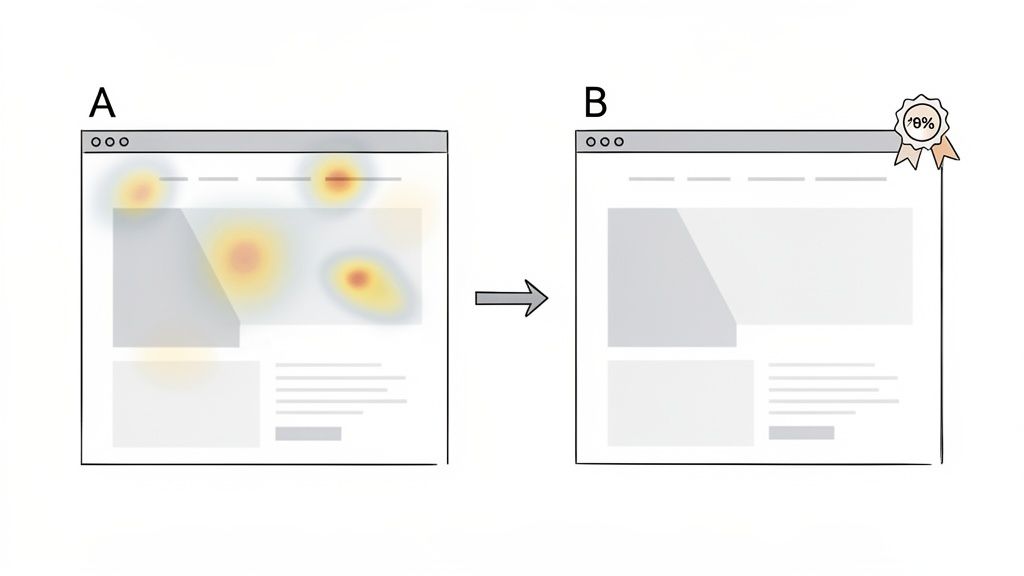
Conversion Rate Optimization (CRO) is a systematic methodology for increasing the percentage of website visitors who take a desired action, such as making a purchase or signing up. Instead of pouring more money into acquiring new traffic, CRO focuses on maximizing the value of the visitors you already have. This is achieved through continuous A/B testing of user experience elements, page layouts, copy, and calls-to-action to identify what works best.
For e-commerce brands, CRO is essential for turning paid marketing investments into profitable returns. A high-performing landing page or a frictionless checkout flow can dramatically increase revenue from the same ad spend. This process connects user behavior directly to business outcomes, making it one of the most powerful e-commerce marketing strategies for sustainable growth.
Why It Works for E-commerce
CRO directly impacts the bottom line by making the path to purchase smoother for your customers. For example, a brand might test reducing its checkout process from five steps to two, leading to a significant drop in cart abandonment. Similarly, testing different product page headlines or button colors can lift add-to-cart rates. To effectively Fix Your Shopify Conversion Rate By Focusing on LTV and AOV, brands must move beyond simple discounts and optimize the entire user journey. For a deeper dive into improving this critical step, see how Ezca Agency approaches e-commerce checkout optimization.
Key Insight: The highest ROI often comes from optimizing what you already have. Improving your conversion rate by just 0.5% can generate more revenue than a 10% increase in ad spend, and the gains are permanent.
Quick Implementation Playbook
- Identify Friction Points: Use tools like Hotjar or Microsoft Clarity to analyze heatmaps and session recordings. Find where users are dropping off or struggling, such as the checkout page or complex forms.
- Formulate a Hypothesis: Based on your data, create a clear hypothesis. For example: "Changing the primary call-to-action button color from grey to orange will increase clicks by 15% because it will have higher visual prominence."
- Run a Controlled Test: Use a tool like VWO, Optimizely, or Google Optimize to test one variable at a time. Run the test for two to four weeks or until you reach statistical significance (typically a 95% confidence level).
- Analyze and Implement: If your variation produces a clear winner, implement the change permanently across your site. If the test is inconclusive, document your findings and move on to the next hypothesis.
- Create a Testing Roadmap: Document all tests, results, and insights. Maintain a backlog of testing ideas prioritized by potential impact and ease of implementation to build a culture of continuous improvement.
3. SEO and Organic Search Optimization
SEO and organic search optimization is the long-term strategy for earning high-quality traffic without paying for every click. It involves improving your website's technical foundation, creating valuable content that answers user questions, and acquiring authoritative backlinks. Unlike paid ads that stop when you stop paying, SEO builds a sustainable, compounding asset that drives brand authority and trust.
This method is essential for e-commerce brands where customers conduct extensive research before purchasing. By ranking for commercial and informational keywords, you capture motivated buyers at every stage of their journey. For marketing leaders, a strong organic presence reduces customer acquisition costs over time and builds a durable competitive advantage that is difficult for competitors to replicate.
Why It Works for E-commerce
SEO works because it aligns directly with user search intent. When a potential customer searches for "best running shoes for flat feet," ranking at the top positions you as the go-to expert and trusted retailer. This is one of the most powerful e-commerce marketing strategies for building brand equity and generating consistent, high-converting traffic. For instance, an e-commerce site can dominate long-tail keywords like "hypoallergenic dog food for small breeds," attracting highly specific, purchase-ready traffic. Similarly, B2B companies like HubSpot built a content empire that attracts millions of organic visitors monthly by answering every conceivable marketing question.
Key Insight: Organic search is not free; it's an investment in your brand's digital real estate. The goal is to build topical authority so that search engines see you as the most credible answer for your niche.
Quick Implementation Playbook
- Conduct Intent-Based Keyword Research: Use tools like Ahrefs or Semrush to identify keywords your customers are searching for. Map them to different stages of the funnel: informational ("how to clean leather boots"), commercial ("best waterproof hiking boots"), and transactional ("buy Dr. Martens size 9").
- Optimize On-Page and Technical SEO: Ensure your product and category pages have optimized titles, meta descriptions, and header tags. Run a technical audit to fix crawl errors, improve site speed, and check Core Web Vitals.
- Build Topical Authority with Content Silos: Create comprehensive blog posts, buying guides, and comparison articles that answer user questions. Group related content together using a hub-and-spoke model to show search engines your expertise on a topic. To get started, you can learn more about how to increase organic traffic.
- Acquire High-Quality Backlinks: Earn links from reputable sites through digital PR, guest posting on industry blogs, and creating link-worthy assets like original research or free tools.
- Monitor and Update Content: Use Google Search Console to track keyword rankings and click-through rates. Regularly refresh older content with updated information to maintain its relevance and search position.
4. Email Marketing and Lifecycle Automation
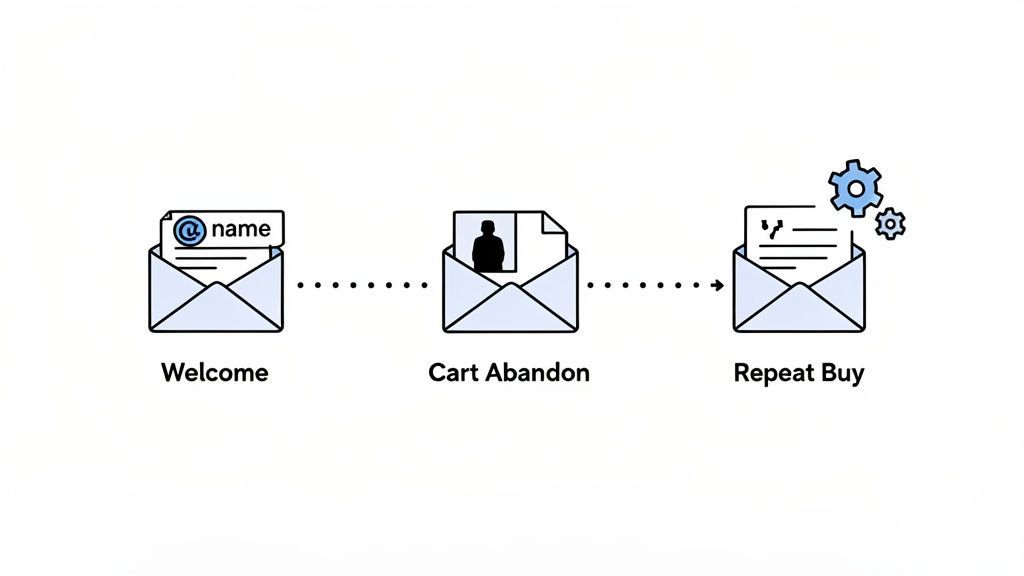
Email marketing and lifecycle automation involve sending personalized, triggered messages to customers at specific stages of their journey. This strategy moves beyond generic email blasts, focusing on automated workflows like welcome series, cart abandonment reminders, and post-purchase follow-ups. By segmenting audiences based on behavior and purchase history, brands can deliver highly relevant content that nurtures relationships and drives repeat sales.
This approach is foundational for maximizing customer lifetime value (LTV). With an average ROI of $36-$42 for every $1 spent, email remains one of the most profitable marketing channels. For e-commerce leaders, it's a direct line to their customer base, enabling them to build brand loyalty and generate predictable revenue outside of paid acquisition channels.
Why It Works for E-commerce
Lifecycle automation converts intent into revenue at critical moments. A well-timed cart abandonment email, for example, can recover 15-30% of otherwise lost sales. This is one of the most cost-effective e-commerce marketing strategies because it targets warm leads who have already shown high purchase intent. D2C brands use platforms like Klaviyo to send personalized product recommendations based on past purchases, increasing cross-sell and upsell opportunities. Similarly, a strategic welcome series can educate new subscribers and drive their first purchase faster.
Key Insight: Automation doesn’t mean impersonal. It enables personalization at scale, ensuring every customer receives the right message at the right time to guide them toward the next purchase.
Quick Implementation Playbook
- Build Your Email List: Implement high-visibility opt-in forms on your website, such as in the footer, pop-ups offering a discount, and at checkout. A healthy list is the foundation of any successful email strategy.
- Set Up Core Automation Flows: Start with the three essential e-commerce workflows: a welcome series for new subscribers, a cart abandonment sequence to recover lost sales, and a post-purchase series to thank customers and request reviews.
- Segment Your Audience: Create segments based on purchase history (e.g., first-time buyers, VIPs), engagement level (e.g., active, at-risk), and browsing behavior. Tailor your campaigns to each group.
- A/B Test Key Elements: Continuously test subject lines, send times, and call-to-action buttons to improve open rates and conversions. Even small improvements can significantly impact revenue.
- Maintain List Hygiene: Regularly clean your email list by removing inactive or unengaged subscribers. This protects your sender reputation and improves deliverability, ensuring your messages land in the inbox.
5. Data-Driven Budget Allocation and Weekly Optimization
Data-driven budget allocation is a fluid strategy that treats your entire marketing budget as a single, agile portfolio. Instead of locking in annual or quarterly budgets per channel, this approach involves reallocating funds weekly based on real-time performance data. It continuously shifts investment toward the highest-return channels (paid search, social, SEO, etc.) and pauses or reduces spending on underperforming tactics.
This model is essential for modern e-commerce brands operating in fast-moving markets. It allows marketing leaders to react instantly to changes in consumer behavior, platform performance, or competitive pressure. By holding every channel accountable to hard metrics like ROAS and CPA, you ensure that your total marketing investment is always working at maximum efficiency to drive profitable growth.
Why It Works for E-commerce
This approach breaks down marketing silos and forces a unified view of performance, making it one of the most effective e-commerce marketing strategies for maximizing ROI. A channel's budget is earned, not guaranteed. For instance, many D2C brands recently shifted significant spend from a declining Facebook ROAS to capitalize on emerging opportunities on TikTok, a move made possible by agile budgeting. Ezca Agency's squad model operationalizes this by reviewing cross-channel performance weekly, enabling swift reallocation from a saturated ad platform to a high-potential organic content initiative.
Key Insight: Treat your marketing budget like a high-performance investment fund. Your job is to constantly move capital to the assets (channels) that deliver the best returns.
Quick Implementation Playbook
- Establish Universal KPIs: Define your primary success metrics (e.g., blended ROAS, CPA, LTV) and set clear targets that apply across all marketing channels.
- Create a Unified Dashboard: Consolidate data from Google Analytics, Shopify, social ad platforms, and other sources into a single dashboard. This provides a clear, real-time view of cross-channel performance.
- Hold Weekly Allocation Meetings: Schedule a mandatory weekly meeting with all marketing stakeholders to review performance against KPIs and decide on budget shifts for the upcoming week.
- Set Allocation Guardrails: Define minimum budgets to keep channels active and maximum caps to prevent over-saturation. Test new channels with a small, dedicated "innovation budget" (e.g., 5% of the total).
- Document Every Decision: Keep a simple log of all budget changes, the data that prompted them, and the resulting impact. This creates an invaluable repository of learnings to guide future decisions.
6. Content Marketing and Thought Leadership
Content marketing is the strategic creation and distribution of valuable, relevant content to attract and educate a clearly defined audience. This approach moves beyond direct selling to establish brand authority, build trust, and drive organic traffic through assets like blogs, whitepapers, case studies, and videos. It acts as the engine for SEO, inbound lead generation, and customer nurturing.
This strategy is fundamental for e-commerce brands, especially those with complex products or longer consideration cycles. It answers customer questions before they even ask, positioning your brand as the go-to expert. For founders and marketing leaders, it’s about building a sustainable asset that generates qualified traffic and leads long after a paid campaign ends, lowering customer acquisition costs over time.
Why It Works for E-commerce
Content marketing directly addresses customer pain points and search intent, capturing traffic at every stage of the buyer's journey. By providing genuine value, you build an audience that trusts your brand, making them more likely to purchase. This is one of the most powerful e-commerce marketing strategies for long-term, compounding growth. For example, HubSpot’s blog attracts millions of monthly visitors by offering free, expert marketing advice, which in turn fuels its software sales. Similarly, B2B companies use educational webinars and industry reports to generate high-quality leads for their sales teams.
Key Insight: The goal is to own the conversation around your industry's problems. When customers search for solutions, your content should be the definitive answer, making your product the logical next step.
Quick Implementation Playbook
- Map Content to the Buyer Journey: Identify key questions your customers have at the awareness, consideration, and decision stages. Create content that answers these questions, such as "how-to" guides for awareness or product comparisons for consideration.
- Conduct Keyword and Topic Research: Use SEO tools to find long-tail keywords your audience is searching for. Focus on topics with high relevance and manageable competition to secure early wins.
- Create Pillar Pages and Topic Clusters: Develop a comprehensive "pillar" page on a core topic (e.g., "The Ultimate Guide to Skincare Routines"). Surround it with shorter "cluster" articles that link back to it (e.g., "Best Cleansers for Oily Skin"), establishing topical authority with search engines.
- Promote and Repurpose Aggressively: Share every new piece of content across email newsletters, social media, and online communities. Repurpose a single blog post into a video, an infographic, and a series of social media updates to maximize its reach.
- Measure Performance Beyond Traffic: Track metrics that connect content to revenue, such as leads generated, newsletter sign-ups, and conversion rates for visitors who engaged with your content. Use this data to refine your content calendar.
7. Social Media Advertising and Audience Targeting
Social media advertising involves running paid campaigns on platforms like Meta (Facebook, Instagram), TikTok, and Pinterest to reach highly specific user segments. This strategy moves beyond organic posting by using detailed audience data, including demographics, interests, and online behaviors, to place products directly in front of the most likely buyers. It allows e-commerce brands to build awareness, drive consideration, and capture sales within a single, visually-driven ecosystem.
This approach is essential for brands seeking to connect with customers where they spend their time. For marketing leaders, it offers unmatched targeting precision, from retargeting website visitors to building lookalike audiences that mirror their best customers. The visual nature of these platforms makes it perfect for showcasing products in action, telling brand stories, and generating immediate demand.
Why It Works for E-commerce
Social media advertising is built for product discovery and impulse purchases. By targeting users based on interests and past purchase behaviors, brands can introduce solutions to problems customers didn't even know they had. This makes it one of the most powerful e-commerce marketing strategies for new product launches and scaling customer acquisition. For instance, a D2C skincare brand can use TikTok video ads to demonstrate a product's benefits, reaching millions of potential customers in their target demographic almost instantly. Luxury brands like those Logitech collaborates with use Instagram’s high-quality visuals to build brand prestige and retarget users who have shown interest.
Key Insight: The power isn't just in the reach; it's in the relevance. You can create hyper-specific audiences, such as "women aged 25-34 who have recently engaged with yoga content and made an online purchase in the last month."
Quick Implementation Playbook
- Install Your Conversion Pixels: Before launching ads, ensure the Meta Pixel, TikTok Pixel, and any other relevant tracking tags are correctly installed on your website. This is non-negotiable for tracking conversions, ROAS, and building retargeting audiences.
- Start with High-Intent Audiences: Begin by targeting your warmest audiences. Create custom audiences from your email list, past purchasers, and website visitors who have added items to their cart. Build lookalike audiences from these core groups.
- Test Creative Aggressively: Launch campaigns with multiple ad creative variations (images, videos, carousels) and copy. Let the platform’s algorithm identify the winning combinations based on actual performance data like click-through rate and cost per purchase.
- Prioritize Authentic Video Content: Video, especially user-generated content (UGC), consistently drives higher engagement and lower costs. To accelerate this process, you can explore platforms that offer ShortGenius AI UGC ads to create compelling, authentic-looking videos at scale.
- Monitor Frequency and Prevent Ad Fatigue: Keep a close eye on your ad frequency metric. If users see the same ad too many times, performance will drop. Set up rules to automatically pause ads or rotate creative once frequency exceeds a certain threshold (e.g., 3-5 in a seven-day period).
8. Marketing Automation and AI-Powered Optimization
Marketing automation and AI-powered optimization involve using intelligent systems to automate workflows, predict customer behavior, and personalize experiences at scale. This strategy moves beyond simple email sequences, employing machine learning to analyze vast datasets and identify patterns that guide bidding strategies, product recommendations, and customer segmentation. For e-commerce brands, it means making smarter, data-backed decisions faster than a human team ever could.
This approach is essential for scaling efficiently and staying competitive. By automating repetitive tasks and using AI for complex analysis, marketing leaders can free up their teams to focus on strategy and creativity. It directly connects marketing actions to outcomes like customer lifetime value (LTV) and conversion rates, ensuring resources are allocated for maximum impact.
Why It Works for E-commerce
This is one of the most powerful e-commerce marketing strategies because it enables true one-to-one personalization, even with millions of customers. AI-driven systems, like those used by Ezca Agency, can optimize ad campaigns across channels in real-time, adjusting bids based on conversion probability. For instance, Amazon's recommendation engine, a prime example of AI in action, is reportedly responsible for up to 35% of its revenue. Similarly, platforms like HubSpot use AI-powered lead scoring to help B2B e-commerce brands identify which prospects are most likely to convert, allowing sales teams to prioritize their efforts effectively.
Key Insight: The goal is not just to automate tasks, but to augment human intelligence. AI can analyze millions of data points to recommend a bidding strategy, but a human marketer provides the strategic context and final approval.
Quick Implementation Playbook
- Establish a Clean Data Foundation: Ensure your data from Google Analytics, your CRM, and your e-commerce platform is accurate and structured. AI models are only as good as the data they are trained on.
- Start with Predictive Analytics: Before automating actions, use AI tools to predict outcomes. For example, identify customer segments with the highest potential LTV or products most likely to be purchased together.
- Implement Platform-Native AI: Activate AI-powered features within your existing tools, such as Google's Smart Bidding for PPC campaigns or Klaviyo's predictive analytics for email marketing. This is a low-barrier way to start.
- Automate High-Impact Workflows: Build automated sequences for cart abandonment, new subscriber welcomes, and post-purchase follow-ups, using AI-driven triggers and product recommendations for personalization.
- Set Guardrails and Monitor Performance: When using AI for bidding or budget allocation, set clear constraints (e.g., max CPA) and monitor performance closely. Regularly review AI-driven decisions to ensure they align with business goals. Agencies with deep AI expertise can help manage this process and refine models over time.
9. Influencer and Affiliate Marketing Partnerships
Influencer and affiliate marketing involves collaborating with content creators and publishers to promote your products through trusted, third-party endorsements. This strategy extends your brand’s reach by tapping into established communities built on authenticity and niche expertise. Instead of broadcasting a message to a cold audience, you work with partners whose followers already trust their recommendations, creating a powerful channel for driving consideration and sales.
This approach is highly effective for e-commerce brands because it combines the credibility of word-of-mouth with the scalability of digital advertising. For marketing leaders, it offers a performance-oriented model, especially with affiliates who are paid on a commission basis (cost-per-sale). This managed-risk approach ensures that marketing spend is directly tied to revenue, making it a predictable and scalable growth lever.
Why It Works for E-commerce
Partnership marketing drives sales by placing your products in a context of trust and lifestyle alignment. When a gaming streamer like Shroud partners with Logitech, their endorsement feels more like a genuine recommendation than a traditional ad. This is one of the most potent e-commerce marketing strategies for building brand affinity and reaching hyper-specific demographics. D2C beauty brands often achieve explosive growth by building armies of micro-influencers who generate authentic, user-generated content that resonates far more than polished studio shots.
Key Insight: The true value is in the audience's trust, not just the follower count. An influencer with 10,000 highly engaged followers in a specific niche can generate more qualified traffic and sales than a celebrity with millions of disengaged ones.
Quick Implementation Playbook
- Define Your Ideal Partner Persona: Before outreach, create a clear profile of your ideal influencer or affiliate. Consider their audience demographics, content style, engagement rate, and brand values. This ensures you find partners with genuine audience alignment.
- Start with Micro-Influencers: For cost-efficiency and higher engagement, begin with micro-influencers (10k-100k followers). Their communities are often more tight-knit, and they are more accessible for new e-commerce brands.
- Establish a Performance-Based Model: Use an affiliate platform like Awin or Impact to manage partnerships. Provide unique tracking links and discount codes to accurately measure the sales driven by each partner and automate commission payouts.
- Provide Creative Freedom Within Guidelines: Give partners clear brand messaging guidelines but allow them the creative freedom to present your product authentically to their audience. Stifling their creativity can result in content that feels forced and unnatural.
- Track and Optimize Partner Performance: Monitor key metrics like conversion rate, cost per acquisition (CPA), and ROAS for each partner. Re-invest in your top-performing relationships and phase out those that don't meet your performance goals.
10. Customer Retention and Lifetime Value Optimization
Customer retention is the strategic focus on keeping existing customers engaged and maximizing their lifetime value (LTV). Instead of concentrating solely on acquiring new customers, this approach prioritizes loyalty programs, personalized communication, and exceptional post-purchase experiences. Since acquiring a new customer is 5-25 times more expensive than retaining an existing one, optimizing for LTV is often the most profitable marketing lever for established e-commerce businesses.
This strategy is essential for sustainable growth, shifting the business model from one-off transactions to long-term relationships. For founders and marketing leaders, a high LTV indicates a healthy business with a strong product-market fit and a loyal customer base, which in turn fuels predictable recurring revenue and justifies higher customer acquisition costs.
Why It Works for E-commerce
Retention marketing directly impacts the bottom line by increasing purchase frequency and average order value. Loyal customers are also more likely to become brand advocates, generating valuable word-of-mouth referrals. This is one of the most powerful e-commerce marketing strategies for building a defensible brand. Amazon Prime is a prime example, creating an ecosystem lock-in where free shipping, content, and other perks drastically increase purchase frequency and customer loyalty. Similarly, SaaS companies like HubSpot use comprehensive onboarding and customer success programs to reduce churn and increase user adoption.
Key Insight: The first purchase is just the beginning. The real profit is in the second, third, and fourth purchases. Focusing on the post-purchase experience is what separates good brands from great ones.
Quick Implementation Playbook
- Calculate Key Retention Metrics: Establish your baseline LTV, customer churn rate, and repeat purchase rate. Use this data to understand how much you can afford to spend on retaining a customer.
- Segment Your Customer Base: Group customers based on purchase history, frequency, and LTV (e.g., high-value VIPs, at-risk customers, new buyers). Tailor your communication and offers to each segment.
- Implement a Tiered Loyalty Program: Reward customers for repeat purchases and engagement. Offer escalating perks like exclusive access, free shipping, or points that translate into discounts to incentivize continued business.
- Personalize Post-Purchase Communication: Use email and SMS to send personalized product recommendations, replenishment reminders, and exclusive content based on past purchases.
- Monitor Churn Signals: Identify behaviors that indicate a customer might be about to churn, such as a drop in engagement or a long period since their last purchase. Proactively reach out with a special offer or survey to re-engage them.
10-Strategy E-commerce Marketing Comparison
From Strategy to Execution: Your Next 90-Day Growth Sprint
You now have a detailed playbook covering ten foundational e-commerce marketing strategies, from the immediate impact of Performance PPC to the long-term compounding returns of SEO. The sheer volume of options can feel overwhelming, but the goal isn't to boil the ocean. True growth comes from strategic focus, not fragmented effort. The real challenge is moving from this comprehensive list to a prioritized action plan that drives measurable results in the next quarter.
Your immediate task is to diagnose your biggest bottleneck. Is it traffic? Conversion? Retention? The strategies detailed above are not a random assortment; they are specific tools for specific problems. A brand with steady traffic but a dismal conversion rate should not be pouring its next dollar into top-of-funnel content marketing. Instead, a 90-day sprint focused intensely on Conversion Rate Optimization (CRO) and A/B testing will produce a far greater return on investment. Conversely, a new brand with a fantastic product but no visibility needs to prioritize channels like targeted paid search and social ads to generate initial momentum.
Prioritizing for Maximum Impact
Think of these strategies as interconnected levers in your growth engine. Pulling the right one at the right time creates momentum. To build your 90-day sprint, follow this simple framework:
- Identify Your Core Challenge: Pinpoint the single biggest obstacle between you and your next revenue milestone. Use data, not feelings. Look at your funnel analytics, from impression to lifetime value.
- Select 1-2 Primary Strategies: Choose the strategies from this article that directly address that core challenge. For instance, if your Customer Acquisition Cost (CAC) is soaring, a focus on Customer Retention and SEO could be your most effective counter-move.
- Define a "Win" Condition: What does success look like in 90 days? Set a clear, quantifiable goal. This could be "increase our add-to-cart rate by 15% through A/B testing" or "achieve a 3.5x ROAS on our new Google Shopping campaign."
This sprint-based approach transforms a long list of tactics into a focused, agile execution plan. It prevents resource dilution and ensures every marketing dollar is aimed at solving your most pressing business problem.
The Power of Integrated Execution
The most successful e-commerce brands don't just execute these strategies in silos; they weave them together. Insights from your SEO keyword research should inform your PPC ad copy. The audience segments that perform best in your social media ads can be used to create targeted email automation flows. This integration creates a flywheel effect where each marketing activity makes the others stronger.
This is precisely the methodology we employ at Ezca. We don't just manage channels; we manage a growth system. Our squad model combines human expertise with AI-powered analysis to dynamically shift budget and effort toward the highest-performing channels on a weekly basis. We identify the key levers for your business and pull them with precision, ensuring your marketing investment is always optimized for maximum return. Mastering these e-commerce marketing strategies is not about doing everything at once. It’s about doing the right things, in the right order, with relentless focus on data and execution.
Ready to stop planning and start scaling? The team at Ezca Agency specializes in building and executing data-driven growth systems for ambitious e-commerce brands. Let's discuss how we can design your next 90-day sprint to deliver measurable, impactful results. Book a strategy call with us today.