
10 Proven Demand Generation Strategies to Scale Revenue in 2026
Discover 10 actionable demand generation strategies with metrics, ROI, and real-world examples. Learn how to drive scalable growth for your business.
In a market where attention is the most valuable currency, simply generating a list of leads is a losing game. True growth comes from creating genuine interest and building a predictable system that turns that interest into revenue. This requires a fundamental shift in thinking: from chasing marketing qualified leads (MQLs) to architecting a full-funnel demand engine. The goal is no longer just filling the top of the funnel but creating and capturing buyer intent throughout their entire journey.
This article moves past abstract theories and dives directly into execution. We will break down ten proven demand generation strategies that are critical for scaling SaaS, e-commerce, and B2B companies. You won’t find generic advice here. Instead, you'll get actionable frameworks you can implement immediately, complete with specific tactics, key metrics like Customer Acquisition Cost (CAC) and Lifetime Value (LTV), and real-world ROI considerations.
We will explore everything from hyper-targeted Account-Based Marketing (ABM) campaigns and authority-building content to high-intent paid search and strategic LinkedIn advertising. Each strategy is presented with a focus on measurable results, helping you understand the direct impact on pipeline velocity and revenue. We’ll also show you how to structure these initiatives within a focused 90-day sprint model, a core methodology we use at Ezca to drive rapid, quantifiable growth for our partners. This guide is your blueprint for building a resilient demand generation machine that fuels sustainable success.
1. Account-Based Marketing (ABM)
Account-Based Marketing (ABM) inverts the traditional marketing funnel. Instead of casting a wide net, ABM is a focused B2B strategy that identifies a select group of high-value target accounts and engages them with personalized campaigns. For companies with an Average Contract Value (ACV) over $50k, this precision approach is one of the most effective demand generation strategies.
The core principle is aligning sales and marketing efforts to define an Ideal Customer Profile (ICP), identify best-fit accounts, and craft bespoke messaging that addresses specific stakeholder pain points. This alignment concentrates resources on opportunities with the highest revenue potential, reducing wasted spend and, according to ITSMA, delivering higher ROI than any other marketing tactic.
How to Implement an ABM Sprint
For a 90-day pilot, concentrate your efforts on a small, manageable cohort of accounts to prove the ROI model.
- Weeks 1-2: Account Selection & Research: Work with sales to select 10-20 target accounts based on firmographic data (industry, company size) and buying intent signals from platforms like G2 or Bombora. Research each account’s business challenges, key decision-makers, and existing tech stack.
- Weeks 3-4: Content & Messaging Personalization: Create account-specific content. This could be a landing page that directly names the company, a case study from a similar industry, or a tailored sales deck addressing their stated Q3 goals.
- Weeks 5-12: Multi-Channel Orchestration: Execute a coordinated outreach campaign. This involves a mix of LinkedIn ads targeted at specific job titles within the account, personalized email sequences, and even direct mail drops for high-value executives.
Key Insight: The success of ABM hinges on a "one-to-one" or "one-to-few" communication style. Generic messaging will fail. Every touchpoint should feel created for that account's unique challenges. The key metric is not lead volume, but the percentage of target accounts engaged and pipeline generated from those accounts.
By treating key accounts as partners, ABM builds stronger relationships and drives significant ROI. At Ezca, we build and manage these highly-targeted ABM campaigns, aligning sales and marketing teams to close enterprise deals faster.
2. Content Marketing & Thought Leadership
Content marketing is a strategic approach focused on creating and distributing valuable, relevant content to attract a clearly defined audience. Unlike direct advertising, it pulls customers in by providing genuine utility, establishing brand authority, and building trust. For SaaS and B2B companies, this strategy is fundamental for generating demand by educating prospects and answering their most pressing questions.
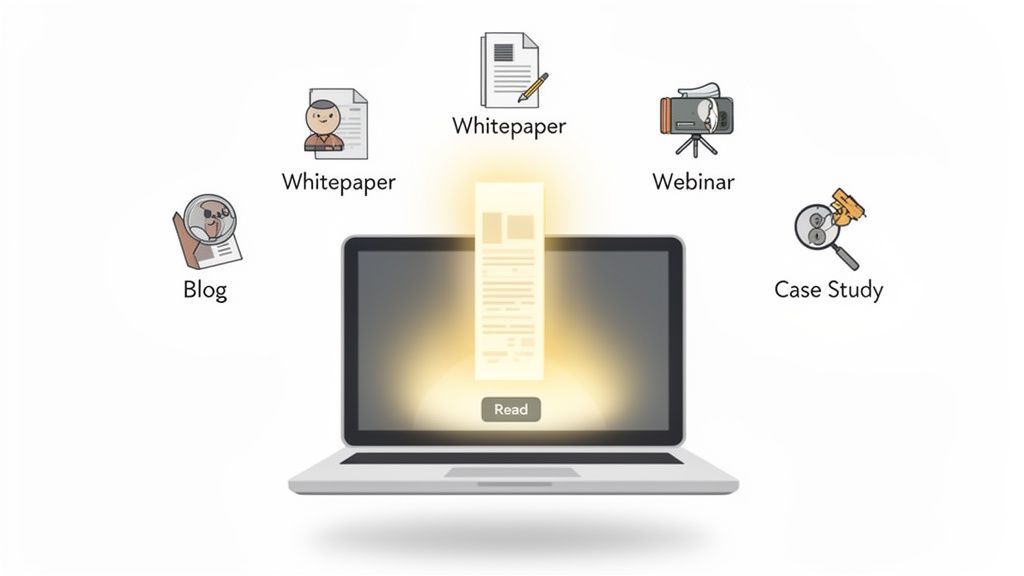
The goal is to become an indispensable resource. When a prospect searches for a solution, your content should provide the answer. Companies like HubSpot built multi-billion dollar valuations by offering educational blogs and free tools. This approach not only drives organic traffic but also nurtures leads, making it one of the most sustainable demand generation strategies for long-term ROI.
How to Implement a Content Marketing Sprint
A 90-day sprint can lay the foundation for a powerful content engine that delivers long-term results.
- Weeks 1-2: Topic Cluster & Keyword Research: Identify a core business theme and build a topic cluster. Use keyword research to find high-intent, low-competition search terms. Plan one in-depth "pillar" page (3,000+ words) and 10-15 supporting articles.
- Weeks 3-8: Content Creation & Optimization: Develop the pillar content and supporting blog posts. Focus on quality and depth, including expert insights, data, and actionable advice. Optimize each piece for search engines and create associated "content upgrades" like checklists to capture emails.
- Weeks 9-12: Promotion & Distribution: Begin promoting the content across multiple channels. Share it with your email list, run targeted paid social campaigns, and reach out to industry partners for backlinks. Creation is only half the battle; distribution is critical for success.
Key Insight: Don't just publish and pray. A successful content strategy requires a robust promotion plan. Repurpose your core content into different formats like videos, social media snippets, and infographics to maximize its reach and impact across various platforms. The key metric here is organic traffic growth to key pages and the conversion rate of that traffic to leads.
By consistently delivering value, you build an audience that trusts your brand. As the search landscape evolves, understanding Answer Engine Optimization is also crucial. For a deeper dive, discover how to build a powerful B2B thought leadership content strategy.
3. Paid Search Advertising (PPC/SEM)
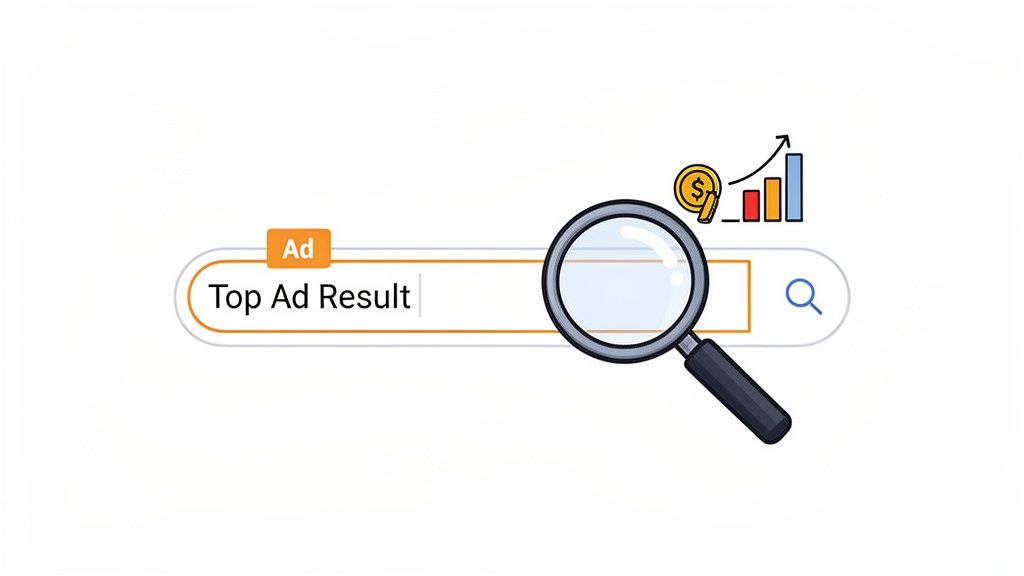
Paid Search Advertising (PPC/SEM) is a direct-response strategy for capturing active buyer intent. It places your ads at the top of search engine results pages (SERPs) when prospects are actively looking for solutions you offer. This makes it one of the most effective demand generation strategies for B2B and e-commerce companies seeking immediate visibility and measurable ROI from platforms like Google Ads.
Unlike strategies that build awareness over time, PPC delivers high-intent traffic from day one. When a potential customer searches for "CRM for small business," your ad can be the first thing they see. Salesforce bids on thousands of keywords to drive demo requests, while e-commerce brands use it to capture sales from shoppers comparing competitor products.
How to Implement a PPC Sprint
A 90-day sprint is ideal for validating keywords, ad copy, and landing pages to find a profitable formula.
- Weeks 1-2: Keyword Research & Campaign Structure: Identify high-intent commercial keywords. Focus on terms that include "pricing," "demo," "alternative," or "vs." Structure your campaigns using Single Keyword Ad Groups (SKAGs) to ensure maximum relevance between the search query, your ad, and the landing page.
- Weeks 3-4: Ad & Landing Page Creation: Write compelling ad copy that highlights your unique value proposition and includes a clear call to action (CTA). Build dedicated landing pages for your ad groups that directly match the user's search intent. Sending PPC traffic to your homepage is a costly mistake.
- Weeks 5-12: Launch, Monitor & Optimize: Launch your campaigns with robust conversion tracking. Monitor performance daily, adjusting bids based on device, time of day, and audience segments. Continuously test ad copy variations and optimize landing pages to improve your Quality Score and lower your cost-per-acquisition (CPA).
Key Insight: PPC success is a function of relevance. The more aligned your keyword, ad copy, and landing page are, the higher your Quality Score will be, leading to lower costs and better ad positions. A target CPA should be less than one-third of your customer LTV to ensure profitability.
By focusing on high-intent keywords and relentless optimization, paid search can become a predictable and scalable engine for generating qualified leads and sales.
4. LinkedIn Advertising & Social Selling
LinkedIn advertising and social selling combine paid media with direct human engagement on the world’s premier B2B professional network. This strategy involves using LinkedIn’s ad platform to target decision-makers with sponsored content, while empowering sales teams to build relationships and engage prospects directly. It's an essential demand generation strategy due to its unmatched targeting precision based on job title, company size, industry, and seniority.
The core principle is a seamless transition from marketing-generated awareness to a sales-led conversation. Marketing runs targeted ad campaigns to capture initial interest with assets like webinars or whitepapers. Sales then uses social selling techniques to nurture those leads, connect with stakeholders, and build rapport by sharing valuable insights, moving them from cold prospects to warm opportunities.
How to Implement a LinkedIn Sprint
A 90-day sprint can effectively integrate paid ads with an organic social selling motion.
- Weeks 1-2: Audience & Offer Definition: Define your Ideal Customer Profile (ICP) on LinkedIn. Identify 3-5 key job titles, target industries, and company sizes. Develop a compelling, high-value content offer for your ad campaign, such as an industry benchmark report.
- Weeks 3-4: Ad Campaign & Profile Optimization: Launch a LinkedIn Lead Gen Form ad campaign targeting your ICP with the defined offer. Simultaneously, ensure your sales team’s LinkedIn profiles are optimized with clear value propositions that align with the campaign.
- Weeks 5-12: Coordinated Engagement & Nurturing: As leads come in from ads, establish a service-level agreement (SLA) for sales to engage within 24 hours. The sales team should connect, referencing the content they downloaded, and begin a social selling sequence of personalized messages.
Key Insight: Success on LinkedIn requires a "give before you get" mentality. Both your ads and sales outreach should lead with value, not a sales pitch. Offer insights, solve a small problem, or provide data before asking for a meeting. Track metrics like Cost-Per-Lead (CPL) from ads and the lead-to-opportunity conversion rate from sales follow-up.
By blending the scale of paid advertising with the personal touch of social selling, you create a powerful B2B demand generation engine. For a deeper dive, explore these 10 proven LinkedIn lead generation strategies.
5. Email Marketing & Nurture Campaigns
Email marketing is the art of guiding prospects through the buyer's journey using automated, segmented campaigns. While it's an established channel, it remains a cornerstone of effective demand generation strategies, with data from Litmus showing an average ROI of $36 for every $1 spent. It’s a direct line to your audience, allowing you to build relationships, provide value, and nurture interest until a prospect is ready to buy.
The power of email lies in its ability to deliver personalized content based on user behavior. Instead of generic blasts, modern email marketing focuses on segmentation. Subscribers are grouped based on lead source, engagement level, or on-site actions. An e-commerce brand sends targeted emails based on browsing history, while a B2B SaaS company uses onboarding sequences to drive feature adoption and convert trial users.
How to Implement an Email Nurture Sprint
To build a foundational nurture sequence in 90 days, focus on a high-value welcome series for new subscribers.
- Weeks 1-2: Segmentation & List Health: Define your key audience segments based on lead source (e.g., webinar attendee, ebook download) or user status (e.g., trial user). Clean your existing list by removing unengaged subscribers to improve deliverability.
- Weeks 3-4: Content & Flow Mapping: Outline a 5-7 email welcome series to be sent over two weeks. Map out the goal of each email: the first delivers the promised value, subsequent emails address common pain points, showcase social proof (case studies), and introduce your core solution.
- Weeks 5-12: Automation & Optimization: Build the sequence in your email platform (like Klaviyo or HubSpot) using behavioral triggers. Launch the campaign and begin monitoring performance. A/B test subject lines relentlessly and track click-through rates on your CTAs to identify your most compelling content.
Key Insight: The goal of email nurturing is not just to sell, but to educate and build trust. Each email should offer genuine value. This approach turns your email list into a community, not just a sales channel. Key metrics are open rate, click-through rate, and ultimately, the conversion rate from the nurtured segment.
By systematically building and optimizing these campaigns, you create an automated engine that qualifies leads. At Ezca, we architect advanced nurture flows that align with complex sales cycles, ensuring no lead is left behind.
6. Conversion Rate Optimization (CRO)
Conversion Rate Optimization (CRO) is a systematic process for increasing the percentage of website visitors who take a desired action, such as filling out a form or making a purchase. Instead of pouring more money into generating traffic, CRO focuses on making your existing traffic more valuable. It uses analytics, user feedback, and A/B testing to eliminate friction points, making it one of the highest-ROI demand generation strategies.
The practice centers on understanding user behavior. By analyzing how visitors interact with your site, you can form hypotheses about what changes might improve performance. For example, B2B companies often see a 30-50% lift in form submissions by simply reducing the number of fields from ten to five. Each improvement, no matter how small, compounds over time to deliver significant revenue gains from the same marketing spend.
How to Implement a CRO Sprint
A 90-day sprint can produce meaningful conversion lifts by focusing on high-impact pages.
- Weeks 1-2: Data Collection & Analysis: Identify your most critical pages (e.g., homepage, pricing page). Use tools like Hotjar to gather heatmaps and session recordings. Analyze Google Analytics to find pages with high exit rates.
- Weeks 3-4: Hypothesis & Prioritization: Based on your analysis, form clear, testable hypotheses. For example: "Changing the CTA button copy from 'Submit' to 'Get My Free Demo' will increase form conversions by clarifying value." Prioritize tests based on potential impact and ease of implementation.
- Weeks 5-12: Testing & Iteration: Launch A/B tests using a platform like Optimizely or Google Optimize. Test one element at a time (e.g., headline, CTA) to isolate what works. Run each test until you reach statistical significance, typically requiring at least 100 conversions per variation.
Key Insight: CRO is not about guesswork. It is a scientific method for understanding your audience. The most successful programs are driven by user data and a relentless focus on removing friction. The primary metric is conversion rate lift, which directly lowers your Customer Acquisition Cost (CAC).
By methodically optimizing your conversion funnels, you turn your website into a more efficient engine for growth. If your team lacks the bandwidth for continuous testing, specialized agencies like Ezca can manage the entire CRO process.
7. Webinars & Virtual Events
Webinars and virtual events are a cornerstone of modern demand generation, creating a direct line of communication with prospects by offering valuable educational content. For B2B and SaaS companies, they serve as a powerful platform to demonstrate expertise, engage a live audience, and generate a pipeline of sales-qualified opportunities. This strategy works effectively across the entire funnel, from building awareness to driving purchase decisions.
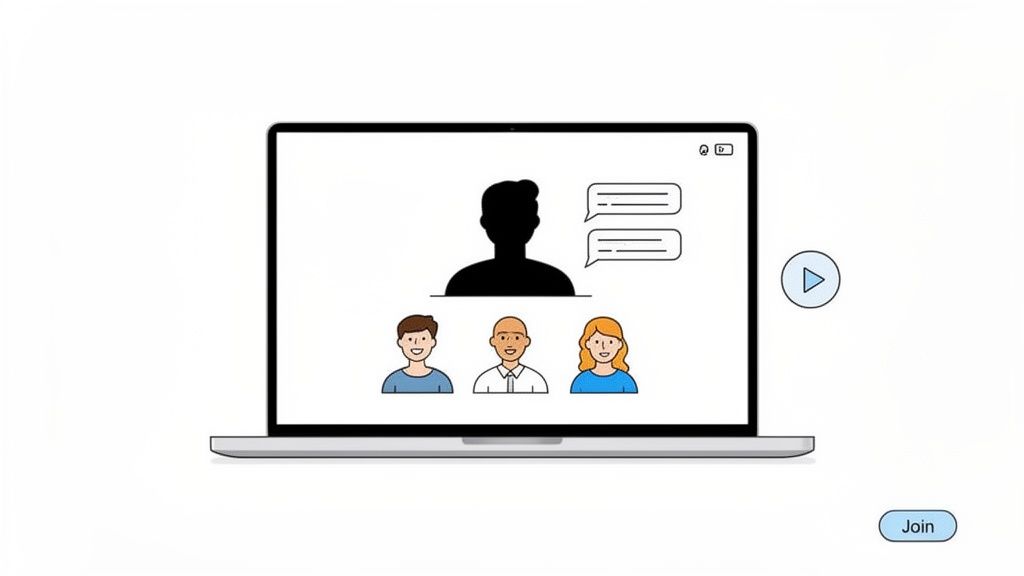
The primary appeal of a webinar is its ability to establish authority and trust at scale. Instead of a static blog post, a virtual event allows for real-time Q&A and product demonstrations. Companies like Databox have built significant lead engines by hosting expert panels and educational sessions, consistently attracting thousands of engaged prospects. This approach positions the host as a thought leader.
How to Implement a Webinar Sprint
A 90-day sprint can help you build a repeatable webinar program that generates consistent demand.
- Weeks 1-2: Topic Selection & Speaker Sourcing: Analyze top sales objections and common customer pain points from your CRM. Choose a topic that addresses a critical challenge your ideal customer faces. Secure an internal expert or an external industry influencer to present.
- Weeks 3-4: Content Creation & Promotion Setup: Develop the slide deck, any downloadable resources, and a compelling registration landing page. Create promotional assets, including email invitations, social media graphics, and ad copy.
- Weeks 5-12: Promotion & Execution: Launch a multi-channel promotion campaign 3-4 weeks before the event using email and paid social. Host the live webinar (aim for 45-60 minutes). Immediately follow up with attendees and no-shows, providing the on-demand recording and passing high-intent leads to sales.
Key Insight: The true value of a webinar isn't just the live event; it's the evergreen content asset it becomes. By gating the on-demand recording, you create a lead-generation machine that works 24/7. Key metrics are attendance rate (typically 30-40% of registrants) and the number of Sales Qualified Leads (SQLs) generated.
By consistently delivering high-value educational content, webinars build a loyal audience and a predictable pipeline. A dedicated growth partner like Ezca can build the entire engine from strategy to execution.
8. Partnerships, Affiliate & Influencer Programs
Partnerships, affiliate programs, and influencer marketing are force multipliers for demand generation. Instead of building an audience from scratch, these strategies allow you to tap into existing communities and distribution channels. By collaborating with complementary companies, content creators, and industry leaders, you gain access to their trusted audiences, generating qualified demand through authentic endorsements.
This approach works by creating mutually beneficial relationships. A tech integration like Stripe partnering with Shopify provides value to both platforms and their customers. Likewise, an e-commerce brand working with a lifestyle influencer on a commission basis creates a performance-based channel. These strategies build on credibility and established trust, sidestepping the noise of traditional advertising.
How to Implement a Partnerships Sprint
To launch a pilot program in 90 days, focus on one channel, such as micro-influencers or a small set of tech partners.
- Weeks 1-2: Partner Identification & Outreach: Identify 10-20 potential partners (influencers, non-competing SaaS companies, or relevant agencies) whose audience perfectly matches your ICP. For influencers, focus on engagement rates over follower counts.
- Weeks 3-4: Program & Collateral Development: Define the terms of your partnership. Create a clear one-pager explaining commission structures, benefits, and rules of engagement. Develop a partner kit with brand assets, messaging guides, and unique tracking links or promo codes.
- Weeks 5-12: Onboarding & Activation: Onboard your first cohort of 3-5 partners. Provide them with the resources they need and schedule a kickoff call to align on goals. Monitor performance closely using UTM parameters and unique codes to track attributed leads and sales.
Key Insight: The foundation of a successful partnership program is making it incredibly easy for your partners to promote you. Provide them with pre-written copy, high-quality creative assets, and a simple way to track their earnings. Track leads and revenue per partner to identify and scale your most successful relationships.
From HubSpot’s vast app marketplace to Notion’s community of creators, partner-led growth is a proven engine for scaling demand. It creates a powerful, defensible moat built on relationships rather than just ad spend.
9. Retargeting & Remarketing Campaigns
Retargeting and remarketing are demand generation strategies designed to re-engage users who have already interacted with your brand. By using pixel-based tracking, you can show targeted ads to people after they leave your website, reminding them of your products or services. This approach is highly effective because it focuses on a warm audience that has demonstrated interest, often resulting in 2-3x higher conversion rates compared to campaigns targeting cold traffic.
The core principle is to stay top-of-mind and guide prospects through the consideration phase. For an e-commerce brand, this means showing an ad for an abandoned shopping cart item. For a SaaS company, it might involve serving case studies to someone who visited the pricing page but didn't sign up. By customizing the message based on previous actions, you create a relevant and timely touchpoint that nudges them toward conversion.
How to Implement a Retargeting Sprint
For a 90-day pilot, focus on building segmented audiences and testing sequential messaging to maximize ROI.
- Weeks 1-2: Pixel Setup & Audience Segmentation: Ensure your tracking pixels (Google, Meta, LinkedIn) are correctly installed. Create distinct audience segments based on user behavior, such as visitors to your pricing page, users who abandoned a cart, or those who watched a product video.
- Weeks 3-4: Creative & Offer Development: Design ad creative and messaging tailored to each segment. For pricing page visitors, you might offer a limited-time demo or a special discount. For cart abandoners, a simple reminder ad featuring the exact product can be highly effective.
- Weeks 5-12: Campaign Launch & Optimization: Launch your campaigns across relevant platforms like Google Display Network and Meta. Monitor performance closely, paying attention to frequency caps to avoid ad fatigue (aim for 3-5 impressions per user per day). A/B test different ad copy, visuals, and CTAs to optimize for click-through and conversion rates.
Key Insight: The power of retargeting lies in segmentation. A user who visited your homepage needs a different message than someone who visited your pricing page. Tailoring your ads to match their stage in the buying journey makes your campaign feel helpful, not intrusive. The key metric is View-Through-Conversions, as many users will convert without clicking the ad.
By re-engaging warm prospects, retargeting recovers potentially lost revenue and improves the overall efficiency of your marketing spend. It’s a foundational strategy for any business serious about converting website traffic.
10. SEO & Organic Search Optimization
Search Engine Optimization (SEO) is a demand generation strategy that drives visibility in organic search results. By optimizing content, technical site health, and building authority through backlinks, companies can rank for high-intent keywords that their target audience is actively searching for. Unlike paid channels, SEO provides long-term, sustainable demand with compounding returns; once you achieve high rankings, the resulting traffic is consistent and effectively free.
The core principle of SEO is to align your website and content with what search engines like Google deem valuable and relevant. For B2B and SaaS companies, this means creating content that solves specific problems for your ideal customers. HubSpot generates over 20 million monthly organic visits by ranking for thousands of marketing and sales-related keywords, capturing demand at every stage of the buyer's journey.
How to Implement an SEO Sprint
For a 90-day pilot, focus on foundational wins and content that can rank relatively quickly.
- Weeks 1-2: Keyword & Intent Research: Identify a core business topic and build a "content cluster." Use tools like Ahrefs to find one high-volume "pillar" keyword and 10-15 related long-tail keywords (3-5 words) that have lower competition but clear commercial or informational intent.
- Weeks 3-8: Content Creation & On-Page Optimization: Develop a comprehensive pillar page for your main topic and shorter, focused articles for your long-tail keywords. Ensure each piece matches searcher intent (e.g., a "how-to" guide, a "vs" comparison). Optimize titles, meta descriptions, headers, and internal links.
- Weeks 9-12: Technical Health & Link Building: Run a technical site audit to fix issues like slow page speed or poor mobile experience, which are critical for Core Web Vitals. Begin outreach for backlinks by guest posting on industry blogs or promoting your new content to relevant publications.
Key Insight: Success in modern SEO is less about keyword stuffing and more about satisfying search intent. Create the best possible resource on the internet for a specific query, and Google will reward you. Track rankings for target keywords and the organic lead velocity from your optimized pages.
By consistently creating valuable content that answers your audience's questions, you build a powerful, self-sustaining engine for growth. At Ezca, our SEO programs are designed to build this kind of long-term, defensible organic traffic moat for our clients.
Demand Generation: 10-Strategy Comparison
Putting It All Together: Your 90-Day Demand Generation Sprint
We've explored ten powerful demand generation strategies, but successful execution isn't about doing everything at once. It's about selecting the right combination of tactics, executing them with discipline, and measuring the outcomes relentlessly. The real challenge for marketing leaders isn't a lack of options; it's the risk of spreading resources too thin, which leads to mediocre results everywhere and a clear ROI nowhere.
The goal is to build a focused, repeatable system—a true demand engine that produces predictable pipeline and revenue, not just a series of disconnected campaigns. This requires moving from theory to focused action.
From Strategy to Execution: The Sprint Model
The most effective way to implement these strategies is through a structured, agile framework. This is why we advocate for and operate in 90-day sprints. This model forces clarity and creates momentum, replacing long planning cycles with rapid testing and learning. It’s about making smart, data-backed bets and doubling down on what works.
A 90-day sprint breaks down the process into manageable phases:
- Days 1-30: Strategy & Foundation: The first month is for deep analysis and focused planning. This involves identifying the 2-3 highest-impact channels from our list by analyzing your ICP, competitive landscape, and immediate business goals. For a B2B SaaS company targeting enterprise clients, this might be ABM and LinkedIn. For an e-commerce brand, it might be PPC and retargeting.
- Days 31-90: Execution & Optimization: The next 60 days are all about execution. Dedicated squads launch campaigns, closely monitoring performance against key metrics like CPL and conversion rates. The critical element here is agility. Budgets are not locked in; they are fluid. If a channel delivers a lower CAC and higher MQL-to-SQL conversion rate than anticipated, we dynamically shift more budget to it.
This sprint-based approach transforms demand generation from a cost center into a direct driver of growth. You're not just "doing marketing"; you are building a system where every dollar is tracked, optimized, and held accountable for producing a measurable return. The insights gained from one sprint directly inform the strategy for the next, creating a continuous cycle of improvement and scalable growth.
Ready to stop planning and start executing? The team at Ezca Agency specializes in designing and running high-impact, 90-day demand generation sprints for ambitious SaaS, e-commerce, and B2B companies. Let's build a demand engine that delivers predictable revenue and a clear return on your investment.