
10 Actionable Data Driven Marketing Examples for Business Leaders
Explore 10 powerful data driven marketing examples with real-world results. Learn actionable tactics for SaaS, e-commerce, and B2B growth.
Relying on intuition for marketing decisions is no longer a viable strategy. The gap between stagnant campaigns and exponential growth is filled with data. For marketing leaders and business owners, making smarter, faster, and more profitable decisions is the baseline for market leadership. This article moves beyond generic advice to provide a tactical playbook of proven data driven marketing examples.
We will break down 10 specific strategies used by top-performing SaaS, e-commerce, and B2B companies, focusing on the tactics, metrics, and ROI considerations you care about. You'll get a detailed look at real-world applications, including:
- Dynamic budget allocation based on real-time ROAS.
- Predictive lead scoring to improve sales efficiency by over 30%.
- Multivariate testing to drive double-digit conversion lifts.
- Cohort analysis for maximizing customer lifetime value (LTV).
Each example is a mini-playbook, complete with objectives, data sources, specific tactics, and key metrics. This structure provides a clear blueprint to drive measurable ROI in your own organization. We'll also highlight how a structured, performance-focused approach, like the agile sprints used by Ezca, can accelerate your transition to a data-first marketing operation. Forget the guesswork; it's time to build a marketing engine powered by evidence.
1. Dynamic Budget Allocation Based on Real-Time Performance Metrics
Static monthly budgets are a liability. A dynamic approach allows you to reallocate capital to capitalize on real-time opportunities and cut underperforming channels fast. This data-driven marketing example involves continuously monitoring KPIs across all channels and reallocating funds to the highest-performing campaigns, often on a weekly or bi-weekly basis, to maximize Return on Ad Spend (ROAS).
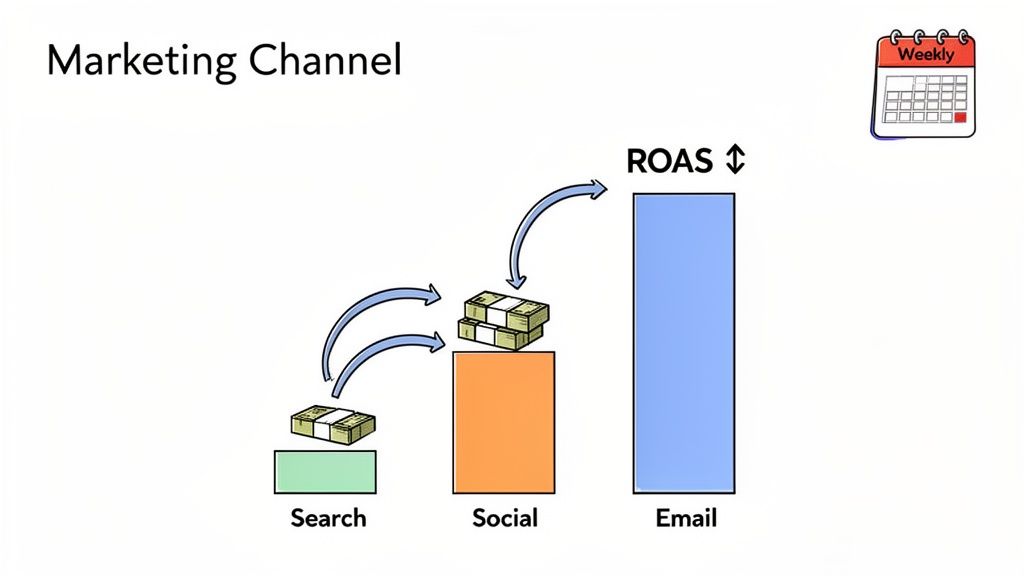
Instead of waiting months to discover a channel is delivering a poor ROAS, this method uses data from platforms like Google Analytics, CRM software, and native ad dashboards to make swift, informed decisions. This agility ensures that every dollar is working as hard as possible to achieve core business objectives like lowering Customer Acquisition Cost (CAC) or increasing conversion volume.
Strategic Breakdown and Application
A B2B SaaS company analyzes lead quality and CAC from LinkedIn Ads versus organic search. Upon discovering that SEO-driven leads have a 40% lower CAC and a higher conversion rate to MQLs, they can pivot a portion of their LinkedIn budget toward creating more high-intent blog content and link-building campaigns. An e-commerce brand can shift ad spend from Facebook to Google Shopping mid-month if they see a consistently higher ROAS.
This methodology is a core pillar of performance marketing. At Ezca, we use sophisticated tracking within 90-day sprints to optimize client budgets for maximum impact, ensuring capital is always deployed to the highest-return activities.
Actionable Takeaways
- Establish Guardrails: Set minimum spend thresholds for each channel to maintain a baseline presence. A sudden drop to zero can kill long-term momentum, especially in SEO.
- Use Rolling Averages: Base decisions on 7-day or 14-day rolling performance averages, not single-day spikes or dips, to avoid reactive, emotional shifts.
- Document Everything: Keep a detailed log of every budget reallocation, including the date, amount, and the data-driven rationale. This is crucial for stakeholder reporting and learning.
- Analyze Contribution Margin: For e-commerce, go beyond ROAS. Factor in Cost of Goods Sold (COGS) and shipping to allocate budget based on true profitability, not just revenue.
2. Predictive Lead Scoring for B2B Qualification and Nurturing
Manual lead scoring is inefficient and prone to bias. Modern B2B marketing leverages predictive models that analyze thousands of data points to assign a score indicating a lead's likelihood to convert. This data-driven marketing example uses historical CRM data, website behavior (e.g., pricing page visits), and third-party intent signals to create an algorithm that prioritizes the most promising leads for the sales team, ensuring they focus their efforts where it counts most.
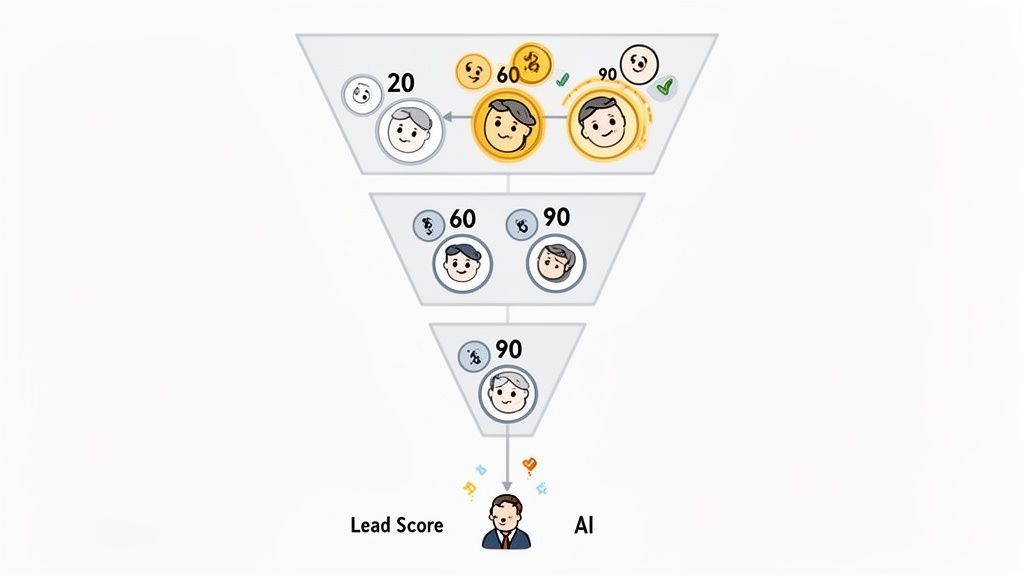
By automating this qualification process, companies drastically reduce the sales cycle and improve alignment between marketing and sales. Instead of sales reps wasting time on low-intent leads, they can engage with prospects who have already been algorithmically identified as near-ready to buy. To gain a deeper understanding of proactive lead identification and buyer readiness, explore a comprehensive guide to B2B Intent Data.
Strategic Breakdown and Application
An enterprise software company can use predictive scoring to shorten a typical six-month sales cycle. The model might learn that leads who visit the pricing page, download a specific case study, and work at a company with over 500 employees are 75% more likely to close. These leads are instantly routed to an account executive, while lower-scoring leads are placed into a personalized email nurture sequence designed to increase their score over time. The ROI is a 20-30% increase in sales team efficiency and higher close rates.
This approach is central to sophisticated B2B campaigns that generate high-quality leads at scale. By focusing on data signals, marketing teams can deliver truly sales-ready opportunities.
Actionable Takeaways
- Gather Sufficient Data: Begin with at least 12-18 months of clean historical CRM data (both won and lost opportunities) to train an accurate predictive model.
- Incorporate Negative Signals: Your model must account for negative indicators like unsubscribing from emails, long periods of inactivity, or job titles that are a poor fit.
- Retrain Models Regularly: Buyer behavior and market conditions change. Retrain your models quarterly to ensure they remain accurate and reflective of current trends.
- Establish Clear Thresholds: Work with your sales team to define what score constitutes an MQL or SQL. For instance, a score of 80+ might trigger an immediate sales call.
3. Conversion Rate Optimization Through Multivariate Testing
While A/B testing is a foundational data-driven tactic, multivariate testing accelerates learning by systematically testing multiple page elements simultaneously. This approach allows marketers to identify the most effective combination of elements like headlines, CTAs, images, and form fields, revealing interaction effects that sequential A/B tests would miss. It's a powerful method to achieve significant conversion lifts on high-traffic pages.
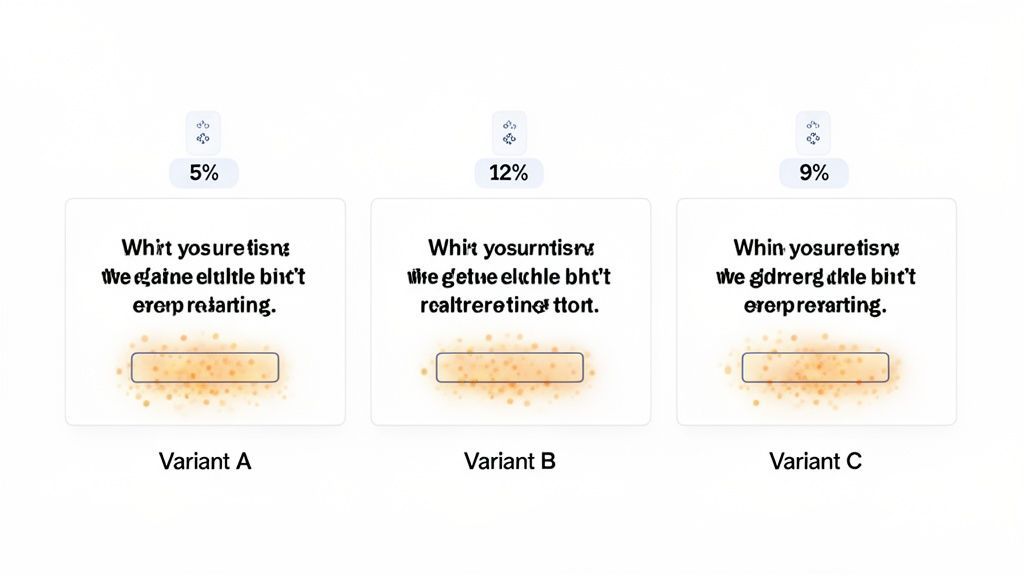
This data-driven marketing example moves beyond simple one-variable changes. By using statistical models to analyze the performance of every possible combination, you can discover that a specific headline only works well with a particular image, or that a change in CTA copy dramatically boosts performance but only when the form is shorter. This level of insight is crucial for optimizing high-impact pages like checkout flows, demo request forms, and SaaS trial signups.
Strategic Breakdown and Application
An e-commerce brand could simultaneously test two headline variations, three CTA button colors, and two trust signals on their checkout page. This creates 12 (2x3x2) different versions of the page served to users. Data from tools like Optimizely or Google Optimize reveals not just that "blue buttons" are best, but that "blue buttons with the Verisign seal and the 'Secure Checkout' headline" drive a 28% higher conversion rate than any other combination.
Conversion Rate Optimization (CRO) services like those offered by Ezca leverage multivariate testing on key funnels to compound gains for clients, turning existing traffic into more revenue.
Actionable Takeaways
- Prioritize High-Impact Pages: Focus testing efforts on pages with sufficient traffic (10k+ monthly visitors) and significant conversion bottlenecks, like pricing pages or checkout, to achieve statistical significance faster.
- Identify Key Elements: Use heatmap and user session data to identify which page elements users interact with the most. These are your prime candidates for testing.
- Calculate Sample Size: Before launching, use a power analysis tool to determine the sample size needed to get a reliable result. This prevents you from ending tests prematurely and making decisions based on noise.
- Iterate on Winners: Use the winning variant from one multivariate test as the new control or baseline for the next round of experiments, creating a cycle of continuous improvement.
4. Cohort Analysis and Retention Tracking for Customer Lifetime Value Optimization
Instead of viewing all customers as a single monolith, cohort analysis segments users into groups based on their sign-up date. This data-driven marketing example allows businesses to track behavior and value over time, revealing which acquisition channels, campaigns, or product features produce the most loyal and profitable customers. It moves beyond initial conversion metrics like cost-per-acquisition to focus on long-term health and Customer Lifetime Value (LTV).
By grouping users acquired in the same week or month, you can compare how different cohorts perform. This method uncovers critical insights into user retention, engagement, and monetization patterns, directly informing strategic decisions. Analytics platforms like Mixpanel and Amplitude have made this once-complex analysis accessible, enabling marketers to see the long-term impact of their efforts.
Strategic Breakdown and Application
A SaaS company might use cohort analysis to compare users acquired from paid search versus those from organic social media. They could discover that while social media drives cheaper sign-ups, the paid search cohort has a 3x higher 12-month retention rate and a greater propensity to upgrade tiers. This data provides a clear mandate to reallocate budget toward paid search, optimizing for LTV, not just initial acquisition cost.
An e-commerce brand could find that customers acquired during a Black Friday sale have a significantly lower repeat purchase rate than those acquired through their evergreen content marketing funnel. This insight would guide future promotional strategies, balancing short-term revenue spikes with long-term customer value.
Actionable Takeaways
- Start with Acquisition Channels: Begin by creating cohorts based on the source of acquisition (e.g., Google Ads, Organic Search, Referral). This is often the most impactful starting point.
- Track Revenue and Retention: Don’t just track the percentage of users who remain active. Also, monitor the cumulative revenue per user for each cohort to get a complete picture of its value.
- Use Rolling Cohorts: Create new cohorts on a weekly or monthly basis. This allows you to spot performance trends or issues much faster than waiting for quarterly or annual analyses.
- Segment by Customer Profile: For B2B, layer on segmentation by Ideal Customer Profile (ICP), such as SMB vs. Enterprise. You may find that certain channels are highly effective for one segment but not another.
5. Attribution Modeling for Multi-Touch Customer Journey Analysis
Relying on a "last-click" attribution model is one of the most common ways to misinterpret marketing performance. It incorrectly assigns 100% of the conversion credit to the final touchpoint, ignoring all the preceding interactions that built awareness and trust. Data-driven attribution modeling rectifies this by analyzing all paths to conversion and assigning fractional credit to each channel based on its actual influence, providing a far more accurate view of the customer journey.
This sophisticated analysis moves beyond simple metrics to reveal how channels like organic search, social media, and email work together. Instead of just seeing what closed the deal, you see what initiated the conversation, nurtured the lead, and ultimately drove the final action. This clarity allows for smarter budget allocation and a deeper understanding of marketing ROI.
Strategic Breakdown and Application
An enterprise SaaS company might find that while paid search ads get the last click for demo requests, their organic blog content was the first touchpoint for 40% of those same leads. Without multi-touch attribution, the true value of their SEO efforts would be completely invisible, leading to underinvestment. An e-commerce brand may discover that while a retargeting ad was the last touchpoint, a nurturing email sequence deserves 35% of the credit for re-engaging a cold lead.
Agencies like Ezca leverage advanced attribution in platforms like Google Analytics 4 to ensure client strategies are built on a complete and accurate picture of channel performance, not just the final click.
Actionable Takeaways
- Start Simple, Then Scale: Begin by comparing first-touch and last-touch models to see the immediate difference in how channels are valued. Graduate to more complex models like linear, time-decay, or data-driven attribution as your analytics maturity grows.
- Define Conversion Events Clearly: Ensure a "conversion" (e.g., demo request, trial signup, purchase) is defined and tracked identically across all platforms to maintain data integrity.
- Use Platform-Native Models: Leverage the built-in data-driven attribution models in Google Analytics 4, HubSpot, or Salesforce. These tools use machine learning to process vast amounts of path data more accurately than manual models.
- Validate with Incrementality Tests: Don't trust attribution models blindly. Use holdout groups or geo-lift tests to confirm whether a channel is truly driving incremental value or just capturing demand that would have existed anyway.
6. Predictive Analytics for Churn Prevention and Win-Back Campaigns
Customer acquisition is expensive; retaining existing customers is far more profitable. Predictive analytics allows businesses to move from a reactive to a proactive retention strategy. This data-driven marketing example involves using machine learning models to analyze customer behavior, identify patterns that precede churn, and flag at-risk accounts before they leave.
These models process signals like declining product usage, a drop in support ticket submissions, changes in purchase frequency, or recent billing issues. By assigning a "churn risk score" to each customer, marketing and customer success teams can prioritize their efforts, intervening with targeted outreach, personalized offers, or support to prevent revenue loss and improve customer lifetime value (LTV).
Strategic Breakdown and Application
A SaaS platform can identify that users who haven't adopted a key feature within 30 days are 70% more likely to churn. This insight triggers an automated email sequence offering a one-on-one demo or a tutorial for that specific feature, reducing churn for that segment by 15%. An e-commerce subscription service can analyze purchase history and flag customers whose order frequency has suddenly decreased, prompting a targeted "we miss you" campaign with a compelling discount to re-engage them.
This proactive approach is critical for sustainable growth, as it directly protects the recurring revenue base. The ROI comes from reduced revenue churn and a lower blended Customer Acquisition Cost (CAC) over time.
Actionable Takeaways
- Identify Leading Indicators: Analyze historical churn data to pinpoint the top 3-5 behavioral signals specific to your business (e.g., login frequency, feature adoption, support interactions).
- Segment Your Models: Create separate predictive models for different customer segments (e.g., enterprise vs. SMB, new vs. tenured) as their churn drivers will vary significantly.
- Tier Your Interventions: Develop a playbook of graduated win-back offers. A high-risk, high-value account might get a personal call, while a low-value account receives an automated email.
- Track Intervention Efficacy: Measure the outcome of every retention attempt. Tag customers as "saved," "churn delayed," or "churned" to continuously refine your models and understand which intervention tactics are most effective.
7. SEO Data Analytics and Search Intent Mapping for Content Strategy
Moving beyond basic keyword volume, this advanced SEO strategy uses data to decode a user's intent behind a search query. It involves analyzing keyword modifiers ("best," "vs," "how to"), click-through rates (CTR), and SERP features to classify searches as informational, commercial, or transactional. This allows businesses to create hyper-relevant content that directly addresses the user's needs at their specific stage in the buyer's journey.
This data-driven marketing example transforms content from a guessing game into a precise engine for attracting qualified traffic. Instead of just targeting broad, high-volume keywords, this method prioritizes search terms that signal a strong likelihood to convert, aligning content creation efforts directly with revenue goals.
Strategic Breakdown and Application
A B2B software company can use tools like Ahrefs or Semrush to identify "commercial investigation" keywords like "best crm for small business" or "[competitor] vs [your brand]". They then create detailed comparison pages and buying guides that rank for these terms, capturing high-intent leads actively evaluating solutions. This content has a significantly higher lead-to-close rate than top-of-funnel blog posts.
This intent-focused approach is a cornerstone of how a modern SEO agency operates. For example, by identifying 50 high-intent keywords with low difficulty scores, our team at Ezca helped a SaaS client develop targeted content that generated over 200 qualified leads in a single quarter.
Actionable Takeaways
- Map Keywords to Funnel Stages: Classify your target keywords into ToFu (informational), MoFu (commercial), and BoFu (transactional) buckets to guide your content calendar.
- Analyze SERP Features: Study the search engine results page. If it's full of videos and "People Also Ask" boxes, the intent is likely informational. If it's all product pages, the intent is transactional.
- Prioritize Commercial Intent: Focus initial efforts on creating content for commercial and transactional keywords (e.g., reviews, comparisons, "best of" lists) as they offer the fastest path to ROI.
- Build Content Clusters: Create a central "pillar" page for a broad topic and surround it with "cluster" content that targets more specific, long-tail intent queries. This builds topical authority and improves rankings across the board.
8. Customer Segmentation Using Behavioral and RFM Analysis
Blanket marketing messages treat every customer the same, ignoring their unique buying history and engagement levels. Data-driven segmentation combats this by grouping customers based on shared characteristics. A powerful method for this is RFM analysis (Recency, Frequency, Monetary value), which is often layered with behavioral data like product usage or support ticket history to create highly specific audiences for targeted messaging.
This approach moves beyond simple demographics to understand how customers interact with a brand. By segmenting users into groups like "VIPs," "At-Risk," or "Dormant," marketers can deploy tailored campaigns for retention, reactivation, and upselling, significantly boosting customer lifetime value (LTV) and improving campaign ROI by 2-3x. To truly optimize your outreach and improve customer lifetime value, understanding how to segment email lists effectively is paramount.
Strategic Breakdown and Application
An e-commerce brand can use RFM data to identify its "Champions" (high R, F, and M scores) and reward them with exclusive early access to new products. Simultaneously, it can target its "At-Risk" segment (declining frequency) with a personalized "We miss you" email campaign that includes a special offer. A SaaS company can combine RFM with feature adoption data to identify high-value users who are prime candidates for an upgrade, increasing average revenue per user (ARPU).
This granular segmentation is essential for effective lifecycle marketing, a service that agencies like Ezca use to nurture leads and customers through every stage of their journey.
Actionable Takeaways
- Start with RFM: Use Recency, Frequency, and Monetary value as the foundational layer for your segmentation before adding more complex behavioral signals. It's simple and highly effective.
- Define Clear Rules: Establish firm, data-backed business rules for each segment. For example, a "Champion" might be defined as R≥4, F≥4, M≥4 on a 1-5 scale.
- Automate Segment Assignment: Implement dynamic segmentation within your marketing automation or customer data platform (CDP) so customers automatically move between segments based on their latest actions.
- Track Segment-Specific KPIs: Monitor key metrics like conversion rate, engagement, and LTV for each segment individually to validate the effectiveness of your targeted campaigns and adjust strategies as needed.
9. Marketing Mix Modeling (MMM) for Budget Optimization Across Channels
For large-scale advertisers, attributing success to a single touchpoint is overly simplistic. Marketing Mix Modeling (MMM) offers a more holistic view by using statistical regression analysis to quantify the incremental impact of each marketing channel. This sophisticated data-driven marketing example accounts for external factors like seasonality, economic trends, and competitor activity to determine optimal budget allocation and identify points of diminishing returns.
Instead of relying solely on platform-reported attribution, which can be biased, MMM provides a top-down, scientific measurement of how much each channel truly contributes to sales. It answers the crucial question: "If I invest another dollar in TV, search, or social, what is my expected return?" This allows enterprise brands to make multi-million dollar budget decisions with confidence.
Strategic Breakdown and Application
A global retail brand might use MMM to analyze its media spend across linear TV, paid search, and social media. The model could reveal that while TV drives significant awareness, its carryover effect is only two weeks, whereas paid search has a higher immediate ROI. Based on this, they could reallocate 12% of their TV budget into search, maintaining revenue levels while reducing overall media spend. A B2B company might discover its podcast advertising has a three-week impact lag, justifying continued investment despite slow initial results.
This advanced analytical approach is a cornerstone for mature organizations managing complex media buys, often executed with specialized partners or in-house data science teams to navigate the statistical complexity.
Actionable Takeaways
- Assess Budget Thresholds: MMM is resource-intensive. It typically provides a strong ROI for organizations with marketing budgets exceeding $500,000 per month, where even small efficiency gains translate into significant savings.
- Aggregate Diverse Data: A robust model requires comprehensive inputs. Integrate data from ad platform APIs, Google Analytics, CRM systems, sales records, and external economic or seasonal data for accuracy.
- Validate with Incrementality: Don't trust the model blindly. Validate MMM findings with controlled experiments like geo-based or hold-out tests to confirm its predictions align with real-world cause-and-effect.
- Remodel Regularly: Markets and channels evolve. Re-run your model quarterly or after any major strategic shift (like a new product launch or a large campaign) to ensure your allocation strategy remains optimal.
10. AI-Powered Content Personalization and Landing Page Optimization
A one-size-fits-all digital experience is no longer competitive. Modern data-driven marketing leverages artificial intelligence and machine learning to deliver uniquely tailored content, product recommendations, and landing pages to individual users. This strategy combines dynamic creative optimization with rapid testing, analyzing user data in real-time to present the most relevant message, offer, or layout to maximize conversions.
By analyzing behavioral signals like browsing history, past purchases, and on-page actions, AI algorithms can predict user intent and personalize the entire customer journey. This moves beyond basic segmentation to true one-to-one marketing, significantly improving conversion rates by creating an experience that feels uniquely built for each visitor.
Strategic Breakdown and Application
An e-commerce brand can use a platform like Dynamic Yield to showcase different hero banners based on a user's purchase history, increasing checkout conversions by over 28% with dynamic product recommendations. A B2B SaaS company can use a tool like Instapage to create distinct landing page variants for SMB versus enterprise traffic, personalizing copy and social proof to improve free trial sign-ups by 35% or more. The core principle is using data to close the gap between user intent and the content they see.
Expert agencies use these tools to build comprehensive personalization strategies that align with business goals. By connecting these tools to a central customer data platform, they can deliver a consistent, personalized experience across all touchpoints.
Actionable Takeaways
- Start with Segments: Before deploying complex AI, begin by creating 3-5 major audience segments (e.g., new visitors, returning customers, high-value purchasers) and build manual personalization rules for them.
- Build a Unified Profile: Integrate data from your CRM, email platform, and website analytics into a single customer profile to enable consistent personalization across all touchpoints.
- Test Incrementally: A/B test one personalization element at a time, like a headline or a CTA, rather than overhauling an entire page. This helps isolate which changes are driving performance.
- Use Behavioral Triggers: Implement real-time personalization based on triggers like cart abandonment, time on page, or specific products viewed to deliver timely and highly relevant offers.
10 Data-Driven Marketing Examples Compared
Putting Data into Action: Your Next Steps for Growth
The ten data driven marketing examples explored here all point to a single truth: modern marketing is about building a predictable, scalable growth engine fueled by insights. The common thread is a disciplined commitment to measurement, iteration, and linking every marketing dollar directly to tangible business outcomes like revenue and customer lifetime value.
Data is no longer a byproduct of marketing; it is the core asset that informs every decision. For SaaS companies, this means using predictive analytics to reduce churn. For e-commerce brands, it’s leveraging RFM analysis to drive repeat purchases. For B2B leaders, it's about refining lead scoring to empower sales teams with conversion-ready opportunities.
Key Takeaways: From Insights to Impact
Implementing these strategies requires a strategic framework for action. Here are the core principles to internalize:
- Connect Data to Business Goals: Never analyze data for its own sake. Whether tracking cohort retention or mapping search intent, the ultimate goal is to connect your findings to a core business objective, such as increasing LTV or lowering customer acquisition costs.
- Embrace a Culture of Testing: Conversion rate optimization and A/B testing aren't one-off projects. They represent a fundamental mindset of continuous improvement. Every campaign, landing page, and ad is an opportunity to learn and refine.
- Integrate Your Technology Stack: The most powerful insights emerge when data sources are connected. Your CRM, analytics platform, and ad channels must communicate seamlessly to build a complete picture of the customer journey, enabling sophisticated attribution and personalization.
- Prioritize Action Over Analysis: While deep analysis is crucial, it's worthless without execution. The goal is to move quickly from insight to implementation, whether that means reallocating a budget, launching a new win-back campaign, or personalizing a user's on-site experience.
Your Actionable Roadmap to Data-Driven Mastery
Transforming your marketing operations can feel daunting, but progress starts with a single, focused step. You don't need to implement all ten strategies at once. Instead, identify the area of greatest opportunity for your business right now.
- Start with a Data Audit: Begin by identifying your most valuable data sources. What do you already have in your CRM, Google Analytics, or advertising platforms that you aren't fully utilizing?
- Choose One High-Impact Initiative: Pick a single strategy from this list to pilot. Perhaps it's implementing a basic lead scoring model or running your first significant multivariate test on a key landing page.
- Define Your Success Metrics: Before you begin, clearly define what success looks like. Is it a 10% increase in conversion rate? A 5% reduction in churn? A 15% improvement in MQL-to-SQL conversion?
- Execute, Measure, and Iterate: Launch your initiative, meticulously track the results against your defined metrics, and use the learnings to inform your next move. This iterative loop is the engine of data-driven growth.
Mastering these concepts is no longer a competitive advantage; it's a requirement for survival and growth. By turning raw data into strategic action, you move from reactive campaign management to predictable revenue generation. This is how you build a marketing function that leads business growth.
Ready to accelerate your journey from data to revenue? The team at Ezca Agency specializes in implementing these exact data-driven marketing strategies for ambitious SaaS, e-commerce, and B2B companies. Our unique squad model and 90-day sprints are designed to embed performance marketing excellence into your operations, fast. Visit Ezca Agency to see how we can help you build a predictable growth engine.