
A Proven Cross-Channel Marketing Strategy to Unify Your Growth
Discover a practical cross-channel marketing strategy with step-by-step frameworks, metrics, and tips to boost ROI for SaaS, e-commerce, and B2B.

A cross-channel marketing strategy is your blueprint for integrating disparate marketing channels into a single, seamless customer conversation. The goal is to move beyond simply having a presence on email, social, and search, and instead ensure those channels work together. This creates a continuous experience for your customer, guiding them from awareness to purchase, regardless of how they interact with your brand.
What Is Cross-Channel Marketing and Why It Matters for ROI
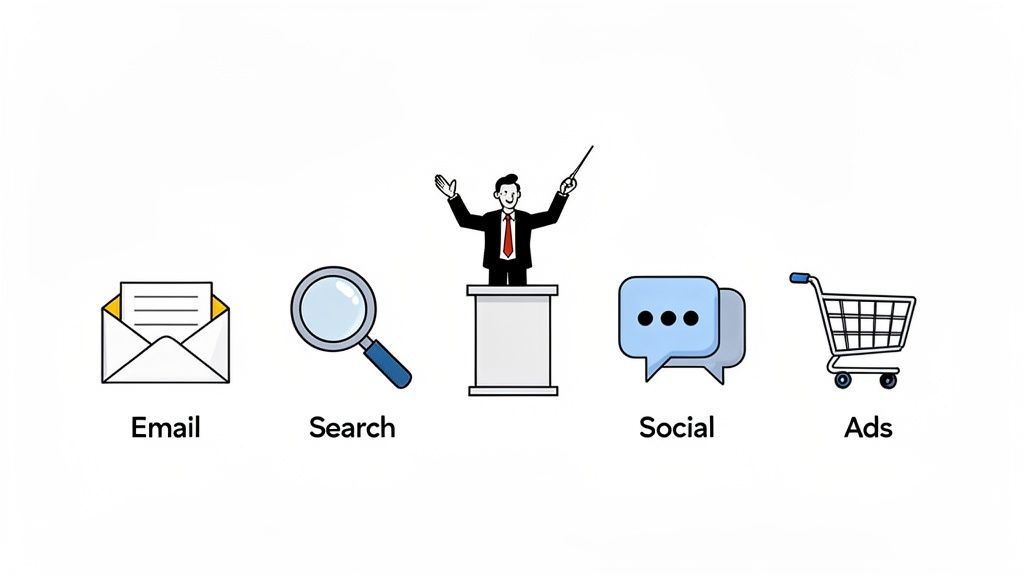
Many marketing leaders run excellent campaigns in isolation—a high-performing social media push, a targeted PPC campaign, and a segmented email sequence—but they don't connect. That's a classic multi-channel approach. It’s an orchestra where every musician plays their own tune; the result is noise, not a symphony.
A cross-channel strategy is the conductor. It ensures every touchpoint, from an initial Google search to a final retargeting ad, is part of a cohesive customer journey. This shifts the focus from channel-specific vanity metrics to measurable business outcomes like Customer Acquisition Cost (CAC) and Lifetime Value (LTV).
The Clear Business Impact of Integration
The data supporting an integrated approach is compelling. Coordinated cross-channel campaigns achieve 166% higher engagement rates compared to siloed efforts. This is because a consistent narrative across email, social, and search keeps prospects engaged and builds trust.
More importantly, businesses that effectively integrate their channels see conversion rates jump by 24% and overall revenue climb 23% higher. You can learn more about these findings on cross-channel marketing wins. This strategy directly addresses fragmented customer journeys and wasted ad spend by revealing how channels influence one another, allowing you to allocate budget for maximum ROI.
Multi-Channel vs. Cross-Channel Marketing At a Glance
The distinction between these two approaches is critical for any business leader aiming for sustainable growth.
Multi-channel is brand-centric, focusing on being present on various platforms. A cross-channel strategy is customer-centric, building an experience around their journey. You can learn more by reading our complete guide that explains what multi-channel marketing is and how it differs.
The fundamental difference is simple: multi-channel marketing is about the brand, placing it at the center of the strategy. A cross-channel marketing strategy is about the customer, placing them at the center and building the experience around their journey.
At Ezca, we implement data-driven, agile sprints that build integrated strategies. By unifying channels and analyzing performance holistically, we help businesses move beyond siloed tactics to build a powerful, ROI-focused growth engine.
The Four Pillars of a Winning Cross-Channel Framework
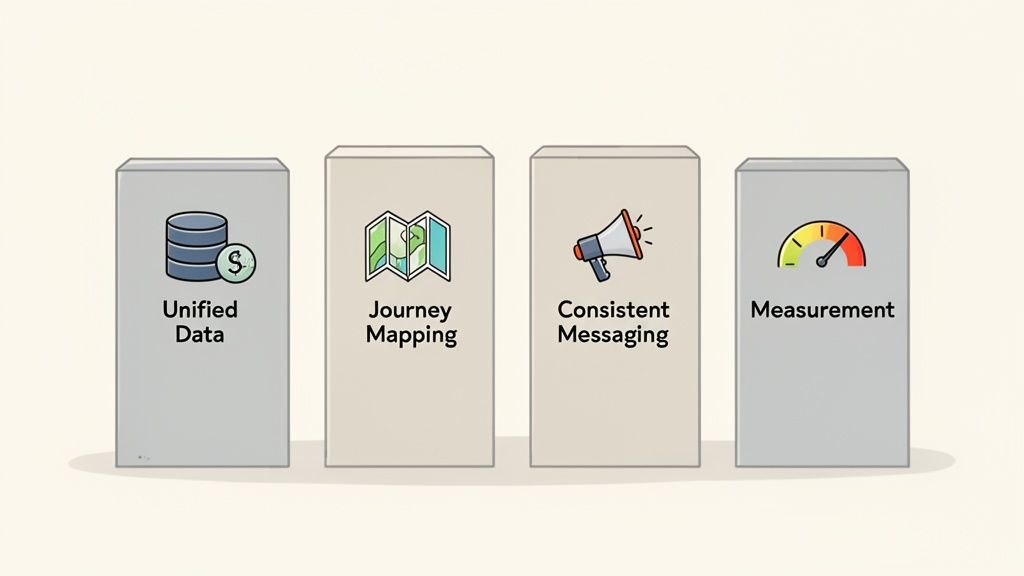
A successful cross-channel strategy isn't about complexity; it's about a repeatable framework that delivers a profitable customer experience. This framework stands on four pillars that must work in harmony.
Getting these pillars right transforms disconnected activities into a unified growth engine. They provide the blueprint for moving from theory to execution, ensuring every investment is strategic, customer-focused, and measurable.
Unified Audience and Data
The bedrock of any effective strategy is a single customer view. Without it, you are marketing blind. The first action is to dismantle data silos that prevent channels from communicating.
This requires connecting key data sources: your CRM, website analytics (like Google Analytics), and ad platform data into a central hub. The objective is to see how a single user interacts with a Facebook ad, then an organic search, and later an email.
This unified view is the engine behind true personalization. It’s what allows you to send a perfectly timed offer to a user who viewed a specific product but abandoned their cart, rather than sending a generic email blast.
A unified data pillar transforms marketing from a series of disjointed messages into a continuous, intelligent conversation with each customer. Every action a user takes provides a signal that should inform the next interaction, regardless of the channel.
At Ezca, this is a day-one priority. Our 90-day sprints begin by connecting these data points, providing the clarity needed to make intelligent decisions on budget and strategy.
Cohesive Customer Journey Mapping
With unified data, you can map the customer journey. This is not an abstract exercise; it's about tracing the real-world paths your highest-value customers take from discovery to purchase and beyond.
First, identify a key customer segment. For a B2B SaaS company, this might be "project managers at mid-sized tech firms." For an e-commerce brand, it could be "repeat buyers of high-end skincare."
Next, map their likely touchpoints:
- Awareness: Do they discover you via a targeted LinkedIn ad or a Google search for a specific problem?
- Consideration: Do they engage with blog posts, watch a webinar, or read product reviews?
- Decision: What prompts conversion? Is it a retargeting ad on Instagram or a "book a demo" email?
This process illuminates critical handoff points between channels, revealing where prospects get stuck or where a smooth transition accelerates their decision. This insight is invaluable for optimizing spend and improving conversion rates.
Consistent Messaging and Creative
As customers move between your social media, website, and email, your brand's voice and message must remain consistent. Inconsistent messaging erodes trust. A user clicking an ad for a 20% discount who lands on a page with no mention of the offer is a classic example of a broken journey.
This pillar is about creating a consistent narrative that adapts to each platform. Your core message remains the same, but the delivery is tailored to the channel.
For example:
- LinkedIn Ad: Professional tone, focused on a business problem and your solution.
- Instagram Story: Quick, visual, and focused on benefits or user-generated content.
- Email Nurture: In-depth, providing value and building trust with educational content.
Effective content repurposing strategies are key. A single asset, like a detailed case study, can be adapted into multiple formats for different channels, ensuring message consistency without tripling the workload.
Integrated Measurement and Attribution
The final pillar ensures accountability. An integrated measurement system moves beyond last-click attribution, which incorrectly assigns 100% of the credit to the final touchpoint and ignores the contributions of preceding interactions.
A modern cross-channel strategy uses a multi-touch attribution model, such as data-driven or position-based. These models assign value to each touchpoint along the customer's journey, providing a clear picture of how each channel contributes to revenue.
This requires unified tracking and reporting dashboards. You must be able to answer questions like, "How do our organic social posts influence the conversion rate of our paid search ads?" Answering this is impossible with siloed measurement. Partnering with an agency like Ezca provides an advantage, as we build the reporting infrastructure to prove cross-channel ROI.
How to Build Your Cross-Channel Strategy Step by Step
Transitioning from siloed channels to a connected cross-channel strategy is a methodical process. It involves deliberate steps to link your channels with the customer at the center.
This five-step process is a practical roadmap for marketing leaders to unify efforts, optimize budget, and create the seamless experience modern customers expect.
Step 1: Audit Your Current Channels and Tech Stack
Before building the future, you must understand your current state. An honest audit reveals integration gaps, data silos, and potential quick wins. Do not skip this foundational step.
List every channel you use, from paid search and social media to email marketing and content. Next to each, note the technology that powers it. Does your email platform integrate with your CRM? Can your analytics tool see ad platform data?
Key questions to ask:
- Data Flow: Which systems share data, and which operate in isolation?
- Customer View: Can you track a single user's journey across at least two channels? If not, you have a critical blind spot.
- Team Structure: Are your teams organized by channel (e.g., an "email team" and a "PPC team")? This often indicates siloed thinking.
Identifying these friction points is the objective. An experienced agency like Ezca can accelerate this process, spotting gaps and designing a tech stack that enables integration.
Step 2: Define Unified Goals and KPIs
Siloed channels lead to siloed metrics. The social media team chases engagement, while the PPC team focuses on click-through rates. A cross-channel strategy requires a shift toward unified goals that measure business impact.
Move beyond channel-specific vanity metrics and rally your team around shared, high-level KPIs. This forces everyone to consider the complete customer journey.
Your primary goal should be to move beyond last-click attribution and measure what truly matters for growth. Focus on metrics that show the combined health of your entire marketing engine.
Essential unified KPIs include:
- Blended Customer Acquisition Cost (CAC): Your total marketing and sales cost divided by the number of new customers acquired across all channels. This provides an honest measure of acquisition efficiency.
- Customer Lifetime Value (CLV): A unified strategy improves retention and repeat business. Tracking CLV demonstrates how seamless journeys create more valuable, loyal customers.
- Journey Conversion Rate: Measure the success of the entire journey. Track the percentage of users who complete a key multi-touch path, such as moving from a social ad to a webinar sign-up to a demo request.
Step 3: Map Key Customer Journeys
You cannot improve a journey you haven't defined. Focus on your most valuable segments and map one or two of their most common, high-impact journeys.
For an e-commerce brand, a classic example is the abandoned cart journey. A customer clicks an Instagram ad, adds a product to their cart, but leaves. Twenty-four hours later, a targeted email arrives with a reminder and a small incentive. This coordinated, cross-channel tactic converts browsers into buyers.
Step 4: Develop a Unified Content and Messaging Matrix
With key journeys mapped, plan the right message for the right moment. A messaging matrix is a simple yet powerful tool for ensuring a consistent brand voice across all interactions.
Create a grid with customer journey stages (Awareness, Consideration, Decision) on one axis and your channels on the other. In each box, define the core message, call to action, and specific content asset. This prevents jarring experiences, like pushing a top-of-funnel ebook to a user ready to buy.
The payoff is significant. Businesses with strong cross-channel strategies achieve 89% customer retention rates, compared to 33% for companies with weak, disjointed marketing. For deeper tactical frameworks, explore guides on effective multi-channel marketing strategies.
Step 5: Implement Your Measurement Model
Finally, establish the right setup to track performance accurately. Connect the unified KPIs from Step 2 to your real-world campaigns. Configure your analytics tools, like Google Analytics 4, to track the events and conversions that constitute your mapped customer journeys.
This means moving away from the default last-click attribution model. Explore alternatives in your analytics platform, such as data-driven or position-based attribution. These models assign partial credit to every touchpoint, providing a realistic picture of which channels drive results. This allows you to optimize your cross-channel marketing strategy with confidence. The financial impact is real—consistent brands see revenue jump by 14.6% year-over-year. You can explore more of the data behind these powerful retention and revenue figures.
Your 90-Day Playbook for Rapid Implementation
An effective cross-channel marketing strategy doesn't require a year-long overhaul. Using an agile, 90-day sprint, you can build momentum, gather data, and prove ROI quickly.
This approach is broken down into three distinct phases.
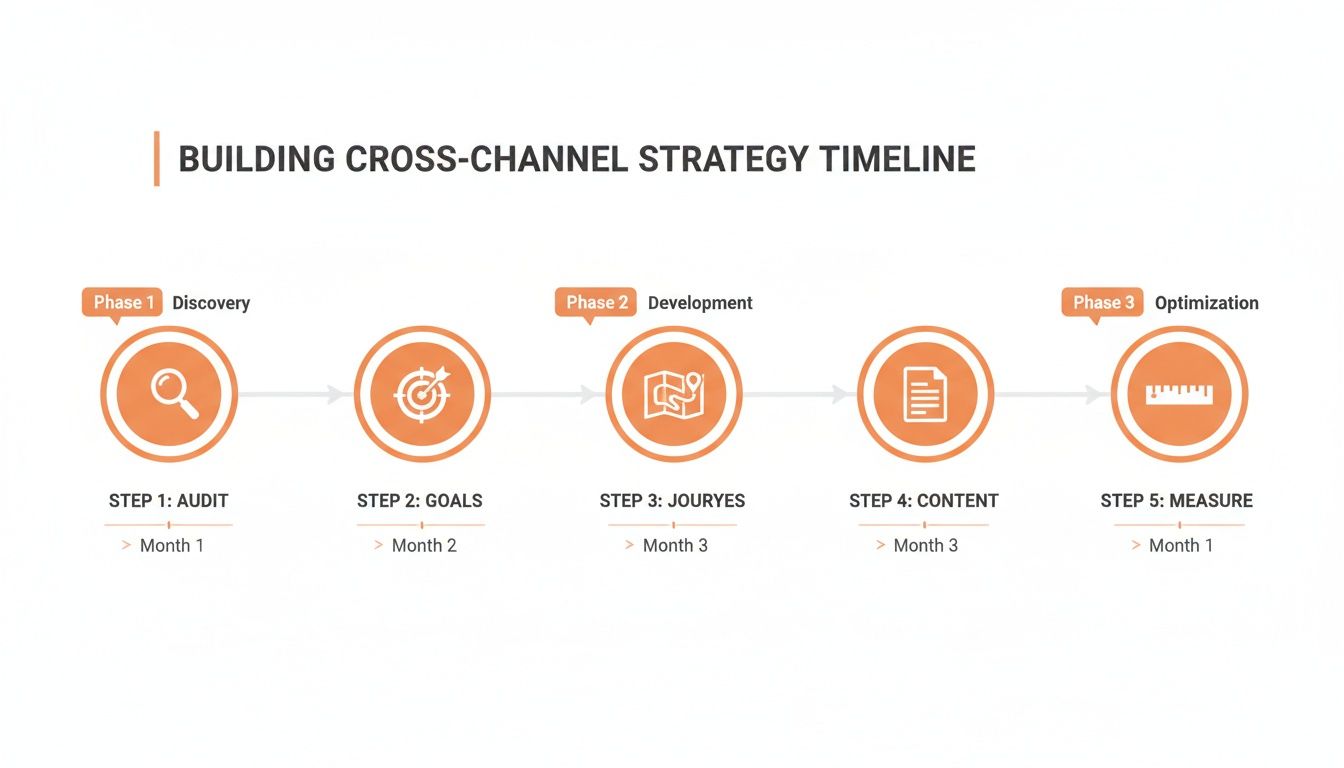
This visual outlines the path: build the foundation before measuring results.
Month 1 (Days 1-30): Foundation and Integration
The first 30 days are about laying the groundwork. Rushing this step leads to disconnected data and ineffective campaigns. Your priority is building the central nervous system for your strategy before launching new campaigns.
Audit your tech stack and identify where customer data resides—typically scattered across your CRM, website analytics (like Google Analytics), and ad platforms. The mission is to integrate these systems and establish clean data pipelines to create a unified customer view.
Concurrently, map one high-value customer journey. Focus on a critical path, such as converting a first-time website visitor into a qualified lead (B2B) or guiding a user from a social ad to their first purchase (e-commerce).
The whole point of Month 1 isn't to chase immediate sales. It’s to build the plumbing for smart, data-driven marketing. Success here is measured by hitting integration milestones, not by conversion rates.
At Ezca, we dedicate the first phase of our sprints to this foundational work. Nailing tech integration and journey mapping first ensures that when campaigns launch, every dollar is trackable and every decision is informed.
Month 2 (Days 31-60): Launch and Test
With a solid foundation, Month 2 is about activation and learning. Launch a pilot campaign targeting the single customer journey you mapped. Keep it small and control your variables. The goal is to gather clean, actionable data, not to achieve immediate perfection.
Choose two or three relevant channels. A SaaS company might use LinkedIn Ads for awareness, Google Ads for high-intent search, and an email sequence for nurturing. An e-commerce brand might use Instagram Ads, Google Shopping, and an SMS campaign for abandoned carts.
The primary goal of this pilot is not immediate profitability. It is to establish baseline metrics, test messaging, validate journey assumptions, and observe how users move between channels. This data fuels the optimization in Month 3.
Month 3 (Days 61-90): Analyze and Optimize
The final 30 days are for analysis and intelligent adjustments. With 30 days of baseline data from your pilot, you can make data-driven decisions to boost performance and generate a return.
Analyze the full-funnel data. Identify drop-off points. Determine which channel initiates interest and which closes the deal. Use these findings to refine creative, sharpen messaging, and reallocate budget.
This iterative process is the core of a modern cross-channel strategy. If data shows LinkedIn Ads are great for awareness but email closes 70% of deals, you can confidently invest more in email nurturing. This constant loop of testing and data-backed optimization is far more effective than a rigid annual plan.
Sample 90-Day Cross-Channel Sprint KPIs
To make this playbook more actionable, here are sample Key Performance Indicators (KPIs) for a 90-day sprint, tailored to different business models.
The table illustrates a logical progression from foundational metrics in Month 1 to performance and optimization metrics in Month 3.
Tracking these specific metrics month-by-month ensures you focus on the right activities at the right time. This structured approach to measurement transforms a good idea into a profitable strategy.
Measuring Success: The KPIs That Actually Prove Cross-Channel ROI
How do you prove your cross-channel marketing strategy is delivering value? The answer lies in business-level metrics that track the entire customer journey, not vanity metrics like likes, shares, or open rates.
A successful strategy is measured by two outcomes: a lower cost to acquire customers and a higher value from each one over time. This represents a fundamental shift from channel performance to business performance.
Beyond Channel Metrics: Blended CAC and CLV are King
Two metrics provide the clearest view of your marketing engine's health: Blended Customer Acquisition Cost (CAC) and Customer Lifetime Value (CLV).
Blended CAC is your all-in acquisition cost. Divide your total sales and marketing spend by the number of new customers acquired. This provides the true average cost to win a customer, cutting through the noise of channel-specific reports.
Customer Lifetime Value (CLV) measures the total revenue you can expect from a single customer over their relationship with your brand. A rising CLV is concrete proof that your seamless journeys are fostering loyalty and repeat business.
The name of the game is simple: get your CLV to climb while you push your Blended CAC down. The gold standard is a 3:1 ratio. For every dollar you spend to get a customer, you should be making three dollars back.
Achieving this balance is the primary financial goal of a serious cross-channel strategy and the clearest way to demonstrate success to executive leadership.
Attribution That Tells the Whole Story
To understand how your channels work together, you must move beyond last-click attribution. Multi-Touch Attribution reports reveal the complete story.
- First-Touch Attribution: Identifies which channels are most effective at generating initial awareness and bringing new prospects into your funnel.
- Linear Attribution: Assigns equal credit to every touchpoint in the journey, providing a balanced overview of the entire path.
- Data-Driven Attribution: Uses machine learning to determine the actual contribution of each touchpoint to a conversion, offering the most accurate view of performance.
These models reveal the "assist" value of channels that last-click reporting ignores. You might discover that social media doesn't close deals directly but is the first touchpoint for 40% of your highest-value customers. You may also be interested in our guide to leveraging AI enablement for deeper marketing insights.
Measuring the End-to-End Journey
Finally, track the Journey Conversion Rate. This KPI measures the success of a defined customer path from start to finish. Instead of just tracking the final sale, you measure the percentage of users who successfully move from an initial ad click to a content download and on to a final purchase.
This metric forces you to optimize the entire customer experience, not just isolated campaigns. The market demands this integrated approach. In B2B, siloed email campaigns saw a 29% decrease in leads year-over-year, prompting 80% of marketers to adopt unified platforms. In e-commerce, channels like email can achieve a 19.3% conversion rate when part of a cohesive flow. You can discover more insights about these market trends.
At Ezca, our dashboards are built for this purpose. We help clients move beyond spreadsheets to a clear, real-time view that directly connects marketing activities to revenue and ROI.
Common Questions About Cross-Channel Marketing
Even with a solid plan, implementing a new cross-channel marketing strategy can be daunting. Here are answers to common questions from business leaders.
What's the Real Difference Between Multi-Channel and Cross-Channel?
Multi-channel marketing is like having a team of great salespeople who never speak to each other. You are active on Facebook, email, and Google Ads, but each channel operates as a silo with its own goals and data.
Cross-channel marketing is about connection. Those salespeople start working together. A user clicks your Facebook ad for running shoes and later receives an email with a guide on "5 Stretches for Runners" featuring those same shoes. The focus shifts from optimizing channels to optimizing the customer's journey.
How Do I Pick the Right Channels to Focus On?
Let your data be your guide, not industry trends. The goal is not to be everywhere; it's to be where your best customers are. Analyze your data: Where do your most profitable customers come from? How do they prefer to interact with your brand?
It is better to master three or four core channels than to have a weak presence on ten.
- A B2B SaaS company might focus on LinkedIn for targeted outreach, Google Search for high-intent prospects, and an email nurture sequence for a longer sales cycle.
- An e-commerce brand might prioritize Instagram and TikTok for visual storytelling, Google Shopping to capture purchase intent, and SMS to recover abandoned carts.
A data-backed channel audit is non-negotiable.
The biggest mistake I see is leaders picking channels because they're popular, not because their own customer data points there. Your analytics platform is a treasure map—use it to find where your ideal customers are hiding in plain sight.
What's the Toughest Part of Making This Work?
The biggest hurdle is data integration. Most companies have data stuck in separate silos: the CRM doesn't communicate with ad platforms, which don't integrate with website analytics. This makes a unified view of the customer journey impossible.
The solution is a central data hub, such as a CRM like HubSpot or Salesforce, or a Customer Data Platform (CDP). When all tools feed into one system, you can see cross-channel behavior and trigger automated actions that are personal and relevant. An experienced partner can save you months of headaches in getting this foundational piece right.
How Fast Can I Realistically Expect to See Results?
While full integration is a long-term goal, you should see progress within the first 90 days. A sprint model allows for rapid data collection, testing, and iteration.
In the first two to three months, look for improvements in engagement and journey completion rates. You will have data showing how users move between channels. Significant bottom-line ROI—such as a lower blended CAC and higher CLV—typically becomes evident around the six- to nine-month mark as optimizations compound. The key is to aim for steady, incremental wins.
Ready to stop juggling disconnected channels and build a unified growth engine? At Ezca Agency, we specialize in implementing data-driven cross-channel marketing strategies in focused 90-day sprints. We integrate your tech, map your customer journeys, and optimize your budget to deliver measurable ROI. Schedule a consultation to see how we can build your strategy.