
10 Actionable Best Practices for Email Marketing Campaigns in 2026
Discover data-driven best practices for email marketing campaigns. Get actionable insights on segmentation, automation, and ROI for marketing leaders.
Email marketing remains the highest-ROI channel, generating an estimated $36 for every $1 spent. Yet, for marketing leaders and business owners, success is no longer about volume; it's about precision. A poorly executed email strategy doesn't just fail to convert; it actively damages brand reputation and deliverability, creating a drag on your entire growth engine.
This article bypasses generic advice to provide a strategic breakdown of the 10 critical best practices for email marketing campaigns that drive measurable ROI. We will move beyond surface-level tips and into actionable frameworks for high-growth SaaS, e-commerce, and B2B companies. This is a practical playbook designed for immediate implementation.
Inside, you will find detailed insights on everything from advanced segmentation and behavioral triggers to building lead scoring models that qualify prospects for your sales team. We'll cover how to personalize content at scale using dynamic blocks, optimize deliverability to maintain a pristine sender reputation, and integrate email with your broader marketing channels for a unified customer view. Each best practice is designed to turn your email list from a passive audience into a predictable, revenue-generating asset.
1. Implement Advanced Segmentation & Behavioral Triggers
Moving beyond generic email blasts is the single most impactful step you can take to elevate your email marketing ROI. Advanced segmentation transforms your email strategy from a monologue into a series of highly relevant, one-on-one conversations. This involves dividing your audience into granular groups based on who they are (firmographics) and what they do (behaviors), then using those actions to send automated, perfectly-timed messages.
For e-commerce, this is the engine behind recovering lost sales. Shopify brands consistently recover 10-20% of lost revenue with automated abandoned cart sequences. In the SaaS world, HubSpot uses behavioral triggers to score leads, nurturing them from MQL to SQL based on content downloads and pricing page visits. These data-driven tactics are a cornerstone of effective email marketing campaigns.
How to Implement This Strategy
To start, focus on high-impact segments before getting lost in countless micro-segments. Connect your email service provider (ESP) to your CRM and analytics platforms to create a unified customer view.
- Start with Key Segments: Begin with 3-5 foundational groups such as new subscribers, repeat customers, high-value customers (top 10% by LTV), and disengaged contacts.
- Map Customer Journey Triggers: Identify critical touchpoints. For a SaaS business, this could be: signup → first feature use → inactivity warning → upgrade prompt.
- Layer Data for B2B: Combine behavioral data (e.g., downloaded a whitepaper) with firmographic data (company size, industry) to create hyper-targeted campaigns for different buyer personas.
- Track Performance: Use cohort analysis to identify which segments and triggers drive the highest conversion rates and lifetime value (LTV).
Implementing this level of personalization requires a deep integration of your marketing technology stack. At Ezca, our marketing automation experts help orchestrate these complex data flows, ensuring your segmentation strategy is built on a solid foundation and drives measurable growth.
2. Optimize Send Times & Frequency Based on Data
Sending the right message to the right person is only half the battle; sending it at the right time is what drives peak engagement. Optimizing send times and frequency involves moving away from a one-size-fits-all schedule and using data to determine when your audience is most receptive. This data-driven approach prevents list fatigue, maximizes open rates, and ensures your campaigns land with impact.
This is a critical lever in any effective email marketing campaign. For instance, B2B SaaS companies have found that sending mid-week mornings (Tuesday-Thursday at 10 AM) aligns perfectly with the professional workday. Conversely, e-commerce brands often see a spike in conversions with evening sends (8 PM - 10 PM), targeting shoppers who browse after work. According to Mailchimp data, exceeding five emails per week can sharply increase unsubscribe rates, highlighting the delicate balance required.
How to Implement This Strategy
The goal is to align your sending schedule with your subscribers' daily routines and engagement habits. This requires systematic testing and segment-level analysis to uncover the optimal windows for different audience groups.
- Start with Educated Guesses: Use industry benchmarks as a starting point. For B2B, target 10 AM Tuesday. For e-commerce, test an 8 PM send time.
- A/B Test Send Times: Isolate a single variable (time or day) and test it on a 10-20% portion of your list. Send the winning variation to the remaining audience.
- Segment Frequency by Engagement: Not all subscribers are equal. Create tiers: highly engaged "VIPs" might receive 3-4 emails per week, while inactive subscribers receive a monthly re-engagement campaign.
- Analyze Key Metrics Together: Don't just track open rates. Monitor the relationship between opens, clicks, conversions, and unsubscribe rates. A high open rate is meaningless if it comes with a surge in unsubscribes.
Mastering this requires an email platform capable of sophisticated scheduling and A/B testing. At Ezca, we analyze audience data to build and execute a dynamic sending strategy that respects the inbox and drives conversions.
3. Create Responsive Design & Mobile-First Templates
With well over 60% of all emails now opened on a mobile device, a mobile-first design isn't just a best practice; it's a fundamental requirement for engagement and ROI. This approach involves designing your email templates for the smallest screen first, then progressively enhancing the layout for larger screens. This ensures a flawless, readable, and actionable experience for the majority of your audience, directly impacting click-through and conversion rates.
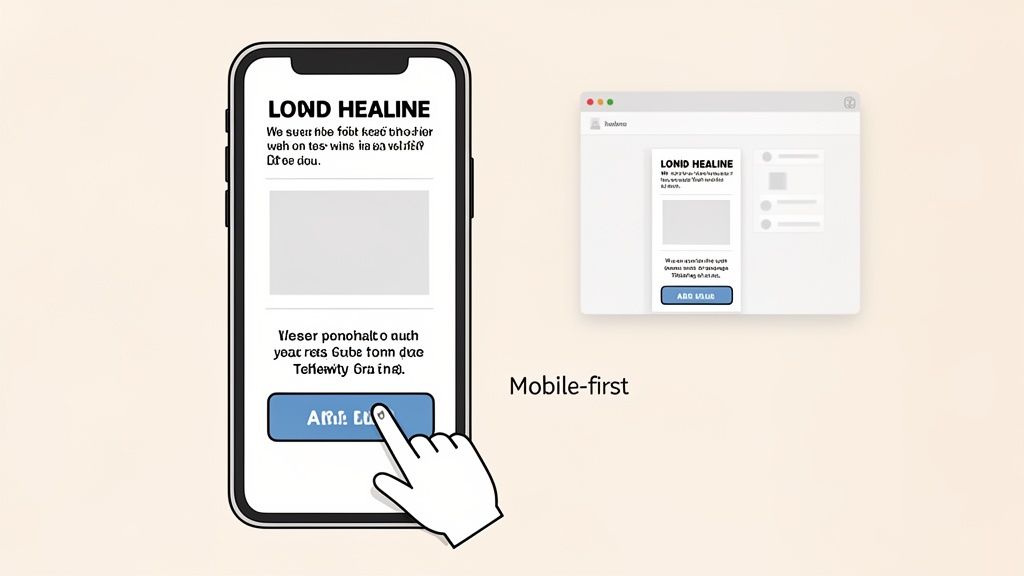
The impact of this strategy is significant. Campaign Monitor found that mobile-optimized campaigns drive up to 20% higher conversion rates. For B2B SaaS companies like Stripe and Twilio, simple, single-column designs are the standard, ensuring critical information is easily digestible on any device. E-commerce giant Zappos achieves over 40% of its mobile conversions through meticulously optimized email templates that make browsing and buying seamless. This commitment to mobile experience is a key driver of successful email marketing campaigns.
How to Implement This Strategy
Adopting a mobile-first mindset means prioritizing clarity and simplicity. Focus on a clean, single-column layout that guides the user's eye directly to the primary call-to-action (CTA). This approach benefits all users, providing a focused experience even on desktop.
- Prioritize a Single-Column Layout: This is the most reliable structure for ensuring compatibility and readability across all email clients and devices.
- Optimize Key Elements: Use a body text font size of at least 16px to prevent users from needing to pinch-and-zoom. Keep subject lines concise (30-40 characters) to avoid truncation on mobile preview panes.
- Place CTAs Above the Fold: Your most important CTA button should be visible without scrolling, making it immediately accessible to mobile users.
- Test on Real Devices: Don't rely solely on emulators. Test your emails on actual devices using popular apps like Gmail, Apple Mail, and Outlook mobile to catch rendering issues that simulators miss.
Building and maintaining a library of fully responsive, brand-aligned email templates is a critical investment. Ezca's creative services include template development and optimization, ensuring every campaign you send is designed for maximum impact, regardless of the device.
4. Implement a Strategic A/B Testing Framework
Relying on assumptions is a fast path to stagnant email performance. A strategic A/B testing framework replaces guesswork with a data-driven process, systematically identifying what resonates with your audience. This involves isolating a single variable, testing it across a sample of your audience, and rolling out the winner to the majority. This scientific approach is a core component of the best practices for email marketing campaigns, ensuring continuous, incremental improvements that compound over time.
The impact of rigorous testing is substantial. For instance, Optimizely reports that companies running consistent tests can improve their email ROI by over 50% year-over-year. In the B2B space, this isn't just about tweaking colors; it's about validating value propositions. Testing an ROI-focused subject line ("Increase Your Pipeline by 30%") against a pain-point-focused one ("Tired of Unqualified Leads?") can reveal crucial insights about your buyer's primary motivations.
How to Implement This Strategy
A successful framework requires discipline and a clear hypothesis for every test. Instead of random experiments, build a testing calendar that aligns with your overarching campaign goals. This structured approach moves beyond simple subject line tests to more impactful strategic optimizations.
- Test One Variable at a Time: To achieve clean results, isolate a single element. Test your subject line, then your CTA copy, then your imagery, but never all at once.
- Establish Statistical Significance: Ensure your test groups are large enough for valid results. A common best practice is a 50/50 split with a minimum of 1,000 recipients in each group to provide reliable data.
- Formulate a Clear Hypothesis: Before launching, state your goal: "We believe a benefit-focused CTA like 'Download the Growth Guide' will increase click-through rates compared to the action-focused 'Click Here' because it highlights value."
- Document and Analyze: Maintain a testing log to record hypotheses, variants, results, and key learnings. This prevents repeating failed experiments and builds a repository of audience intelligence.
Implementing a consistent testing framework turns every email send into a learning opportunity. Ezca can help structure these experiments, ensuring your tests are statistically sound and yield actionable insights that drive measurable improvements in engagement and conversions.
5. Build Lead Scoring & Qualification Sequences for B2B
For B2B companies, not all leads are created equal. Lead scoring and qualification sequences bridge the critical gap between marketing and sales, ensuring your sales team only spends time on prospects who are genuinely ready to buy. This system assigns points to leads based on who they are (firmographics) and how they interact with your brand (engagement), creating an automated process to identify sales-ready opportunities.
This data-driven approach transforms marketing from a lead generation machine into a revenue-driving engine. Research from MarketingSherpa shows that B2B companies with effective lead scoring achieve 77% greater lead generation ROI. Similarly, by using firmographic filters, SaaS companies can slash the number of unqualified leads passed to sales by up to 60%, drastically improving team efficiency.
How to Implement This Strategy
The goal is to define what a Marketing Qualified Lead (MQL) looks like and build a system that automatically identifies them. This requires clear criteria agreed upon by both marketing and sales, turning lead nurturing into a precise, predictable process.
- Define MQL Criteria: Establish a point threshold for a lead to become an MQL. High-intent actions like a "demo request" might be worth 50 points, while a low-intent signal like an "email open" is worth just 1 point.
- Weight Signals Appropriately: Combine behavioral signals (content downloads, webinar attendance, pricing page visits) with firmographic data (company size, industry, job title) to build a comprehensive lead profile.
- Implement Lead Decay: Ensure scores reflect current interest by reducing a lead's score over time. Recent engagement should always be weighted more heavily than actions taken months ago.
- Use Negative Scoring: Create rules to subtract points for disqualifying factors. This could include leads from a non-target industry, students, or competitors, keeping the pipeline clean.
- Calibrate with Sales Data: Review your closed-won and closed-lost data quarterly. Use these insights to refine your scoring model, ensuring it accurately predicts which leads are most likely to convert.
Building a dynamic scoring model is one of the most powerful best practices for email marketing campaigns in a B2B context. Integrating a system like SaaS predictive lead scoring can accelerate this process, using historical data to build a more accurate qualification engine from day one.
6. Personalize at Scale Using Dynamic Content Blocks
Moving beyond basic [First Name] insertion is critical for cutting through inbox noise. Dynamic content blocks transform a single email template into a unique experience for each recipient. This practice involves swapping out entire sections of an email—like images, product recommendations, or calls-to-action—based on a subscriber's data, such as their purchase history, browsing behavior, or industry.
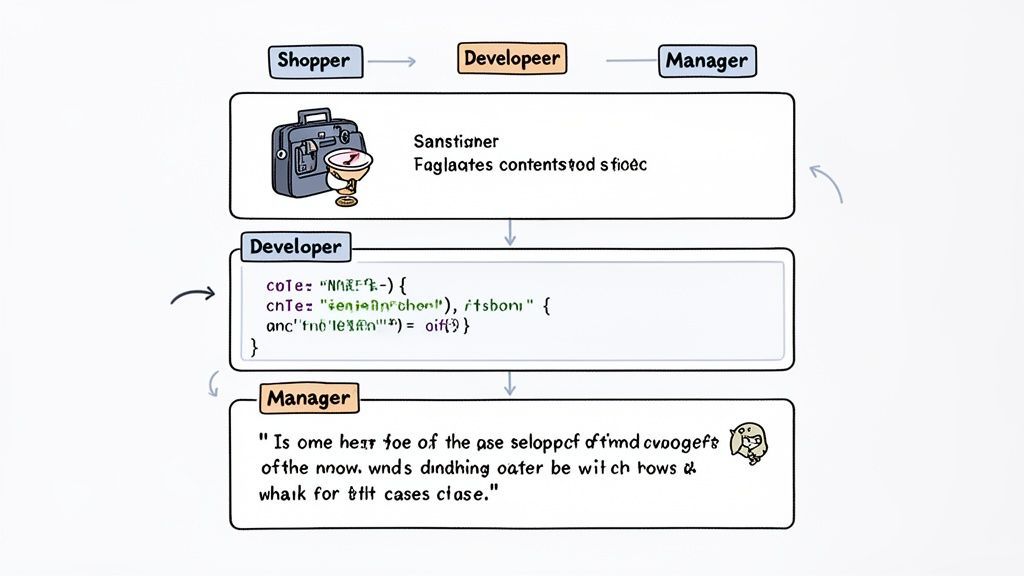
The impact on revenue is direct and measurable. Amazon famously attributes up to 35% of its revenue to its recommendation engine, a core part of which is delivered via email. For SaaS companies, this means personalizing the features highlighted in an email based on user activity; developers might see API documentation, while managers see new reporting dashboards. An Ezca client, a major electronics retailer, uses dynamic content to display device-specific messaging, ensuring gamers see gaming peripherals while remote workers see productivity tools.
How to Implement This Strategy
To execute this effectively, ensure your CRM and e-commerce data are clean and accurately mapped to your email service provider. This data integrity is the foundation of meaningful personalization and one of the best practices for email marketing campaigns that drives real results.
- Start with 2-3 Dynamic Blocks: Begin by personalizing high-impact areas like the hero image or the primary CTA before attempting to personalize the entire email.
- Layer Personalization Logic: Combine segment data with behavioral triggers. For example, show a specific case study to a B2B contact (industry segment) who recently visited your pricing page (behavioral trigger).
- E-commerce Product Recommendations: Display products from recently viewed categories. Adding a modest 10-15% discount code within that dynamic block can significantly boost repeat purchases.
- Audit Your Data Quality: Regularly check that the CRM fields feeding your personalization rules are accurate. Inaccurate data (e.g., wrong industry or job title) can make your personalization efforts backfire.
Dynamic content turns one campaign into thousands of personalized versions, a scalable strategy that drives higher engagement and conversions. Ezca's teams specialize in building the data infrastructure required to power this level of personalization.
7. Build Post-Purchase & Onboarding Email Sequences
The moments immediately following a signup or purchase are the most critical for establishing long-term customer relationships. Strategic onboarding and post-purchase sequences capitalize on this peak engagement by guiding users to value, reinforcing their decision, and setting the stage for retention. This automated series of emails educates, engages, and drives the specific actions that correlate with customer success and repeat business.
This practice is a non-negotiable for reducing churn and increasing lifetime value. For SaaS companies, a well-executed onboarding flow can reduce churn by 25-40% by ensuring users achieve their "first success" quickly. E-commerce brands that implement post-purchase sequences see a 15-30% increase in repeat purchase rates. Slack, for example, uses its onboarding sequence to guide new users toward sending their first 200 messages, a key predictor of long-term retention.
How to Implement This Strategy
The goal is to transform a one-time transaction into a long-term relationship. Map out the key actions a new customer must take to become successful and build your email sequence around driving those milestones. This requires a tight integration between your email platform and product analytics or e-commerce data.
- Map Critical User Actions: For SaaS, identify the core features a user must adopt within their first 7 days. For e-commerce, focus on product education, sharing user-generated content, and introducing the loyalty program.
- Space Emails Intelligently: During the initial onboarding period, send emails every 24-48 hours. Spacing them too closely can overwhelm a new user, while waiting too long risks losing momentum.
- Implement Progressive Education: Start with the basics. Your first emails should cover setup and core benefits. Introduce advanced features or cross-sell opportunities in weeks two and three, after the user has demonstrated initial engagement.
- Use Product Analytics Triggers: For B2B or SaaS, link emails to in-app behavior. For instance, Stripe sends developer-specific onboarding content triggered by API usage milestones, making the guidance hyper-relevant.
Executing these triggered, data-driven sequences is a core component of effective email marketing campaigns. Leveraging a service like Ezca can ensure the necessary data from your CRM and analytics platforms flows seamlessly into your ESP, powering personalized onboarding at scale.
8. Establish Clear CTA Strategy & Conversion Optimization
An email campaign's ultimate success hinges on a single moment: when the subscriber decides to click. A clear Call-to-Action (CTA) strategy is the engine of conversion, guiding users from the inbox to the desired outcome. Many campaigns fail not due to poor content, but because of weak, unclear, or conflicting CTAs. Strategic CTA design, encompassing copy, color, size, and placement, is essential for maximizing click-through rates and campaign ROI.
This is a critical lever in any high-performing email program. For example, e-commerce brands often see a 25% CTR improvement by switching from a generic "Shop Now" to a benefit-driven "Get 20% Off Today." Similarly, SaaS companies report up to 40% higher conversion rates using a direct "Start Free Trial" over a passive "Learn More" on decision-stage emails. These figures underscore how a well-optimized CTA is one of the most impactful best practices for email marketing campaigns.
How to Implement This Strategy
A successful CTA strategy aligns the action you want users to take with their current stage in the customer journey. It's about making the next step obvious, easy, and compelling.
- Align CTA with Journey Stage: Tailor your CTA copy to the user's mindset. Use "Learn More" for awareness, "Compare Plans" for consideration, and "Start Your Free Trial" for decision-making.
- A/B Test CTA Copy Rigorously: Constantly test variations. Pit urgency-based copy ("Offer Ends Tonight") against benefit-focused copy ("Get Your Free Guide") to see what resonates with different segments.
- Optimize for Mobile: Ensure your primary CTA button is at least 44x44 pixels to be easily tappable on mobile devices. Use ample whitespace around the button to make it stand out.
- Focus on a Single, Primary Goal: Emails with a single, clear CTA consistently outperform those with multiple, competing calls-to-action. If you must include secondary links, make them text-based and visually subordinate to the main button.
Optimizing CTAs is a continuous process of testing and refinement. At Ezca, our conversion rate optimization (CRO) services integrate directly with email campaign management, using data-driven A/B testing to identify the CTA variations that drive the most valuable actions for your business.
9. Monitor Deliverability & Maintain Sender Reputation
Even the most brilliant email campaign is worthless if it lands in the spam folder. Deliverability is the technical foundation of your email marketing strategy, and maintaining a high sender reputation is non-negotiable. This involves implementing email authentication protocols to prove your identity to mailbox providers and practicing rigorous list hygiene to signal that you are a legitimate, high-quality sender.
Neglecting this technical side has severe consequences. Validity data shows that nearly 20% of legitimate commercial emails never reach the inbox due to sender reputation issues. With the 2024 sender requirements from Gmail and Yahoo, failing to implement protocols like DMARC is no longer an option; it's a direct path to the spam folder, rendering your campaigns invisible and destroying ROI.
How to Implement This Strategy
Protecting your sender score is an ongoing process of technical setup and disciplined list management. The goal is to send strong, positive signals to Internet Service Providers (ISPs) like Gmail and Outlook, proving your emails are wanted by recipients.
- Implement Authentication Protocols: Immediately set up SPF, DKIM, and DMARC. These are foundational DNS records that verify your domain's sending authority and are now mandatory for bulk senders.
- Aggressively Manage Bounces: Monitor your bounce rates weekly. Hard bounces (invalid emails) must be removed from your list instantly. A bounce rate consistently above 2% is a major red flag for ISPs.
- Practice Proactive List Hygiene: Regularly clean your email list. Prune unengaged subscribers quarterly, meaning anyone who hasn't opened or clicked an email in over six months. This demonstrates to ISPs that you prioritize sending relevant content to an active audience.
- Monitor Your Reputation: Use dedicated deliverability monitoring tools to track your sender score. Establishing feedback loops with major ISPs allows you to receive and act on spam complaint data before it severely damages your reputation.
Mastering these technical best practices for email marketing campaigns ensures your messages have the maximum chance of being seen. Ezca's services include deliverability audits and management, ensuring this critical, yet often overlooked, component is professionally handled.
10. Integrate Email with Broader Marketing Channels for Unified Data
Email marketing achieves its peak performance when it operates not as an island, but as a central hub connected to your entire marketing ecosystem. Integrating email with your CRM, analytics platforms, and paid ad channels creates a unified view of the customer journey, enabling powerful cross-channel optimization. This approach transforms email from a simple communication tool into a strategic data asset that informs and enhances every other marketing activity.
This unified data strategy is a cornerstone of modern, high-ROI marketing. E-commerce brands frequently leverage their email lists to create lookalike audiences on Facebook and Google, often achieving a 50% lower cost-per-acquisition (CPA) compared to cold prospecting. Similarly, when B2B sales teams can see a lead's full email engagement history directly within their CRM, they can tailor their outreach with incredible precision, boosting conversion rates.
How to Implement This Strategy
The goal is to create a seamless flow of data that closes the loop between engagement and revenue. Start by building a foundational data pipeline before moving to more advanced cross-channel tactics.
- Establish the Core Pipeline: Your first priority should be a robust email-to-CRM-to-analytics connection. This ensures that every click and open is tied to a customer record and can be analyzed for its impact on business goals.
- Implement Consistent UTM Tracking: Use standardized UTM parameters for all email campaigns. This allows you to accurately track traffic, conversions, and revenue generated from specific emails directly within Google Analytics.
- Build Custom Ad Audiences: Segment your email subscribers and sync these lists with your paid ad platforms. Create audiences for VIP customers, high-intent leads who haven't converted, and disengaged contacts for targeted remarketing or re-engagement campaigns.
- Enable Closed-Loop Attribution: Go beyond tracking clicks and opens by setting up revenue attribution. This connects specific email campaigns to actual sales, providing a clear picture of your email marketing ROI and justifying budget allocation. Exploring the fundamentals of multi-channel marketing can provide a broader context for this strategy.
Successfully orchestrating these data integrations is a key part of effective email marketing campaigns. Services from agencies like Ezca can help architect and manage this marketing technology stack, ensuring your data flows accurately and drives smarter, more profitable decisions across all channels.
10-Point Email Marketing Best Practices Comparison
Launch Your 90-Day Email Optimization Sprint
You’ve explored the ten pillars of high-performance email marketing. The real challenge, and the greatest opportunity, lies in execution. The difference between an email program that simply exists and one that drives significant, predictable revenue is a commitment to structured, data-driven implementation. These best practices for email marketing campaigns aren't just a checklist; they are the integrated components of a sophisticated growth engine.
Mastering these concepts transforms your email list from a static audience into a dynamic, responsive asset. For a SaaS company, this means higher trial-to-paid conversion rates and lower churn. For an e-commerce brand, it translates to increased repeat purchases and higher average order value. For a B2B organization, it means a pipeline filled with more qualified, sales-ready leads. The core takeaway is this: strategic email marketing is not a cost center; it is one of the most profitable channels for customer acquisition and retention you can build.
From Theory to Tangible Results: Your 90-Day Action Plan
Information without action leads to stagnation. To translate these best practices into immediate momentum, we recommend framing your efforts within a focused 90-day sprint. This agile approach forces prioritization and creates a cycle of rapid learning and iteration.
Here is a structured plan to get started:
Month 1: Foundation & Quick Wins (Days 1-30)
- Audit & Deliverability (Week 1): Conduct a full audit of your sender reputation using tools like Google Postmaster Tools. Implement DMARC, DKIM, and SPF if not already in place.
- Segmentation (Week 2): Implement at least three core behavioral segments. For e-commerce: "High-Intent Shoppers" (viewed product 3+ times, no purchase), "Repeat Customers," and "At-Risk Customers" (no purchase in 90 days). For SaaS: "Engaged Trial Users," "Inactive Users," and "Feature Power Users."
- Welcome Sequence (Weeks 3-4): Build or revamp your welcome series. Focus on delivering immediate value, setting expectations, and guiding new subscribers toward their first key conversion action. A/B test your initial email's subject line to find a baseline winner.
Month 2: Automation & Personalization (Days 31-60)
- Behavioral Triggers (Weeks 5-6): Launch your first high-impact behavioral trigger campaign. An abandoned cart sequence is a classic e-commerce starting point. For B2B, a content download follow-up sequence is highly effective.
- Dynamic Content (Weeks 7-8): Introduce dynamic content blocks into your primary promotional emails. Start simple by personalizing product recommendations based on browsing history or tailoring hero images based on a user's primary interest category.
Month 3: Optimization & Integration (Days 61-90)
- A/B Testing Framework (Weeks 9-10): Move beyond simple subject line tests. Design a test for a core strategic element, such as your primary CTA button copy and color across your most-sent automated email.
- Lead Scoring & Channel Sync (Weeks 11-12): For B2B, implement a basic lead scoring model that weights email opens, clicks, and key page visits. For all businesses, ensure your email data is flowing into your central analytics platform to measure its influence on multi-channel conversion paths.
By the end of this 90-day sprint, you will have moved far beyond the basics. You will have a cleaner list, more relevant messaging, and automated systems working to nurture and convert your audience around the clock. This structured approach ensures you’re not just doing email marketing; you’re building a strategic asset that fuels sustainable business growth.
Implementing this level of strategic oversight requires a unique blend of creative, analytical, and technical expertise. At Ezca Agency, we provide dedicated growth squads that manage this entire process, turning your email program into a primary revenue driver. If you're ready to execute a proven framework for email marketing success, schedule a consultation with Ezca Agency to see how we can build your growth engine.