
A Business Leader's Guide to Performance Marketing: From Cost Center to Revenue Engine
What is performance marketing? Discover data-driven channels, KPIs, and tactics that deliver measurable ROI and scalable growth.
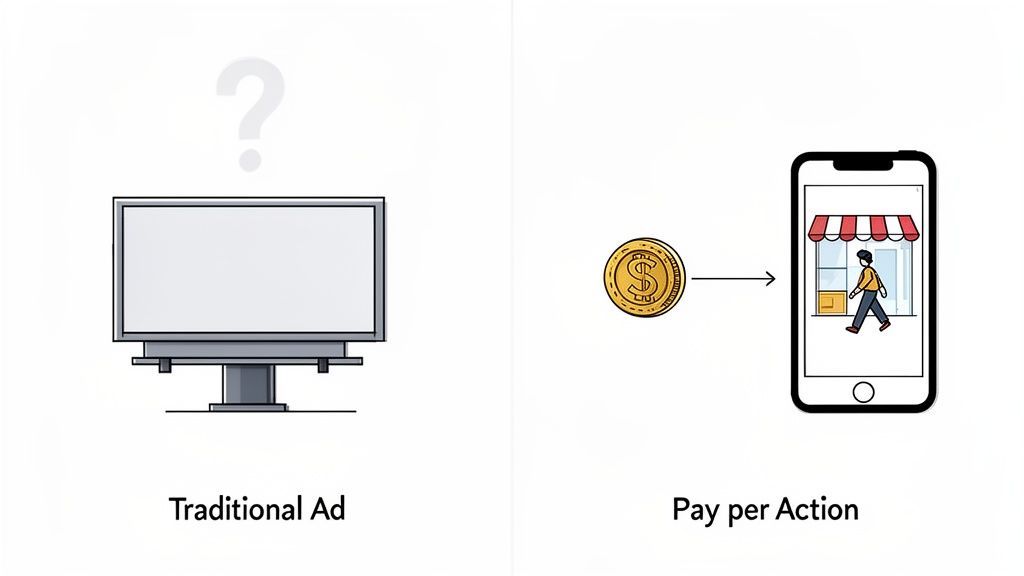
As a business leader, you've likely paid for a billboard, a trade show booth, or a magazine ad. You invest, cross your fingers, and hope it drives business. But what if you could eliminate the hope and only pay for tangible results?
That is the core premise of performance marketing. It's a strategic shift from paying for exposure to paying for specific, measurable actions—a click, a lead, a sale. For leaders, this transforms marketing from a cost center into a predictable, revenue-generating machine. You stop buying ads and start buying business outcomes.
The Core of Performance-Based Growth
Instead of funding campaigns with fuzzy ROI, you allocate budget directly to actions that demonstrably grow your business. This isn't just a trend; it's a fundamental change in how marketing accountability is measured.
The data backs this up. US spending on paid search—a classic performance channel—is projected to hit $124.59 billion in 2024, an 11.1% increase. Why? Because it works. A well-optimized Google Ads campaign, for instance, often generates an average of $2 in revenue for every $1 spent, a 200% ROAS. You can read more about these marketing statistics to benchmark your own industry.
The guiding principle of performance marketing is accountability. If a campaign doesn't drive the specific action you want—a click, a lead, a sale—you don't pay. This creates a relentless focus on optimization and ROI, ensuring every marketing dollar pulls its weight.
How It Works in Practice
The model is built on a data-driven foundation where every action is tracked, measured, and optimized. This diagram illustrates the core components.
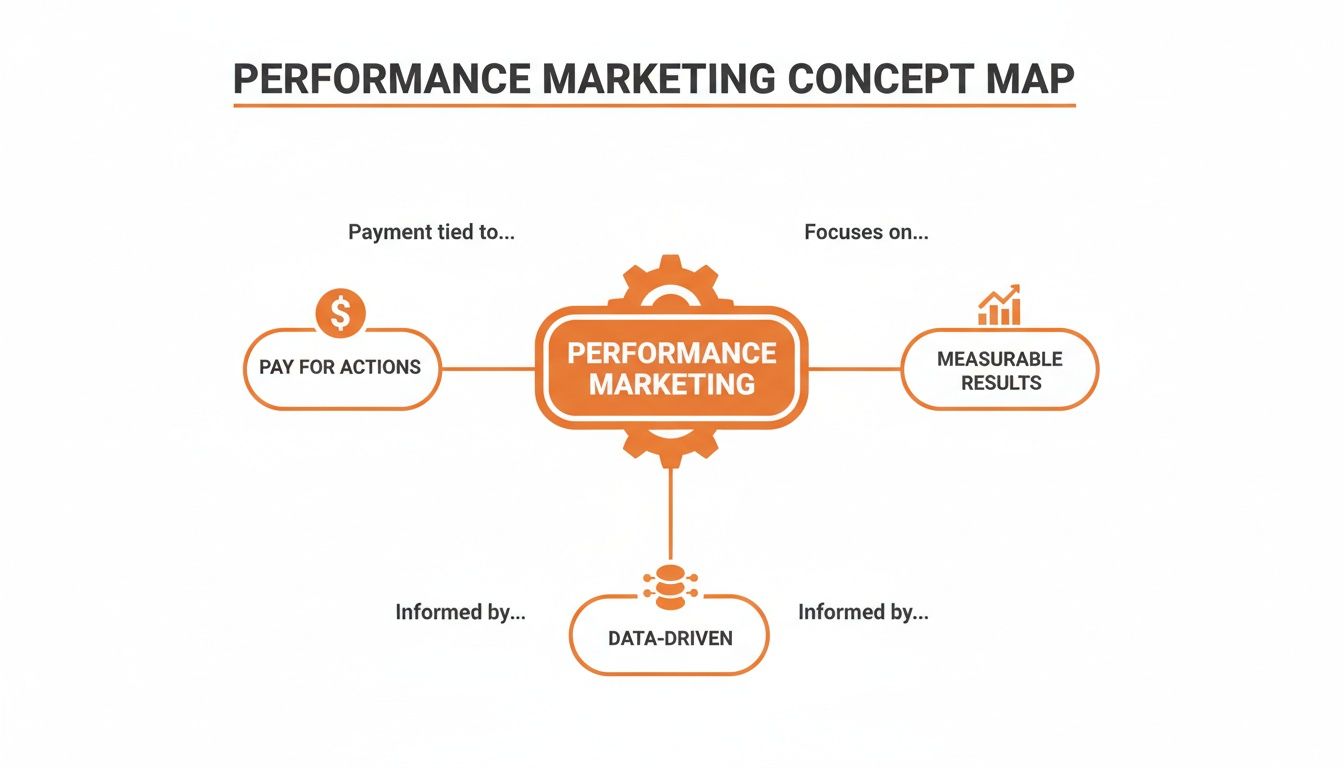
This creates a powerful feedback loop: define a valuable action, track it with precision, and use that data to make the next investment smarter. For a business owner, this eliminates guesswork, providing clear, actionable insights that lead to a tangible return.
This ROI-focused approach is a game-changer for any business focused on efficient customer acquisition, including:
- E-commerce brands targeting a specific Return on Ad Spend (ROAS).
- SaaS companies needing a steady flow of demo requests at a predictable Cost Per Acquisition (CPA).
- B2B firms aiming to capture high-quality Marketing Qualified Leads (MQLs) for their sales pipeline.
By zeroing in on these trackable results, you gain the clarity needed to scale with confidence. An expert team, like the dedicated squads at Ezca, amplifies these results by strategically moving budget to the channels delivering the best returns in real time.
The Core Channels Driving Performance
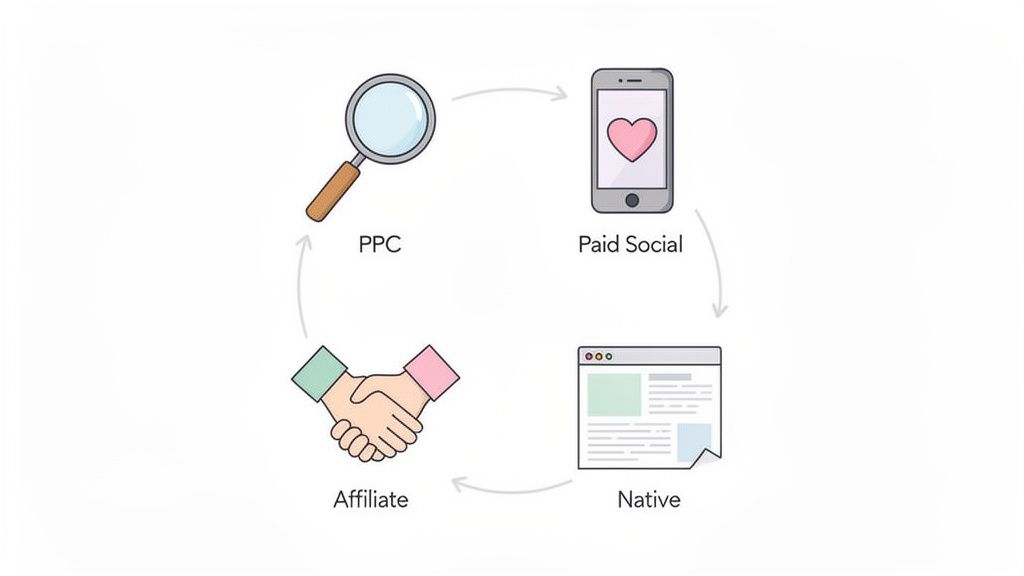
To execute a performance strategy, you must understand the primary channels. These aren't just tactics; they are specialized tools in a growth expert's toolkit. The real skill is knowing which channel to deploy for a specific business objective and when to shift budget for maximum ROI.
Paid Search (PPC)
When you need to capture customers actively seeking a solution, Paid Search, or Pay-Per-Click (PPC), is your most direct tool. It places your business at the top of Google or Bing precisely when a prospect searches "best CRM for small business" or "ergonomic office chair." You meet high-intent buyers at their exact moment of need and only pay when they click.
This makes PPC a workhorse for B2B and e-commerce. A SaaS business can build a reliable pipeline of demo requests. An online retailer can drive immediate sales. For example, an e-commerce client of ours saw a 35% increase in online sales within 60 days by reallocating budget from low-performing social campaigns to a highly-targeted Google Shopping strategy.
Paid Social
While paid search captures existing demand, paid social creates it. Platforms like LinkedIn, Meta (Facebook and Instagram), and TikTok offer powerful targeting tools to reach specific audiences based on job titles, company size, interests, and online behaviors. This is how you build awareness and generate leads from prospects who don't yet know your solution exists.
This isn't just about brand awareness; it's about driving action. Social commerce is projected to hit $908.5 billion by 2026. A B2B tech company could use LinkedIn ads to target VPs of Engineering at Series B startups with an eBook, generating leads for their sales team at a predictable cost-per-lead.
The biggest mistake leaders make is viewing channels in isolation. A smart strategy orchestrates them. A user might first discover your brand via a targeted LinkedIn ad (Paid Social), then search for your company on Google a week later (Paid Search) and finally convert.
An expert team tracks this entire journey. If LinkedIn is generating MQLs at a lower CPA, budget moves there. If Google Ads delivers a higher ROAS the following week, the budget follows the performance. This agility is the heart of effective performance marketing.
Affiliate and Native Advertising
Beyond search and social, two other channels offer unique, performance-based advantages:
- Affiliate Marketing: Partner with publishers, influencers, or other businesses who promote your product. You pay them a commission for each sale or lead they generate. It’s a low-risk way to expand reach, as you only pay for verified results. For example, a software review site earning a 15% commission for every paid subscription it drives.
- Native Advertising: These are sponsored articles or "promoted content" on news sites and blogs, designed to blend in with the surrounding editorial content. They avoid "ad blindness" and are effective for educating prospects on complex solutions before driving them to a landing page.
Pulling the right levers across these channels and applying proven lead generation best practices is what separates a mediocre campaign from a highly profitable one.
KPIs That Truly Measure Business Impact
In performance marketing, you can track almost anything. But metrics like impressions, clicks, and follower counts are "vanity metrics." They look good on a dashboard but don't tell you if your marketing is driving profit.
The goal is to focus on Key Performance Indicators (KPIs) that directly connect to revenue and business growth. A DemandScience report found that a shocking 87% of companies struggle to act on marketing signals, with only 26% of those signals converting. Top-tier marketers cut through that noise by focusing on what matters.
The only question a leader should ask about any marketing activity is this: "Did this make us money?" The right KPIs provide a clear, data-backed answer.
E-commerce Profitability Metrics
For an e-commerce business, the line between ad spend and revenue is direct. Your KPIs must measure the profitability of every transaction, not just the volume.
- Return on Ad Spend (ROAS): The gold standard. For every dollar spent on ads, how much revenue did you generate? A 4:1 ROAS ($4 revenue for every $1 spent) is a common benchmark for a healthy campaign. It is the clearest indicator of campaign profitability.
- Cost Per Acquisition (CPA): The total cost to acquire one new customer. While ROAS measures efficiency, CPA informs scalability. If your average order value is $150 and your profit margin is 40% ($60 profit), you know your CPA must be well below $60 to be profitable.
B2B and SaaS Growth Metrics
For B2B and SaaS, sales cycles are longer. The goal isn't just an immediate sale but acquiring a high-value customer with significant lifetime value (LTV). Your KPIs must track the entire lead-to-revenue journey.
This requires a reliable system for tracking influencer campaign performance and ROI, especially as platforms like TikTok and Instagram become viable B2B channels.
- Customer Acquisition Cost (CAC): A broader metric than CPA. It includes all marketing and sales costs (ad spend, salaries, software) divided by the number of new customers acquired. A sustainable business model requires a CAC that is significantly lower than your LTV. A common rule of thumb is an LTV:CAC ratio of at least 3:1.
- Lead-to-Customer Rate: The percentage of leads that convert into paying customers. A low rate is a major red flag, indicating either poor lead quality from your ads or a disconnect between marketing promises and the sales experience.
This focus on business-critical metrics is how we operate at Ezca. Our 90-day sprints are designed to relentlessly optimize the KPIs that matter—like lowering your CAC and increasing ROAS—to turn marketing spend into a predictable engine for growth.
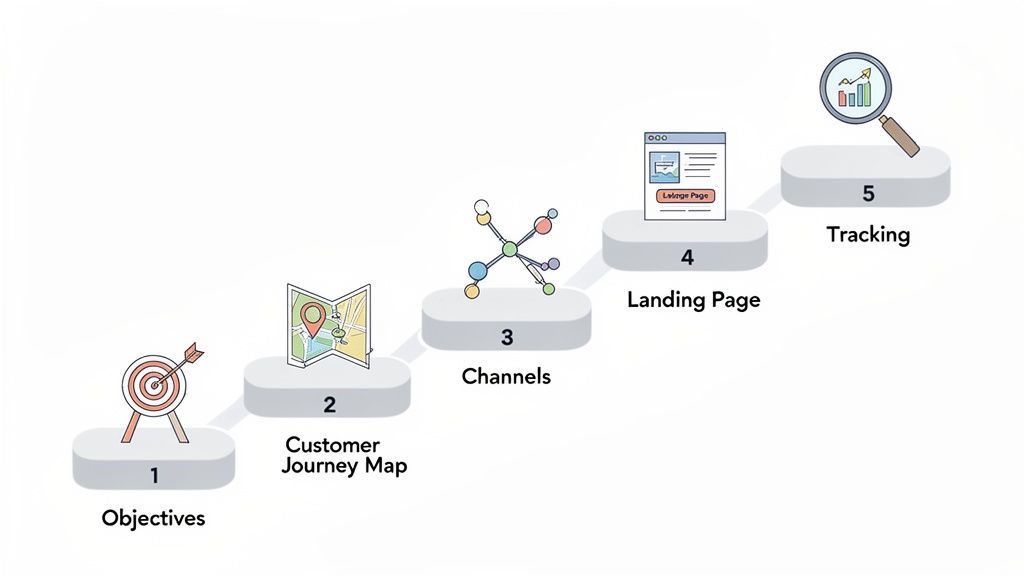
How to Build a Winning Performance Strategy
A winning performance marketing program isn't about "running ads." It's a strategic system designed for growth. For business leaders, this means abandoning the "spray and pray" approach for a predictable, repeatable process that delivers measurable results. It’s the difference between guessing what works and knowing what works.
This process is straightforward but requires discipline. It's how you stop hoping for leads and start building a machine that produces them.
Start with Crystal-Clear Business Objectives
Before you spend a single dollar, define success in concrete terms. "Increase brand awareness" is not a performance marketing goal. Your objectives must be specific, measurable, attributable, realistic, and time-bound (SMART).
Tie goals directly to your P&L. For example:
- For a SaaS company: "Generate 150 qualified demo requests in Q3 at a Marketing Qualified Lead (MQL) cost under $250."
- For an e-commerce brand: "Achieve a 4.5:1 Return on Ad Spend (ROAS) on our new product line within the first 60 days of launch."
These objectives become the north star for your entire strategy. Every decision—from channel selection to ad copy—is made to hit those specific numbers.
Map the Ideal Customer Journey
With a clear goal, map the path your ideal customer takes from problem-aware to solution-ready. What questions are they typing into Google? What social platforms are they using to find information? What pain points does your solution solve?
A classic mistake is fixating only on that last click. The best strategies recognize that a customer’s path is rarely a straight line. They might see a LinkedIn ad, read a blog post a week later, and finally convert from a Google search. If you can’t track this winding, multi-touch journey, you can't properly assign credit or spend your budget wisely.
Choose Channels and Allocate Budget
With a customer journey map, you can make educated bets on the channels that will intersect with your prospects at the right moments. Avoid spreading your budget too thin. Instead, focus your initial investment on the 2-3 channels with the highest probability of success.
Start with a test budget. As the data comes in, be prepared to act decisively. If one channel is delivering leads at a 30% lower CPA than another, it's time to shift spend to the winner. This data-driven agility is the hallmark of a great performance strategy.
Engineer High-Conversion Experiences
Traffic is worthless if it doesn't convert. Your ad and its corresponding landing page must work as a seamless, persuasive unit. The promise made in the ad must be instantly fulfilled on the landing page. The page itself must be clean, focused, and guide the user toward a single, clear call-to-action (CTA).
At Ezca, our squads build these high-conversion assets from the ground up. We then implement robust tracking with tools like Google Tag Manager and platform pixels to measure every step, giving us the data needed for continuous optimization. Explore how our performance marketing services can transform your campaigns.
When to Partner with a Performance Marketing Agency
Every growing company eventually faces a critical decision: keep performance marketing in-house or partner with a specialized agency. While an internal team has deep product knowledge, several clear signals indicate it’s time to bring in outside experts to reach the next stage of growth.
Recognizing these triggers is crucial. If your team is stretched thin, unable to master the complexities of Google Ads algorithms or the nuances of TikTok advertising, you are leaving money on the table.
Key Triggers to Hire an Agency
A classic red flag is diminishing returns. Campaigns that once delivered strong ROAS have gone flat. Your team has exhausted their playbook and lacks the time or advanced tools to diagnose the stall. This is where an agency's specialized expertise provides immediate value.
Here are clear signs it’s time to call for backup:
- You're Struggling to Scale: Your marketing is profitable but has hit a revenue ceiling. You need a team with a proven playbook for breaking through that plateau.
- Your Data Is a Black Box: You have dashboards full of data but no one can translate it into actionable insights that tell you where to invest your next dollar for maximum return.
- Your Team Lacks Channel-Specific Depth: You have talented marketing generalists but need a true specialist—an expert who lives and breathes a single platform, like LinkedIn Ads for a complex B2B sales cycle.
The real power of a good agency is its objective, performance-obsessed viewpoint. They aren't bogged down by past campaigns or internal politics. Their only job is to hit the numbers that grow your business. Period.
Finding the Right Agency Model
The old agency model of long retainers and siloed teams is broken. Today's market demands speed, agility, and a direct link between marketing activity and business outcomes. For a deeper analysis, our guide on in-house vs agency marketing teams is a valuable resource.
This is precisely why we built Ezca around a squad-based model and intensive 90-day sprints. We assign a dedicated team—a strategist, a PPC expert, a social ads manager—to your business. This focused structure enables us to test, learn, and reallocate budget to the highest-performing channels on a weekly basis, ensuring every dollar you invest is working as hard as possible to generate measurable results.
A Few Common Questions About Performance Marketing
As a business leader, you have practical questions about budgets, timelines, and fit. Let's tackle the most common ones we hear.
How Much Do I Really Need to Spend to Get Started?
There is no magic number. Your starting budget depends on your industry's competitiveness, your goals, and channel costs. A click for "enterprise cybersecurity software" can cost 100x more than a click for "handmade leather wallets."
As a baseline, a small to medium-sized business should plan for a minimum of $3,000-$5,000 per month in ad spend, separate from agency or management fees. This budget is necessary to generate statistically significant data from your tests. Anything less makes it nearly impossible to learn what’s working and optimize effectively.
Think of your initial budget as an investment in data, not just ads. The first phase is all about discovery—finding the channels, audiences, and creative that actually move the needle. Once you've found a winner, you can confidently scale up your investment.
What's the Difference Between Performance Marketing and Digital Marketing?
The distinction is critical. Digital marketing is the umbrella term for all online promotional activities, including SEO, content marketing, and email newsletters.
Performance marketing is a subset of digital marketing where payment is tied directly to a measurable action. All performance marketing is digital, but not all digital marketing is performance-based.
For example, writing a blog post for SEO is a classic digital marketing tactic with a long-term, hard-to-attribute ROI. In contrast, running a Google Ads campaign where you pay per click and track every conversion to a sale is pure performance marketing.
How Long Until I See Real Results?
While you can generate clicks and traffic within hours of a campaign launch, meaningful business results require patience. You should see leading indicators—leads, add-to-carts, initial sales—within the first 1-2 weeks.
However, collecting enough data to identify clear trends and begin effective optimization typically takes 30-60 days. This is why a structured approach is vital. Ezca's 90-day sprint model is designed around this reality. We use the first month for rapid testing and validation, then spend the next two months scaling the winning strategies to drive significant, measurable ROI.
Is Performance Marketing a Good Fit for My Business?
If you have a digital product or service with a clear conversion event, the answer is almost certainly yes. This includes nearly all SaaS, e-commerce, and lead-generation-focused B2B companies.
If you can define a valuable action a user can take on your website—booking a demo, purchasing a product, downloading a whitepaper—then performance marketing can help you acquire more of those actions at a profitable cost.
It is less ideal for pure brand awareness campaigns with no defined user action. Even then, performance principles can be applied to optimize for metrics like audience growth and video completion rates.
Ready to turn your marketing spend into a predictable growth engine? The team at Ezca specializes in building data-driven performance strategies for ambitious brands. Our squad-based model and 90-day sprints are designed to deliver measurable results, fast. Discover how our performance marketing services can accelerate your growth.