
What Is Multi-Touch Attribution: A Guide to Boosting Marketing ROI
Learn what is multi touch attribution and discover how it reveals your true marketing ROI. Go beyond last-click to optimize your budget and drive real growth.

Multi-touch attribution (MTA) is a measurement framework that assigns credit to every marketing touchpoint contributing to a conversion. Instead of only rewarding the last click a customer made before buying, MTA provides a complete view of the entire customer journey, preventing you from cutting the budget for channels that are quietly driving initial awareness and consideration.
For business owners and marketing leaders, this means moving from guesswork to data-driven budget allocation. You gain clarity on the true ROI of each channel, enabling smarter investment decisions that directly impact revenue.
Why Last-Click Thinking Is Costing You Money
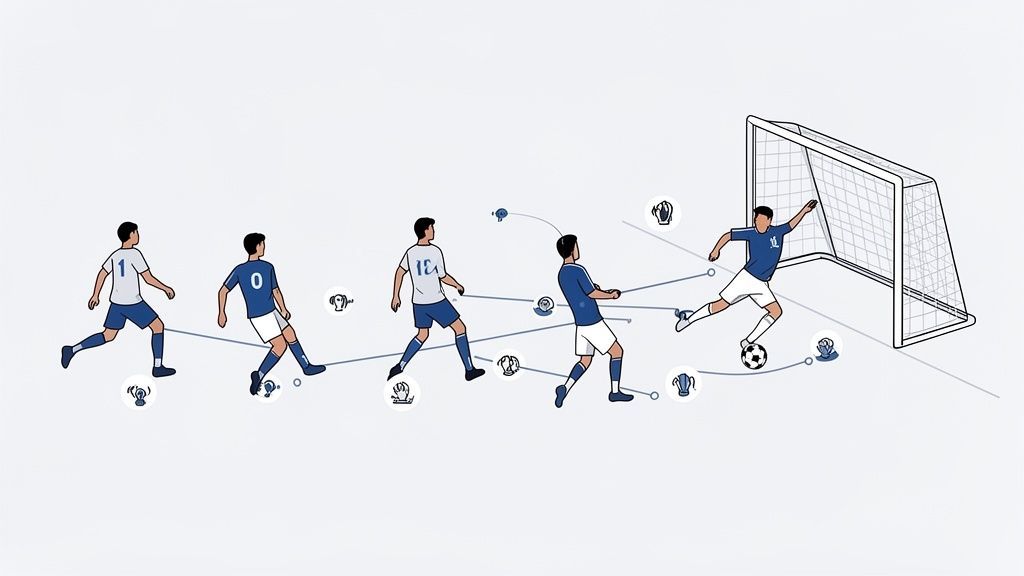
Imagine your top salesperson closes a landmark deal. A last-click model gives that salesperson 100% of the credit. But what about the blog post that first caught the client's attention? The webinar that nurtured their interest? The social media ad that kept your brand top-of-mind? In a last-click world, these critical early efforts are invisible and get zero credit.
This is the expensive flaw in last-click thinking. It dangerously oversimplifies a complex buying process, creating massive blind spots in your analytics. When you only value the final click, you make major budget decisions with a fraction of the necessary data.
This tunnel vision leads to poor financial decisions. For example, you might slash the budget for your top-of-funnel content strategy because it rarely secures the "last click," despite introducing 70% of your new leads to your brand. Multi-touch attribution reveals the full story: every channel has a role, and MTA shows you what it is.
The Problem with a Partial View
Relying on last-click attribution is like trying to understand a soccer game by only watching the goal. You see the ball hit the net but miss the brilliant passes and strategic plays that made the shot possible. In marketing, this means you fail to see the "assists" your channels provide.
A customer might discover you through organic search, read several blog posts, see a retargeting ad on LinkedIn, and then finally convert after clicking an email link. Last-click gives 100% of the credit to the email, creating a false narrative that your SEO and social ad spend are ineffective.
This flawed view leads directly to wasted marketing spend and missed growth opportunities. By embracing a complete measurement model, you connect the dots across your entire marketing mix. To see how this fits into a broader strategy, explore our guide on what is multi channel marketing.
Comparing Last-Click and Multi-Touch
Let's put the two models side-by-side. The difference has immediate consequences for your budget and growth trajectory. The table below breaks down why a holistic view is critical for your bottom line.
Last-Click vs. Multi-Touch Attribution: A Quick Comparison
Shifting your perspective from last-click to multi-touch allows you to invest with confidence, knowing you're funding the entire customer journey, not just the finish line. At Ezca, we leverage multi-touch insights to dynamically shift budgets in our performance marketing sprints, ensuring every dollar is optimized for maximum impact.
Choosing Your Multi-Touch Attribution Model
Once you move beyond last-click attribution, the next critical decision is selecting the right multi-touch model. This is not a one-size-fits-all choice. The optimal model depends on your sales cycle length, customer behavior, and your specific business objectives.
Think of it like choosing a camera lens. A wide-angle lens captures the whole scene, while a macro lens reveals fine details. Each attribution model offers a different perspective on your customer journey. Applying a model built for quick e-commerce sales to a six-month B2B buying process will yield flawed data and lead to poor budget decisions. It’s about matching the model’s logic to how your customers actually buy.
A Practical Comparison of Multi-Touch Attribution Models
To help you find the right fit, let's compare the most common models. Each distributes credit differently, telling a unique story about which touchpoints matter most. The table below breaks down their logic and ideal use cases.
Ultimately, choosing a model is about finding the one that best reflects your customer's real-world path to purchase and provides actionable insights to grow your business.
Linear Attribution: The Equal-Opportunity Model
The Linear attribution model is the most straightforward starting point for MTA. It divides credit for a sale equally among every touchpoint. If a customer engaged with five different marketing assets before converting, each gets 20% of the credit.
This democratic approach is a solid choice for companies new to MTA. It’s also well-suited for businesses with long, complex sales cycles, like many B2B firms, where consistent nurturing is key.
- Actionable Example: A SaaS prospect clicks a LinkedIn ad, downloads a whitepaper, attends a webinar, opens two newsletters, and finally requests a demo. The Linear model assigns 16.7% of the conversion credit to each of those six steps, validating the budget for each stage of the funnel.
Time-Decay Attribution: Valuing What Happened Last
The Time-Decay model operates on the premise that touchpoints closer to the sale are more influential. The first touch gets the least credit, while the last touch gets the most. This model is a natural fit for businesses with shorter sales cycles, where building momentum and closing quickly is the primary objective.
A Time-Decay model is ideal for an e-commerce brand running a 48-hour flash sale. An email sent two hours before the sale ends is likely more influential than a social media post from a week ago. This model correctly weights those final, urgent nudges.
U-Shaped (Position-Based) Attribution: The Opener and the Closer
The U-Shaped model, or position-based, focuses on the two most pivotal moments: the first interaction (awareness) and the last one (conversion). It typically assigns 40% of the credit to the first touchpoint and 40% to the final touchpoint, with the remaining 20% distributed among all middle interactions.
With modern customer journeys averaging over 6.5 touchpoints, understanding which channels bookend the experience is incredibly valuable. The U-Shaped model provides a clear view of what’s working for both customer acquisition and closing.
W-Shaped Attribution: Highlighting Key Mid-Funnel Moments
For more complex journeys, the W-Shaped model identifies three crucial stages: the first touch, a pivotal mid-funnel milestone (like a demo request or lead qualification), and the final converting touch.
In a typical W-Shaped setup, these three events each receive 30% of the credit, with the remaining 10% divided among other supporting touchpoints. This is a game-changer for B2B or high-value sales where a specific action signals high purchase intent.
For instance, a B2B software company could use it to credit:
- The initial Google Ad that drove website traffic (30%)
- The form submission to download a key case study (30%)
- The final click on an email link to sign up for a free trial (30%)
To get an even deeper look into these methodologies, explore this detailed guide on Multi-Touch Attribution Modeling.
The best model is the one that most closely mirrors your unique customer journey. At Ezca, we partner with clients to test and validate different models, ensuring the insights we uncover lead to measurable improvements in marketing ROI.
The Strategic ROI of Implementing MTA
Adopting multi-touch attribution is a strategic shift that directly impacts your bottom line. For marketing leaders and business owners, implementing MTA means replacing guesswork with data-backed confidence and finally proving the tangible value your marketing team delivers.
This new lens on your data unlocks three interconnected benefits that all drive a measurable ROI: smarter budget allocation, deeper customer insights, and a direct line between marketing spend and revenue.
Smarter Budget Allocation
The most immediate ROI from MTA comes from optimized budget allocation. Last-click attribution often misleads you into pouring money into closing channels at the expense of the top-of-funnel channels that generated the leads in the first place. MTA reveals the crucial "assists" along the way.
- Real-World Example: An e-commerce brand sees a fantastic ROI from branded search ads based on last-click data. With MTA, they discover that 60% of those buyers first engaged with the brand through a top-of-funnel TikTok campaign. Without that insight, they might have cut the TikTok budget, inadvertently cutting off their pipeline of new customers.
By understanding which channels introduce, nurture, and close leads, you can confidently shift spend to the highest-impact activities at every stage of the funnel. You stop optimizing for just the finish line and start optimizing the entire profitable journey.
This data-driven approach is core to how Ezca operates. In our performance marketing sprints, we use MTA insights to reallocate budgets weekly, ensuring our clients’ spend is always flowing to the channels driving the highest overall return.
This flowchart can help you begin selecting the right model based on your typical customer journey length.
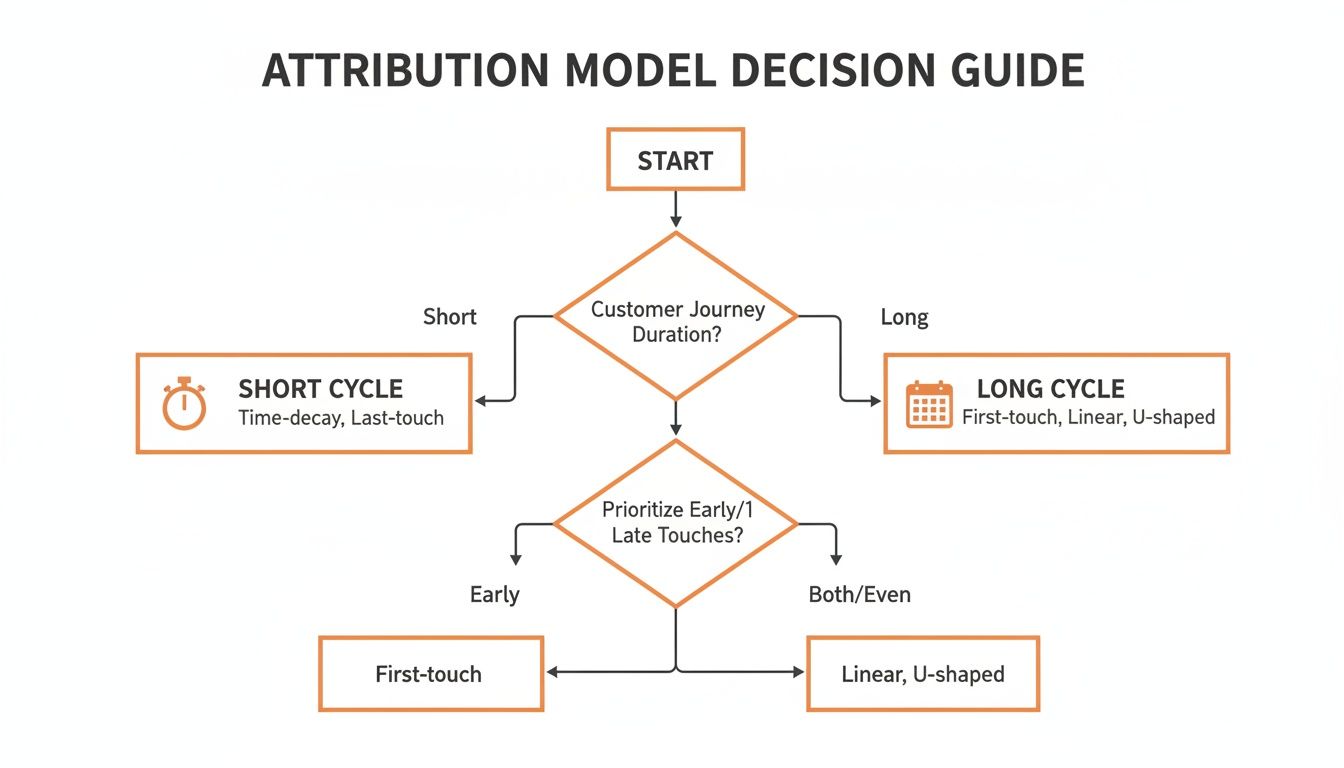
The chart illustrates how your customer journey length—short vs. long—is a critical first factor in choosing an appropriate attribution model.
Deeper Customer Journey Insights
MTA does more than assign credit; it reveals the narrative of how customers engage with your brand. It connects seemingly unrelated activities, showing how your blog posts, social media, and email campaigns work in concert to guide a prospect toward purchase.
This complete picture changes how you view the customer path.
- SaaS Company Example: A B2B SaaS company struggles to prove the ROI of its content marketing because blog posts rarely get the final conversion click. MTA, however, reveals that prospects who read two or more articles are 45% more likely to book a demo within 90 days. Suddenly, the blog’s role as a powerful mid-funnel nurturing tool becomes undeniable.
This level of detail allows you to optimize the sequence of your marketing. You can identify which content performs best for initial awareness versus which assets are better for closing, letting you tailor messaging for maximum impact at every stage.
Proving Marketing’s Value to the Business
For any marketing leader, proving concrete ROI to the C-suite is paramount. Multi-touch attribution provides the hard evidence needed to draw a straight line from your team's activities to company revenue. You can stop reporting on vanity metrics like clicks and impressions and start telling a clear, data-backed story about business growth.
The shift to MTA accelerated in the early 2010s as the explosion of digital channels made single-touch models obsolete. Research from Forrester confirms the financial benefit: organizations that properly implement MTA see an average 19% improvement in marketing ROI within the first year. You can read more on these multi-touch attribution findings.
This shift enables more strategic conversations. You move from defending your budget to demonstrating how increased investment in specific channels will drive predictable revenue growth. You can finally answer the question, "If we invest another $50,000, what is the expected return?" with data-backed confidence.
Your Practical MTA Implementation Roadmap
Getting started with multi-touch attribution doesn't have to be an overwhelming project. The key is a "crawl-walk-run" approach, building a solid foundation before attempting to sprint. The biggest mistake is jumping straight to an expensive, all-in-one MTA platform, which often leads to wasted budget and frustration.
A smarter approach is to start small. Use the tools you already have, like Google Analytics, to begin exploring your data. This lets you prove the value of attribution, secure internal buy-in, and develop the right data habits before seeking a larger budget.
Phase 1: Crawl Before You Walk
This foundational phase is about data integrity. Your attribution model is only as good as the data you feed it. If your data is messy, your results will be useless. Focus on two key areas: defining goals and cleaning up data collection.
- Set Clear Business Goals: Before tracking anything, define what success means. Are you focused on generating MQLs, driving e-commerce sales, or boosting free trial sign-ups? Your core business objective dictates your measurement strategy.
- Master Your Tracking and Tagging: This is the non-negotiable foundation. Implement a strict, consistent UTM parameter system for every marketing link across emails, social posts, and paid ads.
A classic pitfall is inconsistent campaign tagging. If one person uses "summer-sale-2024" and another uses "SummerSale24," your analytics tool sees two separate campaigns. Your data becomes fragmented, and accurate attribution is impossible.
Phase 2: Walk by Connecting Your Data
With clean tracking and clear goals, you can start connecting your data sources to get a complete view of the customer journey. This means breaking down the silos between your marketing platforms and business systems.
A pivotal step is integrating your analytics tool (e.g., Google Analytics) with your CRM (e.g., HubSpot or Salesforce). This connection ties anonymous website activity to real people and, crucially, to revenue.
For instance, this integration might reveal that leads from a specific LinkedIn ad campaign have a 25% higher close rate than leads from other channels—a game-changing insight you'd never find with siloed data. This is exactly where a partner like Ezca can add value, handling the technical integration to ensure seamless data flow.
Phase 3: Run with Advanced Models and Tools
With a solid foundation of clean, connected data, you are ready to run. Now you can confidently explore sophisticated attribution models and dedicated MTA software. You've done the hard work to build an infrastructure that can support these powerful tools.
In the run phase, you can test advanced models like W-Shaped or data-driven attribution. You'll finally be able to answer critical business questions:
- Which blog posts are most effective at the top of the funnel?
- What is the average number of touchpoints for our ideal customer profile?
- What is the true ROI of our content marketing when accounting for all assists?
By following this crawl-walk-run plan, you methodically build your team’s analytical capabilities. You avoid overwhelming your people and overspending on tools you aren't ready for, ensuring your journey to master what is multi-touch attribution is both successful and sustainable.
The Future of Attribution with AI and Machine Learning
The future of attribution is about moving beyond human assumptions. For years, we've relied on fixed, rules-based models like Linear or U-Shaped—essentially, educated guesses. The true future of understanding what is multi touch attribution lies in letting the data speak for itself through Data-Driven Attribution (DDA).
Instead of applying a rigid rule, DDA uses machine learning to analyze every customer journey. It compares the paths of converting users to those who didn't, uncovering the true statistical influence of each touchpoint. Credit is assigned based on what actually drives results, not on preconceived notions.
Moving Beyond Human Bias
The problem with rules-based models is their inherent bias. A U-Shaped model automatically assumes the first and last touches are most important. But what if a mid-funnel webinar is the true hero of your customer journey? A rigid model will almost certainly miss that crucial detail. DDA follows the data. It crunches thousands of user paths to find subtle patterns a human analyst could never catch.
An AI model might discover that customers who see a specific Facebook ad and then read a particular blog post are 300% more likely to convert. It assigns credit based on this observed reality, giving you a far more accurate—and actionable—map of what’s actually growing your business.
These advanced models rely on sophisticated algorithms. For those interested in the technology, this guide to Machine Learning and Predictive Analytics explains how they work.
Future-Proofing Attribution for a Cookieless World
The shift to AI in attribution isn't just about accuracy; it's a strategic necessity. With increasing privacy regulations and the deprecation of third-party cookies, tracking a complete customer journey is becoming more difficult. Machine learning is the key to navigating this new reality.
AI-powered models can work with incomplete data sets. Using predictive modeling, they fill the gaps created by privacy constraints, providing a probable and highly accurate view of the customer journey even without perfect tracking. It's no surprise that 73% of marketers plan to prioritize algorithmic attribution by 2026. This isn't a minor tweak; it's a fundamental shift.
The Human-AI Partnership
This doesn't mean AI is replacing marketers. It means your team is getting a powerful upgrade. The most effective marketing operations will blend the analytical horsepower of machine learning with the strategic wisdom of human experts. Let AI handle the complex data processing, freeing up your team to interpret insights, build compelling creative, and make final strategic decisions.
This powerful combination helps teams work smarter. At Ezca, this human-AI partnership is central to our growth strategies. Our team's deep industry expertise, guided by sophisticated analytics, delivers results for our clients. See how we put this into practice with our AI enablement services.
Frequently Asked Questions About Multi-Touch Attribution
Even with a clear understanding of the benefits, practical questions often arise. Here are answers to the most common queries from business leaders.
How Much Does MTA Cost to Implement?
The cost varies widely, from free to over $50,000 annually, depending on your business complexity and analytical needs.
- Free Starting Point: You can begin for free. Tools like Google Analytics offer basic multi-touch models (Linear, Time-Decay, U-Shaped) out of the box. This is the perfect entry point for smaller teams to prove the concept without any investment.
- Mid-Tier Platforms: For growing businesses, platforms in the $500 to $2,000 per month range offer better CRM integration, improved tracking, and superior data visualization.
- Enterprise Solutions: Large companies with complex, multi-channel campaigns may invest $50,000+ annually for enterprise-level systems that feature AI-driven models, cross-device tracking, and dedicated support.
The best strategy is to start small. Use free tools to demonstrate value and build a business case before requesting a larger budget.
MTA vs. Marketing Mix Modeling
Multi-touch attribution (MTA) and Marketing Mix Modeling (MMM) are often confused, but they answer different strategic questions.
MTA is a bottom-up analysis, looking at individual user actions (clicks, views) to assign credit for specific conversions. MMM is a top-down, big-picture analysis that uses aggregated data (e.g., weekly ad spend vs. weekly sales) to measure the impact of entire channels and external factors like seasonality.
Simply put: MTA can tell you that a specific Facebook ad led a customer to buy. MMM can tell you how your overall TV advertising budget impacts total company revenue. They are complementary tools, not competitors.
Can MTA Track Offline Channels?
Yes, and it's crucial for a complete view. Tracking offline touchpoints like trade shows, print ads, and direct mail is achievable with a bit of setup.
Common tactics include:
- Unique Promo Codes: Assign specific codes to each offline campaign (e.g., "PODCAST20" for a podcast ad).
- Custom URLs or QR Codes: Use a vanity URL or QR code in print materials that directs to a tagged landing page.
- CRM Data Integration: Upload event attendee lists or conference leads directly into your CRM. By connecting your CRM to your attribution platform, you can see how those offline leads later engage with your online marketing.
Tagging these offline activities connects the dots, allowing you to see how a lead from a conference eventually converted after engaging with your digital content.
Ready to stop guessing and start measuring what truly drives your growth? The team at Ezca specializes in implementing data-driven attribution strategies that deliver measurable ROI. Get your free growth plan today.