
Programmatic Advertising Services: Your Guide to Growth in 2026
Unlock scalable growth with programmatic advertising services. This guide shows you how to choose an agency, prove ROI, and drive results for your business.
Think of programmatic advertising less as a piece of software and more as a hyper-efficient stock market for your ads. It's the automated, real-time buying of ad space, placing your message in front of the right person at the exact moment they're most likely to engage.
But for a marketing leader or business owner, it's more than automation—it's a strategic shift. It’s about tying every ad dollar directly to business outcomes like revenue and customer acquisition, not just clicks and impressions.
Beyond Automation: The Strategic Value of Programmatic Advertising
At its heart, programmatic simply uses technology to buy digital ads. But that description barely scratches the surface. For any business leader managing a budget, it represents a move away from slow, manual negotiations for ad placements. It’s a data-fueled system designed to maximize the ROI of every dollar you spend.
This isn’t a "set it and forget it" tool. Real success comes from leveraging this technology to make sharper, faster decisions at a scale no human team could ever manage alone.
The market’s explosive growth tells the story. The global programmatic advertising market is projected to jump from $15.68 billion in 2025 to $19.04 billion in 2026, growing at a compound annual growth rate (CAGR) of 21.5%. This isn't just a trend; it's a direct response to better AI and the absolute need for marketing that delivers measurable results. You can see more on this growth at The Business Research Company.
How The Programmatic Ecosystem Works
To grasp the strategic power of programmatic services, you have to understand the technology that makes it work. In the milliseconds it takes a webpage to load, this entire ecosystem springs into action to decide if your ad is the right one to serve.
This automated marketplace is built for two things: efficiency and precision. Let's break down the core components.
- Demand-Side Platforms (DSPs): This is your command center. It's the software you (or your agency) use to set campaign goals, define target audiences, manage your budget, and buy ad space from thousands of publishers.
- Supply-Side Platforms (SSPs): This is the publisher's tool. Website owners and app developers use SSPs to manage their available ad space and sell it to the highest bidder in real-time, maximizing their ad revenue.
- Ad Exchanges: Picture the New York Stock Exchange, but for digital ad impressions. This is the central marketplace where DSPs (buyers) and SSPs (sellers) connect to conduct transactions through real-time bidding.
This simple table lays out the core components and their roles in the ad-buying process.
The Programmatic Advertising Ecosystem at a Glance
The following diagram shows you what this looks like in action.
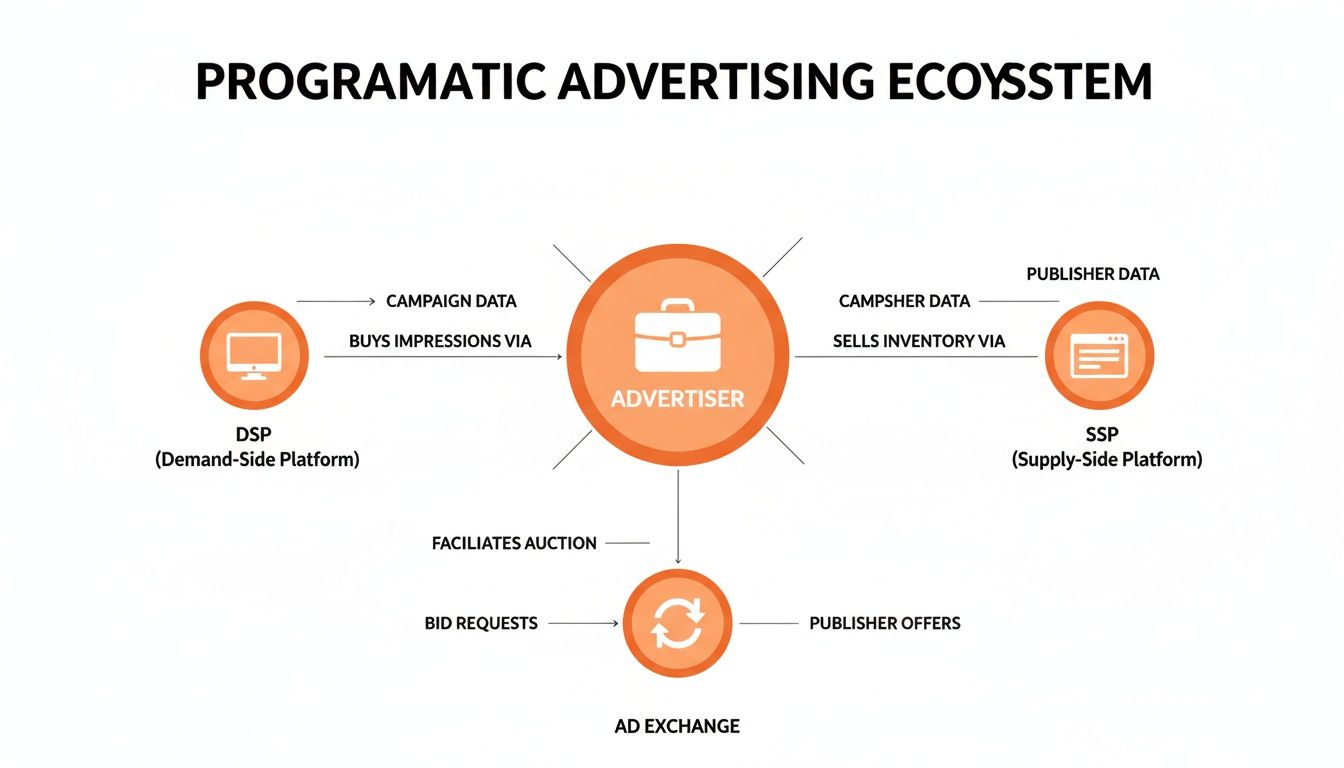
It's a fluid cycle. Advertisers use DSPs to find their target audiences, publishers make ad space available through SSPs, and the ad exchange is where the deal happens instantly.
The Key Takeaway: Programmatic advertising services aren't just about automating ad buys. They provide a strategic advantage. An experienced partner like Ezca uses this ecosystem to tie your ad spend directly to tangible business goals, ensuring every impression is a measurable step toward real growth and a positive ROI.
The Building Blocks of a Programmatic Strategy That Actually Works
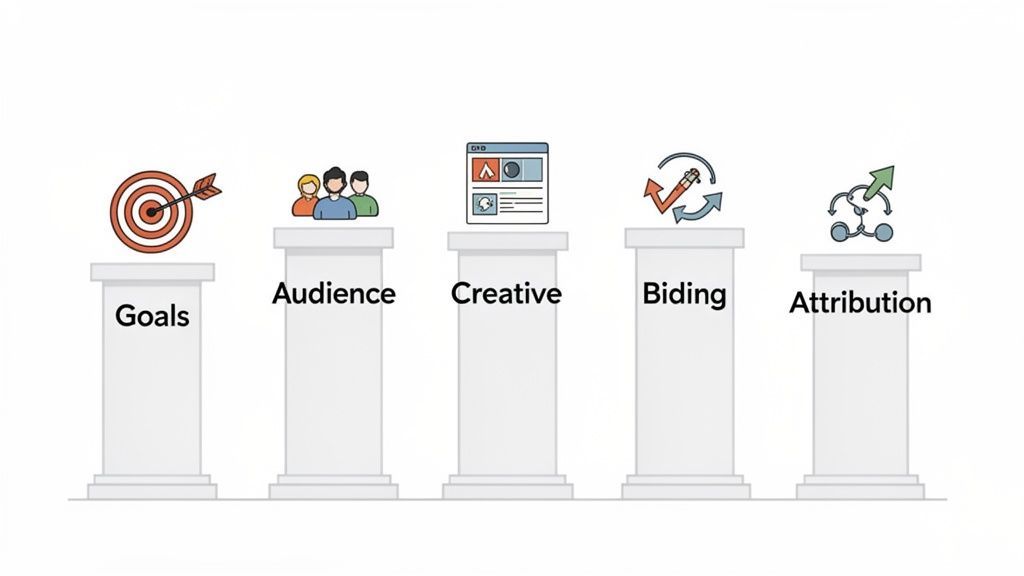
A successful programmatic campaign isn't about flipping a switch on automation. For business owners and marketing leaders, the real win comes from a solid strategic framework that connects every ad and every dollar to a business goal. A high-performing strategy is built on four core components that work together, with data from one area sharpening the next.
1. Setting Goals That Matter
Before spending a dollar, you must define success in concrete terms. Vague goals like "brand awareness" aren't actionable. A performance-driven approach demands precision.
- Define Your Target CPA: How much can you afford to pay for a new customer or qualified lead? This is your Target Cost Per Acquisition (CPA).
- Know Your Customer's Worth: Calculate your Customer Lifetime Value (LTV). This number dictates your acquisition budget by showing the long-term payoff.
- Establish a ROAS Floor: What’s the minimum revenue you need back for every dollar spent on ads? That’s your breakeven Return on Ad Spend (ROAS).
For example, a SaaS company might set a $250 CPA for a new trial sign-up, knowing their average LTV is over $3,000. This data-backed goal provides a clear benchmark for success.
2. Intelligent Audience Targeting
The power of programmatic lies in its ability to zero in on specific audiences, far beyond basic demographics. A modern strategy blends different data sources to connect with people most likely to become customers.
A high-performance programmatic strategy isn't about reaching the most people; it's about repeatedly reaching the right people. This shift in mindset separates budget-draining campaigns from revenue-generating machines.
For an e-commerce brand, this means using their own sales data (first-party data) to build lookalike audiences that mirror their best customers. For a B2B firm, it could involve leveraging third-party data to serve ads directly to individuals with specific job titles, like "VP of Marketing," at target companies.
3. Dynamic Creative That Adapts
Even perfect targeting is wasted if your ad creative is generic. Dynamic Creative Optimization (DCO) technology automatically tests and serves the best ad version to different users in real time.
This delivers a personalized experience without manually creating thousands of ad variations. A travel website, for example, can use DCO to show a user an ad for Paris right after they’ve searched for flights, complete with real-time pricing. That relevance drives significantly higher engagement and conversions. Mastering this is key, and it's a core part of the comprehensive performance marketing services we offer at Ezca.
4. AI-Powered Bidding and Clear Attribution
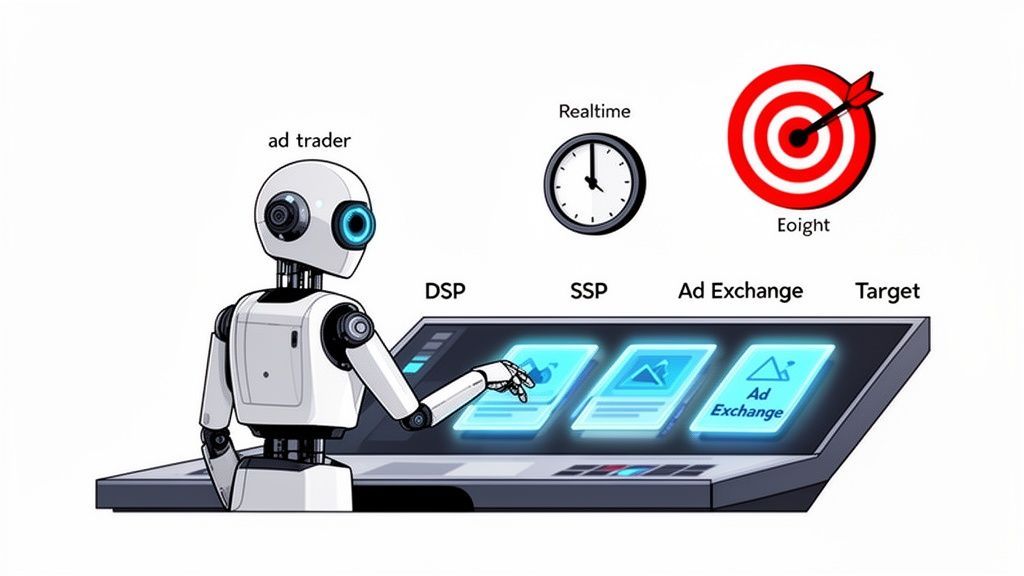
Behind the scenes, powerful AI algorithms are the engine of programmatic bidding. These systems analyze thousands of signals—the user, time of day, device, publisher history—to calculate the perfect bid price for each ad impression.
Simultaneously, you need a transparent attribution model. A partner like Ezca provides a unified dashboard tracking the entire customer journey, from the first ad impression to the final purchase. This real-time visibility is why 84% of marketers report their programmatic performance improves year after year. When you can prove ROI instantly, you can confidently shift budget to the channels that are working best. Dive deeper into this trend in the U.S. programmatic market outlook.
How to Measure Programmatic Advertising ROI
For a marketing leader or business owner, every dollar must answer to the bottom line. With programmatic advertising, success isn't measured in vanity metrics like impressions or clicks. It's measured in tangible business growth.
The goal is to connect your ad spend to a predictable revenue engine. This requires a clear, data-backed picture of what's actually working so you can double down on effective strategies.
The Core Metrics That Actually Matter
While dozens of metrics are available, only a few truly measure the business impact of your programmatic services.
- Return on Ad Spend (ROAS): The ultimate bottom-line metric. For every dollar you put into a campaign, how many dollars did you get back in revenue? A 4:1 ROAS means you’re generating $4 for every $1 spent.
- Customer Acquisition Cost (CAC): This tells you exactly what it costs to win a new customer. Divide your total ad spend by the number of new customers acquired. A low, stable CAC is the hallmark of a healthy, scalable campaign.
- Customer Lifetime Value (LTV): This metric provides a long-term view, estimating the total revenue you can expect from a single customer over your entire relationship. When your LTV is significantly higher than your CAC, your acquisition strategy is sustainable and profitable.
By focusing on the LTV to CAC ratio, you move from short-term campaign results to long-term business health. A strong programmatic partner like Ezca builds strategies designed to acquire high-LTV customers, ensuring your investment pays dividends for years to come.
Setting Realistic Benchmarks and Understanding Attribution
There is no universal "good" benchmark for these KPIs. The numbers that matter vary dramatically by industry. An e-commerce brand might need an 8:1 ROAS to be profitable, while a B2B SaaS company with high-margin subscriptions could thrive with a 3:1 ROAS if those customers have high retention.
Your attribution model—how you assign credit for a conversion—also changes the story. A last-click model credits only the final ad a user saw. A multi-touch model shares credit across all touchpoints in the customer journey. Knowing which model your team uses is crucial for accurate analysis. To truly gauge effectiveness, you must understand how to measure marketing ROI.
This is only becoming more important. With 75% of marketers planning budget increases, the demand is for real-time proof of performance. AI-driven bid optimization is already pushing ROAS higher, making quick, data-backed decisions more critical than ever. Discover more insights about these market trends.
Ultimately, you need a unified dashboard giving you a live view of your most important metrics. This enables the agile budget shifts that turn programmatic from an expense into a powerful revenue engine.
How Programmatic Strategy Changes With Your Business Model
Programmatic advertising is not a one-size-fits-all solution. Its power comes from tailoring the strategy to your specific business. The playbook for a SaaS company chasing enterprise deals looks completely different from an e-commerce brand trying to sell more sneakers.
Let's explore how this works in the real world, using proven playbooks that turn ad spend into predictable growth.
The Playbook for SaaS and B2B
For B2B and SaaS businesses, the goal is quality over quantity. You're not looking for an impulse buy; you're trying to start a conversation with the right decision-makers. The long sales cycle requires a focus on generating high-value leads.
This is where account-based marketing (ABM), powered by programmatic, excels. We can take your target list of dream companies and use data to serve ads directly to people with specific job titles—like "Director of Operations" or "VP of Finance"—within those organizations. Every dollar is spent reaching someone with buying authority.
A Real-World Scenario: SaaS Lead Generation
- The Goal: Drive qualified leads for a new project management platform.
- The Tactic: Run programmatic display and video ads promoting a high-value asset, like a whitepaper on "Boosting Team Productivity." The campaign would target professionals with titles like "Project Manager" or "Head of Product" at tech companies with 50-500 employees.
- How We Measure Success: The core metric is Cost Per Lead (CPL). The target is to keep CPL under $75, a smart investment when the average customer lifetime value (LTV) is $5,000.
- The Follow-Through: After downloading the whitepaper, leads are entered into a retargeting funnel showing them case study ads and, later, an invitation for a free trial. This methodical process nurtures leads through the B2B buying journey.
This approach turns your advertising from a wide-net awareness campaign into a laser-focused tool for building your sales pipeline. You stop wasting money on irrelevant audiences and start speaking directly to your ideal customer.
The Playbook for E-commerce
E-commerce businesses live and die by driving sales efficiently at scale. Programmatic is a powerhouse for both finding new customers and maximizing revenue from existing site visitors.
The killer tactic is Dynamic Product Retargeting. This technology automatically shows people ads for the exact products they viewed on your site or added to their cart. It’s why those shoes you considered yesterday seem to be following you around the internet—and it works.
A Real-World Scenario: E-commerce Cart Recovery
- The Goal: Win back customers who abandoned their shopping carts and lift overall sales.
- The Tactic: Launch a Dynamic Product Retargeting campaign aimed at anyone who adds an item to their cart but leaves without buying. The ads show them the products they left behind, often with a nudge like a time-sensitive discount ("10% off for the next 24 hours") to create urgency.
- How We Measure Success: It’s all about Return on Ad Spend (ROAS). For this type of campaign, we aim for a 10:1 ROAS. That means for every $1 spent, the campaign brings in $10 in recovered sales.
- The Optimization: This campaign runs across the open web and social media. We constantly analyze which channels and placements deliver the highest ROAS and shift budget in real-time to the top performers. Combining programmatic with our powerful social advertising strategies is a huge force multiplier.
Programmatic Strategy by Business Model
This table provides a clear breakdown of how goals, tactics, and KPIs change based on your business model.
Ultimately, the right programmatic strategy isn't about using every feature. It's about a deep understanding of your business model and applying the right tools to achieve specific, measurable goals.
Choosing the Right Programmatic Advertising Partner
Choosing a partner to manage your programmatic advertising can make or break your marketing budget. The right agency becomes an extension of your team, tying every ad dollar directly to business goals. The wrong one can burn through your budget with little more than vanity metrics to show for it.
Making a smart choice means looking past sales decks and asking the hard questions that uncover a partner's real capabilities.
Technical Expertise and Platform Access
First, look under the hood at their tech stack. A top-tier programmatic partner shouldn’t be locked into a single Demand-Side Platform (DSP). They should have access to a range of them.
This is critical because different DSPs excel at different tasks. Some are masters of Connected TV (CTV) advertising, while others offer superior B2B targeting data. A single-platform agency is a one-trick pony.
Here are the questions you need to ask:
- Which DSPs do you have access to, and why do you use each one? Their answer should be strategic, showing they know how to match the right tech to your business goals.
- What are your go-to data partnerships? Great data is the fuel for programmatic success. Access to high-quality first, second, and third-party data is what enables precise audience targeting.
- How do you ensure brand safety? A competent partner will have a rock-solid process using whitelists, blacklists, and advanced fraud detection to protect your brand and prevent ad waste.
A partner’s value is directly tied to the sophistication of their tech stack and their ability to strategically deploy it. If they can only offer a one-size-fits-all solution, they aren’t a true expert.
A Transparent and Actionable Reporting Process
Vague promises and confusing reports are massive red flags. At Ezca, we believe in radical transparency. You need real-time access to a dashboard that clearly shows the KPIs that matter to your business, like ROAS, CAC, and CPL.
Demand clarity on how they report results. A great agency will show you not just what happened, but why it happened and what they’re doing next to improve performance. This requires dedicated strategists and data analysts who can turn raw numbers into an actionable plan.
Many businesses wrestle with whether to build this function internally or hire an agency. Our guide on choosing between an in-house vs. agency marketing team provides a detailed framework for this decision.
The Agency Vetting Checklist
Use this checklist to objectively evaluate potential programmatic advertising services:
- Industry Experience: Can they show proven success and case studies in your specific vertical (SaaS, e-commerce, B2B)?
- Strategic Depth: Is their team made up of dedicated strategists and analysts, or are they just campaign managers pushing buttons?
- Pricing Model: Is their pricing structure clear and tied to performance? Be wary of models that just incentivize them to spend more of your budget.
- Team Communication: How will they communicate? Expect regular, structured meetings focused on performance and future strategy.
Choosing a partner is a major commitment. A structured approach helps you cut through the noise and find an agency that will be a genuine asset to your growth.
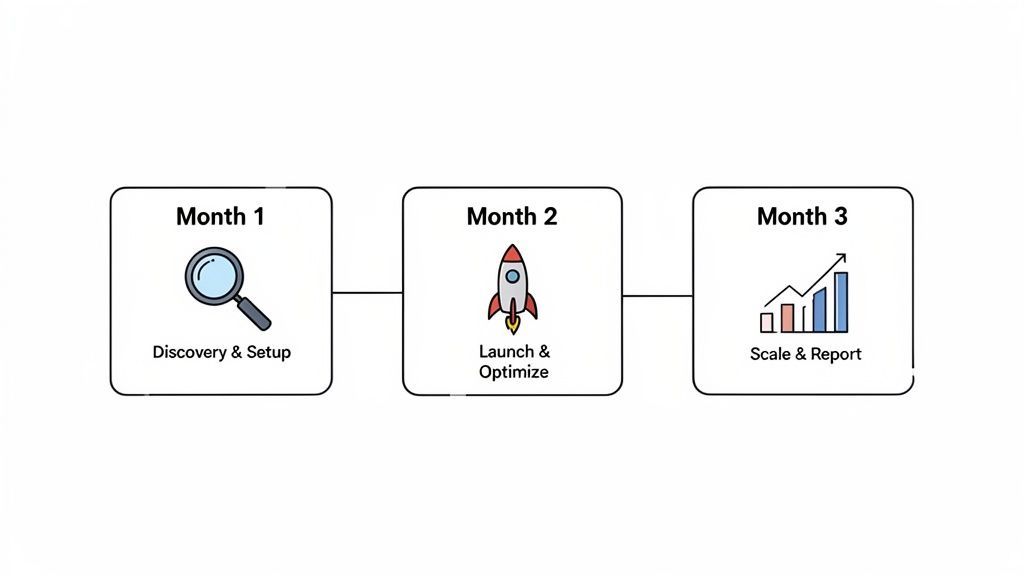
Your First 90 Days with a Programmatic Agency
So, you’ve signed with a programmatic agency. What happens now? For most marketing leaders, this is where the anxiety can creep in. You're committing a significant budget and need to see a return. A great agency partnership is built on a tangible, 90-day playbook that turns strategy into measurable results.
A skilled agency like Ezca will walk you through a structured process designed to get the foundation right before accelerating. Here’s what that journey should look like.
Month 1: Discovery and Technical Setup
The first 30 days are about getting the plumbing right. This phase is less about sales numbers and more about building the technical and strategic infrastructure. Rushing this step is the single biggest mistake you can make.
Your agency should be running workshops to understand your business, your true KPIs, and your ideal customers.
Key activities in Month 1 include:
- Technical Audit and Tagging: This is non-negotiable. Your agency will install tracking pixels across your website. Without this, you're flying blind, unable to track conversions or build effective retargeting audiences.
- Audience Segmentation: They’ll build your first audience groups using your customer data, lookalike models, and relevant third-party data sources.
- Creative Asset Development: The agency will work with you to collect and organize the images, videos, and ad copy for your first campaigns.
By the end of this month, every tracking tag should be firing correctly, initial audiences will be loaded into the DSP, and you'll have a clear launch plan.
A Word on Expectations: The goal for Month 1 isn't a high ROAS. The goal is flawless technical setup and strategic alignment. Success is measured by data collection accuracy, not initial sales.
Month 2: Launch and Optimization
With the groundwork laid, Month 2 is when the campaigns go live and data starts flowing. This is the crucial "learn and adapt" phase.
The initial budget is an investment in data. The algorithms gather performance signals that inform all future decisions. Your agency will be A/B testing variables to see which audiences, creatives, and channels are performing.
Key activities in Month 2 include:
- Campaign Launch: Campaigns are activated across the platforms and channels mapped out in Month 1.
- A/B Testing: The agency systematically tests different ads, headlines, and calls-to-action to find what resonates.
- Bid and Budget Refinement: Based on early data like CTR and CPA, the team will make small, strategic tweaks, moving budget toward what’s working.
During this period, you should have weekly check-ins with your agency to review data, discuss learnings, and plan next steps.
Month 3: Scale and Report
By Month 3, the algorithms have moved past the initial learning curve and have enough data to make intelligent decisions at scale. The focus now shifts to maximizing your return on investment.
Your agency will aggressively reallocate budget toward the top-performing campaigns, audiences, and ad formats. The winning tests are scaled, while the losers are cut.
This is when you should start seeing a significant, steady return on your ad spend. Key metrics like ROAS and CAC should be trending in the right direction. The foundational work from the first 60 days is what makes this profitable scaling possible.
Answering Your Top Questions About Programmatic Ads
Even after buying into the strategy, practical questions always come up. As a business leader, you need to understand the real-world implications. Here are the most common questions we hear.
How Much Do Programmatic Advertising Services Actually Cost?
This is always the first question. The answer typically comes down to two main pricing models:
- Percentage of Ad Spend: The most common model, where your agency takes a fee that’s a set percentage of your total monthly ad budget, typically in the 15-25% range.
- Monthly Retainer: A flat monthly management fee, which works well for stable, predictable budgets.
Realistically, to see meaningful results, you should plan for a starting ad spend of at least $10,000 to $15,000 per month. This isn't arbitrary—it ensures there's enough data for the algorithms to learn and for your agency to run effective tests.
Isn't This Just like Running Google or Facebook Ads?
That's a common confusion, but the difference is fundamental. Platforms from Google and Meta are "walled gardens." They are powerful, but they keep your advertising locked within their own ecosystems.
Programmatic advertising, on the other hand, gives you access to the entire open internet. This includes millions of websites, mobile apps, streaming TV services, and digital audio stations. It allows you to find and follow your ideal audience wherever they are, not just when they are on a specific social feed.
A great partner like Ezca will integrate your programmatic campaigns with social and search ads, but it’s the programmatic piece that unlocks massive scale beyond what the tech giants offer alone.
How Long Does It Take to See Real Results?
This is the ROI question every leader needs to ask. You will see activity from day one, but true, repeatable performance takes time.
The first 30 to 60 days are about discovery and optimization. This is a critical learning phase where the AI algorithms gather data and your agency tests audiences and creatives to find what drives conversions for your business.
Once that foundation is set, you'll see key metrics like ROAS and CPA steadily improve. Scalable growth, where you can confidently increase budget and see a predictable return, usually kicks in around the 90-day mark. That's when the campaign shifts from learning to aggressive, data-backed optimization.
Ready to see how a data-driven programmatic strategy can transform your growth? The team at Ezca Agency specializes in creating and executing high-performance campaigns that deliver measurable ROI. Start your 90-day growth sprint with us today.