
The Business Leader's Guide to PPC Ad Campaign Management
Level up your PPC ad campaign management. This guide offers actionable strategies for planning, optimizing, and scaling paid ads to drive real ROI.
Effective PPC ad campaign management isn’t about "running ads." It's a strategic system for overseeing and optimizing paid advertising to hit specific business outcomes—like generating qualified leads or driving profitable sales. It’s the critical difference between burning cash and building a predictable revenue engine.
This guide outlines a proven framework for managing high-performing PPC programs. We'll focus on the actionable insights marketing leaders need to turn ad spend into a strategic investment.
Core Pillars of High-ROI PPC Management
These pillars are an interconnected system. A brilliant ad will fail if the targeting is off, and perfect targeting is useless if your landing page doesn't convert. Now, let's explore why this systematic approach is no longer optional.
Why Top-Tier PPC Management Is Non-Negotiable
For marketing leaders and business owners, the question isn't whether to invest in PPC. It's whether you're managing it with enough strategic rigor to generate a positive return. Too many ad accounts are chaotic money pits instead of profitable growth channels.
The difference almost always comes down to the quality of the management.
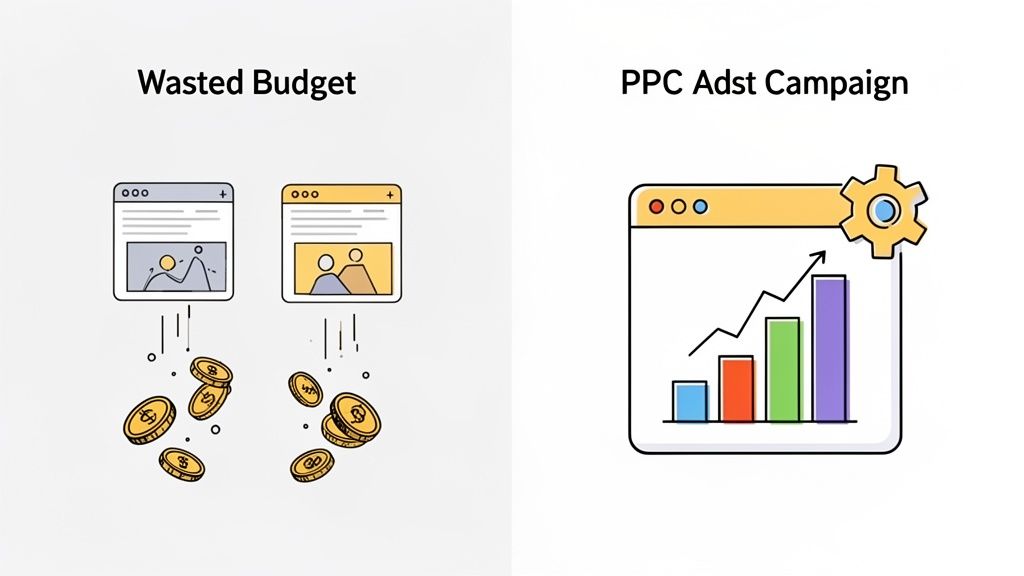
When managed well, the data is compelling. On average, businesses earn $2 for every $1 spent on Google Ads, a solid 200% ROI. That’s a return that fuels business growth.
But here's the reality check: a shocking 72% of companies haven’t looked at their ad campaigns in over a month. That’s not management; it's negligence. If you want to dig deeper into the data, these 2026 PPC statistics highlight the performance gap between the top 10% and everyone else.
Get Beyond "Set It and Forget It"
The outdated approach of launching a campaign and hoping for the best is a guaranteed way to waste money. Today's ad platforms are complex ecosystems that reward—and expect—active, strategic oversight.
This means shifting your mindset from passive observation to active optimization. In practice, this looks like:
- Continuous Refinement: Constantly digging into performance data to fine-tune bids, adjust targeting, and iterate on ad creative based on what's driving conversions.
- Precision Audience Targeting: Using your first-party data and platform tools to zero in on your most valuable, high-intent buyers, not just broad keyword match types.
- Strategic Automation: Leveraging AI for the heavy lifting of bidding and data analysis, which frees up your team's time for high-level strategy, creative direction, and business goal alignment.
The secret to modern PPC is realizing you aren't just buying clicks—you're buying data. Every click is an insight. When you use that data to inform your next move, every dollar you spend becomes more efficient than the last.
Adopt a 90-Day Sprint Framework
To break free from campaign neglect, we run our PPC programs in a "90-day sprint" framework. This agile approach forces you to treat PPC management as a series of focused projects with clear, measurable objectives.
Instead of vague, ongoing "management," you operate in intense cycles of learning, optimizing, and scaling what works. For example, a sprint goal could be "Reduce Cost per Lead by 15% in Q3." This is the exact agile methodology our squads at Ezca use, giving us the flexibility for weekly budget adjustments and continuous improvement. It’s how you turn ad spend into a predictable part of your revenue machine.
This playbook gives you the tactical steps to put this system to work.
Blueprinting Your Campaigns for Profitability
Your PPC strategy doesn't start with clever ads or keyword bids. It starts with the campaign blueprint. After auditing hundreds of ad accounts, the story is always the same: messy, illogical structures lead to wasted spend, poor Quality Scores, and indecipherable data.
A flawed foundation forces you to fight an uphill battle against the platform's algorithm. A clean, logical structure, on the other hand, gives you precise control, enables you to speak directly to specific audience needs, and feeds you clean data for smart decision-making.
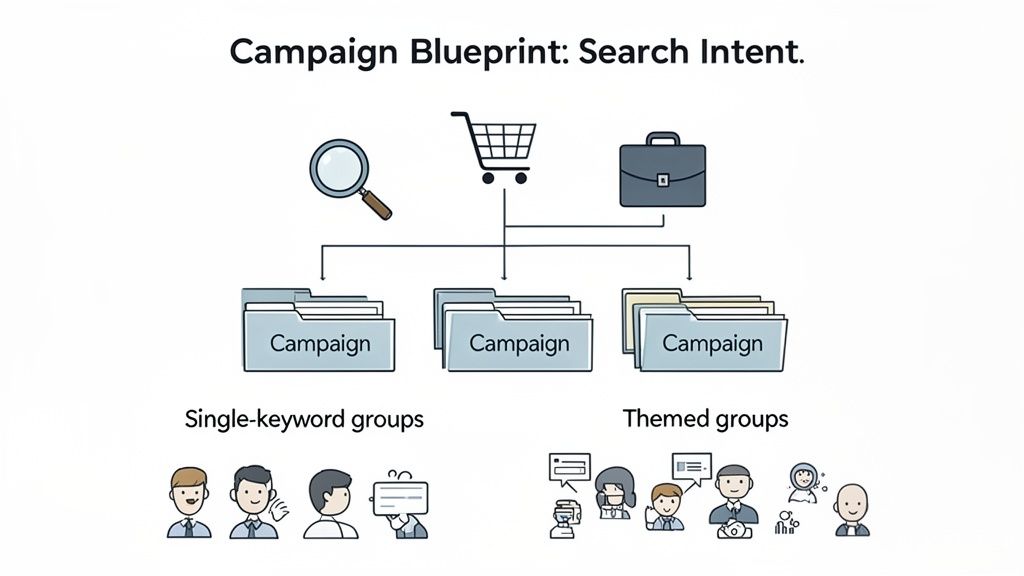
At its core, great structure is about matching your account architecture to the way real people search. The goal is to create perfect alignment between the search query, the ad they see, and the page they land on.
Structuring for Search Intent
Before you even think about keywords, you must get inside your customer’s head. Map out the different ways they search for solutions. This is search intent, and it generally falls into distinct buckets.
Let’s use a real-world example: a B2B SaaS company with a project management tool.
- Informational Intent: A search for "how to improve team productivity." This prospect is problem-aware but not yet solution-aware. They are not ready for a hard sales pitch.
- Commercial Intent: Now they're searching for "best project management software for small business." They are actively comparing options. This is a crucial, high-value mid-funnel stage.
- Transactional Intent: A search for "Acme Project Tool pricing" or "Acme Project Tool demo" signals they're ready to buy. The intent is high and immediate.
You cannot treat these searchers the same way. You wouldn't serve a "Request a Demo" ad to someone looking for productivity tips. By building separate campaigns for each intent level, you can tailor your message, offer, and landing page to meet prospects exactly where they are in their buying journey.
SKAGs vs. Themed Ad Groups: A Practical Guide
A long-running debate in PPC is how to group keywords: Single Keyword Ad Groups (SKAGs) or broader, themed ad groups? The right answer depends on your search volume, budget, and management resources.
Single Keyword Ad Groups (SKAGs) This granular approach dedicates an entire ad group to a single exact match keyword. For instance, the keyword [b2b crm software] gets its own ad group with ads written specifically for that exact phrase.
- Pro: Maximum relevance, leading to high Quality Scores, higher click-through rates (CTR), and lower costs. You have ultimate message control.
- Con: Can be a nightmare to manage at scale. It also spreads your data thin, making it harder for automated bidding strategies to learn effectively.
Themed Ad Groups This practical approach groups a small handful of tightly related keywords. For example, one ad group might contain "[crm for sales teams]," "[sales team crm solution]," and "[best crm for salespeople]."
- Pro: Much easier to manage and consolidates data, giving bidding algorithms more conversion signals to work with. This plays well with Google's AI and broader match types.
- Con: You lose a small degree of ad-to-keyword relevance, which can sometimes result in a slightly lower CTR compared to a pure SKAG.
For most businesses, a hybrid model is the sweet spot. Use SKAGs for your highest-volume, highest-intent "money" keywords where precision is critical. For everything else, use themed ad groups to maintain efficiency and feed the algorithm enough data to optimize.
Budgeting and Bidding for Maximum ROI
You've built the perfect campaign structure. Now it's time to fuel it. Your budget and bidding strategy are where your plan becomes reality—it’s the difference between a high-performance growth engine and an expensive hobby.
Setting a budget isn't about picking a random number. It’s about providing enough data for the platform’s algorithm to learn. A budget that's too small starves the system of clicks and conversions, preventing it from identifying patterns and optimizing effectively. You won't get meaningful results.
For a new campaign, a starting budget of $1,500 to $5,000 per month is a realistic minimum. This isn't arbitrary; it's the typical investment needed to gather enough click and conversion data to make statistically significant decisions.
The real art is scaling that budget intelligently. The only rule that matters is to scale based on performance, not gut feelings. When a campaign consistently hits your target Cost Per Acquisition (CPA) or Return on Ad Spend (ROAS), it has earned the right to more budget. Increase it methodically—about 15-20% at a time—to give the algorithm room to adapt without resetting its learning phase.
Choosing the Right Bidding Strategy for Your Goal
Google's automated bidding is powerful, but it needs clear instructions. Each bidding strategy aligns with a specific business objective.
- Maximize Conversions: Your default for new campaigns. You're telling Google, "Get me as many conversions as possible within this daily budget." It's the fastest way to gather the initial conversion data needed to establish a baseline CPA.
- Target CPA (tCPA): The workhorse for lead generation. If your business can profitably acquire a lead for $100, you set your tCPA to $100. Google's algorithm will then aim to deliver leads at or below that cost, optimizing for volume at a predictable price.
- Target ROAS (tROAS): Essential for e-commerce. When product prices and profit margins vary, you care about total revenue, not just the number of sales. By setting a tROAS target of 400% ($4 in revenue for every $1 spent), you instruct the algorithm to prioritize high-value sales to meet your profitability goals. Use this Break Even ROAS Calculator to determine your minimum threshold.
- Manual CPC: A tool for experts needing absolute control over specific, high-value keywords. Think of it as driving a manual car—powerful in the right hands but requires constant attention. It's rarely the primary choice in an AI-driven world.
A B2B SaaS company aiming for demo requests will live and die by tCPA. An e-commerce brand selling shoes must obsess over tROAS. Your bidding strategy must mirror your business's economic model.
Layering Audiences for Surgical Precision
This is where good PPC management becomes great. Keywords tell you what people are searching for. Audiences tell you who is searching. Layering them together delivers surgical precision and maximizes budget efficiency.
Instead of just bidding on a broad keyword like "CRM software," you can instruct Google to bid higher (or only bid at all) when the searcher is also part of a high-value audience.
Powerful audience layers include:
- Your First-Party Data: Your most valuable asset. Upload a list of qualified leads from your CRM to retarget them, or better yet, create a lookalike audience to find new prospects with similar characteristics. For B2B, this is how you execute an Account-Based Marketing (ABM) strategy on search.
- In-Market Audiences: Google identifies users actively researching and comparing products or services. Layering an "In-Market for Business Software" audience ensures your ads are prioritized for users deep in the buying cycle.
- Strategic Remarketing Funnels: Don't treat all website visitors equally. Create separate audience lists: one for blog readers, another for pricing page viewers, and a high-priority list for cart abandoners. Then, serve each segment a tailored message to guide them to the next step.
This advanced audience work is a key differentiator between amateur and professional campaign management. It's also where our squad-based model at Ezca delivers an edge. Our specialists use these strategies as part of our comprehensive paid search services to ensure client budgets are laser-focused on the most profitable opportunities.
The Conversion Trifecta: Ad Creative, Landing Pages, and Tracking
You can have the world's best targeting, but if the post-click experience is weak, you're just buying expensive traffic. Successful PPC hinges on the seamless connection between your ad, your landing page, and your measurement framework.
Think of it as a three-legged stool: if your ad creative is uninspired, your landing page is confusing, or your tracking is broken, the entire campaign will collapse. The goal is message match—making a clear promise in your ad and delivering on it instantly when the user lands on your page.
Aligning Ad Creative With User Intent
Your ad is your first impression. It must do more than get a click; it must get the right click by precisely matching the user's search query. If someone searches for "best project management software for agencies," your headline must reflect that specific need—not a generic "Project Management Tool."
A strong message match between the keyword, ad copy, and landing page headline is one of the fastest ways to improve Quality Score, lower your cost-per-click (CPC), and dramatically lift conversion rates.
For example, an ad targeting the keyword "emergency roof repair" must have a headline like "24/7 Emergency Roof Repair" and a description promising a fast response. Anything less specific is a wasted impression.
Building High-Converting Landing Pages
You've earned the click. Now, your landing page has one job: convert. It must continue the conversation your ad started, not begin a new one. A page that makes users hunt for information or second-guess their click is a conversion killer.
A high-performing landing page is defined by clarity, not flashy design. The non-negotiables include:
- A Clear Value Proposition: A headline that immediately answers the user's question: "What's in it for me?"
- Frictionless Forms: Only ask for the information you absolutely need. For a top-of-funnel ebook, an email is enough. For a sales demo request, you can ask for more context.
- Compelling Social Proof: Display customer logos, testimonials, case study results, or review ratings to build instant trust and credibility.
- A Single, Obvious Call-to-Action (CTA): Don't confuse visitors with multiple options. Provide one primary, action-oriented command like "Get Your Free Demo" or "Download the Guide Now."
The best landing pages are relentlessly focused. They remove all distractions—like site navigation—to guide the user toward a single conversion goal. Every element on the page should support that goal or be removed.
The only way to know what works is through systematic A/B testing. Optimizing the landing page is one of the highest-leverage activities in PPC. Our conversion rate optimization services focus on building testing frameworks that can double or even triple conversion rates over time.
Landing Page A/B Testing Ideas
Start with one high-impact test at a time, like the headline or CTA, to get clean data. Once you have a statistically significant winner, it becomes your new control for the next test.
The Non-Negotiable World of Tracking and Attribution
If you can’t measure it, you can’t manage it. Accurate tracking is the bedrock of intelligent PPC management. It's how you prove ROI and make data-driven decisions about where to invest your next dollar.
Start with the basics: UTM parameters. These are simple tags added to your ad URLs that tell platforms like Google Analytics precisely where traffic originated (e.g., utm_source=google, utm_medium=cpc, utm_campaign=winter_sale). This is how you distinguish paid search traffic from organic, social, or direct traffic.
Next, define what a "conversion" means for your business. In Google Analytics 4 (GA4), you must set up meaningful conversion events.
- Macro-conversions: The primary business goal, like a completed purchase or a "Request a Quote" form submission. These are tied directly to revenue.
- Micro-conversions: Smaller actions that signal user engagement, like downloading a whitepaper, watching 75% of a demo video, or a key page view. These are leading indicators of future macro-conversions.
Finally, understand attribution models. For years, "last-click" was the default, giving 100% of the credit to the final ad a user clicked. This model is outdated. Data-driven attribution, now the standard in GA4 and Google Ads, uses machine learning to assign fractional credit across all touchpoints in the customer journey. This provides a far more accurate view of which campaigns are truly influencing your bottom line.
How to Continuously Optimize for Peak Performance
Launching a PPC campaign is just the beginning. The real work—and the real ROI—comes from the continuous cycle of analyzing, tweaking, and iterating. Effective ppc ad campaign management is a disciplined process, not a one-time setup.
Without a structured rhythm for reviewing performance and making data-backed changes, your budget will drift, and you'll miss critical opportunities to improve profitability.
Think of the customer journey as a funnel. Your job is to optimize each stage to reduce friction and maximize throughput, turning more clicks into profitable customers.
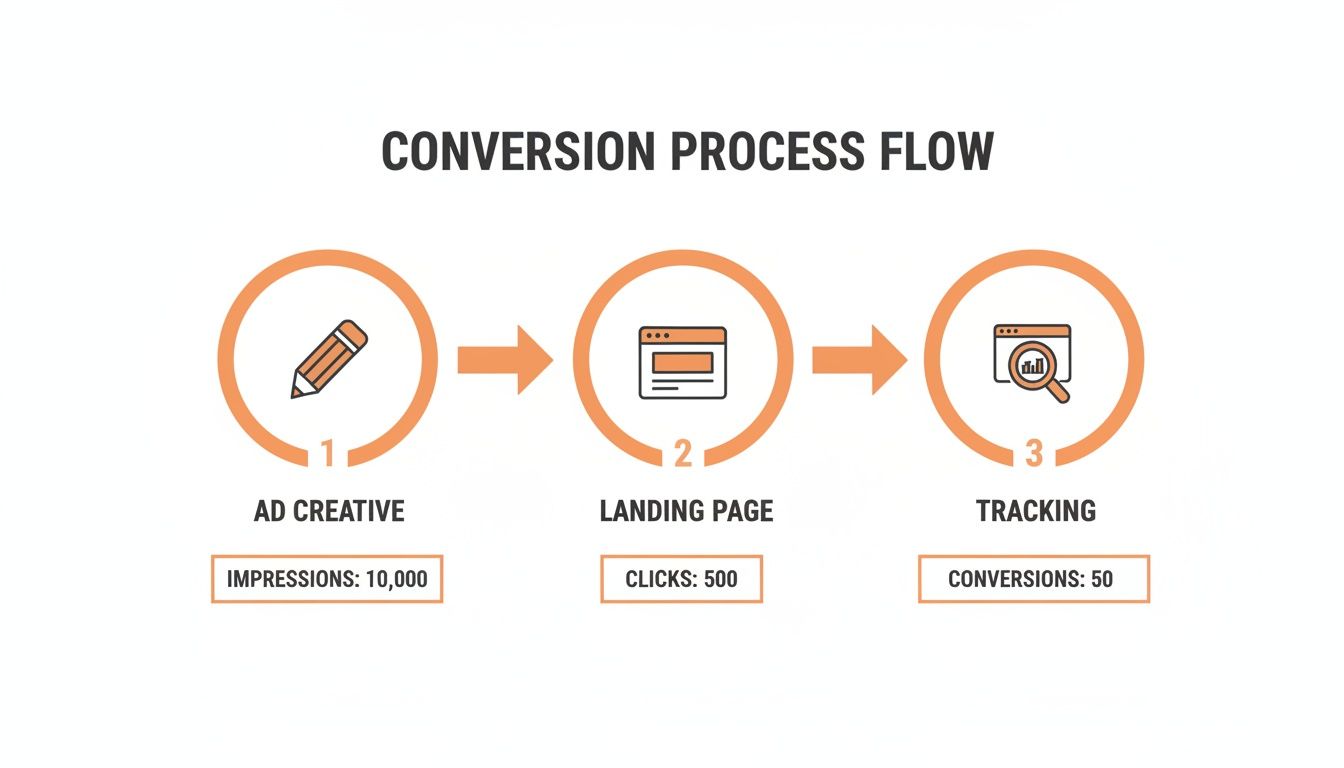
This entire flow is an interconnected system. A weak ad creative kills your CTR, a confusing landing page destroys your conversion rate, and broken tracking leaves you blind. You have to optimize the whole system, not just one part.
Establish a Weekly and Monthly Optimization Cadence
Discipline is what separates proactive performance management from reactive fire-fighting. A regular optimization schedule ensures you are methodically improving campaigns based on data.
Here's a battle-tested rhythm:
- Weekly Tasks (The Tactical Tune-Up):Mine Search Query Reports (SQRs): This is your most important weekly ritual. Analyze what users actually typed to trigger your ads. Add irrelevant terms as negative keywords to eliminate wasted spend. For example, if you sell software and see queries for "free software," add "free" as a negative. Identify new, high-intent phrases to build out more targeted ad groups.
- Review Ad Copy Performance: Pause ads with low click-through or conversion rates. Launch new variations to A/B test against your winners. A small 0.5% increase in CTR can significantly impact traffic volume and cost efficiency.
- Check Budget Pacing: Are you on track to spend your monthly budget? Make small daily budget adjustments to ensure efficient spending without exhausting your funds early.
Monthly Tasks (The Strategic Review):
- Analyze Performance by Segment: Dive into performance by device (mobile vs. desktop), location, and time of day. Are mobile users converting for less? Do leads spike on weekdays between 9 AM and 5 PM? Use this data to apply bid adjustments—increase bids where performance is strong and decrease them where it's weak.
- Review Landing Page Metrics: Check the bounce rates and conversion rates of your key PPC landing pages. A page with high traffic but a low conversion rate is a major opportunity. It’s a clear signal to run an A/B test or overhaul the page experience.
To set realistic goals, compare your metrics against industry standards. This guide to B2B SaaS advertising benchmarks provides crucial context for what "good" looks like.
Execute with a 90-Day Sprint Framework
An ongoing optimization cadence is essential, but wrapping it in a larger strategic framework is where you achieve breakthrough results. We manage campaigns using a "90-Day Sprint" model, breaking the work into focused cycles, each with a clear, quantifiable objective.
A 90-Day Sprint shifts your mindset from an endless to-do list to a series of strategic projects. It forces prioritization, measures results against a clear goal, and builds momentum through iterative wins.
Here’s a real-world example with a B2B SaaS client:
- Goal: Reduce Cost Per Demo Request by 20% in 90 days.
- Month 1 (Foundation & Learning): We focused heavily on SQR analysis, adding over 200 negative keywords to plug budget leaks. Simultaneously, we launched A/B tests on landing page headlines to improve message match and initial conversion rates.
- Month 2 (Refinement & Expansion): We analyzed the headline test, declared a winner that increased conversions by 18%, and rolled it out. We then reallocated budget toward top-performing campaigns and began testing new in-market audience layers to improve targeting precision.
- Month 3 (Scaling & ROI): The data was now clear. We paused underperforming ad groups, scaled budgets for winning campaigns by 20%, and used our learnings to launch a new campaign targeting a valuable adjacent keyword theme.
The outcome? We surpassed the goal, reducing the Cost Per Demo Request by 28%. This is modern, performance-driven ppc ad campaign management.
Deciding Between In-House vs. Agency Management
As a business leader, deciding who will manage your PPC campaigns is a critical strategic choice. The decision between building an in-house team and partnering with an agency should be based on your budget, growth goals, complexity, and internal resources.
Getting this wrong can lead to wasted ad spend, stalled growth, and missed opportunities. The choice boils down to retaining direct control with an in-house team versus leveraging the specialized, cross-industry experience of an agency.
When to Keep PPC Management In-House
Managing PPC internally can be the right move, but only under the right conditions. It works best when you have a marketing generalist who can dedicate significant time to becoming a PPC specialist—not someone juggling it with ten other responsibilities.
The in-house route often makes sense if:
- Your budget is under $5,000/month: At this level, agency management fees can consume a large portion of your total investment. Campaigns are also typically simple enough for one person to manage.
- Your business model is straightforward: Selling a few specific products or local services with a short sales cycle can often be handled effectively by a dedicated internal resource.
- Deep brand immersion is critical: No one will understand the nuances of your company culture and product like a full-time employee.
The primary pitfall of the in-house approach is hitting a knowledge plateau. It's rare for one person to be an expert in strategy, copywriting, landing page optimization, and deep-dive analytics.
Warning Signs It’s Time to Outsource
How do you know when you’ve outgrown your internal capabilities? The signs are clear if you know what to look for. The most obvious is plateauing performance. If your results have been flat for a quarter or more, it’s a strong signal that you need a fresh set of expert eyes.
A lack of time for strategic work is another critical red flag. If your "PPC manager" spends more time on social media updates than analyzing Search Query Reports or building A/B tests, you aren't truly managing your campaigns. You're just keeping them running.
Other indicators appear when you feel out of your depth. If you need to implement complex bidding strategies, scale a Performance Max campaign, or get serious about conversion rate optimization (CRO), and those terms feel overwhelming, it’s likely time to partner with specialists. We break down the decision further in our guide to choosing between in-house vs agency marketing.
The Agency 'Squad Model' Advantage
Partnering with an agency isn't about outsourcing tasks; it's about plugging into a complete team of specialists. A modern agency structure, like the "Squad Model," provides a significant ROI advantage over a single in-house hire.
For the cost of one senior-level marketing manager, you get an entire team of experts focused on your account:
- A PPC Strategist who sets the high-level vision and manages the budget.
- A CRO Analyst who designs and runs landing page tests to lift conversion rates.
- A dedicated Copywriter who crafts ad copy that converts.
- A Data Analyst who ensures your tracking is accurate and your reports tell a clear story of business impact.
This integrated, multi-disciplinary approach creates a compounding effect. While the strategist fine-tunes bidding, the CRO analyst is finding ways to turn more clicks into customers. This is how you transform a decent PPC account into a predictable revenue machine.
Frequently Asked Questions from Business Leaders
No matter how long you've been in marketing, PPC management always seems to stir up a few tough questions. Let's tackle some of the most common ones we hear from business owners who are trying to get their ad spend to work harder for them.
How Long Until I Actually See ROI from PPC?
While you'll see clicks and impressions almost immediately, a measurable ROI takes time. Plan for a 60-90 day runway to establish a profitable, scalable formula.
- Month 1 (Data Collection): The focus is on launching, learning, and gathering baseline performance data. Profitability is not the primary goal.
- Month 2 (Optimization): Using data from Month 1, we begin refining bids, targeting, and creative. You should start to see improvements in key metrics like CPA and conversion rate.
- Month 3 (Scaling): By this point, a well-managed campaign should be hitting its stride, demonstrating a clear positive return, and be ready for scaling.
What's a Realistic Budget to Get Started?
There’s no magic number, but you need enough fuel to gather meaningful data. For most small to mid-sized businesses, a realistic starting budget is between $1,500 and $5,000 per month.
Anything less, and you're flying blind. You won't get enough clicks to achieve statistical significance, meaning your "optimizations" are just guesses.
Think of your starting budget as an investment in market data. That initial spend buys the critical insights needed to discover what works, become profitable, and then scale with confidence.
How Often Should I Be Tinkering with My Campaigns?
Active campaign management requires a tiered approach, not constant, random changes.
A quick, daily check-in (5-10 minutes) is smart to spot major issues like a disapproved ad or a sudden spike in spend.
Deeper, tactical work, like analyzing Search Query Reports and adjusting ad copy, should happen weekly. This is where most hands-on optimization occurs.
Strategic reviews, such as analyzing overall performance trends, landing page effectiveness, and high-level strategy, should happen on a monthly or quarterly basis. This cadence balances tactical execution with strategic oversight.
Is AI Going to Make My PPC Manager Obsolete?
No. AI is an incredibly powerful co-pilot, not a replacement for the pilot. It excels at crunching massive datasets for tasks like automated bidding and identifying audience patterns that are invisible to the human eye.
However, AI cannot set your business goals. It doesn't understand your customer's motivations, it can't write compelling, emotionally resonant ad copy, and it can't make the high-level strategic pivots your business needs to grow. The winning formula is a skilled strategist guiding powerful AI tools.
Ready to stop guessing and start seeing real returns from your ad spend? The Ezсa team uses a data-driven squad model and 90-day sprints to turn PPC into a predictable revenue engine for your business. Get your free proposal today.