
Master Your Lead Gen Campaign: A Guide to Driving ROI & High-Quality Leads in 2026
Tired of lead gen campaigns that burn cash? This playbook gives you a framework to build, launch, & optimize for measurable ROI. Generate quality leads.

A lead gen campaign isn't about casting a wide net and hoping for a bite. It's about engineering a predictable system for growth that transforms marketing spend into measurable revenue. This is how you shift marketing from a cost center to a profit driver. This guide provides actionable strategies for marketing leaders and business owners ready to build a high-ROI lead generation machine.
Building Your High-ROI Lead Gen Foundation
Before spending a dollar on a new campaign, you must lay the groundwork. A scattershot approach—a random webinar here, a few disjointed ads there—is a recipe for inconsistent results and wasted budget.
The campaigns that truly move the needle are won long before launch. Success hinges on planning. Every decision, from ad creative to landing page copy, must tie directly to a concrete business outcome. Are you aiming to capture 5% market share in a new vertical? Do you need to generate a $2M sales pipeline this quarter? These are the questions that must drive your strategy.
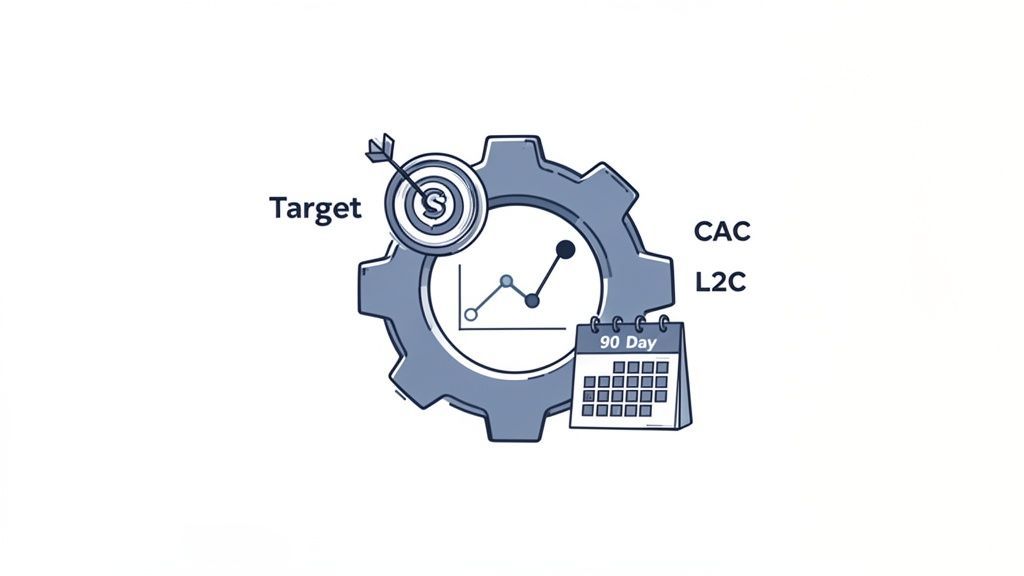
Anchor Your Campaign to Business Goals
First, define what a "win" actually looks for the business. Generating 1,000 "leads" is a vanity metric if none are qualified or become customers.
Start by identifying a core business objective, not a marketing one. Examples include:
- Adding $500k in new Annual Recurring Revenue (ARR).
- Securing the first 100 enterprise clients for a new product.
- Reducing customer churn by 10% through better initial onboarding.
Once that top-level goal is set, you can work backward to define the marketing KPIs that will get you there. This translates C-suite objectives into actionable targets your marketing team can execute against.
Focus on Metrics That Matter for ROI
Forget clicks and impressions for a moment; they can be incredibly misleading. To build a campaign with a strong return, you must obsess over the KPIs that connect marketing spend directly to revenue.
Your lead gen campaign shouldn't be judged by the sheer volume of leads it creates, but by the volume of revenue it influences. The only metrics that truly matter are the ones that tell a financial story: Customer Acquisition Cost (CAC) and Lead-to-Customer Rate.
A solid campaign foundation rests on tracking a handful of key performance indicators that paint a full picture of your ROI. The table below breaks down the essential primary and secondary metrics for your dashboard.
Essential KPIs for Your Lead Gen Campaign
By tracking these, you create a crystal-clear line from daily campaign activities to the bottom line. This data-first approach is crucial for making smart, agile decisions. A stubbornly low Lead-to-Customer rate, for example, often points to a problem with your targeting or offer—a clear signal that it's time for conversion rate optimization.
Adopt an Agile 90-Day Sprint Framework
Annual marketing plans are often obsolete upon arrival. The market moves too fast. A smarter approach is an agile, 90-day sprint framework—a system we rely on at Ezca to drive consistent, predictable results for our clients.
This approach breaks your larger strategy into focused, manageable cycles. Instead of a rigid, year-long plan, you create a dynamic system for constant learning and adaptation. Each 90-day sprint is a self-contained cycle of planning, executing, measuring, and optimizing.
This forces you to analyze data and make quick decisions, doubling down on what’s working and cutting what isn’t. That agility is your competitive advantage in a market projected to hit $15.55 billion by 2031. With over half of all marketers dedicating over 50% of their budgets to lead generation, using the best lead generation tools within this agile method is non-negotiable for building a scalable system for long-term growth.
Defining Who You're Talking To and What You're Offering
I've seen technically brilliant lead gen campaigns fall flat because they shouted the wrong message to the wrong crowd. A campaign’s success is built on a deep, obsessive understanding of your Ideal Customer Profile (ICP).
This means going beyond job titles and company size. You must dive into psychographics. What really frustrates them day-to-day? What event triggers them to search for a solution? What are they trying to achieve for their company and their career? Get this right, and everything else follows.
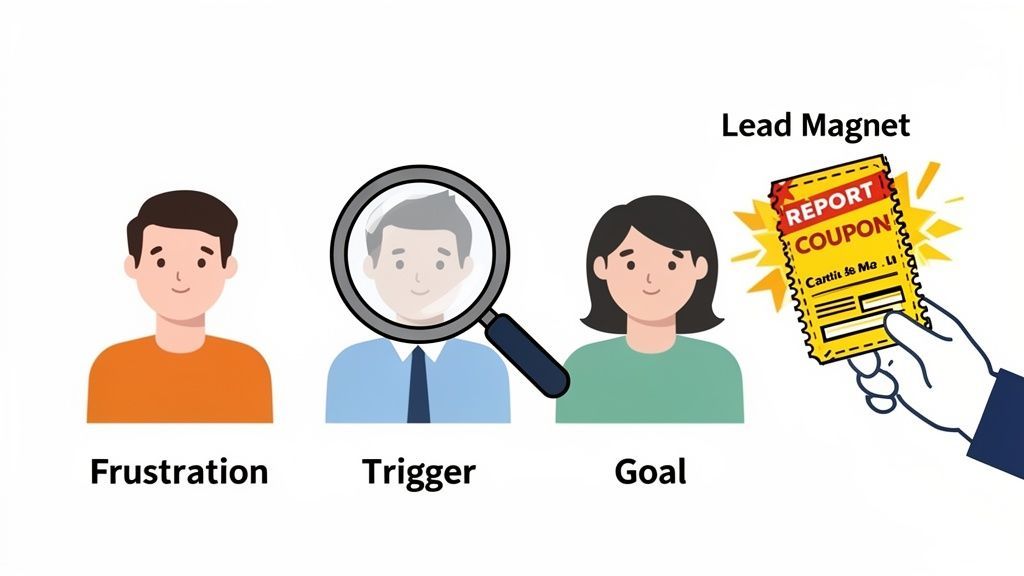
Go Beyond Surface-Level Personas
Most customer personas are worthless—generic, filled with assumptions, and quickly forgotten. You need a profile grounded in real data, not guesswork.
- Customer Interviews: Get on the phone with your best customers. Ask them about their "before" story. What was their work life like before you? What breaking point sent them searching for help?
- Sales Team Feedback: Your sales team is a goldmine. They hear raw, unfiltered objections and pain points daily. Set up regular debriefs to capture this intelligence.
- Data Analytics: Use Google Analytics and your CRM to find patterns among your most valuable customers. What content did they consume? Which channels brought them to you? Their behavior tells a story.
This is how you turn a vague "VP of Marketing" into "Sarah, a VP of Marketing at a Series B SaaS startup under immense pressure to prove marketing ROI to her board." Suddenly, you know exactly which problems to address and how to frame your solution.
Craft an Irresistible Value Exchange
Once you truly know Sarah, you can create an offer she can’t ignore. This is your campaign's heart—a value exchange where you provide something so useful that a prospect is happy to trade their contact information for it.
The goal of a lead magnet is not just to capture an email. It's to deliver a moment of genuine value that positions your brand as an expert and primes the prospect for the next step in their journey.
This is your chance to flex your expertise without being salesy. Your offer should feel like a mini-consultation, giving them a real taste of the results you can provide.
High-Value Lead Magnet Examples
The best lead magnets are never one-size-fits-all. They must provide immediate utility and connect directly to the core problem your product solves.
- For a B2B SaaS Company: An interactive ROI calculator is far more compelling than a generic ebook. Let a finance leader plug in their own numbers and see the potential cost savings of your software for themselves.
- For an E-commerce Brand: Instead of a simple "10% off," offer an exclusive early-access code for an upcoming product launch, targeted to previous customers. It creates urgency and rewards loyalty.
- For a B2B Service Provider: Create a benchmark report like "The 2026 State of Cybersecurity for Regional Financial Institutions." This provides unique industry data and instantly positions your firm as an expert.
At Ezca, we push our clients to develop lead magnets that solve a top pain point uncovered during ICP research. When the offer is perfectly aligned with the audience's needs, you generate highly qualified prospects, dramatically improving your Lead-to-Customer rate.
Building Your Multi-Channel Campaign Framework
Relying on a single channel for leads is a recipe for disaster. One algorithm update or spike in ad costs, and a company's pipeline can dry up overnight. The most resilient and profitable campaigns are built on a multi-channel framework, where different channels support and amplify each other.
This isn't about being everywhere at once; that’s a good way to burn budget. It’s about being in the right places with a strategy that makes each channel more powerful together. The goal is a seamless flow that guides potential customers from first interaction to sale.
Designing Your Channel Mix
The right channel mix depends on your business model and audience. There’s no magic formula, but the principle of synergy is universal. You want channels to work like a relay team, passing the baton as a prospect moves from discovery to decision.
Here are two real-world scenarios.
A B2B SaaS company we worked with built their campaign this way:
- SEO: Built a foundation of in-depth blog posts targeting problems their ideal customers were actively searching for, attracting high-intent inbound interest.
- LinkedIn Ads: Used targeted ads to get that same content in front of specific job titles at target accounts, establishing the company as a credible authority.
- Email Nurturing: As soon as someone downloaded a guide, they entered an automated email sequence offering more value and building trust to eventually ask for a demo.
An e-commerce brand took a different approach:
- Google & Meta Ads: Ran highly-targeted shopping and dynamic retargeting ads to capture people ready to buy now.
- Conversion Rate Optimization (CRO): Obsessed over optimizing their site, A/B testing everything from product page layouts to checkout flows to maximize ad spend.
- Email & SMS Marketing: The moment a purchase was made, the customer was added to a list for post-purchase flows, exclusive offers, and loyalty programs to increase LTV.
In both cases, no channel works in a vacuum. They form a cohesive system. To dig deeper, our guide on what multi-channel marketing is is a great place to start.
A Data-First Approach to Budgeting
How do you split the budget? The biggest mistake is setting a rigid annual budget and ignoring performance. A far smarter approach is a dynamic, data-first model.
Think like a portfolio manager, constantly moving money toward investments delivering the best returns. Our teams at Ezca review performance weekly, with the authority to shift spend on the fly. If LinkedIn Ads are bringing in qualified leads at a $150 CPL while another channel struggles at $400, we move the money.
Your budget has to follow the ROI. Don't get emotionally attached to a channel that isn't working. Be ruthless with the data. That agility is what separates the campaigns that just spend money from the ones that profitably scale.
This is especially true for organic channels like SEO. Despite an upfront investment, its payoff is undeniable. 35% of marketers say their best leads come from organic search, highlighting the power of user intent. Considering nearly 97% of websites get zero traffic from Google, getting SEO right is a massive opportunity. You can find more lead generation statistics and trends to build your own business case for channel investment.
Nailing Down Your Tracking with UTMs
Without rock-solid tracking, a multi-channel campaign is just guesswork. The key to a clear, unified view of your performance is a disciplined use of UTM parameters.
UTMs are simple tags added to URLs that pass crucial information to your analytics, telling you exactly where every visitor came from. A consistent UTM structure is what allows you to see precisely which channels, campaigns, and even individual ads are driving leads.
At a minimum, your UTMs should always include:
utm_source: The platform sending the traffic (e.g.,google,linkedin,newsletter).utm_medium: The type of marketing (e.g.,cpc,organic,email).utm_campaign: The name of your specific initiative (e.g.,q4-saas-launch,summer-sale-2026).
By enforcing a strict UTM policy, you eliminate "I think this is working" conversations and create an accountable, cross-channel view that connects every dollar spent to a real result.
Hitting "launch" on a new lead generation campaign feels great, but that’s when the real work begins. Sustainable, predictable growth comes from a disciplined cycle of testing and optimization, not a "set it and forget it" mindset.
Instead of a rigid annual plan, break everything down into focused, 90-day sprints. This agile approach keeps you flexible and responsive to real-time data. Each sprint is a complete cycle: launch, measure, optimize, and scale what works.
Weeks 1-2: The Stabilization Phase
The first two weeks of any campaign are about data integrity. Your only job is to ensure every piece of your tracking system is working flawlessly. You’re making sure the plumbing is connected before turning on the water full blast.
- Check Your UTMs: Is every ad, post, and email link tagged properly?
- Test Every Form: Submit test leads. Do they appear instantly in your CRM?
- Verify Your Pixels: Are conversion events firing correctly in Google Ads, LinkedIn, and other platforms?
Don't make big strategic changes yet. The goal is to gather a clean baseline data—your initial CPL and conversion rates become the benchmark for everything that follows.
Weeks 3-8: The Aggressive Optimization Phase
With a solid data foundation, shift into aggressive optimization. For the next six weeks, your job is to be a scientist, challenging every assumption and running rapid, data-driven tests.
This is about quick, iterative cycles. For a B2B SaaS campaign, this might look like:
- Refining PPC Bids: Notice a keyword group is converting 25% better? Increase bids and impression share for that group.
- A/B Testing Landing Pages: Test a new headline addressing a different pain point. A simple copy change can take a landing page from a 2.5% to a 3.5% conversion rate, massively impacting acquisition costs.
- Experimenting with Audiences: On LinkedIn, pit a broad "Director-level" audience against a tight, account-based list. Which one delivers more actual MQLs?
This is also the time to leverage advanced tools. AI-powered platforms can sift through search query reports to uncover high-intent, low-competition long-tail keywords—a goldmine for SEO.
The whole point of the optimization phase is to relentlessly hunt for wins, big or small. A series of small, calculated improvements is what turns a decent campaign into a great one.
Ultimately, you're building a system where all your channels work together. SEO brings in steady traffic, paid ads capture immediate demand, and your email sequences nurture leads over time.
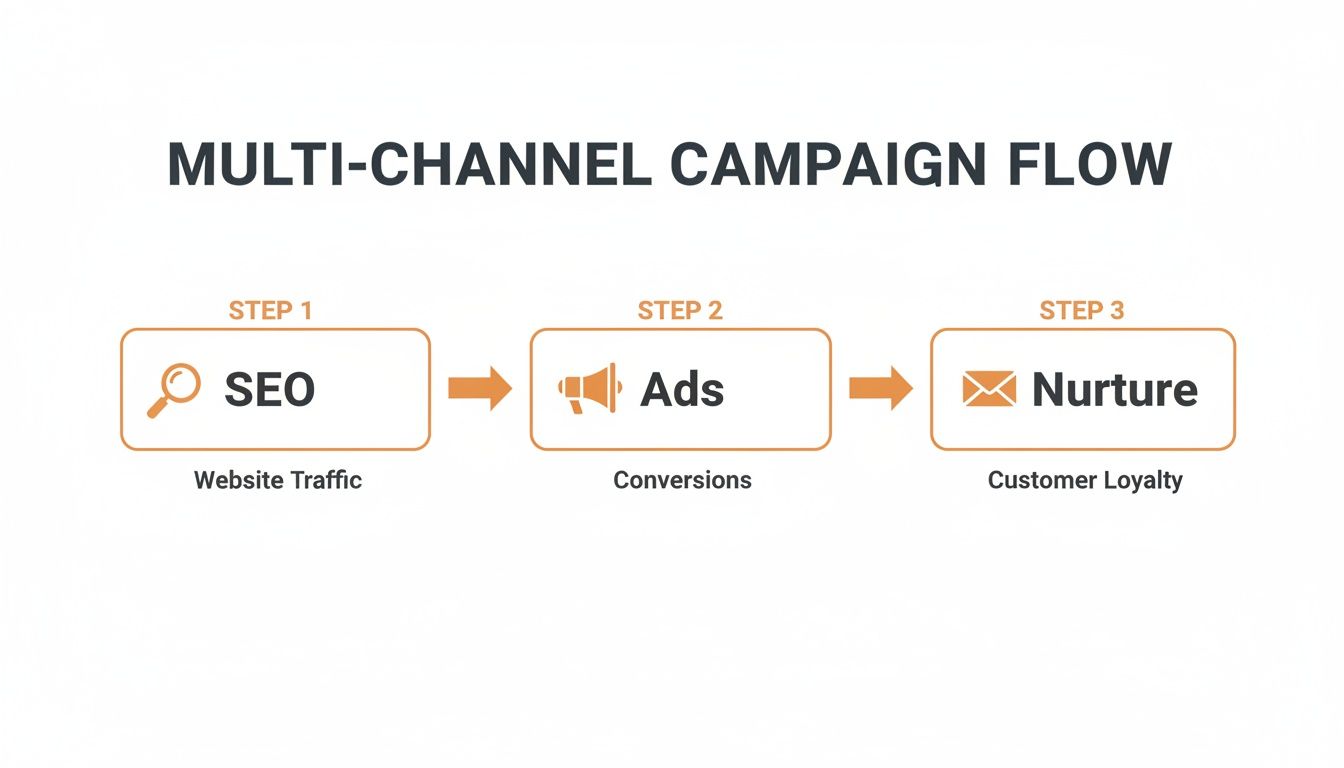
As seen above, this isn't about channels competing. It’s about creating a seamless journey where organic discovery, paid acquisition, and relationship-building all play a part.
Weeks 9-12: The Scaling and Planning Phase
The final stretch is about cashing in on your hard work and setting up for the next cycle. By now, the data should clearly point to which ads, landing pages, and audiences are your champions.
It’s time to scale the winners.
If one ad creative is outperforming others by 40%, pour more budget behind it and make it the new "control" to test against. If a cluster of blog posts is generating organic MQLs, double down on that topic and build out more supporting content.
At the same time, conduct a sprint retrospective with your team. Look at the data and have an honest conversation:
- Which tests gave us our biggest wins?
- Which initial assumptions were flat-out wrong?
- What did we learn that we can apply to the next 90 days?
This is the exact methodology we use at Ezca because it works. By treating marketing like a series of focused learning cycles, you build a campaign that gets smarter, more efficient, and more profitable over time.
Measuring True ROI and Scaling Profitably
Your CFO doesn't care about clicks or CPL. The C-suite wants to see a clear line from your marketing budget to revenue. This is how you prove marketing isn't a cost center, but a predictable growth engine. To do that, you must focus on the numbers that tell the real story of profitability.
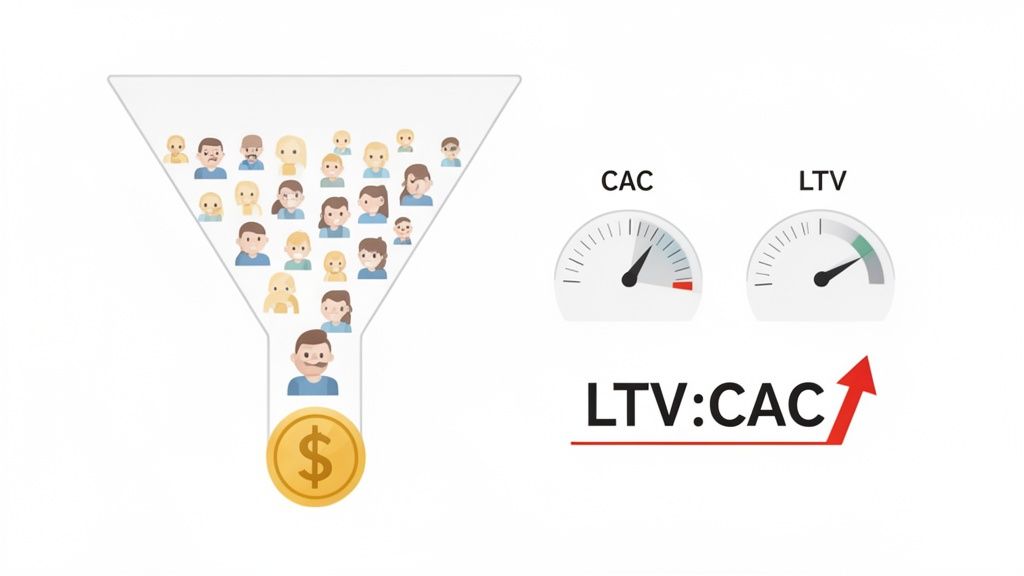
Beyond CPL to CAC and LTV
A low Cost Per Lead (CPL) can be dangerously misleading. I’ve seen teams celebrate a cheap CPL from a channel that was feeding their sales team junk leads that never converted, making the channel a complete waste of money.
This is why you must graduate to more sophisticated metrics:
- Customer Acquisition Cost (CAC): Your total cost to land one new paying customer. Calculate it by adding up all marketing and sales costs—ad spend, salaries, tools—and dividing by the number of new customers acquired in that period.
- Lifetime Value (LTV): The total revenue you can reasonably expect from a customer over their entire time with your company.
The real insight comes from the LTV:CAC ratio. For a SaaS company, a healthy ratio is typically 3:1 or better. This signals a profitable, sustainable acquisition model. If LTV is lower than CAC, you're paying to lose money on every new customer.
The LTV:CAC ratio should be your north star. It’s the single most important number for proving the financial viability of your lead gen efforts and making a confident case for more budget.
Attributing Revenue With the Right Model
Calculating an accurate CAC depends on knowing which channels are actually driving revenue—not just first clicks or last visits. This is the job of attribution modeling. Getting it right prevents you from accidentally killing a channel that’s quietly doing heavy lifting in the middle of a buyer's journey.
There are many ways to slice this, but understanding the basic models is a great place to start.
Choosing the Right Attribution Model
Picking an attribution model is a strategic choice. This table breaks down common options to help you choose.
For most businesses I work with, a simple first- or last-touch model doesn’t paint the full picture. A linear or other multi-touch model usually provides a more balanced view. The key is to pick one, use it consistently, and let data guide your next move.
Scaling Profitably by Focusing on Quality
Once you can connect spend to revenue, you can scale intelligently. You can finally see which campaigns, channels, and customer segments are most profitable, and that’s where you double down. This isn’t just about spending more; it's about spending smarter.
This often means being pickier about your leads. The average B2B tech lead can run anywhere from $180 to $250, but quality pays off—research shows that 68% of sales leaders find outsourced lead generation delivers a better ROI, and their teams close 19% more deals.
A tight feedback loop with your sales team is non-negotiable. At Ezca, we help clients implement predictive lead scoring models that automatically flag leads matching the profile of their highest-LTV customers. This allows sales to stop wasting time and focus energy where it counts. You can see an example of how we helped a SaaS client with predictive lead scoring in this case study.
By tying every dollar of your lead gen spend to closed-won deals, you stop being a speculative expense and become the measurable, scalable growth driver your company needs.
Your Lead Gen Campaign Questions, Answered
Even with a detailed blueprint, questions will pop up once your lead gen campaign is live. Here are answers to the most common questions from marketing leaders and founders.
What Is a Realistic Budget for My First Campaign?
There’s no magic number. Work backward from your goal.
Let’s say you need 10 new customers. If your lead-to-customer rate is 5%, you need to generate 200 qualified leads. If a solid B2B lead on LinkedIn costs around $100, your starting budget estimate is $20,000. I always advise adding a 15-20% cushion for testing and unexpected costs.
How Long Does It Take to See Results?
This depends entirely on your channels.
With paid channels like Google Ads or LinkedIn Ads, you can see leads within days. But those initial leads are often pricey as the algorithm learns. Give it 4-6 weeks for your CPL to stabilize as you optimize.
Channels like SEO and content marketing are the long game. It can take 6-9 months to see a meaningful stream of organic traffic and leads. That's why a healthy campaign mixes short-term wins and long-term investments.
A lead gen campaign isn't a light switch; it's a flywheel. It takes time to build momentum, but once it's spinning, the results compound and become more cost-effective over time.
How Do I Know if My Leads Are Actually Good?
A low CPL is a vanity metric if the leads are junk. The only true measure of lead quality is your Lead-to-Customer Conversion Rate. This requires a tight feedback loop between marketing and sales.
Give sales an easy way to accept or reject leads in your CRM. Make it a weekly ritual to review rejected leads. Are they from a specific industry you don't serve? Are they interns instead of decision-makers? This qualitative feedback is gold for refining your targeting and messaging.
What's a Good Conversion Rate for My Landing Page?
This number varies wildly by industry, traffic source, and offer. A good baseline to shoot for is 2% to 5%.
More specifically:
- B2B SaaS Demo Request:2-4% is reasonable.
- E-commerce Discount Popup:10-15% is achievable.
- High-Value Content Download:20-25% or more is possible for a genuinely useful ebook.
If you’re falling short, start A/B testing. Tweaking headlines, form fields, and calls-to-action can make a massive difference and lower your overall Customer Acquisition Cost.
We've covered some pressing questions, but there are always more. The table below offers quick answers to other common queries.
Lead Gen Campaign FAQ
Hopefully, these answers provide more clarity as you map out your strategy. The key is to stay flexible and let the data guide your decisions.
Ready to build a predictable revenue engine instead of just running another campaign? The team at Ezcas combines human expertise with AI to help SaaS, e-commerce, and B2B companies execute high-ROI lead generation strategies in focused 90-day sprints. Discover how our performance marketing agency can help you scale.