
How to Do an SEO Audit That Drives Business Growth
Learn how to do an SEO audit with this guide for marketing leaders. Uncover actionable insights that boost rankings, drive leads, and deliver measurable ROI.

An SEO audit isn't just a technical to-do list. For marketing leaders and business owners, it's a strategic diagnostic that uncovers revenue opportunities. It breaks down into four critical areas: setting business goals, running a technical crawl, analyzing content and backlink authority, and turning findings into a prioritized growth plan.
Your Blueprint for a High-Impact SEO Audit
Let's get one thing straight: a proper SEO audit is not a simple technical checklist. For any marketing leader or business owner, it’s a strategic diagnostic tool that should have a direct line to your bottom line. A great audit doesn't just flag errors; it uncovers hidden opportunities and hands you a clear plan to capitalize on them. It’s about making sure your website is a growth engine, not just a digital brochure.
The point is to shift your perspective from "fixing things" to "building a business case for growth." For a more exhaustive overview of the entire process, this guide on how to conduct an SEO audit is a fantastic resource.
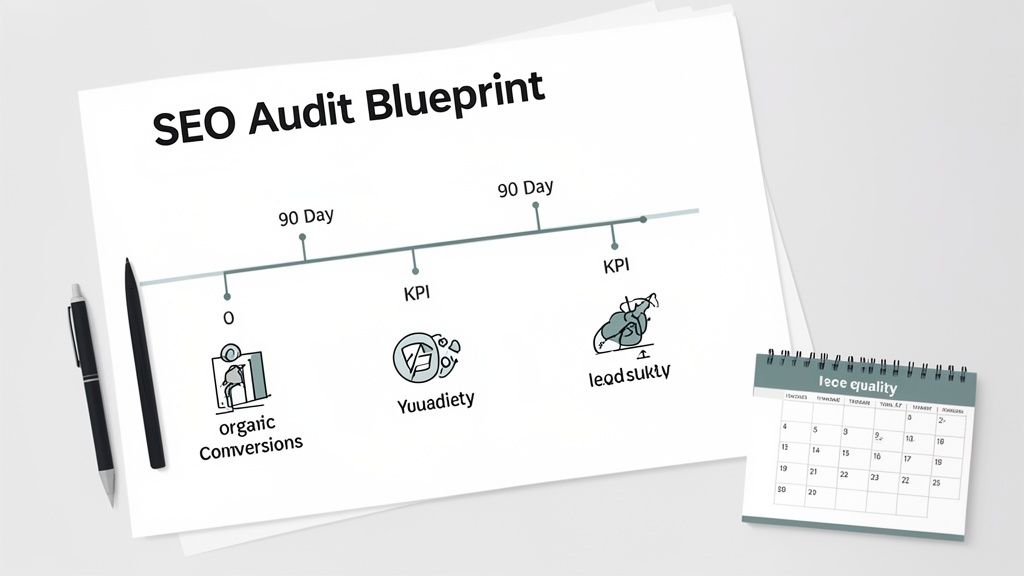
Before running a crawl or opening a tool, we need to define what truly matters.
Set Goals Tied to Business Outcomes
Every impactful audit starts with the "why." Before analyzing a single keyword, you must define what success looks like in business terms. Vague goals like "get more traffic" lead to wasted resources and a lack of measurable ROI.
Instead, anchor your audit objectives to tangible outcomes your C-suite cares about. Your goals must be specific and measurable.
- For a SaaS Company: Increase qualified demo requests from organic search by 20% in Q3.
- For an E-commerce Brand: Reduce customer acquisition cost (CAC) by 15% by improving organic conversion rates on top product pages.
- For a B2B Service Provider: Grow the pipeline of marketing qualified leads (MQLs) from non-branded searches by 30% in H2.
This ensures every recommendation directly supports a core business objective.
Key Takeaway: An audit without clear business goals is just an academic exercise. The aim isn't to find every SEO issue; it's to find the specific issues that, once fixed, will have the biggest impact on driving revenue.
Focus on High-Return KPIs
With business goals locked in, identify the key performance indicators (KPIs) that measure progress. Avoid vanity metrics like rankings for keywords that don't convert.
Focus on performance-driven data that tells the real story:
- Organic Conversion Rate
- Cost Per Acquisition (from organic channels)
- Lead Quality Score
- Organic-Sourced Revenue
This focus on ROI is critical. SEO can deliver incredible returns, but that depends entirely on a healthy, well-optimized website. That's precisely what a strategic audit is designed to deliver. At Ezca, our entire approach is built on drawing a clear line from audit findings directly to your financial impact.
Now, let's pop the hood and examine the website's technical foundation. This technical crawl is where you find the invisible roadblocks hindering a site's true potential.
I think of it this way: your website is a storefront. If the doors are broken or the aisles are cluttered, customers will leave—it doesn't matter how amazing your products are. A technical audit finds and fixes those problems.
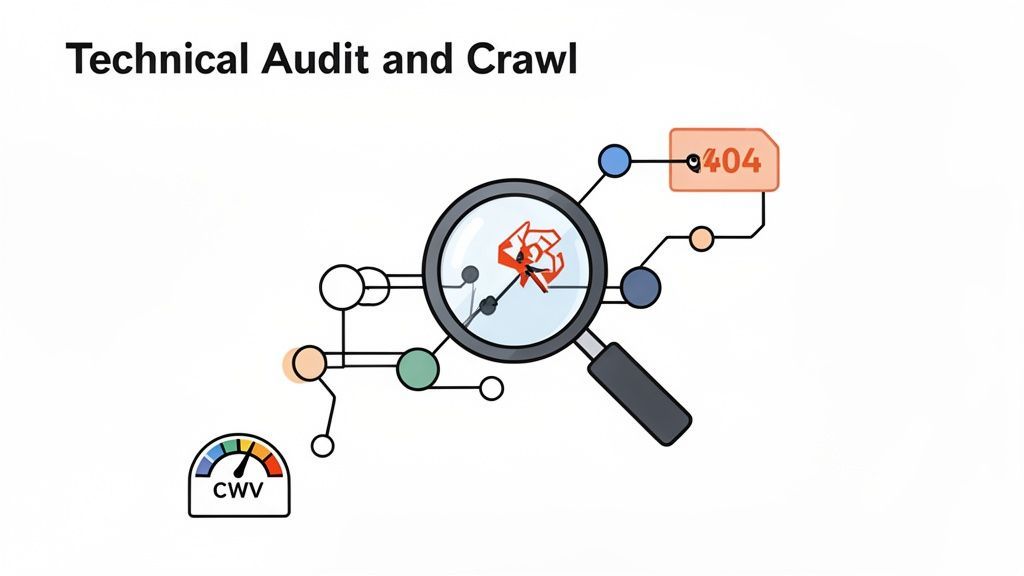
This part of the audit is a serious investment, but the payoff is huge. The global SEO market is on track to hit $108.28 billion by 2026, with technical SEO accounting for over $27 billion. That tells you just how critical this is. You can explore more about these market projections to see the scale of the opportunity.
Crawlability and Indexing: Is Google Even Seeing Your Pages?
First, you need to see your site the way Googlebot does. Can it find, crawl, and make sense of every page you want to rank? A tool like Screaming Frog or Ahrefs’ Site Audit becomes your best friend, crawling your site just like a search engine.
Your main goal is to hunt down anything stopping Google from indexing your content. These issues are often hiding in plain sight:
- Rogue
robots.txtrules: A single misplaced slash in this file can tell Google to ignore huge sections of your site, making entire product categories vanish from search results overnight. - Stray
noindextags: A developer adds anoindextag to a page during staging, and it never gets removed. This tag is a direct command telling Google to ignore a page you’re desperately trying to get traffic to. - Pages buried too deep: If your most important, money-making pages are five or six clicks from the homepage, Google assumes they aren't very important and crawls them less often, if at all.
These aren't just technical footnotes; they have a direct impact on the bottom line. If a B2B service page isn't indexed, it’s not generating a single lead. If a product category is blocked from crawling, it’s not making a single sale.
Site Architecture and Internal Linking
How you link pages together creates your site's architecture. A logical structure guides users and search engines to your most valuable content, passing authority along the way. A messy structure creates dead ends and confuses everyone.
You might have a fantastic pillar article with great backlinks. But if that article doesn't link out to your related product or service pages, all that authority just sits there—a superhighway leading nowhere.
Real-World Example: We had a SaaS client with a high-traffic blog, but no posts linked to their new feature pages. We added relevant, contextual links, funneling both traffic and authority. The result? A 30% lift in feature adoption in under 60 days.
When you run your crawl, look for "orphaned pages" with no internal links. More importantly, ensure your core money pages receive ample internal links from relevant, high-authority pages. This is a fundamental part of how we approach SEO at Ezca—turning data into strategy.
Site Speed and Core Web Vitals
A slow website is no longer a minor annoyance; it's a ranking and conversion killer. Google’s Core Web Vitals (CWV) are user experience metrics baked directly into the ranking algorithm. A clunky site gets pushed down in the search results.
Use Google PageSpeed Insights to test your most important pages. Don't obsess over the top-line score. Instead, dig into the three metrics that matter:
- Largest Contentful Paint (LCP): How fast does the main content appear? You want this under 2.5 seconds.
- First Input Delay (FID): How quickly does the page react to user interaction? Aim for less than 100 milliseconds.
- Cumulative Layout Shift (CLS): Do elements on the page jump around as it loads? Keep this score as low as possible.
The usual culprits are unoptimized images, render-blocking JavaScript, and slow server response times. Fixing these isn't just a developer task; it’s a direct investment in your conversion rate. A faster site means fewer bounces, more engagement, and ultimately, more leads and sales.
Diving Into On-Page SEO and Content Gaps
With technical fixes underway, it’s time to focus on your content. A technically flawless website with lackluster content is a beautiful car with no engine—it looks great, but it’s not going anywhere.
This part of the audit moves beyond title tags and keyword density. We're digging deep to determine if your content answers your audience's questions, demonstrates expertise, and persuades them to act. This is where you find game-changing opportunities.
Start by Auditing Your Content's Performance and Intent
First, you need to know how your existing content performs. You can't plan your next move without a clear picture of what’s already working (and what’s not).
Start by pulling crawl data from a tool like Screaming Frog and layering it with performance data from Google Search Console and Google Analytics. This lets you segment your content—like blog posts, service pages, or product pages—and see how each contributes.
You're looking for answers to fundamental business questions:
- Which page types bring in the most non-branded clicks and impressions?
- What content actually drives conversions, whether that’s leads or sales?
- Are there pages with high impressions but a terrible click-through rate (CTR)? That's a classic sign of a weak title tag or meta description that fails to capture user interest.
This exercise quickly reveals your star performers and your underachievers. You might discover your blog gets a ton of traffic but generates zero leads, while a few key service pages convert well but are nearly invisible in search. That's a powerful insight that immediately shapes your optimization plan.
Actionable Tactic: Your audit should pinpoint content with high potential but low performance. We found a B2B client with old articles stuck on page two for valuable, high-intent keywords. We gave them a targeted refresh—updated stats, new examples, better formatting—and saw a 45% jump in organic traffic to those pages in under 90 days.
Get Your Hands Dirty with E-E-A-T and User Experience Audits
Once you’ve flagged your priority pages, it’s time for a manual review. This is the part an automated tool just can't do. You need to look at these pages through the eyes of both Google and a real user.
The focus here is on E-E-A-T (Experience, Expertise, Authoritativeness, and Trustworthiness). For a service page, are you backing up claims with case studies and client testimonials? For a blog post, is the author's expertise clear? These trust signals are non-negotiable today.
At the same time, be honest about the on-page experience.
- Structure and Clarity: Is the H1 compelling? Do H2s and H3s break the content into logical, scannable sections that use keywords naturally?
- Readability: Are you using short paragraphs, bullet points, bold text, and helpful images to guide the reader?
- Calls-to-Action (CTAs): Does the CTA match the user's journey? You wouldn't put a "Buy Now" button on a top-of-funnel article; a "Download Our Free Guide" CTA is a much better fit.
This granular, page-by-page review reveals why a page isn't performing. It's a fundamental part of how we build strategies at Ezca that don't just chase rankings, but drive real business results.
Uncover and Fill Your Content Gaps
A content gap analysis answers a simple, powerful question: "What are my competitors ranking for that I'm completely missing out on?"
Using a tool like Ahrefs or Semrush, you can run your domain against key competitors to get a list of valuable keywords they rank for, but you don't.
But this isn't just about finding more keywords. It's about finding strategic holes in your customer journey. You might realize your top competitor ranks for "best [your product] for small businesses," a crucial bottom-of-funnel topic you haven't touched.
This analysis is your roadmap for a prioritized content plan, built on keyword volume, difficulty, and business relevance. This is how you create content that proactively meets market demand, a key part of how to increase organic traffic. While you're at it, your technical crawl might have turned up broken links; learning how to find 404 errors and improve SEO is critical for keeping your site healthy.
Taking a Hard Look at Your Backlink Profile and Authority
Think of your website’s backlink profile as its professional reputation. It doesn't matter how polished your content is—if your reputation is tied to spammy, low-quality sites, you won't get very far. This part of the audit is about managing that reputation, cleaning up damaging links, and building real authority.
This isn't just about tidying up past mistakes. It's about building a strategic plan for earning the kind of links that genuinely boost your authority and revenue. This deep-dive analysis is a cornerstone of the comprehensive Ezca services we provide.
Establishing Your Backlink Baseline
First, you need a complete picture of where you stand. Use a tool like Ahrefs or Semrush to export every domain linking to your site.
Don't just look at the total number of links. The real story is in the quality.
- Referring Domains: How many unique websites are linking to you? One link from 100 different quality sites is far better than 100 links from one questionable domain.
- Domain Rating (DR) or Authority Score (AS): What's the quality of the sites linking to you? If your profile is swamped with low-DR sites (e.g., below DR 20), your foundation is weak.
- Link Distribution: Where are these links pointing? If they're all aimed at your homepage, your important product and service pages aren't getting the authority they need to rank.
This initial review gives you a tangible starting point. For example, finding that 80% of your links point only to your homepage while your site has a DR of 35 tells you two things immediately: you need a strategy to build links to your deeper, money-making pages, and you have to work on increasing your overall domain authority.
Identifying and Mitigating Toxic Links
Let's be blunt: some backlinks are actively harming your site. These "toxic" links usually come from spammy directories, paid link farms, or irrelevant sites. To Google, these look like you're trying to cheat the system, and that can lead to penalties.
Comb through your backlink export and flag anything suspicious:
- Domains with rock-bottom authority scores and no organic traffic.
- Sites using weird, overly-optimized anchor text like "best saas marketing agency in new york."
- Links from websites that have absolutely nothing to do with your industry.
Once you’ve compiled a list of truly toxic links, use Google's Disavow Tool. This tells Google to ignore these links when evaluating your site. Think of it as telling a judge to strike false testimony from the record. It cleans up your profile and stops others from hurting your reputation.
Uncovering Competitive Link Gaps
Now it's time to go on the offense. A link gap analysis is one of the most powerful tactics available, showing you exactly which high-authority websites link to your competitors but not to you. This is a goldmine for your link-building strategy.
In Ahrefs, use the "Link Intersect" report. Plug in your domain and two or three top competitors. The tool will generate a list of every site that links to them but not to you.
Filter that list for quality and relevance. You’re looking for gems. For instance, you might discover that two main rivals were featured in a major industry publication’s "best tools" roundup. That’s not just a backlink; it’s a massive signal of trust and a PR win you're missing. These insights become the foundation of a targeted outreach campaign designed to earn links that move the needle.
Turning Audit Findings Into Actionable Sprints
An SEO audit that just sits in a folder is a complete waste of time and money. The real value isn't in the massive spreadsheet of findings; it’s in turning that data into a smart, prioritized plan that gets results.
For any marketing leader, this is the critical step. It’s about translating technical SEO jargon into a clear roadmap for growth, bridging the gap between analysis and action.
From Overwhelming List to Prioritized Plan
Finishing a deep-dive audit can feel like staring at a mountain of work. The biggest mistake is trying to do it all at once, which leads to paralysis.
Instead, score every single task using a simple prioritization matrix. This forces you to weigh each item against two key factors:
- Potential Impact: How much will this help us hit our goals (like generating more leads or revenue)? Score this from 1 (low) to 5 (high).
- Required Effort: How much time, budget, and developer resources will this take? Score this from 1 (low) to 5 (high).
A simple calculation (Impact ÷ Effort) gives you a priority number. A task with high impact and low effort, like fixing a noindex tag on your main service page, is an obvious quick win. A huge project like a full site migration will score lower, demanding more careful planning.
Expert Tip: Prioritization isn't just about deciding what to do first. It's about consciously deciding what not to do right now. Focusing your team on high-impact, manageable tasks ensures you get the most value for your effort and avoid getting bogged down in low-return fixes.
Use this framework to organize and score your findings.
SEO Audit Task Prioritization Matrix
This matrix helps you see what to tackle in your first 90-day sprint and assign clear ownership.
Once your tasks are scored and sorted, the path forward becomes much clearer.
Structuring Your 90-Day Marketing Sprints
With your list prioritized, slot the work into a 90-day sprint. At Ezca, we use this agile approach to break down overwhelming projects into focused, manageable cycles. It builds momentum and delivers tangible progress every quarter.
Your first sprint should blend quick wins with foundational projects.
- Month 1: Quick Wins. Knock out urgent technical fixes and on-page wins. Repair broken internal links, optimize title tags on pages ranking on page two, and disavow toxic backlinks. These tasks deliver fast results.
- Month 2: Content Initiatives. Shift focus to high-priority content. Update valuable but aging blog posts or create new content to plug competitive gaps.
- Month 3: Foundational Projects. Begin a bigger project, like implementing schema markup across the site or launching a targeted link-building campaign to boost authority.
This sprint-based model ensures you build both short-term momentum and long-term strength. After 90 days, you’ll have real results and a clear direction for the next sprint. The comprehensive SEO services offered by Ezca are designed around this very principle to drive continuous growth.
Even a single part of the audit, like reviewing your backlinks, can be broken down into a logical flow of analysis, cleanup, and strategic action.
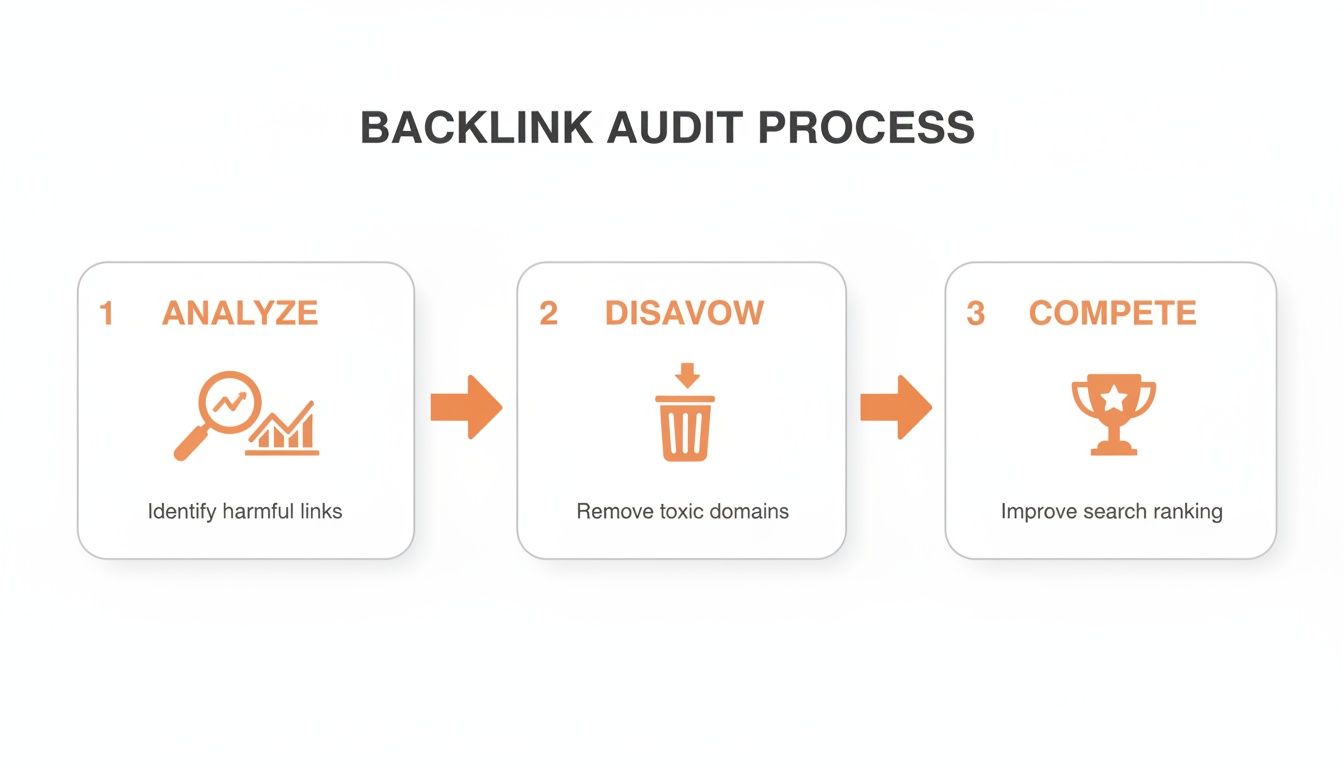
First, analyze what you have, then clean up toxic links, and finally, build a plan to earn the high-quality links your competitors have.
Reporting on Business Outcomes, Not Technical Jargon
When reporting progress, how you frame the results is everything. Your CEO doesn't need a lecture on crawl depth—they want to know about leads, sales, and competitive positioning.
Always tie reporting back to business outcomes.
- Instead of this: "We fixed 50 broken internal links this month."
- Try this: "By fixing our site's broken navigation, we drove a 15% increase in organic traffic to our product pages, contributing to a 10% lift in demo requests."
Connect the dots for your stakeholders. Show the direct line from tasks completed to the impact on KPIs that matter: organic conversion rates, lead quality, and revenue. This elevates an SEO audit from a one-off technical checklist to a strategic initiative that proves its value time and time again.
Your SEO Audit Questions, Answered
Even with a solid plan, you're bound to have questions as you dive into an SEO audit. It's only natural. Let's tackle some of the most common ones I hear from business owners and marketing leaders, so you can set the right expectations and invest your resources wisely.
How Often Should I Perform an SEO Audit?
For a full, deep-dive strategic audit, plan on doing one annually. This gives you a comprehensive benchmark to steer your strategy for the next 12 months. But if you wait a full year to check in, you're leaving a lot to chance. Things move way too fast for that.
A smarter rhythm is to supplement that big annual review with quarterly "health checks." These are much quicker, focusing on the big-ticket items. We always run them after a major Google algorithm update or if we've made significant changes to a client's site.
The best teams I've worked with don't really think in terms of one-off audits. They build a continuous process. At Ezca, we weave this directly into our 90-day sprint model. It means we're constantly monitoring technical health, content gaps, and what competitors are up to. This lets us jump on opportunities and fix problems before they ever have a chance to hurt revenue.
This kind of agile approach is what keeps your SEO strategy sharp and effective.
What Are the Most Common Critical Issues in an SEO Audit?
Every website has its own unique quirks, but I see the same handful of critical, performance-killing issues over and over again. These are the silent saboteurs, and they're almost always technical. After auditing hundreds of sites, these are the biggest culprits:
- Indexing and Crawlability Errors: This is ground zero. You'd be shocked how often a crucial page is invisible to Google because of a bad
robots.txtrule or a straynoindextag someone forgot to remove. If Google can't see it, it doesn't exist. - Poor Site Speed and Core Web Vitals: A slow site is a non-starter. Users bounce, and that high bounce rate signals a poor experience to Google, which pushes you right down the rankings. It's a direct penalty.
- Widespread Mobile-Friendliness Issues: With over 60% of searches now on mobile, Google's mobile-first indexing isn't a suggestion. If your site is a mess on a phone, you're facing a serious handicap. This is about pure usability.
- Significant Duplicate Content: This is a sneaky one. It often creeps in from things like URL parameters or inconsistent linking, creating multiple versions of the same page. When Google gets confused about which version to rank, it just dilutes the authority of all of them.
Fixing these isn't just about small tweaks. These are foundational problems that can make all your other marketing efforts completely useless.
Can I Do an SEO Audit Myself or Should I Hire an Agency?
This really comes down to what you need to achieve and what your time is worth.
You can absolutely run a basic audit on your own. Getting familiar with free tools like Google Search Console and Google PageSpeed Insights is a great starting point. You'll catch the most obvious problems and get a real feel for your site's health.
But when you need to uncover the deep technical issues or find those sophisticated gaps in your competitors' strategy, that's a different ballgame.
The decision to hire an agency is a straightforward ROI calculation. Take the hours you or your team would spend learning advanced tools, running the analysis, and building a prioritized roadmap. If the cost of that time is more than hiring an expert who can get you actionable results faster, the agency is the smart business call.
Bringing in a performance marketing agency like Ezca gives you three things you can't easily get in-house: access to enterprise-level tools that cost a fortune, a team of dedicated specialists, and—most importantly—an objective outside perspective that isn't colored by internal politics or biases.
What Is the Difference Between a Technical Audit and a Content Audit?
I like to think of it this way: a technical audit is the building's foundation and plumbing, while a content audit is the interior design and what happens in each room. You absolutely need both.
A Technical SEO Audit is all about your site's infrastructure. It asks one simple question: "Can search engines easily find, crawl, understand, and index this site?" This audit looks at:
- Site speed and Core Web Vitals
- Mobile responsiveness
- Crawlability and indexation
- Site architecture and internal linking
- Security (HTTPS) and schema markup
A Content Audit, on the other hand, judges the quality and performance of what's actually on your pages. It asks: "Does our content actually solve the user's problem and prove we're experts?" This audit digs into:
- On-page SEO (titles, headers, etc.)
- Keyword targeting and matching user intent
- E-E-A-T signals (Experience, Expertise, Authoritativeness, Trust)
- Content gaps when compared to top competitors
- How well your content actually drives conversions
A technically flawless site with thin, useless content won't rank for anything that matters. And the best content in the world is worthless if it's on a broken site that Google can't even crawl. They are two sides of the same coin.
An SEO audit gives you the blueprint for growth, but it's the execution that gets you results. At Ezca, we turn audit insights into prioritized 90-day sprints that drive real, measurable ROI. If you're ready to go from analysis to action, see how our data-driven process can accelerate your growth at https://ezcaa.com.