
10 Email Marketing Benefits to Drive Growth in 2026
Discover the top email marketing benefits for marketing leaders. Learn actionable tactics for ROI, retention, and lead gen to scale your business.
In a marketing environment defined by algorithm shifts and soaring ad costs, business owners and marketing leaders are rediscovering a fundamental truth: owned channels deliver the most predictable, profitable growth. Among these, email marketing stands alone, consistently generating an average ROI of up to $42 for every $1 invested. But the real story isn't just about the impressive return. The true power and key email marketing benefits lie in its unique ability to forge direct customer relationships, accelerate sales funnels, and provide a stable, measurable engine for growth in any business model-from SaaS and e-commerce to complex B2B sales.
To understand why email remains such a vital channel, it's essential to explore the core benefits of email marketing, which grant marketers direct control over their audience communication, a privilege not afforded by third-party platforms. This control is the foundation for building sustainable revenue streams.
This article moves beyond generic praise to deliver a roundup of 10 mission-critical email marketing benefits, complete with actionable tactics, real-world examples, and the specific metrics you need to track. We will break down how to transform these advantages into tangible results for your SaaS, e-commerce, or B2B company. You will learn how to build a resilient, high-performance program that turns subscribers into your most valuable asset. Forget the fluff; it's time to focus on the data, strategies, and execution that drive measurable outcomes.
1. Cost-Effective Customer Acquisition and ROI Optimization
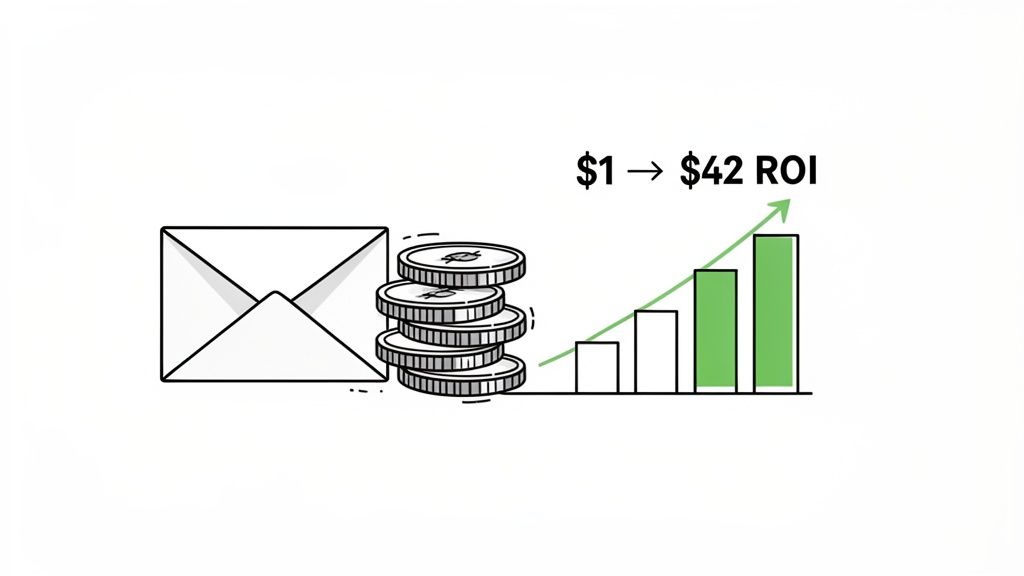
Among all digital marketing channels, email marketing stands out for its exceptional return on investment (ROI). Industry benchmarks consistently show an average return of $42 for every $1 spent. This efficiency makes it a cornerstone for any performance-focused growth strategy, allowing businesses to nurture leads and convert customers at a fraction of the cost associated with paid advertising or extensive content marketing campaigns alone.
Unlike pay-per-click (PPC) ads that cease to deliver value the moment you stop paying, email marketing helps you build a proprietary, long-term asset: your subscriber list. This owned audience becomes a reliable channel for generating ongoing returns, insulating your business from rising ad costs and volatile platform algorithms. This direct line of communication is one of the most powerful email marketing benefits for sustainable growth.
Actionable Examples of High-ROI Email Marketing
- SaaS Nurture Sequences: A new trial user receives an automated 5-part email series. The sequence showcases key "aha" moments, links to tutorials for high-value features, and presents a limited-time upgrade offer in the final email, converting free users to paid subscribers at a near-zero marginal cost.
- E-commerce Abandoned Cart Recovery: A customer leaves a product in their cart. Within an hour, an automated email arrives with a reminder and a customer testimonial. A follow-up 24 hours later offers a 10% discount. This tactic alone can recover 10-15% of lost revenue.
- B2B Lead Nurturing: A lead downloads a whitepaper. They are entered into a nurture track that sends a relevant case study three days later, followed by an invitation to a webinar on a related topic. This builds authority and qualifies the lead for sales without manual intervention.
Tactics to Maximize Your Email ROI
To replicate this success, your focus must be on relevance and measurable performance. Generic blasts are a waste of resources; targeted automation is a revenue multiplier.
At Ezca, our 90-day sprints are designed to operationalize these high-ROI tactics from day one. We start by analyzing your data to build intelligent segmentation and automation frameworks that convert leads efficiently, ensuring your email program becomes a primary revenue driver, not a cost center.
- Implement Smart Segmentation: Group subscribers by behavior (e.g., last purchase date, pages visited, webinar attendance). For a B2B audience, segment by role or industry to tailor the messaging. For e-commerce, segment by purchase category.
- Use Triggered Automation: The top three revenue-driving automations are welcome series, abandoned cart reminders, and post-purchase follow-ups. Set these up first.
- A/B Test Relentlessly: Continuously test one variable at a time. Start with subject lines to improve open rates, then test calls-to-action (CTAs) to improve click-throughs. Even a 5% lift compounds over time.
- Track Key Metrics: Focus on ROI-centric metrics: Revenue Per Email (RPE), Conversion Rate, and Customer Lifetime Value (LTV) of email-acquired customers. Monitor deliverability metrics like Inbox Placement Rate to ensure your messages are being seen.
2. Precision Targeting and Audience Segmentation
Generic email blasts are a thing of the past. Email marketing’s power lies in its ability to enable sophisticated audience segmentation based on behavioral data, demographics, purchase history, and engagement patterns. This precision ensures your messages reach the right people with the right offer at the right time, dramatically increasing relevance and conversion rates. For B2B and e-commerce companies, segmentation is essential for delivering personalized experiences at scale.
Unlike broad-stroke advertising, email lets you speak directly to micro-audiences with specific needs and interests. This targeted communication builds stronger customer relationships, reduces unsubscribe rates, and makes your marketing efforts feel more like a helpful conversation than a sales pitch. This ability to deliver relevance at scale is one of the most impactful email marketing benefits for driving meaningful engagement and conversions.
Actionable Examples of Precision Segmentation
- E-commerce VIPs: Create a segment for customers who have spent over $500 in the last 6 months. Send them exclusive early access to new products or a surprise "thank you" discount. This drives loyalty and higher LTV.
- B2B Role-Based Content: A software company segments its list into "Developers," "Project Managers," and "Executives." Developers receive technical API updates, PMs get case studies on team efficiency, and executives see ROI calculators.
- SaaS Engagement Tiers: Segment users into "Power Users" (used 5+ features in 30 days) and "At-Risk Users" (no login for 14 days). Power users get invites to a beta program, while at-risk users receive a "Did you know?" email showcasing an easy-to-use feature.
Tactics to Maximize Your Targeting and Segmentation
To truly unlock precision targeting, a deep dive into specific Audience Segmentation Strategies for B2B Email can provide actionable insights. Start with a few core segments and expand as your data and capabilities mature.
At Ezca, we use predictive analytics to identify high-potential segments you might be missing. Our data-first approach helps build dynamic segments that adapt to user behavior in real-time, ensuring your campaigns are always hitting the most receptive audience with the perfect message.
- Start with 3-5 Core Segments: Begin with high-impact groups like "New Subscribers" (for a welcome series), "Repeat Customers" (for loyalty offers), and "Inactive Users" (for a re-engagement campaign).
- Use Event-Based Triggers: Create dynamic segments based on real-time actions. For example, a user who views the pricing page three times but doesn't sign up is automatically added to a segment that receives a case study and a sales outreach email.
- Implement RFM Analysis: For e-commerce, segment your audience based on Recency, Frequency, and Monetary value. This helps you identify and nurture your most valuable customer cohorts.
- Regularly Analyze Segment Performance: Track Open Rate, Click-Through Rate (CTR), and Conversion Rate for each segment. If a segment consistently underperforms, it's a sign that your messaging or offer is not resonating, and you need to refine it.
3. Measurable Performance Analytics and Attribution
Unlike channels with opaque performance data, email marketing offers granular analytics that connect campaign activities directly to business outcomes. This transparency allows you to track every step of the customer journey, from the initial email open to the final conversion, providing clear evidence of what works and what doesn't. This direct feedback loop is essential for calculating accurate ROI and making data-driven decisions.
The ability to measure everything from open and click-through rates to revenue per email and impact on customer lifetime value (LTV) is one of the most critical email marketing benefits for growth-focused companies. It transforms marketing from a cost center into a predictable revenue engine by attributing specific outcomes to specific campaigns, justifying investment and guiding strategy.
Actionable Examples of Data-Driven Email Marketing
- SaaS Funnel Tracking: By using UTM parameters, a SaaS company can track a user from an email click to a trial sign-up, and finally to a paid conversion. This allows them to calculate the exact ROI of a specific email campaign. For example, "Our Q3 onboarding sequence generated $15,000 in new ARR."
- E-commerce Campaign Attribution: An e-commerce brand attributes $50,000 in sales to its "Black Friday" email campaign. This data allows the marketing leader to justify a larger budget for the next year's campaign and optimize send times based on when most conversions occurred.
- B2B Lead Scoring: A lead who opens 5 emails and clicks on a pricing page link is automatically assigned a higher lead score. This triggers a notification to the sales team, who can see the exact content the lead engaged with, enabling a highly relevant follow-up.
Tactics to Maximize Your Email Analytics and Attribution
To achieve this level of clarity, you need a systematic approach to tracking and reporting. It begins with a solid data foundation and a commitment to consistent measurement.
At Ezca, our 90-day sprints establish this foundation by implementing robust tracking frameworks from the start. We create custom dashboards that connect email metrics to your core business KPIs, giving you a real-time view of performance and making attribution clear and actionable.
- Implement UTM Parameters Consistently: Use a standardized UTM structure for all links (
utm_source=email,utm_campaign=q4-promo,utm_medium=newsletter). This is non-negotiable for accurate attribution in Google Analytics or other platforms. - Set Up Multi-Stage Conversion Tracking: Track micro-conversions like "demo requested" or "added to cart" in addition to the final sale. This helps you understand how email influences the entire funnel, not just the last click.
- Use Cohort Analysis: Analyze groups of subscribers who joined at the same time (e.g., "January 2024 cohort"). Track their LTV over 3, 6, and 12 months to measure the long-term value generated by your email program.
- Create Custom Reporting Dashboards: Build a dashboard that focuses on business outcomes, not vanity metrics. Key metrics should include Email-Attributed Revenue, Customer Acquisition Cost (CAC) via email, and Conversion Rate by Segment.
4. Rapid Testing and Iterative Optimization
Email marketing enables fast, low-risk experimentation through A/B testing of subject lines, copy, CTAs, send times, and creative elements. This agility is invaluable in performance marketing environments where rapid iteration drives growth. Unlike longer-cycle channels, email campaigns can be tested, analyzed, and optimized within days, allowing you to compound improvements and achieve significant performance gains quickly.
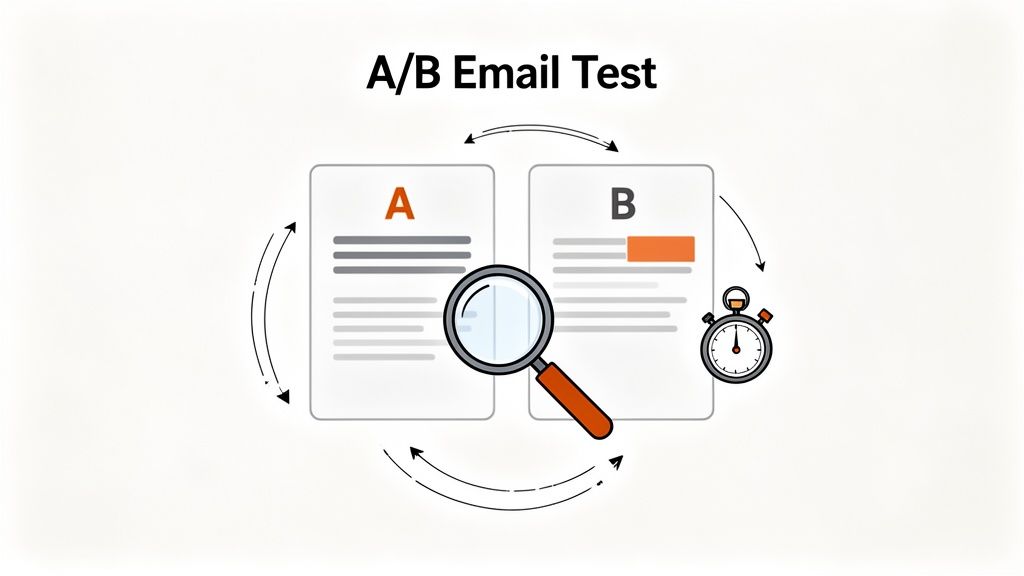
The ability to gather direct, quantitative feedback from your audience is a key competitive advantage. You can quickly answer critical business questions like "Does our audience respond better to an ROI-focused message or a time-saving one?" This direct feedback loop makes rapid optimization one of the most powerful email marketing benefits for any growth-focused team.
Actionable Examples of Rapid Iteration
- Subject Line Testing: A B2B company tests "Increase Your Team's Productivity by 30%" vs. "How [Competitor] is Wasting Your Time." The winning subject line increases the open rate by 25%, immediately boosting the reach of that campaign.
- CTA Button Test: An e-commerce brand tests "Shop Now" vs. "Claim Your 15% Off." The second, more specific CTA increases click-through rate by 40%, driving significantly more traffic to the product page.
- Send Time Optimization: A SaaS company discovers through testing that sending emails at 10 AM on Tuesday results in the highest engagement for its US audience, while a 2 PM Wednesday send works best for its European segment. This simple change lifts overall campaign performance.
Tactics to Maximize Your Testing Velocity
To build a high-performing testing program, you need a structured approach that prioritizes impact and generates clear, actionable learnings.
At Ezca, our 90-day sprints build a rigorous testing framework into your email program from the start. We identify high-impact variables, design experiments, and document learnings to create a compounding growth engine that continuously refines your messaging and boosts conversions.
- Use a Sequential Testing Methodology: Test one variable at a time (e.g., subject line A vs. B). Sending a small test to 10-20% of your list, then rolling the winner out to the rest, maximizes impact.
- Focus on High-Impact Variables First: Prioritize tests on elements with the biggest potential influence. The hierarchy is typically: Subject Line (impacts opens), Email Body/Offer (impacts clicks), and Call-to-Action (impacts conversions).
- Document All Test Results: Maintain a simple spreadsheet to log your hypothesis, variables, segment, results (with statistical significance), and key learnings. This builds a playbook of what works for your audience.
- Implement Automated Multivariate Testing: For advanced programs, use tools that automatically test multiple combinations of elements (e.g., 3 headlines x 2 images x 2 CTAs) to find the winning formula faster. The key metric to watch is the conversion rate, not just opens or clicks.
5. Enhanced Customer Lifetime Value and Retention
While customer acquisition often takes the spotlight, retention is where sustainable profitability is built. Email marketing is a premier channel for increasing customer lifetime value (LTV) by keeping users engaged, encouraging repeat business, and reducing churn. For many SaaS and e-commerce companies, a 5% increase in customer retention can produce a profit increase of 25% to 95%.
Unlike acquisition-focused channels, email nurtures the post-purchase relationship. Through targeted onboarding, educational content, and re-engagement campaigns, you can guide customers toward becoming power users and brand advocates. This direct communication transforms a one-time transaction into a long-term relationship, making it one of the most impactful email marketing benefits for scaling businesses.
Actionable Examples of Retention-Driven Email Marketing
- SaaS Onboarding: A new user receives a triggered email sequence that guides them through setting up their first project. This "activation" campaign is proven to reduce churn by up to 30% in the first 90 days.
- E-commerce Cross-selling: A customer who buys a camera receives an email two weeks later showcasing compatible lenses and tripods. This automated, relevant offer can increase the average customer's LTV by 15-25%.
- Proactive Churn Reduction: A SaaS platform identifies a user whose activity has dropped. An automated email is triggered, asking for feedback ("How can we improve?") and offering a 1-on-1 session with a customer success manager. This proactive outreach can salvage at-risk accounts.
Tactics to Maximize Your Customer LTV with Email
To turn your email list into a retention machine, you must move beyond generic newsletters and focus on triggered, value-added communication.
At Ezca, we specialize in building data-driven retention engines. Our 90-day sprints focus on mapping your customer journey and implementing automated sequences that increase engagement, drive upsells, and reduce churn, turning your existing customer base into your most reliable source of growth.
- Create a Comprehensive Onboarding Sequence: For SaaS, this means guiding users to their "aha" moment quickly. For e-commerce, it means confirming the order, sharing shipping updates, and asking for a review post-delivery.
- Implement Engagement Scoring: Track user activity (logins, feature usage, purchase frequency) to identify at-risk customers. Trigger a win-back campaign for users whose score drops below a certain threshold.
- Build a Post-Purchase Upsell/Cross-sell Flow: Use purchase data to trigger automated campaigns that recommend complementary products or higher-tier service plans. Time these based on typical product usage cycles.
- Launch a Loyalty Program: Use email to manage a VIP program. Reward your top 10% of customers (by spend or frequency) with exclusive perks, early access, and special recognition to foster strong brand advocacy.
6. Seamless Integration with Multi-Channel Marketing Strategies
Email marketing does not operate in a silo. Its true power is unlocked when it acts as the connective tissue for your entire marketing ecosystem, creating a cohesive customer journey. It works synergistically with channels like SEO, paid ads, and content marketing to capture, nurture, and convert leads with greater efficiency. This integrated approach ensures consistent messaging and prevents the drop-offs that occur when channels are managed separately.
When a lead generated by a paid ad or organic content enters your email list, you gain a direct, low-cost way to continue the conversation. This process turns expensive, one-time clicks into long-term relationships, amplifying the ROI of your acquisition efforts. This coordination is one of the most critical email marketing benefits for building a resilient marketing machine.
Actionable Examples of Multi-Channel Integration
- Paid Ads to Email Nurture: A user clicks a LinkedIn ad for a B2B whitepaper and subscribes to download it. They are immediately entered into an email nurture sequence that builds on the whitepaper's topic, guiding them toward a demo request and increasing the ROI of the initial ad spend.
- Email to Retargeting Ads: An e-commerce brand sends a promotional email for a new shoe collection. They sync the segment of users who clicked the email but didn't purchase with their Meta Ads account and run a retargeting campaign showing those exact shoes. This "surround sound" effect can lift conversion rates by 20-30%.
- SEO to Email Conversion: A visitor lands on a blog post via organic search. A content upgrade (e.g., a downloadable checklist) captures their email. This new subscriber is then nurtured with related content via email, turning a one-time organic visitor into a long-term lead.
Tactics to Maximize Your Multi-Channel Strategy
Integrating your channels requires a unified view of the customer. Start by ensuring your data flows smoothly between platforms to enable coordinated marketing plays.
At Ezca, our data-first approach breaks down channel silos from the start. We implement a unified data framework, often using a CDP, to track the full customer journey. This allows us to build campaigns where an SEO click leads to an email nurture sequence that syncs with a paid retargeting ad, maximizing conversion at every stage.
- Unify Customer Data with a CDP/CRM: Implement a Customer Data Platform (CDP) or a well-configured CRM to create a single source of truth. This is the technical foundation for any serious multi-channel strategy.
- Sync Email Segments to Ad Platforms: Upload your most valuable email segments (e.g., "VIP Customers," "Engaged Leads") to Google Ads, Meta, and LinkedIn to create high-performing lookalike audiences. This leverages your first-party data to improve ad targeting.
- Create Cross-Channel Journeys: Map out customer journeys that span multiple touchpoints. Example: User sees a Facebook ad -> Clicks to a landing page -> Subscribes via email -> Receives a 3-part nurture sequence -> Gets a retargeting ad if they don't convert.
- Support CRO with Email: Use email to drive specific, warm audience segments to A/B tests on your website. This helps you achieve statistically significant results for your Conversion Rate Optimization (CRO) efforts much faster.
7. Personalization at Scale and Dynamic Content
Modern email platforms enable true personalization at scale through dynamic content blocks, behavioral triggers, and AI-powered recommendations. Rather than sending generic broadcasts, you can deliver unique email experiences to each subscriber based on their actions, preferences, and profile data. This level of personalization dramatically increases engagement, conversions, and revenue per email.
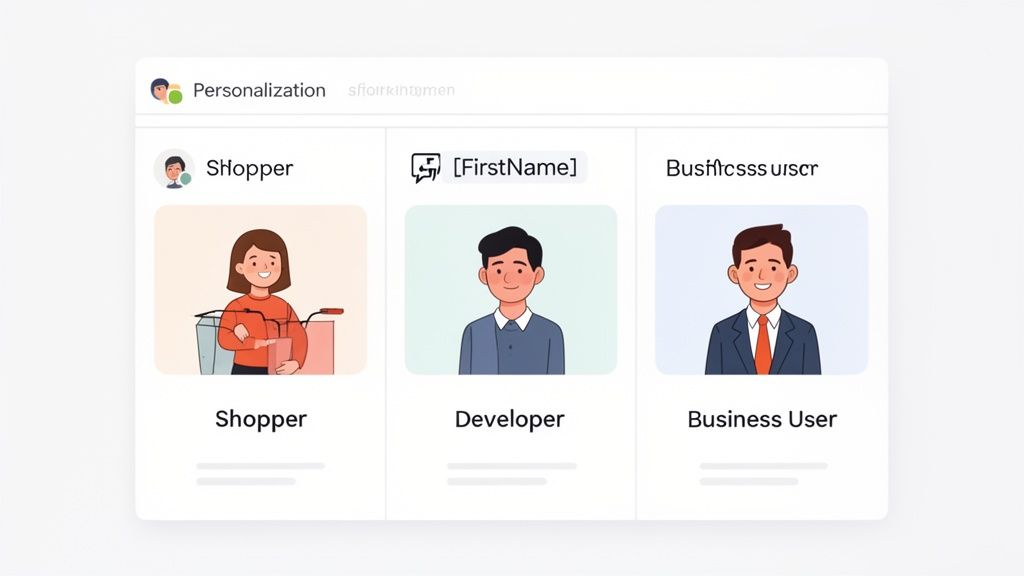
Moving beyond simple [FirstName] tags, dynamic content swaps entire sections of an email-like images, offers, or calls-to-action-based on subscriber data. This ensures every message feels relevant and timely. For marketing leaders and business owners, this capability is one of the most powerful email marketing benefits for driving meaningful interactions and demonstrating a deep understanding of customer needs.
Actionable Examples of Personalization at Scale
- E-commerce Product Recommendations: An email from an online retailer dynamically populates with products related to a user's recent browsing history. This simple tactic can lift click-through rates by 300% or more compared to a generic product email.
- SaaS Usage-Based Content: A project management tool sends a weekly digest email. For a user who frequently uses the "Gantt chart" feature, the email includes a dynamic block with "3 advanced Gantt chart tips." For another user, that block is replaced with content about a different feature they use.
- B2B Industry-Specific Case Studies: A B2B marketing email features a customer success story. Using dynamic content, the case study shown is automatically matched to the recipient's industry (e.g., a healthcare company sees a healthcare case study), making the message far more persuasive.
Tactics to Maximize Your Email Personalization
To achieve this level of customization, start with a clear data strategy. Focus on collecting and organizing the behavioral and demographic information that matters most.
At Ezca, we use a data-first approach to personalization. In our 90-day sprints, we integrate your customer data platforms and analytics tools to build a unified customer view, then deploy dynamic content logic that directly impacts your core KPIs, turning your email list into a high-performance personalization engine.
- Start with 3-5 Dynamic Blocks: Begin by personalizing key content areas. Ideas include: showing different hero images based on gender or location, displaying different CTAs for customers vs. prospects, or inserting a user's loyalty point balance.
- Use Behavioral Data for Content Logic: The most effective personalization is based on behavior. Use data like
last_page_visited,last_purchase_category, orfeature_usage_levelto drive your dynamic content rules. - Implement Send Time Optimization (STO): Use your ESP's AI features to deliver emails at the specific time each individual subscriber is most likely to open them. This is a simple but powerful form of personalization that can lift open rates by 10-15%.
- Test and Measure Incrementally: Don't try to personalize everything at once. Roll out a single dynamic content block to a segment, measure the lift in CTR or conversion rate against a control group, and then expand.
8. Lead Qualification and Sales Funnel Acceleration
Email marketing is a powerful engine for efficiently qualifying leads and moving them through the sales funnel. By delivering targeted content that addresses specific pain points and buyer objections, strategic email sequences can dramatically shorten B2B sales cycles and improve sales team productivity. This is one of the most critical email marketing benefits for companies with a considered purchase process.
The core function here is using email engagement data to score leads. This process helps sales teams prioritize high-intent prospects, distinguishing genuinely interested buyers from passive subscribers. By focusing effort on the most engaged leads, sales teams can operate with greater precision and achieve higher close rates.
Actionable Examples of Sales Funnel Acceleration
- B2B Lead Scoring: A lead gets +5 points for opening an email, +10 for clicking a link, and +50 for visiting the pricing page. When a lead's score surpasses 100, they are automatically flagged as a Marketing Qualified Lead (MQL) and assigned to a sales rep in the CRM.
- SaaS Trial Nurturing: A user in a 14-day trial receives emails that highlight advanced features, showcase customer testimonials, and offer a demo with a product specialist. This educational sequence is designed to prove value and drive conversion before the trial ends.
- Enterprise Sales Enablement: An account executive adds a prospect to a specific email sequence designed to address common objections from CFOs. The sequence automatically sends an ROI report and a case study from a similar-sized company, helping the AE build their business case.
Tactics to Accelerate Your Sales Funnel
To turn your email list into a qualification machine, focus on alignment between marketing content and sales signals.
At Ezca, our 90-day sprints connect marketing actions directly to sales outcomes. We build lead scoring models that analyze email engagement and website behavior, creating automated workflows that hand off high-intent leads to your sales team with the full context they need to close the deal.
- Create Segment-Specific Nurture Sequences: Develop distinct email tracks for different buyer personas (e.g., Marketing Manager vs. CEO) or stages of awareness (e.g., "Problem Aware" vs. "Solution Aware").
- Implement Lead Scoring: Assign points for high-intent actions. Examples: visiting the pricing page (+25), downloading a case study (+15), clicking a link in an email (+5). Subtract points for inactivity.
- Use Trigger-Based Handoffs: When a lead's score passes a predefined threshold (e.g., 100 points), trigger an automation that creates a new deal in your CRM, assigns it to a sales rep, and sends them an internal notification.
- Provide Sales with Context: Ensure your sales team can see a lead's engagement history. Knowing they opened the "ROI" email and clicked on the "Enterprise Plan" link is critical context for a productive sales call.
9. Brand Building and Customer Relationship Development
Email marketing offers a direct, permission-based channel that builds lasting connections with customers and prospects. Regular, valuable communication strengthens brand recall, establishes your company as a thought leader, and fosters loyalty. Unlike paid ads that vanish when budgets stop, email creates consistent touchpoints that deepen customer relationships and turn subscribers into brand advocates.
This direct line of communication is one of the most powerful email marketing benefits because it operates on your terms. You own the audience and control the narrative, allowing you to reinforce your brand's values, mission, and personality with every send. This consistent presence in the inbox keeps your brand top-of-mind, making customers more likely to choose you when they are ready to buy.
Actionable Examples of Email-Led Brand Building
- Thought Leadership Newsletters: A B2B consulting firm sends a bi-weekly newsletter with original analysis of industry trends. It rarely includes a hard sell, instead focusing on providing immense value, which builds authority and trust.
- Behind-the-Scenes Content: A direct-to-consumer (DTC) brand sends emails showing how their products are made, introducing the team, and sharing their commitment to sustainability. This transparency builds an emotional connection with customers.
- Community-Building Emails: A SaaS company features a "Customer of the Month" in their newsletter, sharing how that user achieved success with their tool. This celebrates customers and provides social proof to other users.
Tactics to Use Email to Build Your Brand
To transform your email list into a community of advocates, prioritize value over promotions. Your subscribers' inboxes are crowded, so earning their attention requires delivering content they genuinely want to read.
At Ezca, we help clients build brand affinity by developing content pillars that resonate with their specific audience segments. Our 90-day sprints focus on creating a sustainable content-to-commerce engine where brand-building emails naturally lead to higher engagement and long-term revenue.
- Establish a Consistent Schedule: A reliable cadence (e.g., a newsletter every Tuesday) trains subscribers to expect your content. Consistency builds trust.
- Follow the 80/20 Rule: Dedicate 80% of your email content to providing value (education, entertainment, insights) and only 20% to direct promotion. This ratio ensures you're giving more than you're asking.
- Share Success Stories and Social Proof: Regularly feature customer testimonials, case studies, and positive reviews in your emails. This builds trust far more effectively than any marketing copy.
- Define and Use a Consistent Brand Voice: Whether your brand is witty, authoritative, or supportive, ensure that voice is consistent across all emails. This makes your brand more recognizable and relatable.
10. Regulatory Compliance and Direct Customer Relationship Control
In an era of rising ad costs and unpredictable platform algorithms, email marketing provides an invaluable asset: an owned, direct line of communication with your customers. Unlike paid channels that rely on third-party platforms like Meta or Google, your email list is a proprietary asset that cannot be taken away or de-prioritized by an algorithm update. This control is one of the most strategic email marketing benefits available today.
Operating as a direct channel gives you stability and insulates your business from market volatility. When privacy changes like Apple's iOS 14 update disrupt ad targeting, a strong email list ensures you can still reach your audience effectively. With proper adherence to regulations like GDPR, CAN-SPAM, and CCPA, you build a sustainable and compliant marketing engine that future-proofs your customer relationships.
Actionable Examples of Channel Control and Compliance
- Hedging Against Ad Costs: A brand sees its Facebook CPA increase by 50%. They reallocate budget from ads to an email acquisition campaign (e.g., a giveaway or content upgrade). While the upfront cost is higher, the LTV of an email subscriber is 3x that of a social follower, providing better long-term ROI.
- Navigating Privacy Changes: Post-iOS 14, an e-commerce brand that relied on Meta's pixel for retargeting lost visibility. They shifted focus to their email-driven abandoned cart flow, which is based on first-party data and unaffected by browser privacy settings, successfully recovering lost revenue.
- Building Trust Through Compliance: A company implements a clear preference center where users can choose to receive weekly or monthly emails, and select topics of interest. This transparency reduces unsubscribes and signals to users that their preferences are respected.
Tactics to Maintain Control and Ensure Compliance
Building and maintaining this owned channel requires a commitment to best practices. Your goal is to respect subscriber privacy while maximizing the value of your direct connection.
At Ezca, we build compliance directly into our email strategies. From implementing double opt-in to creating user-friendly preference centers, we ensure your email program is not only a revenue driver but also a trusted and secure channel that strengthens customer relationships.
- Implement Double Opt-In: Require new subscribers to click a confirmation link in their email. This is a best practice for GDPR and improves list quality by filtering out typos and bots.
- Maintain a Preference Center: Allow subscribers to manage their experience. Let them choose content frequency (daily, weekly, monthly) and topics (product updates, blog posts, promotions). This drastically reduces unsubscribe rates.
- Regularly Clean Your List: Every 3-6 months, run a re-engagement campaign for subscribers who haven't opened an email in 90 days. If they don't re-engage, remove them. This improves deliverability and lowers ESP costs.
- Document Consent Practices: Keep clear records of the date, time, IP address, and form source for every subscriber's consent. This is non-negotiable for demonstrating compliance with regulations like GDPR and CCPA.
10-Point Email Marketing Benefits Comparison
Turn Benefits into Performance with a Data-Driven Sprint
Understanding the theoretical power of email marketing is one thing; operationalizing it to drive consistent, measurable growth is the real challenge for today's marketing leaders. We've explored the significant email marketing benefits, from precision targeting and unparalleled ROI to building lasting customer relationships and accelerating sales funnels. But these benefits don't materialize from sporadic campaigns or a "set it and forget it" mentality. They are the direct result of a systematic, data-driven engine.
The true value is unlocked when you move beyond isolated tactics and create a unified system. Imagine your segmentation strategy directly informing your dynamic content, your A/B test results automatically refining your lead nurturing sequences, and your email performance data providing crucial insights for your paid media and SEO efforts. This isn't just about sending emails; it's about building an intelligent communication machine that adapts and improves with every interaction. This is the framework that turns a contact list into a predictable revenue generator, a principle that has helped Ezca generate over $100M in tracked revenue and more than 200,000 qualified leads for our clients.
From Insights to Action: A 90-Day Sprint Framework
The gap between knowing the benefits and achieving them is bridged by a structured, agile methodology. For SaaS founders, e-commerce owners, and B2B marketing directors, the speed of execution is critical. A prolonged, year-long strategy session is a luxury few can afford. Instead, a focused, high-intensity sprint can deliver tangible results quickly, providing the momentum needed for long-term success.
At Ezca, we operationalize these principles through our 90-day sprint model. This approach is designed for rapid learning and immediate application. A dedicated squad, combining human expertise with AI-powered analytics, focuses on your most critical growth levers.
Here’s how this framework directly translates the benefits we’ve discussed into performance:
- Rapid Iteration on Personalization: Instead of spending months designing the "perfect" campaign, we launch and test multiple segmentation and personalization hypotheses within the first few weeks. We quickly identify which audience subsets respond to specific messaging, offers, or content formats, allowing for immediate optimization.
- Integrated Multi-Channel Feedback: Our model connects email strategy to SEO, paid media, and CRO in weekly optimization cycles. If an email campaign reveals high engagement around a particular feature or pain point, that insight is immediately fed to the content and paid media teams to create aligned assets and target similar audiences on other platforms.
- Data-Driven Resource Allocation: By continuously monitoring performance analytics, we dynamically allocate resources to the highest-return activities. If a lead nurturing sequence is outperforming a general newsletter in converting MQLs to SQLs, we double down on refining and expanding that sequence. This ensures that every dollar and hour spent is directly contributing to your most important business objectives.
This integrated, performance-focused system ensures your email marketing efforts are not just another task on a checklist. It transforms your program into a core pillar of your growth strategy, making every email sent a calculated step toward acquiring high-value customers, increasing lifetime value, and building a defensible brand. The email marketing benefits are immense, but they are earned through disciplined execution, not passive observation. The key is to start now, with a clear plan to test, measure, and scale what works.
Ready to stop guessing and start growing? The team at Ezca Agency builds high-performance marketing engines for ambitious brands using a data-driven, 90-day sprint methodology. Schedule a consultation with Ezca Agency to see how we can turn your email marketing benefits into predictable revenue.