
12 Actionable E-commerce Growth Strategies for 2026
Discover 12 actionable e-commerce growth strategies. Drive revenue with data-backed tactics for acquisition, conversion, and retention. Learn more.
In a crowded market, generic advice won't cut it. Sustainable e-commerce growth isn't about chasing fleeting trends; it's about building a robust, data-driven engine across acquisition, conversion, and retention. This article moves beyond the fluff to deliver a prioritized roundup of actionable e-commerce growth strategies for marketing leaders and business owners.
We will dissect each strategy, providing the 'why' behind its effectiveness, specific implementation tactics, the key metrics to track, and real-world ROI considerations. From performance-based paid media to advanced LTV optimization, these are the frameworks that scale revenue predictably. For a comprehensive blueprint on how to increase Shopify sales, it's crucial to understand a variety of actionable growth strategies that complement the tactics discussed here.
This guide provides the blueprint for building a resilient, high-growth e-commerce brand. We'll cover a complete growth system, including:
- Customer Acquisition: Performance-based paid search, SEO, and social media advertising.
- Conversion Optimization: CRO, landing page testing, and product-led growth models.
- Retention & Expansion: Email marketing automation and customer LTV optimization.
- Growth Operations: 90-day sprint methodologies and advanced attribution modeling.
For leaders looking to accelerate this process, an agency partner like Ezca can implement these strategies within focused 90-day sprints. This approach uses a dedicated squad model to shift budgets to the highest-return channels weekly, ensuring your marketing spend is always working its hardest. Now, let’s explore the frameworks that drive real results.
1. Performance-Based Paid Search (PPC) Management
Performance-based PPC management is an e-commerce growth strategy that moves away from a “set it and forget it” budget. Instead, it treats ad spend as a fluid asset, allocating funds in real-time based on performance metrics like Return on Ad Spend (ROAS) and Cost Per Acquisition (CPA). This data-driven approach involves constant A/B testing and weekly, sometimes daily, budget shifts toward the highest-converting campaigns, ad groups, and audiences.
This method requires a robust tracking foundation to connect ad spend directly to revenue, making every dollar accountable. By optimizing for profitability metrics over vanity metrics like clicks or impressions, it ensures your ad budget contributes directly to the bottom line. The fast feedback loops allow for rapid adaptation to market changes and competitor actions, which is essential for sustainable acquisition.
Key Insight: A performance-based model isn't about spending more; it's about spending smarter. The goal is to maximize your marketing investment by focusing relentlessly on what drives profitable sales, not just website traffic.
Actionable Tactics
- Implement Conversion Tracking First: Ensure accurate conversion and revenue tracking is configured in Google Ads and Analytics before scaling any campaigns.
- Establish Profit-Based ROAS Targets: Calculate your break-even ROAS based on your product profit margins, not just revenue. This gives you a clear profitability benchmark.
- Segment Branded vs. Non-Branded Keywords: Create separate campaigns for branded searches (e.g., "Ezca services") and non-branded searches (e.g., "PPC agency for e-commerce"). They have different intents and performance expectations.
- Use Search Term Reports Weekly: Actively mine your search term reports to find and add irrelevant queries as negative keywords, preventing wasted ad spend.
- Automate Bid Adjustments: Set up automated rules to increase bids on high-performing keywords (e.g., ROAS > 4x) and decrease them on underperformers.
Agency Support & 90-Day Sprints
This is a core competency for a performance marketing agency. For example, Ezca’s squad model uses a 90-day sprint framework to set aggressive ROAS targets. Our team reallocates budgets weekly based on hard data, combining expert oversight with AI-powered bid management to achieve significant ROAS improvements for clients.
2. Conversion Rate Optimization (CRO) & Landing Page Testing
Conversion Rate Optimization (CRO) is a systematic approach to increasing the percentage of website visitors who complete a desired action, such as a purchase or a form submission. This strategy relies on user behavior analytics, A/B testing, and iterative improvements to remove friction points in the user journey. By focusing on optimizing existing traffic, CRO delivers a high ROI and is a critical e-commerce growth strategy for maximizing profitability from every click.
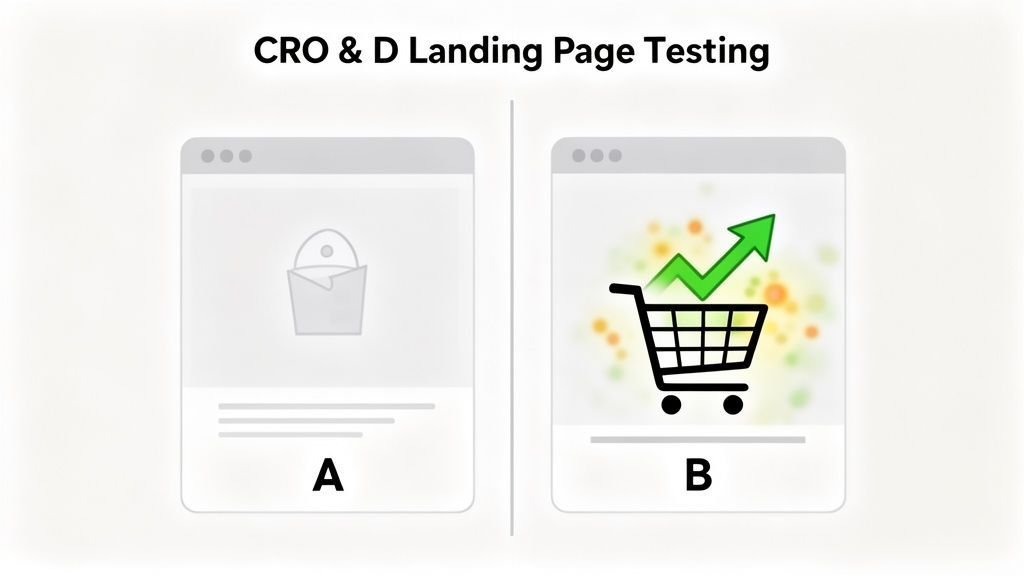
The process involves identifying drop-off points in your sales funnel, forming hypotheses about why users are leaving, and then testing changes to prove or disprove those hypotheses. Continuous testing, inspired by companies like Amazon and HubSpot, allows brands to make data-backed decisions that compound over time, leading to significant lifts in revenue without increasing ad spend.
Key Insight: CRO is not about guesswork or chasing design trends. It's a scientific method for understanding customer behavior and systematically improving their on-site experience to guide them toward conversion.
Actionable Tactics
- Start with High-Impact Pages: Focus initial efforts on high-traffic pages like your homepage, key product pages, and the checkout flow. A small percentage improvement here translates into substantial revenue gains.
- Analyze User Behavior with Heatmaps: Use tools like Hotjar or Crazy Egg to see where users are clicking, scrolling, and getting stuck. Heatmaps often reveal "rage clicks" on non-interactive elements, indicating user frustration.
- Isolate Test Variables: To achieve statistically significant results, test one major element at a time. For instance, test your headline first, then your call-to-action button color, then your primary image.
- Reduce Friction in Forms and Checkout: Test a version of your checkout form with 50% fewer fields. For every field you remove, you reduce the effort required to convert, often leading to a higher submission rate.
- Build Trust Above the Fold: Place trust signals like customer testimonials, security badges (SSL, payment providers), and free shipping banners in a prominent, visible location on product and checkout pages.
Agency Support & 90-Day Sprints
Executing a structured CRO program requires specialized skills in analytics, user experience, and statistical analysis. At Ezca, our 90-day sprint framework for CRO involves a deep-dive audit to identify the biggest opportunities. We then design and run a series of A/B tests aimed at specific KPIs, like checkout completion rate, providing clients with a clear roadmap for turning more of their existing traffic into paying customers.
3. SEO & Organic Content Marketing Strategy
An SEO and organic content marketing strategy is a long-term approach to growth focused on earning, not buying, visibility in search engine results. This involves technical website optimization, the creation of high-quality content that answers user questions, and building your site's authority through backlinks. Unlike paid ads, the value of this e-commerce growth strategy compounds over time, as higher rankings and increased domain authority create a durable competitive advantage.
This method requires a deep understanding of customer intent, mapping keywords to different stages of the buying journey. Success hinges on creating content that is genuinely better than what currently ranks, whether that's through more comprehensive guides, better data, or clearer explanations. As your organic presence grows, you build a sustainable source of qualified traffic that isn't dependent on daily ad spend, directly improving profitability.
Key Insight: SEO isn't just about ranking for keywords; it's about owning the customer conversation. By creating the best answer for every relevant query, you become the default authority in your category, building trust long before a purchase decision is made.
Actionable Tactics
- Prioritize Buyer-Intent Keywords: Focus initial efforts on keywords that signal a readiness to buy, such as those including "pricing," "vs," "best for," or specific product model numbers.
- Build Pillar and Cluster Content: Develop a comprehensive "pillar" page (5,000+ words) on a core topic, then create shorter "cluster" articles on related subtopics that all link back to the pillar.
- Optimize Existing High-Traffic Pages: Before creating net-new content, use tools like Google Search Console to find pages that already get traffic and improve them for higher conversion rates and better rankings.
- Implement Schema Markup: Add structured data to your product pages, blog posts, and FAQs to help search engines understand your content and earn rich snippets in search results.
- Monitor Core Web Vitals: Check your site's performance against Google's Core Web Vitals metrics monthly. A fast, mobile-friendly experience is a critical ranking factor.
Agency Support & 90-Day Sprints
SEO is a long game, making it ideal for a structured sprint-based approach. An agency can conduct the deep technical audits and competitive analysis required to build a winning roadmap. At Ezca, our 90-day sprints for SEO focus on high-impact initiatives first, like targeting low-competition, long-tail keywords to secure early wins. Our team then builds momentum through a disciplined content calendar and targeted backlink outreach to achieve significant organic traffic growth.
4. 90-Day Growth Sprint Methodology
The 90-day growth sprint methodology is an intensive, time-boxed approach for achieving specific business goals. It applies agile principles to performance marketing, forcing teams to focus on a narrow set of measurable objectives-like revenue, user acquisition, or lead generation-within a three-month cycle. This framework drives accountability and rapid iteration, making it one of the most effective e-commerce growth strategies for producing tangible results quickly.
This model, used by top-tier companies like Logitech and Samsung, prevents marketing efforts from becoming aimless or diluted. By setting clear Objectives and Key Results (OKRs) from the start, every action and dollar spent is tied to a specific outcome. The structured cadence of weekly check-ins and data analysis allows teams to double down on what works and cut losses on what doesn’t, maximizing ROI in a compressed timeframe.
Key Insight: A 90-day sprint isn't a long-term plan; it's a focused burst of execution. Its power comes from creating urgency and clarity, forcing ruthless prioritization on the activities with the highest potential impact on growth.
Actionable Tactics
- Set Clear Sprint OKRs: Before starting, define specific, measurable objectives. For example, "Increase revenue from new customers by 40% (from $100k to $140k)" or "Achieve a 3.5x blended ROAS across all paid channels."
- Follow the 70/30 Budget Rule: Allocate 70% of your sprint budget to proven, high-performing marketing channels. Dedicate the remaining 30% to structured experiments with new channels, audiences, or creative angles.
- Establish Weekly Data Check-ins: Hold mandatory weekly meetings to review performance against OKRs using a real-time data dashboard. Make immediate decisions on budget reallocation based on this data.
- Document and Build Playbooks: Keep a detailed log of all tests, wins, and failures. At the end of the sprint, consolidate the findings into a playbook that informs the strategy for the next 90 days.
- Plan the Transition: Begin planning the next sprint two weeks before the current one ends. This ensures a seamless transition and maintains momentum without any "downtime" between cycles.
Agency Support & 90-Day Sprints
This methodology is the core operational framework for a results-driven agency. At Ezca, our entire service model is built around 90-day sprints. Our dedicated squad, led by a sprint owner, defines aggressive OKRs with clients and takes full responsibility for hitting them. This structure allows us to consistently deliver measurable outcomes, such as helping e-commerce brands achieve six-figure launch revenue in their first sprint.
5. Email Marketing & Automation Segmentation
Email marketing and automation segmentation is a powerful e-commerce growth strategy focused on delivering personalized communication at scale. It moves beyond generic email blasts by dividing your audience into smaller groups based on behaviors, purchase history, and engagement levels. This allows you to send highly relevant messages, from abandoned cart reminders to post-purchase follow-ups, that feel personal and timely.
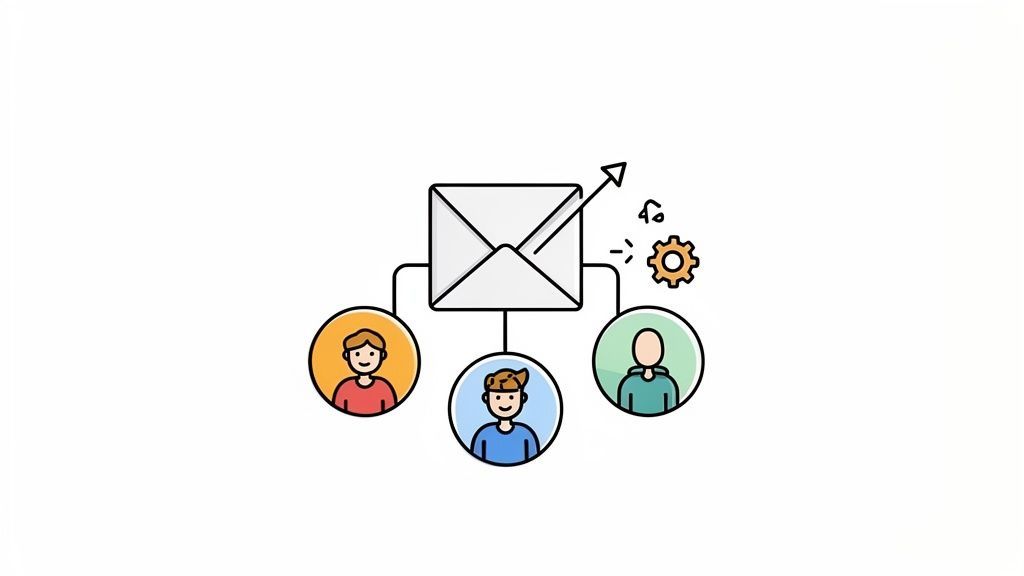
This method directly impacts customer lifetime value (CLV) by nurturing leads, encouraging repeat purchases, and winning back lapsed customers. By automating these communications, you can build a consistent revenue stream that works in the background, often delivering the highest ROI of any marketing channel. It's a foundational component for sustainable e-commerce growth.
Key Insight: The true value of email isn't list size, but list quality and segmentation. A small, engaged list that receives relevant content will always outperform a massive, inactive list receiving generic messages.
Actionable Tactics
- Implement a Welcome Series: Create a 5-7 email welcome sequence that triggers immediately upon subscription. Use it to introduce your brand story, showcase best-selling products, and offer a first-purchase incentive.
- Build an Abandoned Cart Flow: Trigger an email within one hour of a user abandoning their cart. Follow up with 2-3 more reminders over the next 48 hours to recover what is often 10-15% of lost sales.
- Segment by Purchase History: Create dynamic segments for first-time buyers, repeat customers, and high-value customers. Tailor offers and content to each group to increase purchase frequency and loyalty.
- Create Win-Back Campaigns: Target subscribers who haven't purchased or engaged in 90-120 days. Use a compelling offer to re-engage them before they become permanently inactive.
- Use Behavioral Triggers: Set up automations based on specific actions, such as viewing a product category multiple times or reaching a spending threshold.
Agency Support & 90-Day Sprints
Executing a sophisticated email strategy requires expertise in both creative and data analysis. An agency can build and optimize these complex flows. In our 90-day sprints, Ezca maps out the entire customer journey and builds the key automation sequences (welcome, abandoned cart, post-purchase) needed to lift CLV and repeat purchase rates, freeing your team to focus on product and operations.
6. Social Media Advertising & Community Building
This e-commerce growth strategy combines direct-response advertising with organic community engagement. It uses platforms like Meta and TikTok for immediate sales through targeted ads while simultaneously building a loyal follower base through authentic content, influencer partnerships, and active participation. This dual approach creates both short-term revenue and long-term brand equity.
The method acknowledges that modern consumers discover and connect with brands on social media. By running dynamic product ads to acquire new customers and sharing user-generated content to foster a sense of belonging, you create a powerful growth loop. Paid ads fill the top of the funnel, while a strong community improves retention and generates organic referrals.
Key Insight: Social media is a two-way street. The most successful brands don't just advertise; they participate. Combining paid acquisition with genuine community interaction creates a moat that competitors can't easily replicate with ad spend alone.
Actionable Tactics
- Test Creative Aggressively: Launch campaigns with 8-12 creative variations to quickly identify winning visuals, copy, and video formats.
- Build a Tiered Audience Structure: Prioritize your warmest audiences first (e.g., website visitors, past purchasers), then expand to high-quality lookalikes (1% of best customers), and finally to broader interest-based groups.
- Create Platform-Native Content: Shoot vertical videos for TikTok and Instagram Reels. Use high-quality, professional imagery for LinkedIn. Tailoring content to each platform's format and user expectations is critical.
- Partner with Micro-Influencers: Collaborate with influencers in the 10K-100K follower range. Their audiences are often more engaged, and their endorsements are perceived as more authentic than those from larger creators.
- Implement a Retargeting Funnel: Guide users from awareness to purchase with a sequenced ad approach. For example, retarget video viewers with a carousel ad, then retarget cart abandoners with a discount code.
Agency Support & 90-Day Sprints
Managing both paid social campaigns and community engagement requires significant resources and platform-specific expertise. An agency can accelerate this process. Within a 90-day sprint, Ezca's social media squad can establish a robust testing framework, build out multi-layered funnels, and identify scalable influencer partnerships, turning social platforms into a reliable and profitable acquisition channel.
7. AI-Powered Predictive Analytics & Attribution Modeling
This advanced e-commerce growth strategy uses machine learning to move beyond historical reporting and start predicting future customer behavior. It analyzes multi-touch customer journeys to assign credit more accurately across all marketing channels, from initial ad view to final purchase. Instead of relying on simplistic last-click attribution, this model identifies which touchpoints genuinely influence conversions, enabling smarter budget allocation.
This method requires a clean and unified data foundation, often built on a customer data platform (CDP) and server-side tracking. By feeding this high-quality data into predictive models, brands can forecast customer lifetime value (CLV), identify at-risk customers before they churn, and automate bid optimizations across thousands of keywords. This allows marketing leaders to make proactive, data-validated decisions rather than reactive adjustments.
Key Insight: Predictive analytics and algorithmic attribution are about understanding the true value of each marketing touchpoint. This shifts budget from channels that claim credit to channels that actually create it, often revealing hidden opportunities in top-of-funnel activities.
Actionable Tactics
- Standardize UTM Parameters: Implement a strict, company-wide policy for UTM tagging across all campaigns to ensure data consistency for your models.
- Implement Server-Side Tracking: Use tools like the Facebook Conversions API and Google Tag Manager's server-side container to capture accurate conversion data that isn't blocked by browser restrictions.
- Map the Customer Journey First: Before building any model, visually map your typical customer journeys to understand common touchpoint sequences and inform your attribution logic.
- Run Incrementality Tests: Use holdout groups (e.g., excluding a specific audience from a campaign) to validate whether your attribution model’s conclusions match real-world lift.
- Combine AI with Human Oversight: Use AI models for recommendations and automation, but have a strategist review and approve major budget shifts based on broader business context.
Agency Support & 90-Day Sprints
Attribution modeling is a specialized discipline where an agency’s expertise is critical. For instance, Ezca’s data science team helps clients move past default attribution in Google Analytics 4. We build custom models within our 90-day sprint framework to identify which channels are undervalued. This process frequently leads to reallocating 20-30% of a client’s budget to higher-impact channels, boosting overall portfolio ROAS. You can learn more about AI-driven personalization in our case studies.
8. Product-Led Growth (PLG) & Free Trial Strategy
Product-Led Growth (PLG) is a model where the product itself serves as the primary engine for customer acquisition, conversion, and expansion. Instead of relying on a traditional sales team, PLG uses free trials or freemium tiers to let users experience the product’s value firsthand. Companies like Slack and HubSpot use this strategy to acquire millions of self-serve users who then convert to paid plans.
This approach works by minimizing the friction to get started and demonstrating immediate value. The entire user journey, from initial signup to becoming a paying customer, is designed around the product experience. Success depends on strong onboarding, in-app education, and viral features that encourage users to invite others, creating a powerful growth loop.
Key Insight: PLG shifts the focus from selling a promise to demonstrating value. The product becomes the main marketing and sales channel, driving organic adoption and creating a more efficient conversion funnel.
Actionable Tactics
- Reduce Signup Friction: Implement one-click signup using SSO options like Google or LinkedIn to make getting started as easy as possible.
- Create an "Aha!" Moment Fast: Design an onboarding flow with a sample project or pre-populated template so new users see the product’s core value within minutes.
- Track Activation Metrics: Define and monitor your key activation metric, such as the percentage of users who complete a critical action within their first week.
- Guide Users with In-App Tours: Use tooltips and guided tours to help users discover advanced features they might otherwise miss, increasing engagement and perceived value.
- Nurture Trial Users: Create an automated email sequence that engages trial users with tips, case studies, and a clear call-to-action as their trial nears expiration.
Agency Support & 90-Day Sprints
While PLG is product-centric, it requires marketing support to drive top-of-funnel awareness and optimize the user journey. An agency can build performance marketing campaigns to feed the free trial funnel. Ezca’s 90-day sprints focus on identifying the most profitable acquisition channels for PLG models, testing messaging that highlights key product features, and driving qualified traffic to your signup page to fuel the product-led engine.
9. Influencer & Affiliate Marketing Partnerships
Influencer and affiliate marketing is a performance-based growth strategy that uses creators, publishers, and brand advocates to drive traffic and sales. Instead of broadcasting a message to a cold audience, you partner with trusted figures who have already built a loyal following in your niche. These partnerships typically operate on a commission (affiliate) or flat-fee (influencer) basis, providing authentic social proof and direct access to engaged communities.
This approach turns content creators into a distributed sales force. D2C brands like Dollar Shave Club achieved massive scale by collaborating with YouTubers, while affiliate networks like Impact now drive a significant portion of total e-commerce revenue for many businesses. The key is finding partners whose audience genuinely aligns with your product, making their recommendation feel like a tip from a friend rather than a disruptive ad.
Key Insight: This strategy is about borrowing trust. By aligning with authentic creators, you gain immediate credibility and bypass the skepticism often directed at traditional advertising, making it one of the most effective e-commerce growth strategies for reaching new customers.
Actionable Tactics
- Start with Micro-Influencers: Begin your outreach with 5-10 micro-influencers (10k-100k followers). They often have higher engagement rates and a more dedicated audience than mega-influencers, delivering better ROI.
- Vet Partners with Data: Use tools like HypeAuditor to verify follower authenticity and engagement metrics before committing to a partnership. Prioritize audience fit over raw follower count.
- Create Tiered Commission Structures: Motivate your top performers by offering higher commission rates to affiliates who consistently drive significant sales. This incentivizes growth and loyalty.
- Require FTC Compliance: Mandate clear disclosures like
#ador#sponsoredin all partnership agreements to maintain transparency with the audience and comply with legal standards. - Track Performance Relentlessly: Use unique discount codes or affiliate links for each partner to track CPA and ROAS. Remove underperforming partners after a 60-90 day trial period to keep the program efficient.
Agency Support & 90-Day Sprints
Managing dozens of affiliate and influencer relationships is a full-time job requiring constant communication, negotiation, and performance analysis. An agency can build and scale this channel for you. For instance, an Ezca 90-day sprint would focus on building the foundational program: vetting and onboarding an initial cohort of partners, establishing tracking, and setting clear performance benchmarks. We would manage the entire process, from outreach to creative approval, to build a profitable, scalable new revenue stream.
10. Customer Retention & Lifetime Value (LTV) Optimization
Focusing on customer retention and lifetime value (LTV) optimization is a core e-commerce growth strategy that shifts attention from acquiring new customers to maximizing revenue from existing ones. It’s a strategic effort to improve retention, increase average order value, and reduce churn by identifying and nurturing high-value customer cohorts. This approach is often far more cost-effective than acquisition, as increasing retention by just 5% can boost profits significantly.
This method centers on building long-term relationships and creating repeat buyers. By understanding customer behavior and what drives loyalty, brands can implement programs and communication strategies that encourage subsequent purchases. The goal is to create a sustainable revenue engine where the value of each customer grows over time, directly improving profitability and business valuation.
Key Insight: The most profitable customer is the one you already have. Prioritizing LTV turns your customer base into a compounding asset, making your growth more stable and less reliant on volatile acquisition costs.
Actionable Tactics
- Calculate Your LTV:CAC Ratio: Establish your Lifetime Value to Customer Acquisition Cost ratio and aim for a target of 3:1 or higher. This proves your acquisition efforts are profitable long-term.
- Track Retention Rates by Cohort: Monitor your monthly and annual retention rates for specific customer groups (e.g., acquired in Q1) to identify trends and drop-off points.
- Identify Churn Drivers: Use surveys, support ticket analysis, and exit interviews to understand exactly why customers are leaving.
- Implement a Tiered Loyalty Program: Create a loyalty program where rewards and perceived value increase as customers spend more, encouraging them to climb the tiers.
- Set Up Strategic Win-Back Campaigns: Target churned customers with compelling offers 3-6 months after their last purchase to reactivate them.
Agency Support & 90-Day Sprints
Optimizing LTV is a multi-channel effort where an agency can connect the dots. An Ezca sprint can focus on creating an integrated retention strategy across email, SMS, and paid media. Our teams build LTV dashboards to track cohort performance, then launch targeted loyalty campaigns and personalized win-back automations to boost repeat purchase rates and improve the LTV:CAC ratio.
11. Omnichannel Marketing & Sequential Messaging
Omnichannel marketing coordinates your brand's presence across multiple touchpoints to create a single, unified customer experience. Rather than treating email, SMS, social ads, and push notifications as separate channels, this strategy sequences messages to guide users through their journey logically. For example, a shopper who browses a product might first see a dynamic retargeting ad on Facebook, then receive an abandoned cart email 24 hours later, followed by an SMS with a small discount if they still haven't purchased.
This method requires a deep understanding of the customer journey and a centralized data platform to track interactions across channels. The goal is to deliver the right message on the right platform at the right time, making the path to purchase feel natural and supportive rather than disjointed or repetitive. This is a crucial e-commerce growth strategy because it increases message relevance, prevents channel fatigue, and reinforces conversion intent at critical decision points.
Key Insight: True omnichannel isn't just being on every channel; it's about making the channels work together. The conversation with the customer should feel continuous, whether they are interacting with an ad, an email, or an SMS message.
Actionable Tactics
- Map the Full Customer Journey: Identify every touchpoint from initial awareness to post-purchase. Define key conversion and drop-off points to target with sequential messaging.
- Establish Clear Funnel Stages: Create distinct messaging goals for awareness, consideration, decision, and retention phases. Align your channel sequence with the user's intent at each stage.
- Synchronize Offers and Creative: Ensure promotions, discounts, and brand messaging are consistent across all platforms to avoid confusing the customer and devaluing the offer.
- Implement Dynamic Rules and Frequency Caps: Set up rules to adjust the sequence based on user behavior (e.g., if a user opens the email, suppress the SMS). Cap marketing touches to avoid overwhelming your audience. For a deeper dive into channel integration, read about the nuances of multi-channel marketing.
- Start with a Simple Sequence: Begin with a core abandoned cart sequence (e.g., email -> SMS) and use data to validate its impact before adding more complex layers like display ads or push notifications.
Agency Support & 90-Day Sprints
Executing a true omnichannel strategy is complex, requiring sophisticated automation and data integration. An agency partner can build and manage the entire ecosystem. At Ezca, our 90-day sprints for retention marketing focus on building out and optimizing these sequences. We use customer data platforms (CDPs) to map journeys, A/B test channel timing and messaging, and ensure compliance, turning disparate touchpoints into a cohesive revenue-driving machine.
12. Measurement, Reporting & Growth Operations
Effective growth operations establish a single source of truth for your e-commerce business. This strategy involves centralizing your measurement framework, standardizing Key Performance Indicators (KPIs), and creating governance to align all teams. It moves beyond siloed channel reports to build a cohesive data ecosystem where every decision is informed by reliable, accessible information.
This approach requires building robust data pipelines that feed into a central dashboard or Business Intelligence (BI) tool like Looker or Tableau. By standardizing definitions for metrics and events, such as UTM parameters and conversion actions, you ensure that cross-channel attribution is clean and trustworthy. For sustainable growth, accurate and timely measurement is non-negotiable, and it begins with mastering e-commerce performance metrics to build a solid foundation.
Key Insight: Growth operations aren't just about reporting what happened; they're about building a system that enables faster, smarter decisions. A unified data view prevents teams from working at cross-purposes and focuses everyone on the same North Star metrics.
Actionable Tactics
- Define Core KPIs First: Before building dashboards, get leadership to agree on 5-10 core business KPIs. This ensures stakeholder alignment and prevents metric overload.
- Standardize Naming Conventions: Create and enforce a strict UTM and event naming taxonomy for all campaigns. This is the bedrock of clean attribution.
- Automate Anomaly Detection: Set up alerts in your analytics or BI tool to flag significant deviations in key metrics (e.g., a sudden drop in conversion rate), enabling rapid response.
- Document Everything: Maintain a "data dictionary" that defines every metric, dimension, and report. This documentation is critical for onboarding and maintaining consistency.
- Run Incrementality Tests: Don't just trust your attribution model. Regularly run incrementality or lift tests to validate the true causal impact of your marketing channels.
Agency Support & 90-Day Sprints
Data governance is a complex, specialized skill set that many internal teams lack the bandwidth to manage. An agency partner can act as your outsourced growth operations team, building the data infrastructure needed for scale. In a 90-day sprint, Ezca can audit your existing analytics setup, implement standardized tracking, and build a unified performance dashboard. This creates the visibility needed to make confident decisions, bridging the gap between raw data and profitable action.
12-Strategy E-commerce Growth Comparison
Building Your Growth Engine: From Strategy to Execution
The journey through these e-commerce growth strategies reveals a critical truth: sustainable success is not born from isolated tactics but from an integrated, well-oiled system. From the immediate impact of Performance PPC and Social Media Advertising to the long-term value created by SEO and LTV optimization, each strategy represents a vital component of a larger growth engine. The true challenge lies not just in understanding these methods but in weaving them together into a cohesive, data-driven operation.
Moving from random acts of marketing to a disciplined growth framework requires a fundamental shift in perspective. Instead of seeing paid search, email, and CRO as separate channels, you must view them as interconnected gears. A successful paid ad campaign is only as effective as the landing page it sends traffic to. A high-converting landing page loses its power if there is no email automation sequence to nurture the lead or customer. This interconnectedness is where compounding returns are found.
From Individual Tactics to a Unified System
The most common mistake brands make is trying to do everything at once. The key is to start small, validate, and then expand.
- Foundation First: Begin by mastering one or two core acquisition and conversion strategies. For many brands, a potent combination is Performance-Based Paid Search paired with a rigorous Conversion Rate Optimization program. This creates a direct feedback loop: you pay for traffic, analyze its on-site behavior, and optimize pages to convert that traffic more efficiently, maximizing your return on ad spend (ROAS).
- Layering for Compounding Growth: Once you have a predictable acquisition channel, you can layer on retention-focused strategies. Implement Email Marketing & Automation to increase repeat purchases from the customers you acquired. Introduce a Customer Retention & LTV Optimization plan to build loyalty and increase the value of each customer, which in turn allows you to spend more to acquire new ones.
- Operational Excellence: Underlying it all is a commitment to Measurement, Reporting, and Growth Operations. Without clean data and clear attribution, you are flying blind. Establishing a single source of truth for your metrics ensures every decision is informed by performance data, not just intuition.
This systematic approach transforms your marketing efforts from a cost center into a predictable revenue generator. It’s a methodical process of building a machine that consistently attracts, converts, and retains high-value customers. The discipline required to execute this can be demanding, which is why structured frameworks like the 90-Day Growth Sprint are so effective. They enforce focus, accountability, and rapid iteration, ensuring your team or agency partner is always working on the highest-impact activities.
The Path to Market Leadership
Ultimately, the most successful e-commerce growth strategies are those that are consistently executed, measured, and refined. Your ability to turn this collection of strategies into a functioning, day-to-day operational rhythm will define your brand’s trajectory. It’s about building institutional knowledge, whether through an in-house team or a dedicated agency partner, and committing to a culture of continuous improvement. The goal is not just to run campaigns, but to build an enduring growth asset for your business.
Ready to stop guessing and start building a predictable growth engine? The team at Ezca Agency specializes in implementing these integrated e-commerce growth strategies using our proven 90-day sprint methodology. Let's build a customized roadmap to scale your revenue.