
10 Actionable Conversion Rate Optimization Best Practices for 2026
Unlock growth with our guide to conversion rate optimization best practices. Actionable insights for SaaS, e-commerce, and B2B leaders. Drive ROI now.
In a competitive market, incremental improvements in user experience translate directly to revenue growth. For marketing leaders and business owners, the difference between market leadership and stagnation often lies in your ability to convert existing traffic more effectively. This isn't about chasing vanity metrics; it's about systematically turning more visitors into valuable customers.
This guide cuts through the noise, providing a prioritized roundup of 10 conversion rate optimization best practices tailored for high-stakes SaaS, e-commerce, and B2B environments. We’ll move beyond generic advice to deliver actionable tactics, real-world examples from brands like Logitech and HubSpot, and specific ROI considerations. Each best practice is a lever you can pull to directly impact your bottom line.
For leaders aiming to implement data-driven strategies, a comprehensive resource such as this practical guide on how to improve ecommerce conversion rates can be invaluable. The insights in resources like that, combined with the structured approach here, create a powerful foundation for growth.
We'll explore how these strategies are implemented within focused, 90-day sprints, a methodology we at Ezca use to generate measurable results by dynamically allocating resources to the highest-return channels. This approach ensures every marketing dollar is invested with purpose. If your goal is to reduce customer acquisition costs, increase lead quality, and maximize marketing ROI, this is your roadmap. We'll show you not just what to do but how to do it, covering everything from A/B testing and funnel analysis to the nuances of qualitative user research and messaging optimization.
1. A/B Testing (Split Testing)
A/B testing is a foundational methodology in conversion rate optimization best practices. It's a controlled experiment comparing two versions of a digital asset—a control (Version A) and a variant (Version B)—to determine which performs better against a specific goal. By showing each version to a segment of your audience and measuring engagement with statistical rigor, you can make data-backed decisions that directly impact your conversion rates and remove guesswork from your marketing strategy.
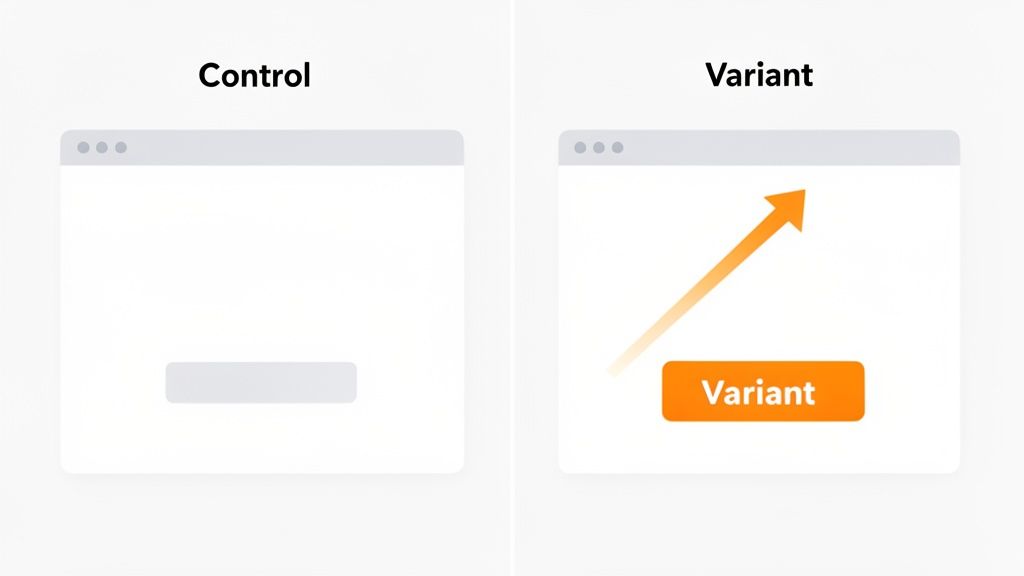
This technique is about isolating a single variable, like a headline, call-to-action (CTA) button color, or the number of form fields, and measuring its effect. For performance marketing agencies like Ezca, which operate in fast-paced 90-day sprints, A/B testing is essential for rapid iteration. It allows for quick validation of hypotheses, ensuring that every change is a step toward better performance and higher ROI.
How to Implement A/B Testing
- Isolate One Variable: To get clean data, change only one element at a time. Testing a new headline and a new button color simultaneously makes it impossible to attribute the results to a single change.
- Calculate Sample Size: Before launching, use a statistical significance calculator to determine how much traffic your test needs. This prevents you from ending a test too early and acting on flawed data.
- Run for a Full Business Cycle: Let your test run long enough to capture user behavior across different days, including weekdays and weekends. A minimum of one to two weeks is a standard starting point to avoid seasonality bias.
- Document Everything: Maintain a centralized repository of all tests, including your hypothesis, the variant details, results, and key learnings. This builds an internal knowledge base that informs future optimization efforts.
Key Insight: A/B testing isn't just about finding a "winner." Even a failed test provides valuable insight into what your audience doesn't respond to, helping you refine your understanding of customer behavior and improve future hypotheses.
2. Heat Mapping and Session Recording
Heat mapping and session recording are qualitative analytics tools that visualize user behavior, revealing the "why" behind your quantitative data. Heat maps show where visitors click, scroll, and move their mouse, while session recordings provide video-like playbacks of individual user journeys. These tools expose user friction and UX issues that metrics alone cannot explain.
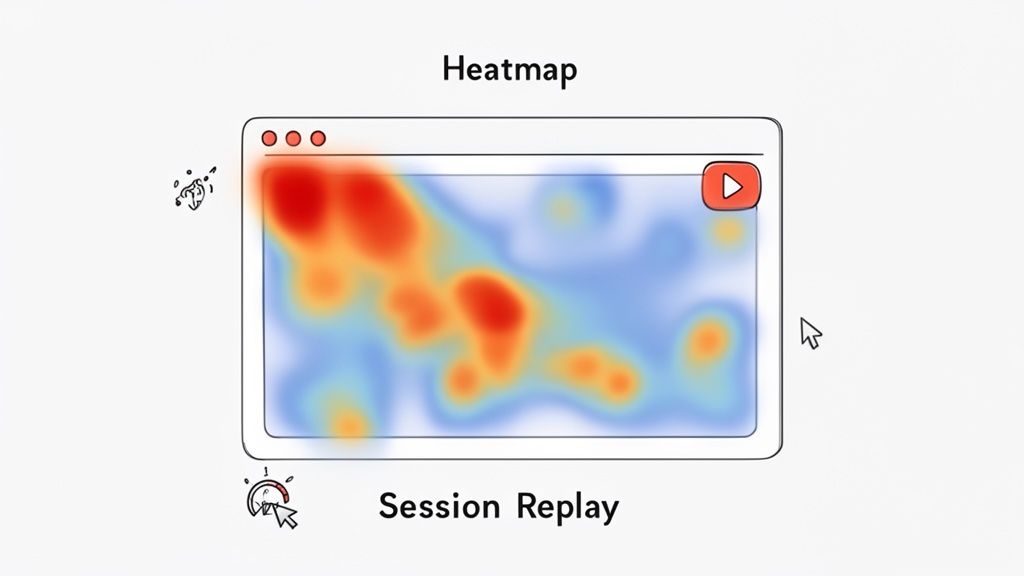
Understanding user intent is a cornerstone of conversion rate optimization best practices. For instance, an e-commerce brand might see a high abandonment rate at checkout. A session recording could reveal users are struggling with a confusing form field, a discovery that immediately informs an A/B test. For Ezca, these insights are invaluable for optimizing B2B lead forms, SaaS onboarding flows, and e-commerce checkout processes, turning user frustration into conversion opportunities.
How to Implement Heat Mapping and Session Recording
- Filter with a Goal in Mind: Don't watch random sessions. Filter recordings for users who abandoned a specific step in your funnel, like the pricing page or checkout, to identify the exact point of friction.
- Segment by User Type: Analyze behavior based on device, traffic source, or conversion status. Mobile users often behave differently than desktop users, and behavior from paid ad traffic may differ from organic search visitors.
- Prioritize Privacy: Ensure your tool automatically excludes sensitive data inputs like passwords and credit card numbers. This is critical for maintaining user trust and complying with privacy regulations like GDPR and CCPA.
- Validate Hypotheses: Use heat maps to confirm if a call-to-action is being ignored because it's below the average scroll depth. This data provides strong evidence to support a hypothesis for an A/B test.
Key Insight: Qualitative data from heat maps and session replays is most powerful when paired with quantitative analytics. Use analytics to find what is happening (e.g., a 40% drop-off on a page) and use recordings to discover why it's happening.
3. Landing Page Optimization
Landing page optimization is a critical conversion rate optimization best practice focused on refining standalone pages built for a single conversion goal, such as a signup, purchase, or demo request. Unlike a homepage, which serves multiple purposes, a great landing page eliminates distractions like navigation and aligns every element, from headline to CTA, toward one specific action. An optimized landing page is a direct multiplier for paid advertising campaigns; a 10% improvement in conversion rate directly lowers customer acquisition cost (CAC) by 10%.
This focused approach is essential for maximizing ROI from paid traffic. SaaS companies often see trial signup rates of 40% or more from dedicated PPC landing pages, while e-commerce brands can achieve 2-3x higher conversion rates compared to their standard homepage. For a practical guide on Improving Conversion Rates On Landing Pages, you can find more valuable insights.
How to Implement Landing Page Optimization
- Match Message to Ad: Ensure your landing page headline and core message directly reflect the ad copy the visitor clicked. This "message match" confirms to users they are in the right place and reduces bounce rates by up to 50%.
- Simplify Your Forms: Reduce form fields to the absolute minimum. Each additional field can decrease conversions by up to 11%, so only ask for information that is essential for the initial conversion. For SaaS companies, we explore this tactic in our SaaS trial signup optimization case study.
- Design for Mobile-First: With over 60% of web traffic coming from mobile devices, design your landing page for the small screen first. Ensure buttons are easily tappable and text is readable without zooming.
- Add Targeted Social Proof: Use social proof, such as testimonials, case studies, or client logos, that is specific to the audience segment you are targeting. A relevant customer story is far more persuasive than a generic one.
- Optimize Page Load Speed: Aim for a load time under three seconds. A one-second delay in page response can result in a 7% reduction in conversions, directly hurting your potential before a user even sees your offer.
Key Insight: A high-converting landing page isn't just about a good design; it’s about creating a frictionless, focused path from ad click to conversion. Every element must support the single goal of the page, removing any friction or distraction that could lead a visitor astray.
4. Funnel Analysis and Drop-off Optimization
Funnel analysis maps the customer journey across key conversion steps, from initial awareness to the final purchase or sign-up. It's a critical practice in conversion rate optimization because it visually pinpoints where visitors abandon the process. By measuring the conversion rates between each stage, you can identify the biggest leaks in your funnel and focus your efforts for maximum impact. This systematic approach ensures you aren't spreading resources thin on low-impact optimizations.
For Ezca's clients, funnel analysis is foundational. A small 5% improvement in a mid-funnel step, like moving from a product page to checkout, often produces a much higher ROI than optimizing the final step where fewer visitors remain. For example, in a B2B SaaS funnel, improving the trial signup-to-activation rate from 20% to 25% can dramatically increase the number of qualified users entering the sales pipeline.
How to Implement Funnel Analysis
- Establish Baseline Metrics: Before making any changes, use a tool like Google Analytics 4 or Mixpanel to map your current funnel and document the conversion rate at each step. This baseline is your source of truth.
- Identify the Biggest Drop-offs: Focus 80% of your optimization efforts on the steps with the highest percentage of user drop-offs and the largest volume of traffic. A high-traffic, high-leakage step is your top priority.
- Segment Your Funnels: Don't treat all users the same. Analyze funnel performance across different segments, such as traffic sources (e.g., organic vs. paid), device types (desktop vs. mobile), and user demographics to uncover specific friction points. A prime example is optimizing the mobile experience, as explored in our e-commerce checkout optimization guide.
- Track and Iterate: Monitor your funnel performance weekly, especially within a 90-day sprint cycle. This allows you to quickly validate whether your A/B tests at drop-off points are successfully patching the leaks and improving flow-through rates.
Key Insight: The goal of funnel analysis isn't just to find problems; it's to quantify their impact. Knowing that 70% of users drop off between "Add to Cart" and "Initiate Checkout" gives you a clear, data-driven mandate to test hypotheses specifically for that transition.
5. Multivariate Testing (MVT)
Multivariate testing (MVT) elevates the experimental process by testing multiple variables and their combinations simultaneously. While A/B testing isolates one change, MVT examines how different elements interact, such as a headline, an image, and a call-to-action button color. This method is statistically powerful for discovering the single most effective combination of elements on a page.
The primary trade-off for this depth is traffic; MVT requires a significantly larger audience than a simple A/B test to reach statistical significance. For high-traffic clients like those Ezca partners with in enterprise SaaS or e-commerce, MVT is a game-changer. For example, optimizing how multiple variables on a paid advertising landing page interact can unlock conversion improvements of 15-30% by identifying a synergistic combination that A/B testing would miss.
How to Implement Multivariate Testing
- Ensure Sufficient Traffic: MVT is only practical if you have substantial traffic, typically 10,000+ monthly visitors or conversions per month to the page you're testing. Without it, tests will take too long to reach statistical significance.
- Limit Your Variables: To keep the number of combinations manageable, start with a maximum of three or four high-impact variables. Testing too many elements at once dilutes your traffic and complicates analysis.
- Focus on High-Impact Elements: Concentrate on variables you hypothesize have the greatest potential to influence conversions. This could include the main headline, the hero image, key value propositions, and the primary CTA.
- Use Fractional Factorial Design: Some testing tools, like Google Optimize or Optimizely, allow for fractional factorial design. This advanced method lets you test a smaller, representative subset of all possible combinations, making MVT more accessible with less traffic.
Key Insight: Multivariate testing is a high-leverage tool for mature optimization programs with sufficient traffic. The goal is to understand the interaction effects between elements, revealing which combination works best, not just which individual element is a winner.
6. Conversion Rate Optimization Audits
A conversion rate optimization (CRO) audit is a methodical evaluation of your entire conversion funnel, designed to pinpoint opportunities for improvement. Unlike ongoing A/B tests that focus on single variables, a comprehensive audit assesses your website from multiple angles, including technical performance, user experience (UX), messaging clarity, and design. It establishes a crucial baseline and prioritizes fixes using frameworks like RICE (Reach, Impact, Confidence, Effort), ensuring your resources are directed at the most impactful changes.
For performance marketing agencies like Ezca, which operate in fast-paced 90-day sprints, these audits are non-negotiable. Kicking off a sprint with a baseline audit ensures the team immediately focuses on the highest-potential opportunities, rather than wasting time on low-impact tests. This process combines quantitative data from analytics and heatmaps with qualitative insights from user session recordings and expert heuristic analysis to create a clear, actionable roadmap for growth. For example, an audit might reveal that missing trust signals on an e-commerce product page or poor value proposition clarity on a B2B landing page are costing you conversions.
How to Implement a CRO Audit
- Establish a Baseline: Conduct a thorough audit at the beginning of any major optimization initiative, such as a 90-day sprint. This provides a benchmark to measure all future improvements against.
- Use a Prioritization Framework: Score each identified issue using a system like RICE. This data-driven approach helps you avoid emotional decision-making and focus on changes that balance impact with effort. For example, a high-reach, high-impact, low-effort fix like clarifying a CTA should be prioritized.
- Combine Data Sources: Don't rely solely on analytics. Validate quantitative findings with qualitative data. If analytics show a high drop-off on your checkout page, watch session recordings to see why users are leaving.
- Analyze the Competition: Systematically review 5-10 of your strongest competitors' websites. Document their user flows, messaging, and trust signals to identify gaps and opportunities in your own funnel.
Key Insight: A CRO audit is not a one-time task but a recurring strategic process. Re-auditing quarterly helps you track your improvement trajectory, adapt to changing user behavior, and continuously uncover new optimization opportunities as your product and market evolve.
7. Copy Testing and Messaging Optimization
Copy testing is a high-impact conversion rate optimization best practice focused on refining the words, tone, and messaging across your digital assets. While design changes often require developer time, optimizing copy can be done quickly and produce significant, measurable improvements. Small changes to a headline, call-to-action (CTA), or value proposition can clarify your offer and better resonate with your audience's needs, directly boosting conversions.
For marketing leaders, copy optimization is one of the highest-leverage activities available. At Ezca, we prioritize copy testing for SaaS and e-commerce clients because it consistently delivers results. For example, testing a specific, benefit-driven headline like "Schedule Meetings 5x Faster" against a vague one like "Smarter Scheduling" can dramatically increase engagement and sign-ups by speaking directly to a user's pain point.
How to Implement Copy Testing
- Lead with Your Strongest Benefit: The first few words of your headline are critical. Frame your primary value proposition immediately to capture attention and communicate why a user should care.
- Make CTAs Action-Oriented and Specific: Vague buttons like "Submit" or "Learn More" create uncertainty. Test clear, value-focused alternatives like "Get Your Free Demo" or "Start My Free Trial," which set clear expectations and have been shown to improve form conversions by over 20%.
- Address Objections Directly: Identify the top 2-3 reasons a user might hesitate to convert and address them explicitly in your copy. Use risk-reversal language like guarantees, free trial details, or social proof ("Join 15,000+ happy customers") to build trust.
- Test Benefit vs. Curiosity: Experiment with different headline styles. A benefit-driven headline ("Save 10 Hours a Week") is direct, while a curiosity-driven one ("The One Mistake Most Managers Make") can drive clicks. Test to see what resonates most with your specific audience.
Key Insight: Your copy isn't just about describing features; it's about connecting your solution to the customer's problem. The most effective copy mirrors the language and pain points of your target audience, making them feel understood and confident in their decision.
8. Form Field Optimization
Form field optimization is the process of making online forms easier and more intuitive to complete. This involves strategically reducing the number of fields, refining field types, and improving user feedback to minimize friction. Since every required field can decrease completion rates, particularly in B2B lead generation and e-commerce checkouts, optimizing forms is a critical component of any conversion rate optimization best practices.
The core principle is simple: ask for only what you absolutely need at that moment. For Ezca's B2B clients, this tactic has proven highly effective; reducing a form from seven fields to just three or four can increase submission rates by 25-50%. This balance between gathering enough information to qualify a lead and not overwhelming the user is key. A shorter form for a top-of-funnel ebook makes sense, while a longer one for an enterprise demo request may be appropriate.
How to Implement Form Field Optimization
- Identify and Eliminate: Start by auditing your forms. Mark each field as "must-have" or "nice-to-have." Remove every field that isn't absolutely essential for the initial conversion goal. You can always gather more data later.
- Use Progressive Profiling: Implement tools like HubSpot Forms to ask for new information each time a known contact interacts with a form. This builds a rich profile over time without creating a high-friction initial experience.
- Test Single-Step vs. Multi-Step: While it may seem counterintuitive, breaking a long form into multiple, smaller steps can feel less intimidating to users and often improves completion rates. Test both formats to see what your audience prefers.
- Provide Real-Time Validation: Give immediate feedback as users fill out the form. A green checkmark for a valid email format or a red error message for a mistake prevents frustration and guides the user smoothly toward submission.
Key Insight: The length of your form should directly correspond to the value of your offer. A user is more willing to provide detailed information for a high-value offer, like a custom quote or a personalized demo, than for a simple newsletter subscription.
9. User Testing and Qualitative Research
While quantitative data tells you what is happening, user testing and qualitative research explain why. This approach involves watching real people interact with your website, product, or app to uncover friction points, confusion, and preferences that analytics alone can't reveal. It’s a direct window into the user’s mind, making it a critical part of conversion rate optimization best practices.
Qualitative research gives context to your quantitative metrics. For Ezca’s clients, this means validating A/B test hypotheses before investing time and traffic, or diagnosing why a high-traffic SaaS landing page isn’t converting. Research by Nielsen Norman Group shows that testing with just five users can uncover 85% of major usability issues, making this a high-impact, low-cost activity.
How to Implement User Testing
- Recruit Your Target Profile: Use platforms like Respondent or UserTesting.com to find participants who match your ideal customer persona. Testing with the wrong audience will yield misleading feedback.
- Create Task-Based Scenarios: Instead of guiding users, give them a goal. For an e-commerce site, a task could be: "Find a pair of black running shoes under $100 and add them to your cart." Observe where they struggle.
- Record and Synthesize Sessions: Always record sessions to share with your team. Look for recurring patterns and pain points across multiple tests to identify the most critical issues to fix.
- Pair with Quantitative Data: Use qualitative insights to form a hypothesis, then validate it with a quantitative A/B test. For example, if users say a form feels "too long," test a version with fewer fields and measure the impact on submission rates.
Key Insight: Don't wait for a finished product to start testing. You can run user tests on anything from a simple sketch or wireframe to a high-fidelity prototype. Early feedback is exponentially cheaper and easier to act on than post-launch fixes.
10. Social proof and Trust Signal Optimization
Social proof and trust signal optimization is a powerful conversion rate optimization best practice that reduces purchase anxiety by tapping into fundamental human psychology. It uses principles like consensus and authority, popularized by Robert Cialdini, to build credibility. By showcasing testimonials, reviews, customer logos, and security badges, you signal to potential buyers that your product or service is a safe and valuable choice.
Strategically placing these elements near friction points like CTAs or payment forms can significantly lift conversions. For Ezca's e-commerce clients, displaying prominent star ratings and customer reviews is non-negotiable for driving sales. For B2B and SaaS accounts, featuring logos of well-known customers and detailed case studies is crucial for building credibility with decision-makers, especially for high-ticket items where hesitation is common.
How to Implement Social Proof and Trust Signals
- Place Proof at Friction Points: Position your strongest social proof, like a key testimonial or customer count, directly beside your primary CTA. On checkout pages, place security badges and trust seals near payment fields to reassure users.
- Be Specific and Quantifiable: Vague statements like "Join thousands" are less effective. Use concrete numbers such as "Join 50,000+ happy users" to add weight. In testimonials, include specific metrics like "Increased our lead conversion by 40%."
- Diversify Your Proof: Showcase a variety of testimonials that reflect your different customer segments, use cases, or industries. For B2B, featuring logos from both startups and enterprise companies can broaden your appeal.
- Keep It Fresh: An outdated testimonial from five years ago can damage credibility more than it helps. Regularly update your reviews, case studies, and customer logos to show current relevance and ongoing success.
Key Insight: The most effective social proof directly addresses a user's primary objection at the exact moment they feel it. A security badge on a payment form or a testimonial about easy onboarding on a trial signup page can be the final nudge a user needs to convert.
10-Point CRO Best Practices Comparison
From Insight to Impact: Implementing Your CRO Strategy
We've explored a detailed playbook of ten essential conversion rate optimization best practices, moving from foundational split testing to the nuances of qualitative user research. The common thread connecting them all is a shift in mindset. True optimization is not a one-time project or a checklist to complete; it is a continuous, data-driven system for generating sustainable business growth. For marketing leaders and founders in SaaS, e-commerce, and B2B, the mandate is to build a culture of curiosity and disciplined experimentation within your organization.
Simply knowing about A/B testing, funnel analysis, and social proof is not enough. The real value comes from their strategic application. It's about moving beyond random acts of testing and creating a structured process that methodically improves your customer experience and, consequently, your bottom line. Each practice, from heat mapping and session recording to copy testing and form field optimization, offers a unique lens through which to understand user behavior. Combining these quantitative and qualitative insights is where the magic happens.
Bridging the Gap Between Data and Action
The most significant challenge for many teams is not a lack of data, but a failure to translate that data into concrete action. You might have heatmaps showing where users don't click or session recordings of rage clicks, but what do you do with that information? This is where a systematic framework becomes critical.
A successful CRO program operates on a continuous loop:
- Identify: Use tools like CRO audits and funnel analysis to pinpoint the biggest areas of opportunity and friction in your customer journey.
- Hypothesize: Formulate clear, testable ideas based on qualitative feedback and quantitative data. A strong hypothesis states what you believe will happen and why.
- Prioritize: You can't test everything. Focus your resources on experiments with the highest potential impact and the highest probability of success.
- Execute: Run clean, statistically significant tests, whether they are simple A/B tests or more complex multivariate experiments.
- Analyze & Learn: Win or lose, every test provides a valuable insight. Document these learnings to inform future hypotheses and build a library of customer knowledge.
This disciplined process turns marketing from a function based on guesswork into a predictable, scalable growth engine. For B2B companies, this might mean optimizing demo request forms to generate more qualified leads. For e-commerce brands, it could be streamlining the checkout flow to reduce cart abandonment. For SaaS platforms, it could involve refining the onboarding experience to improve user activation rates.
The Power of a Systematic Approach
Adopting these conversion rate optimization best practices is about more than just lifting a single metric. It’s about building a deeper connection with your audience by systematically removing friction and delivering more value. When you understand why users drop off, what messaging resonates, and which trust signals matter most, you can create experiences that not only convert but also build loyalty.
This is the operational model we champion at Ezca. We believe that world-class CRO is achieved through a dedicated, agile system. Our 90-day sprints are designed to do just that, starting with a deep-dive audit to identify your highest-return opportunities. From there, our expert squads, blending human strategy with AI-powered execution, work to test, iterate, and drive measurable revenue across your key channels. This is the same approach trusted by industry leaders and has generated over $100M in tracked revenue for our partners. If you're ready to transform insights into tangible impact, the journey starts with a single, structured step forward.
Ready to turn your website traffic into measurable revenue with a disciplined, data-driven system? The team at Ezca Agency specializes in building and executing high-tempo CRO programs that deliver results. Schedule a call with our strategy team today to discover how a 90-day sprint can unlock your next stage of growth.