
Your Playbook for a High-Performance Content Strategy for Websites
Build a content strategy for websites that drives real growth. Learn to connect content to ROI with data-backed blueprints, AI tools, and smart distribution.

A strong content strategy for websites isn't just a plan; it's a financial model. It connects every blog post, video, and case study you create to a specific business goal. This is the blueprint for transforming content from a cost center into a predictable system that drives qualified traffic, generates high-intent leads, and grows revenue. It’s not about publishing more—it’s about publishing smarter for a measurable ROI.
Why an Ad-Hoc Content Approach Is Costing You Money
Let's be direct. If your content process is a scramble of last-minute ideas and a "publish and pray" mentality, you're leaving money on the table. An unstructured workflow produces content without a clear purpose. It fails to rank for keywords that signal purchase intent and does nothing to guide potential customers toward a sale.
The alternative is a documented content strategy for websites. This is the blueprint for turning content into a appreciating business asset. Here, you get specific about who you're targeting, the problems you solve for them, the exact phrases they use in Google, and the metrics that prove your success.
A documented strategy transforms content from a cost center into a predictable growth engine. Without a plan, you're just making noise; with one, you're building a competitive advantage that compounds over time.
The Business Case for a Documented Strategy
The numbers don't lie—planning gets results. Companies with a documented content strategy are 3x more likely to report success. A plan forces you to tie your content directly to business outcomes, like generating Marketing Qualified Leads (MQLs) or influencing pipeline revenue.
For B2B marketing leaders, the ROI is even clearer. Content marketing generates about three times more leads per dollar spent compared to paid search. You can dig into more of these content marketing statistics to see the full breakdown.
This disciplined approach is how a performance-focused agency like Ezca operates. We don't just "do content." We build a growth framework where content is the engine for SEO, lead generation, and customer acquisition. Every piece is a deliberate investment tied to a measurable KPI.
Predictable Outcomes vs. Random Acts
Without a plan, your content efforts are disconnected. A single blog post might get a traffic spike from a social share, but that's a sugar rush. It does nothing for long-term organic growth or capturing high-intent leads who are ready to buy.
A documented strategy ensures every piece of content works together toward a common business objective. The difference is stark.
The bottom line: a strategy provides a clear path to revenue. You know what you're creating, who it's for, and why it matters to the business. An ad-hoc approach is like throwing darts in the dark. A documented strategy is your map to a specific financial destination.
Crafting Your Audience and Keyword Blueprint
If your content isn't moving the needle, the issue probably isn't the writing. It's a disconnect between what you're publishing and what your ideal customer is actually searching for. A winning content strategy is built on a blueprint that understands your target audience's problems and the exact words they use to find solutions.
As a business owner or marketer, this foundational work is what separates content that generates a real return from content that disappears into the digital ether.
Go Beyond Personas with Jobs-to-be-Done
Traditional personas like "Marketing Mary" offer a general direction but lack the tactical detail needed for high-impact content. The Jobs-to-be-Done (JTBD) framework is a game-changer. Instead of asking who your customer is, JTBD asks a more powerful question: "What 'job' is this person hiring our product to do?"
This shift moves you from demographics to motivations. For a B2B SaaS company, the "job" might be to "unify customer data by connecting my CRM and email marketing platform." For an e-commerce brand, it could be "find durable hiking boots that can handle rocky trails."
Understanding the 'job' is everything. It lets you map content directly to a user's core need, creating content that doesn't just get clicks but drives conversions.
Uncovering Opportunities with a Competitive Gap Analysis
Once you know the "jobs" your audience needs done, you can pinpoint where your competitors are falling short. A competitive content gap analysis isn't just a list of keywords; it’s about finding the specific questions they aren't answering well enough.
Look for:
- Thin or outdated content: Pages ranking for valuable keywords but offering only surface-level information. This is a prime opportunity for a more comprehensive resource.
- Missing formats: Are competitors only writing blog posts when a topic demands a video tutorial, a calculator, or a downloadable template?
- Unanswered questions: "People Also Ask" boxes on Google, Reddit threads, and Quora are goldmines for topics your competitors have missed.
This analysis is your treasure map. If everyone else has a basic "what is X" article, you can create the definitive "how to implement X" guide. You're not just creating more content; you're creating better content that serves the user's next logical step. At Ezca, we use this process to plan 90-day content sprints, ensuring we always target the highest-impact opportunities first.
Prioritizing Keywords That Drive Revenue
Solid keyword research is the bedrock of any content plan. The mistake many make is chasing high search volume. The real goal is to identify keywords that signal purchase intent and help you build topical authority.
Map your keywords to the buyer's journey.
A B2B SaaS company will see a much higher ROI targeting bottom-funnel terms like "[competitor] alternative" or "[software] integration" than from broad, top-of-funnel keywords. An e-commerce brand should zero in on "best X for Y" or "product review" keywords. This is how your content stops being a cost center and becomes a powerful engine for qualified leads and sales.
Now, let's turn this research into a repeatable system for content production.
The core of this system is your set of content pillars: the three to five major topics your brand will own. For a cybersecurity firm, these pillars might be "Threat Detection," "Data Privacy," and "Cloud Security." These are the highways connecting your expertise to your audience’s most pressing problems.
From Broad Pillars to Specific Clusters
Pillars provide high-level direction, but they're too vague for execution. You need to break each pillar down into smaller topic clusters. A cluster is a group of related articles that all link back to a central, comprehensive "pillar page." This model signals to Google that you have deep authority on a subject, boosting your SEO performance.
Using our "Cloud Security" pillar, you could create clusters like:
- Cloud Misconfiguration Risks: A series on common setup mistakes, audit procedures, and prevention checklists.
- Identity and Access Management (IAM): Practical guides on setting user permissions, implementing MFA, and best practices for role-based access.
- Compliance in the Cloud (GDPR/HIPAA): Specific content on how regulations apply within AWS, Azure, or Google Cloud environments.
Each article in a cluster targets a specific long-tail keyword and links back to the main pillar page. This hub-and-spoke approach creates a powerful internal linking structure that can lift your entire site's organic performance. It’s this organized methodology that forms a key part of the comprehensive content marketing services we execute for clients.
Executing with 90-Day Sprints
To get this done without feeling overwhelmed, operate in 90-day sprints. This agile method forces your team to focus on clear, achievable goals over a set period, escaping the "endless to-do list" trap.
A sprint goal isn't just "publish four blog posts." It’s a specific, measurable business objective.
Sprint Goal Example: "Increase organic-driven Marketing Qualified Leads (MQLs) from our 'Threat Detection' pillar by 20% in Q3."
A goal like this instantly focuses the team. You know you need to prioritize bottom-of-the-funnel content for that pillar—case studies, detailed competitor comparisons, or implementation guides. It provides clarity and makes it easy to measure success.
The research you did earlier is the bedrock for all of this. It's what makes these pillars and sprints strategic instead of random.
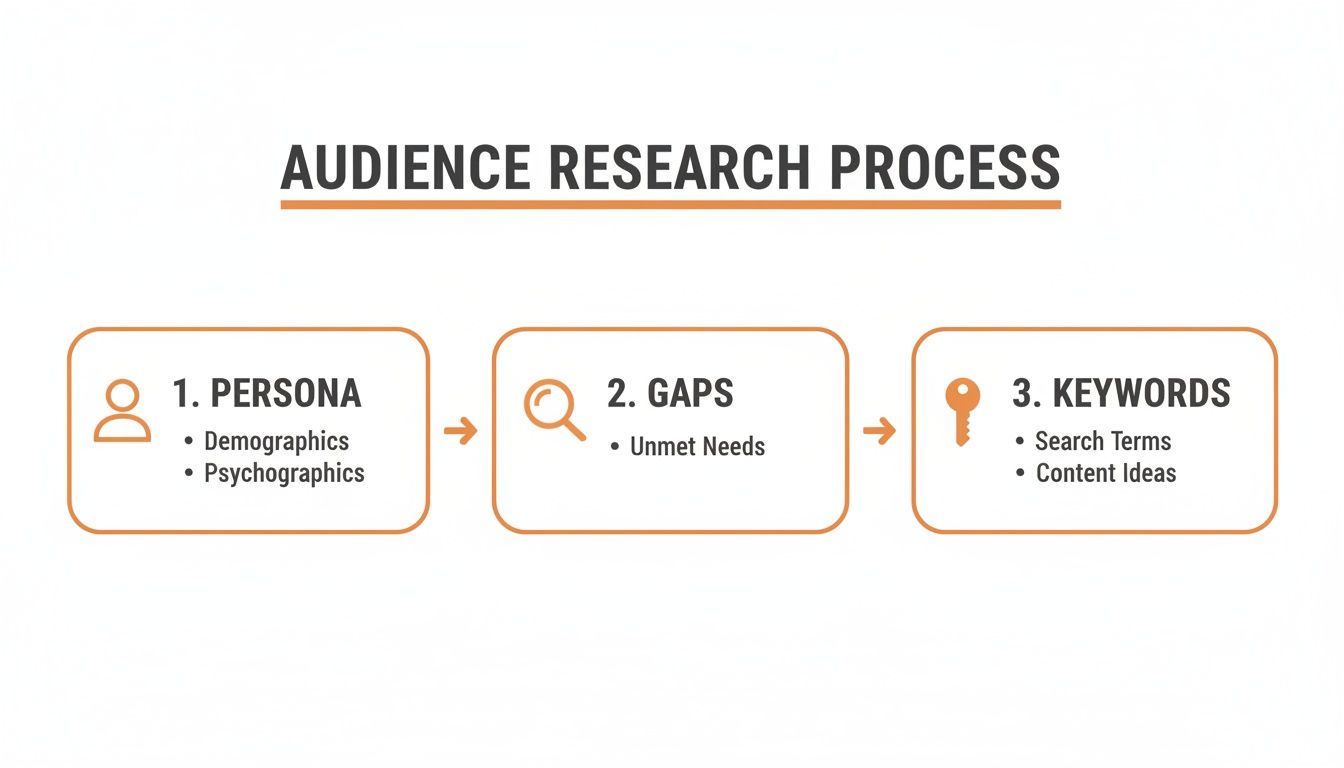
As you can see, the process flows together. Strong audience understanding leads to smart keyword choices, which then inform the pillars you build your entire strategy upon.
A Practical Production Workflow
A successful sprint requires a documented process. Using a tool like Asana or Trello, a typical content piece moves through several key stages.
It begins with the content brief. A strategist outlines the target keyword, audience profile, essential talking points, internal linking opportunities, and the call-to-action.
The writer then drafts the content, weaving expert insights from the brief into a compelling narrative that solves the reader's problem.
Next comes the SEO and editorial review. An editor or SEO specialist polishes the draft for clarity, tone, and on-page optimization, ensuring the final piece is both high-quality and built to rank.
After revisions, the content gets final approval before being published. The work isn't done. The plan must also include distribution—a clear process for promoting the new content via email, social media, and relevant communities. This structured workflow takes the guesswork out of creation and ensures every article has a clear purpose and path to delivering results.
Turning Your Content into a Growth Engine with SEO and CRO
Publishing content is just the starting line. If your articles attract traffic but don't convert visitors, you’ve just created a vanity metric. The real goal is to turn readers into customers. This is where Search Engine Optimization (SEO) and Conversion Rate Optimization (CRO) must work together.
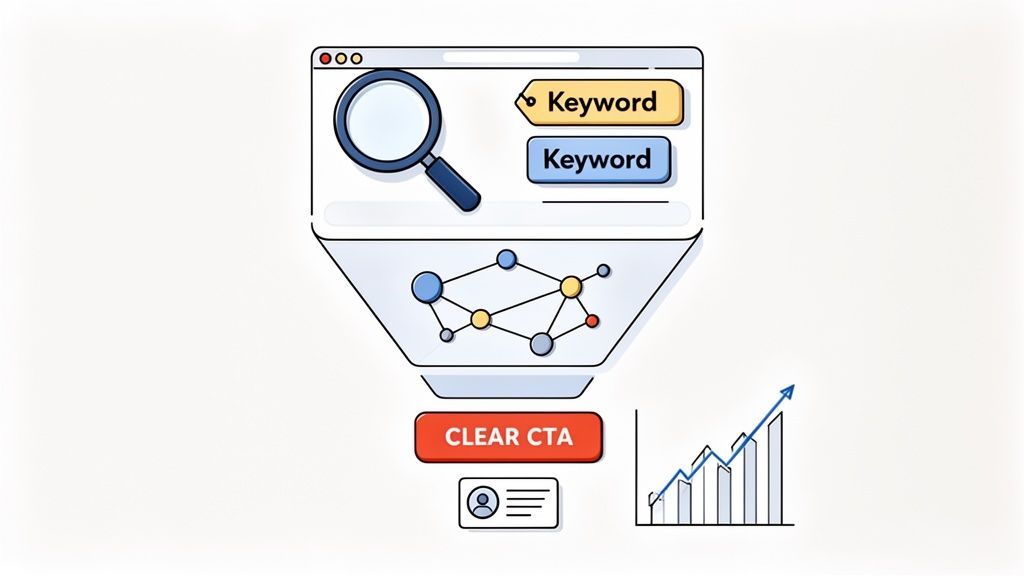
Think of it this way: SEO brings the right people to your door. CRO welcomes them inside and guides them to what they need. When these two are aligned, every piece of content becomes a tool for growth.
First Things First: Get Your On-Page SEO Right
Before you can convert anyone, they need to find you. This means dialing in your on-page SEO fundamentals—not by keyword stuffing, but by proving your expertise to Google.
- Go Beyond the Main Keyword: For an article on "email marketing software," naturally weave in related terms like "automation workflows," "subscriber segmentation," and "A/B testing features." This signals deep topical knowledge.
- Link with a Purpose: Your internal links should create a web of knowledge, guiding users and search engines. A new post should always link to its core pillar page and other relevant articles to build topical authority.
- Use Schema to Stand Out: Schema markup can trigger rich snippets—like FAQ dropdowns or star ratings—directly in search results. For an e-commerce guide, this could mean showing price ranges and ratings before a user even clicks.
Nailing these technical details is non-negotiable. Without a solid SEO foundation, even the best content will never find its audience. This is where expert SEO services can lay the groundwork for your content to perform.
From Reader to Lead: Weaving in CRO Tactics
Once you have a steady stream of qualified traffic, the focus shifts from getting found to getting action. The key is to make the next step incredibly obvious and valuable.
For example, a B2B guide for marketing VPs shouldn't end with a generic "Contact Us" button. Embed a high-value, contextual call-to-action (CTA) where it’s most relevant.
A B2B article on "improving sales pipeline velocity" shouldn't just fizzle out. It should offer a practical, downloadable "Sales Pipeline Audit Checklist" in exchange for an email. Just like that, you've turned a reader into a warm lead.
This works just as well in e-commerce. An article reviewing the "best running shoes for flat feet" can embed product cards for the top-rated shoes directly into the content, shortening the path from advice to purchase.
Designing Content That Converts
Visual presentation is as important as the words themselves. A massive wall of text is an instant turn-off. A well-designed page guides the reader’s eye where you want it to go.
Keep these design principles in mind:
- Create a Clear Visual Path: Use headings, bold text, and short paragraphs to make content scannable.
- Place CTAs Contextually: Place buttons, forms, and offers where they naturally fit the reader's journey.
- Offer Genuine Value: Ensure your lead magnets—checklists, templates, webinars—are genuinely helpful and solve a problem discussed in the article.
The data backs this dual approach. Organic search still accounts for 40.65% of all website traffic, delivering one of the best ROIs in marketing. It's why 61% of marketers are increasing their SEO budgets. At Ezca, our strategies are built on this principle: content shouldn't just rank—it should build your pipeline. You can review more data on digital marketing effectiveness to see the full picture.
Getting Your Content Seen: Smart Amplification and AI
Hitting "publish" is just the beginning. The best article in the world is worthless if no one sees it. Your content strategy isn't complete until you have a solid plan for getting it in front of the right people. An article is an asset; amplification is how you get a return on that asset.
Build Your Content Amplification Engine
Think of a foundational piece of content—like a pillar blog post—as the sun. Your distribution strategy is the solar system orbiting it, with each asset drawing energy from that central source. One great article can be deconstructed into a dozen smaller assets that fuel your marketing for weeks.
For a business owner, this is about maximizing your investment.
- Video Scripts: A long-form article is a ready-made script for a YouTube video, hitting an audience segment that prefers watching over reading.
- Social Media Carousels: Extract 3-5 key takeaways and create a visual carousel for LinkedIn or Instagram. Each slide makes a single, powerful point.
- Email Sequences: Break the article into a bite-sized email series for your subscribers, dripping value directly into their inboxes.
- Short-Form Video Clips: Use AI video clipping tools like Opus Clip to chop longer videos into snappy clips for TikTok, Reels, and Shorts, casting a wider net.
This "create once, distribute forever" mindset is the core of an efficient content strategy for websites. By meeting your audience on multiple fronts, you dramatically increase your content's shelf life and impact.
How to Actually Use AI (Without Sounding Like a Robot)
AI is a key part of modern content strategy, but its real strength is in efficiency, not authorship. Relying on AI to generate entire articles typically results in bland, generic copy that fails to connect with savvy business leaders. The smart play is to use AI as a research assistant, not the author.
This "AI + human expert" model gets the best results. We use AI for heavy lifting—analyzing data, finding keyword gaps, summarizing research—which frees up our human strategists to focus on creativity, nuance, and strategic insights.
The best way to use AI in your content strategy isn't for writing articles from scratch. It's for finding the hidden opportunities—analyzing competitor content at scale, spotting untapped keyword clusters, or even suggesting new distribution channels you hadn't considered.
The data supports this. While 94% of marketers are projected to use AI for content creation by 2026, the real story is in how they use it. 72% of B2B teams already use AI, with the most successful leveraging it for ideation and analysis, not just drafting. This aligns with findings that 45% of B2B marketers prioritize AI tools to improve existing efforts. You can find more data on AI's impact on content marketing to inform your own strategy. This balanced approach ensures the tool serves the strategy, not the other way around.
7. Measuring Success and Proving Content ROI
A content strategy is only as strong as its results. Page views and social shares rarely move the needle in the boardroom. To prove your content's worth and secure budget, you must draw a straight line from your work to revenue. This means shifting the conversation from vanity metrics to growth metrics that business leaders care about.
Tying Content to C-Suite Metrics
To get executive buy-in, speak their language. Show how content influences the entire customer journey, from first touch to signed contract. This requires a full-funnel view that attributes real dollars back to your articles and videos.
Focus on these core business metrics:
- Content-Attributed Revenue: The total revenue generated from customers who engaged with your content before converting. This is the gold standard.
- Pipeline Contribution: For B2B, this shows how many qualified leads and sales opportunities your content sourced or influenced.
- Lead Quality: Track lead-to-customer conversion rates by content source to prove you're attracting the right audience.
- Customer Acquisition Cost (CAC): A lower CAC from content marketing compared to paid ads is a powerful argument for more investment.
The ultimate proof of your content’s value is showing that a blog post didn't just get traffic—it directly helped close a deal. This is how you prove ROI and turn the content team into a respected growth engine.
Building Your Measurement Framework
Connecting content to revenue requires the right tracking. Integrate your website analytics with your CRM. Using Google Analytics 4, you can track user journeys and conversion events like demo requests.
When that data is passed to your CRM (like HubSpot or Salesforce), you can see which blog posts a lead read before becoming a customer, creating a clear chain of attribution. At Ezca, we live by this data-driven model. It shows us what's working so we can confidently reallocate budget.
A key part of our process is the quarterly content audit, where we sort content into "winners" (high-performing assets) and "losers" (underperforming ones). This simple audit lets you double down on topics and formats that generate high-quality leads while updating or pruning content that isn't delivering. It's also the perfect time to strengthen internal linking, which you can learn more about in our guide on how to increase organic traffic.
Content Marketing Metrics Mapped to Business Goals
This table outlines which KPIs to monitor for different strategic goals, from building top-of-funnel awareness to driving bottom-of-funnel revenue.
Ultimately, your goal is to build a simple, clear reporting dashboard that translates this data into business impact. This dashboard becomes your single source of truth for proving the value of your work and making a rock-solid case for continued investment.
A Few Questions We Hear All The Time
Even with a solid plan, a few practical questions always arise when executing a new content strategy for websites. Let's tackle the ones I hear most from marketing leaders and founders.
How Quickly Can I Expect To See ROI?
Content marketing is a marathon, not a sprint. While you may see encouraging signs like traffic spikes within your first 90-day sprint, true, measurable ROI—consistent organic leads and revenue attributable to content—takes time to build.
Typically, you will start to see the flywheel spin after 6 to 9 months of consistent, high-quality effort. This is due to the compounding power of SEO. Search engines need time to index and, most importantly, trust your website as an authority. The first few months are about laying the foundation for an exponential growth curve.
How Much Content Should We Create?
My answer is always the same: focus on quality over quantity. One deeply-researched pillar page will deliver more business value than ten thin, rushed blog posts.
Instead of a quota, determine what your team can realistically produce without sacrificing quality. A good starting point for a 90-day sprint is:
- 1-2 foundational "pillar" pages covering core topics.
- 6-8 supporting "cluster" articles exploring specific sub-topics in detail.
- Consistent repurposing of this content across email and social channels.
This rhythm builds topical authority and momentum. You can ramp up production later, but never at the expense of quality.
Focus on the cadence you can maintain without compromising the depth and value of your content. Consistency will always beat sporadic bursts of high volume.
If your team is stretched thin, producing high-impact content can lead to burnout. This is often where partnering with a performance agency like Ezca makes strategic sense. We provide the expertise and execution power to deliver results without derailing your internal team's focus.
Ezca can help you build and execute a data-driven content strategy that delivers measurable results. If you’re ready to turn your content into a predictable growth engine, let's connect.