
A Modern Content Strategy for Social Media That Drives Growth
Learn to build a winning content strategy for social media. Our guide covers audience research, AI tools, and measuring ROI for real business growth.
A modern content strategy for social media is the blueprint that turns random posting into a predictable revenue stream. For marketing leaders and business owners, it's the difference between a resource drain and a high-ROI performance channel.
Your Social Media Needs a Strategy, Not a Guessing Game
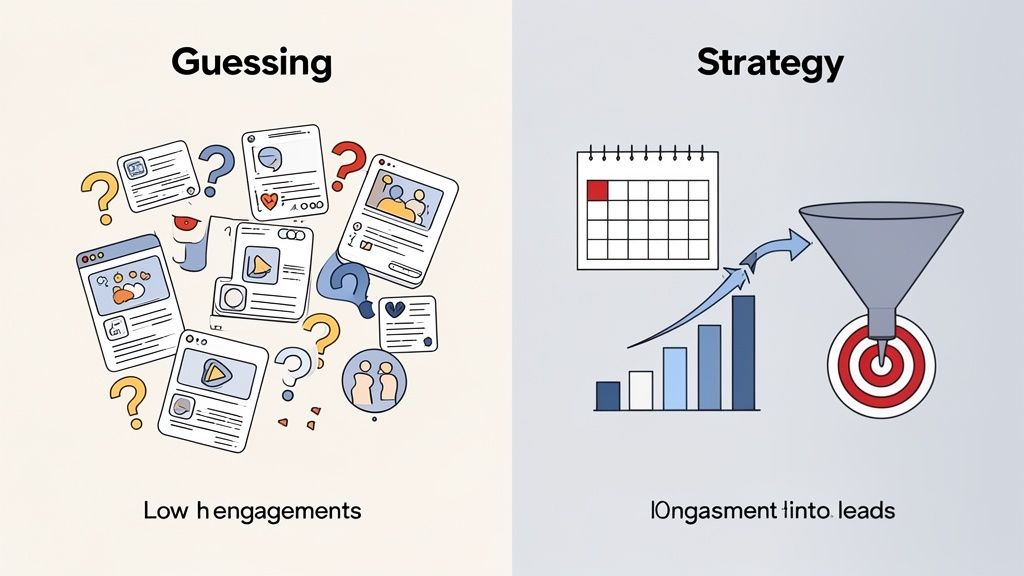
Does your social media feel like a black hole for time and budget? If you’re posting consistently but can't connect that activity to leads, pipeline, or sales, you’re operating without a strategy. You're stuck in a cycle of creating content for content's sake, a common but costly mistake.
The fastest-growing brands treat social media as a performance channel, held to the same ROI standards as paid search or email marketing. This guide provides an actionable framework to build that same results-driven engine for your business.
Shifting from Activity to Impact
The first step is to stop throwing content at the wall and hoping it sticks. A winning content strategy for social media is built on business impact, not vanity metrics.
Forget follower counts and likes. The metrics that matter to leadership are:
- Lead Conversion Rate from social channels.
- Customer Acquisition Cost (CAC) attributed to social media.
- Direct Revenue from features like Instagram Shopping or attributable to specific campaigns.
This focus transforms social media from a time-consuming chore into a measurable growth driver.
A great strategy means every piece of content has a job. It’s not about filling a calendar; it’s about moving your audience from discovery to conversion and proving your budget's value every quarter.
A Framework for Predictable Growth
To achieve this, you need a process that is both structured and agile. The framework we use at Ezca is a 90-day sprint methodology. This approach allows you to test hypotheses, learn from real-time data, and pivot quickly.
Instead of a rigid annual plan that becomes obsolete, you work in focused cycles. This empowers your team to double down on what’s working and cut what isn't, fast. Building your content strategy for social media within this framework creates a system that delivers predictable results and proves its ROI.
Laying the Groundwork for a Killer Social Strategy
Before creating a single post, you must build a strategic foundation. A documented plan is what transforms social media from a headache into a growth machine. A well-executed social media content strategy experiment shows how a structured approach can drive significant, measurable growth.
The first move isn't opening Instagram; it's opening a strategy document. A winning strategy begins with a deep focus on your audience, going far beyond basic demographics. For marketing leaders, the real value lies in psychographics: What are your ideal customer's primary pain points? What drives their purchasing decisions? And what content do they find valuable enough to stop scrolling?
Ditch the Generic Audience Personas
Vague, cookie-cutter personas are a waste of time. To be effective, your persona must reflect the real-world behavior and platform-specific expectations of your customer.
Consider these scenarios:
- For a B2B SaaS Company: Your ideal customer is a VP of Engineering. On LinkedIn, she seeks sharp industry analysis, case studies proving ROI, and expert takes on new technology. On X (formerly Twitter), she follows key innovators for quick, real-time updates.
- For a D2C E-commerce Brand: You're targeting Gen Z fashion enthusiasts. On Instagram and TikTok, they demand raw, authentic user-generated content (UGC), behind-the-scenes looks, and styling videos. They can spot polished corporate marketing a mile away and will swipe past it.
That VP won't engage with a TikTok trend, and the Gen Z shopper will ignore a dense whitepaper on LinkedIn. Understanding these nuances is the difference between connecting and getting scrolled past.
The single biggest mistake is treating an audience as a monolith. Your strategy must be built on platform-specific insights. If you don't know why your customer logs into LinkedIn versus TikTok, you'll never create content that resonates.
Define Your Core Content Pillars
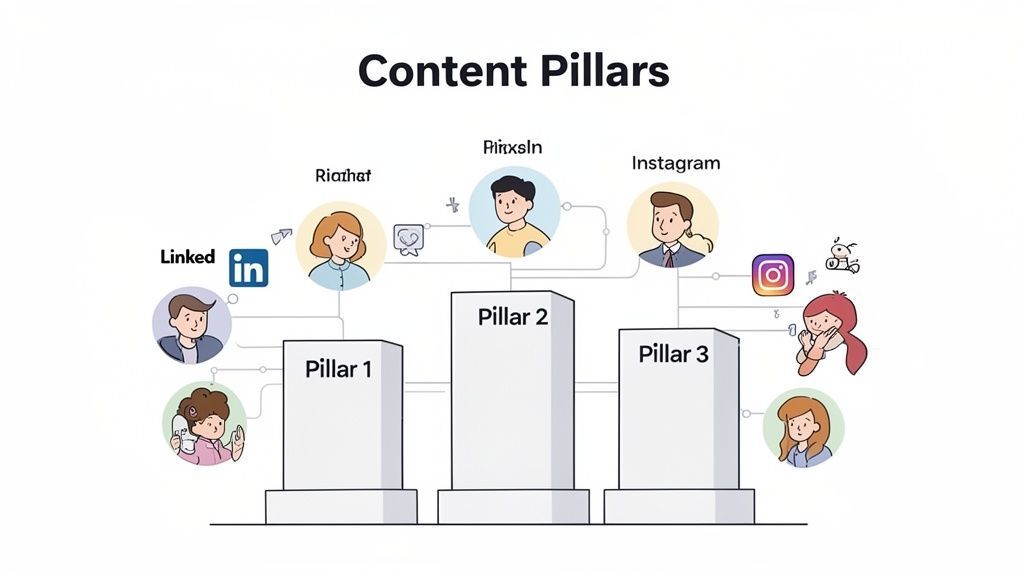
Once you know who you're talking to and where, establish your content pillars. These are the 3-5 core themes that form the backbone of your content, sitting at the intersection of your audience's interests and your business objectives.
Content pillars provide consistency and prevent your team from chasing random trends. They act as the primary conversational territories your brand will own.
Here’s how to define pillars for different business types:
These pillars give your team a clear roadmap. Instead of a blank slate, your brainstorming starts with: "What's a compelling story we can tell this week under our 'Customer ROI Stories' pillar?"
Create Content That Feels Native to the Platform
Finally, commit to creating platform-native content. Blasting the same image and caption across every channel is a hallmark of a lazy strategy, and your audience will tune it out.
This doesn't mean reinventing the wheel for every platform. It's about smart adaptation.
- A deep-dive customer case study can become a professional carousel on LinkedIn, a compelling video testimonial for YouTube, and a quick, punchy quote graphic for an Instagram Story.
- At Ezca, when we deconstruct a successful client campaign, we might turn it into a detailed LinkedIn article for marketing leaders, a short video highlighting top results for X, and a shareable infographic for our blog. Each format is tailored to the platform's audience and their expectations.
By defining your audience, setting clear pillars, and tailoring your message, you build a social media strategy that is both effective and resilient.
Where to Play and What to Say: Picking Your Platforms and Formats
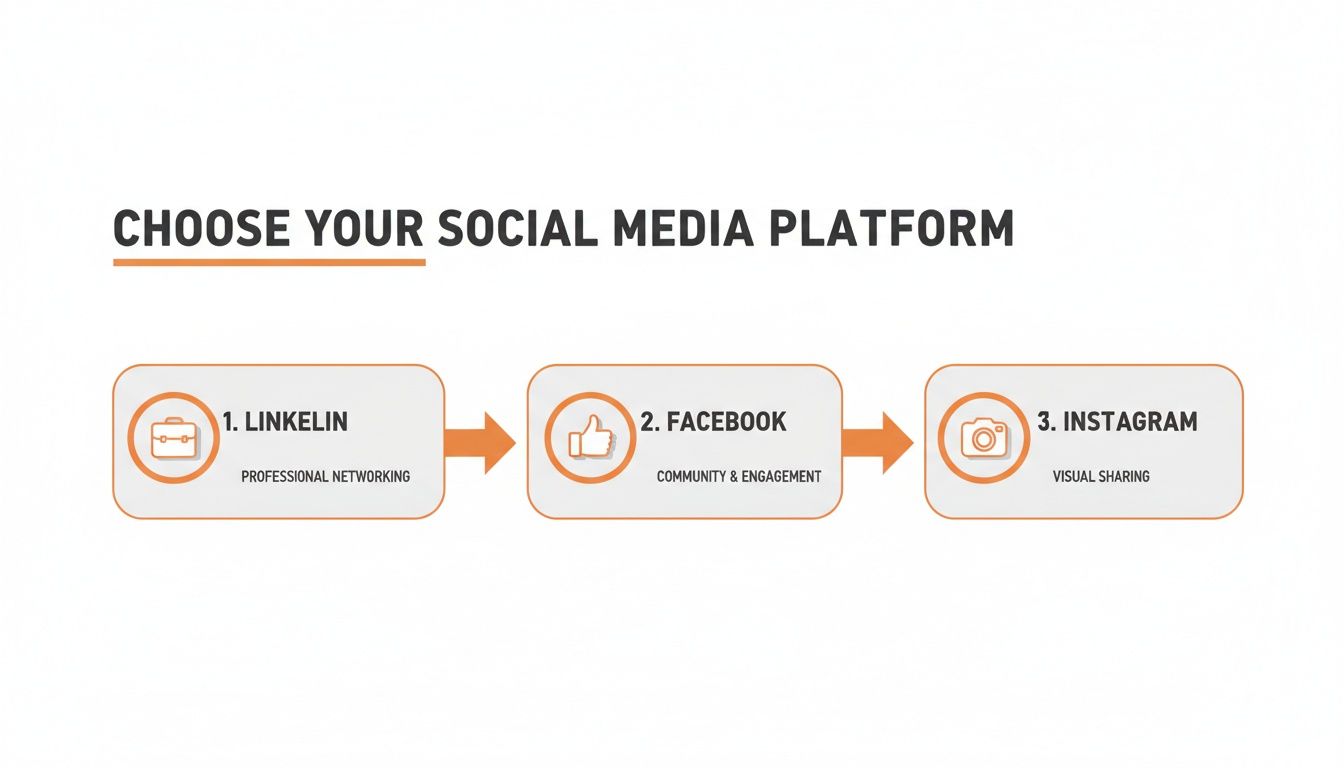
Spreading your team thin across every social network is a recipe for burnout and mediocre results. The goal isn't to be everywhere—it's to be where it counts. For business leaders, this comes down to ROI. Every hour and dollar invested in a platform must deliver a measurable return. This requires making strategic bets based on data, not just chasing trends.
Match Your Platform to Your Business Model
The most critical decision is aligning your platform choice with your revenue model. A platform that works for e-commerce can be a dead end for a B2B SaaS company. You must go where the user’s mindset matches your business goals.
- For B2B & High-Consideration Services: Your audience is on LinkedIn. The platform is built for a longer sales cycle, making it the ideal ground for thought leadership, in-depth case studies, and building relationships that lead to high-value deals.
- For D2C E-commerce: Your game is visual discovery and social proof. Your home base is on platforms like Instagram, TikTok, and Pinterest. Users are there to find new products, get inspired, and see real people using items they might buy.
Let's look at the data. Engagement rates reveal where to focus your energy.
Platform Engagement and Best-Fit Use Case in 2026
The table below breaks down median engagement rates and, more importantly, shows where each platform shines for different business models, helping you make a data-backed decision.
Source: Industry benchmarks and trend analysis reports.
Despite a -26% drop in engagement, Instagram remains a powerhouse for visual brands. This shows context is everything; you must look beyond a single number.
Consistency is the one non-negotiable rule. Our analysis shows that top-performing accounts post frequently. Skipping even a single week causes a noticeable dip in growth. Doing something is always better than doing nothing.
Connect Your Content Format to Your Goal
Once you've picked your channels, the next question is what to post. The format you choose is as important as the message. Align the format with your objective.
Here are the formats delivering results right now:
- Short-Form Video (Reels, Shorts, TikToks): Unbeatable for top-of-funnel reach and brand awareness. If you want to scale video production, Ezca's video marketing services build a predictable content engine.
- Carousels (Instagram & LinkedIn): Excellent for educational content. The multi-slide format lets you break down complex ideas, tell a story, or showcase a product. For B2B on LinkedIn, carousels are gold for sharing data and case study highlights.
- Text-Based Posts (LinkedIn & X): A well-crafted text post sharing a strong opinion or personal story can spark massive conversation and establish thought leadership instantly.
- User-Generated Content (UGC): For e-commerce, this is the ultimate social proof. Sharing photos and videos from happy customers builds a level of trust and authenticity that polished, branded content cannot match.
Use 90-Day Sprints to Test and Refine
Your initial platform and format choices are just a hypothesis. The social landscape moves too fast for a "set it and forget it" strategy. This is why we run everything in 90-day sprints.
For a new B2B client, we might hypothesize that LinkedIn carousels are their key to generating MQLs. We’ll dedicate a 90-day sprint to executing that strategy, posting consistently, running small ad experiments, and tracking all metrics tied to engagement and leads. At the end of the sprint, we have hard data to decide whether to double down or pivot. This agile approach turns social media into a reliable growth channel.
Putting Your Strategy Into Motion: The 90-Day Sprint Model
A strategy on paper is useless without sharp, consistent execution. The number one reason social media plans fail is a lack of a clear system for getting things done.
To turn your content strategy for social media into a real growth engine, you need an agile approach. At Ezca, we run everything on a 90-day sprint model. This framework forces you to break your vision into focused, manageable chunks, set clear quarterly goals, execute with intensity, and then analyze and adapt.
Build an Editorial Calendar That Breathes
Your editorial calendar is your team's roadmap, but it must be flexible. The best calendars balance your core content pillars with the agility to jump on trends and reactive opportunities.
A well-built calendar maps out:
- Pillar Content: Foundational posts tied to your core themes, scheduled in advance to ensure key messages are covered.
- Reactive Content: Intentionally leave gaps in your schedule to engage with industry news, trending topics, or audience conversations.
- Campaigns: Block out specific weeks for major product launches, promotions, or seasonal marketing pushes.
For example, a B2B SaaS company might have carousels planned around a new feature (pillar content) but leave slots open to create a quick text post reacting to a competitor's announcement.
An editorial calendar’s real job isn’t to lock you in. It’s to free your team from the daily "what should we post?" panic so their creative energy goes into making great content.
Nail Down Your Production Workflow
Consistency is the bedrock of social media growth. You can’t build momentum with sporadic posting. A clear, repeatable production workflow, whether in-house or with an agency like Ezca, is critical to eliminating bottlenecks and maintaining quality.
Turn Organic Wins into Paid Fuel
One of the biggest mistakes marketing leaders make is siloing organic and paid social. Your best-performing organic content is a free focus group telling you exactly what resonates with your audience.
Set aside a dedicated budget to amplify your top organic posts. This is one of the most efficient ways to expand reach and drive business results.
- Spot the Winners: Use your analytics to find posts with unusually high engagement, shares, or link clicks.
- Boost to Lookalikes: Use the platform's ad tools to show that winning content to new audiences who resemble your best followers.
- Drive to an Action: Add a clear call-to-action (CTA) to the boosted post, sending that qualified traffic to a landing page, product page, or demo request form.
This tactic transforms social media from a branding exercise into a measurable revenue channel. You’re no longer guessing at ad creative; you’re betting on a sure thing.
Community Management Is Not Optional
Execution isn't just about publishing. Responding to comments, answering DMs, and joining relevant conversations are non-negotiable. This is where you build brand loyalty and get priceless customer feedback. Active engagement is what fuels explosive growth, as seen in how one D2C brand used it to skyrocket their TikTok presence. Community management is the human element that makes the entire strategy click.
How We Use AI to Build a Smarter Social Media Engine
In 2026, using AI in social media isn't a futuristic concept—it's a practical, daily tool. The goal isn't to replace your creative team but to give them a powerful assistant, freeing them from repetitive tasks to focus on high-level strategy and audience connection.
For business leaders, this means moving beyond simple caption generation. It’s about building a smarter, faster workflow for everything from ideation to ROI measurement.
Stop Staring at a Blank Page
The "blank page" problem is a massive time-suck. We use AI as a brainstorming partner to generate initial ideas in minutes.
Here’s how we apply it:
- Finding New Angles: We feed an AI a content pillar—like "Integration Workflows"—and ask for ten post angles targeting a CTO persona on LinkedIn.
- Testing Hooks: For a product launch, we generate 20 opening lines for an Instagram Reel. The team then tests the top three to see which performs best.
- Creating First Drafts: AI can produce a solid first draft of a blog post or text update. It's never the final product, but it gives our writers a running start, allowing them to focus on adding brand voice, nuance, and strategic insight.
AI Helps You Create Content People Actually Like
Audiences want content that feels human: entertaining, relatable, and timely. Data confirms this. A 2026 survey showed that the top-performing content attributes were funny (66%), relatable (63%), and trendy (59%). While 94% of marketers plan to use AI, a staggering 48% are still just copy-pasting the same content across all platforms—a huge missed opportunity.
The real opportunity with AI is creating more of the right content, faster. It can help you quickly adapt a core idea into the funny, relatable, and trendy formats that audiences actually engage with, a critical edge in a crowded feed.
From Content Creation to Real ROI
Beyond ideation, AI's greatest value is in optimization. It can analyze performance data and provide clear, actionable recommendations.
At Ezca, we use AI to tune social strategies for maximum ROI:
- Performance Analysis: AI instantly flags which organic posts are driving the best engagement or clicks, telling us exactly which ones to amplify with paid budget.
- Timing Recommendations: By analyzing your specific audience's activity, AI can pinpoint the optimal days and times to post.
- Format Identification: AI tools spot trends early—like if your audience is loving carousels but ignoring single images—guiding future production away from underperforming formats.
Our teams combine proprietary AI tools with deep human expertise to make faster, smarter decisions. If you want to build this data-driven engine, our AI enablement services can provide the framework and support you need. Ultimately, a human is always in the driver's seat, ensuring every piece of content is authentic, on-brand, and genuinely valuable.
Measuring What Matters to Prove Social Media ROI
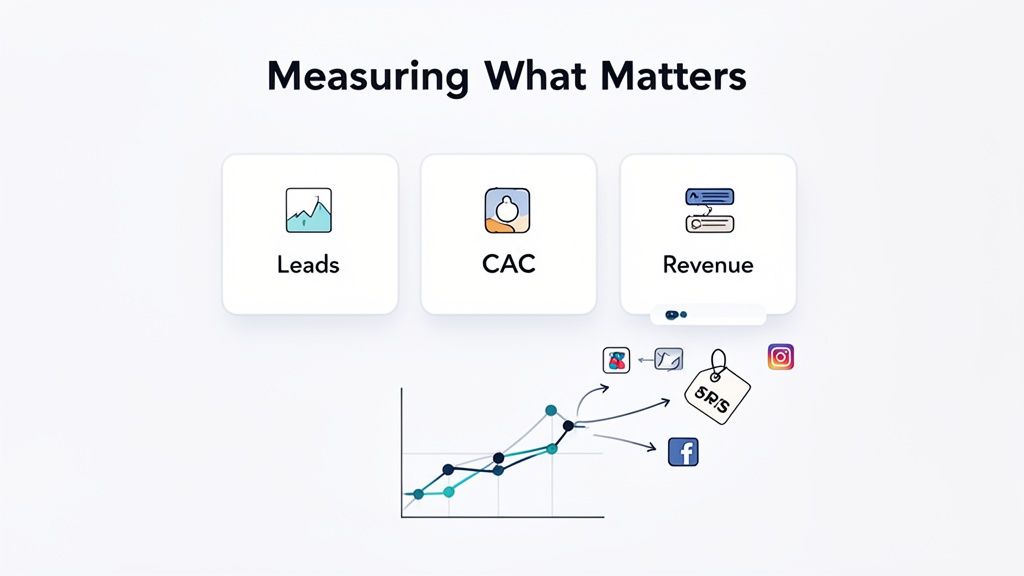
The only question that matters to a business leader is: "Is our social media investment generating a return?" Likes, comments, and followers don't pay the bills. Revenue does.
The true test of your strategy is found in Measuring Social Media ROI. It's how you tie every post and campaign back to business results, secure your budget, and justify your team's efforts.
Moving Past Vanity Metrics
It's time to stop reporting on metrics that don't impact the bottom line. A large follower count is meaningless if it doesn't convert. Your focus must shift to KPIs that track customer acquisition and revenue.
Your new performance dashboard must feature metrics that speak the language of business growth:
- Lead Conversion Rate from Social: What percentage of users from a specific social channel complete a goal (e.g., book a demo, download a resource)?
- Customer Acquisition Cost (CAC) by Channel: What is the total cost to acquire one new customer through social media?
- Revenue Attribution: How much new revenue can be directly traced back to your social media activities?
These are the numbers your CEO and CFO care about. They must be the foundation of your measurement plan.
Connecting Actions to Outcomes with Real Examples
The goal is to draw a straight line from a social media action to a business outcome.
Consider these practical examples:
- For a B2B SaaS Company: You run a LinkedIn campaign promoting a new case study. You track clicks, but more importantly, you use UTMs and your CRM to track how many of those clicks led to a demo request. You can then calculate the cost per MQL for that specific campaign.
- For an D2C E-commerce Brand: You launch a new product with an Instagram Reels series. By using native shopping tags and unique UTM links in your bio, you can attribute specific sales figures directly back to that content, calculating a direct ROAS (Return On Ad Spend) if boosted.
This level of detailed tracking is the core of a modern, performance-focused content strategy for social media.
The goal is to confidently state, "This LinkedIn carousel series generated $15,000 in new pipeline," or "This TikTok video drove 250 direct sales worth $12,500." That is the power of a real strategy.
The Tools and Data That Make It Possible
Accurate ROI measurement requires a connected tech stack.
- Platform-Native Analytics: Use tools like LinkedIn Analytics and Instagram Insights for post-level reach, engagement, and audience demographics.
- UTM Parameters: These are non-negotiable. Use them to tag all links so your web analytics tool (e.g., Google Analytics) can identify traffic sources with precision.
- CRM Integration: This is the final piece. Connecting your social media and web analytics to your CRM (e.g., HubSpot, Salesforce) allows you to track a user's entire journey from first social touchpoint to closed-won deal.
The data from this setup fuels your 90-day sprints. At the end of each cycle, you have a data-backed view of what worked and what didn’t. You can then confidently reallocate budget from an underperforming experiment to the LinkedIn format that is proven to drive demo sign-ups.
With global content marketing revenue projected to exceed $100 billion by 2026, the marketers who win will be those who can prove their impact. This disciplined, ROI-focused approach is how we operate at Ezca, and it's how we've helped our clients generate over $100M in revenue.
Ready to stop guessing and start driving measurable results with your social media? The team at Ezca builds and executes data-driven content strategies that deliver predictable growth. Schedule a call with us today.