
Using Competitor Keywords in AdWords to Steal Market Share
Unlock powerful competitor keywords AdWords strategies. Learn to analyze rivals, craft superior ads, and drive measurable ROI for your Google Ads campaigns.

Analyzing your competitors' Google Ads keywords isn't just about spying; it's essential market intelligence for any business owner or marketing leader. It's how you de-risk your ad spend, validate market demand, and make data-driven decisions that directly impact your bottom line.
Why Competitor Keyword Analysis is a Non-Negotiable Tactic
The Google Ads landscape is more challenging than ever. Costs are rising, and the battle for user attention is fierce. Average B2B Cost-Per-Click (CPC) can be $3.33, while competitive sectors like legal services can see clicks costing upwards of $6.75. Guessing which keywords will drive qualified leads is a surefire way to burn through your budget with no tangible ROI.
This is where analyzing competitor keywords in AdWords provides a decisive advantage. It’s not about blind imitation. The strategic goal is to reverse-engineer their paid acquisition funnel to understand their successes and, more importantly, their costly failures.
Find Proven Paths to Profit
Think of your competitor's ad budget as a multi-million-dollar research fund that you get to analyze for free. Every keyword they consistently pour money into is a strong signal of profitability. By identifying these terms, you can bypass the expensive and time-consuming trial-and-error phase of a new campaign.
This analysis allows you to:
- Validate Market Demand: See which customer problems and solutions are actively being searched for.
- Discover Untapped Niches: Find high-intent, long-tail keywords that your rivals are quietly profiting from.
- Reduce Ad Spend Risk: Allocate your budget to keywords with a proven track record of conversion.
For example, a new SaaS startup could waste thousands testing broad terms like "project management tool." A smarter approach is to analyze a market leader and discover they're bidding heavily on "project management software for agile marketing teams." This instantly validates a profitable niche and reveals the specific language that resonates with high-value customers.
By analyzing competitor keywords, you're not just finding terms to bid on. You’re gaining a blueprint of the customer journey, identifying your rival's core value propositions, and pinpointing the exact messaging that drives clicks and conversions.
This intelligence is invaluable. It informs not just your PPC campaigns but also your SEO and content strategy. If a keyword is valuable enough for a competitor to pay for every click, it's a strong candidate for organic ranking efforts. At Ezca, we use this insight as a cornerstone of our 90-day sprints, ensuring every marketing dollar is aimed at a validated target from day one.
How to Uncover Your Competitors' Winning Keywords
To gain a real advantage in Google Ads, you must go beyond a surface-level look at your rival's keyword list. The objective is to reverse-engineer their entire paid acquisition machine—from the specific keywords driving growth to the ad copy that converts and the landing pages that close deals.
This isn't about copying their strategy. It’s about understanding the why behind their tactics. What high-intent, long-tail keywords are they dominating? What unique selling propositions appear consistently in their ads? Answering these questions provides a proven roadmap of competitor keywords adwords tactics you can adapt for your own campaigns.
Systematically Mapping the Keyword Landscape
Start by using a competitive intelligence tool like Semrush, Ahrefs, or SpyFu. Don't just export a massive keyword list; that’s a rookie mistake.
Filter with strategic intent. Focus on keywords with high estimated traffic, a reasonable CPC, and, most importantly, a consistent bidding history over the last 6 to 12 months. A competitor's sustained investment in a keyword is a powerful indicator of its profitability.
For instance, an e-commerce brand might see a competitor bidding on "running shoes." Deeper analysis might reveal a heavy, sustained investment in "zero-drop trail running shoes for wide feet." You’ve just uncovered a specific, high-intent micro-niche ready for targeting.
While 50-75% of top keywords are often shared across an industry, the remaining 25-50% are where the real opportunities for market share growth lie. These are the gaps where you can build visibility and acquire customers more efficiently.
Competitor Keyword Analysis Tool Comparison
For a business owner or marketing leader, choosing the right tool depends on the strategic advantage you seek. Is it historical ad copy, landing page analysis, or direct competitor comparisons?
The best tool is the one that provides the clearest view of your competitor's playbook, enabling data-backed decisions instead of costly guesswork.
From Keywords to Conversion Insights
A keyword list is just data; it’s not a strategy. The real value is unlocked when you connect those keywords to the ad copy and landing pages they trigger. Most competitive intelligence tools allow you to do this.
- Pinpoint Core Messaging: What benefits are they consistently highlighting? Are they competing on price, features, or a specific customer pain point?
- Track Ad Copy Evolution: Analyze how their ads have changed over time. A shift in messaging often reveals the winner of an A/B test—a lesson you can learn for free.
- Analyze Their Landing Pages: Don't just look at their current page. Use tools to view historical versions. Did they add testimonials, change the CTA, or simplify a form? Every change is a lesson they paid for.
A competitor keyword list is your starting point. The real value comes from connecting those keywords to the ads and landing pages they trigger. This reveals their entire conversion path, from search query to a signed-up customer.
By blending this paid search intelligence with your organic search efforts, you build a more resilient marketing engine. Identifying paid keywords that also drive significant organic traffic can give your SEO team a valuable head start. For more on this synergy, check our guide on how to increase organic traffic. This holistic approach, which forms the basis of our work at Ezca, ensures you build long-term assets, not just rent temporary traffic.
Turning Competitor Data Into Actionable Insights
You have a list of your competitor's keywords. Now what? A spreadsheet full of terms is just noise until it’s translated into a revenue-focused action plan. Without a strategic framework, you risk chasing high-volume vanity keywords while your rivals capture the high-intent, profitable traffic.
Evaluate every potential keyword through a strategic filter based on four pillars: commercial intent, search volume, estimated cost, and your ability to compete and win the click.
Consider a SaaS company targeting the CRM space. Bidding on a broad term like 'CRM for small business' means entering a highly competitive, expensive auction with fuzzy user intent. Targeting a specific, high-intent keyword like 'Salesforce alternative for startups' attracts a much smaller audience, but one that is actively looking to make a purchase decision—a far more valuable prospect.
Finding Your Keyword Strike Zone
Your "strike zone" is where high commercial intent, sufficient search volume, and manageable competition overlap. These are the keywords where your budget will deliver the maximum impact on revenue.
From an e-commerce perspective, instead of entering a bidding war for 'Nike running shoes,' a smarter brand might focus on 'sustainable running shoes for marathon training.' This narrows the audience to a specific, motivated buyer with a higher propensity to convert.
Use this simple decision tree to triage the keywords you’ve uncovered.
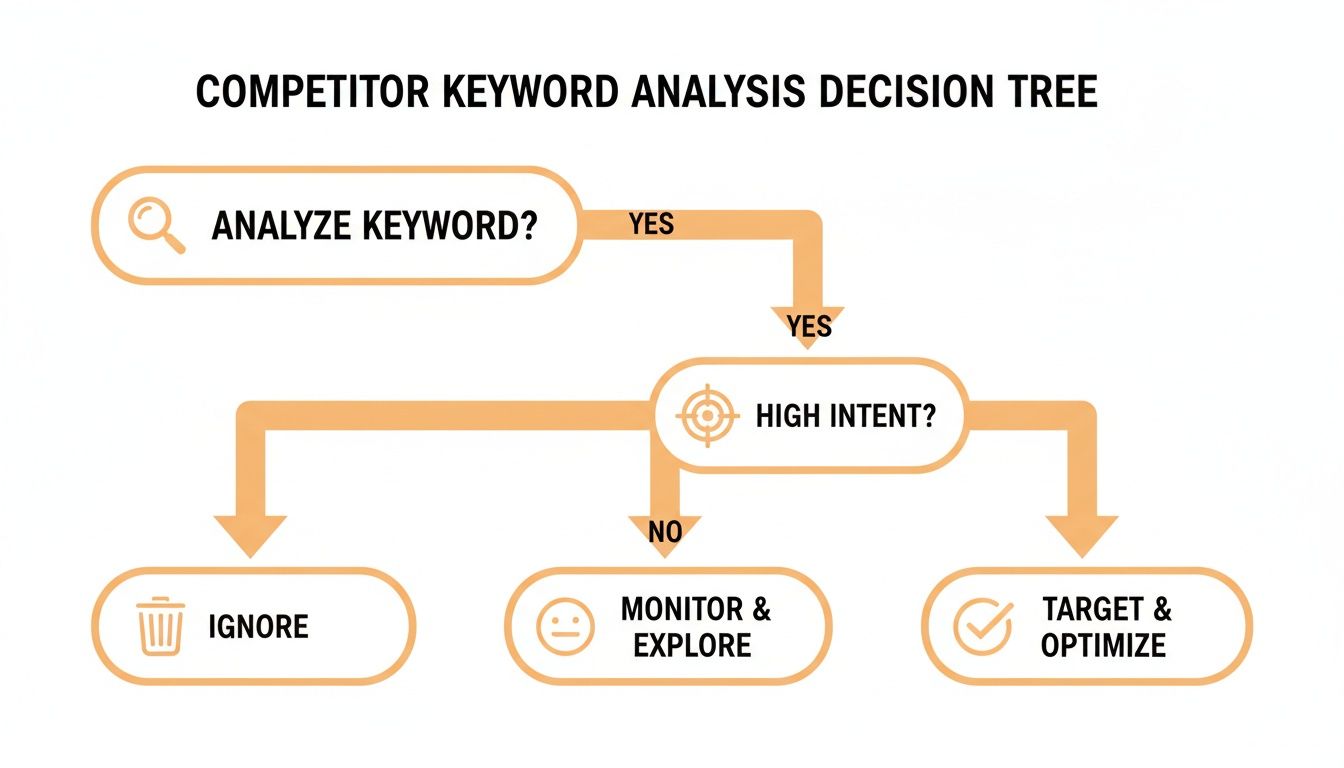
This flowchart provides an initial filter. Keywords with no clear commercial intent? Ignore them for now. High intent? These are your primary targets. This is the first critical step in transforming a messy list into a sharp, actionable campaign.
Prioritizing Based on ROI Potential
Once your strike zone is identified, prioritize keywords by their potential ROI. Knowing industry benchmarks is crucial here. While the average Google Ads Search conversion rate is around 4.40%, this varies dramatically. B2B industries often see rates closer to 1.42%, whereas a well-targeted tech campaign can exceed 4%.
This is precisely why you can't just copy a competitor's bids. Their conversion rates, offer, and landing page experience could be completely different from yours. You can uncover competitor keywords adwords and turn rival data into a winning ROI by understanding these nuances.
A keyword isn't just a word; it’s an audience with a specific need at a specific moment. The best competitor keywords adwords strategy isn’t about bidding on everything your rival does. It’s about identifying the moments where you can provide a better answer to the user's query.
Finally, map your prioritized keywords to specific stages of the buyer's journey. Top-of-funnel keywords (e.g., "what is CRM") require educational content. Bottom-of-funnel, high-intent keywords (e.g., "Hubspot vs Zoho pricing") demand direct, conversion-focused landing pages. This creates a cohesive campaign, not just a scattered list of bids. At Ezca, our data-driven sprint methodology is designed to execute these prioritized, journey-mapped campaigns to deliver measurable growth.
Launching Campaigns That Intercept Competitor Traffic
With your research done and keyword list prioritized, it's time for execution. Running a campaign on competitor keywords in AdWords is more than just outbidding your rivals. The goal is to surgically intercept traffic heading for a competitor and provide a compelling reason for them to choose you instead.
This raises a common question: should you bid on a competitor’s brand name? While legal in most regions, the real question is whether it's profitable. Brand term bidding is often expensive, and your Quality Scores will be lower since your ad is not for the brand the user searched for. However, it can be a highly effective tactic for high-consideration purchases where buyers are actively comparing options.
To Bid or Not to Bid on Brand Names
The decision to bid on a competitor's brand name hinges on your ability to offer a clearly superior alternative. If your product has a demonstrable advantage—on price, features, or support—this can be a powerful strategic move.
- When to bid: You have a stronger value proposition, your competitor has known weaknesses (e.g., poor customer service, high prices), or you are a challenger brand aiming to disrupt an established incumbent.
- When to hold back: Your product is nearly identical, they have a fiercely loyal customer base, or your budget is too small to sustain a bidding war.
For example, a SaaS company bidding on "Asana alternative" is a smart move. Bidding directly on "Asana," however, requires an ad and landing page that immediately answer the user's question: "Why should I consider switching?"
Crafting Interceptive Ad Copy
Your ad copy is where you will win or lose the click. Its sole purpose is to disrupt the searcher's intent. They searched for your competitor, so you must acknowledge that and immediately pivot to why you are the better choice. Generic messaging will fail.
Consider a project management tool competing with Monday.com.
- Before (Generic Ad): "Powerful Project Management Tool | Collaborate Seamlessly & Boost Productivity | Try For Free Today!"
- After (Intercept Ad): "Tired of Monday's Limits? | Get Unlimited Projects & Users for One Flat Fee. | See Why Teams Are Switching."
The second ad is effective because it targets a specific pain point (feature limits), highlights a unique selling proposition (flat-fee pricing), and uses social proof ("teams are switching") to create intrigue. This is the level of specificity your competitor keywords adwords campaigns require.
The Landing Page Switch Strategy
Sending traffic from a competitor campaign to your generic homepage is the fastest way to waste your ad spend. Your bounce rate will be astronomical. The user searched for Brand X and landed on your site for Brand Y; you have seconds to convince them they are in the right place.
The most effective landing pages for these campaigns acknowledge the visitor's original intent. A headline like "Looking for a [Competitor Name] Alternative?" instantly validates their search and signals that you understand their needs.
The entire page must then build a compelling case for making the switch. Use comparison tables, testimonials from former customers of your competitor, and a clear call-to-action for a free trial or demo. This dedicated user experience is what drives conversions.
At Ezca, we've found that rapid optimization of these specialized landing pages is a critical part of our 90-day sprints. This agile process allows us to relentlessly test messaging and layouts, ensuring your ad spend delivers maximum ROI. This focused testing of paid search services and landing pages is a cornerstone of intelligent growth marketing.
Moving Beyond Keywords with AI-Driven Targeting
Fixating solely on competitor keyword lists is a dated strategy. Modern Google Ads is not just about keywords; it's about understanding the audience behind the search. Keywords are no longer the target—they are signals that feed Google's powerful AI.
The real competitive advantage lies in understanding the "who" and "why" behind a search, not just the "what." Google's platform is a predictive engine. Given that 15% of all daily Google searches are entirely new, a strategy based only on historical keyword data misses a significant portion of potential customers. To learn more about this fundamental shift, you can get a deeper look into how Google Ads has changed.
Analyzing Predictive Audience Strategies
Stop asking, "What keywords are my competitors bidding on?" and start asking the more strategic question: "What audiences are their campaigns designed to find?"
Your competitors are constantly feeding Google’s machine learning with data about their best customers. The AI uses these signals to find more people who look and act like them, even if their search terms aren't an exact match.
This requires a deeper analysis of their audience strategy:
- Audience Layers: Are they targeting in-market audiences (people actively shopping for products)? Have they built custom segments based on users visiting specific industry websites? Are they heavily reliant on remarketing?
- Creative Hooks: What pain points and offers are featured in their ads? The creative reveals the audience they are trying to attract.
- Conversion Goals: What are they optimizing for? A newsletter sign-up, a demo request, or a direct purchase? The conversion goal dictates the type of traffic Google's AI is instructed to find.
Your competitor’s true strategy isn't their keyword list; it's the combination of audience signals, creative assets, and conversion goals they feed into Google's AI. This is the predictive framework you must reverse-engineer.
This is where a team that understands both the technology and the strategy is critical. At Ezca, we use modern tools to identify these audience signals and apply our expertise to interpret what they mean for your business. This allows us to see past surface-level keywords and map a competitor's entire acquisition model.
To gain a true edge, think beyond ads and consider the broader applications of AI for ads. This deeper level of analysis is a key component of our AI enablement services, where we help businesses build a sustainable competitive advantage by shifting focus from keywords to the audiences behind them.
Common Questions About Competitor Keyword Strategies
Even for seasoned marketing leaders, bidding on competitor keywords in Google Ads can be complex. You must navigate legal considerations, tight budgets, and constant pressure to demonstrate ROI. Here are direct answers to the most common questions.
Is It Legal to Bid On a Competitor's Brand Name in Google Ads?
Yes, in most regions, including the U.S. and the UK, bidding on a competitor's trademarked brand name as a keyword is legal and a standard industry practice.
However, there is a critical distinction: while you can bid on their name to trigger your ad, you cannot use their trademarked name in your ad copy or display URL. Doing so can confuse users, imply a non-existent partnership, and lead to trademark infringement issues.
The best practice is to use their brand name as the keyword to target an interested searcher, then present your brand as a superior alternative. When in doubt, consult with a legal professional to ensure your campaigns are fully compliant.
How Do I Measure the ROI of Bidding On Competitor Keywords?
Measuring ROI requires clean data and a focus on business-critical metrics. Isolate your efforts by creating a dedicated campaign or ad group for competitor-focused keywords. This prevents their performance data from being diluted by your general brand or non-brand campaigns.
Once segmented, monitor these key metrics:
- Cost Per Acquisition (CPA): What is the total cost to acquire a new customer from this specific campaign?
- Return On Ad Spend (ROAS): For every dollar invested, how much revenue is generated?
- Impression Share: How often are your ads appearing for competitor-related searches? A low number may indicate your budget or bid is insufficient.
The ultimate test of success is profitability. If the CPA for a customer acquired via a competitor keyword is lower than that customer's lifetime value (LTV), the campaign is a winner. It's time to scale.
How Can I Compete If My Competitor Has a Huge Budget?
Compete smarter, not by spending more. A large budget is often a blunt instrument, creating opportunities for a more agile competitor. Avoid a direct bidding war on their primary, high-traffic brand term—you will likely lose and exhaust your budget.
Instead, target their blind spots. Focus on high-intent, long-tail keywords they are likely ignoring, such as "Asana alternative for small teams" instead of just "Asana."
Your greatest weapon is relevance. By crafting highly specific ad copy and a dedicated landing page experience that directly addresses the user's query, you can achieve a higher Quality Score. A better Quality Score can lower your CPC, allowing you to outrank bigger spenders. It's about maximizing the efficiency of your budget, not the size of it.
Ready to turn competitor insights into measurable growth? The team at Ezca Agency combines data-driven strategy with AI to build high-performance marketing campaigns in focused 90-day sprints. Learn more about our approach.