
Your Definitive B2B Digital Marketing Strategy for 2026
Build a winning B2B digital marketing strategy that drives revenue. Get actionable tactics on SEO, ABM, and AI for B2B leaders seeking measurable growth.
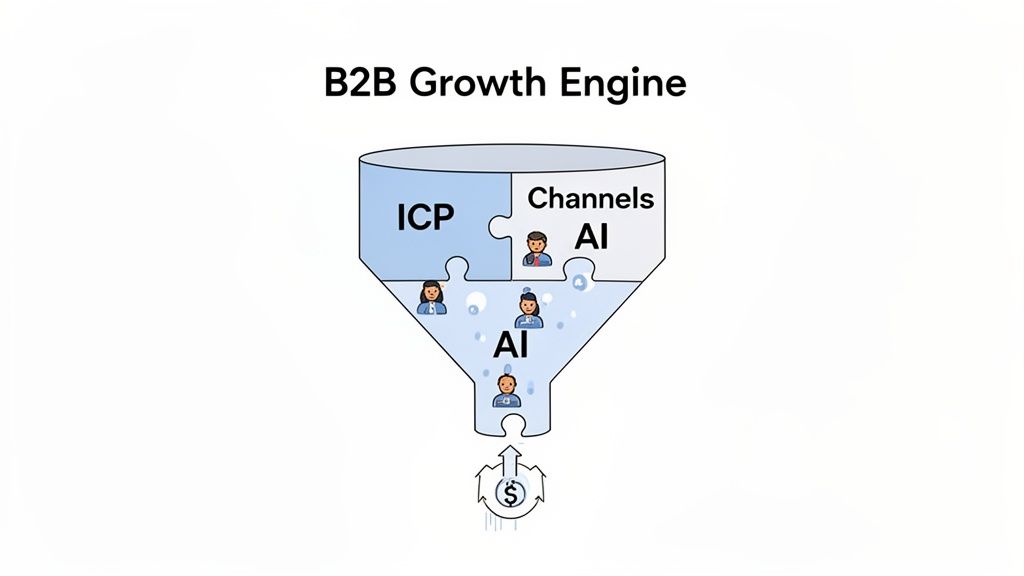
A modern B2B digital marketing strategy is not a collection of tactics; it's a revenue-focused system built to attract, engage, and win high-value accounts. For marketing leaders and business owners, the objective is to build a cohesive growth engine where every dollar spent is tied to a measurable business outcome. This requires a sharp definition of your Ideal Customer Profile (ICP), a multi-channel plan to reach them, and the intelligent use of AI to personalize the experience at scale.
The Blueprint for a Modern B2B Growth Engine
For any marketing leader or business owner, a solid b2b digital marketing strategy should connect every dollar you spend to real business outcomes, like qualified leads and new revenue. This isn't about random acts of marketing. It's about building a predictable system for growth.
Think of it less like a toolbox full of individual tools and more like a high-performance engine. Each component must work in concert to drive your business forward. This engine is fueled by data and engineered for the long, complex sales cycles common in B2B, where decisions involve multiple stakeholders and can take months to close. Your strategy must nurture those relationships over the long term.
Let's break down what a high-performance strategy actually looks like. The following table outlines the core components, their objectives, and how to measure their impact.
Core Components of a High-Performance B2B Strategy
These pillars are not just concepts; they are the active parts of your growth machine, each requiring focus and refinement to generate real results.
Core Pillars of a High-Performance Strategy
A truly effective strategy is built on a few non-negotiable pillars. If one of these is weak, the whole system can stall out.
- Data-Driven Foundations: Everything starts with solid research. It's a fact: firms that systematically research their prospects grow three to ten times faster than those that don't. This means going beyond basic firmographics and defining your ICP by their tech stack, recent hiring activity, and other critical buying signals.
- Integrated Channel Execution: Your website is the heart of your marketing, but its power comes from the channels that feed it. A modern strategy has to master search visibility. To really dig in and learn how to attract qualified leads organically, you should explore proven B2B SEO strategies.
- Measurement and ROI Focus: Forget vanity metrics like likes and shares. The only numbers that truly matter are the ones tied to revenue: Customer Acquisition Cost (CAC), Lifetime Value (LTV), and marketing-generated pipeline. This is how you walk into the boardroom and prove marketing's direct impact on the bottom line.
From Strategy to Actionable Results
The real difference between a strategy document that gathers dust and one that drives growth is execution. This demands a structured process that’s both agile and accountable.
A common mistake is rushing potential buyers into a sales pitch. Many prospects are months or even years away from a decision. The middle of the funnel—where you engage and nurture—is where most opportunities are won or lost.
At Ezca, we put strategy into motion using focused 90-day sprints. This framework forces rapid learning and adaptation, which lets us shift budgets to the channels delivering the highest ROI in near real-time. It’s an agile model that turns plans into measurable progress, fast.
If you’re curious how this approach can be tailored to your specific goals, you can learn more about our dedicated B2B marketing services. Throughout this guide, we’ll break down these pillars into a clear roadmap for building a system that delivers predictable, scalable growth for your business.
Nail Your Foundation: Who You're Selling to and Why They Should Care
Before launching any campaign, two questions must be answered with data, not guesswork: Who are you talking to? And what's in it for them?
Getting this wrong means wasting budget. Getting it right lays the groundwork for a marketing engine that grows your business. This starts with a data-driven Ideal Customer Profile (ICP) and a compelling value proposition.
An ICP is a sharp, data-backed description of the exact type of company that is a perfect fit for your solution. It becomes your north star, guiding every marketing and sales decision so you're not wasting resources on accounts that will never convert.
Go Deeper Than Just Demographics to Pinpoint Your ICP
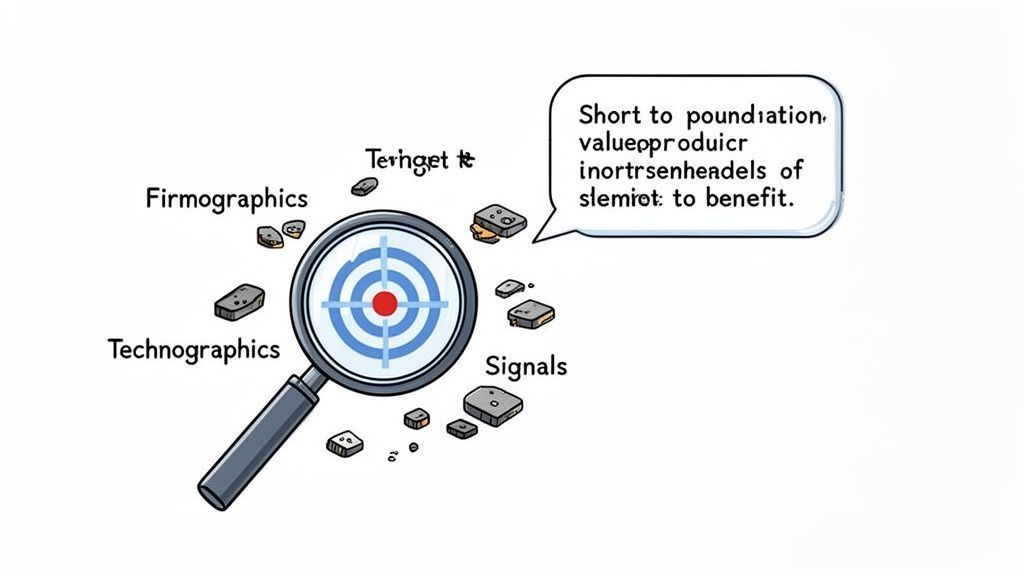
As a marketing leader, you know that basic details like company size and industry are just the starting point. A truly powerful ICP digs much deeper, layering different types of data to build a complete picture of your ideal accounts.
- Firmographics: This is your foundation. Think industry, company size (both in revenue and employee count), and where they're located. For instance, a fintech SaaS might specifically target US-based companies with $50M - $250M in annual revenue.
- Technographics: What's in their tech stack? Knowing the CRM, marketing automation platform, or ERP they currently use can reveal a perfect integration opportunity or a clear frustration with their current tools. A cybersecurity firm, for example, could target companies still using outdated firewall tech—that's a clear signal they need a better solution.
- Buying Signals: These are the real-time clues that show a company is in-market. Is a target account suddenly hiring a "VP of Sales Operations"? Did they just land a new round of funding? Are their executives talking about a specific business challenge at an industry conference? These are your cues to engage.
Your ICP isn't something you create once and file away. It's a living document. As you learn more from your customers and your business grows, you have to keep refining it. This constant sharpening is what drives better and better marketing ROI.
Stop Talking About Features. Start Selling a Compelling Value Prop.
Once you know who you're talking to, your value proposition must deliver a clear, concise statement spelling out the real-world results a customer gets from choosing you. It's the "why" that cuts through the noise.
The secret is to translate your product's features into customer-focused benefits. A feature is what your product does. A benefit is the valuable outcome the customer gets.
Let's take a B2B project management software:
- Feature: "Kanban-style task boards." (So what?)
- Benefit: "Eliminate project bottlenecks and deliver on time, every time, boosting your team's productivity by up to 25%." (Now you're talking ROI!)
Crafting a Message That Solves a Real Problem
Your value proposition only lands if it solves a genuine, pressing problem for your ICP. Buyers aren't looking for more features; they're hunting for solutions to their biggest business headaches. Your marketing has to prove you understand their world and can make their pain go away.
Here’s a straightforward way to connect your solution to their problem:
- Pinpoint the Core Pain: From your ICP research, what's the one challenge that keeps them up at night? (e.g., "Our sales team is buried in manual data entry and it's killing our productivity.")
- Connect Your Solution: How does a specific part of your product solve that exact pain? (e.g., "Our platform fully automates CRM data sync.")
- Show the "So What" with Numbers: What's the measurable, tangible result? (e.g., "This gives each sales rep back 10+ hours every single week, freeing them up to actually sell and grow the pipeline.")
This foundational work—getting laser-focused on your ICP and building a benefit-driven value proposition—is what separates a winning B2B digital marketing strategy from a failing one. At Ezca, this is the non-negotiable first step in our 90-day sprints. It ensures every subsequent activity is perfectly aligned to attract, engage, and convert the right customers.
Choosing Your High-Impact B2B Marketing Channels
Once you’ve defined your ICP and value proposition, the next step is selecting the right channels to reach them. Spreading your budget too thin across multiple platforms is a common mistake. A focused approach is more effective.
The goal is to show up where your ideal customers are already looking for answers. For a business owner or marketing leader, that means ditching the "spray and pray" mindset and investing in a handful of channels that deliver qualified leads and a measurable return.
Drive High-Intent Leads with SEO and Content Marketing
B2B buyers are researchers. Over 80% of buyers check out a company’s website when evaluating them, and their journey almost always starts with a search. This makes Search Engine Optimization (SEO) non-negotiable. It’s how you get your solution in front of the right person at the exact moment they need it.
Modern B2B SEO is about building topical authority. Instead of just trying to rank for a broad keyword like "project management software," you should create comprehensive content clusters around specific problems like "how to improve engineering team velocity" or "stopping project budget overruns."
This strategy achieves two key objectives:
- It attracts high-intent organic traffic from people actively hunting for solutions.
- It establishes your brand as a trusted expert, building credibility long before a demo request. Studies have shown that firms that consistently educate their audience can grow up to ten times faster than those that don't.
Target Key Accounts with Precision Using ABM
If traditional marketing is a shotgun, Account-Based Marketing (ABM) is a sniper rifle. Instead of trying to reach everyone, you hand-pick a small list of high-value target accounts and treat each one as its own market. This is an incredibly powerful play, especially if you have a long sales cycle or sell high-ticket services.
An effective ABM campaign is a masterclass in personalization. It's about demonstrating a deep understanding of a specific company's challenges and tailoring every touchpoint—from ads to emails—to address those exact pain points.
Let’s say a cybersecurity firm wants to land clients in the financial sector. Using ABM, they might identify 50 target companies. Their campaign would look something like this:
- LinkedIn Ads: They'd run ads targeting specific job titles at those 50 companies with content about "FINRA compliance challenges."
- Personalized Outreach: The sales team would then follow up with a thoughtful email or even a direct mail piece referencing the company's recent news or specific regulatory pressures.
- Custom Landing Pages: When someone from a target account clicks an ad, they see a landing page customized with their company's logo and case studies from their industry.
This hyper-focused approach aligns sales and marketing, ensuring every dollar is spent on accounts that can move the needle.
Optimize for Quality Leads with Paid Media
Paid media channels like Pay-Per-Click (PPC) and paid social offer speed and precision that SEO cannot provide immediately. While SEO is a long-term strategy, paid channels can start generating leads tomorrow. A healthy b2b digital marketing strategy needs both.
In B2B paid media, the goal is lead quality over quantity. Five perfect-fit leads are better than 50 unqualified leads that waste your sales team's time. For this, LinkedIn is a powerhouse, allowing you to target decision-makers by job title, company size, industry, and even specific skills.
Imagine a SaaS company selling to HR leaders. They could run a LinkedIn campaign promoting an ebook on "Employee Retention in a Hybrid Workforce." The ad would be set to only show to VPs of HR at tech companies with 500-5,000 employees. This guarantees that the people downloading the ebook aren't just curious; they fit the ideal customer profile perfectly.
Ultimately, the most effective strategies are integrated, with channels supporting one another. For more on how to make that happen, you can check out our guide on what multi-channel marketing means for B2B. It's the core principle behind our squad model at Ezca, where we dynamically shift budgets between channels like SEO and paid media to maximize your ROI based on real-time performance.
Executing Your Strategy with a 90-Day Sprint
Even the most brilliant b2b digital marketing strategy is useless until you execute it. The gap between planning and execution is where most marketing initiatives fail. The 90-day sprint is a framework designed to turn your big ideas into measurable results, fast.
A 90-day sprint is an agile cycle: build, launch, measure, and adapt. This is how high-performing teams and agencies like Ezca operate, forcing focus and accountability for every dollar spent. The aim is to build momentum, deliver quick wins, and earn trust for continued investment.
Weeks 1–2: Laying the Foundation
The first two weeks are for preparation. You're not launching anything yet; you're building the launchpad and translating your high-level strategy into a concrete 90-day plan.
Your main job here is to set one clear, measurable goal. Avoid vague ambitions like "increase brand awareness." You need a specific, achievable target.
For example, a solid quarterly goal sounds like this: "Generate 50 new Marketing Qualified Leads (MQLs) from our target account list by running a thought leadership campaign on LinkedIn and optimizing our top three bottom-of-funnel blog posts for conversion."
During this setup phase, your team needs to get aligned on a few key things:
- Define Your Quarterly KPIs: Lock in the core metrics that define success. Will it be MQLs, Cost per Acquisition (CPA), or the revenue your pipeline influenced? Get specific.
- Assign Clear Ownership: Who does what? The content writer, the paid media specialist, and the marketing ops manager all need to know their exact roles, tasks, and deadlines. No ambiguity.
- Set Your Meeting Rhythm: Schedule weekly check-ins and a more formal monthly review. This regular communication is what keeps the train on the tracks and everyone accountable.
Weeks 3–8: Campaign Launch and Optimization
With the groundwork laid, it’s go-time. Weeks 3 through 8 are for execution and, crucially, for optimizing in real time. Your campaigns are now live, pulling in data and giving you immediate feedback from the market.
This is absolutely not a "set it and forget it" period. The team should be huddling weekly, poring over the performance data. Is that LinkedIn ad campaign hitting its target Cost per Click? Is the new landing page converting visitors at the rate you projected? This is where an agile mindset pays off.
If a particular ad creative is bombing after just two weeks, don't wait until the end of the quarter to fix it. Kill it. Figure out why it’s not connecting, and immediately spin up a new version based on the ads that are working. This constant cycle of testing and iterating stops you from wasting money and dramatically speeds up your learning curve.
The timeline below shows how different B2B channels have come into focus over the years. It's a great reminder of the different speeds at which channels operate.
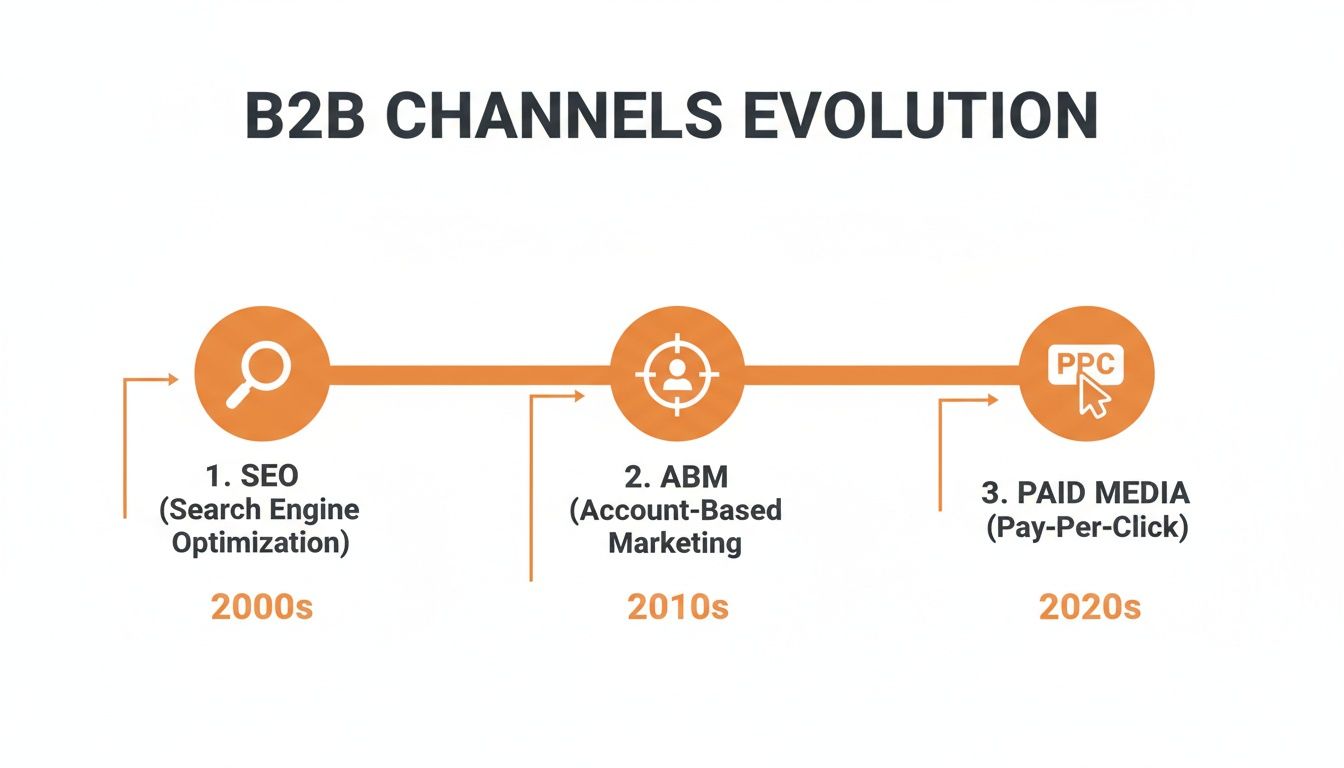
What this shows us is that while a channel like SEO is a foundational, long-haul play, paid media and ABM give you the speed and targeting you need to drive meaningful results inside a 90-day window.
Weeks 9–12: Analysis and Planning the Next Round
The final month is all about deep analysis and setting the stage for your next sprint. By this point, you're sitting on a mountain of performance data. The objective is to dig in and understand not just what happened, but why.
In this phase, you’ll run a full post-mortem on the quarter:
- Performance vs. KPIs: Did you hit your goal of 50 MQLs? If you fell short, how close did you get? What were the biggest roadblocks that stood in your way?
- Channel-Specific ROI: Run the numbers for each channel. Maybe you found that LinkedIn, despite a higher cost, delivered leads that were far more qualified, making it a smarter long-term investment for this goal than cheaper search ads.
- Key Learnings and Insights: Write down what worked, what failed, and what completely surprised you. Were any of your initial assumptions proven dead wrong? This knowledge is gold.
The insights you uncover here aren't just for a report—they become the direct foundation for your next 90-day sprint. This continuous cycle of doing, analyzing, and iterating is the real engine behind sustainable growth in any modern b2b digital marketing strategy.
Gaining Your Unfair Advantage with AI
Artificial Intelligence is now a core component of any serious B2B digital marketing strategy. For marketing leaders and business owners, this is about running more efficient campaigns, optimizing spend, and gaining a real handle on Customer Acquisition Cost (CAC). We're moving past guesswork and into an era of data-backed decisions at scale.
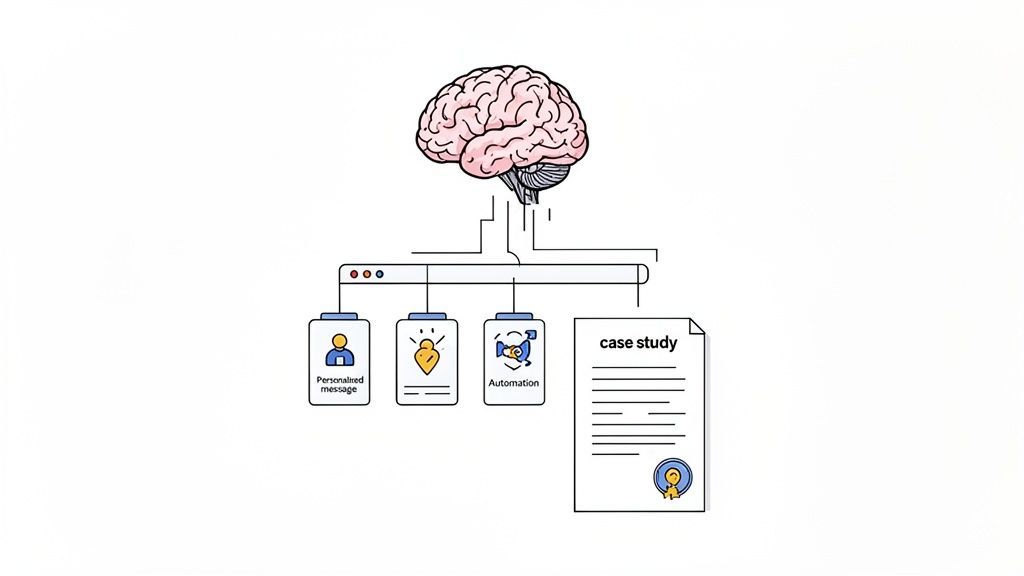
The budget data confirms this isn't just talk. By 2026, 45% of B2B content marketers plan to increase what they spend on AI tools, making it their number one budget item. This isn’t a shot in the dark; it’s a response to proven results. Predictive analytics and generative AI are becoming the standard for crafting hyper-relevant campaigns that actually get noticed.
Automate the Work, Personalize the Experience
The real power of AI is its ability to handle complex, time-consuming tasks, turning mountains of raw data into actionable intelligence that drives real-world personalization.
Here’s how this actually plays out:
- Predictive Lead Scoring: AI can analyze thousands of signals—from website clicks to company size—to identify which accounts are most likely to buy. This allows your sales team to focus their time where it will have the most impact.
- Automated Audience Segmentation: AI can dynamically group your audience based on real-time behavior. This ensures your messaging is always relevant because it’s tailored to where they are in their buying journey.
- Hyper-Personalized Content: Imagine an email nurture sequence that automatically adapts based on a prospect's industry, job title, and the specific case studies they've read on your site. AI-driven content engines make this a reality.
The point of AI isn't to replace great marketers; it's to supercharge them. It handles the monotonous work, freeing up your team's brainpower for what humans do best: strategy, creativity, and building genuine customer relationships.
Get Ready for the New Age of Search
The way B2B buyers find information is changing. Thanks to Large Language Models (LLMs) like ChatGPT, they are asking detailed questions and expecting direct, conversational answers. This is where Generative Engine Optimization (GEO) comes in.
GEO is about ensuring your company's content, data, and expertise are what AI models use to generate those answers. It's a step beyond traditional SEO. It means structuring your content to explicitly answer your ICP’s most urgent questions, publishing original research, and positioning yourself as the go-to authority in your field.
To really get ahead of the curve, it's worth exploring the ultimate guide to AI automation through agentic workflows, which explains how autonomous AI systems can execute complex marketing tasks from start to finish.
At Ezca, we don’t just bolt on AI as an extra feature; it’s woven into our 90-day sprints from day one. We use it to constantly fine-tune campaigns, giving our clients a clear and sustainable advantage. If you want to see how we build these smarter growth engines for our partners, take a look at our AI enablement services.
Measuring B2B Marketing Success with the Right KPIs
"If you can't measure it, you can't improve it" is a well-worn cliche, but for marketing leaders, it's the truth. We must prove that our work drives business growth.
Impressions and clicks don't pay the bills. The real challenge is tying every marketing dollar directly to revenue. It's about building a dashboard your CEO and CFO can look at and immediately understand how marketing is driving revenue. This isn't just about reporting; it's about making confident, data-backed decisions on where to invest next.
Moving Beyond Vanity Metrics
The first, most critical shift is to look past the top of the funnel. While it feels good to see a spike in website traffic or social media likes, those are vanity metrics. They show activity, not results.
The metrics that really count are the ones that track a person’s journey from a curious prospect to a paying customer. When you start speaking in terms of qualified leads and customer acquisition costs, you're speaking the language of the C-suite. You're showing exactly how your team contributes to the bottom line.
It’s a classic mistake to get fixated on numbers that look good on a slide but have no real connection to sales. Think social media followers or total blog views. Real success is measured by the quality of the leads you generate and how effectively they move through the sales pipeline.
The KPIs That Truly Matter for B2B Growth
To get a clear, unfiltered view of your marketing performance, you need to zero in on a handful of business-centric KPIs. These metrics will give you a full-funnel picture of what’s working and what’s not.
- Marketing Qualified Leads (MQLs): This isn't just any lead. An MQL is a prospect who has shown genuine interest and fits your ideal customer profile. Crucially, this definition has to be created and agreed upon with your sales team to ensure everyone is on the same page.
- Sales Qualified Leads (SQLs): This is an MQL that sales has reviewed and officially accepted as a real opportunity worth their time. A high conversion rate from MQL to SQL is a fantastic sign that your marketing is hitting the mark and attracting the right people.
- Customer Acquisition Cost (CAC): This one is simple but powerful. It’s your total sales and marketing spend over a set period, divided by the number of new customers you brought in. A low or decreasing CAC means your growth engine is becoming more efficient.
- Customer Lifetime Value (LTV): This metric estimates the total revenue you can expect to generate from a single customer over the entire course of your relationship. The real magic happens when you compare it to your CAC. The LTV-to-CAC ratio is a vital sign of your business's long-term health; a healthy goal to aim for is 3:1 or higher.
Connecting Actions to Outcomes with Attribution
One of the toughest parts of B2B marketing is figuring out which specific effort led to a sale. A future customer might read a blog post, see one of your LinkedIn ads, and then attend a webinar before finally asking for a demo. So, which touchpoint gets the credit?
Multi-touch attribution models are designed to answer that question by giving credit where credit is due across the entire customer journey. This data is gold for optimizing your budget. If you find that webinars are consistently part of your highest-value deals, you can confidently invest more resources there. This is exactly the data-driven approach we use at agencies like Ezca, allowing for quick, dynamic budget shifts toward the channels that deliver the best possible ROI.
Frequently Asked Questions About B2B Digital Marketing
Let's tackle some of the most common—and toughest—questions we hear from B2B leaders when they're mapping out their digital marketing strategy. Here are the straight answers.
How Much Should a B2B Company Spend on Digital Marketing?
Everyone wants a magic number for their marketing budget, but the honest answer is: it depends. A good starting point for most established B2B companies is somewhere in the ballpark of 7-10% of your total company revenue.
However, that's not a one-size-fits-all rule. If you're an early-stage company aggressively pursuing growth, you’ll likely need to invest more heavily—often pushing that number closer to 15-20% to capture market share quickly.
The smartest approach is to anchor your budget to concrete business goals. Instead of just picking a percentage, work backward from what you need to achieve, whether that's a specific number of MQLs or a healthy CAC-to-LTV ratio of at least 3:1.
What Is the Most Important Metric to Track?
It’s easy to get bogged down in vanity metrics or even top-of-funnel indicators like MQLs and SQLs. While those are helpful signposts, the one number that truly matters to the C-suite is marketing-sourced pipeline revenue.
Focusing on pipeline revenue shifts the conversation from marketing costs to marketing investment. It's the clearest way to demonstrate tangible ROI and justify future budget requests.
This metric directly ties your marketing efforts to the bottom line. When you track it alongside your Customer Acquisition Cost (CAC) and Lifetime Value (LTV), you get a full, undeniable picture of your strategy's financial impact and long-term viability.
How Long Until I See Results from B2B Marketing?
Patience is key, but the timeline really depends on the channel. With paid media campaigns, like those on LinkedIn, you can start seeing leads and traffic within the first few weeks of launch. It's a great way to get some quick wins and test your messaging.
On the other hand, building a real competitive advantage with SEO and content marketing is a marathon, not a sprint. It often takes a good 6-12 months of consistent, high-quality work to see significant and, more importantly, sustainable organic results.
The best strategies don't choose one or the other. They blend the immediate feedback from paid channels with the long-term, compounding growth that comes from building a strong organic foundation.
At Ezca Agency, our 90-day sprint model is designed to deliver a blend of immediate wins and foundational growth. We build data-driven marketing engines that create predictable revenue. Learn how we can do it for you at https://ezcaa.com.