
Grow with B2B Digital Marketing Services: A Practical Guide to ROI
Discover how b2b digital marketing services can boost ROI. Learn how to choose services, measure impact, and partner with a top agency for measurable results.
B2B digital marketing services are the strategies and tactics businesses use to find, attract, and win new clients online. But it's not about running a few ads. B2B sales cycles are long, involve multiple stakeholders, and demand deep trust before a deal is signed.
The focus for any marketing leader isn't just generating noise; it's about building a performance-driven program that delivers highly qualified leads and turns them into long-term revenue.
The New Rules Of B2B Digital Marketing
Let's be blunt: the old B2B marketing playbook is obsolete. Publishing sporadic blog posts, dabbling in ads, and maintaining a token social media presence won't create a predictable flow of new business.
The game has changed because the B2B buyer has changed. Today, your potential clients complete up to 70% of their research online before ever speaking to a sales rep. This is a fundamental rewiring of the buying journey that demands a new, integrated approach.
Consider this common scenario: a SaaS company runs a brilliant PPC campaign but sends that expensive traffic to a generic landing page that fails to convert. Or a B2B e-commerce brand has excellent products that are invisible because their SEO is an afterthought. This is where budgets are torched and growth stalls.
From Isolated Tactics To An Integrated Engine
The only way forward is to stop thinking in terms of isolated tactics and start building an integrated digital marketing engine. It’s like engineering a high-performance car. You wouldn't install a powerful engine but then use cheap tires and ignore the transmission. For the car to perform, every part must work in perfect sync.
The same is true for your marketing. Effective b2b digital marketing services aren't a collection of activities; they're an interconnected system.
The goal is to build a cohesive customer journey where each channel supports and amplifies the others. This is how you move from random acts of marketing to building a predictable revenue machine.
The Problem With A Fragmented Strategy
When your marketing channels don't talk to each other, you're flying blind. It's impossible to track what's actually working, measure true return on investment (ROI), and make smart, data-backed decisions.
This fragmented approach creates predictable headaches:
- Inconsistent Messaging: A prospect sees one message in your ads, reads something different on your website, and hears another story from sales. This erodes trust instantly.
- Wasted Ad Spend: Driving clicks with paid campaigns is useless if your content and landing pages aren't optimized to convert that interest into leads.
- Missed Opportunities: Valuable data remains trapped in silos. For example, keywords driving organic traffic could be gold for refining Google Ads copy, but the connection is never made.
This guide is your blueprint for putting the pieces together. We’ll walk through how core services like those we offer at Ezca—from SEO and content to PPC and conversion optimization—combine to create a powerful engine that delivers what every B2B leader wants: a predictable, scalable sales pipeline.
Building Your B2B Growth Engine
Let's move past the idea of one-off marketing campaigns. Real growth comes from building a system—a well-oiled engine where every part works together. Think of B2B digital marketing services less like a random checklist and more like an integrated set of tools, each with a specific job, all working in concert to drive revenue.
The goal is to stop patching a broken playbook and start engineering a predictable growth machine.
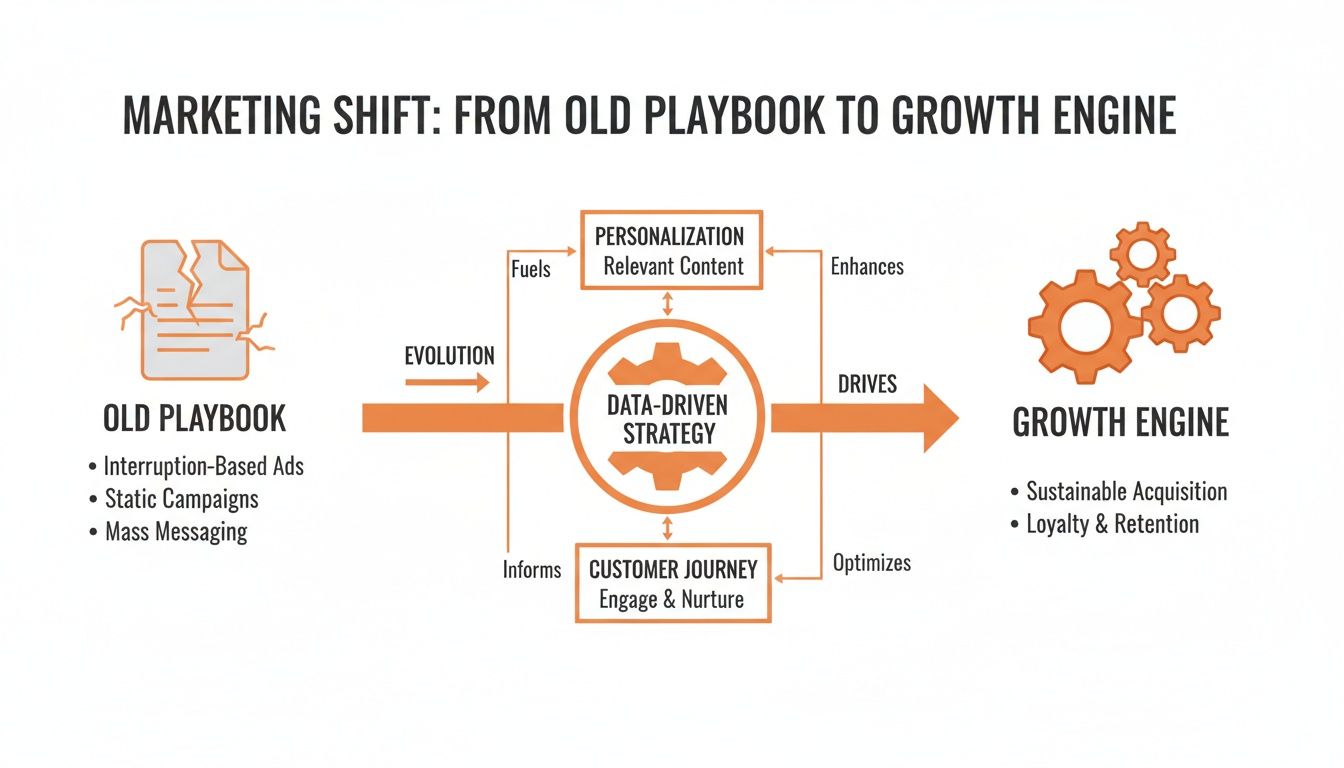
This shift is fundamental. It’s about creating a feedback loop where every action informs the next, transforming your marketing from a cost center into a reliable source of pipeline and profit.
To get there, you need to master the core components and understand what they actually do for your business.
Core B2B Digital Marketing Services And Their Primary Goal
Understanding these goals is the first step. Now, let's look at how they function in the real world.
Search Engine Optimization (SEO): The Long-Term Asset
Think of SEO as building prime real estate on Google’s main street. It’s not about getting just anyone to your site; it’s about ensuring the right people find you the moment they look for a solution. With 71% of B2B buyers starting their journey with a generic search, first-page visibility isn't optional—it's essential.
SEO is not a quick project with an overnight payoff; it's a strategic investment that builds compounding value. For example, a SaaS company that ranks for "enterprise project management software" generates a steady flow of highly qualified leads, month after month, without paying for every click. That’s a durable asset.
For business leaders, the metrics that matter extend beyond traffic:
- Organic Keyword Rankings: Are you visible for the commercial-intent terms that drive business?
- Marketing Qualified Leads (MQLs) from Organic Traffic: Is visibility turning into actual sales opportunities?
- Customer Acquisition Cost (CAC) from Organic: How efficient is your SEO at acquiring customers compared to paid channels?
Our strategic SEO services focus on building this foundation for sustainable business growth.
Pay-Per-Click (PPC) Advertising: The Immediate Accelerator
If SEO is your long-term real estate investment, PPC is your high-speed vehicle to get there now. PPC advertising lets you buy your way to the top of search results and target specific professionals on platforms like LinkedIn. It’s about speed, precision, and—most importantly—data.
Imagine a B2B e-commerce company launching a new line of specialized equipment. Instead of waiting for SEO to mature, they use PPC to get their products in front of procurement managers in target industries today.
PPC isn't just about buying traffic; it's about buying data. It is one of the fastest ways to test messaging, validate market demand, and generate pipeline while your long-term channels mature.
If a specific ad headline achieves a high click-through rate, you've just discovered powerful language to use across your website and sales pitches. That’s an immediately actionable insight.
Account-Based Marketing (ABM): The Spear-Fishing Approach
Most marketing feels like casting a wide net. Account-Based Marketing (ABM) flips that model. It’s more like spear-fishing.
With ABM, you don't wait for leads to come to you. You and your sales team create a "dream client" list—for example, 50 high-value accounts—and focus all your energy on them.
Here's a practical ABM play:
- Identify: Sales and marketing agree on a target list of ideal-fit companies.
- Personalize: Marketing creates ads and a landing page speaking directly to a specific target company's known challenges.
- Engage: Sales reps use hyper-relevant messages on LinkedIn, referencing the personalized content to start a meaningful conversation.
This coordinated approach ensures marketing dollars are spent only on accounts that can truly move the needle, cutting through the noise and dramatically shortening sales cycles for your biggest potential wins.
Content Marketing And Conversion Rate Optimization (CRO)
Content is the fuel for your entire growth engine. It’s the white papers, webinars, case studies, and calculators that answer your audience's questions, build trust, and guide them through their decision.
But great content is only half the battle. What happens when people get to your site? That's where Conversion Rate Optimization (CRO) comes in. CRO is the science of turning more of your website visitors into actual leads.
It involves methodically testing everything from headlines and button text to page layouts and form lengths. By removing friction, you get more value from the traffic you already have. A 1% improvement in your website's conversion rate can have a massive ripple effect, significantly boosting your pipeline and overall ROI.
Using AI To Gain A Competitive Edge
Let's be clear: AI isn't a far-off concept in B2B marketing. It’s here, and it's being used to create a measurable advantage. This isn't about replacing smart marketers; it's about giving them a co-pilot that makes them faster and more effective. When implemented correctly, AI fundamentally changes how you find and win customers.

AI can process immense amounts of data instantly, spotting patterns a human simply couldn't. This frees your team to focus on what they do best: strategy, creativity, and building relationships. It’s the key to shifting from guesswork to decisions built on solid data.
Hitting The Bullseye With Precision And Personalization
One of the first places you'll feel AI's impact is in ad targeting. AI tools dig through thousands of signals—from website behavior to company data—to predict who is ready to buy. Your ad budget is no longer a shotgun blast; it becomes a sniper's shot, aimed at decision-makers when their buying intent is highest.
For instance, an AI might notice that CFOs at mid-market tech firms who have recently viewed your pricing page are your hottest prospects. It can then automatically shift more ad spend to reach that specific group on LinkedIn, driving up your return on ad spend (ROAS).
This intelligence also enables personalization at scale. Forget generic email campaigns. AI allows you to serve dynamic content that adapts to a person's industry, role, or past interactions with your brand, creating a one-to-one conversation that builds trust and shortens the sales cycle.
Automating The Busywork And Focusing Your Sales Team
Beyond ads, AI brings new intelligence to lead management. Sales teams often waste hours sifting through leads to find the few that are sales-ready. AI-powered lead scoring automates that painful process.
The system analyzes a lead’s digital footprint, looking at data points like:
- Firmographics: Company size, industry, annual revenue.
- Engagement: Pages visited, content downloaded, emails opened.
- Intent Signals: Searches for your brand name or competitor comparisons.
The AI assigns a score to every lead, allowing your sales team to focus 100% of their effort on the opportunities most likely to convert. That alignment between marketing and sales is what truly accelerates revenue growth.
The Critical Need For Expert Human Guidance
But AI isn't a "set it and forget it" solution. Without a skilled hand, it can cause more problems than it solves. A staggering 96% of marketers are using AI, and while it has boosted efficiency for 45%, Forrester warns that ungoverned AI use could cost B2B companies over $10 billion by 2026 due to errors.
AI is a powerful tool, but it requires a skilled operator. Without a clear strategy and expert governance, you risk creating off-brand content, misinterpreting data, or alienating your audience.
This is where an experienced agency makes all the difference. Our approach to AI enablement ensures technology serves your core business goals. We provide the human oversight to guide the AI, interpret its findings, and turn them into strategies that deliver a real competitive edge. To get started, a structured approach like the one in this AI for advertisers playbook is essential.
How to Measure What Actually Matters
Are you tracking metrics that look good in a report, or are you tracking metrics that grow the business? A great B2B digital marketing partner moves past vanity metrics like clicks and impressions to focus on the numbers that impact your bottom line.
For any marketing leader or business owner, the goal isn't to be busy; it's to be profitable. This means putting a clear financial framework around every marketing dollar. It's about drawing a straight line from digital efforts to revenue—a discipline that has helped us at Ezca generate over $100M in tracked revenue for our clients.
Beyond Clicks to Customer Value
The first mind-shift is moving from measuring activity to measuring value. Clicks and traffic are easy to report, but they don't pay the bills. The real story is told by metrics that connect marketing investment directly to customer revenue.
The most critical question isn't "How many clicks did we get?" It's "What did it cost to acquire a customer, and what is that customer's long-term worth to our business?"
This brings us to two metrics that should be your North Star:
- Customer Acquisition Cost (CAC): This is the total sales and marketing cost required to land one new customer. Calculate it by dividing your total spend by the number of new customers acquired in a given period. A low CAC signals an efficient marketing machine.
- Lifetime Value (LTV): This metric forecasts the total revenue you can expect from a single customer over their entire relationship with you. For any B2B company, especially SaaS, a high LTV is the cornerstone of sustainable growth.
The magic happens when you look at the LTV:CAC ratio. This tells you if your marketing is a cost center or a profit engine. A healthy ratio, generally 3:1 or higher, is proof that you're not just spending money—you're making a profitable investment.
Tracking The Journey From Lead To Revenue
In B2B, the path from a curious lead to a closed deal is rarely a straight line. It's a journey with multiple touchpoints and a sales cycle that can span months. That's why measuring the entire pipeline is non-negotiable.
This is where your lead funnel takes center stage. You must track how leads progress from a Marketing Qualified Lead (MQL)—someone who has shown interest—to a Sales Qualified Lead (SQL), a lead vetted by sales as a viable opportunity.
A critical metric here is pipeline velocity: the speed at which leads move through your sales funnel and convert to revenue. Even a small improvement in this speed can have a huge impact on quarterly and annual results.
Budget Allocation And Expected ROI
When you have a clear view of these core metrics, making smart decisions about your marketing budget becomes much easier. This is more important than ever, as 83% of decision-makers expect B2B marketing budgets to grow by 2026. Data from Gartner shows companies allocate around 8% of revenue to marketing, with SEO alone getting 9% of those digital budgets.
The investment is justified. For B2B SaaS companies, the average SEO ROI can be a massive 702% with an organic CAC of just $205. This is why savvy marketers seek partners who live and breathe data. You can dig deeper into these B2B budget trends and what they mean for your strategy.
To set realistic expectations, it's useful to know the typical returns you can anticipate from different channels.
B2B Digital Marketing ROI Benchmarks By Channel
This table provides a data-driven look at the typical return on investment and key metrics for core B2B marketing channels. Use it to help set realistic expectations for your own programs.
By focusing your attention on these business-critical KPIs, you can confidently justify marketing spend, prove your team's impact, and make strategic decisions that fuel genuine, measurable growth.
How To Choose The Right Marketing Partner
Choosing your next marketing partner is a make-or-break decision for a business owner or marketing leader. Get it right, and you’ve found a true growth partner. Get it wrong, and you'll burn through your budget with little to show for it.
The key is to look past slick sales presentations and dig into their process, their proof, and their people.
This starts with a hard look at their track record. Don’t just glance at client logos; ask for specific case studies with real numbers. Vague promises about "increasing brand awareness" are a red flag. A great agency will be eager to show you data on pipeline growth, lower Customer Acquisition Cost (CAC), and increased Marketing Qualified Leads (MQLs) for businesses like yours.
Look For A Documented Methodology
A repeatable, structured framework for getting results separates top-tier agencies from the rest. The best partners don't "do marketing" on the fly. They operate with a clear methodology designed for speed and accountability.
For instance, our entire model at Ezca is built around 90-day sprints. This agile system allows us to set concrete quarterly goals and quickly double down on what’s working. Instead of being locked into a rigid annual plan, we can pivot based on real-time data, ensuring your investment is always aimed at high-impact activities.
A partner without a clear, documented process is simply guessing with your money. You should be able to understand exactly how they plan to tackle your goals, measure progress, and adapt to new information.
When you're vetting an agency, ask them to walk you through their exact process—from contract signing to how they run meetings and report on results.
Key Questions To Vet A Potential Partner
To get past the sales pitch and find out what an agency is really made of, ask the right questions. This is how you learn about their team, communication style, and focus on results.
Here’s your checklist:
- Who exactly will be on my team? Insist on meeting the actual strategists and specialists who will work on your account, not just the sales reps. A modern approach, like our squad-based model, gives you a dedicated team of experts completely focused on your business.
- How do you measure and report on ROI? Ask for sample reports. The reports should directly connect marketing activities to bottom-line metrics like MQLs, pipeline value, and CAC—not just vanity metrics.
- How do you handle communication and strategy adjustments? Look for a structured schedule, like weekly check-ins and monthly strategy reviews. This ensures everyone is aligned and you always know what's happening with your investment.
Ultimately, you’re looking for a partner who is transparent, accountable for financial results, and has a process built for agility. If you're weighing your options, our guide on hiring an agency versus building an in-house team can help you think through the decision.
Common Questions About B2B Marketing Services
If you're considering a partner for B2B digital marketing services, you likely have some big questions. That's smart. Every marketing leader and business owner needs straight answers before committing resources.
Let's tackle the most common questions about timelines, budgets, and the return you can realistically expect.
How Long Until We See A Real ROI?
This is the million-dollar question. The honest answer is, it depends on the channel. I advise clients to think in terms of a two-speed approach: immediate traction and long-term momentum.
- Immediate Impact (30-90 Days): Paid channels like PPC and paid social are built for speed. You should expect to see your first leads, a traffic spike, and valuable performance data within a month or two. This is where we can quickly test which messages and offers resonate.
- Sustained Growth (6-12 Months): Organic channels like SEO and content marketing are about building an asset. It takes time to build domain authority, earn valuable rankings, and create a content library that attracts your ideal customer. You'll likely see a meaningful, steady flow of organic leads around the six-to-nine-month mark, with results compounding from there.
A well-rounded strategy, like the programs we build at Ezca, uses quick wins from paid media to fill the pipeline now while laying the SEO and content foundation for predictable, cost-effective growth.
Should We Hire An Agency Or Build In-House?
This is the classic "build vs. buy" debate. The decision depends on your company's stage, budget, and existing expertise. An in-house team offers deep product knowledge but comes with heavy overhead and almost certain skill gaps.
Consider the cost: hiring a full, senior-level in-house team to cover SEO, PPC, content, and analytics can easily run over $500,000 per year in salaries alone, before benefits, software, and training.
Partnering with a performance marketing agency gives you an entire team of specialists on day one for a fraction of that cost. For most B2B companies looking to scale efficiently, an agency partner is the fastest way to get the expertise and horsepower you need without the massive fixed costs and HR challenges of hiring.
What Is A Realistic Marketing Budget?
Your budget should be a direct reflection of your revenue goals and market competitiveness. A solid benchmark from Gartner is that companies typically allocate around 8% of their total revenue toward marketing.
For a full program combining several B2B digital marketing services, agency retainers usually fall in the $5,000 to $25,000+ per month range, plus ad spend. The key is to stop seeing this as a "cost" and start viewing it as an investment with a measurable return. When you partner with an agency that obsesses over revenue-focused metrics, your budget gets tied directly to real business growth.
Ready to stop guessing and start building a predictable revenue engine? The team at Ezca uses a data-driven, 90-day sprint methodology to help B2B leaders like you achieve measurable growth. Book a free strategy call with us today.