
10 Actionable B2B Demand Generation Strategies for 2026
Discover 10 actionable b2b demand generation strategies. Learn proven tactics for SEO, ABM, and paid ads to drive measurable growth and ROI.
In the crowded B2B market, generic marketing is a sunk cost. Marketing leaders and business owners need more than just leads; you need a predictable pipeline of high-quality opportunities that convert into revenue. But with countless channels and tactics, deciding where to focus your resources for maximum ROI is a constant challenge.
Many companies struggle, trapped in a cycle of chasing vanity metrics that don't translate to bottom-line growth. This listicle cuts through the noise. We'll break down 10 proven b2b demand generation strategies, moving beyond theory to provide actionable frameworks, real-world examples, and the specific KPIs you need to measure true ROI. These methods are designed to build a system that creates awareness and interest, turning potential customers into qualified sales prospects.
Whether you're in SaaS, e-commerce, or B2B services, this guide is your blueprint for building a scalable demand engine. We'll explore how modern approaches combine data, AI, and human expertise to turn marketing spend into measurable results. To dive deeper into specific tactics for achieving measurable results in demand generation, refer to these 10 High-Impact Performance Marketing Strategies from AdStellar AI.
This article provides the structure to implement strategies like Account-Based Marketing (ABM), content marketing, and SEO, helping you identify and capture demand with precision. Let's get started.
1. Account-Based Marketing (ABM)
ABM flips the traditional demand generation funnel on its head. Instead of casting a wide net, it concentrates marketing and sales resources on a select group of high-value target accounts. This strategy treats each account as a market of one, requiring deep research and personalized outreach to the entire buying committee.
This focused approach is one of the most effective b2b demand generation strategies because it eliminates wasted spend on audiences that will never convert. It forces sales and marketing alignment around a unified goal: penetrating and winning specific, high-revenue accounts. The result is often shorter sales cycles, larger deal sizes, and a significantly higher return on investment. According to ITSMA, 87% of marketers measuring ROI say that ABM outperforms every other marketing investment.
How to Implement an ABM Sprint
To get started, identify a manageable list of 20-50 target accounts. Use a combination of firmographic data (company size, industry, revenue) and intent data (signals that a company is actively researching your solution) to build your initial list.
- Step 1: Unify Sales and Marketing: Create a shared "target account list" that both teams agree on. Define the criteria for inclusion and establish a service-level agreement (SLA) for follow-up and reporting.
- Step 2: Map the Buying Committee: Identify the key decision-makers and influencers within each account—CFO, CTO, Head of Ops, etc. Map their specific pain points and priorities.
- Step 3: Craft Personalized Campaigns: Develop role-specific content, ads, and outreach. A CFO cares about ROI and TCO, while a CTO is focused on integration and security. Your messaging must reflect these distinct priorities.
- Step 4: Execute & Measure: Launch multi-channel campaigns using targeted advertising and website personalization. Track account-level engagement (e.g., number of engaged contacts from a target account) and pipeline velocity, not just individual lead scores.
For a deeper dive into structuring these campaigns, you can explore detailed b2b account-based marketing frameworks and see how Ezca applies this methodology to different business models. This method works exceptionally well for companies with a high customer lifetime value, where the effort of personalization delivers a substantial payoff.
2. Intent Data and Buyer Intelligence
Intent data reveals the invisible buying signals your prospects generate online. Instead of waiting for a form fill, this strategy identifies accounts that are actively researching solutions like yours by tracking their content consumption, keyword searches, and competitor website visits. This gives your sales and marketing teams a powerful head start.
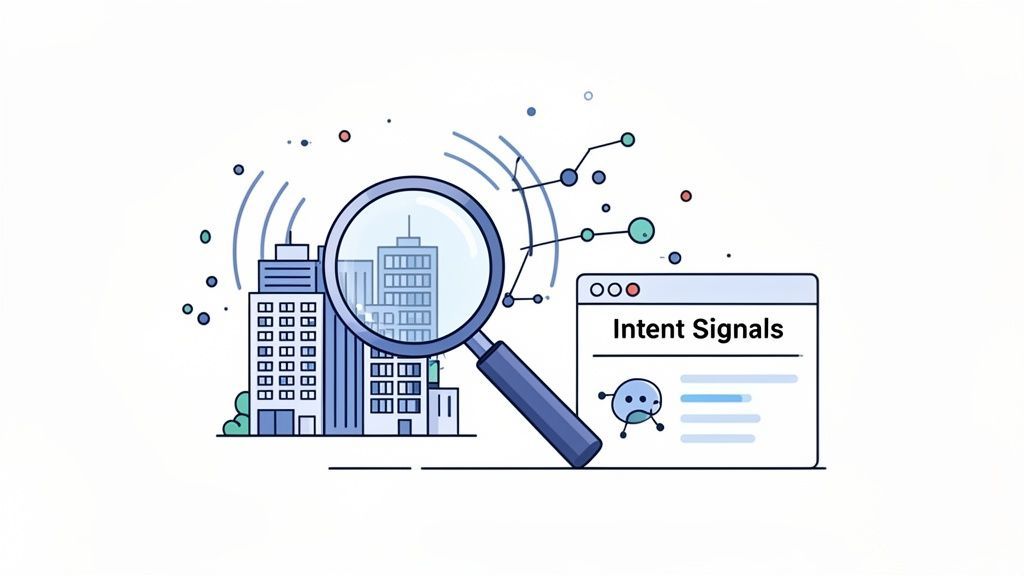
This data-driven approach is a cornerstone of modern b2b demand generation strategies because it focuses resources on accounts with a demonstrated need. Companies like 6sense have used this method to identify eight times more in-market accounts compared to traditional lead generation. By knowing who is ready to buy, you can engage them with timely, relevant messaging long before your competitors even know they exist.
How to Implement an Intent Data Sprint
Start by defining the "intent topics" most relevant to your product. These are the keywords, competitors, and concepts your ideal customers research before a purchase. Platforms like Bombora or Demandbase can provide this third-party data.
- Step 1: Combine Data Sources: Integrate third-party intent data (broad market signals) with your first-party data (website visits, content downloads). This creates a complete picture of an account's interest level.
- Step 2: Set Up Real-Time Alerts: Create automated alerts for your sales team when a target account shows a surge in intent. This enables immediate and relevant outreach when buying interest is at its peak.
- Step 3: Build Segmented Workflows: Create distinct marketing campaigns for high-intent accounts versus those in early-stage research. High-intent prospects should receive demo offers and case studies, while others get top-of-funnel educational content.
- Step 4: Personalize and Measure: Use intent topics to personalize ad copy, email outreach, and website content. Track the lift in pipeline velocity for intent-qualified leads compared to other sources to measure ROI.
This strategy is highly effective for B2B companies looking to shorten their sales cycle and improve marketing ROI. By focusing on accounts that are already in-market, you can explore how to build targeted campaigns that convert faster and close at a higher rate. It ensures your message reaches the right people at the exact moment they are ready to listen.
3. Content Marketing and Thought Leadership
Content Marketing and Thought Leadership involve creating and distributing valuable, relevant information to attract, engage, and retain a clearly defined audience. Instead of directly pitching your products, you provide expertise that solves your audience's problems, which builds trust and establishes your brand as an industry authority.
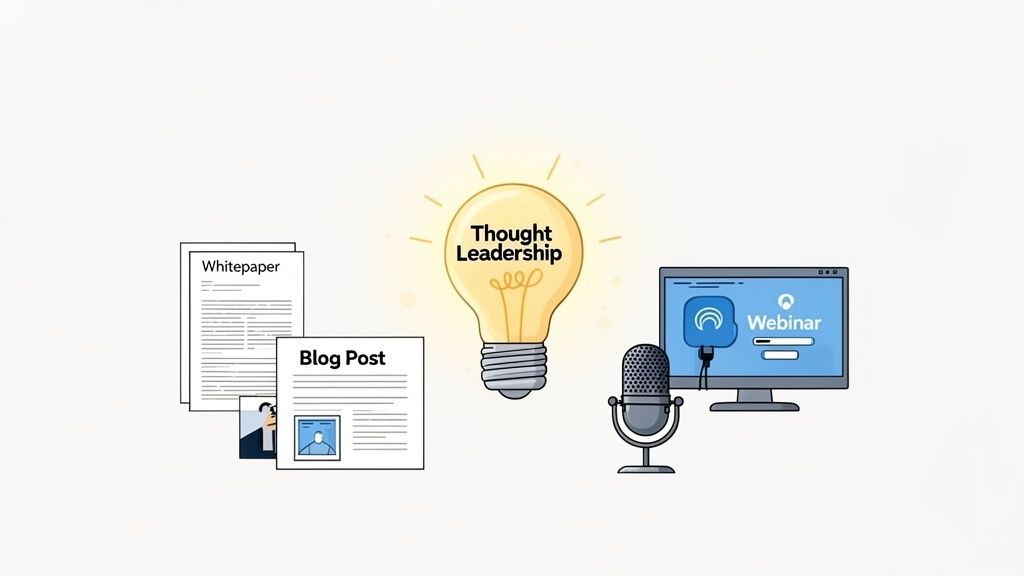
This long-term play is one of the most sustainable b2b demand generation strategies available. While paid ads stop working the moment you stop paying, a high-performing blog post or research report can generate qualified leads for years. Companies like HubSpot built their entire empire on this model, attracting millions of monthly visitors by answering their audience’s most pressing questions.
How to Launch a Thought Leadership Initiative
A successful content program requires a deep understanding of your customer's journey and a commitment to producing original, high-quality material. Focus on creating cornerstone assets that address major pain points or industry trends.
- Step 1: Map Content to the Buyer’s Journey: Identify the key questions your prospects ask at the awareness, consideration, and decision stages. Create targeted content for each, such as top-of-funnel blog posts, mid-funnel comparison guides, and bottom-funnel case studies.
- Step 2: Invest in Original Research: Differentiate your brand by producing data-backed reports or surveys. This original intellectual property becomes a magnet for backlinks and media mentions, positioning you as a primary source of industry information.
- Step 3: Build an Internal Expert Program: Identify subject matter experts within your company and create a process to turn their knowledge into articles, webinars, and conference talks. This gives a human face to your brand and builds genuine authority.
- Step 4: Repurpose and Distribute: Turn a single research report into a webinar, a series of blog posts, an infographic, and social media soundbites. Promote these assets across all relevant channels to maximize their reach and impact.
This strategy is ideal for B2B companies with complex sales cycles where trust and education are critical. By measuring content ROI through attributed leads and pipeline influence, you can prove its direct contribution to revenue growth.
4. Paid Search (PPC) and Search Engine Marketing
Paid Search, or Pay-Per-Click (PPC), targets high-intent prospects actively searching for solutions like yours. By bidding on relevant keywords across platforms like Google and Bing, B2B marketers can capture qualified leads at the exact moment they express a need. This direct approach offers measurable results and can scale quickly with effective optimization.
This channel is one of the most dependable b2b demand generation strategies because it connects you with buyers actively looking for answers. Unlike passive marketing, PPC places your brand in front of an audience with pre-existing commercial intent. For B2B companies, well-managed PPC programs have generated hundreds of thousands of qualified leads and millions in attributable revenue by reaching decision-makers during their critical research phase.
How to Implement a 90-Day PPC Sprint
Begin with a tightly focused campaign designed to generate quick wins and gather performance data. The goal is to prove ROI and establish a foundation for scaling your search marketing efforts.
- Step 1: Identify High-Intent Keywords: Focus your initial budget on problem-aware and solution-aware keywords. These are terms like "[competitor] alternative" or "enterprise accounting software," which indicate a user is close to making a purchase decision.
- Step 2: Build Persona-Based Campaigns: Create separate ad groups and landing pages for different buyer personas. A CFO's search for "financial reporting tools ROI" requires different messaging and a different landing page than a CTO's search for "secure API for payment processing."
- Step 3: Implement Rigorous Conversion Tracking: Go beyond tracking simple form fills. Set up tracking for Marketing Qualified Leads (MQLs), Sales Qualified Leads (SQLs), and, ideally, pipeline revenue within your ad platform. This provides a clear view of your return on ad spend (ROAS).
- Step 4: Optimize with Negative Keywords & Audiences: Actively build a negative keyword list to prevent wasted spend on irrelevant searches (e.g., "free," "jobs," "template"). Layer audience targeting, such as company size or industry, to further refine who sees your ads and control costs.
While PPC captures immediate search demand, it's most effective when paired with a strong organic presence. For a comprehensive approach to capturing organic demand in the age of AI, explore a definitive guide to AI Search Engine Optimization. This combination ensures you meet buyers at every stage of their journey.
5. Marketing Automation and Lead Nurturing
Marketing automation turns inconsistent follow-up into a systematic process for guiding prospects through the buyer's journey. By using platforms like HubSpot or Marketo, you can deliver personalized, timely communication at scale, ensuring no interested lead falls through the cracks. This frees up your sales team to focus on conversion-ready opportunities instead of manually nurturing early-stage prospects.
This approach is one of the most fundamental b2b demand generation strategies for companies managing a high volume of inbound interest. It bridges the gap between marketing’s lead generation efforts and sales’ need for qualified opportunities. According to Forrester, companies that excel at lead nurturing generate 50% more sales-ready leads at a 33% lower cost. Effective automation keeps your brand top-of-mind, educates prospects, and systematically builds trust.
How to Implement a Lead Nurturing Workflow
Start by focusing on a single buyer persona and their primary pain point. A simple, targeted sequence is a better starting point than a complex, multi-path workflow.
- Step 1: Segment Your Audience: Begin with a clearly defined segment. For example, contacts who downloaded a specific ebook about "improving manufacturing efficiency."
- Step 2: Map the Nurture Path: Outline a sequence of 3-5 emails. The first email should deliver the requested asset, the next can offer a related case study, and a subsequent one could invite them to a webinar on the topic.
- Step 3: Build the Automation Workflow: Use your marketing automation platform to create the workflow. Set enrollment criteria (e.g., form submission for the ebook) and time delays between each communication (e.g., wait 3 days).
- Step 4: Define a Goal and Sales Handoff: Determine the goal of the sequence, such as a demo request or reaching a certain lead score. Once a lead meets this goal, the workflow should automatically create a task for a sales rep in your CRM.
To ensure your sequences are effective, you can explore SaaS lifecycle email nurture programs that provide frameworks for different customer stages. Ezca helps businesses design these programs to efficiently manage and qualify leads before sales engagement.
6. LinkedIn and Social Selling
LinkedIn has become the central hub for B2B professionals, making it an indispensable platform for building relationships, establishing authority, and generating high-quality leads. A social selling strategy combines organic content, paid advertising, and direct personal outreach to create multiple touchpoints that build awareness and guide prospects through the buying journey.
This method stands out among b2b demand generation strategies because it allows for precision targeting and relationship-building at scale. By engaging decision-makers where they are actively seeking industry insights, you can build trust long before a sales conversation begins. Companies like Gong have mastered this, using their founder's and employees' profiles to build a massive, engaged audience that fuels their sales pipeline.
How to Implement a LinkedIn Sprint
Start by focusing on a specific audience segment and a clear content pillar. The goal is to establish your company and key team members as go-to resources in your niche. A consistent presence is more important than sporadic, high-effort posts.
- Step 1: Optimize Your Foundation: Refine your company page with a clear value proposition and links to key resources. Ensure key employees have optimized personal profiles that reflect their expertise and role.
- Step 2: Develop a Content Cadence: Create a content mix of educational posts, industry news, and company culture highlights. Encourage your team to share and engage to broaden reach.
- Step 3: Launch Targeted Ads: Use LinkedIn's ad platform to target by job title, company size, industry, and even specific account lists (ABM). Use Lead Gen Forms to capture contact information directly within the platform, reducing friction.
- Step 4: Engage and Nurture: Monitor brand mentions and join relevant conversations in industry groups and on influencer posts. For high-value accounts, use Sponsored InMail and Conversation Ads to start direct, personalized dialogues with key decision-makers.
To properly measure campaign effectiveness, you must implement the LinkedIn Insight Tag on your website and use UTM parameters for all links. This allows you to track conversions and demonstrate a clear ROI from your social selling activities.
7. Webinars and Virtual Events
Webinars and virtual events are powerful engines for top-of-funnel demand generation, blending educational content with direct lead capture. By hosting live or on-demand sessions on industry trends, product deep dives, or expert panels, B2B companies can attract and engage a targeted audience at scale. This format establishes authority and provides a direct channel to convert interest into qualified leads.
This approach is one of the most scalable b2b demand generation strategies because it creates a high-value asset that can be repurposed long after the live event. According to ON24, the average attendee watches 52 minutes of a 60-minute webinar, representing a massive opportunity for engagement. The key is delivering genuine value that educates and solves a problem for your ideal customer.
How to Implement a Webinar Sprint
Focus on a single, high-impact topic that addresses a critical pain point for your target audience. Partnering with a complementary brand or an industry influencer can instantly double your promotional reach and add credibility.
- Step 1: Plan and Promote: Choose a compelling topic and secure your speakers. Begin promoting the event 3-4 weeks in advance across email lists, social media channels (especially LinkedIn), paid ads, and partner networks.
- Step 2: Optimize Registration: Create a dedicated landing page with a clear value proposition, speaker information, and a simple registration form. Send a sequence of reminder emails to maximize live attendance.
- Step 3: Deliver a High-Value Session: Structure the webinar to be 45-60 minutes, with the first 35-40 minutes dedicated to educational content and the remainder to a Q&A. Include a clear call-to-action (CTA) during the session, such as booking a demo.
- Step 4: Execute Post-Event Nurturing: Immediately follow up with all registrants. Send the recording to everyone, but create separate nurture sequences for attendees versus no-shows. Attendees are warmer leads and should receive a more direct, sales-oriented follow-up.
For a deeper dive into creating multi-channel promotion for these events, you can explore detailed b2b content marketing services and see how to build a content ecosystem around your virtual event strategy. This method works well for companies that can translate complex solutions into educational content, building trust before the sales conversation begins.
8. Conversion Rate Optimization (CRO) and Landing Page Testing
Conversion Rate Optimization (CRO) is the systematic process of improving your website and landing pages to increase the percentage of visitors who take a desired action. This isn't about getting more traffic; it's about getting more value from the traffic you already have. By methodically testing elements like headlines, calls-to-action (CTAs), form fields, and page layouts, you can turn more passive visitors into active leads.
This discipline is one of the highest-ROI b2b demand generation strategies because it directly impacts the efficiency of every other marketing channel. A 1% lift in conversion rate on a high-traffic demo page can generate thousands in new pipeline value without any additional ad spend. For B2B companies, where each conversion can be worth a significant amount, small, data-driven improvements compound into major revenue gains.
How to Implement a CRO Sprint
Start by focusing on your highest-impact pages, such as demo request or pricing pages, where improvements will have the most significant effect on your pipeline. Use analytics and user behavior tools to form hypotheses about what to test first.
- Step 1: Analyze User Behavior: Use tools like Hotjar or Crazy Egg to understand where users click, scroll, and drop off. This qualitative data helps you identify points of friction and opportunities for improvement.
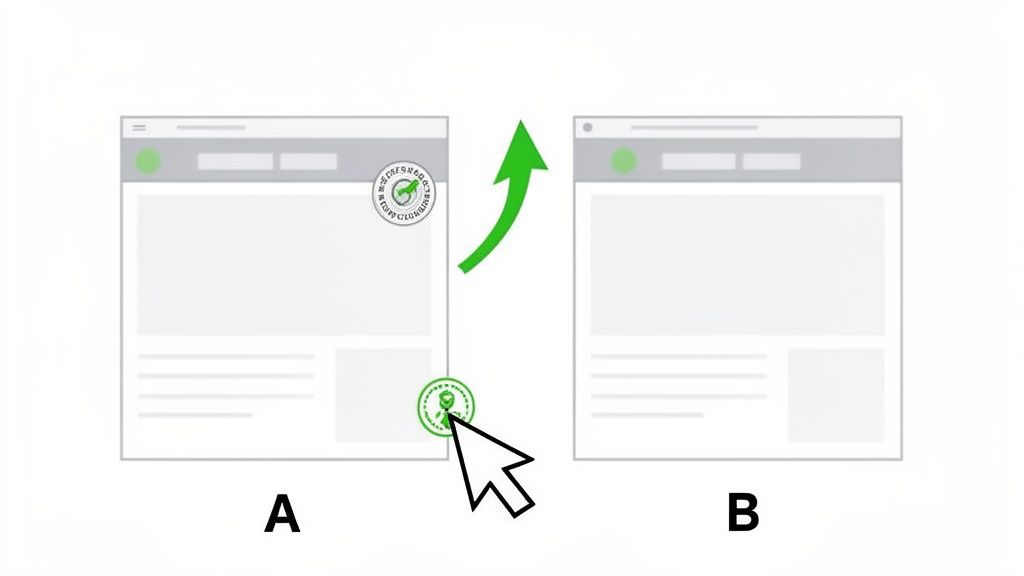
- Step 2: Formulate a Hypothesis: Create a clear, testable hypothesis based on your analysis. For example: "Reducing the number of form fields from seven to four will increase demo request submissions by 20% because it lowers user friction."
- Step 3: Run an A/B Test: Create a variation of your page with the proposed change. Use an A/B testing tool to show the original page (control) to 50% of your traffic and the new page (variant) to the other 50%. Run the test long enough to achieve statistical significance.
- Step 4: Analyze and Iterate: Once the test concludes, analyze the results. If your variant won, implement it as the new control. Document your findings and use them to inform your next test. This continuous cycle of improvement is the core of CRO.
For a structured approach, you can learn more about data-driven conversion optimization programs that establish a testing roadmap. Ezca's CRO programs are designed to maximize the efficiency of your paid and organic marketing efforts, turning website traffic into a predictable source of qualified leads.
9. Referral Programs and Customer Advocacy
Referral programs and customer advocacy turn your most valuable asset—your existing customers—into a powerful engine for growth. This approach incentivizes happy clients to recommend your solution to their networks, generating high-trust, warm leads through word-of-mouth. This strategy capitalizes on social proof, one of the most credible forms of marketing.
This is one of the most cost-effective b2b demand generation strategies because it directly taps into established trust. A recommendation from a peer is far more convincing than a display ad, leading to faster conversions and a lower customer acquisition cost (CAC). According to Nielsen, 92% of consumers trust referrals from people they know. When a trusted colleague suggests a solution, it bypasses much of the initial skepticism in the buying process.
How to Launch a Customer Advocacy Sprint
A successful program begins with a strong foundation of satisfied customers. Before launching, confirm you have product-market fit and a high Net Promoter Score (NPS), as this indicates a willingness to refer.
- Step 1: Identify and Segment Advocates: Analyze your customer base to find those with high satisfaction scores, usage rates, and positive support interactions. These are your ideal first participants.
- Step 2: Create Compelling Incentives: Design a two-sided reward system. Offer value to the referrer (e.g., account credits, gift cards) and the new customer (e.g., a first-month discount).
- Step 3: Make Sharing Effortless: Provide advocates with a unique referral link, pre-written email and social media templates, and a dashboard to track their referral success. Remove all friction from the sharing process.
- Step 4: Amplify and Recognize: Launch the program and publicly celebrate your top advocates. Amplify their stories through case studies, testimonials, and review site campaigns. This provides social proof and encourages more customers to participate.
By formalizing word-of-mouth, you create a predictable and scalable channel for high-quality leads. This approach works best for B2B companies with a strong product and an engaged user base, where customer success is a core value.
10. SEO and Organic Search Demand Generation
Search Engine Optimization (SEO) is the process of improving your website's visibility in organic search results to attract qualified traffic. By targeting keywords your audience uses throughout their buying journey—from early-stage research ("how to solve X problem") to late-stage evaluation ("best software for X")—you can generate a consistent flow of high-intent inbound leads. This method creates a compounding asset that grows in value over time.
Unlike paid advertising, where traffic stops when you stop paying, organic search is one of the most sustainable b2b demand generation strategies. It builds long-term brand authority and trust, attracting prospects who are actively seeking solutions. Companies like HubSpot, which generates millions of monthly visitors from search, demonstrate the power of a well-executed content and technical SEO program.
How to Implement an SEO Sprint
To begin, focus on capturing low-hanging fruit and building a solid technical foundation. Your goal is to prove ROI by targeting high-intent keywords while establishing the groundwork for broader topical authority.
- Step 1: Conduct Foundational Keyword Research: Use tools like Ahrefs or SEMrush to identify long-tail keywords with clear commercial intent. Look for terms with moderate search volume and low keyword difficulty that your prospects are likely to use when they are close to making a purchase.
- Step 2: Perform a Technical SEO Audit: Ensure your site is fast, mobile-friendly, and easy for search engines to crawl. Fix any broken links, improve site speed, and implement a clean URL structure. These technical fixes are crucial for ranking.
- Step 3: Create Pillar and Cluster Content: Develop a "pillar page" that provides a comprehensive overview of a core topic. Support it with multiple "cluster" articles that dive deeper into specific subtopics, all linking back to the main pillar. This structure signals your expertise to search engines.
- Step 4: Build High-Quality Backlinks: Launch a targeted outreach campaign to acquire links from reputable industry websites. Focus on quality over quantity by guest posting, collaborating on research, or getting featured in expert roundups.
To successfully execute this sprint, you must continually monitor rankings, traffic, and conversions to refine your approach. For a more detailed guide on building your organic presence, you can learn how to increase organic traffic with proven tactics. This strategy works exceptionally well for B2B companies with longer sales cycles, as it nurtures prospects with valuable information at every stage.
B2B Demand Generation: 10-Strategy Comparison
From Strategy to Execution: Building Your Demand Generation Engine
Choosing the right mix of B2B demand generation strategies is the starting point, not the finish line. True growth originates from disciplined execution, precise measurement, and a relentless commitment to optimization. Throughout this guide, we've explored tactics from the hyper-focused precision of ABM to the foundational reach of SEO. The common thread is clear: isolated efforts fall short. Real momentum comes from building an integrated, self-reinforcing system.
Imagine your content marketing efforts not only attracting organic traffic but also providing the exact assets needed for your email nurturing sequences. Picture your paid search campaigns capturing high-intent leads directly from your curated ABM target lists. Consider how rigorous CRO can double the value of every single visitor, whether they arrived from a webinar or a referral. This is the goal: an interconnected demand generation engine where each part amplifies the others.
Key Takeaways for Immediate Action
To move from theory to practice, focus on these core principles:
- Integration Over Isolation: Your strategies must work in concert. An insight from your intent data platform should immediately inform your ABM outreach and the keywords you target in PPC. A successful webinar topic should be repurposed into a thought leadership article, social media clips, and a lead nurturing email series.
- Data is Your Compass: Do not rely on gut feelings. Establish clear Key Performance Indicators (KPIs) for every initiative, from MQL-to-SQL conversion rates for your marketing automation to Customer Acquisition Cost (CAC) for your paid channels. Use this data not just to report on the past but to predict future outcomes and allocate resources effectively.
- The 90-Day Sprint Mentality: The B2B buying journey is long, but your planning cycle shouldn't be. Adopt a 90-day sprint approach to test new channels, launch campaigns, and measure results. This forces agility and ensures you can quickly pivot away from underperforming tactics and double down on what’s working, maximizing your budget’s impact.
Building a Predictable Revenue Machine
Mastering these B2B demand generation strategies transforms marketing from a perceived cost center into a predictable, scalable revenue engine. When you can confidently show that every dollar invested in a specific channel generates a measurable return, you change the conversation from "How much does marketing cost?" to "How much can we invest to grow faster?" This shift is fundamental for any business leader aiming to capture greater market share.
The complexity of managing this integrated system, however, can be a significant hurdle. Coordinating expert-level SEO, paid media, ABM, and CRO requires specialized talent and dedicated focus that many in-house teams are stretched too thin to provide. This is where a performance-focused partner becomes a critical advantage. An agency built on a foundation of data-driven sprints and cross-channel expertise can provide the structure and firepower needed to accelerate results.
Ready to turn these strategies into a cohesive, high-performance growth engine for your business? Ezca Agency specializes in implementing integrated B2B demand generation sprints that deliver measurable results. Let's build a customized plan to hit your revenue targets.