
Unlocking Growth: Actionable AI Powered Marketing Solutions for Business Leaders
Discover how AI powered marketing solutions accelerate growth. Learn actionable strategies for SEO, PPC, and content that deliver real ROI for your business.
Forget the tech hype. For marketing leaders and business owners, AI-powered marketing solutions are about one thing: giving your marketing a predictive brain to drive measurable growth.
What Are AI-Powered Marketing Solutions, Really?
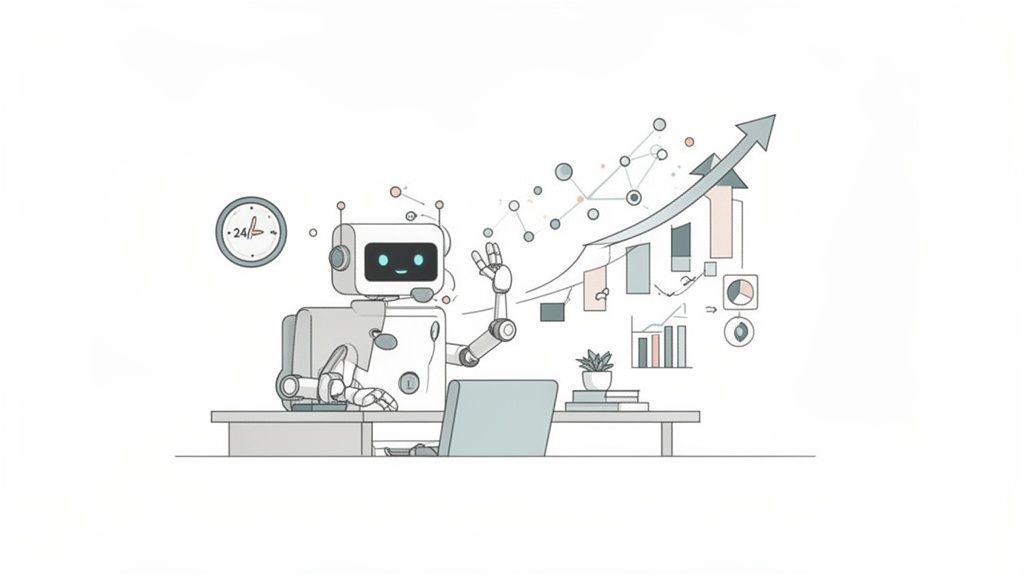
Think of AI as a tireless team of expert analysts working 24/7. This team sifts through mountains of data—customer behavior from your CRM, ad performance from Google, social media sentiment, and market trends—to spot patterns that are invisible to the human eye. Then, it translates those findings into actionable growth strategies.
For a business owner, this means you stop making decisions based on what happened last quarter and start building strategies based on what the AI predicts will happen next. It’s the difference between reviewing a report and having a system that automatically shifts ad spend in real-time to capitalize on a new trend as it emerges, directly impacting your bottom line.
It’s More Than Just Basic Automation
Marketing automation, based on "if/then" rules, is standard practice. If a user downloads an ebook, send them a three-part email sequence. It's functional but rigid, treating broad segments identically.
AI-powered marketing is adaptive. It uses machine learning to learn from outcomes and self-optimize. An AI system might analyze thousands of data points and discover that for a specific customer cohort, a webinar invitation followed by a targeted LinkedIn ad drives a 20% higher MQL-to-SQL conversion rate than your standard email sequence. It then automatically pivots to that higher-ROI strategy for that cohort.
An AI-driven approach doesn't just execute your plan; it constantly refines it. This is the engine for turning data into measurable outcomes like lower Customer Acquisition Cost (CAC) and higher Customer Lifetime Value (LTV).
To see just how different the two approaches are, let's break it down side-by-side.
Traditional Marketing vs. AI-Powered Marketing
The shift from a manual, rule-based system to a predictive, adaptive one fundamentally changes how marketing operates.
This table highlights the core evolution: AI empowers marketers to move from educated guesses to data-driven certainty.
The Business Case for AI
The AI in advertising market is projected to explode from $11.17 billion in 2025 to $36.34 billion by 2030. You can explore the full projections of the AI advertising market to see the speed of this shift. This growth is driven by one thing: tangible ROI.
This isn't just for Fortune 500s. Agencies like Ezca now use AI to give businesses of all sizes access to this intelligence. By focusing on rapid, 90-day sprints, we prove ROI by tracking the metrics that matter to leadership—like a lower Customer Acquisition Cost (CAC) and a clear rise in marketing-attributed revenue.
Inside the AI Marketing Engine
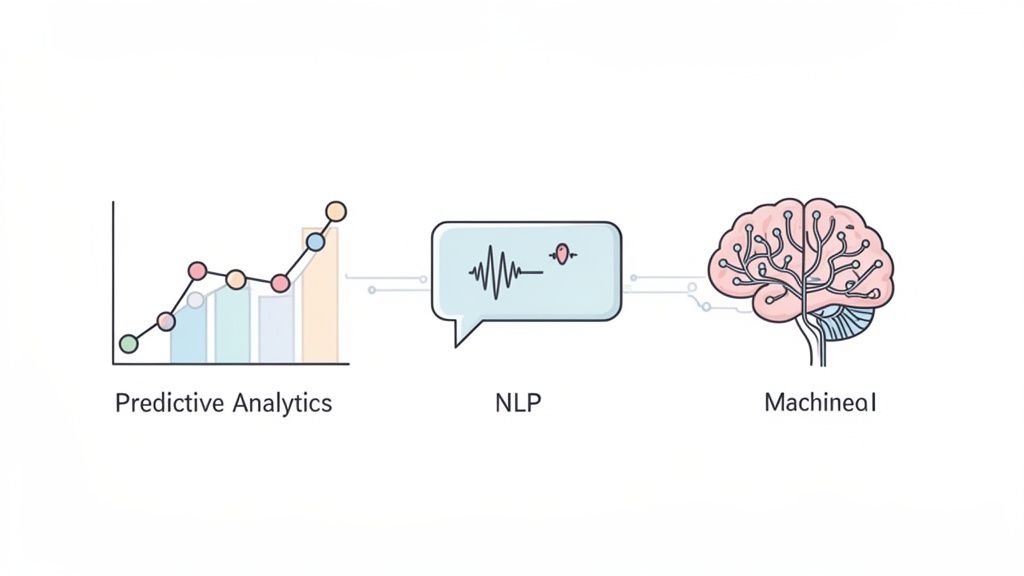
You don't need a computer science degree to understand what makes AI-powered marketing solutions effective. They are a combination of specialized technologies working in concert to deliver business results. Here are the three core components.
Predictive Analytics: Forecasting What's Next
Predictive analytics is your data-backed crystal ball. It sifts through historical and current data—from sales figures to website behavior—to find patterns and forecast what’s likely to happen next.
For a marketing leader, this means identifying which customers are at risk of churning or which leads are most likely to convert. For example, a B2B SaaS company can use predictive analytics to identify free-trial users exhibiting behaviors that correlate with a future subscription purchase, allowing the sales team to engage them at the perfect moment.
Natural Language Processing: Understanding Your Customer's Voice
Natural Language Processing (NLP) gives computers the ability to understand, interpret, and generate human language. It's the engine behind intelligent chatbots, sentiment analysis of customer reviews, and AI-assisted ad copywriting.
- Sentiment Analysis: NLP can scan thousands of social media comments, G2 reviews, or support tickets to quantify brand sentiment. This gives you an instant, data-driven look at how your market perceives you, highlighting specific pain points or features they love.
- Chatbot Intelligence: An NLP-powered chatbot can understand user intent, handle complex queries, and qualify leads before handing them off to a human, ensuring your sales team only talks to high-intent prospects.
A core benefit of understanding what's "inside the AI marketing engine" is its capacity to generate valuable AI-driven marketing insights. These components work together not just to automate tasks, but to uncover opportunities for growth that would otherwise remain hidden in your data.
Machine Learning: The Engine of Optimization
If predictive analytics is the forecast, machine learning (ML) is the brain that acts on it. ML algorithms learn from data and improve over time without being explicitly programmed. With every new campaign and customer interaction, the system gets smarter, constantly refining its approach to hit your KPIs.
This is what drives dynamic budget allocation. For example, an ML model can monitor ad performance across Google, Facebook, and LinkedIn in real-time. If it sees that your cost per qualified lead is 25% lower on LinkedIn for a specific job title, it can automatically shift more budget there to maximize marketing ROI. This rapid optimization is a cornerstone of our 90-day sprint methodology at Ezca.
Applying AI Across Your Marketing Funnel
The real power of AI is seeing it solve specific problems in your most important channels—turning abstract concepts into tangible results like lower costs and higher conversion rates.
Instead of a broad, one-size-fits-all approach, AI delivers the biggest ROI when aimed at specific weak points in your marketing funnel. Let’s look at how this plays out in three critical areas: PPC, SEO, and CRO.
Supercharge Your PPC with Predictive Bidding
In paid advertising, manual bid management is too slow. AI changes the game by using predictive audience targeting and automated bid management.
Imagine an AI analyzing thousands of signals in real-time for every ad impression—time of day, device, location, past search behavior—to calculate the probability of conversion. It then adjusts your bid for that single auction, ensuring you don't overpay for low-intent clicks or underbid on high-value prospects.
This means you stop paying a flat rate for a generic audience and start bidding precisely what each potential customer is worth at that moment.
- Metric to Watch: A sharp drop in your Cost Per Acquisition (CPA).
- ROI Impact: A measurable climb in your Return on Ad Spend (ROAS) as wasted spend is eliminated.
Dominate SERPs with AI-Driven SEO
Modern SEO is about proving topical authority to search engines. AI excels here, performing complex keyword clustering and competitive content gap analysis at a scale impossible for human teams.
Let's say your business sells "project management software." An AI tool will analyze the entire search landscape, uncovering hundreds of related questions, subtopics, and user intents. It then groups this data into logical content clusters, providing a data-backed blueprint for pillar pages and supporting articles that cover the topic exhaustively.
This shifts your team from a keyword-focused strategy to a topic-focused one, giving you a clear roadmap to prove you're the definitive expert—which is exactly what Google wants to see before sending high-value organic traffic.
Scale Your CRO with Intelligent A/B Testing
Traditional A/B testing is a bottleneck. AI-powered multivariate testing shatters it by testing dozens of combinations simultaneously—five headlines, three calls-to-action, and four hero images, all at once.
The AI learns in real-time which combinations perform best for different audience segments (e.g., mobile vs. desktop, new vs. returning visitors) and automatically sends more traffic to the winning variations. This drastically accelerates the optimization cycle.
The data backs this up: AI-driven personalization can lead to a 40% spike in conversion rates. Early results from AI-powered ad campaigns show they can achieve a 34% lower CPA while boosting conversions by 28%.
AI Marketing ROI by Channel
This table shows the real-world value you can expect. By focusing AI on specific KPIs, you can create a direct line between your technology investment and revenue growth.
At Ezca, we use these exact AI tactics to drive revenue and qualified leads. By integrating AI into SEO, PPC, and CRO, we get a clear picture of what’s working and can rapidly shift focus to maximize ROI. We’ve seen firsthand how a strategic AI program can transform marketing from a cost center into a predictable revenue engine. You can see how our AI-driven content strategy delivered results in this case study.
Your 90-Day AI Implementation Roadmap
Jumping into AI-powered marketing solutions can feel overwhelming. A 90-day sprint is the ideal framework to go from idea to measurable ROI, making the process manageable and focused on results. The goal is to score a quick, decisive win that provides the hard data needed to justify wider rollout.
Weeks 1-2: Data Audit and Goal Setting
Start with your data, not the tech. The first two weeks are for auditing what you have—your CRM, your Google Analytics account, and ad platform data.
Answer these critical questions:
- What data are we collecting? Is it clean and accessible?
- Where are the most obvious gaps?
- What is the single business outcome we want AI to achieve?
Set a sharp, measurable Key Performance Indicator (KPI). A vague goal like "improve marketing" fails. A strong KPI is "reduce Customer Acquisition Cost (CAC) by 15%" or "increase marketing-qualified leads (MQLs) from PPC by 20%."
Weeks 3-4: Tech Stack Evaluation
With a clear KPI, you can find the right tools. Work backward from your goal. If the goal is to lower CAC, look at AI-powered bidding tools or predictive audience modeling software.
Focus on solutions with proven case studies in your industry. A platform that helped other B2B SaaS companies achieve a 30% lift in qualified demos is a much safer bet than an unproven tool. At Ezca, we integrate a pre-vetted, enterprise-grade AI stack into our 90-day sprints to accelerate this phase for clients.
The timeline below shows how different AI applications can be layered to affect different parts of your funnel over time.
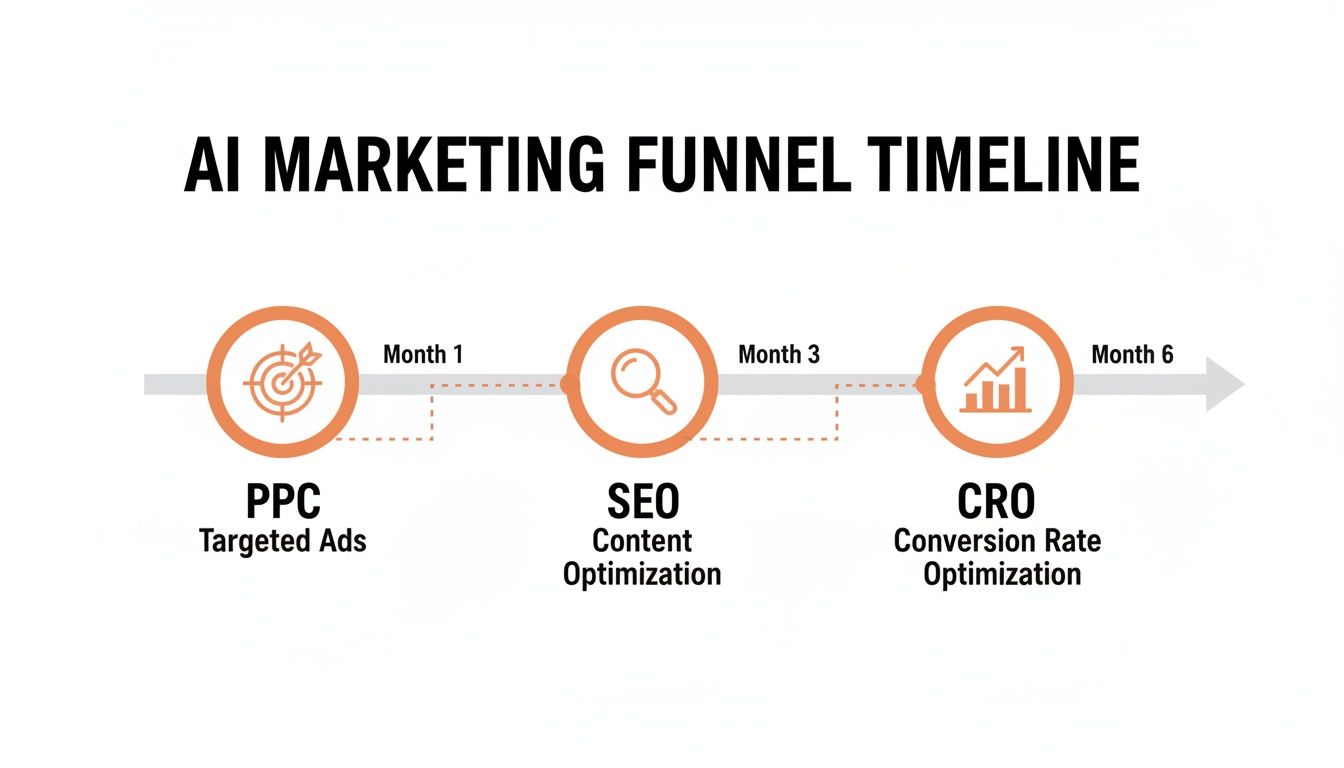
As you can see, a well-planned implementation delivers compounding returns. You can start with quick wins in PPC and build toward bigger, long-term gains in SEO and CRO.
Weeks 5-8: Pilot Program Launch
Launch a small-scale pilot laser-focused on your KPI. By isolating a single variable, you can clearly measure the AI's impact.
For example, if your goal is to slash PPC costs, run an AI bidding tool on a single campaign that accounts for 20% of your ad spend. This contained experiment lets you prove ROI without risking your entire budget.
The key is to run the pilot long enough to gather statistically significant data (usually 3-4 weeks). This controlled test will give you the irrefutable evidence you need.
Weeks 9-12: Analysis and Scaling
With pilot data in hand, analyze performance. Compare the AI-driven campaign against your control group. Did you hit your KPI? Was the reduction in CAC or lift in conversions significant enough to justify the cost?
If yes, you have a powerful business case. The final step is to map out a plan for scaling the solution, such as rolling the AI tool out across all PPC campaigns or designing a new pilot to tackle your next challenge, like conversion rate optimization. This iterative, sprint-based approach turns a daunting AI project into a series of manageable, value-driven wins.
Measuring Success and Proving AI's ROI
To justify an AI investment, you must speak the language of the C-suite: the bottom line. The conversation must shift from "our new AI tool boosted engagement" to "our AI strategy cut our Customer Acquisition Cost by 22%, contributing $75,000 to our profit margin last quarter."
Tying AI to Bottom-Line Metrics
Vanity metrics like clicks and impressions don't pay the bills. Leadership needs to see a direct line between AI initiatives and financial growth.
Focus on the KPIs that reflect business health:
- Customer Acquisition Cost (CAC) Reduction: Is AI bidding making it cheaper to acquire new customers? This is a direct impact on profitability.
- Customer Lifetime Value (LTV) Improvement: Is AI personalization creating more loyal, repeat customers? A rising LTV signals sustainable growth.
- Marketing-Attributed Revenue: Use attribution models to clearly show how much revenue your AI-optimized campaigns are generating.
- Sales Cycle Velocity: Is AI lead scoring helping the sales team close deals faster? Calculate the reduction in your average sales cycle length.
The goal is to build a direct, data-backed narrative. You want to be able to say, "When we launched the predictive audience model, our ROAS on key campaigns jumped by 35%, adding $50,000 in revenue last quarter alone."
Building a Business Case for Further Investment
Once a successful pilot yields solid numbers, you have everything needed to build a compelling case for expansion. The formula is simple: present the problem, the AI solution, and the tangible financial return. For this to work, you absolutely need robust AI automation ROI tracking.
Here’s a real-world example:
- The Challenge: "Our sales team was overwhelmed with leads, but only 15% converted from MQL to SQL. We were wasting time and money on low-quality prospects."
- The AI Solution: "We implemented a predictive lead scoring model to automatically rank every incoming lead based on their propensity to close."
- The Result & ROI: "That change pushed our MQL-to-SQL conversion rate to 40%. The system costs $2,000/month but has already added $60,000 in new pipeline value. That’s a 30x ROI we can reinvest into growth."
This is precisely why we structure our work at Ezca in 90-day sprints—to prove ROI quickly and unambiguously. We focus on these core business metrics from day one. See how we applied this thinking to improve a client's lead quality and sales pipeline with SaaS predictive lead scoring.
Common Questions About AI Marketing Solutions
Even with clear upsides, it's natural for business leaders to have tough questions about implementing AI-powered marketing solutions. Let's tackle the most common concerns.
Will AI Replace My Marketing Team?
No. The most successful model is a human-AI partnership. AI handles the large-scale data analysis and repetitive tasks that are beyond human capacity. This frees up your marketers to focus on strategy, creative storytelling, and building customer relationships.
"Your job will not be taken by AI. It will be taken by a person who knows how to use AI."
When your team can offload manual work, their roles elevate from task execution to strategy and innovation. At Ezca, we’ve seen this boost not just efficiency but also job satisfaction.
What Is the Real Cost and ROI of AI Marketing?
Costs vary, but focusing only on the price tag misses the point. A properly implemented AI strategy is a profit driver, not a cost center. The conversation must be about ROI.
For instance, an AI bidding tool costs $1,000/month. If it lowers your CPA by 30% on a $20,000 monthly ad spend, that’s a $6,000 savings. Your net gain is $5,000. That’s the math that gets a CFO’s attention.
At Ezca, our enterprise AI stack is included in our service. We use 90-day sprints to prove positive ROI quickly, ensuring your investment pays for itself with tangible growth.
Can We Use AI if Our Company Data Is Messy?
Yes. Waiting for "perfect" data is a common mistake that leads to inaction. Almost every company starts with imperfect, scattered data. That's the normal starting point, not a barrier.
A good AI initiative starts with a data audit to identify, clean, and organize your most critical data streams. Launch a pilot project using your most reliable data source first, like your Google Ads account or CRM data. This allows you to score an early win and build the momentum needed to tackle other data sources over time.
How Do We Choose the Right AI Marketing Tools?
The market is flooded with tools. The secret is to work backward from your biggest business problem.
- Identify Your Bottleneck: Is it a high cost per lead? Low-quality traffic? A slow content process?
- Find a Problem-Specific Solution: Look for tools built specifically to solve that problem. A tool brilliant for PPC bid management will likely be mediocre for content analysis.
- Vet with Real-World Proof: Demand case studies, a live demo with your data, and proof that the tool delivered results for businesses like yours.
Working with a specialized partner like Ezca is a shortcut. We've already vetted, tested, and integrated a best-in-class AI tech stack. Our clients get the benefits without the risk and headache of the evaluation process.
Ready to see how a dedicated team combining human expertise with AI can drive measurable growth for your business? At Ezca, our 90-day sprints are designed to deliver clear ROI and build momentum fast. Let's talk about what we can achieve together. Schedule your free consultation today.