
What is Paid Search Advertising: 2026 Pro Guide
What is paid search advertising - Deep dive into what is paid search advertising with our 2026 expert guide. Learn about auctions, bidding, KPIs, and ROI for Sa
Lead flow is inconsistent. Some months search brings in qualified demand. Other months the pipeline depends on referrals, outbound, or a single campaign that happened to work.
That is usually the moment paid search enters the conversation.
For a marketing leader, the appeal is simple. Paid search lets you show up when a buyer is already looking for a solution, not days later after they scroll past a social post or months after they find a blog article. It is intent capture with measurable economics. Done well, it can become one of the few channels you can scale with real visibility into cost, lead quality, and revenue contribution.
The problem is that most explanations stop at “you bid on keywords and pay for clicks.” That definition is technically true and strategically incomplete. In 2026, what is paid search advertising matters less than how you make it profitable in a more expensive, more privacy-constrained, more competitive environment.
What Is Paid Search Advertising Really
Paid search advertising is the practice of paying to appear in search engine results when someone searches for a keyword related to your product, service, or problem space.
That sounds basic. Its business value is not the ad placement itself. It is the ability to buy access to high-intent demand with measurable feedback loops.
If you sell B2B software, that could mean showing up when a prospect searches for “CRM software for manufacturing.” If you run an e-commerce brand, it could mean capturing a buyer searching for a specific product category with clear purchase intent. In both cases, you are not interrupting someone. You are meeting them at the decision point.
That is why paid search remains such a large part of the digital mix. Paid search advertising represents over 40% of total digital ad spend globally, businesses earn an average of $2 for every $1 invested in Google Ads, and sponsored results for commercial keywords account for 65% of all clicks according to Skai’s paid search in 2025 analysis.
It is a growth system, not just an ad channel
A weak paid search program looks like a set of campaigns.
A strong one looks like an operating system for demand capture:
- Keywords map to intent: You separate research searches from bottom-funnel searches.
- Ads qualify traffic: The copy attracts the right click and filters out the wrong one.
- Landing pages convert: The page continues the promise made in the ad.
- Measurement closes the loop: You learn what produces profitable customers.
That is why many companies move paid search from a media line item to a strategic acquisition channel. It gives leadership something rare in marketing: a direct line between market demand and budget deployment.
Paid search works best when the business already knows what a qualified lead or profitable order looks like. Without that definition, you can buy clicks fast and learn very little.
For teams evaluating whether to build internally or outsource, the practical question is not “should we run Google Ads?” It is whether you have the structure, testing discipline, and reporting needed to turn spend into controlled growth. That is the work behind paid search management, not just campaign launch.
The Ad Auction How Google Ranks Your Ads
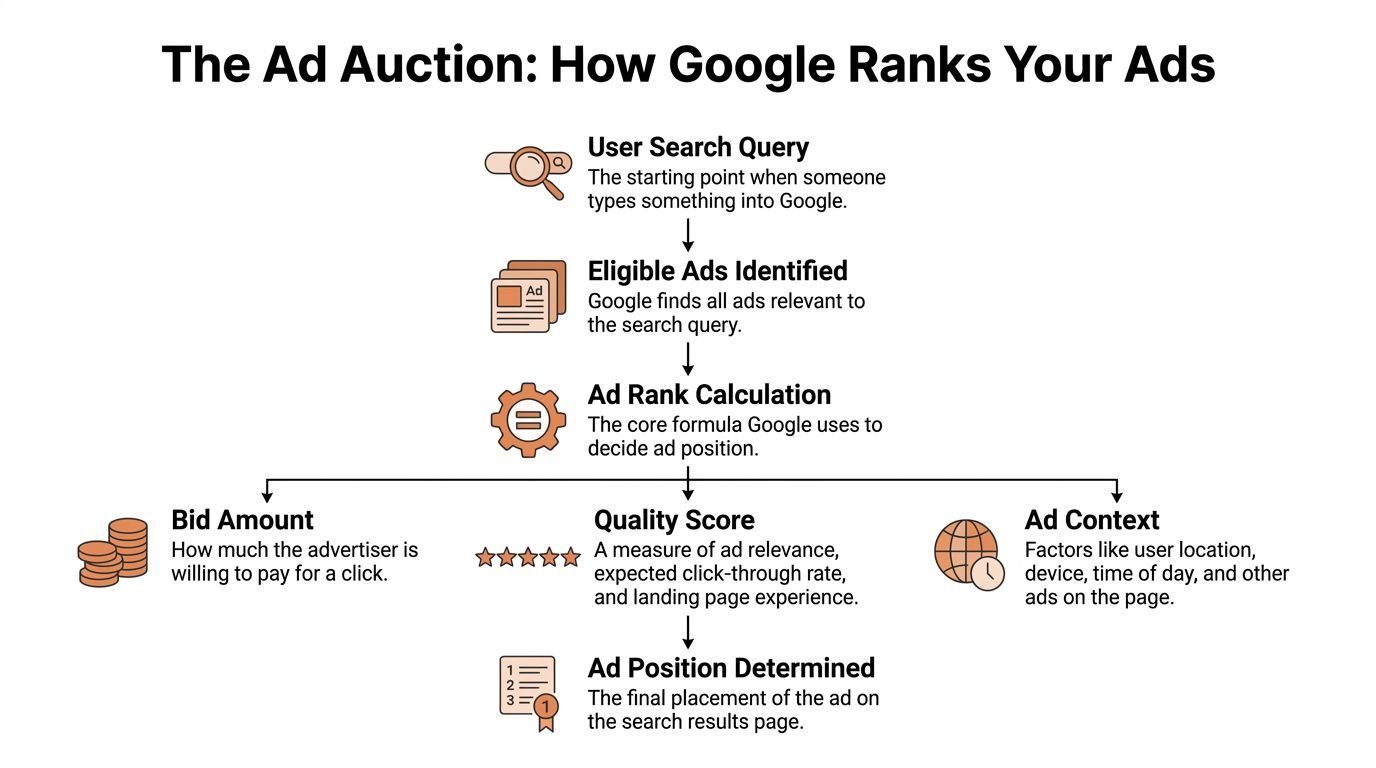
Google does not run a simple highest-bidder auction. It runs a relevance auction.
Two advertisers can target the same query and bid similar amounts, yet one wins a better position at a lower effective cost because the system predicts that ad will create a better user experience. That is the part many business owners miss when they assume paid search is only about who spends more.
Ad Rank decides placement
At the center of the auction is Ad Rank.
The verified formula is:
Ad Position = Max Bid × Quality Score × Expected Impact of Extensions
That means bid still matters, but it is only one input. Relevance and expected performance shape whether your ad appears and where it lands on the page.
Here is the practical takeaway. If your team keeps raising bids to fix weak positions without fixing ad quality or landing page alignment, you usually buy a temporary lift in visibility and a lasting increase in acquisition cost.
Quality Score changes your economics
Quality Score is one of the strongest levers in search because it affects both rank and cost efficiency.
According to DesignRush’s paid search metrics analysis, a company with a 7/10 Quality Score pays significantly more per click than a competitor with a 9/10 score for the same position. The same source notes that average CPC increased 12.88% year-over-year in 2025, which makes Quality Score work even more important when you are trying to protect CAC.
In practice, Quality Score comes down to three operating questions.
Expected click-through rate
Google wants evidence that users are likely to click your ad when it appears.
That usually improves when the ad reflects the actual query, the offer is clear, and the language is specific. “All-in-one CRM platform” is broad. “CRM software for field sales teams” is more likely to earn a qualified click for the right search.
Ad relevance
Campaign structure matters here.
If one ad group tries to cover unrelated themes, the copy becomes generic. Generic ads rarely match search intent closely enough to perform well. Better accounts separate keyword themes tightly enough that headlines can mirror what the user is searching for.
Landing page experience
A lot of teams treat the click as the win. It is not.
If the page is slow, confusing, off-message, or built like a general homepage instead of a decision page, Quality Score suffers. Google sees that friction. So do buyers.
When I audit underperforming accounts, the most common problem is not low bids. It is weak message alignment between keyword, ad, and landing page.
Extensions still matter
Extensions add context and improve how much real estate your ad occupies. Sitelinks, callouts, structured snippets, and other assets can improve the ad’s usefulness to the searcher.
They also contribute to that expected impact element in Ad Rank. So if your account still treats extensions as optional setup tasks, you are leaving ranking efficiency on the table.
What smart operators review every week
A good auction review is not a single dashboard check. It is a pattern review across queries, ads, and pages.
Useful diagnostics often include:
- Search term quality: Are actual queries matching the buyer intent you intended to buy?
- CTR by theme: Which keyword clusters are earning attention and which are ignored?
- Landing page fit: Are high-impression ad groups sending traffic to pages built for conversion?
- Competitive pressure: Are rising costs coming from the market, or from your own relevance issues?
For teams that want a faster benchmark on account structure and reporting, tools like Google Ads reports can help surface patterns before deeper manual analysis starts.
Choosing Your Targets Keywords and Match Types
Keywords are how you translate business strategy into search demand.
The mistake is thinking keyword research is just a volume exercise. In real account work, it is an intent exercise. The goal is not to collect more phrases. The goal is to identify the searches that indicate someone is close enough to action that a paid click makes economic sense.
A high-value search account usually contains a mix of brand, competitor, category, and problem-aware terms. But not every account should weight those buckets the same way. A venture-backed SaaS company chasing demos may lean harder into commercial non-brand terms. An established e-commerce business may prioritize high-intent product terms and shopping behavior.
Match type determines how tightly you control intent
The same root keyword can behave very differently depending on match type. That is why structure matters more than most beginner guides admit.
Broad match is not reckless by default
Broad match gets blamed for wasted spend because many teams use it without proper guardrails.
Broad can be useful when:
- you have reliable conversion tracking
- you review search terms often
- you maintain an active negative keyword list
- you want to uncover adjacent commercial language your internal team missed
Broad is a poor fit when the account has little conversion data, weak budget control, or vague offers. In those conditions, it can drift quickly into low-quality traffic.
Phrase and exact are control tools
Phrase match gives you a practical middle ground.
It usually works well for advertisers who know their category language and want reach without opening the door too far. Exact match remains the cleanest option when a small set of queries drives most of the business value and every irrelevant click hurts.
What works in B2B often differs from what works in e-commerce. B2B sales cycles are longer, lead values vary more, and search intent can be noisier. That usually argues for tighter control earlier. E-commerce can sometimes support broader coverage if product feed quality, site merchandising, and remarketing are strong.
Negative keywords protect budget
Negative keywords are not a cleanup task. They are a core part of campaign design.
A CRM company might want to exclude terms related to free templates, jobs, training, definitions, or unrelated software categories. An agency account often accumulates negatives around low-intent educational searches when the client only wants demo requests or consultations.
Useful negative keyword categories often include:
- Informational intent: Terms used by people researching, not buying.
- Irrelevant audiences: Student, job seeker, DIY, or support-related queries.
- Mismatched price intent: Searches that signal expectations your offer does not meet.
- Product exclusions: Features, models, or use cases you do not support.
If your search terms report gets reviewed only when performance drops, you are usually paying for noise longer than you think.
The best keyword strategy is rarely the widest one. It is the one that keeps intent, economics, and account control aligned.
Managing Your Investment Platforms Bidding and Budgets
Platform choice matters, but not as much as leaders often think.
For most businesses, Google Ads is the core paid search platform because that is where demand volume and buying intent are concentrated. Microsoft Ads can still be valuable, especially for B2B, older desktop-heavy audiences, and accounts looking for efficient incremental reach. The stronger move is usually to build the system on Google first, then expand when measurement and creative discipline are solid.
Rising costs change how you manage budgets
The cost environment is less forgiving than it was a few years ago.
According to WordStream’s 2025 Google Ads benchmarks, CPC increased for 87% of industries in 2025, and the average cost per lead rose to $70.11. In that environment, weak bidding logic gets expensive quickly.
A team can no longer afford to spread budget evenly across campaigns just because they all sound strategically important. Budget has to follow conversion quality and marginal efficiency.
Manual bidding versus automated bidding
There is no universal “best” bidding strategy. The right choice depends on data quality, conversion volume, and business objective.
Manual bidding
Manual bidding gives advertisers direct control over keyword-level bids.
It works best when:
- conversion data is limited
- the account is new
- margin varies sharply by keyword theme
- you want a tighter read on auction behavior before giving the platform more automation authority
The downside is time. Manual control is useful, but it can become slow and reactive in larger accounts.
Automated bidding
Automated bidding strategies like Target CPA, Target ROAS, and Maximize Conversions can work well when the account has enough reliable conversion data and the goals are clearly defined.
These strategies are useful because the platform can adjust bids in real time based on signals human operators cannot process fast enough, such as device, location, search context, and historical conversion patterns.
They fail when inputs are bad. If the account tracks low-quality form fills as conversions, the bidding system will optimize toward low-quality form fills. Automation amplifies your setup, whether that setup is strong or weak.
Budget allocation should reflect business value
The simplest budgeting mistake is equal distribution.
A better framework is to rank campaigns by:
- Intent quality
- Conversion rate
- Lead or order quality
- Down-funnel revenue contribution
That often means brand terms, high-intent exact campaigns, and strongest-performing non-brand themes get protected budget first. Experimental campaigns get controlled spend and clear evaluation windows. Weak campaigns do not stay alive because they “might work later.”
What disciplined budget management looks like
In practice, strong account management usually includes:
- Daily pacing checks: Prevent overspend and catch traffic spikes early.
- Bid strategy reviews: Confirm the chosen strategy still matches business goals.
- Device and geo adjustments: Shift spend toward segments producing stronger outcomes.
- Query pruning: Remove waste before it compounds.
- Creative refresh cycles: Support bidding efficiency with better CTR and relevance.
This is one area where agency operating model matters. Some teams still manage paid search like a monthly reporting exercise. That is too slow for competitive categories. Ezca, for example, runs search inside focused sprint cycles where channel budgets can be adjusted weekly based on return signals rather than fixed quarterly assumptions.
Budget control is not about spending less. It is about refusing to fund traffic that does not create business value.
From Click to Conversion Ads and Landing Pages
Many paid search campaigns fail after doing the hard part right.
They find relevant queries, win the click, and then send traffic to pages that do not convert. That is why the actual unit of performance is not the ad alone. It is the full path from keyword to ad to landing page.

Good ads pre-qualify the click
A strong search ad does two things at once. It attracts the right prospect and discourages the wrong one.
That means your headlines and descriptions should not chase clicks with vague promises. They should make the offer clear enough that the searcher understands what comes next.
For lead generation, that might mean naming the audience, the problem, and the next action. For e-commerce, it usually means clear product relevance, offer clarity, and trust signals.
Useful ad elements often include:
- Specific headlines: Reflect the keyword theme closely.
- Clear value proposition: State what makes the offer worth attention.
- Direct CTA: Demo, quote, trial, consult, buy.
- Extensions: Add depth without forcing the user to guess.
Message match is where conversion rate starts
If someone searches for enterprise payroll software and clicks an ad for enterprise payroll software, the landing page should continue that conversation.
Too many advertisers send traffic to generic homepages or broad category pages. That creates friction immediately. The user has to re-orient, hunt for relevance, and decide whether they landed in the right place. Each extra step lowers the chance of conversion.
A good landing page continues the same promise made in the ad:
- same category language
- same offer framing
- same intended audience
- same next step
For teams actively improving this layer, dedicated conversion rate optimization services often matter just as much as media buying.
Landing pages should remove doubt, not add options
High-converting pages are usually simpler than internal stakeholders want them to be.
They tend to have:
- one primary CTA
- a visible headline tied to the search intent
- proof points such as testimonials, client logos, or product credibility signals
- concise supporting copy
- short forms when lead quality allows
- mobile-friendly layout and fast load behavior
What hurts performance is familiar: too many links, broad corporate messaging, unclear forms, buried CTA buttons, and long blocks of copy that never answer the user’s real question.
The ad earns attention. The landing page earns trust.
A useful way to evaluate pages is to ask one question: can a first-time visitor understand the offer and next step within a few seconds?
This walkthrough gives a simple visual explanation of how ads and landing pages work together.
What usually works better than the homepage
For most commercial search campaigns, dedicated pages outperform generic destination pages because they narrow the decision.
That does not mean every keyword needs its own page. It means every high-value intent cluster should have a page built for that stage of buyer intent. A pricing-intent query may need a different page than a solution-comparison query. A branded demo term may need a different path than a first-touch category term.
The closer the destination fits the intent, the easier it is to turn paid traffic into actual revenue.
Measuring What Matters KPIs and Attribution in 2026
Most paid search reporting still overstates certainty.
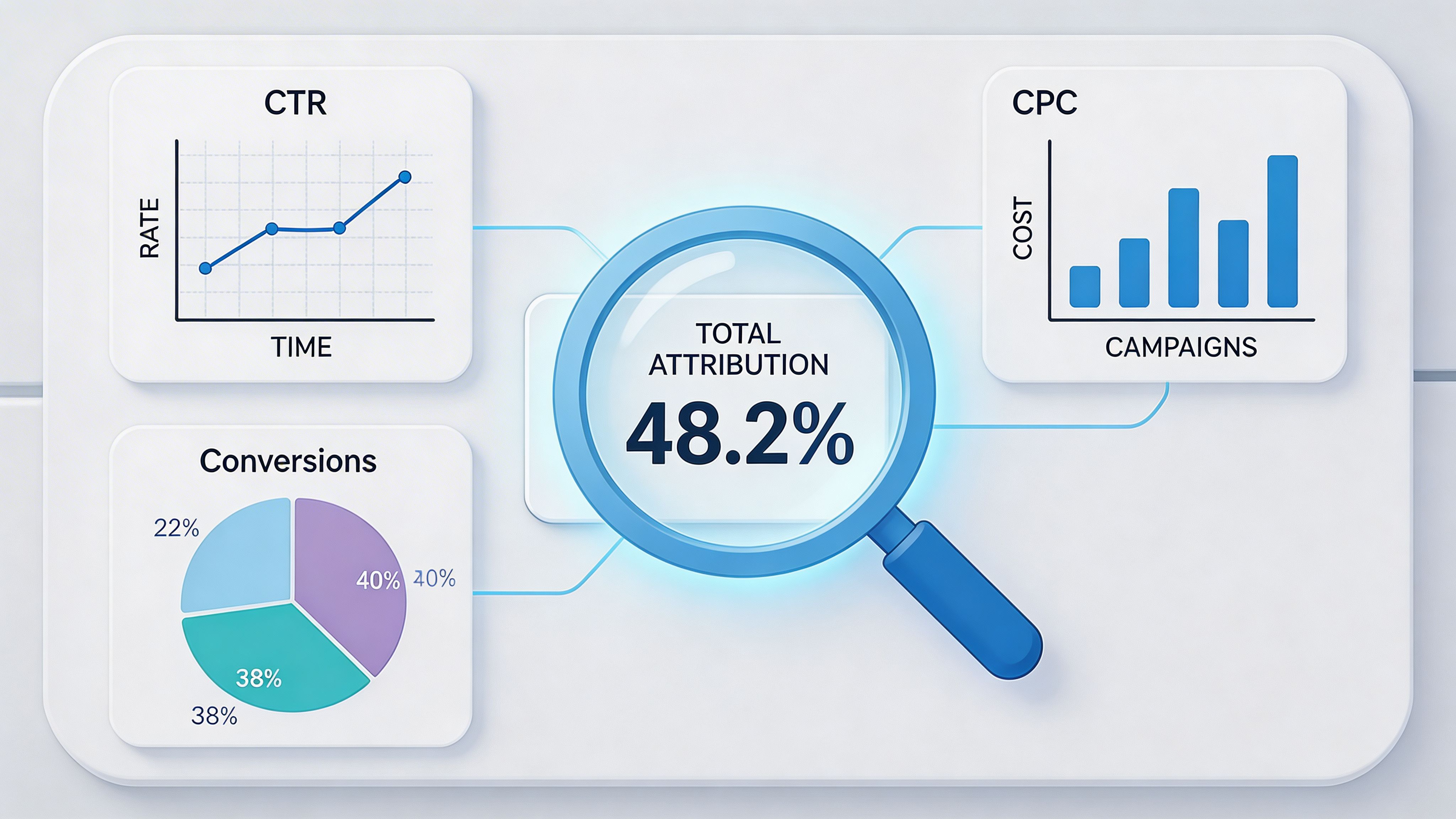
Teams look at clicks, CPC, CTR, CPA, and conversion counts, then present a neat performance story. In reality, measurement in 2026 is less tidy. Privacy changes, modeled conversions, offline sales influence, and multi-channel journeys all complicate the picture.
That does not make measurement impossible. It means leaders need better questions.
Start with operational KPIs, not vanity metrics
You still need baseline search KPIs. They are useful when interpreted in context.
CPC
Cost per click tells you what traffic costs. It does not tell you whether that traffic is valuable.
A high CPC can be acceptable if lead quality and downstream close rate justify it. A cheap CPC can be destructive if the traffic never converts or produces poor-fit leads.
CTR
Click-through rate is a relevance signal.
Strong CTR often indicates alignment between keyword, ad, and audience. But CTR alone can also flatter ads that are broad, curiosity-driven, or overpromising. The click only matters if it leads to quality action.
CPA or CPL
Cost per acquisition or cost per lead is often where finance teams focus.
That is reasonable, but it can become misleading when all leads are treated equally. If one campaign produces low-cost form fills that sales rejects, it is not outperforming a campaign with a higher CPL and much stronger pipeline contribution.
For teams that want a useful refresher on the mechanics behind metric design and reporting discipline, this breakdown of how KPIs are measured is a helpful companion read.
Last-click attribution is too simple
A common reporting mistake is giving paid search full credit because the final session came from a branded ad or remarketing search click.
That often misses the journey.
A buyer may discover your company through organic content, return later through direct traffic, and finally convert after clicking a paid brand ad. If the report uses last-click attribution only, paid search gets all the glory. SEO, content, and brand familiarity vanish from the story.
Channel budget decisions get distorted fast. Paid search can look more efficient than it really is, while organic investment looks weaker than it is.
That is especially important for brands running paid search and SEO at the same time. The overlap is real, and many reporting setups still fail to handle it well.
Privacy-first measurement has volume requirements
One of the least discussed realities in modern paid search is that advanced measurement is not equally available to every campaign.
According to Search Engine Land’s analysis of advanced PPC analytics, Google’s privacy-first conversion modeling requires a minimum daily ad click threshold of 700 clicks over a seven-day period per country and domain grouping to function effectively. Campaigns below that threshold cannot access modeled conversions in the same way.
That creates a structural difference between high-volume accounts and lower-volume B2B demand gen programs.
What lower-volume advertisers should do
If your campaigns do not have enough click density, measurement discipline matters even more.
Practical responses include:
- Consolidate where necessary: Over-segmentation can starve campaigns of usable data.
- Track meaningful secondary actions: Demo starts, qualified page visits, pricing interactions, or other strong proxy events can help preserve signal.
- Connect CRM outcomes: Search metrics improve when lead quality and sales outcomes feed back into analysis.
- Review by intent cluster: Individual keyword data can be noisy. Intent-group analysis is often more reliable.
One useful example of performance framing in practice is this SaaS company paid search results page, which reflects the kind of business-outcome reporting marketing leaders should ask for, not just top-of-funnel ad metrics.
A paid search report should help you answer where profitable demand comes from, not just where clicks came from.
Winning with Paid Search A Strategic Framework
The hard part of paid search in 2026 is not access. It is discipline.
Anyone can launch campaigns. The teams that win are the ones that treat paid search as a system of compounding decisions. Keyword selection, budget allocation, message match, measurement design, and landing page improvement all influence whether the account scales or stalls.
That matters more in competitive categories because economics have tightened. In SaaS and B2B markets, keyword costs have escalated since 2024, with CPC increases of 20-40% year-over-year according to Skai’s overview of how paid search advertising works. When bid density rises like that, average execution is not enough.
What breaks accounts
Most underperforming programs are not broken by a single catastrophic choice. They decline through small, repeated mistakes.
Common failure patterns include:
- Set-and-forget management: Campaigns run for weeks without search term pruning, ad testing, or landing page review.
- Too much segmentation: Accounts become hard to optimize and too thin for reliable learning.
- Weak conversion definitions: The platform optimizes toward actions that do not reflect revenue quality.
- Budget spread too thin: Every campaign gets some spend, but none gets enough to prove value.
- No connection to sales outcomes: Marketing reports lead volume while sales rejects most of the leads.
What stronger teams do instead
The best paid search programs tend to share a few habits.
They narrow before they expand
They start with high-intent queries, clean account structure, and clear conversion actions. Expansion comes after the economics are visible.
They test continuously
Not randomly. Methodically.
That includes ad copy, landing page layouts, form friction, CTA language, offer framing, and audience layering. Search performance improves when testing is tied to a specific hypothesis, not when teams change five variables at once.
They use paid search with other channels, not against them
Search works better when the rest of the funnel is doing its job.
SEO can educate the market. Email can reactivate dormant demand. CRO can convert more of the traffic you already bought. Paid search often performs best as part of a coordinated acquisition system rather than a standalone fix for weak pipeline.
A practical decision framework for leaders
If you are evaluating what is paid search advertising for your business, use these questions:
- Is there enough commercial search intent in our category?
- Do we know what a qualified conversion is?
- Can our landing pages support the traffic we plan to buy?
- Do we have the measurement setup to judge incrementality, not just clicks?
- Can the team manage weekly optimization, not just monthly reporting?
If the answer to several of those is no, paid search can still work. It just should not be treated as a plug-and-play growth lever.
Where agency support helps
The strongest case for outside management is not “someone else can push the buttons.”
It is that a good performance team can connect search intent, auction efficiency, creative testing, CRO, and attribution into one operating rhythm. That is particularly useful for SaaS, e-commerce, and B2B brands running lean internal teams while trying to scale acquisition without losing margin discipline.
Paid search is still one of the clearest ways to capture active demand. But it only stays profitable when strategy and execution move together. The teams that keep learning from query data, tighten relevance, improve pages, and report against business outcomes usually keep finding room to grow even when the market gets more expensive.
If your team needs a more rigorous paid search program, Ezca Agency helps SaaS, e-commerce, and B2B brands run search with tighter measurement, stronger landing page alignment, and sprint-based optimization built around business outcomes rather than vanity metrics.