
Sales Process in B2B: A Data-Driven 2026 Guide
Master the modern sales process in B2B. Our guide covers stages, metrics, AI tools, and how to iterate your strategy in 90-day sprints for measurable growth.
The biggest problem with the sales process in B2B isn't its absence of stages. It's that the existing process is built for an older buyer.
The evidence is hard to ignore. The average B2B sales cycle has increased by 22% over the past five years, and 28% of sales pros say prospects back out because the process takes too long, according to LeadForensics. That’s not a small operational issue. That’s revenue leaking out of the funnel because the system no longer matches how buyers buy.
A static playbook breaks fast in a market where buyers do more research on their own, move in and out of channels, and involve more people before a seller gets real access. The old response was to add more meetings, more sequences, and more CRM stages. That usually makes things worse.
What works is treating the process as a living system. Every stage needs a clear entry rule, a clear exit rule, and a clear feedback loop into marketing, sales, and customer success. If you need a practical outside view on how teams redesign the flow itself, this guide on how to optimize your B2B sales process is worth reviewing alongside your own funnel data.
The strongest teams I’ve seen don’t treat sales as a handoff chain. They treat it like a coordinated revenue engine. Marketing creates signal, sales validates signal, and both teams adjust based on what moved deals forward in the last quarter, not what looked good in a slide deck six months ago.
That’s the operating model behind focused 90-day sprint planning. Instead of rewriting the whole machine every year, you fix the constraint that hurts revenue now. Sometimes that’s qualification. Sometimes it’s proposal quality. Sometimes it’s a bad handoff that sales has normalized.
Why Your Current B2B Sales Process Is Leaking Revenue
Most B2B teams don’t have one fatal flaw. They have a dozen small ones that compound.
A lead gets scored too early. An SDR books a call without enough context. An AE runs discovery without mapping stakeholders. A proposal goes out before the buyer has internal alignment. Then leadership blames close rates.
The process looks active but isn't efficient
The common pattern is motion without progression. Reps are busy. Dashboards are full. Pipeline meetings happen every week. But deals stall because stage movement is based on seller optimism, not buyer action.
That’s where most pipelines deteriorate.
Practical rule: If a deal can advance stages without the buyer doing anything concrete, your process is measuring hope, not progress.
A healthy B2B process needs to answer a few blunt questions:
- What qualifies a lead for human follow-up beyond a form fill or content download?
- What evidence shows real buying intent rather than curiosity?
- Which stage exits depend on buyer behavior instead of rep opinion?
- How quickly does feedback return to marketing so channel quality improves?
If you can't answer those clearly, the process is leaking in places your CRM won't surface on its own.
Silos create drag that buyers feel immediately
Marketing often optimizes for lead volume. Sales optimizes for meetings. Leadership wants forecast confidence. None of those goals are wrong. They just conflict when the process isn't designed around the same definition of quality.
The buyer feels that disconnect fast. Messaging changes between ad, landing page, SDR outreach, and AE pitch. Context gets lost between systems. Follow-up slows down because nobody owns the next move cleanly.
The fix isn't another static SOP document. It’s a process that gets reviewed on a tight cadence and updated from actual funnel behavior.
High-performing teams do this better because they formalize and refine the system instead of assuming reps will improvise around broken steps. That discipline is what turns a funnel from fragile to scalable.
The 7 Stages of a High-Performing B2B Sales Process
A strong B2B sales process works like an assembly line. Not because it should feel mechanical to the buyer, but because each stage needs a specific job, a quality check, and a clean handoff.
When teams skip that discipline, defects move downstream. Poor-fit leads reach discovery. Weak discovery reaches proposal. Bad proposals enter negotiation. Then everyone acts surprised when close rates disappoint.
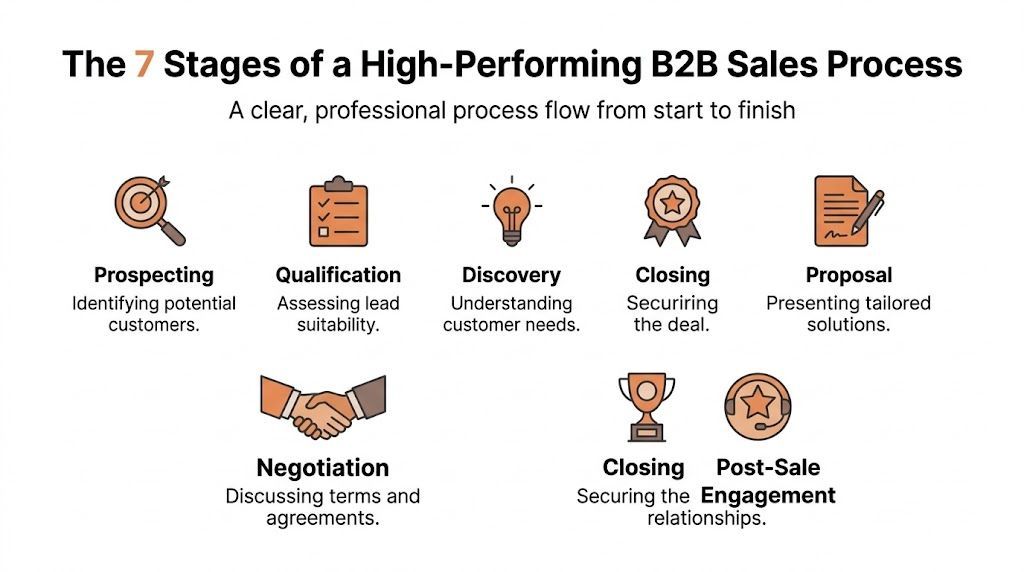
Stage 1 Prospecting
This stage is about finding accounts that are worth attention, not just accounts that exist.
The strongest prospecting motions combine firmographic fit, technographic context, and intent signals. That matters because integrating intent and technographic data can shorten sales cycles by up to 30% and increase outreach conversion by 2 to 3x when timing and relevance improve, according to DemandScience.
A practical example is simple. If an account is showing active research behavior and already uses a tool your product replaces or complements, your outreach can be specific. Generic messaging loses to that every time.
Output: A prioritized account list with clear fit and timing rationale.
Stage 2 Qualification
Qualification exists to protect the rest of the funnel.
A lot of teams still treat it like a script. Good teams treat it like controlled filtering. The rep is testing whether the account has a real problem, a credible path to purchase, and enough urgency to justify sales time now.
Qualification frameworks help, but they only matter if they lead to disqualification when the signal is weak.
Verifiable customer action: The buyer confirms the problem is active and agrees there’s a reason to continue the conversation now.
Stage 3 Discovery
Discovery is where average reps collect facts and strong reps build a deal.
This is the stage where you uncover pain, process, stakeholders, risks, decision criteria, and what “success” means inside the buyer’s business. It should feel diagnostic, not performative.
Good discovery also checks whether the person in front of you can move internal consensus, not just whether they like your product.
Discovery should leave the rep with fewer assumptions, not more confidence.
Output: A documented problem map, stakeholder map, and agreed next step.
Stage 4 Proposal
Proposal is not where you introduce your value. It’s where you organize value the buyer already recognizes.
Weak proposals dump features. Strong ones reflect the buyer’s language, tie the solution to the pains uncovered in discovery, and reduce internal friction for the prospect who has to sell your recommendation internally.
A proposal should also make implementation and expected ownership clear. Ambiguity slows internal approval.
Verifiable customer action: The buyer reviews the proposal with the relevant internal stakeholders, not just alone.
Stage 5 Negotiation
Negotiation starts too late in many funnels because teams wait until procurement pushes back.
In practice, negotiation begins in discovery when pricing sensitivity, legal constraints, integration concerns, and switching friction first appear. By the time formal negotiation starts, the rep should know what trade-offs matter and which concessions protect the deal.
The objective here is not to “win” the negotiation. It’s to preserve deal quality while removing blockers.
Output: Agreed commercial terms and no unresolved decision blockers.
Stage 6 Closing
Closing is operational. The emotional part of the sale should be done already.
At this point, the job is to reduce friction. Contract flow, signatory access, internal approvals, procurement timing, and implementation readiness all matter more than another persuasive talk track.
This is also where weak process discipline gets exposed. Deals that seemed close suddenly stall because no one validated who signs, who approves security, or who owns rollout.
Verifiable customer action: Contract approval steps are active and documented.
Stage 7 Onboarding and post-sale engagement
The sale isn't complete when the contract is signed. It’s complete when the customer starts getting value.
That makes onboarding part of the sales process in B2B, not just a customer success concern. If the handoff is poor, expansion suffers, referrals slow, and churn risk rises long before anyone labels it a retention issue.
A clean post-sale stage should include:
- Expectation transfer: The delivery team knows what was sold and why it matters.
- Success criteria: The customer agrees on what early wins look like.
- Commercial continuity: Sales notes future expansion triggers without forcing them early.
When teams define these seven stages tightly and use Verifiable Customer Actions as stage gates, pipeline reviews become far more honest. That alone improves decision-making more than another dashboard widget ever will.
Aligning Sales and Marketing for a Seamless Handoff
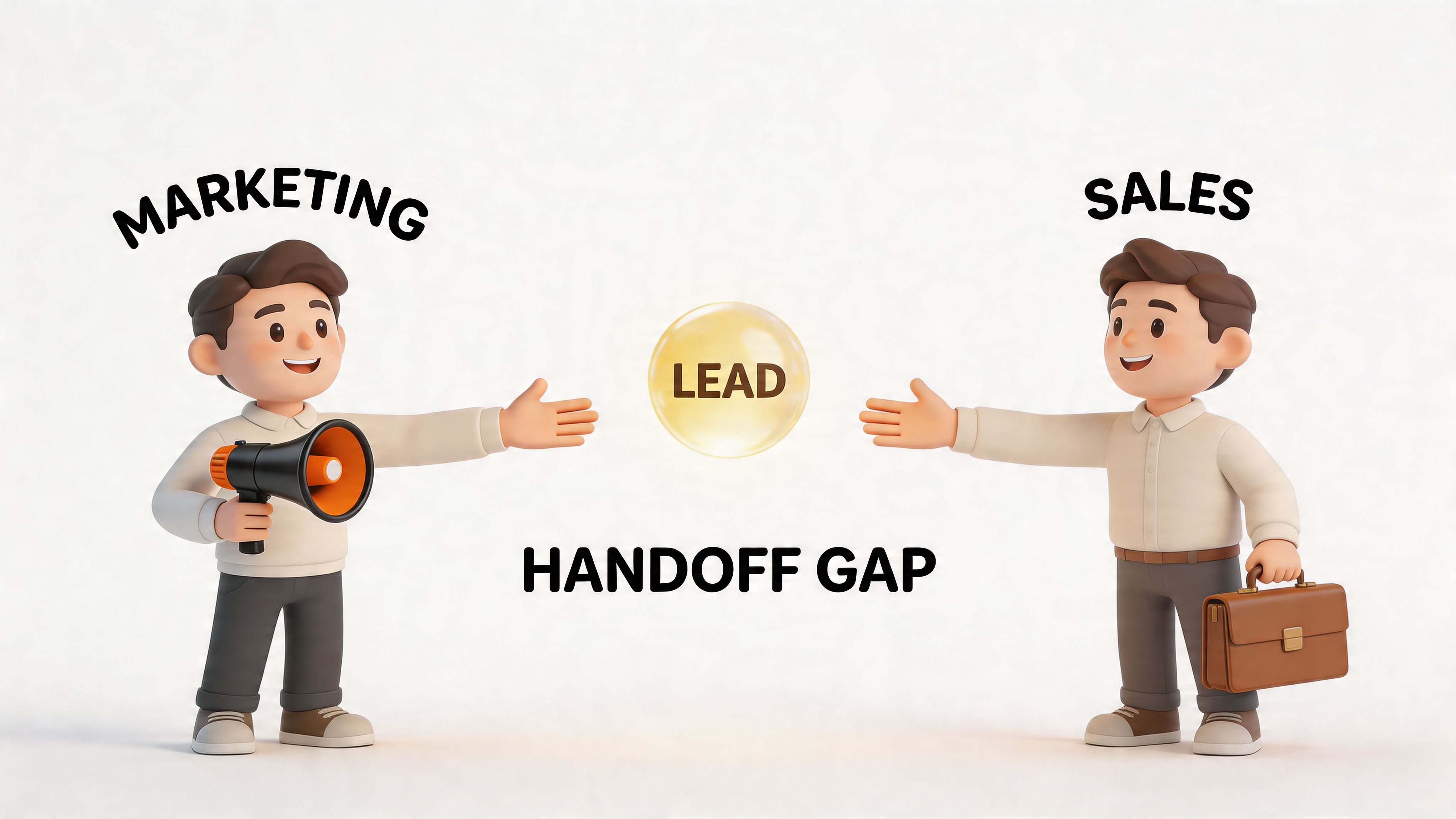
The most expensive leak in most funnels sits between MQL and SQL.
That handoff decides whether pipeline quality improves or decays. If marketing sends leads that sales doesn’t trust, sales builds workarounds. If sales rejects leads without useful feedback, marketing keeps funding channels that create activity without revenue.
That’s why alignment isn't a culture project. It’s an operating requirement.
Define the handoff in writing
A service level agreement sounds boring until you’ve watched teams argue over lead quality for two quarters.
A useful SLA answers four things:
- What counts as an MQL
- What sales must do with that lead
- What makes it an SQL
- What happens when sales rejects it
The mistake most companies make is defining MQLs by engagement alone. A webinar attendee is not automatically sales-ready. A demo request without fit data is not automatically urgent. Marketing needs to combine source, behavior, ICP fit, and context before triggering a handoff.
Sales then needs a response window, disposition rules, and mandatory rejection reasons inside the CRM. If that’s not enforced, the handoff becomes opinion-driven.
Build automation around shared definitions
The CRM should be the referee.
When a lead reaches your agreed threshold, create the task automatically, assign ownership automatically, and log response time automatically. Don’t rely on Slack pings and memory.
Closed-loop reporting matters just as much. Marketing leaders need to see which campaigns produce pipeline that survives qualification, reaches opportunity, and contributes to revenue. If reporting stops at MQLs, you’re optimizing a vanity layer.
For teams trying to build true sales and marketing alignment, the practical standard is shared pipeline accountability, not shared language alone.
What a strong handoff looks like in practice
The cleanest handoffs usually include:
This is one place where a cross-functional execution model helps. On campaigns where ABM, paid media, content, and CRM operations need to move together, a single sprint structure is easier to manage than separate department plans. Ezca uses that kind of coordinated model in B2B programs such as https://ezcaa.com/results/b2b-account-based-marketing, where marketing and sales operate against the same account and pipeline signals.
If marketing celebrates MQL growth while sales complains about quality, the process isn't aligned. It’s split.
Essential Metrics to Measure and Optimize Your Funnel
Many teams track too many metrics and trust the wrong ones.
Revenue is a lagging result. Closed-won count is a lagging result. Even pipeline value can hide a weak process if stage definitions are loose. The metrics that help you manage a B2B funnel are the ones that expose friction early.
Start with stage conversion health
The first place to look is stage-to-stage movement.
Median B2B benchmarks show the biggest drop from MQL to SQL at 15%, with overall lead-to-customer conversion at 1.5% to 2.5%, and 81% of buyer dissatisfaction tied to poor guidance during the sales journey, according to Martal. Those numbers should force a hard look at what your team calls a qualified lead and how well reps guide buyers through the process.
If your funnel underperforms, don’t jump to volume. Find the broken stage.
Track leading indicators before executive outcomes
The metrics that matter most are the ones that tell you what happens next.
Here’s a practical KPI view.
The value of this table isn't in memorizing benchmarks. It’s in seeing where one weak conversion rate distorts the entire system.
Don't ignore velocity and forecast trust
Conversion rates show where leads die. Velocity shows how long they sit there first.
For most leadership teams, I’d watch these closely:
- Sales cycle length: Longer cycles usually mean unclear qualification, weak urgency, or missing stakeholders.
- Pipeline velocity: Useful for seeing whether opportunities are moving, not just sitting in stage names.
- Forecast accuracy: If the forecast misses repeatedly, stage criteria are probably too soft.
- Stage aging: Deals that overstay in one stage need intervention rules.
A good operating rule is simple. Any stage metric should lead to an action. If it doesn’t change budget, messaging, routing, qualification, or coaching, it’s just report decoration.
One useful way to sharpen qualification inputs is predictive scoring tied to fit and engagement patterns. Teams using approaches like https://ezcaa.com/results/saas-predictive-lead-scoring are effectively trying to reduce wasted follow-up and prioritize accounts that deserve rep time now.
Use metrics to make weekly decisions
A practical review rhythm looks like this:
- Weekly: Stage conversion, stage aging, source quality
- Biweekly: Rep response time, rejected lead reasons, campaign-to-pipeline contribution
- Quarterly: Funnel redesign decisions, scoring model changes, SLA revisions
That cadence keeps the funnel measurable without turning the team into spreadsheet operators.
The Modern Tech Stack for Sales Automation and AI
A modern sales stack should remove admin work, improve judgment, and make stage movement more reliable.
Most stacks fail because they grow tool by tool, not process by process. One rep buys a sequencing platform. Ops adds enrichment. Leadership adds forecasting. Nothing talks cleanly, and the reps still spend time stitching context together by hand.
The right question isn't “Which software should we buy?” It’s “Which bottleneck are we fixing?”
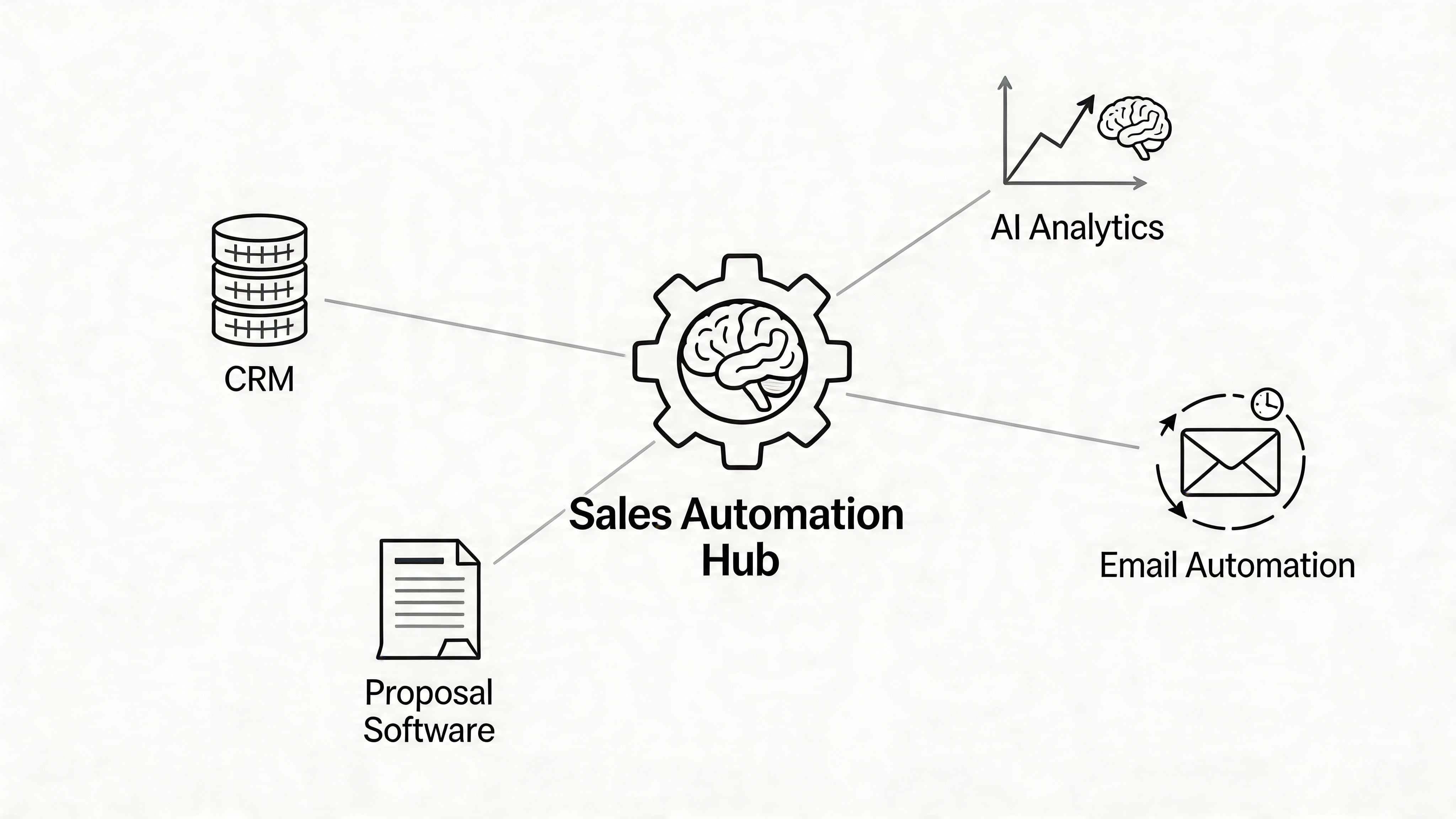
CRM first, always
The CRM is the control layer.
If pipeline stages, ownership, activities, and handoff rules aren’t disciplined in HubSpot or Salesforce, every other tool just produces prettier confusion. Your CRM should hold account history, stage logic, lead source, stakeholder notes, and next-step accountability.
A good test is simple. If a rep leaves, can another rep understand the actual status of the deal from the CRM alone? If not, your system depends too much on memory.
Engagement and enrichment solve different problems
Teams often lump these together. They shouldn’t.
Engagement platforms like Outreach or Salesloft help reps run follow-up sequences, task flows, and multichannel activity at scale. They solve consistency and speed.
Enrichment tools solve context. They add company data, role data, and buying clues that help reps decide who deserves that effort in the first place.
Used together, they keep reps from blasting generic outreach into low-probability accounts.
Conversation intelligence changes coaching from opinion to evidence
AI has demonstrated considerable effectiveness.
Teams using AI-powered conversation intelligence to analyze calls and coach reps see 20% to 40% faster stage progression and a 35% improvement in forecast accuracy, according to AI Bees. The practical value is not that the tool is “smart.” It’s that it catches missing discovery topics, surfaces competitor mentions, and maps conversations to qualification frameworks like GPCT while the deal is still alive.
That helps managers coach to deal reality, not rep confidence.
Here’s a quick walkthrough worth watching if you’re evaluating how automation and AI fit into the workflow:
A practical stack by function
Instead of buying software by category labels, map tools to bottlenecks.
Where AI actually earns its keep
AI is most useful in three places:
- Lead scoring: Prioritizing accounts based on fit and behavior, not list order.
- Call analysis: Flagging missed pains, objections, and competitive mentions.
- Forecast support: Highlighting deals that look healthy in CRM but weak in buyer behavior.
A lot of companies still misuse AI by putting it at the front of the process instead of inside it. Generic AI-generated messaging won’t save a bad targeting model. Strong AI support inside a disciplined process can save reps hours and improve decision quality.
For teams building those workflows across marketing and sales, https://ezcaa.com/services/ai-enablement is one example of how AI gets operationalized around scoring, content, and execution rather than treated as a standalone tool purchase.
Buy software that strengthens a stage gate. Skip software that creates one more dashboard nobody acts on.
Common Sales Process Pitfalls and How to Avoid Them
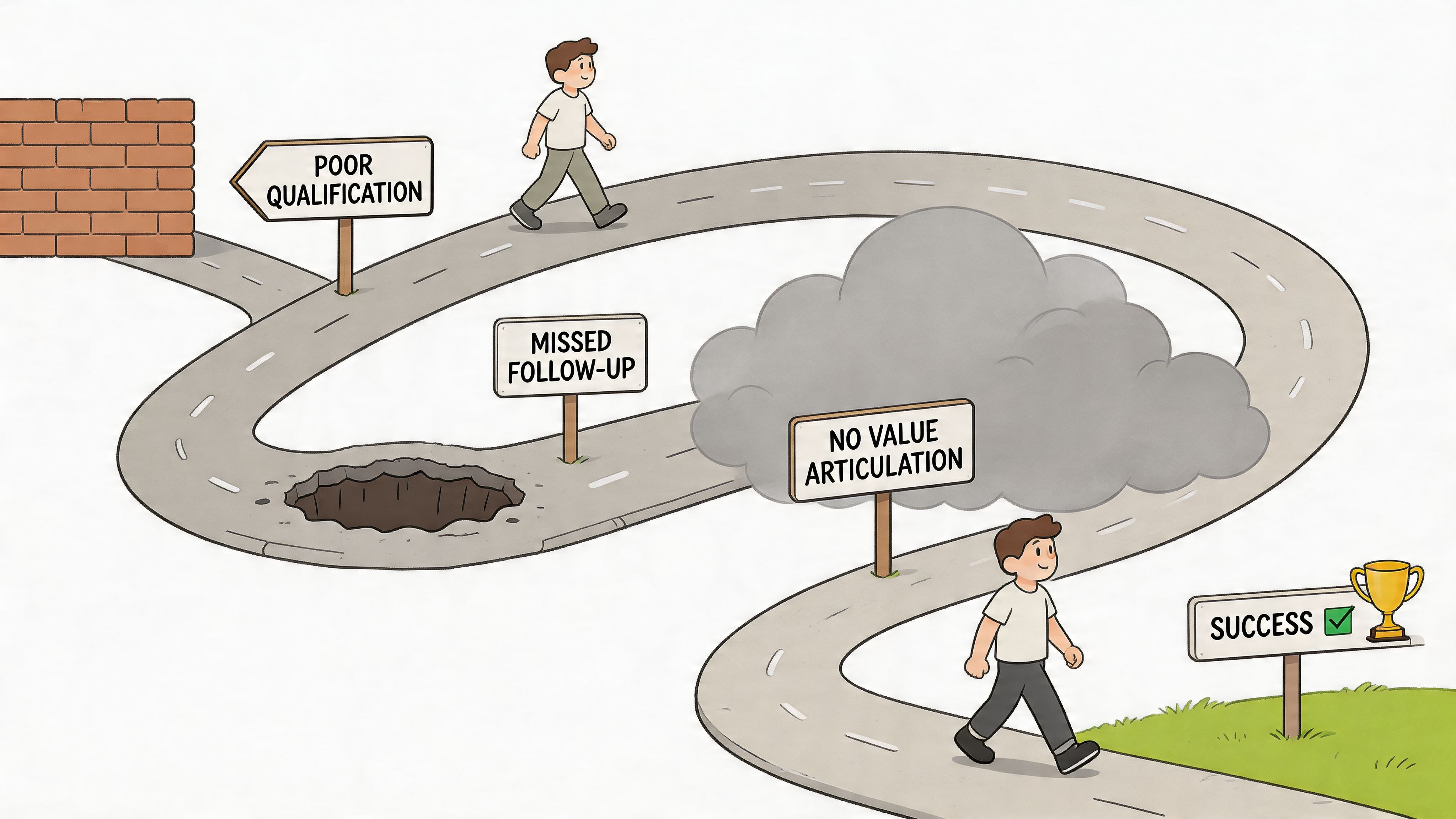
Most sales process failures don't look dramatic when they start. They look normal.
A rep logs a “good call.” A proposal gets sent. The buyer says they’ll circle back. The deal stays open for weeks. Everyone assumes momentum still exists.
That’s how weak process design hides.
Pitfall one, selling only to the visible contact
One of the most costly assumptions in B2B is believing your main contact is the whole buying group.
Up to 70% of purchase rejections for unknown brands are influenced by hidden buyers, and buying committees can expand to 13+ people, according to MarketingProfs. If your process only arms one champion and ignores silent stakeholders, objections surface late and often look “sudden” when they weren’t.
Fix: Build stakeholder mapping into discovery and proposal stages. Ask who will evaluate security, budget, operations, and implementation. Then give your champion material those people will use.
Pitfall two, accepting weak qualification because pipeline looks thin
This one is common when leadership pressure rises.
Teams lower the bar for SQLs because they want more pipeline coverage. That creates false comfort for a few weeks, then drags conversion rates down and fills the forecast with noise.
Fix: Tighten qualification rules when the market gets harder, not looser. It’s better to have fewer real deals than more fictional ones.
Pitfall three, treating proposals like the persuasive moment
By proposal stage, persuasion should mostly be done. If the proposal is doing all the heavy lifting, discovery was shallow or stakeholder consensus never formed.
Fix: Don’t send proposals until the buyer has confirmed the problem, the decision path, and the internal review process. If those are unclear, the next step is another buying conversation, not a PDF.
Pitfall four, confusing activity with buyer progress
A flurry of emails can fool a team into thinking a deal is active. It may just be polite back-and-forth from one contact.
Fix: Use buyer actions as stage gates. Meeting accepted by the right stakeholder. Internal review scheduled. Technical validation completed. Procurement engaged. Those are stronger indicators than rep notes.
Pitfall five, ignoring the dark funnel
By the time a form fill appears, much of the evaluation has already happened elsewhere. Teams that only invest in direct response channels often miss the earlier trust-building needed to survive long, committee-driven deals.
Fix: Support the process with brand-building content, category education, proof assets, and consistent messaging across channels. Unknown vendors need more trust support than familiar ones.
A broken sales process in B2B rarely fails because reps don’t care. It fails because the system lets bad assumptions move too far downstream.
How to Iterate Your Sales Process with 90-Day Sprints
Annual sales process planning is too slow for the way B2B buying changes now.
By the time a yearly redesign gets approved, trained, and rolled out, the bottleneck has often moved. That’s why the process should be managed in 90-day sprints, not annual overhauls.
The business case is straightforward. The average B2B sales cycle has increased by 22% in the past five years, 28% of sales pros say prospects back out when the process takes too long, and teams that formalize and iterate their process achieve 18% higher revenue growth, according to LeadForensics.
Sprint one, isolate the real constraint
Start with data from the last quarter.
Not broad feelings. Not rep anecdotes in isolation. Look for the stage where deals either disappear, slow down, or distort the forecast. In one quarter that might be MQL-to-SQL quality. In another it might be proposals sent without multi-stakeholder buy-in.
Choose one bottleneck. Not five.
A useful diagnostic lens:
- Conversion problem: Too few deals move forward
- Velocity problem: Deals move, but too slowly
- Quality problem: Pipeline exists, but forecast trust is poor
- Handoff problem: One team creates work the next team doesn’t value
Sprint two, turn the diagnosis into a testable hypothesis
The best sprint plans sound almost boring because they’re so specific.
Examples:
- If we add technographic filtering before SDR outreach, then qualification quality should improve.
- If proposals require stakeholder confirmation first, then late-stage stalls should fall.
- If rejected SQL reasons are coded and reviewed weekly, then paid channel quality should improve.
A weak sprint goal sounds like “improve sales efficiency.” A strong one names the behavior change and where it should show up.
The point of a sprint is not to prove your strategy was right. It’s to learn fast enough to improve the system.
Sprint three, pilot before scaling
Don’t roll out major process changes to the entire revenue team on day one.
Test with one segment, one pod, or one market first. That keeps noise lower and lets you compare outcomes against a stable baseline. It also prevents a bad process idea from becoming a company-wide habit.
At this stage, operators usually make the process better in small but meaningful ways:
- Rewrite stage exits so reps need evidence, not confidence
- Adjust lead scoring to reflect intent and fit together
- Change routing rules so hot accounts reach the right owner faster
- Update proposal templates to reflect stakeholder concerns uncovered in discovery
Sprint four, review and decide hard
At the end of the sprint, every test should land in one of three buckets:
Teams frequently skip the “kill” option because they’ve already invested time in the idea. That’s how bad process layers survive.
Why this model works better
A 90-day sprint model keeps the sales process in B2B tied to current buyer behavior, current channel performance, and current team capacity. It also forces sales and marketing to operate from the same evidence window.
That matters because no process stays optimal for long. Messaging shifts. Intent sources change. Committee dynamics change. Response quality changes. The process has to keep adapting or it turns into drag.
The companies that improve fastest usually aren't the ones with the most elaborate playbooks. They’re the ones willing to inspect the system, fix one meaningful constraint at a time, and repeat that discipline every quarter.
If your team needs a tighter B2B sales process, cleaner handoffs, and a practical 90-day growth rhythm, Ezca Agency works with SaaS, e-commerce, and B2B companies on data-driven execution across demand generation, SEO, paid media, CRO, content, and AI-supported optimization.