
How to Scale Facebook Ads: A 2026 Guide for Business Leaders
Learn how to scale Facebook Ads effectively in 2026. Our guide covers advanced audience, creative, and bidding strategies to grow from six to seven figures.
When you hear "scale Facebook ads," what comes to mind? For many business leaders, it's just about cranking up the daily budget. But strategic scaling is a different beast entirely. It’s about methodically increasing ad spend while maintaining—or even improving—your return on ad spend (ROAS) and profitability.
This guide moves beyond simple post "boosts" to a structured framework. It's a system for expanding audiences, testing new creative, and making data-backed decisions on where every dollar goes. It’s less about spending more and all about spending smarter to drive measurable business growth.
Moving Beyond Boosting to Strategic Scaling
We've all been there. You find an ad that’s finally working, you get excited, and you pump more money into it. Then, the inevitable happens: your ROAS tanks, frequency skyrockets, and the magic fizzles out. That frustrating plateau is a critical turning point for any marketing leader.
This is where you must shift from reactive spending to a proactive scaling system. It's the difference between gambling on short-term results and engineering a predictable machine that drives revenue and enterprise value.
Your Data Is Your Foundation
Before you touch your budget in Ads Manager, get your data in order. A solid data foundation is non-negotiable. This isn't about vanity metrics like clicks or likes; it's about tying ad performance directly to your business's bottom line.
For scaling to work, these are the metrics that truly matter:
- Average Order Value (AOV): How much is a new customer spending on that first purchase? This dictates your immediate return.
- Customer Lifetime Value (LTV): What’s the total long-term revenue you can expect from a single customer? This informs your maximum allowable acquisition cost.
- Return on Ad Spend (ROAS): How much revenue are you getting back for every dollar you put in? This is your core efficiency metric.
Without a firm grip on these numbers, you’re flying blind. You're guessing, not strategizing. To move past basic boosting and into a scalable framework, mastering these foundational Facebook Ad expert tips is a must.
Are You Actually Ready to Scale?
Before you hit the accelerator, a quick health check on your ad account is crucial. Aggressive scaling can expose weaknesses you didn't know you had. This checklist helps you quickly gauge if your foundational pillars are strong enough to support growth.
Scaling Readiness Checklist
If you see more red flags than success indicators, pause. It's far better to fix these foundational issues now than to waste thousands of dollars trying to scale a leaky bucket.
Adopt a Relentless Testing Mindset
After managing millions in ad spend, we've seen one trait that separates accounts that achieve explosive growth from those that stagnate: a relentless test-and-learn mindset.
The best advertisers treat every campaign as an experiment and every dollar spent as a data point. This is the opposite of the "set it and forget it" approach that dooms so many accounts. It’s an active, iterative process of optimization.
The core principle is simple: You cannot scale what you cannot measure. Profitable scaling is born from a deep understanding of your unit economics and a commitment to data-driven decision-making.
Proof That the System Works
This isn't just theory. We helped one brand scale from a modest $200-$300 per day to over $1,000 per day—all while taking their ROAS from a shaky 1-2x to a consistent 3-4x.
This 2026 case study started by fixing the offer before touching the ads. First, they optimized their AOV with strategic price anchoring, which gave conversions an immediate lift. Then, they ruthlessly focused on conversion rate optimization (CRO) for their landing pages and checkout flow.
The results were stunning. In the final seven days of their aggressive scaling push, ROAS jumped by nearly 35%, and net profit more than doubled. It's powerful proof that when you have a solid system, you don't have to sacrifice profitability for volume. You can dig deeper into this e-commerce scaling success story to see how they did it.
Building Your Audience and Creative Engine
With a solid data foundation, it’s time to build the two-part engine that fuels growth: a system for expanding your audience and a relentless creative testing process.
Many advertisers think scaling just means pouring more money into a winning ad set (vertical scaling). While this provides a short-term boost, it’s not a sustainable strategy. Real, long-term growth comes from combining this with horizontal scaling—where you’re not just spending more, but exploring entirely new audiences.
This boils down to a continuous cycle: analyze your data, form a strategy based on insights, and then test your assumptions in the real world.
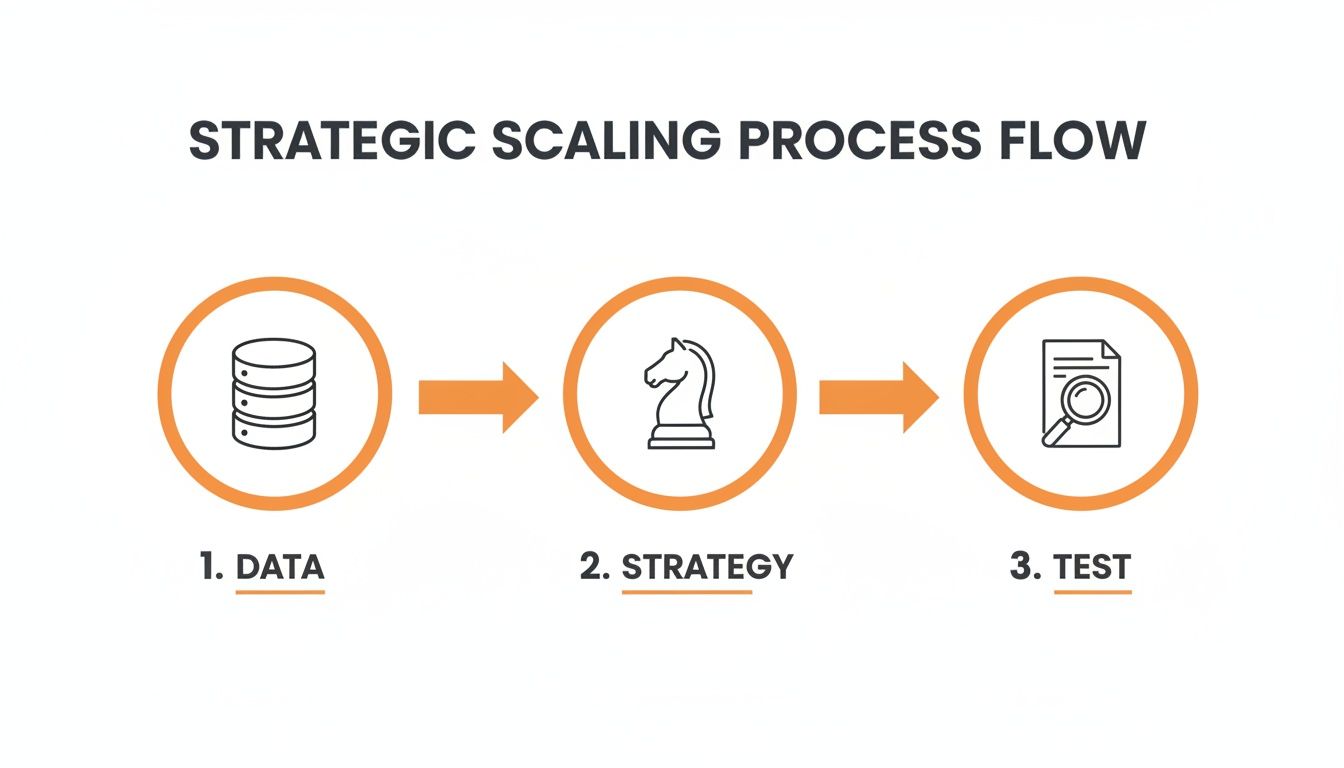
As the diagram shows, scaling isn't a one-and-done action. It’s an ongoing, iterative loop of Data, Strategy, and Test.
Expanding Your Reach With Smart Audience Layering
Horizontal scaling is your best defense against the dreaded one-two punch of audience saturation and ad fatigue. It’s the art of finding new pockets of customers who look and act just like your best ones. This is where Lookalike Audiences (LALs) become your most valuable player.
When done right, Lookalikes let you find new customers without sacrificing relevance. A proven playbook starts with a very tight 1% Lookalike audience built from a high-value source, like your top 10% of customers based on lifetime value. This audience is a direct reflection of your absolute best buyers.
Once that small, potent audience proves profitable, you can strategically expand to broader 3-5% Lookalikes to increase reach. If you just crank up the budget without growing your audience, your ad frequency will skyrocket, leading to ad fatigue and a 20-50% spike in CPMs that can torch your ROAS.
Pro Tip: Don't just build one Lookalike and call it a day. Create a "stack" of them using different value-based sources—purchasers, high-AOV customers, newsletter subscribers. Pit them against each other in testing to uncover new winning segments.
Building a High-Performance Creative Engine
Your audience strategy finds the right people, but your creative stops their scroll and earns the click. When spending at scale, ad fatigue isn't a maybe; it's a certainty. Your creative engine is the system you build to constantly develop, test, and iterate on ad concepts to stay one step ahead.
This isn't about chasing one mythical "unicorn" ad. It’s about building a library of proven hooks, angles, and formats that you can mix, match, and deploy. The goal is to isolate winning elements and recombine them to produce a steady stream of fresh, high-performing ads. At Ezca, our expertise in managing high-volume social ads campaigns is built on this very principle of iterative creative testing.
Here’s what that looks like for different business models:
- SaaS: Test a demo offer (bottom-funnel) against a whitepaper download (mid-funnel). Within that demo offer, test a "features" angle against a "problem/solution" angle, each with a different video hook.
- E-commerce: Pit polished, product-focused studio shots against raw, user-generated content (UGC). Test an ad showing the product in use versus another featuring a customer testimonial directly to the camera.
- B2B: Test creative for an in-depth case study against an invitation to an industry webinar. The case study ad might use static images highlighting impressive stats, while the webinar ad uses a short video of the host explaining key takeaways.
The core idea is to shift from big, monolithic creative tests to smaller, agile ones. Instead of testing two completely different videos, test the same video with three different opening hooks. This approach yields clearer data on what’s actually driving performance.
An AI ad creative generator can be a powerful asset here. These tools can quickly produce new ad copy and visual concepts, freeing up your team to focus on high-level strategy instead of getting bogged down in production. This ensures you always have new assets ready for your next test.
Getting Your Budget and Bidding Right for Scale
So, you've found a winning ad campaign. While the natural next step is to increase the budget, doing it the wrong way can torch your ROAS faster than you can say "learning phase."
This is where most advertisers get it wrong. They see good results, get excited, and double the budget overnight. That's not a strategy; it's a gamble. A real scaling strategy is methodical, disciplined, and designed to work with Meta's algorithm, not against it.
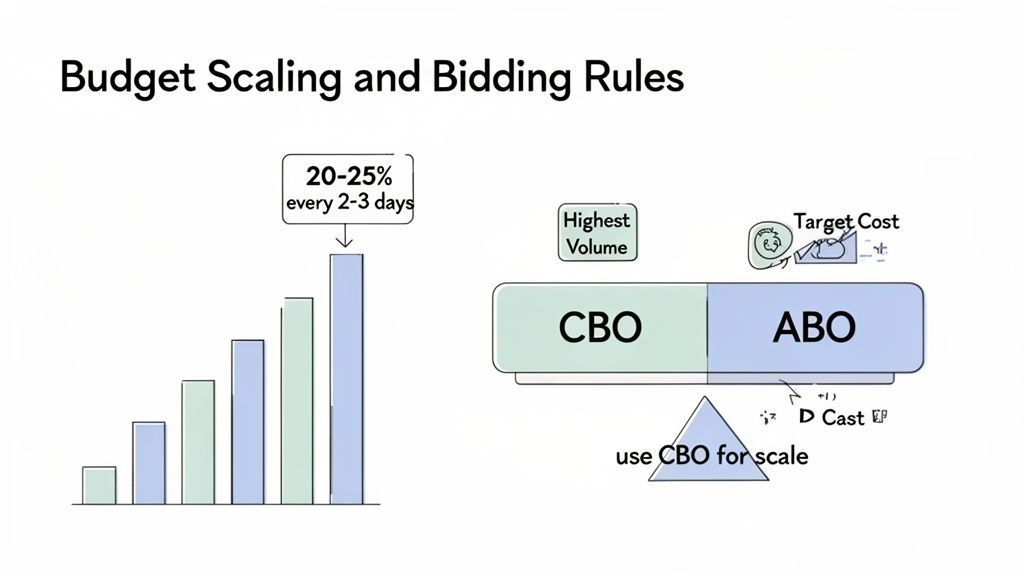
A reliable guideline is the 20-25% increase rule. When a campaign is hitting your targets, increase the budget by no more than 20-25% every 2-3 days.
This gradual increase keeps the algorithm stable. Big, sudden budget changes can shock the system, forcing it back into the volatile "learning phase" where performance often tanks. Remember, only increase spend if your ROAS or CPA has been stable and on-target for at least 48–72 hours. If it's shaky, hold off and diagnose the issue first.
The CBO vs. ABO Scaling Battle
A critical decision is how you manage that budget. Do you control it for each ad set individually (ABO), or let the campaign manage the total (CBO)?
- Ad Set Budget Optimization (ABO): This is your go-to for testing. You set a specific budget for every ad set, giving you total control to guarantee spend on a new audience or creative to get clean data.
- Campaign Budget Optimization (CBO): You set one budget for the whole campaign. Meta’s AI then takes over, automatically shifting spend to the ad sets that are performing best in real time.
When it's time to scale, there's a clear winner: CBO is built for scaling. While ABO provides control for testing, CBO delivers the efficiency needed for growth. It lets the algorithm find the cheapest conversions across all your ad sets. At our agency, Ezca, once we've identified winners and are ready to grow, CBO campaigns consistently deliver superior ROI.
Switching to CBO means trusting the algorithm to find the most efficient path to conversions. This consolidation gives the system more data and flexibility, which almost always results in a lower CPA and better ROAS as you scale. Don't fight the AI—let it do the heavy lifting.
Matching Your Bidding Strategy to Your Goal
Your bidding strategy aligns your budget with your actual business goals. For scaling, two strategies stand out: Highest Volume and Cost Per Result Goal.
For an e-commerce brand, the combination of CBO + Highest Volume is a powerhouse. It gives the algorithm maximum freedom to hunt down every last profitable sale.
Conversely, a B2B company that can’t afford to pay more than $150 per qualified lead would use a Cost Per Result Goal. This acts as a financial guardrail, ensuring you don't overpay for unprofitable leads as you scale. It’s all about protecting your ROI.
Put Meta's AI to Work for Faster, Smarter Scaling
To scale Facebook ads in 2026, you must partner with Meta’s AI. This isn’t a far-off concept; it’s about using the powerful machine learning tools already in your Ads Manager. The old days of managing dozens of granular ad sets and manually shifting budgets are behind us.
The new playbook for scaling is account consolidation. You provide the inputs and trust the algorithm to find your customers. This shift is driven by Meta's Advantage+ suite, which uses AI to automate the micro-optimizations that used to consume your team's time.
When the AI handles tactical execution, your team can focus on what humans do best: big-picture strategy and creating killer ads.
Why Advantage+ is Your Key to Growth
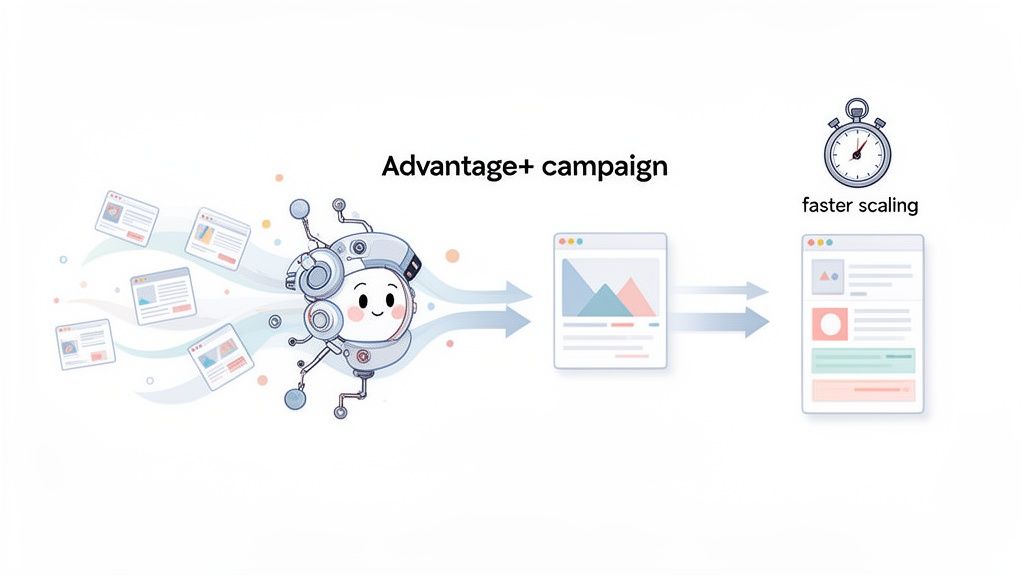
Advantage+ campaigns are the single biggest lever for efficient scaling on Facebook today. They work by blending your best-performing audiences and creatives into one consolidated campaign, letting the AI determine the most efficient way to spend your budget.
This solves a classic scaling headache. In a traditional setup, a new ad set often fails to exit the learning phase because it never gets enough budget. Advantage+ fixes this by dynamically pushing spend to whichever ad or audience pocket is delivering the best results in real-time, ensuring every asset gets a fair shot.
The proof is in the numbers. Meta's own AI upgrades are delivering huge performance gains. They doubled the GPUs for their Generative Ads Recommendation Model (GEM), leading to a 3.5% increase in ad clicks on Facebook and a 1% bump in Instagram conversions. This translates directly to lower CPMs and more stable ROAS as you increase spend. You can dig into Meta's full breakdown of their 2026 AI performance drivers to see the data for yourself.
How to Structure Advantage+ for Maximum Impact
Setting up an Advantage+ campaign for scale requires a change in mindset. You're no longer the pilot manually pulling every lever. You're the architect who designs the system and provides the right inputs.
Here’s a proven framework:
- Feed It Clean Data: Ensure your Pixel and Conversions API are tracking everything perfectly. Advantage+ is hungry for high-quality data; its decisions are only as good as the information you provide.
- Provide Creative Variety: Don’t just use one or two winning ads. The algorithm thrives on options. Give it a healthy mix of your top performers—videos, static images, carousels, and user-generated content. The more assets it has to test, the better it can optimize.
- Set a Meaningful Budget: Start with a budget that allows for meaningful learning. A small budget will suffocate the algorithm's ability to explore and find pockets of high performance.
- Hands Off the Wheel: This is the hardest part for most media buyers. Once you launch, resist the urge to make constant changes. Give the campaign at least 72 hours to gather data, stabilize, and find its rhythm. Trust the process.
Think of an Advantage+ campaign like giving a world-class chef a pantry stocked with your best ingredients. Your job is to source high-quality creative and set a clear goal (like a target CPA). The AI’s job is to turn those ingredients into the perfect dish.
Analyzing Performance and Making Your Next Move
Analyzing an Advantage+ campaign is a top-down exercise. Forget dissecting individual ad sets. Focus on high-level campaign metrics and creative performance. Is your overall CPA on target? Which creative angles are driving the most conversions?
This perspective shifts your decision-making from tactical to strategic. For example, if you see that videos are outperforming static images, your next move isn't to just pause the images inside the campaign. Instead, you brief your creative team to produce more video variations based on what’s working. You then feed those new ads back into the AI engine.
This is the feedback loop that drives modern performance marketing. For businesses ready to build these kinds of advanced systems, our AI enablement services can provide the framework to scale with confidence. It’s all about creating a system where AI-driven insights continuously inform your creative strategy.
Tailoring Your Scaling Strategy to Your Business Model
Knowing the mechanics of scaling is one thing. Applying them to your unique business is another. The levers an e-commerce store pulls are worlds apart from what a SaaS or B2B company needs to do to grow.
Success comes from a strategy built around your specific sales cycle, customer journey, and the metrics that actually matter to your bottom line. Let's break down the playbooks for three common business types.
Scaling Metrics by Business Model
A B2B company chasing a low Cost Per Purchase would be optimizing for the wrong thing entirely. Understanding these distinctions is the foundation of a scalable advertising program.
The E-commerce Playbook: Driving ROAS and AOV
For e-commerce, it all comes down to profitable volume. Your north star is Return on Ad Spend (ROAS). Every decision you make while scaling needs to protect—or improve—that number as you increase spend.
A powerful tool in your arsenal is Dynamic Product Ads (DPAs) aimed at broad audiences. Once your product catalog is synced with Meta, you can spin up a CBO campaign and let the algorithm match the right products to the right people.
Simultaneously, you must be obsessed with your Average Order Value (AOV). Trying to scale with a low AOV is like trying to fill a leaky bucket. Your creative and post-click experience should be engineered to boost it.
- Creative Angles: Test "bundle and save" offers directly in your ads. Show customers how much more value they get by buying a set instead of a single item.
- Post-Click Strategy: Use one-click post-purchase upsells and cross-sells. For example, an ad for a moisturizer could lead to an immediate offer for the complete skincare kit right after the initial purchase.
- Pacing Your Scale: Keep a close eye on your MER (Marketing Efficiency Ratio) and ROAS. Increase your daily budget by 20-25% every few days, but only if those core metrics hold steady.
In e-commerce, scaling is a full-funnel job. A 10% lift in AOV from a better upsell flow can provide the margin you need to bid more aggressively and win more auctions.
The SaaS Playbook: From Content to Conversion
Scaling a SaaS business is a longer game. You're guiding users through a multi-stage funnel to acquire high-quality leads who become paying customers. Your key metric shifts from ROAS to Cost Per Lead (CPL) and, ultimately, the Trial-to-Paid Conversion Rate.
Structure your campaigns to mirror this funnel.
At the top of the funnel (ToFu), your goal is broad awareness and lead capture. Run campaigns promoting valuable content—ebooks, whitepapers, or webinar sign-ups—with target CPL as your main KPI.
At the bottom of the funnel (BoFu), get direct. Retarget people who engaged with your ToFu content with high-intent offers like "Request a Demo" or "Start Your Free Trial." The creative here must be benefit-driven, focusing on your Cost Per Demo or Cost Per Trial.
The real power comes from connecting these stages. If someone downloads your ebook on "Project Management for Remote Teams," your retargeting ad can hit them with a message like, "Tired of the chaos? See how our tool fixes it." This creates a cohesive, persuasive journey.
The B2B Playbook: When Lead Quality Is Everything
For B2B companies, lead quantity is a vanity metric. One perfect Sales Qualified Lead (SQL) is worth a hundred unqualified contacts. Your scaling playbook must filter for quality above all else.
Your targeting needs to be precise. Upload custom audiences from your CRM to target decision-makers at specific accounts, layered with job title and industry targeting, to pinpoint the exact people your sales team wants to talk to.
Lean into Meta Lead Forms. They’re native to the platform, which reduces friction and often results in a lower CPL. The key is to add qualifying questions to weed out tire-kickers.
- Example Qualifying Question: Don't just ask for a name and email. Add a dropdown question like, "What is your company's approximate annual revenue?" or "Which best describes your role in the purchasing process?"
Your true north star KPI here is Cost per SQL. This requires a rock-solid integration between Meta Ads and your CRM to track which leads convert into qualified opportunities. That feedback loop is the only way to optimize for what actually drives revenue. We’ve seen this work across many verticals, as shown in our case study on consumer app growth using Meta ads.
Common Questions About Scaling Facebook Ads
Once you've found a winning formula, scaling is the natural next step. But this is where most marketing leaders get nervous. Pushing more budget into the system can break things if you aren't careful.
Let's address the most common questions from teams ready to grow responsibly.
How Quickly Can I Scale My Budget?
There is no magic number. The key is to be methodical. A reliable rule of thumb is to increase the budget on a successful campaign by no more than 20-25% every 2-3 days.
This steady approach prevents you from jolting Meta's algorithm back into the unpredictable "learning phase." Most importantly: only increase spend if your core metrics (like ROAS or CPA) have been stable and hitting your targets for at least 48 hours. If performance is wobbly, scaling will only magnify the problem.
What ROAS Should I Aim for When Scaling?
Your target ROAS is determined by your business's profit margins, not an industry benchmark. You must know your break-even ROAS—the point where you're covering ad spend and your cost of goods.
A SaaS company with a 70% profit margin might be happy with a 2.0x ROAS during a growth phase. But an e-commerce brand with a 30% margin might need a 3.5x ROAS or higher to stay profitable.
As you scale, expect your ROAS to dip slightly. A realistic goal is to keep it within 10-15% of your baseline profitable target.
When you scale, you're buying data as much as you're buying sales. A slightly lower ROAS is often an acceptable trade-off for the market share and customer data you acquire, as long as it remains above your break-even threshold.
When Should I Kill an Underperforming Ad Set?
Avoid emotional decisions based on a single bad day. Implement a firm, data-based rule for when to cut losses.
A great starting point is the "2x CPA Rule." If an ad set has spent twice your target Cost Per Acquisition (CPA) without a single conversion, pause it. For a target CPA of $50, you'd kill any ad set that spends $100 without a result. This gives new ads a fair shot while preventing you from burning cash on obvious duds.
How Do I Handle Ad Fatigue at Higher Spend?
Ad fatigue isn't a possibility when you scale; it's a certainty. The only way to manage it is to get ahead of it with a system for constantly feeding the machine new creative.
When an ad’s frequency creeps up and its click-through rate sags, start rolling in fresh variations—even while the original is still performing.
- Build a Testing Pipeline: Always have a separate ABO campaign where you're testing 2-3 new creative concepts. This is how you find your next winner before you desperately need one.
- Isolate Your Variables: Test one thing at a time. Use the same video but test three different hooks in the first three seconds. Use the same image with three different headlines.
- Refresh Your Audiences: New creative works best with fresh eyes. Make it a weekly habit to refresh your Lookalike audiences to give the algorithm new, fertile ground to explore.
Managing the complexities of scaling requires expertise and a disciplined process. The team at Ezca Agency builds and executes data-driven growth strategies, turning ad spend into predictable revenue. If you're ready to scale with confidence, see how our performance marketing sprints can help you achieve your goals.