
E-commerce PPC Management: A Complete Guide for 2026
Master e-commerce PPC management with our complete 2026 guide. Learn to set objectives, structure campaigns, optimize with AI, and drive profitable growth.
Most e-commerce brands don’t lose money because they picked the wrong ad platform. They lose money because they mistake motion for management.
The account is active. Clicks are coming in. Shopping campaigns are spending. Performance Max is finding conversions. Yet margin gets tighter every month, branded traffic props up the dashboard, and non-brand acquisition never becomes reliably scalable. That’s the point where e-commerce ppc management stops being a channel task and becomes an operating system.
A scalable PPC engine doesn’t come from chasing one campaign type or one hack. It comes from portfolio thinking. You set goals by funnel stage, structure the account so you can see profit by segment, feed ad platforms better data, and reallocate budget fast when reality changes. The strongest teams run this in tight operating cycles, not in quarterly guesswork.
Why Your Ad Spend Is Leaking and How to Fix It
A common pattern looks like this. Revenue is flat, spend is up, and the account manager says the campaigns are “learning.” Search term quality slips. Shopping traffic broadens. Returning visitors keep converting, but new customer acquisition gets more expensive. Nothing is technically broken, but the economics are.
That leak usually starts in one of three places. The account isn’t segmented well enough to show where profit is coming from. Conversion tracking is too weak to guide bidding. Or the landing and checkout experience can’t support the traffic you’re buying. If you want a broader strategic primer before rebuilding, this ultimate guide to e-commerce PPC marketing is a useful companion read.
Activity isn’t performance
Spending more isn’t management. Management means knowing which clicks deserve more budget and which segments need to be cut back even if they look healthy in the platform.
I’ve seen stores keep increasing spend because impression share looked attractive while contribution margin kept deteriorating. The platform showed growth. The business saw less cash.
Practical rule: If your reporting can’t separate branded demand capture from true incremental acquisition, you don’t yet know whether PPC is scaling or just harvesting.
The fix starts below the ad account
A profitable PPC system starts with business constraints, not campaign settings. You need to know what a new customer is worth, which products can tolerate aggressive acquisition, and where abandonment is happening after the click. Many brands try to solve a checkout or merchandising problem with bidding tweaks.
That’s backwards.
If your store has friction after the ad click, fix that first. Improving the handoff from traffic to checkout often does more for profitability than another round of bid changes. This is why serious operators review product pages, cart flow, and payment friction alongside campaign metrics. A checkout audit like e-commerce checkout optimization is often the fastest way to find the hidden tax on paid traffic.
Setting Clear Goals and Choosing Your Channels
Before you launch anything, define what success looks like at each stage of the buying journey. A channel can be efficient for one objective and weak for another. Brands get into trouble when they expect prospecting social traffic to behave like branded search, or when they use Shopping to do awareness work it wasn’t built for.
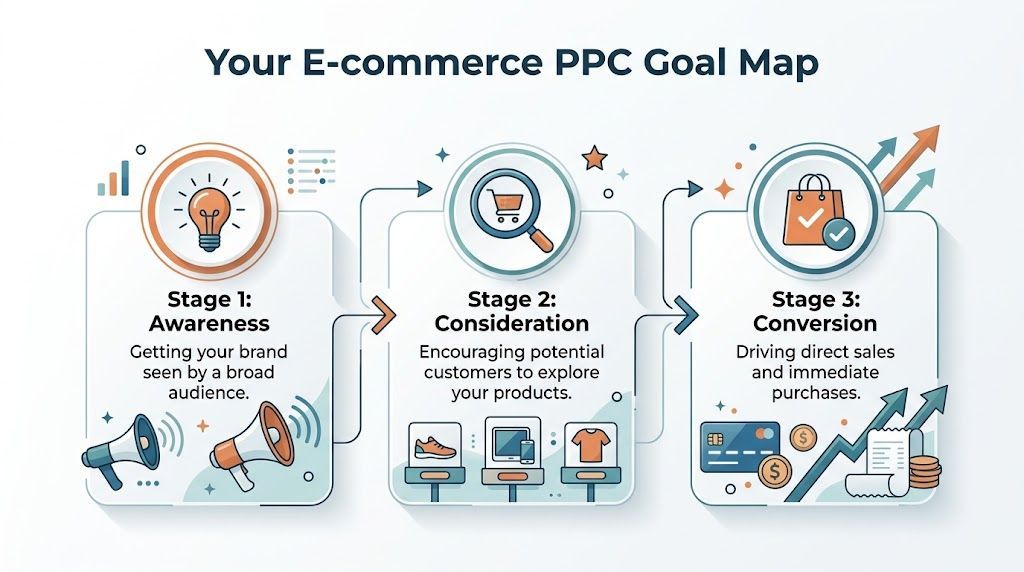
Build goals around the funnel
Use three operating buckets.
Awareness
This is reach with a purpose. You’re trying to put the brand or product category in front of people who are likely to care, then qualify whether they engage. On paid social, video, and upper-funnel discovery placements, judge performance by engagement quality and on-site behavior, not just immediate revenue.
This is also where creative testing matters most. If messaging doesn’t earn attention here, the lower funnel never gets enough qualified traffic.
Consideration
At this stage, shoppers compare products, revisit the site, evaluate offers, and move closer to purchase. Google Shopping, retargeting, and category-level search campaigns usually do a lot of work here. Your job is to reduce ambiguity. Price clarity, shipping visibility, reviews, and product imagery all matter.
Conversion
This is direct response. Branded search, high-intent non-brand search, Shopping for proven SKUs, and remarketing often sit here. At this stage, traffic quality and landing-page continuity need to be tight. If someone searched a product-specific query, don’t send them to a vague category page and hope automation figures it out.
Your PPC goals should map to a buyer’s next step, not your internal reporting preference.
Channel selection should follow intent
The global paid search advertising market was projected to reach $351.55 billion in 2025, and mobile accounted for 52% of all PPC clicks and 70% of search ad impressions in the U.S., according to Digital Silk’s PPC statistics roundup. That matters because channel choice now has to account for mobile behavior first, not desktop assumptions.
Here’s a practical way to think about the core mix.
What works and what usually doesn’t
A healthy portfolio usually combines high-intent search capture with broader demand generation. That gives you both efficiency and room to grow. If you rely only on branded search and remarketing, the account can look efficient while acquisition stalls.
A few channel-selection rules hold up well:
- Choose Search when intent is obvious: Branded terms, product-specific queries, and urgent category needs belong here.
- Choose Shopping when the feed is strong: If titles, images, pricing, and availability are inconsistent, Shopping won’t rescue weak catalog hygiene.
- Use Performance Max selectively: It works best when you already have solid tracking, a clean feed, and clear exclusions.
- Use social to create demand and support retargeting: Social is often where you learn which offer, hook, or angle deserves more budget elsewhere.
The mistake is going all in on one channel because it performed well for one month. Good e-commerce ppc management treats channels like an investment portfolio. Different jobs. Different time horizons. One combined profit target.
Building a Scalable Account and Product Feed
A messy account can still spend money. It just can’t teach you much.
If you want scale, build the account so a new product line, new region, or new campaign type doesn’t require a structural reset. That means naming conventions that make sense, clear ownership of assets, and a setup that separates strategic decisions from platform clutter.
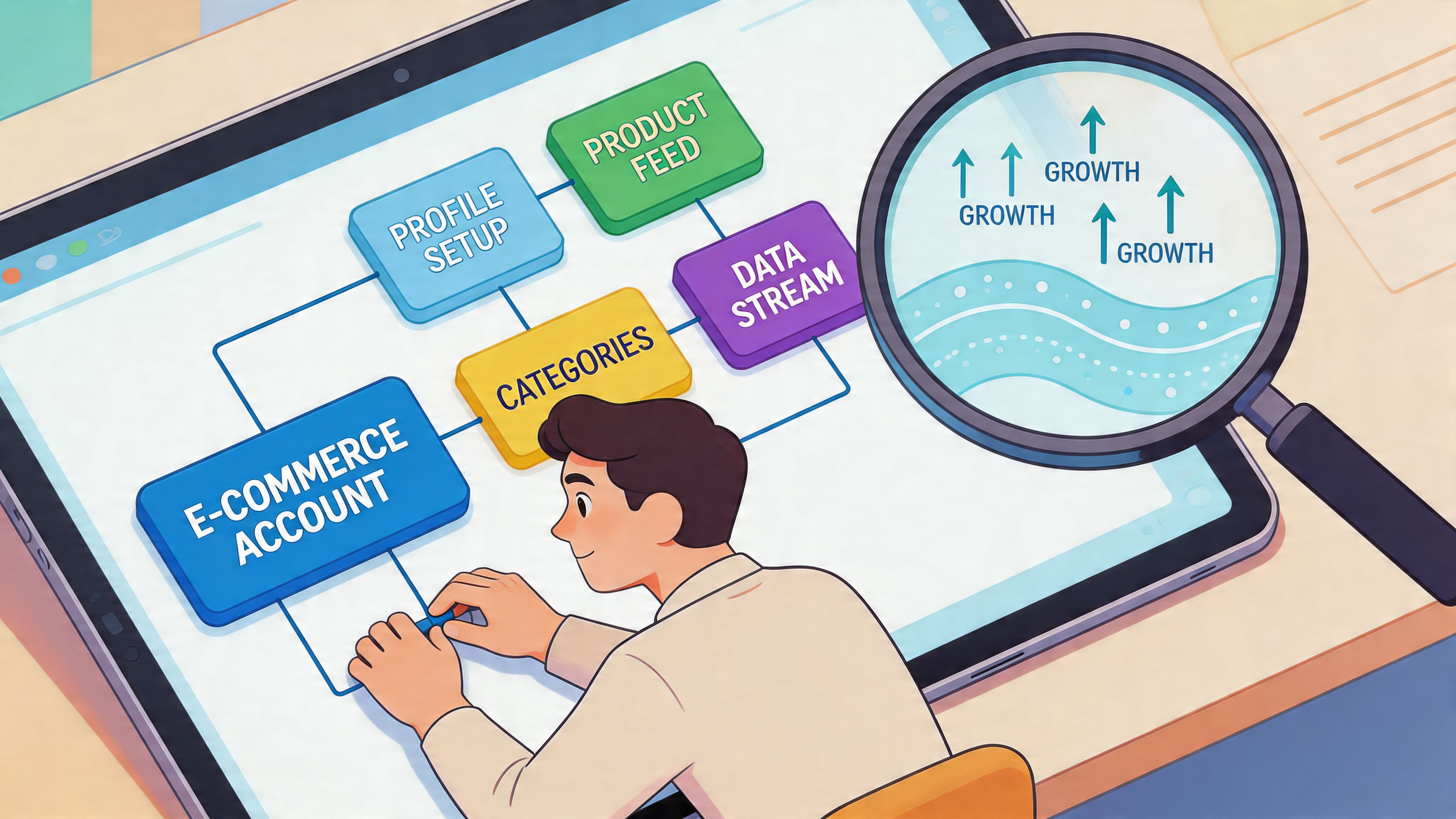
Start with the account skeleton
At minimum, keep these assets organized:
- Manager account access: If you ever add brands, regions, or partner teams, you’ll want clean oversight.
- Separate campaign intent: Don’t mix branded search, generic search, and feed-led shopping activity into one opaque structure.
- Shared negative keyword and audience logic: Centralize what should be excluded so you don’t repeat errors across campaigns.
- Clean naming standards: Include market, channel, objective, and segment in campaign names so reporting is usable.
This sounds operational because it is. Bad structure doesn’t always hurt in week one. It hurts when you try to diagnose why one product family is profitable and another is draining spend.
Tracking quality decides bidding quality
Automation only performs as well as the signals you feed it. If GA4 e-commerce tracking is incomplete, purchase values are wrong, or enhanced conversions aren’t implemented well, Smart Bidding will optimize on a distorted picture of the business.
A practical setup includes:
- GA4 e-commerce events that reflect real revenue
- Enhanced conversions so platforms get better post-click signals
- Consistent attribution rules across reporting views
- A regular QA process after site changes, app installs, or checkout updates
Bad tracking doesn’t just affect reporting. It changes what the algorithm chases.
When brands say bidding “stopped working,” the cause is often that the signal degraded. A template change broke event firing. A cart app disrupted values. A consent setup reduced match quality. If the platform can’t identify good outcomes reliably, it will spend into noise.
Your feed is a performance asset
For Shopping and Performance Max, the product feed is one of the most important assets in the stack. Titles, descriptions, image quality, availability, price, category mapping, and custom labels all affect how products are matched, shown, and prioritized.
Custom labels are especially useful because they let you organize products by business logic, not just catalog taxonomy. Label products by margin tier, bestseller status, seasonal relevance, clearance priority, or testing status. That gives you a way to separate budget and read performance by what matters commercially.
Product imagery matters here too. Better feed images improve merchandising clarity before the click, not just on the site. If your catalog visuals are weak, this guide to professional product photos that sell is worth reviewing before you blame campaign settings.
A few feed mistakes show up repeatedly:
- Incomplete titles: They hide the attributes shoppers search.
- Generic images: They lower click quality because users can’t quickly judge fit or value.
- Missing labels: They block useful campaign segmentation later.
- Out-of-sync inventory or pricing: They create wasted spend and poor user trust.
The technical foundation isn’t glamorous. It is, however, what makes advanced campaign strategy possible.
Designing High-Impact Campaign Structures
Campaign structure should answer one question fast. Where is profit coming from, and where is waste hiding?
If every product shares the same budget logic, the same bidding goal, and the same reporting bucket, you can’t make sharp decisions. Strong structure creates economic visibility. It lets you protect efficient demand, test new demand, and avoid subsidizing weak products with strong ones.
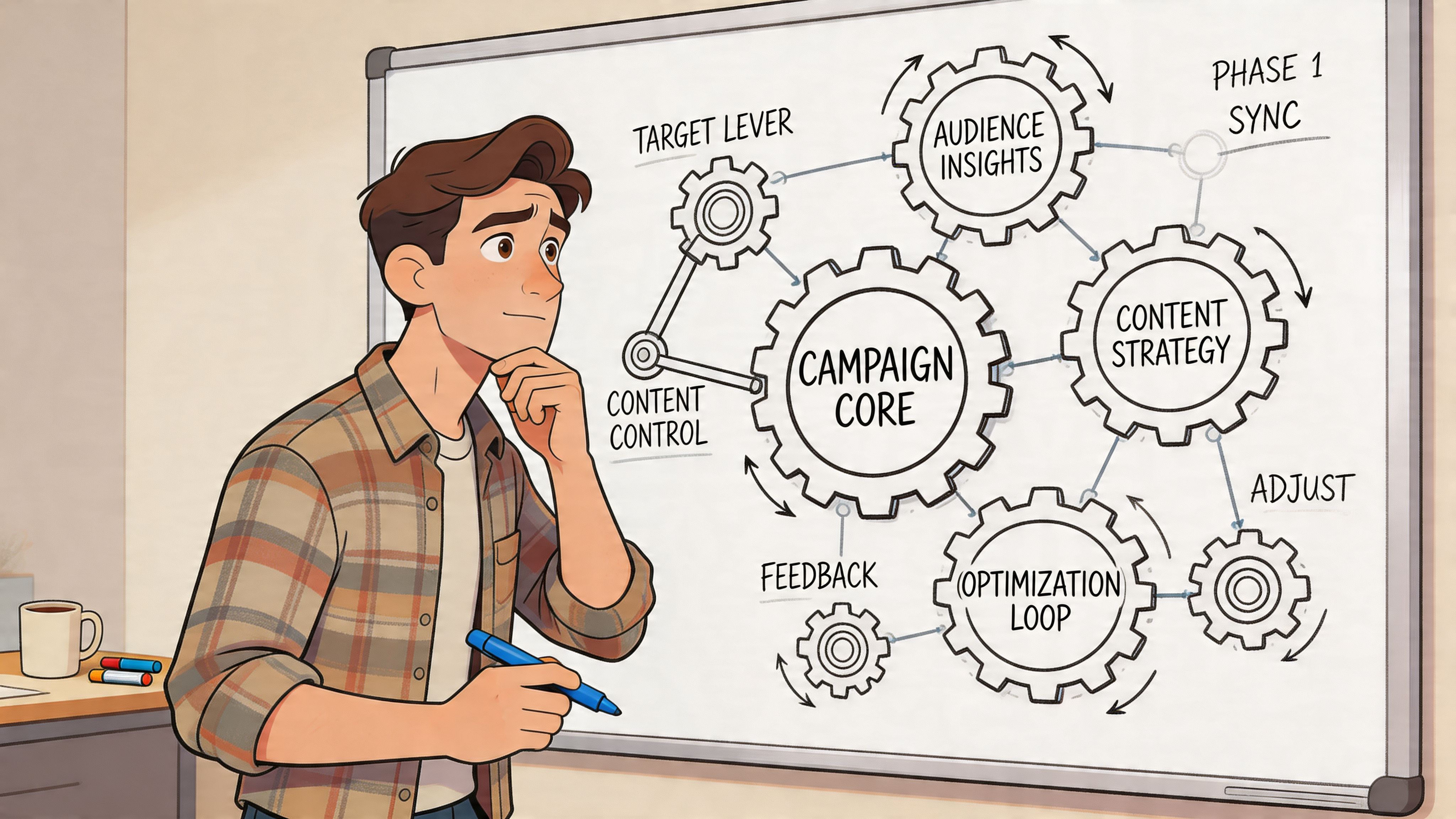
Segment by business reality
The simplest upgrade is separating campaigns by strategic role.
Brand and non-brand
Branded search captures existing demand. Non-brand search creates incremental acquisition. If you merge them, branded efficiency masks non-brand weakness. Keep them separate so you can defend your brand terms while judging prospecting accurately.
High-margin and low-margin products
A product that can absorb aggressive acquisition should not compete internally with a low-margin SKU that needs strict efficiency. Use feed labels to split these groups in Shopping and Performance Max.
Proven winners and test inventory
Your bestsellers deserve stable delivery. New or uncertain products need controlled testing. Mixing them under one campaign target often causes the platform to over-serve historical winners and starve emerging opportunities.
Use niche angles on purpose
Many e-commerce businesses struggle with poor audience targeting, yet PPC’s granularity lets smaller brands compete where larger brands stay broad. According to 1Digital Agency’s analysis of common e-commerce PPC issues, niche campaigns built around specific value propositions such as “family-owned” or “locally-made” can boost conversion rates by up to 25%.
That doesn’t mean every niche hook deserves its own account structure. It means you should create dedicated campaign paths for differentiated messages when the USP changes buying behavior.
Examples that usually justify separation:
- Locally made products with shipping or craftsmanship emphasis
- Giftable product lines with seasonal urgency
- Bundles and sets that appeal to a different buyer than single units
- Premium variants where price sensitivity is lower and creative should reflect that
If you need a benchmark for how a specialized paid search team approaches this kind of segmentation, this overview of paid search services shows the operational side well.
Structure for budget control, not platform convenience
Default automation tends to consolidate. Business operators often need the opposite. The point of structure is to tell the platform where control matters.
Here’s a useful way to evaluate your current build:
A short walkthrough can help if you’re redesigning a live account:
The right structure usually feels slightly more detailed than the platform recommends, but simpler than what an analyst would build in a spreadsheet. That balance matters. Too much consolidation removes insight. Too much fragmentation slows learning.
Mastering Bidding Budgets and Creative Optimization
Bidding, budgets, creative, and landing pages are one system. Teams often treat them as separate workstreams, then wonder why optimization stalls.
A bid strategy can only allocate spend among the opportunities it sees. Creative determines who clicks. The landing page determines whether that click turns into revenue. If one part of the loop is weak, the other parts get blamed unfairly.
Smart bidding needs stable signals
Target ROAS and Maximize Conversion Value can work well in e-commerce ppc management when the account has clean revenue tracking, enough conversion consistency, and a stable product feed. They tend to struggle when too many variables change at once.
Common failure patterns include:
- Changing targets too often: The platform never settles long enough to learn useful patterns.
- Launching with weak tracking: Revenue signals are incomplete or delayed.
- Forcing one target across unlike products: Margin and buyer behavior differ too much.
- Ignoring post-click friction: The bid strategy keeps paying for traffic that the site can’t convert.
A better approach is to set bid strategy by product economics and campaign role. Brand defense can tolerate one logic. Non-brand acquisition often needs another. Testing campaigns should usually run with tighter guardrails than proven winners.
If automation is buying the wrong traffic, don’t assume the bid strategy is wrong first. Check the inputs, the creative promise, and the page experience.
Budget pacing should protect optionality
The easiest way to lose control is to let one campaign absorb budget solely because it can spend. That isn’t the same as deserving spend.
Strong pacing means reviewing spend against commercial priorities throughout the month. If a category is stock-constrained, don’t keep feeding it because its recent ROAS looks good. If a hero product has room to scale and strong margin, don’t starve it because a broad campaign is soaking up demand.
A practical pacing routine includes:
- Reserve budget for proven demand capture
- Set a testing allocation for new products, new audiences, or new creative
- Review intra-month shifts, not just end-of-month totals
- Adjust based on margin, inventory, and site readiness, not only platform-reported return
Many businesses overspend on channels that report well and underspend on channels that build future demand. The answer isn’t to reject attribution. It’s to connect channel decisions to the wider revenue model.
Creative and landing pages decide whether scale holds
Ad copy should match intent. Shopping images should reduce uncertainty. Landing pages should continue the promise made in the ad. If you sell premium goods, the page needs to justify premium pricing immediately. If you promote speed or convenience, shipping details and delivery expectations need to appear early.
Audit this loop regularly:
- Headline to query match: Does the ad reflect what the shopper searched?
- Image to product reality: Is the visual clear, accurate, and differentiated?
- Offer continuity: Does the landing page repeat the same incentive or value proposition?
- Mobile usability: Can the shopper browse, choose options, and purchase without friction?
- Trust signals: Are reviews, return policy, shipping info, and payment clarity visible?
Creative optimization isn’t decoration. It changes traffic quality before the click and conversion efficiency after it. That’s why high-performing teams don’t ask whether the problem is “media” or “CRO.” They look at the whole loop.
Implementing a 90-Day AI-Powered Growth Sprint
Static PPC management wastes time because the market doesn’t stand still for monthly reporting cycles. Prices shift, creative fatigue sets in, inventory changes, organic rankings improve, and competitors force different auction dynamics. If your process reacts slowly, the account bleeds efficiency between meetings.
That’s why a sprint model works better. It compresses learning into a short window with a clear commercial objective, a fixed testing agenda, and weekly budget decisions.

What a real 90-day sprint looks like
A useful sprint has one dominant goal. That might be improving new customer acquisition economics, scaling a profitable product family, or increasing blended efficiency across paid search and social.
The operating rhythm is simple:
- Weeks 1 to 2 Audit tracking, feed quality, campaign segmentation, and landing page continuity. Define what gets protected and what gets tested.
- Weeks 3 to 6 Launch focused tests. This usually includes query segmentation, offer variation, feed title changes, audience exclusions, and creative angle testing.
- Weeks 7 to 10 Reallocate harder. Push budget into validated segments. Pull back where the thesis failed.
- Weeks 11 to 13 Consolidate wins, document learnings, and set the next sprint around the most impactful constraint.
This is more disciplined than “always be testing” because every test has to earn its place inside a business objective.
AI should assist allocation, not replace judgment
The strongest use of AI in e-commerce ppc management isn’t blind automation. It’s faster pattern recognition paired with human budget decisions.
According to Scube Marketing’s guide to e-commerce PPC management, agencies using AI-driven dynamic budget shifting across channels within 90-day sprints have found that weekly reallocations can produce double the ROAS of static PPC strategies. The same source notes that AI optimization tools can reduce costs by 20% to 30% through predictive bidding.
That doesn’t mean you hand your budget to a model and walk away. It means AI helps identify where momentum is building, where efficiency is degrading, and where spend should move next. The human team still decides whether the signal is commercially meaningful.
If you’re evaluating what this looks like in practice across a broader growth stack, this page on AI enablement services is a useful reference point.
Weekly reallocation is where the sprint model gets its edge. Budget moves while the opportunity still exists.
Think in portfolio terms, not channel silos
Here’s the shift most brands need to make. PPC is not a self-contained budget bucket. It’s one asset inside a marketing portfolio.
If SEO is starting to win category terms, you may taper non-brand search spend in that segment and redeploy budget to product launch support or social creative testing. If paid social is generating strong retargeting pools, search can capture more branded demand efficiently. If a product line has inventory pressure, both channels may need to step back.
A portfolio operator asks different questions:
The sprint model reduces waste because it shortens the time between observation and action. Monthly reporting often tells you what went wrong. Weekly reallocation gives you a chance to stop funding it.
Tracking True Performance and Finding the Right Partner
A lot of PPC reporting looks impressive and still fails the business test. Click-through rate can rise while profit falls. Platform ROAS can improve while total revenue stalls. Conversion volume can grow while customer quality declines.
That’s why leadership teams need a tighter KPI stack.
The metrics that matter
ROAS tells you how much revenue the platform reports relative to ad spend. It’s useful, but it’s not enough on its own. It can be inflated by branded demand, remarketing, or attribution bias.
Cost per Conversion, often shown as Cost/Conv., is one of the clearest operating metrics because it measures spend divided by conversions. According to Adspert’s e-commerce PPC management guide, practitioners treat it as a key KPI and investigate when Cost/Conv. rises by more than 20% week over week without a corresponding revenue lift, while managing toward ROAS goals in the 300% to 400% range.
MER, or Marketing Efficiency Ratio, is the broader lens many business owners need. It compares total revenue to total marketing spend across channels. MER helps answer the question platform dashboards can’t. Is the whole system becoming more efficient, or are channels just taking credit from one another?
How to read the numbers together
A healthy review process doesn’t ask for one winner metric. It looks for consistency across the stack.
For example:
- ROAS up, MER flat often means channel attribution improved more than business performance did.
- Cost/Conv. rising, revenue stable points to growing inefficiency that needs diagnosis.
- Platform results strong, blended margin weak usually means campaign success isn’t aligned with product economics.
The business pays invoices with blended profit, not with in-platform screenshots.
How to evaluate a PPC partner
If you’re deciding between in-house management and an agency, don’t start with promises. Start with operating method.
A credible partner should be able to explain:
- How they structure accounts for visibility and control
- How they validate tracking and revenue data
- How often they review and reallocate budget
- How they connect media decisions to margin, inventory, and landing page performance
- How they report on blended business outcomes, not just platform metrics
Avoid agencies that talk mostly about “optimizations” without showing how decisions tie back to commercial goals. Strong partners work like operators. They ask for feed access, analytics access, margin context, and a clear view of business constraints. They don’t hide behind automation.
Frequently Asked Questions About E-commerce PPC
How much budget do I need to start?
Enough to generate learning, not just impressions. The exact level depends on your category, average order value, margin, and how many products you’re advertising. Start with the products most likely to convert profitably, keep the structure tight, and protect room for testing. A tiny budget spread across too many channels usually creates noise.
Can I run PPC without a strong product feed?
You can run search campaigns without a full retail feed, but Shopping and feed-led automation become much weaker. If you sell many SKUs, the feed is not optional. It shapes visibility, click quality, and how well platforms match products to intent.
How long until PPC becomes profitable?
Some campaigns can produce sales quickly, but reliable profitability takes iteration. Expect an initial period of signal gathering, segmentation, and creative refinement. The question isn’t just “did it convert?” It’s “can it repeat profitably at a larger spend level?”
Should I manage PPC in-house or hire a partner?
Manage it in-house if you have strong tracking, feed ownership, creative support, and someone who can make fast budget decisions. Bring in a partner if the business needs tighter execution, deeper channel expertise, or a stronger operating cadence across PPC, CRO, and adjacent channels.
If you want a team that runs paid media like a growth portfolio instead of a set-and-forget channel, Ezca Agency is worth a look. Ezca works in focused 90-day sprints, combines human operators with AI-assisted allocation, and helps e-commerce brands connect paid search, CRO, SEO, and broader performance marketing into one measurable growth system.