
10 Actionable Drip Marketing Examples to Drive ROI
Discover 10 actionable drip marketing examples for SaaS, e-commerce, and B2B. Learn the strategies, metrics, and ROI behind high-performing campaigns.
As a marketing leader or business owner, you know the theory of drip marketing. The real challenge is translating that theory into measurable ROI. Generic advice doesn't drive revenue; actionable, data-driven strategies do.
This guide provides a strategic breakdown of 10 proven drip marketing examples from high-growth SaaS, e-commerce, and B2B companies. We will move past the basic "what is" and into the "how to succeed."
This isn't just a list; it's a playbook. For each campaign, we dissect the goals, audience segmentation, email/SMS sequences, timing, and critical metrics that define success. The focus is on replicable strategies you can implement to drive measurable results. Before diving into these advanced strategies, a solid grasp of fundamental principles is helpful. Understanding What Is a Drip Marketing Campaign provides a strong foundation for the detailed examples that follow.
We will explore the specific tactics that turn automated sequences into powerful revenue engines. For leaders tired of campaigns that fizzle out, this guide provides the blueprints necessary for building funnels that convert. From SaaS free trial onboarding to B2B lead nurturing, you'll gain the insights needed to build drip campaigns that directly impact the bottom line. Let's get to the examples.
1. Welcome Series for SaaS Free Trial Users
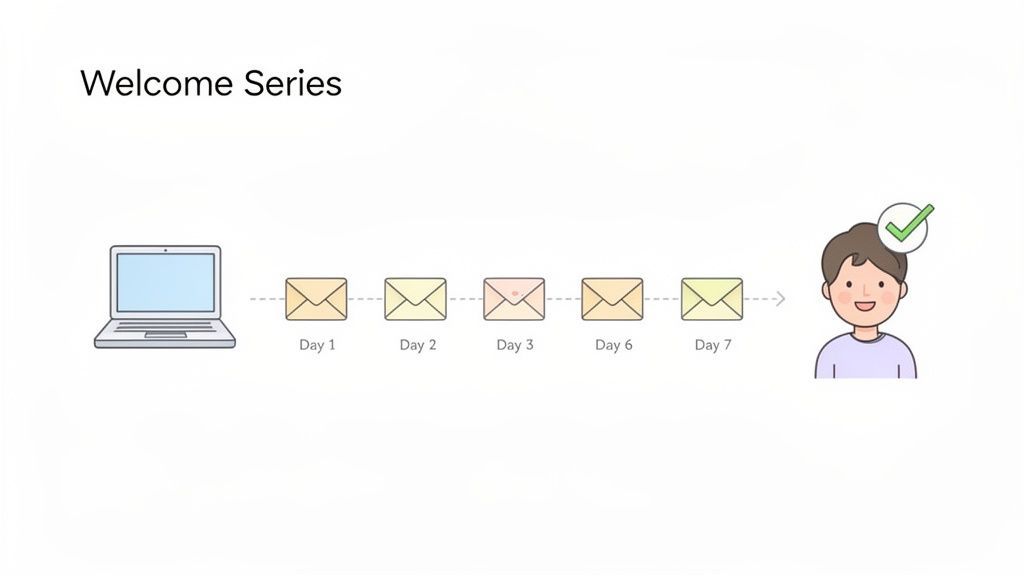
A welcome series for SaaS free trial users is a foundational drip campaign designed to convert sign-ups into paying customers. This automated sequence delivers timely educational content and feature highlights over the 7-14 day trial period. Its primary goal is to guide the user to their "aha!" moment, demonstrating the product's core value and making the upgrade to a paid plan a logical next step.
This drip campaign is critical because a user’s initial engagement directly impacts their long-term retention and lifetime value (LTV). Companies like Notion have mastered this, introducing users to templates, then databases, and finally team features, progressively revealing the app’s power without causing overwhelm.
Strategic Breakdown and Sequence
This is a powerful example of drip marketing because it directly ties marketing actions to product activation and revenue.
- Campaign Goal: Maximize trial-to-paid conversion rate by driving user activation. Target a 15-25% conversion rate.
- Audience: New free trial sign-ups. Segment based on user role (e.g., admin vs. team member) or initial in-app action.
- Sequence & Timing:Email 1 (Immediately): Welcome & First Step. Subject:
Welcome to [Product]! Here's how to start.Guide them to one key action. - Email 2 (Day 2): Introduce a Core Feature. Subject:
Pro Tip: Automate [Task] with [Feature].Focus on a quick win. - Email 3 (Day 4): Social Proof. Subject:
How [Similar Company] achieved [Result].Share a case study to build trust and demonstrate ROI. - Email 4 (Day 7): Advanced Tip or Product Tour. Subject:
Ready to become a [Product] power user?An embedded video walkthrough works well here.
Actionable Insight: The most effective welcome drips are behavior-based. If a user completes a key action, trigger an email guiding them to the next logical step. If they are inactive for 48 hours, send a re-engagement email with support options or a helpful tutorial. This dynamic approach significantly outperforms static sequences.
2. E-commerce Abandoned Cart Recovery Campaign
An abandoned cart recovery campaign is a high-ROI automated sequence targeting shoppers who add items to their cart but leave without purchasing. This time-sensitive drip uses email and SMS to send reminders, create urgency, and offer incentives. Its sole purpose is to recover lost sales.
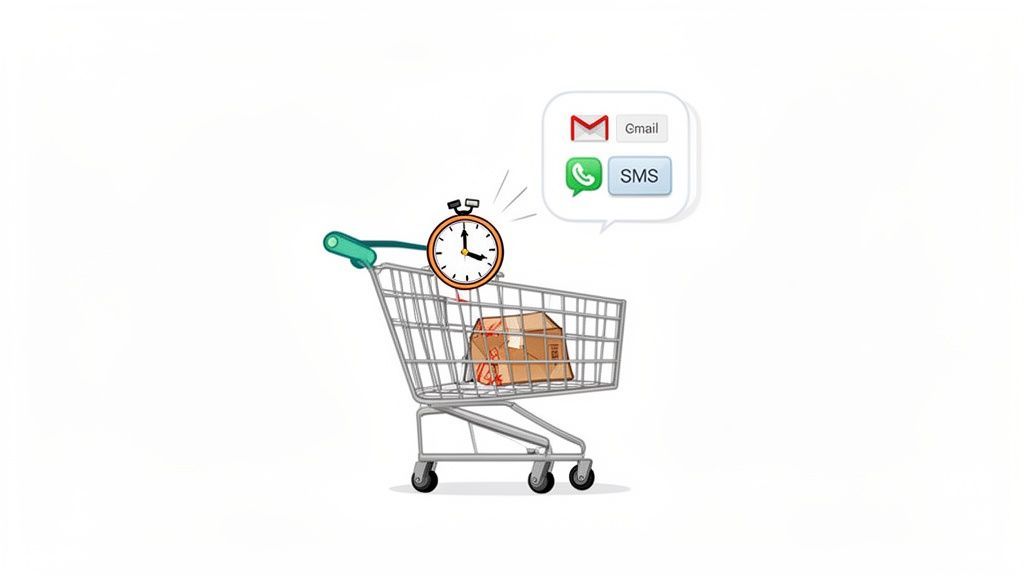
This drip campaign is a staple for a reason; brands often reclaim 10-30% of abandoned carts. Fashion retailer ASOS effectively combines email with urgent SMS reminders, while Warby Parker uses copy like "Your frames are waiting" to pull users back. This is a critical example of drip marketing because it directly impacts bottom-line revenue with minimal ongoing effort once set up.
Strategic Breakdown and Sequence
Understanding how to reduce shopping cart abandonment is the first step; this automated flow is the direct response. At Ezca, our email marketing services specialize in building these high-ROI sequences to recapture lost revenue.
- Campaign Goal: Recover lost sales. A successful sequence can recover 10-15% of abandoned carts, representing a significant revenue lift.
- Audience: Visitors who provided an email/phone number during checkout but did not purchase. Segment by cart value (e.g., >$100 vs. <$100) for different incentive strategies.
- Sequence & Timing:Email 1 (30-60 Minutes): Gentle Reminder. Subject:
Did you forget something?Include images of the cart items. This is a helpful nudge, not a hard sell. - Email 2 (24 Hours): Introduce an Incentive. Subject:
Complete your order + enjoy free shipping.A soft incentive like free shipping often outperforms a discount. - SMS 1 (24-48 Hours): Urgent Nudge. Copy:
Your [Brand] cart expires soon! Click here to finish your order: [Link]. SMS has a ~98% open rate, making it perfect for a final push. - Email 3 (48-72 Hours): Final Offer & Urgency. Subject:
Last chance: Get 15% off your cart!Present the strongest offer combined with urgency.
Actionable Insight: Test your incentives rigorously. A/B test a 10% discount against free shipping to see what resonates with your audience. For high-value carts (e.g., >$250), a larger discount is justifiable and can maximize both recovery rate and profit margin.
3. B2B Lead Nurturing Campaign for Long Sales Cycles
For industries with 6-12+ month sales cycles, a B2B lead nurturing campaign is essential. This sustained drip sequence delivers a strategic mix of educational content, case studies, and thought leadership to keep leads engaged. The goal is to build trust and maintain top-of-mind awareness, so your brand is the clear choice when the prospect is finally ready to buy.
This campaign is crucial for enterprise software, professional services, and high-ticket B2B products where purchase decisions involve multiple stakeholders. Companies like Salesforce use marketing automation to deliver relevant content at each stage of the buyer's journey. A prospect might receive a whitepaper, followed by a webinar invitation a month later, then a targeted case study relevant to their industry.
Strategic Breakdown and Sequence
This is one of the most powerful drip marketing examples because it turns cold leads into sales-ready opportunities over time.
- Campaign Goal: Nurture MQLs to SQLs, build authority, and identify buying signals. Success metric: Increase MQL-to-SQL conversion rate by 20%.
- Audience: Marketing Qualified Leads (MQLs) who are not yet sales-ready. Segment by industry, company size, and job role (e.g., IT Director vs. CFO).
- Sequence & Timing:Email 1 (Week 1): Educational Content. Subject:
[Report] The Future of [Prospect's Industry]. Deliver a high-value, non-promotional asset. - Email 2 (Week 4): Problem-Focused Webinar. Subject:
Solving [Common Pain Point] for companies like yours.Introduce a solution-oriented event. - Email 3 (Week 8): Targeted Case Study. Subject:
How [Similar Company] increased ROI by X%. Provide social proof relevant to the prospect's context. - Email 4 (Week 12): ROI Calculator or Tool. Subject:
Calculate your potential savings with [Product/Service]. Offer a tool to help them build an internal business case.
Actionable Insight: Implement lead scoring. As leads engage with content (downloading PDFs, attending webinars), their score increases. Once a threshold is met (e.g., a score of 100), automate an alert to a sales representative for a timely, personalized follow-up. This aligns marketing and sales efforts for maximum ROI.
4. Post-Purchase Customer Onboarding and Success Campaign
A post-purchase onboarding campaign begins the moment a customer buys. Its purpose shifts from conversion to retention and expansion. This drip guides new customers through product adoption, reinforces the value of their purchase, and builds a foundation for loyalty, ultimately reducing churn and increasing customer lifetime value (CLV).
This campaign is fundamental for any subscription-based business (e.g., SaaS) where sustained usage is tied to profitability. Asana excels at this, sending tips to encourage project creation and team invites. These actions drive a user from signing up to actively collaborating, solidifying the product's value.
Strategic Breakdown and Sequence
This is a powerful example of drip marketing because it nurtures the customer relationship beyond the sale, turning a transaction into a partnership.
- Campaign Goal: Maximize retention, drive deep product adoption, and identify upsell opportunities. Target a 10% reduction in first-90-day churn.
- Audience: New paying customers. Segment by subscription tier or intended use case (e.g., marketing team vs. engineering team).
- Sequence & Timing:Email 1 (Within 1 Hour of Purchase): Welcome & First Key Action. Subject:
Welcome Aboard! Your first step to success with [Product].Direct them to a single, critical setup task. - Email 2 (Day 3): Celebrate an Early Win. Subject:
You’ve already accomplished [Milestone]!Acknowledge their first major action to build momentum. - Email 3 (Day 7): Introduce an Advanced Feature. Subject:
Unlock more power: A quick guide to [Advanced Feature].Showcase a capability that solves a deeper pain point. - Email 4 (Day 14): Check-in & Offer Help. Subject:
How are things going with [Product]?A human-centric email from a "Customer Success Manager" to offer support.
Actionable Insight: Synchronize automated drips with human touchpoints. Use product usage data to trigger emails celebrating milestones, but also use it to alert your Customer Success team when a user is struggling or shows signs of high growth potential. This tech-and-touch approach creates a superior customer experience and higher CLV.
5. Webinar and Virtual Event Promotion Drip Campaign
A webinar promotion drip campaign works before, during, and after a virtual event to maximize attendance and convert leads. This multi-stage approach builds anticipation, reminds registrants to attend, and follows up strategically to turn attendees into qualified sales opportunities. It's a cornerstone for B2B marketers using educational content to generate pipeline.
This is one of the most effective drip marketing examples because it supports a high-value marketing initiative. HubSpot has built a massive lead generation engine on this model, consistently achieving attendance rates over 40% and demonstrating a clear path from registration to revenue.
Strategic Breakdown and Sequence
A successful webinar drip isn't just a series of reminders; it's a coordinated effort to create value and urgency.
- Campaign Goal: Drive maximum live attendance (target 35-45% of registrants), increase post-event engagement, and generate qualified leads.
- Audience: Segmented into three core groups: Registrants (before), Attendees (after), and Non-Attendees (after).
- Sequence & Timing:Email 1 (3 Weeks Out): Initial Invitation. Subject:
[New Guide] How to Double Your MQLs in 60 Days. Focus on the value and outcome. - Email 2 (1 Week Out): Agenda & Speaker Teaser. Subject:
Meet the experts behind our [Topic] strategy. Build credibility. - Email 3 (Day Of - 1 Hour Before): Final Reminder. Subject:
We're starting in 1 hour! [Webinar Name]. Create urgency and provide the join link. - Email 4 (Immediately Post-Event): Attendee Thank You & Offer. Subject:
Thanks for joining! Here are your resources. Send exclusive content (slides, special offer) only to attendees. - Email 5 (24 Hours Post-Event): Replay for Non-Attendees. Subject:
You missed it, but here's the replay for [Webinar Name]. Provide a time-sensitive link to the recording.
Actionable Insight: Post-event segmentation is critical. Attendees are warm leads who should get an immediate, high-value offer or a meeting link. Non-attendees need a different nurture path focused on catching them up. Sending a generic "thanks for registering" email to everyone misses a huge ROI opportunity.
6. Re-engagement Campaign for Inactive Customers or Leads
A re-engagement or "win-back" campaign is a targeted drip sequence designed to reactivate dormant customers or leads. This automated series triggers after a defined period of inactivity (e.g., 60-90 days), delivering value reminders, new feature announcements, and special offers to reignite interest before they are lost for good.
This drip campaign is essential for combating churn and maximizing CLV. Netflix’s iconic "We miss you" emails use personalized show recommendations to lure dormant subscribers back. This is a powerful example of drip marketing because it directly addresses a critical revenue risk, turning potential churn into renewed engagement.
Strategic Breakdown and Sequence
A well-executed re-engagement campaign is a strategic effort to retain a valuable asset.
- Campaign Goal: Re-activate dormant users and prevent churn. A successful campaign can win back 5-10% of the targeted segment.
- Audience: Inactive users (last activity > 60 days). Segment by past behavior (e.g., was a power user vs. low-engagement user).
- Sequence & Timing:Email 1 (60 Days Inactive): Gentle Nudge & Value Reminder. Subject:
New since you've been away at [Product].Focus on what’s new and improved. - Email 2 (75 Days Inactive): Social Proof & Use Case. Subject:
How [Similar Company] gets value from [Product].Re-establish relevance with a success story. - Email 3 (90 Days Inactive): Direct Offer. Subject:
A special 25% offer to welcome you back.Introduce a compelling, limited-time discount to create urgency. - Email 4 (120 Days Inactive): The "Goodbye" Email. Subject:
We're cleaning up our email list.Inform them they will be unsubscribed unless they take action. This cleans your list and improves deliverability.
Actionable Insight: Don't just beg a user to come back; demonstrate evolved value. Lead with what has improved or what new problems your product now solves. If a user is still inactive, a final "permission-based" email that offers a graceful exit is a best practice for list hygiene and maintaining a strong sender reputation.
7. Content Consumption and Educational Nurture Funnel
An educational nurture funnel is a drip campaign that prioritizes teaching prospects over selling to them. It delivers a progressive series of high-value content to build trust, establish your brand as an authority, and guide potential customers through complex buying decisions. This is ideal for B2B or products with a long, considered sales cycle.
This strategy is one of the most powerful drip marketing examples for building a durable pipeline. HubSpot has perfected this with its free certification courses, which educate users on marketing principles while organically introducing their software as the tool to execute those principles.
Strategic Breakdown and Sequence
This campaign's effectiveness comes from its patience; it builds a relationship by offering genuine value before asking for the sale.
- Campaign Goal: Educate and nurture leads, establish thought leadership, and guide them toward a purchase-ready state.
- Audience: Early-to-mid-stage prospects, segmented by persona, industry, or interest in a specific topic (e.g., downloaded an ebook on "AI in Marketing").
- Sequence & Timing:Email 1 (Day 1): Foundational Content. Subject:
Your guide to [Industry Topic] is here.Deliver an introductory asset that defines the problem. - Email 2 (Day 4): Deeper Dive. Subject:
Next Step: The "Why" behind [Solution Area].Share a more detailed resource, like a whitepaper or webinar recording. - Email 3 (Day 8): Introduce Your Approach. Subject:
How [Your Company] helps solve [Problem].Begin connecting the educational content to your specific solution. - Email 4 (Day 12): Social Proof/Case Study. Subject:
How [Similar Company] achieved [Specific Result].Provide a case study demonstrating ROI. - Email 5 (Day 15): Bottom-of-Funnel Offer. Subject:
Ready to see how it works?Offer a demo or consultation now that the prospect is educated.
Actionable Insight: This funnel starts broad ("what" and "why") before narrowing to "how" and "who" (your company). Use lead scoring to track engagement. Gating more advanced content (like an in-depth report) behind a form helps you identify highly engaged, sales-ready leads based on their content consumption behavior.
8. Product Launch and Feature Announcement Campaign
A product launch campaign is a time-sensitive drip sequence designed to generate excitement and drive adoption for new releases. It informs existing customers and prospects about a new product or feature, highlighting its value and guiding them toward usage. The objective is to turn a release event into a revenue and customer engagement opportunity.
This drip campaign is essential for maximizing the ROI of product development. Companies like Slack have set the standard, transforming announcements into major events. Slack's launch drips often include in-app notifications, educational emails with GIFs showing the feature in action, and blog posts to ensure users understand how to use it.
Strategic Breakdown and Sequence
This is a powerful example of drip marketing because it aligns marketing communications directly with product roadmap milestones.
- Campaign Goal: Drive rapid adoption of a new product/feature and generate buzz. Metric: Achieve 20% adoption among the target user segment within 30 days.
- Audience: Existing customers (segmented by usage or plan), active trial users, and warm marketing leads.
- Sequence & Timing:Email 1 (1-2 Weeks Before Launch): Teaser. Subject:
Something big is coming to [Your Brand] on [Date].Build anticipation without revealing details. - Email 2 (3-5 Days Before Launch): Benefit Reveal. Subject:
Get ready to solve [Problem] like never before.Focus on the "what's in it for me." - Email 3 (Launch Day): The Announcement. Subject:
It's here! Introducing [New Feature/Product Name].Provide a clear CTA to try it now, with a link to a demo or tour. - Email 4 (2-3 Days Post-Launch): Social Proof & Use Cases. Subject:
See how customers are loving [New Feature].Share testimonials from beta users to inspire adoption.
Actionable Insight: A launch is a multi-channel event. Coordinate your message across email, social media, in-app notifications, and even paid retargeting ads. Segment your audience: announce a power-user feature to the right people, not to new users still learning the basics. This targeted approach maximizes relevance and adoption rates.
9. Referral and Ambassador Program Drip Campaign
A referral program drip campaign is a specialized sequence designed to turn existing customers into a cost-effective acquisition channel. This campaign systematically educates happy customers on the benefits of sharing, provides easy-to-use tools, and rewards their advocacy. The goal is to activate a base of brand evangelists who bring in high-quality, warm leads.
This strategy is one of the most effective drip marketing examples for sustainable growth. Dropbox famously used this model to grow by 3900% in 15 months, rewarding users with extra storage for referrals. Similarly, Airbnb's host and guest referral programs were central to its early global expansion.
Strategic Breakdown and Sequence
An effective referral drip is an automated effort to encourage and simplify sharing.
- Campaign Goal: Activate existing customers to become active referrers, driving low-cost, high-conversion leads. Target a Customer Acquisition Cost (CAC) that is 50% lower than paid channels.
- Audience: Satisfied customers, identified by high Net Promoter Scores (NPS), positive reviews, or repeat purchase history.
- Sequence & Timing:Email 1 (Immediately after a positive signal, e.g., a 5-star review): The Invitation. Subject:
A special invitation for you, [First Name]. Introduce the program and its core benefit. - Email 2 (3-5 days later): How-To & Simplification. Subject:
Sharing [Product] is easy (and rewarding). Provide a pre-written message and one-click share links. - Email 3 (1-2 weeks later): Reinforce the "Why". Subject:
Give friends [Benefit], get [Reward]. Focus on the mutual value. - Email 4 (Monthly check-in): Progress & Nudge. Subject:
Your referral stats are in!. Show them their referral dashboard to prompt action.
Actionable Insight: Remove all friction. Don't just tell customers the reward; show them exactly how to share in 10 seconds. Provide a dedicated dashboard where they can track clicks, sign-ups, and earned rewards in real-time to gamify the experience and drive sustained engagement.
10. Seasonal and Promotional Campaign Drip Series
A seasonal or promotional drip series is a time-sensitive campaign built around events like holidays or major sales. This automated sequence is engineered to build anticipation, create urgency, and maximize revenue during high-intent purchasing periods. It’s a staple for e-commerce brands driving sales spikes and for recurring revenue businesses launching limited-time offers.
This drip campaign is powerful because it capitalizes on external events that already have consumers in a buying mindset. Amazon’s Prime Day and Black Friday/Cyber Monday are perfect examples. They don't just announce a sale; they create a multi-week event around it, turning a simple discount into a significant revenue driver.
Strategic Breakdown and Sequence
This is a top-tier example of drip marketing because it ties communication cadences to inventory and peak revenue goals.
- Campaign Goal: Drive a significant sales spike during a specific promotional window. Target a 2-3x lift in daily revenue during the sale period.
- Audience: The entire email/SMS list, segmented into tiers: VIPs/loyal customers, recent purchasers, and subscribers who have never purchased.
- Sequence & Timing:Email 1 (2-3 Weeks Prior): Announce the event. Subject:
It’s Coming… Our Biggest Sale of the Season.Build initial awareness. - Email 2 (1 Week Prior): Reveal the offer. Subject:
First Look: Get Ready for 30% Off Everything.Give subscribers a reason to plan their purchases. - Email 3 (Day Of Launch): Sale is Live. Subject:
It’s Here! The Holiday Sale Starts Now.Drive immediate traffic and conversions. - Email 4 (24 Hours Before End): Final Reminder. Subject:
Last Chance: Our Sale Ends Tomorrow!Use a countdown timer to amplify urgency.
Actionable Insight: Profit lies in segmentation. Send your best customers a "VIP early access" email 24 hours before the general public. For subscribers who haven't purchased, focus messaging on the value of the discount or free shipping. This targeted approach maximizes conversions across different customer segments and increases overall ROI.
10-Point Drip Marketing Campaign Comparison
Turning Examples Into Your Growth Engine
The drip marketing examples we've explored move beyond simple automation. From SaaS onboarding to long-cycle B2B nurturing, each case study demonstrates a core principle: strategic, value-driven communication is the foundation of scalable growth. These are dynamic systems designed to guide prospects and customers through their unique journeys.
A successful campaign is defined by its relevance, not its complexity. The best examples don't just send information; they deliver specific assets that address pain points at each stage of the buying process. The e-commerce abandoned cart sequence uses a multi-channel approach (email, SMS) to create a cohesive experience that respects the customer's context and timing.
From Blueprint to Actionable Strategy
Seeing these examples is one thing; implementing them effectively is another. To bridge the gap between blueprint and execution, you must shift from isolated tactics to an integrated system.
Key Strategic Takeaways:
- Segmentation is Non-Negotiable: Every high-performing campaign began with a deep understanding of its audience. Whether segmenting by user behavior, purchase history, or lead score, precision targeting is mandatory.
- Value Precedes the Ask: The post-purchase and educational funnels are perfect illustrations. They prioritize customer success and education, building trust long before asking for a referral, an upsell, or the final sale.
- Timing is a Competitive Advantage: A welcome email sent a day late or a cart reminder sent a week late loses its impact. The timing detailed in these drip marketing examples is intentional, designed to align with the user's decision-making process.
- Measurement Dictates Optimization: Each campaign identified clear success metrics, from conversion rates to CLV. Without this data, you're flying blind. Continuous measurement allows you to test hypotheses and allocate resources to what’s working.
Implementing Your Own Growth Engine
The path forward is a structured one. Start by mapping your most critical customer journeys. Where are the biggest drop-off points? Where is the greatest opportunity to add value? Choose one high-impact area—like onboarding new customers or re-engaging inactive leads—and build your first campaign.
Use the structures in this article as your starting point. Define your goal, segment your audience, map the sequence, and define your KPIs before you launch. After launching, commit to a cycle of review and refinement. This process of building, measuring, and learning is the true engine of sustainable growth. The goal isn't just to implement a few drip campaigns; it's to build a system that consistently turns prospects into customers and customers into loyal fans.
The campaigns we've detailed require a blend of strategic planning, creative execution, and analytical rigor. At Ezca, our squad-based model is designed to manage this entire process for you, turning these drip marketing examples from theory into a powerful revenue driver for your business. If you're ready to build a sophisticated automation engine that delivers measurable results, let's connect and map out your strategy.