
What Is a Data Driven Marketing Agency and How Do They Work?
Discover how a data driven marketing agency uses analytics and AI to deliver real ROI. Learn the questions to ask before hiring an agency for your business.
A data-driven marketing agency isn't your typical creative shop. Think of them less as artists relying on intuition and more as an analytics-driven growth team embedded in your business. Their entire philosophy revolves around using hard data to make every marketing decision, ensuring every dollar you spend has a clear, measurable impact on your bottom line.
For marketing leaders and business owners, this approach transforms marketing from a cost center into a predictable revenue engine.
What Does a Data Driven Marketing Agency Actually Do?
Imagine your marketing is a complex engine. A true data-driven agency acts as the telemetry system, providing real-time analytics that show you exactly how every component is performing. This allows for precise, strategic adjustments that drive real growth, moving far beyond vanity metrics like likes and shares.
This isn't just a trend; the ROI is significant. Data-driven strategies can deliver six times higher profitability year-over-year. Personalized campaigns informed by customer data can boost ROI by 5-8x and lift sales by 10% or more.
For example, an e-commerce brand might discover through data analysis that customers who buy Product A are 70% more likely to buy Product B within 30 days. The agency would immediately build an automated email and retargeting campaign to capitalize on this, directly increasing Customer Lifetime Value (LTV).
Traditional vs. Data-Driven Agency At a Glance
The difference in mindset and execution is stark. For a business owner, this table highlights the shift from spending on marketing activities to investing in business outcomes.
Ultimately, a data-driven partner is obsessed with tying every action back to a measurable business outcome, transforming marketing from an expense into a quantifiable investment.
From Insights to Action
A great data-driven agency doesn’t just hand you reports. They are translators, turning raw numbers into an actionable game plan. The core process is simple but powerful: data informs strategy, strategy guides execution, and execution produces measurable results.
For marketing leaders, this changes the conversation. You move from, "I think this ad will work," to, "The data shows this audience segment has a 25% higher conversion rate, so we are shifting 15% more budget to it."
The fundamental promise of a data-driven approach is accountability. Every campaign, every ad, and every piece of content has a clear job to do and a way to measure its success, whether that’s lowering your Customer Acquisition Cost (CAC) or increasing Customer Lifetime Value (LTV).
How This Approach Delivers Verifiable Results
The entire model is built on a continuous feedback loop. This cycle ensures your marketing spend is constantly optimized to maximize ROI.
- Measure Everything: They track every meaningful touchpoint in the customer journey, from the first ad impression to final conversion and repeat purchases.
- Analyze Performance: Using advanced analytics, they pinpoint exactly which channels, campaigns, and messages are driving the most valuable outcomes.
- Optimize and Iterate: Based on the data, they reallocate budgets, fine-tune audience targeting, and A/B test creative to improve performance. This agile process allows for rapid adjustments, keeping marketing aligned with business goals.
For example, if data shows that LinkedIn ads are generating leads with a 50% higher MQL-to-SQL conversion rate than Facebook ads for a B2B SaaS client, the agency will immediately shift budget toward LinkedIn. This obsession with performance is central to how we approach all our performance marketing services, ensuring we consistently drive tangible results for our partners.
The Engine Room: Where Analytics, Attribution, and Optimization Drive Growth
If a data-driven marketing agency is a high-performance vehicle, its engine is a powerful combination of three interconnected parts: analytics, attribution, and optimization. For business owners and marketing leaders, this is where raw data is forged into revenue. These pillars work in concert to answer the most critical question: "What is the ROI of my marketing spend?"
This simple flowchart breaks down the core idea: it all starts with clean, reliable data. That data fuels a clear strategy, which in turn leads directly to measurable growth.
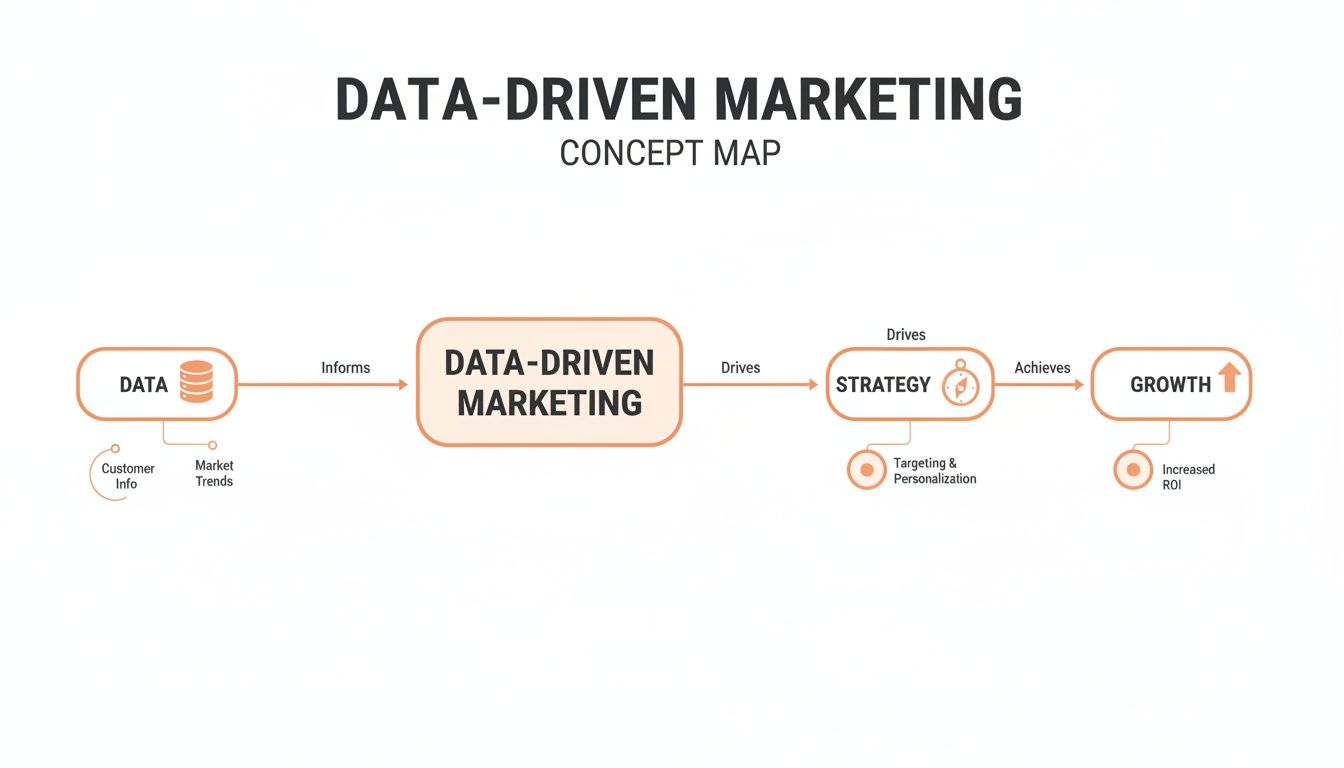
Without a solid data foundation, any marketing strategy is just guesswork. And guesswork makes sustainable growth impossible.
Analytics That Actually Drive Business Decisions
Real analytics go far beyond vanity metrics like social media likes or website impressions. A top-tier data-driven agency cuts through the noise and focuses squarely on business-critical KPIs that connect directly to your P&L.
These are the metrics that truly matter:
- Customer Acquisition Cost (CAC): Exactly how much you spend to acquire a new customer. The goal is to continuously lower this number while maintaining or improving lead quality.
- Lifetime Value (LTV): The total projected revenue a single customer will generate. A rising LTV is a key indicator of a healthy, sustainable business. The LTV:CAC ratio is a crucial health metric.
- MQL-to-SQL Conversion Rate: Especially vital for B2B, this measures how many marketing-qualified leads become sales-qualified leads, indicating lead quality and sales/marketing alignment.
- Return on Ad Spend (ROAS): The ultimate measure of paid media efficiency. It shows precisely how much revenue you generate for every dollar spent on advertising.
By focusing on these KPIs, every marketing decision becomes financially grounded. You move from "we got more traffic" to "we reduced CAC by 15% while increasing qualified leads by 20%." That's a conversation every CEO and board member wants to have.
Attribution Models: Uncovering a Channel's True Value
Attribution is the science of assigning credit to the marketing touchpoints that influence a conversion. Without a smart attribution model, you risk over-investing in channels that simply claim final credit (like branded search) while under-funding channels that did the heavy lifting of building awareness and consideration.
Choosing the right model is critical for accurate ROI measurement:
- First-Touch Attribution: Gives 100% credit to the first interaction. Useful for understanding what initiates the customer journey but ignores all subsequent influence.
- Last-Touch Attribution: The most common but often misleading model. It gives 100% credit to the final touchpoint, ignoring the funnel-building activities that preceded it.
- Multi-Touch Attribution: The most sophisticated approach. It distributes credit across multiple touchpoints. Models like Linear, Time-Decay, and U-Shaped provide a more accurate picture of how different channels contribute to a sale.
For a complex B2B sale, relying on a last-click model is like giving all the credit for a championship win to the player who scored the final point. You ignore the assists, defense, and teamwork that made the win possible.
Optimization That Directly Impacts Your Revenue
Optimization, or Conversion Rate Optimization (CRO), is where insights from analytics and attribution are put into action. It's a systematic process of testing and improving every element of your customer journey to increase the percentage of users who take a desired action.
This is how a data-driven agency ensures your marketing budget works harder and smarter.
Here are a few tangible examples with real ROI impact:
- A/B Testing a Headline: On a B2B landing page, changing "Our Software Features" to "Cut Project Time by 40%. See How." could boost demo requests by 20%, directly increasing sales pipeline.
- Redesigning a Checkout Flow: For an e-commerce store, simplifying a checkout from three steps to one could slash cart abandonment by 35%, directly increasing revenue.
- Optimizing Ad Creative: Testing a testimonial video ad against a static image on social media might reveal the video generates leads at a 50% lower Cost Per Acquisition (CPA).
This relentless testing cycle is essential. Performance specialists like Ezca focus on this opportunity, targeting e-commerce and B2B growth with highly personalized tactics. This strategy is backed by the 80% of marketers who report better results from personalization. You can explore more powerful agency marketing trends to see the full impact.
How Top Agencies Use AI to Amplify Human Expertise
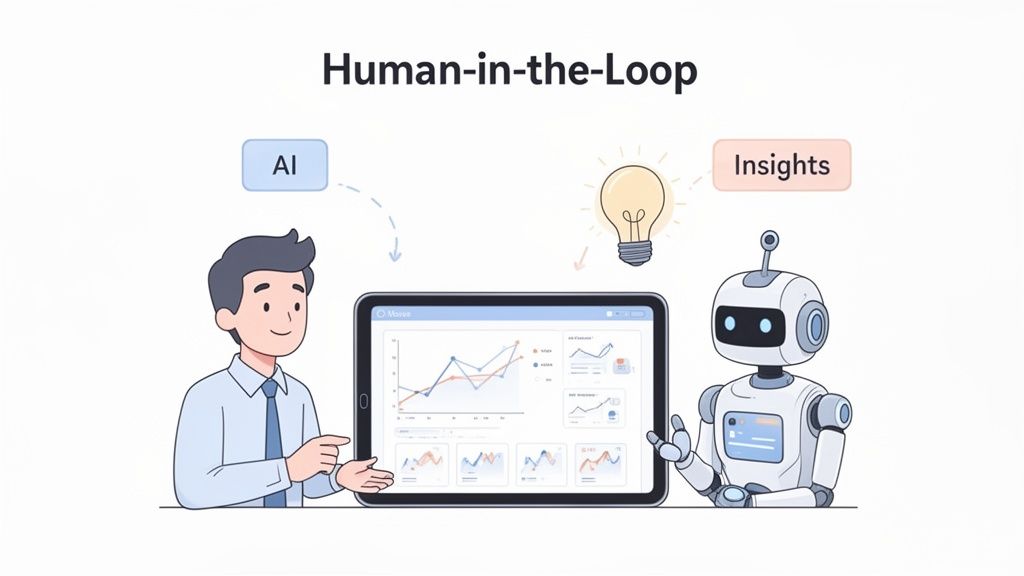
A modern data-driven marketing agency doesn't replace skilled strategists with AI; it supercharges them. AI acts as a powerful co-pilot, handling massive-scale analysis and pattern recognition so human experts can focus on high-level strategy, creative direction, and final judgment calls.
This hybrid "human-in-the-loop" model combines the raw computational power of machines with the irreplaceable strategic wisdom of experienced marketers.
Practical AI Applications in Marketing
AI is a practical toolset that top agencies use daily to gain a competitive edge. It analyzes thousands of data points in minutes—a task that would take a human team weeks—unlocking a new level of agility and precision.
Here’s how that delivers actionable results:
- PPC Campaign Optimization: AI can analyze thousands of ad variations to predict which will perform best before spending a dollar. For an e-commerce brand, this could mean identifying that an ad showing a product in-use combined with a "free shipping" message drives a 30% higher ROAS among women aged 25-34 on Instagram.
- Predictive Lead Scoring: For B2B companies, AI models analyze CRM data and user behavior to score leads. A score of 90+ might indicate a prospect has visited the pricing page three times and works at a 500+ person company, signaling sales to engage immediately.
- Audience Segmentation: AI can sift through audience data to identify niche segments a human might miss. For instance, it might discover a high-LTV segment of "weekend project" buyers for a hardware retailer, allowing for hyper-targeted campaigns.
Supercharging Content and SEO Strategy
Generative AI has become a game-changer for content and SEO. It automates tedious tasks, freeing up strategists to focus on brand voice, strategic messaging, and creating an emotional connection.
The generative AI marketing market is projected to hit $22 billion by 2032. The 83% of sales teams using AI who report revenue growth are a testament to its effectiveness. To stay ahead, smart agencies are using AI for data analysis to move faster and uncover insights.
AI is fantastic at generating outlines, summarizing research, and creating first drafts. The human marketer’s job is to then infuse that raw output with brand personality, strategic purpose, and the creative spark that builds a genuine connection with the audience.
This human-AI partnership accelerates the entire content lifecycle. At Ezca, our teams use these tools to move faster and deliver better results. A structured approach to AI enablement is core to how we ensure our human experts consistently outperform the competition. The real value lies in this synergy—combining human expertise with AI efficiency to create a smarter, faster marketing engine.
The 90-Day Sprint Framework for Predictable Growth
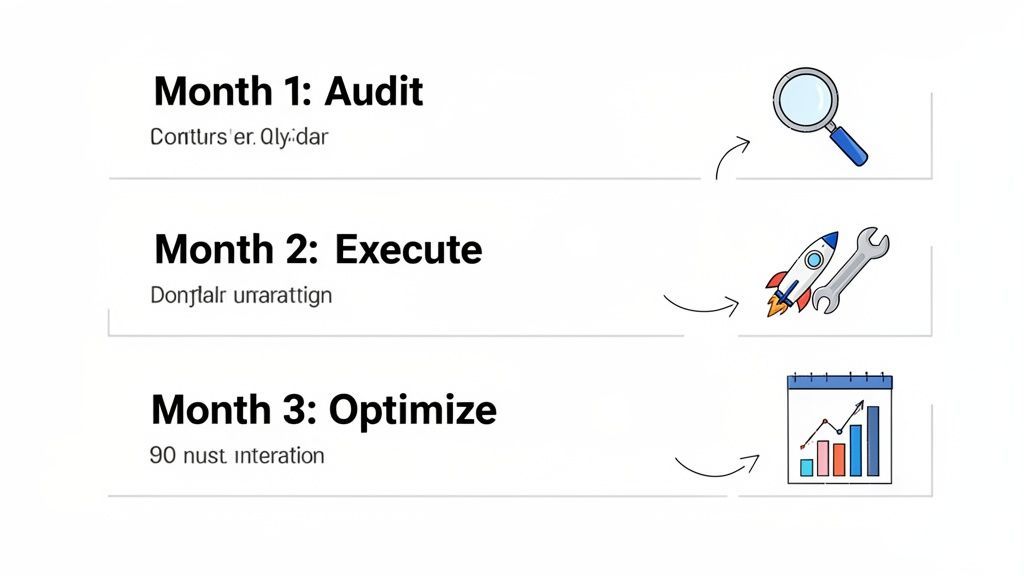
The best data-driven agencies have abandoned rigid, long-term retainers for a more agile and accountable system: the 90-day sprint. This framework builds momentum, ensures transparency, and delivers predictable results by breaking large marketing goals into manageable quarterly cycles of auditing, executing, and optimizing.
For a business owner or marketing leader, this is a game-changer. You're no longer waiting a year to see if a strategy pays off. Sprints provide clear checkpoints every 90 days, enabling you to pivot based on real performance data and keeping your investment tightly tethered to results.
Month 1: The Audit and Strategy Phase
The first 30 days are about building a rock-solid foundation. This is a deep-dive audit of your entire marketing ecosystem to find the quickest wins and establish a clear baseline for every important metric.
In this initial phase, a data-driven marketing agency will:
- Conduct comprehensive audits: Dig into technical SEO, conversion rate optimization (CRO) opportunities, paid media account structures, and content performance to identify immediate impact areas.
- Align on KPIs: Partner with you to define the North Star metrics that drive your business—typically Customer Acquisition Cost (CAC), Lifetime Value (LTV), and qualified lead velocity.
- Deploy "quick-win" strategies: Based on audit findings, launch initial campaigns. This could be fixing critical site speed issues, reallocating ad budgets from a failing channel, or optimizing a high-traffic landing page for a 5% conversion lift.
Month 2: The Execution and Testing Phase
With a clear strategy, Month 2 is about high-tempo execution and rapid learning. The agency launches campaigns, collects data, and runs controlled experiments to learn what your audience truly responds to. The focus is on generating statistically significant data, not just activity.
A core principle of the sprint model is that every action is a test. A new ad, a different landing page headline, or a fresh email sequence is an opportunity to validate a hypothesis with data, not opinions.
This is where breakthroughs happen. For instance, an A/B test might show one ad creative delivers a 30% lower cost per lead—a clear signal to scale budget. An agency like Ezca would dynamically shift ad spend to the highest-performing channels weekly, improving ROI in near real-time.
Month 3: The Analysis and Optimization Phase
The final month is for analysis and planning. The agency synthesizes all the data from Month 2 into a clear, actionable report. This is a strategic debrief that explains what worked, what didn't, and most importantly, why.
Here’s what happens in this phase:
- Comprehensive performance review: The team analyzes the sprint's impact on your core KPIs. Did CAC drop by 10%? Did MQLs increase by 15%?
- Strategic optimization: Winning strategies are scaled, while underperforming campaigns are cut or re-engineered based on the data.
- Planning the next 90-day sprint: Insights are used to build an even smarter, more targeted plan for the next quarter.
This cyclical process creates a powerful feedback loop. Each 90-day sprint builds on the lessons of the last, generating compounding growth and making your marketing more effective and efficient over time.
How to Evaluate Your Next Data-Driven Agency
Choosing a data-driven marketing agency is a critical decision. The right partner becomes a growth engine for your company; the wrong one can burn cash with little to show for it. To make a smart choice, you must dig deeper than a slick sales presentation and ask questions that reveal their operational DNA.
Think of the evaluation as a deep dive into their thinking. It’s less about their pitch and more about their process and problem-solving skills.
The Critical Questions to Ask
Forget generic questions about team size. Put them on the spot with scenarios that force them to demonstrate their data-driven expertise. Your goal is to see evidence of their process in action.
Here are the questions that separate the real experts from the pretenders:
- "Show me a sanitized client dashboard. What KPIs do you prioritize for a business like mine, and why?" This is a powerful gut check. A competent agency will immediately pull up an anonymized dashboard and explain why they focus on metrics like ROAS, the LTV:CAC ratio, or MQL to SQL conversion rate. Their answer reveals whether they think like a business owner or a typical marketer.
- "Walk me through a time you pivoted strategy mid-sprint based on new data. What was the trigger, what did you change, and what was the outcome?" This tests their agility. A true data-driven agency will have a story ready. They’ll recall a campaign that was underperforming, point to the specific data that sounded the alarm (like a sudden spike in cost-per-lead), and detail the exact changes they made to turn it around, with specific numbers.
- "How do you approach attribution for a business with a complex sales cycle like ours?" This reveals their sophistication. A weak answer focuses on last-click attribution. A strong one discusses the pros and cons of multi-touch models (Linear, Time-Decay, U-Shaped) and explains how they blend data sources to paint an accurate picture of what's really driving revenue.
Agency Evaluation Red Flag Checklist
As you vet potential partners, watch for common red flags that indicate a lack of true data expertise. Understanding the different agency models can also help; learn more about agencies to see how they vary.
Here’s a quick-reference guide to spot potential issues.
Agency Evaluation Red Flag Checklist
Spotting these red flags can save you from a costly mistake.
The most telling sign of a great data-driven marketing agency is their curiosity. They should ask you more questions than you ask them, digging into your customer lifecycle, profit margins, and sales process before ever proposing a solution.
Ultimately, picking the right data-driven marketing agency means finding a partner as obsessed with your business metrics as you are. A team like Ezca doesn’t just run campaigns; we build a predictable growth framework designed to move your key numbers in the right direction, sprint after sprint.
Answering Your Top Questions About Hiring a Data-Driven Agency
When considering a new agency, practical questions about cost, ROI timeline, and scope are paramount for any marketing leader or business owner. Getting clear answers is non-negotiable.
Let's tackle the most common questions head-on.
What Should We Budget for an Engagement?
Agency pricing is tied to the value and results you aim to achieve. You'll typically encounter a few pricing structures.
- Percentage of Ad Spend: Common for paid media, usually 10-20% of the monthly budget. It's simple but can incentivize spending more, not smarter.
- Flat Retainers: A fixed monthly fee for a set scope of work, offering predictable budgeting for services like SEO or content.
- Performance-Based Fees: The agency's compensation is directly linked to hitting agreed-upon KPIs, like a target cost per acquisition (CPA) or return on ad spend (ROAS). This creates powerful alignment: if you win, they win.
Many top agencies, including Ezca, use a hybrid model: a base retainer for core strategic work plus performance bonuses. This ensures dedicated resources are focused on your account while holding everyone accountable for hitting real-world numbers.
How Quickly Can We Expect to See Results?
Sustainable growth is methodical. With a 90-day sprint framework, results appear in two waves.
Leading indicators—like better click-through rates, lower cost-per-lead, or improved keyword rankings—often emerge within the first 30-60 days. However, lagging indicators—the major business results like a significant revenue jump or higher customer LTV—typically take a full 90-120 days to materialize as optimizations compound.
Do Data-Driven Agencies Also Handle Creative and Branding?
A true data-driven firm has a laser focus on performance. They don't typically handle wholesale brand redesigns or logo creation.
Instead, they operate within your established brand guidelines to produce creative assets—copy, design, video—that are scientifically engineered to get a response. The goal is not just to create a beautiful ad, but to create an asset that drives a measurable, positive return on investment.
Ezca helps SaaS, e-commerce, and B2B companies achieve measurable growth through data-driven strategies. If you're ready to build a predictable revenue engine, explore our performance marketing services.