
Content Writing vs Copywriting: Master Your Strategy
Understand content writing vs copywriting. Discover key differences in goals, KPIs, and ROI for a data-driven strategy for your SaaS, e-com, or B2B brand.

Your team probably has this argument every quarter.
One person wants more blog content because pipeline needs stronger top-of-funnel coverage. Another wants sharper landing pages, tighter ads, and better email sequences because traffic is already arriving and not converting. Finance wants faster payback. Sales wants better lead quality. Nobody wants to waste the next 90 days.
This represents the core content writing vs copywriting debate.
It is not a writing style question. It is a capital allocation question.
If you treat content and copy as interchangeable, you get the usual mess. SEO publishes articles that do not move pipeline. Paid media sends traffic to pages that explain too much and persuade too little. Product marketing writes feature pages that rank for nothing and convert poorly. Then leadership concludes “content is slow” or “ads are expensive” when the problem is simpler. The wrong writing discipline is being used for the wrong job.
The fix is not complicated. Content writing earns attention. Copywriting converts attention into action. High-growth teams know the difference and budget accordingly.
The High-Stakes Choice Content vs Copy
A CMO gets fresh budget at the start of a quarter and asks a reasonable question. Do we hire more content writers to build search demand, or do we put the money into conversion-focused copy that turns existing traffic into revenue?
That decision changes the quarter.
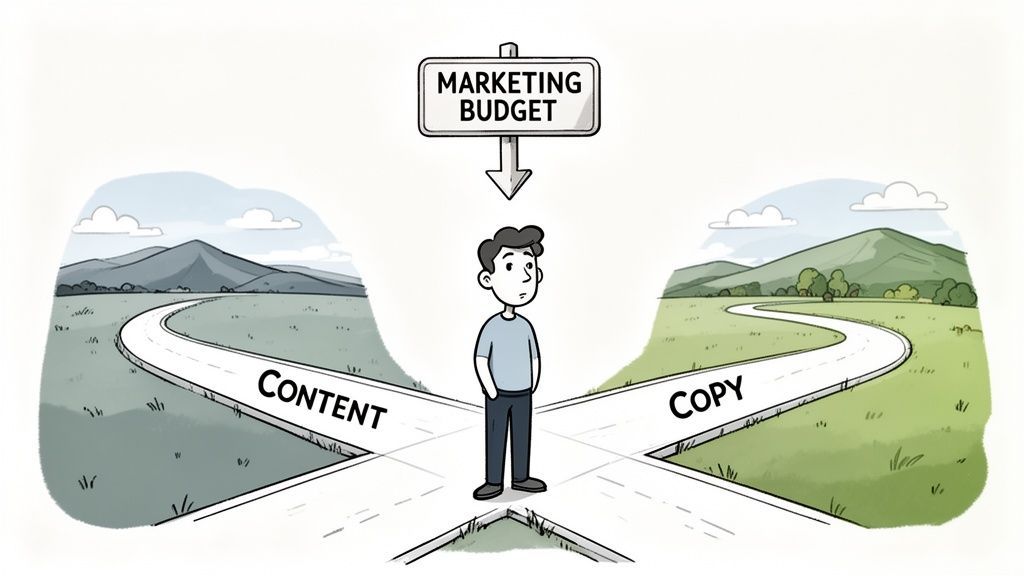
In practice, most companies are not choosing between two equal options. They are choosing which bottleneck to attack first.
If your site gets traffic but trials, demos, or checkouts stall, more articles will not rescue the quarter. You need better copy. If your paid campaigns are expensive because branded search and direct traffic do all the heavy lifting, you need stronger content to widen demand and reduce dependence on paid channels.
Consider this straightforward way to frame it:
That table looks basic. It is not. It is where most budget mistakes start.
What goes wrong when leaders blur the line
Teams often ask writers to do both jobs in one asset without deciding which outcome matters more. The result is mediocre content and weak copy.
A blog post becomes a padded sales page. A landing page turns into an educational essay. An email nurture flow reads like a knowledge base article. Buyers do not care which internal team wrote it. They respond to clarity, relevance, and timing.
If the quarter demands revenue now, put persuasive writing closer to the conversion point before you expand educational output.
The real P&L issue
The companies that grow faster do not merely “create more content.” They assign each asset a financial role. Some assets exist to lower acquisition cost over time. Others exist to improve conversion this week.
That is the lens you should use for content writing vs copywriting. Not format. Not length. Not whether the asset sits in a blog folder or a campaign folder.
Defining the Core Functions Engage vs Persuade
Content writing and copywriting often look similar on the surface. Both use words to influence buyers. Both can live on the same website. Both can support the same campaign.
Their core functions are still different.
Content writing builds trust
Content writing helps the buyer understand something.
It answers questions, frames problems, clarifies options, and gives the audience a reason to return. A strong content writer thinks like a strategist and a teacher. The goal is not to pressure the reader. The goal is to reduce friction by improving understanding.
That is why content writing usually performs best in search, education, and brand authority programs. Blog posts, resource centers, comparison articles, case-style explainers, and email newsletters all fit here. The audience is still learning, still evaluating, or still naming the problem.
A useful shorthand is this. Content writing acts like a library. It gives buyers reliable context so they trust your brand when they are ready to act.
Teams investing in content marketing services are usually trying to build that authority layer.
Copywriting creates movement
Copywriting has a narrower and harder job. It asks the buyer to do something now.
That action could be a click, a demo request, a trial signup, a purchase, or a reply. The copywriter is not trying to cover every angle. The copywriter is trying to move a specific audience from hesitation to action.
That is why copywriting often feels sharper. It leads with stakes, benefits, objections, proof, and urgency. It trims explanation unless explanation helps conversion. Long-form sales pages are still copy if the purpose is persuasion.
Think of copywriting as a salesperson in text form. It does not exist to cover every detail. It exists to make the next step feel obvious.
The goal decides the label
A lot of teams label writing by format. That creates confusion quickly.
A long article can still be copy if it is engineered to sell. A short product page can still be content if it mainly informs. Word count tells you nothing. Placement tells you very little.
Use this test instead:
- If success means deeper understanding, it is content writing.
- If success means a measurable action, it is copywriting.
- If one asset must do both, choose a primary job first and let the secondary job support it.
Do not ask one piece to carry two equal goals. Pick the dominant outcome, then write for that outcome.
Why this matters in execution
When teams ignore the engage-versus-persuade split, briefs become vague. Writers fill the gap with their own instincts. Most default to explanation because it feels safer.
Safe writing rarely wins a quarter.
In a performance environment, every asset needs a clear role in the funnel. Content expands qualified attention. Copy converts qualified attention. Once leadership enforces that distinction, planning gets easier, briefs get better, and results get more predictable.
A Deep Dive Comparison Across Business Metrics
Most explanations of content writing vs copywriting stop at definitions. That is not enough for a marketing leader deciding where budget goes. The useful comparison is operational.
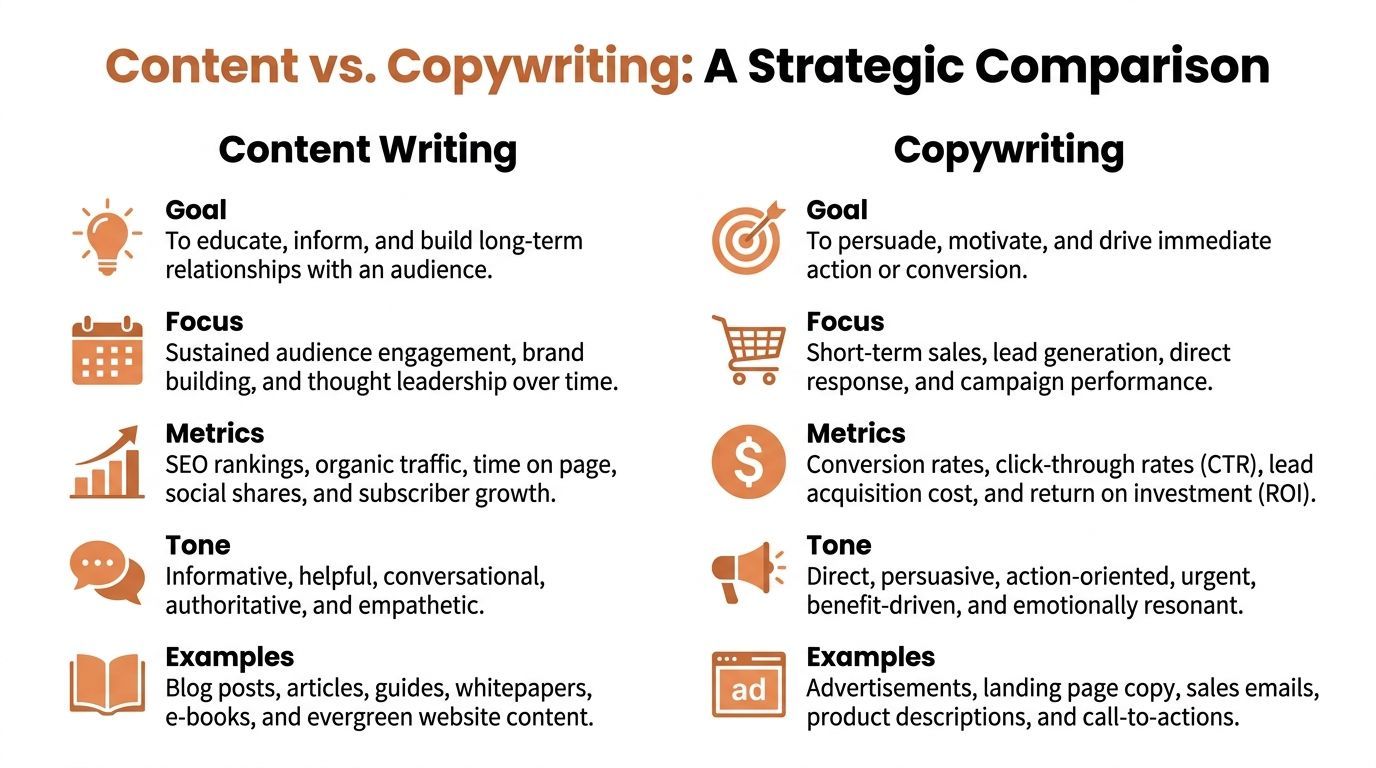
Side-by-side business comparison
That comparison should drive planning decisions. It should also shape how your team briefs, hires, and evaluates writers.
Goals matter more than channels
Content writing is usually the right choice when the business needs more discoverability and trust. Copywriting is the right choice when the business needs more action from traffic already in motion.
This is why the performance gap can be so wide. According to this breakdown of content writing and copywriting performance, copy on landing pages and ads reaches 20-50% conversion rates in optimized campaigns, while blog-driven leads from content marketing average 2-5%. The same source notes that content writing is tied to long-term engagement metrics such as organic traffic growth up to 300% over 12 months and time on page averaging 3-5 minutes for educational pieces.
That is not a contradiction. It is the point.
Content writing and copywriting should not be judged by the same outcome on the same timeline.
Audience mindset decides what kind of writing works
A reader who searches “how to solve” behaves differently from a buyer who clicks “book demo.”
The first person needs orientation. The second person needs conviction.
That is why great content writing often expands context. It names tradeoffs, teaches terminology, and helps the buyer ask better questions. Great copywriting narrows context. It selects the strongest angle, handles the core objection, and points to one next action.
Content reduces uncertainty through education. Copy reduces hesitation through persuasion.
KPI design is where many teams fail
If you judge content by immediate revenue alone, you will underinvest in it. If you judge copy by impressions or pageviews, you will protect weak conversion assets for too long.
Use different scorecards.
For content writing
- Search visibility: Track whether target pages begin earning relevant rankings and qualified sessions.
- Engagement quality: Review time on page, return visits, scroll depth, and assisted conversions.
- Authority signals: Watch backlinks and social distribution patterns. The HazenTech benchmark notes 20-50 backlinks per pillar post and 500+ social shares as indicators tied to stronger authority assets in some campaigns.
For copywriting
- Action rates: Measure click-through rate, form completion, purchase rate, and reply rate.
- Page efficiency: Look at conversion rate by landing page, email step, or offer.
- Revenue linkage: Tie copy changes to pipeline creation or sales wherever attribution is available.
Formats tell you where each discipline wins
Content writing dominates when the buyer needs depth. Think comparison posts, integration explainers, implementation articles, webinar recaps, and thought leadership.
Copywriting dominates where a micro-decision happens. Think headlines, ads, CTA sections, pricing pages, product detail pages, trial signup flows, and outbound email.
A page can include both. Most good pages do. The problem starts when nobody knows which layer should lead.
Skill sets are not interchangeable
A good content writer usually knows how to structure information, satisfy search intent, and make complex material readable. A good copywriter usually knows how to build desire, sharpen positioning, handle objections, and create urgency without sounding desperate.
You can find hybrids, but they are rare. Teams often achieve better output when they stop pretending one writer naturally excels at both jobs.
If your organic program matters, invest in writers who understand search strategy and collaborate well with SEO specialists. If your quarter depends on trial starts, booked demos, or product purchases, prioritize conversion copy.
Sector-Specific Playbooks for SaaS E-commerce and B2B
The right content-copy mix changes by business model. A SaaS company, an e-commerce brand, and a B2B service firm do not win with the same asset stack, even if they buy from similar channels.

The common mistake is treating content and copy as separate tracks. The practical challenge is hybrid execution. Lean teams need a blog post that educates and also converts subscribers, or a product page that sells and still answers search intent. That gap is called out in this analysis of the hybrid challenge.
SaaS playbook
SaaS buyers usually need education before commitment. They want to understand the problem, the workflow change, the integration burden, and the expected outcome.
That makes content essential at the top and middle of the funnel. Use articles, comparison pages, use-case pages, and feature education to capture intent and frame the category on your terms.
But SaaS growth stalls when teams stop there. Trial pages, demo pages, onboarding emails, and lifecycle prompts need copy that removes friction and pushes the user to the next milestone.
A practical 90-day approach for SaaS looks like this:
- Content focus: Publish pieces that answer high-intent questions, compare alternatives, and support category education.
- Copy focus: Rewrite trial pages, pricing pages, and product emails around one job only. Start the trial. Book the demo. Activate the feature.
- Operational rule: Content should feed retargeting, email capture, and sales enablement. Copy should monetize that attention fast.
For software teams operating in growth mode, this integrated model matters more than choosing one discipline. It is also why many leaders look for support from specialists in SaaS marketing.
E-commerce playbook
E-commerce is usually more copy-heavy.
The sale often depends on ad copy, product detail pages, collection page messaging, offer framing, cart recovery emails, and checkout prompts. Buyers are close to purchase. They do not need a course. They need confidence.
That said, strong content still matters when product education affects trust. Buying guides, ingredient explainers, care instructions, comparison pages, and brand stories can improve acquisition efficiency over time and support remarketing.
Use this split:
- Copy should lead on paid landing pages, product pages, bundles, upsells, and email flows.
- Content should support branded search growth, product education, and post-purchase confidence.
If the store has traffic but weak conversion, fix copy first. If the store depends too much on paid acquisition, strengthen content next.
B2B playbook
B2B usually requires the most patience and the cleanest division of labor.
Decision cycles are longer. More stakeholders weigh in. Buyers need more proof and more internal language to justify the purchase. That makes content writing valuable for nurturing demand across a long evaluation window.
Use content to answer strategic questions, explain process, publish category insights, and support sales conversations after first touch. Then use copy at the pressure points. Demo requests. Contact forms. Consultation pages. Follow-up emails. Proposal support.
A useful B2B operating model looks like this:
- Attract with expertise. Publish content that proves your team understands the business problem.
- Convert with clarity. Tighten service pages and lead capture pages so the next step feels low-friction.
- Nurture with sequence logic. Let educational emails build confidence, then switch to direct-response copy when intent rises.
Consequently, many teams underinvest in copy because they assume long sales cycles make persuasion less important. The opposite is true. The more complex the sale, the more every conversion point needs precision.
A useful perspective on blending channels and intent appears below.
For SaaS, e-commerce, and B2B, the winning question is not “content or copy.” It is “which asset needs to educate, and which asset needs to close?”
Building Your Growth Team Hiring and Briefing Talent
Most hiring mistakes happen before the interview.
Leaders write a single job description that asks for SEO, email nurture, sales pages, paid social ads, thought leadership, CRO, and product messaging. Then they wonder why the hire looks good on paper and underdelivers in production.
Hire for the critical bottleneck
If your issue is discoverability, hire a content writer.
If your issue is low action rates on high-intent traffic, hire a copywriter.
That sounds obvious. Teams still get it wrong because they evaluate both roles using generic writing samples instead of business outcomes.
For a content writer, ask for samples that show subject depth, structure, search intent alignment, and editorial judgment. For a copywriter, ask for landing pages, email sequences, ad concepts, pricing page rewrites, and before-after rationale.
Pay differences reflect revenue pressure
The freelance market values copy more aggressively because the output is tied to revenue. According to this review of copywriting vs content writing rates, copywriters command 2-5x higher freelance rates than content writers. The same analysis notes that top copywriters earn $5,000-$15,000 per sales page plus 5-10% royalties, while content writers typically earn $200-$800 per 2,000-word blog post.
That price gap tells you something important. The market expects copy to move money.
It does not mean content is less valuable. It means content is usually monetized through a longer chain of events.
What to look for in each portfolio
Content writer signals
- Search awareness: They understand SERP intent, internal linking, topical coverage, and editorial structure.
- Clarity: They simplify hard topics without flattening them.
- Authority-building instinct: Their work sounds credible, not inflated.
Copywriter signals
- Offer framing: They know how to lead with stakes, outcomes, and differentiation.
- Objection handling: They can spot hesitation and answer it inside the page.
- CTA discipline: They write toward a single action instead of wandering.
Briefs should be radically different
A weak brief creates weak writing, no matter who you hire.
For content writing, your brief should include:
- Target query or topic cluster
- Reader intent
- Subject matter inputs from product, sales, or customer success
- Desired internal links
- Primary business role of the asset, such as ranking, education, or lead nurture
For copywriting, your brief should include:
- Exact audience segment
- Offer
- Desired action
- Main objection
- Proof points available
- Traffic source, because ad traffic and email traffic need different page treatments
Never brief a copywriter with “write a landing page about our product.” That is not a brief. It is a request for guessing.
In-house, freelance, or squad
In-house works when output is steady, leadership can train well, and adjacent functions exist.
Freelancers work when the scope is narrow and the brief is sharp.
A dedicated external team works best when you need coordinated execution across SEO, paid media, lifecycle, CRO, and creative testing inside one quarter. That model matters because content and copy do not perform in isolation. Their output depends on channel strategy, testing cadence, and how quickly feedback loops turn.
For most growth-stage companies, the best setup is not one magical hybrid writer. It is a small team with distinct strengths and one operator who knows how to connect their work to pipeline.
Integrating Content and Copy into 90-Day Performance Sprints
Most companies do not have a writing problem. They have an attribution problem.
They know copy tends to drive immediate action and content tends to build long-term engagement, but they cannot decide how much to fund each inside one quarter. That blind spot is called out in this discussion of the ROI measurement gap. It highlights the lack of practical frameworks for attributing revenue to content writing versus copywriting, especially in B2B and SaaS where sales cycles are longer.
That gap is fixable if you run content and copy inside one operating model instead of two unrelated workstreams.
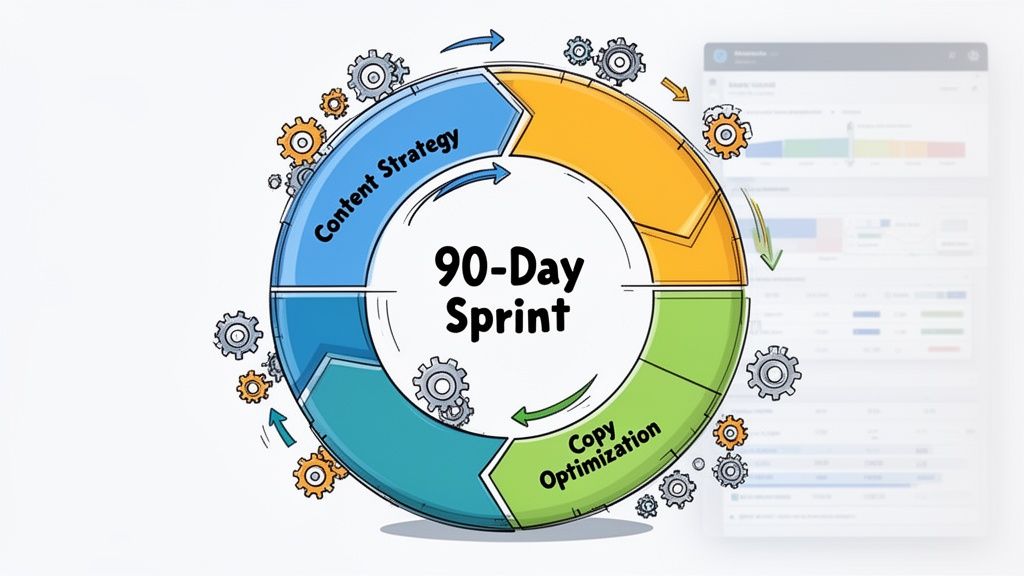
Use separate jobs inside one sprint
A 90-day sprint should assign each discipline a different mandate.
Content writing should build assets that increase qualified entry points, strengthen sales conversations, and support retargeting and nurture. Copywriting should improve conversion at the moments where buyers can act now.
Run both at once, but do not expect them to mature at the same speed.
A practical sprint split looks like this:
Measure contribution, not vanity
You do not need perfect attribution to make smart budget calls. You need disciplined contribution tracking.
For content, tie each asset to one of these roles:
- Acquisition assist: Did it bring in relevant traffic?
- Pipeline assist: Did leads touch it before converting?
- Sales enablement assist: Did sales use it in active deals?
For copy, tie each asset to direct response outcomes:
- Higher click-through on traffic sources
- Higher conversion on landing pages
- Stronger progression in email or trial flows
- Better close-support messaging on decision pages
This framework stops the usual internal fight where content teams defend pageviews and copy teams defend isolated conversion wins without considering pipeline quality.
Shift budget weekly, not emotionally
The best sprint operators do not lock budget on day one and protect it out of pride. They review signals every week.
If ad traffic is solid but the landing page underperforms, move effort into copy iterations. If paid acquisition gets expensive and search intent gaps are obvious, increase content production around those topics. If nurturing stalls, rebuild the email layer with a clearer split between educational content and persuasive copy.
What matters is responsiveness.
A rigid content calendar and a rigid testing calendar are dangerous when the market is telling you where friction sits.
Keep one owner accountable
This point often causes many marketing teams to break down. SEO owns content. Paid owns ads. Lifecycle owns email. Product marketing owns pages. Nobody owns the combined path from visit to revenue.
Assign one sprint owner.
That person should decide:
- which funnel stage is underperforming,
- which writing discipline best fixes it,
- which assets need hybrid treatment,
- and when budget should move.
The recommendation I give most CMOs
If you already have traffic and weak conversion, start the quarter by fixing copy.
If you have strong product-market fit but thin inbound demand, build content steadily while protecting key conversion points with strong copy.
If your business has multiple channels running at once, stop treating content writing vs copywriting as a philosophical debate. Treat it as portfolio management. Fund both. Give each a defined financial role. Reallocate based on weekly evidence, not team preference.
That is how you turn writing from a production function into a growth lever.
If you want a team that can run that model without adding management overhead, Ezca Agency is built for it. Ezca works in focused 90-day sprints for SaaS, e-commerce, and B2B brands, combining content, copy, SEO, paid media, CRO, and email into one performance system that shifts effort toward the highest-return opportunities each week.